Video Stabilization Using Block Based
Motion Vectors
Dhanashree Bhujbal1, Prof. B.V.Pawar2
P.G. Student, Department of Electronics & Telecommunications, PVPIT, Pune, Maharashtra, India1 Associate Professor, Department of Electronics & Telecommunications, PVPIT, Pune, Maharashtra, India2
ABSTRACT:In recent years, from teenagers to adults use advanced multimedia devices (camcorders, Personal digital assistants, mobile phone cameras, Tablets, etc)for taking pictures and videos. Due to handshaking of user, cameras placed on moving platform cause some undesirable motion effects, and vibrations in videos. Thus, to acquire good quality video it needs video stabilization. The digital video stabilization aims at getting rid of undesirable movements, unwanted jiggle, poor quality and video. There are various video stabilization techniques are developed with many algorithms & methods. The paper presents a block based algorithm the motion estimation and video stabilization. This paper focuses on Full search or Exhaustive Block Matching Algorithm (EBMA). Block Based approach divides each frame from video into macroblocks and matches current frame with the previous frame from the video sequence. Applying the block matching criteria such as Sum of Absolute Difference (SAD) we acquire difference between two frames. Using proposedblock matching algorithm, motion vectors are calculated. The stabilized video is achieved by applying steps such as Motion Estimation (ME), motion vector validation, motion Correction (MC) by padding and histogram equalization and at final stage motion compensation is done. With the use of video stabilization quality standards such as PSNR & ITF, we can plot graph and analyze the proposed algorithm.
KEYWORDS: Exhaustive Block Matching Algorithm (EBMA), Block Matching, Sum of Absolute Difference (SAD), Macroblocks, Motion Estimation, Motion vector, Video stabilization.
I.INTRODUCTION
ISSN (Print) : 2320 – 3765 ISSN (Online): 2278 – 8875
I
nternational
J
ournal of
A
dvanced
R
esearch in
E
lectrical,
E
lectronics and
I
nstrumentation
E
ngineering
(An ISO 3297: 2007 Certified Organization)
Vol. 5, Issue 7, July 2016
as padding. Histogram equalization of motion vectors tries to uniform these motion vectors. In motion compensation macroblocks are adjusted according to motion vectors to obtain stabilized frame. In block based algorithm, particular size of macroblocks is defined and for certain search range,motion vectors are calculated. Using Sum of Absolute Difference (SAD) cost function, we acquire difference between previous frame and current frame of the video sequence. Experimental results show good performance for the proposed DVS algorithm.
II.
RELATED WORKIn past few years, researchers have developed and experimented various algorithms for video stabilization. Matsushita et al. [6], explored direct pixel based full frame video stabilization method with motion inpainting. In this method affine motion model was used for estimation and for smoothen camera motion Gaussian kernel filtering was used. Motion estimation (ME) is the foundation of any video stabilization algorithm
A robust block-based image/ video registration approach for mobile imaging device was explored by Battiato et al. [7]. With the use of some simple rejection rules he estimated Interframe camera transformation parameters from local motion vectors (LMVs). To stabilize video frames, in this registration approach they used motion estimator, filters and error matrix. The whole work was tested on ARM device and achieved stabilized video sequence for the real time performance. Cai et al. [2] developed and tested camera motion estimation algorithm using histograms of local motions for mobile platforms. By considering highest peak in each histogram of local motions, they sorted arrays to implement and to avoid selecting the number of bins for histogram.
A fast and robust method for video stabilization was proposed by Okade et al. [8] for a novel compressed domain framework As an enhancement in the development, they utilized wavelet analysis for estimating the camera motion parameters from block motion vectors. This method was efficient and better in case to avoid computational complexity. For removing high frequency jitters, Rawat and Singhai [5] proposed adaptive motion smoothening method. This algorithm achieved stability for worst and large motion videos in which multiple moving objects were present in the scene or a frame. Manish Okade et.al [10] developed robust learning based camera motion characterization scheme for stabilizing video sequence. The experimental validations were carried out using exhaustive block matching algorithm (EBMA) of motion estimation as well as H.264/AVC and reduced processing time for stabilizing video sequence.
III.PROPOSED WORK
The flowchart of the proposed digital video stabilization System is depicted in fig. 1. The details of proposed system are described in the sequel.
A. Motion Estimation (ME) Unit:
Motion Estimation is heart of DVS system. The motion of any pixel between two consecutive frames can be estimated either by global motion or by local motion. Global motion occurs due to camera motion but in local motion object in the scene is in motion. In case of non-stationary camera or for small motion of the object, motion is estimated by a global motion model. In this paper, the global motion is estimated by the DVS system based on block motion vectors.The LMVs are estimated based on block matching using a standard criterion of Sum of Absolute Difference (SAD). A global motion vector is computed for each video frame based on validated LMVs. GMVs represent camera motion during the time interval of two frames.
Fig.1: Flowchart of Digital video stabilization using block based algorithm.
Minimum is the value of SAD, we get the best match of macroblocks. We use Full search Algorithm as it gives best PSNR (Peak Signal to Noise Ratio) and ITF (Interframe Transformation Fidelity) but no. of search points are high compared to other block matching algorithms. Block matching criteria SAD is applied over the frame from left to right and top to bottomwithin the search range.MSE, MAD, PSNR and ITF are the video stabilization quality standards [1] which are used for our proposed method.
B. Motion Correction (MC) Unit:
In motion estimation unit motion vectors were calculated. There were some distortions or shaky movements present in the frame, thus motion correction unit is another important stage in DVS system. There is certain desired motion vector range to get minimum displacement of motion vectors within the frame. In this unit, Motion is corrected applying padding & Histogram method to the consecutive frames. Padding is the process of keeping motion vectors within certain search range applied over the frame. Histogram equalization method equalizes these motion vectors and makes them uniform. Padding & Histogram equalization of motion vectors arrange motion vectors within certain range and uniformly distribute them.
In padding method, the peripheral part of block gets copied to form a new column and row to its adjacent area. While, in the histogram equalization uniforms motion vectors to simplify motion compensation procedure. The idea comes from a well-known procedure of histogram equalization to improve contrast of an image. In this procedure, brightness or darkness which has been accumulated at particular region is made uniform to improve the contrast of an image. In the similar manner, maximum of the motion vectors will be made uniform.
C. Motion Compensation Unit:
ISSN (Print) : 2320 – 3765 ISSN (Online): 2278 – 8875
I
nternational
J
ournal of
A
dvanced
R
esearch in
E
lectrical,
E
lectronics and
I
nstrumentation
E
ngineering
(An ISO 3297: 2007 Certified Organization)
Vol. 5, Issue 7, July 2016
process to the pixel value of current frame with that new object to form new current frame compensating the prediction error.
IV.RESULTS AND DISCUSSION
MATLAB2014b is used on Intel core2 Duo CPU running with 2GB RAM for testing different video sequences. The Block motion vector field is generated by Exhaustive Block Matching Algorithm (EBMA) considering the resolution of input and output frame in GUI = 320x 240,block size = 16 x16, search range -7 to +7, video format = .aviformat and cost function set to SAD for any number of frames. Plot function in MATLAB is used to obtain graph. Every video is tested with different frame numbers. The video sequence of “Fly On Leaf” and “Shaky Car” are used for testing purpose and the results are shown.
(a) (b) Fig2:(a) Unstable input frame (b)Stable output frame for “Fly On leaf” videoframe.
Fig. 2(a) shows unstable input video frame which is a fly on leaf. This unstable input when applied to the proposed method, we get stable output frame shown in Fig. 2(b). As a result, we can compare both frames and plot a graph for ITF values Vs frame number. We also have provision to calculate ITF average of nonstable video and stable video. ITF of output video is compared with that of unstable i.e. shaky input video at particular frame and the graph plotted shows results for all frames. In Fig.3 it can be seen that ITF of output video is much more than that of input unstable video frame in almost all frames in video sequence.
Video Sequence No. of frames Average of ITF of Input Video Average of ITF of output Video
Fly on leaf 10 22.29 25.76
Table I .ITF Of Input and Output video: Fly on Leaf
With reference to the input and output video frames and the graph plotted,Table I shows total no. of frames and average ITF values for input and output video sequence.We can conclude from the table above that more the value of avg. ITF of output video, more stable is the output. We have successfully stabilized the unstable input video.
Fig. 3:Comparison of ITF of stabilized and Non-stabilized Video over each frame.
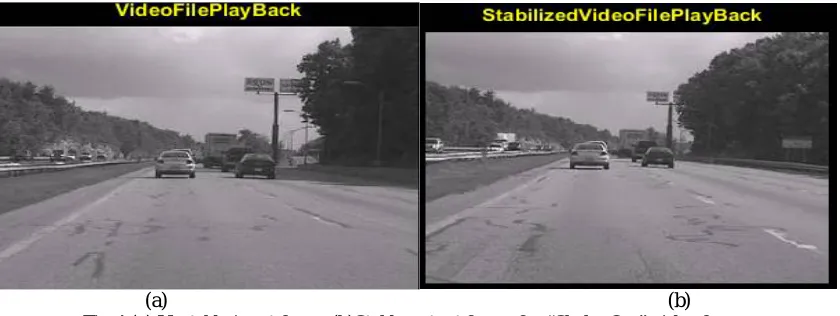
Fig. 4(a) shows unstable input video frame which is a shaky car. This unstable input when applied to the proposed method, we get stable output frame shown in Fig.4(b).
(a) (b) Fig 4:(a) Unstable input frame (b)Stable output frame for “Shaky Car” video frame.
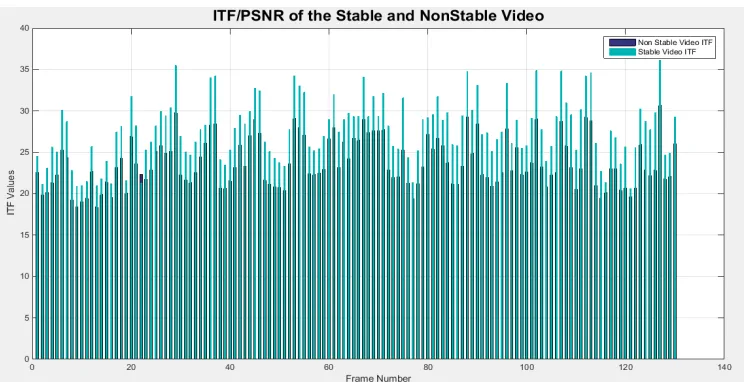
Total numbers of frames in this “Shaky Car” video are 132. Our algorithm stabilizes shaky frames among all these frames and gives stable output and the respective ITF graph. Fig 4(b) shows black edges outside the stable frame which indicates motion compensated area of the shaky frame.As a result,we can compare both frames and plot a graph for ITF values Vs frame number. We also have provision to calculate ITF average of nonstable video and stable video.
ITF of output video is compared with that of unstable i.e. shaky input video at particular frame and the graph plotted shows results for all frames. In Fig. 5, it can be seen that ITF value of output video is much more than that of input unstable video frame in almost all frames in video sequence.
Video Sequence No. of frames Average of ITF of Input Video Average of ITF of output Video
Shaky Car 132 23.66 27.66
Table II .ITF Of Input and Output video: Shaky Car
ISSN (Print) : 2320 – 3765 ISSN (Online): 2278 – 8875
I
nternational
J
ournal of
A
dvanced
R
esearch in
E
lectrical,
E
lectronics and
I
nstrumentation
E
ngineering
(An ISO 3297: 2007 Certified Organization)
Vol. 5, Issue 7, July 2016
Fig. 5:Comparison of ITF of stabilized and Non-stabilized Video over each frame.
V.CONCLUSION
The development and implementation of software for video stabilization technique using block based motion vectors is done successfully for video frames. It is tested for the different video sequences. Following conclusions are obtained from the results:
1. The unstable input frames and stabilized output frames are shown in “Fig 2: (a) Unstable input frame (b) Stable output frame for “Fly On leaf” video frame”and ”Fig 4: (a) Unstable input frame (b) Stable output frame for “Shaky Car” video frame.” This gives satisfactory outcome.
2. ITF of output video is better than that of the input video. (From Fig. 3: Comparison of ITF of stabilized and Non-stabilized Video over each frame, Fig.5: Comparison of ITF of stabilized and Non-stabilized Video over each frame and Table I .ITF Of Input and Output video: Fly on Leaf , Table II .ITF Of Input and Output video: Shaky Car)
3. The unstable input and stabilized output frames are clearly distinct and the output is improved in present work. 4. From tables (Table I .ITF Of Input and Output video: Fly on Leaf, Table II .ITF Of Input and Output video:
Shaky Car), where the number of frames are 10 and 132 respectively, the average ITF is more for the more number of frames. Thus, this video stabilization technique provides better quality of video for the increase in the number of frames in the video sequence.
REFERENCES
[1] Dhanashree Bhujbal, Prof. B.V. Pawar. ”Review of video stabilization using Block Based motion vectors ”.IJARSET, Vol.3,Issue 3, pp-1741-1747, March 2016.
[2] JinhaiCai,Rodney Walker. ”Robust Motion Estimation for Camcorders Mounted in Mobile Platforms”.Digital Image Computing: Techniques and Applications,DOI 10.1109/DICTA.2008.48, pp.491-497,Dec. 2008.
[3] ArohBarjatya. “Block Matching Algorithms for Motion Estimation”. DIP6620, pp.1-6, spring 2004
[4] Paresh Rawat, Jyoti Singhai“.Efficient Video Stabilization Technique for Hand Held Mobile Videos”. International Journal of Signal Processing, Image Processing and Pattern Recognition Vol. 6, No. 3,pp.-17-32, June 2013
[5] Paresh Rawat, Jyoti Singhai. “Adaptive Motion Smoothening for Video Stabilization “. International Journal of Computer Applications (00975 -8887), Vol. 72 –No.20,pp.-14-20, June2013.
[6] Y. Matsushita, E. Ofek, Weina Ge, X. Tang and H. Y. Shum. Full frame video stabilization with motion inpainting. IEEE Trans. on Pattern Analysis and Machine Intelligence, vol. 28, no. 7, pp.- 1163,1178July 2006
[7] Sebastiano Battiato, Arcangelo Ranieri Bruna, Giovanni Puglis.”A Robust Block Based Image/Video Registration Approach for Mobile Imaging Device”. IEEE Trans. On multimedia, Vol. 12No. 7, pp.-622-635, Nov2010.
[8] Manish Okade, Prabir Kumar Biswas.” Fast Video Stabilization in the compressed domain”. IEEE International Conference and Expo ,DOI 10.1109/ICME.2012.113, pp. 1015-1020,2012
[9] Bartlomiej Dudek. “Development of software anti-shake filter for video stream”,pp.-25-63, AGH,2011.
[11] Murali E. Krishnan, E. Gangadharan ,Niramal P. Kumar.” H.264 Motion Estimation and Applications”, InTech, pp.57-82,2012.
[12] N.M. Khokhar .“ Performance Analysis of Fast Block Matching Motion Estimation Algorithms”, International Journal of Computer Applications Volume 122 – No.6,pp.15-20, July 2015