ISSN (Print) : 2320 – 3765 ISSN (Online): 2278 – 8875
I
nternational
J
ournal of
A
dvanced
R
esearch in
E
lectrical,
E
lectronics and
I
nstrumentation
E
ngineering
(An ISO 3297: 2007 Certified Organization)
Vol. 5, Issue 12, December 2016
Frame Based Recovery of Corrupted Video
Files Using Video Codec Specification
Priyanka Nagargoje1, K. R. Khandagale
PG Student, Dept. of Communication Engineering, MIT Aurangabad, Maharashtra, India1
Assistant Professor, Dept. of Electronics & communication Engineering, MIT Aurangabad, Maharashtra, India2
ABSTRACT: Digital forensics is one of the cornerstones to investigate criminal activities such as scam, computer security breaks or the distribution of criminal content. The significance and consequence of this research fields attracted various research institutes leading to substantial progress in the area of digital investigations. In digital forensics, recovery of a damaged or altered video file plays a crucial role in searching for evidences to resolve a criminal case. One essential piece of evidence is multimedia data. For this cause these papers gives an overview of the various available techniques to restore the corrupted video files. The main contribution of this paper is a discussion of existing and new approaches for the recovery of multimedia files.
KEYWORDS: Cognitive Radio, Spectrum Sensing, Efficient Communication, System Security.
I.INTRODUCTION
ISSN (Print) : 2320 – 3765 ISSN (Online): 2278 – 8875
I
nternational
J
ournal of
A
dvanced
R
esearch in
E
lectrical,
E
lectronics and
I
nstrumentation
E
ngineering
(An ISO 3297: 2007 Certified Organization)
Vol. 5, Issue 12, December 2016
hard-disk controllers of personal computers. Actually file carving aims to support investigators in efficient recovery
from storage devices, but nevertheless it is currently necessary for humans to actively participate in the process as there is a chance for false positives to be recovered. Once the areas for hidden data are identified, the process of data
recovery can be broken down into several steps. The three major steps for file carving are: • In the identification phase files have to be found in a forensic image. This comprises the classification of file fragments and the identification of file fragmentation points to put fragments back together. • During the validation phase found files are checked if they
can be decoded properly using so called validators or decoders. The main problem here is the vast amount of available
file formats. • In the last step a human expert has to validate found data based on its content. False-Positives are sorted out, e. g. bad files that are irrelevant for the investigated case. The following sections summarize existing file carving
approaches. They are sorted by the properties they consider to get back the content of files in the original order.
Recovery of damagedorcorruptedvideo files obtained from a crime scene or a disaster site has provided a key evidence
to resolve the cause. Conventional techniques for video file restoration use the meta-information of the file system to
recover a video file stored in a storage medium such as a hard
drive or a memory card [8]. The file system meta-information contains the information such as the address and the link of a video file that can be used for file restoration. Carrier [8] proposes a file restoration tool based on the file system,
which was implemented in a software toolkit, The Sleuth Kit . This program is based on the information from the file
and directory structure of a storage filesystem. Video file restorationmay not be possible with such techniques,however,
when the file system meta-information is not available. Thus, attempts have been made to restore the video data from video contents, rather than the meta-information of a file system. This paper also presents a technique to restore
damaged or corrupted video files irrespective of a file system. The signature-based video restoration technique proposes File Carver to address this problem. This method creates a database of the file header (beginning mark of file) and
footer (the end mark of file), and define a set of rules for a specific file type. Signature-based file recovery techniques do
not require file system information, which can be applied to a video file with no meta-informationbecause of file system
change and reformattingof a storage medium. Signature-based file recovery techniques identify the fragments from the bytesequence (or magic bytes) containing file header or footer. Scalpel does not rely on a file system to restore a video file. This technique requires an indexing step to find the file header and footer from a whole disc as well as a restoration step to recover indexed header and footer. We do note use file system metadata to restore the data between the header
and footer to a file. This method is limited to the cases when the files are unfragmented. This method does not recover partially overwritten video files. Garfinkelutilizes additional information stored in the file to extend the idea to
signature-based restoration techniques. For some files, file header may contain the information of file size or length.
When the file footer does not exist, they can use this information to extract a file. A video file can be restored using
Bifragment Gap Carving. This method find a combination of the region containing the header and the footer to test if a
video sample is valid. This computes the difference between the two data regions and check if the difference passes the predefined validation procedure. This procedure repeats until the gap passes the validation test. However, this method
can only be applied to a video file with two fragments and this technique has limitation when the gap between the two
file fragments is large. SmartCarving technique was proposed to restore a file without being restricted by the number of fragments. This technique, if it identifies the occurrence of fragmentation, combines the permutations of the fragment components and searches for the order of the fragments. They technique consists of three steps: preprocessing, collation, and reassembly. In the preprocessing step, they collect the called block part, which was not allocated to a file,
using the file system information to reduce the size of the data to analyze. The collation step categorizes the collected
ISSN (Print) : 2320 – 3765 ISSN (Online): 2278 – 8875
I
nternational
J
ournal of
A
dvanced
R
esearch in
E
lectrical,
E
lectronics and
I
nstrumentation
E
ngineering
(An ISO 3297: 2007 Certified Organization)
Vol. 5, Issue 12, December 2016
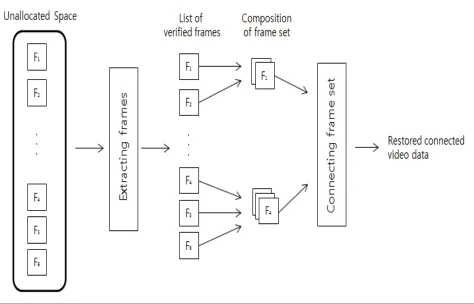
Fig. 1. Processing steps of the proposed frame-based video file restoration technique.
The reassembly step determines fragmented parts and merges them into a file. In [15], they extended SmartCarving to
apply to multimediafiles. In the reassembly step, they increased the restoration rate of multimedia file by assigning a
weight to each fragment using the decoded frame difference. However, the method presented in [15], which is also a
file-based approach, has a limitation to restore a video file when a part of video file is overwritten. In addition, graph
theoretical carving was proposed by which the k-vertex disjoint graph is created to piece together fragments [14]. This technique proposed various greedy heuristic restorationtechniqueswith whichto use the matching technique and search for the sector/block order. The weight of all the fragment pairs should be calculated in advance, however, which is costly. Most of previous technique bases its file restoration on a file unit, however, so only when a whole file is restored
can the video be obtained. In general, the signature-based file carving techniques mentioned above consist of the
following three steps [2]. 1) Identification Phase: To identify a video fragment in a storage medium and to connect it to
the previous fragment. 2) Validation Phase: To validate if all connected video fragments successfully form a playable video file. 3) Validate by Human Expert: To sort out false positive video segments by human expert. The validation
ISSN (Print) : 2320 – 3765 ISSN (Online): 2278 – 8875
I
nternational
J
ournal of
A
dvanced
R
esearch in
E
lectrical,
E
lectronics and
I
nstrumentation
E
ngineering
(An ISO 3297: 2007 Certified Organization)
Vol. 5, Issue 12, December 2016
technique consists of two phases, extraction and connection as shown figure 1. • Extraction Phase: The data are
extracted based on video frame from the unallocated space, as extracted from the storage medium for restoration. The start code signature of video frame is searched for without consideringthe file system and the file composition. The
frames are extracted based on the start code signature, the extracted frame data are verified through the decoder, and it
is determined if the data are frames. • Connection Phase: The codec and file specifications are used to connect the
frames verified in previous phases. Based on the extracted frame sets, the length information of each frame recorded in the files is used to connect frame sets that are restored into a connected picture. Figure 1 shows an overall process of the
proposed file restoration technique. In extraction phase, we extract frame data, F1, F2, F4, F5, and F6, which have a start code signature of frame from the unallocated space, the region of a video file to recover, containing the deleted
video files and verify if the decoded frame is a normal frame data. Verified frames form a frame set, which will be
connected as far as it can go in the stage of connecting frame set. When the video file is fragmented, we restore a video file by connecting fragmented pieces of data. In case of a partially overwritten file, not overwritten parts are connected
to create a connected video. In this manner, the proposed method finds meaningful data in the video file using the codec
and convert into file structure after connecting them.
Extraction of Video Frames A video file consists of a sequence of video frames, and each video frame is encoded into a binary data using a codecfor data compression purpose. A codec inserts identifiers into each video frame to identify.
The proposed method verifies if the data is a frame using the identifier characterized by a codec used in video encoding.
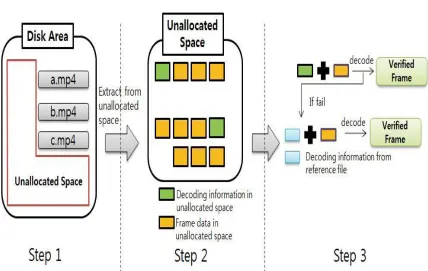
Figure 2 shows the steps for extracting the verified frame data from a storage medium. Step 1 is to extract an
unallocated space using file system meta-information. Because deleted file data could be stored in unallocated space. It
is possible to reduce the amount of data which frame has to be analyzed. In practice, the popular forensic tools such as Encase and WinHex are used to extract unallocated space from storage medium. In Step 2, we extract the signature of the frame data from unallocated space extracted in Step 1. In figure 2, yellow rectangles indicate the frame data with
signature. If the frame data is found in the unallocated space, we verify them by decoder. For verifying frame data, the decoding header is attached in front of frame data. So the proposed method also extract the signature of decoding header information from unallocated space. We search for decoding header marked in green in figure 2. In general,
decoding header is usually recored in the playback information and can be overwritten. In this case, if the decoding header encoded in the same manner as the file to be restored is found in an unallocated space, we can restore the video file. Even though the decoding header is not found, we can restore the video file using the decoding header of the
reference file.2 Reference video file refers to a video file encoded in the same codec as the video to be restored. In this
paper, two most popular codecs, MPEG-4 Visual and H.264 are tested. Sections III-A1 and III-A2 describe how to find
ISSN (Print) : 2320 – 3765 ISSN (Online): 2278 – 8875
I
nternational
J
ournal of
A
dvanced
R
esearch in
E
lectrical,
E
lectronics and
I
nstrumentation
E
ngineering
(An ISO 3297: 2007 Certified Organization)
Vol. 5, Issue 12, December 2016
Fig. 2. The procedure of video file restoration using video file format specifications.
IV. RESULT AND DISCUSSION
To evaluate the performance of the proposed technique, we tested for three kinds of video files encoded with MPEG-4 Visual, H.264_Start, and H.264_Length codecs, respectively. Experiments were carried out with different amount of data fragmentation and overwriting. For each codec, 20 video files (.mp4) were fragmented into 0–20 pieces in any size, and 0–90% of each video file was overwritten.First, to evaluate the fragmentation impact, with the overwriting
level set at 50%, the number of fragmentations was changed. Second, to evaluate the overwriting impact, with the number of fragmentations set at 10, the overwriting level was changed. Table 1 summarizes average file size, the
number of intraframe (denoted IDR frame in H.264 standard) and the total frame count of the 20 video files encoded
using three differenttypes of codec.The file size andthenumberofframes were largest with H.264_Start, and the standard
deviations by item varied significantly. Also, with both MPEG-4 Visual and H.264_Length, the 20 samples had a consistent picture file size, number of intraframes, and total number of frames. MPEG-4 Visual and H.264 codecs has 18 and 14 interframes following an intraframe, respectively. In terms of the ratio of file size and the number of frames,
MPEG-4 Visual and H.264_Length differ by 3 times while file sizes differ by two times. MPEG-4 Visual has low compression ratio and each frame size is big.
ISSN (Print) : 2320 – 3765 ISSN (Online): 2278 – 8875
I
nternational
J
ournal of
A
dvanced
R
esearch in
E
lectrical,
E
lectronics and
I
nstrumentation
E
ngineering
(An ISO 3297: 2007 Certified Organization)
Vol. 5, Issue 12, December 2016
fragmentations. Especially, the proposed technique can restore the frames of the non-overwritten portions in partially overwritten files.
REFERENCES
[1] R. Poisel and S. Tjoa, “Forensics investigations of multimedia data: A review of the state-of-the-art,” in Proc. 6th Int. Conf. IT Security Incident Manag. IT Forensics, May 2011, pp. 48–61. R. Chen et al., “Toward Secure Distributed Spectrum Sensing in Cognitive Radio Networks,” IEEE Commun. Mag., vol. 46,pp. 50–55, Apr. 2008.
[2] H. Khalife, N. Malouch, S. Fdida, “Multihop cognitive radio networks: to route or not to route,” IEEE Network, vol. 23, no. 4, pp. 20-25, 2009.
[3] K. Medaris and R. Mislan. (2008). Expert: Digital Evidence Just as Important as DNA in Solving Crimes [Online] Available: http://news.uns.purdue.edu/x/2008a/080425T-MislanPhones.htmlP. K. Visscher, “How Self-Organization Evolves,” Nature, vol. 421, pp. 799– 800 Feb.2003.
[4] K. Nance, B. Hay, and M. Bishop, “Digital forensics: Defining a research agenda,” Hawaii International Conference on System Sciences, vol. 0, pp. 1–6, 2009.Q. Wang, H. Zheng, “Route and spectrum selection in dynamic spectrum networks,” in Proc. IEEE CCNC 2006, pp. 625-629, Feb. 2006.
[5] N. D. M. Sencar, H. T., “Overview of state-of-the-art in digital image forensics,” in WSPC - Proceedings, September 2007.. [6] M. Breeuwsma et al., Forensic Data Recovery from Flash Memory, Small Scale Digital Forensics J. Vol.1(1), June 2007. [7] G. G. Richard and V. Roussev, “Scalpel: A frugal, high performance file carver,” in Proc DFRWS, 2005, pp.1–10 [8] A. Pal and N. Memon, “The evolution of file carving,” IEEESignalProcess. Mag., vol. 26, no. 2, pp. 59–71, Mar.2009.