ISSN (Print) : 2320 – 3765 ISSN (Online): 2278 – 8875
I
nternational
J
ournal of
A
dvanced
R
esearch in
E
lectrical,
E
lectronics and
I
nstrumentation
E
ngineering
(An ISO 3297: 2007 Certified Organization)
Vol. 5, Issue 11, November 2016
Key Enabling Technologies for Future
MANET Applications
Sadanand R. Inamdar 1, Sathish Babu B 2, Ravi M. Yadahalli 3
Research Scholar, Dept. of CSE, SIT, Tumkur, India1
Prof. Dept. of CSE, SIT, Tumkur, India2
Professor & Head, Dept. of ECE, SGBIT, Belgaum, India3
ABSTRACT: The class of networks called wireless ad hoc networks can be created on the fly without dependence on infrastructure. In presence of technical advancements, ad hoc networks have primary goal of multi-objective optimization to solve the challenges that will be confronted during the coming decades in view of increased demand on volume of mobile user’s traffic. The numerous emerging solutions of advanced wireless technologies offer simultaneous optimization of conflicting objectives like lower cost, secured information exchange, topological flexibility and adaptation to changing network conditions due to free movement of nodes. Seamless ubiquitous access to distributed resources and service requirements of present 3G/4G and future 5G standard based applications are now feasible in wireless ad hoc networks. This paper discusses the perspective scope of latest technologies in the context of ad hoc networks.
KEYWORDS: Ad hoc Networks, Smart antenna, Nanotechnology, MAC Protocol, Cross layer Optimization, Directional hidden terminal problems, ACO.
I. INTRODUCTION
Based on their purpose of usage the wireless ad hoc networks are distinguished in three categories; Mobile Ad hoc NETwork (MANET), VANET and WSN [1]. The MANET has continuously self-organizing and infrastructure independent network of mobile nodes that communicate via wireless links. Nodes of MANET include mobile devices such as laptop computers, pocket PCs and cellular phones, etc. The MANETs that have been successfully employed in military environments are today considered for applications that involve cooperative mobile data exchange. Some of the MANET applications include; low cost commercial networks to extend fixed infrastructure, wearable computing and network to support IP compliant data service requirements in disaster relief/rescue operation scenarios [2]. In present technological development like 4G and 5G, it now possible to overcome distance and time barriers of communication and provide the user with facility of anytime, anywhere, anyhow communication using Key Enabling Technologies (KETs) like; Smart antenna technology, Nano-technology, Cross Layer Optimization techniques and Bio-inspired meta-heuristic algorithms. The innovation offered by the KETs and subsequent derivative technologies in diverse fields influence to bring radical change in the capabilities of MANET applications. This paper discusses the role of KETs in enhancing the overall performance of in MANET applications and attempts to presents the updated account.
II. SMART ANTENNA TECHNOLOGY
ISSN (Print) : 2320 – 3765 ISSN (Online): 2278 – 8875
I
nternational
J
ournal of
A
dvanced
R
esearch in
E
lectrical,
E
lectronics and
I
nstrumentation
E
ngineering
(An ISO 3297: 2007 Certified Organization)
Vol. 5, Issue 11, November 2016
Antenna is a means for a source node to establish an interface with its surrounding environment using radio energy or electromagnetic energy. Better methods of radiating signal energy at the sender node and lossless gathering of signal energy at the destination node for a given surrounding conditions indicate the quality of network service. It also reflects on frequency resource utilization and shows how good the network is functioning. An antenna system could be controlled in an intelligent way to maximize its performance by using digital signal processing [3]. Typical omni-directional antennas employed in conventional wireless ad hoc networks have simple dipole antennas that radiate and receive to/from all directions. Only a small part of the radiated signal transmitted from the source reaches to the intended receiver hence results in effects like, waste of signal energy, serious interference to neighboring nodes, poorer spectral efficiency and reduced frequency re-use. To able to reach destination in presence of poor propagation environment, one option of omni-directional antenna is to increase signal power level of the radiation, but this will contribute for increased interference in neighboring nodes. All these effects combined together contribute for low capacity and this has motivated researchers to use of smart antenna technology in MANETs.
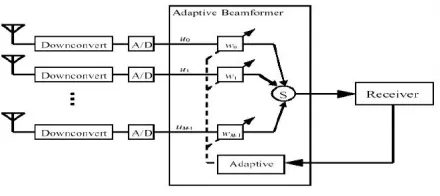
Simple way to reduce unwanted interference due to omni-directional antennas in MANETs is use of sectorization scheme in antenna. In the sectorization scheme the area around the antenna is divided into several coverage areas and then radiates the signal using directional beams into certain specific sector areas. This way sectorization scheme support more capacity by using higher gain value of sectorization but, as the signal cannot be segregated in the spatial domain hence it is not possible to perform spatial interference reduction or cancellation. Further problem with sectorization scheme is that, it could not change antenna direction or beam width in response to varying traffic load and persistent propagation scenario. Sectorization scheme results in wastage of capacity in sparse traffic cell and leads to blocking of traffic in dense traffic cell. One method suggested to overcome the problems mentioned above, is to employ spatial signal separation capable antenna array system. In antenna array system it is possible to radiate radio frequency energy towards an intended receiver with very narrow beam width and also nulls are created towards interfering nodes of a MANETs. An antenna array system is able to reduce the co-channel interference and impacts of multipath effects. Smartness of smart antenna lies in its ability to send and receive in specific direction by properly orienting its antenna direction towards intended node and processing of signal digitally. In smart antenna, energy radiation in unwanted directions can be quelled and signals received from non required senders can be filtered out. Typical smart antenna is made up of number of antenna elements that are organized to form a special configuration and complex weights are assigned to each element as illustrated in figure 1.
Fig. 1 Adaptive antenna array approach
ISSN (Print) : 2320 – 3765 ISSN (Online): 2278 – 8875
I
nternational
J
ournal of
A
dvanced
R
esearch in
E
lectrical,
E
lectronics and
I
nstrumentation
E
ngineering
(An ISO 3297: 2007 Certified Organization)
Vol. 5, Issue 11, November 2016
Fig. 2 Patterns of radiation: conventional, switched and adaptive antenna array
Smart antenna technology is now considered as one of the KETs in Beyond 3rd Generation communication network system (B3G) due to its cost reduction, it will turn into more preferred antenna technology in various communication systems like, Ultra wideband (UWB), mobile satellite TV, Wireless Fidelity (Wi-Fi), Worldwide Interoperability for Microwave Access (Wi-Max) and Radio Frequency Identification (RFID) etc. However the advantages of smart antenna technology can be efficiently explored by adopting required changes to the higher layers of the MANET and by effectively overcoming the new challenges that arise due to beamforming nature of smart antenna technology. The smart antenna technologies have evolved as the most promising development in MANETs that increases the coverage range from 20 to 200 percent over traditional antenna and provides narrower focus with less interference to neighboring users. Smart antenna technologies provide a solution to resolve traffic bottlenecks of MANET applications. Smart antenna usage in the early design phase of MANET protocols promises to give its applications with enhanced capacity for given bandwidth and transmit power. However, to date, lot of new challenges and issues are still open to use smart antenna and they need to be addressed in the high speed applications of MANET.
III. MAC STRATEGY WITH SMART ANTENNA TECHNOLOGY
Channel access activity of Medium Access Control (MAC) layer is most important building block of MANET and plays a major role in ensuring successful data delivery. Even though the number of the simultaneous communication pairs at the same time in a given networked area of smart antenna technology enabled MANET is increased by reduction of signal interference, due to unique nature of smart antenna called beamforming the new challenges are witnessed that decline the throughput performance of network [5]. The challenges include: Deafness, Directional hidden terminal problems, MAC layer capture, Head of line blocking and Communication range under utilization. The predominant problems found in the literature are: Deafness problem and Directional hidden terminal problems. The solutions to these new challenges should be considered while designing of the directional MAC protocols for smart antenna technology enabled MANETs.
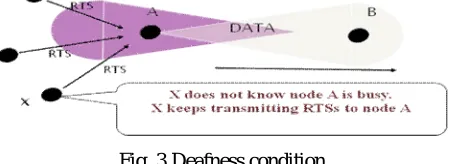
Deafness problem: Deaf node condition is a critical challenge, a packet sending node fails to establish communication with its targeted receiver which is beamformed to another direction for the purpose of completing an ongoing communication. Intended receiver appears as deaf node and is unable to receive signal due to characteristics of directional beamforming. The figure 3 illustrates deafness condition.
Fig. 3 Deafness condition
ISSN (Print) : 2320 – 3765 ISSN (Online): 2278 – 8875
I
nternational
J
ournal of
A
dvanced
R
esearch in
E
lectrical,
E
lectronics and
I
nstrumentation
E
ngineering
(An ISO 3297: 2007 Certified Organization)
Vol. 5, Issue 11, November 2016
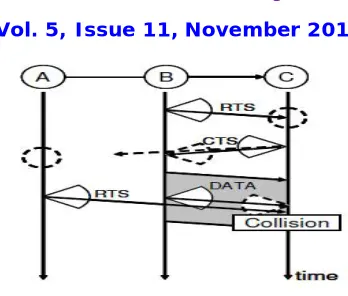
Fig. 4 Directional hidden terminal problem.
Hidden Terminal due to Asymmetry in Gain: Beam forming nature of smart antenna results in beamformed gain (Gd)
which if sufficiently greater than antenna gain in the omni-directional mode (Go). This difference of gain values create hidden terminal due to asymmetry in gain. Initially as a node does not know from which direction control message arrives so, it listens using omni-directional mode and during that time it is unable to catch control messages being exchanged, so unaware of ongoing transmissions. Such node’s directional transmission affects ongoing transmission.
Hidden Terminal due to Unheard RTS/CTS: Loss of channel state information due to beam formation in other direction
creates this kind of hidden terminal problem. Directional communication engaged node becomes deaf and not available to remaining other directions than its beamformed direction, this make it loose control packets being exchanged hence is unaware of new transmission being initiated. In comparison to the node deafness problem where in the packets are lost by its potential receiver, hidden terminals problem due to unheard RTS/CTS occurs because the neighbor node does not catch RTS/CTS packets being exchanged by a sender and receiver pair. Hence, due to unawareness of ongoing communication taking between neighboring sender receiver pair a nodes transmission effort later time will cause collision condition.
ISSN (Print) : 2320 – 3765 ISSN (Online): 2278 – 8875
I
nternational
J
ournal of
A
dvanced
R
esearch in
E
lectrical,
E
lectronics and
I
nstrumentation
E
ngineering
(An ISO 3297: 2007 Certified Organization)
Vol. 5, Issue 11, November 2016
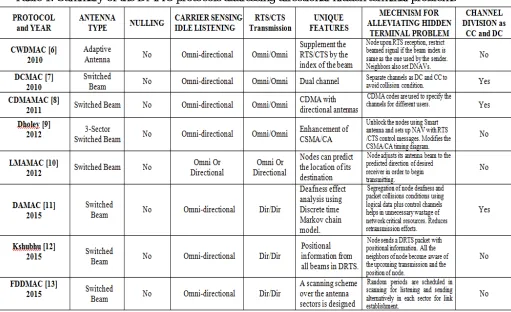
Table 1: Summary of the DMAC protocols addressing directional hidden terminal problems
IV. ROUTING STRATEGY WITH SMART ANTENNA TECHNOLOGY
IETF’s MANET group defines the qualitative parameters that all ad hoc routing protocols should posses in RFC 2501 [14]. Routing in ad hoc networks employs distributed algorithm to identify multiple, loop free routes while keeping the communication overhead to its minimum value. Two major components of the routing protocol are:
1. Route discovery: In route discovery phase, source unit starts a process of finding possible path on demand basis. To check for availability of path to destination, source unit verifies its route cache, if a feasible path is not available source unit initiates route discovery process. The information present with source unit includes the details of address of destination and intermediate units.
2. Route maintenance: Node mobility creates change of network topology and link breakages in the network that creates route failure. To maintain route, reactive protocols use acknowledgement mechanism.
ISSN (Print) : 2320 – 3765 ISSN (Online): 2278 – 8875
I
nternational
J
ournal of
A
dvanced
R
esearch in
E
lectrical,
E
lectronics and
I
nstrumentation
E
ngineering
(An ISO 3297: 2007 Certified Organization)
Vol. 5, Issue 11, November 2016
V. ROLE OF NANOTECHNOLOGY
Ever increasing user’s wireless traffic volume, demand for high band frequencies in the range of 2-5 GHz and user devices that are capable of operating at speed of 60-100 GHz [16]. Present silicon dependent RF transistor technology have limitations at these high band frequencies, grapheme nano electro-mechanical resonators are today considered as an alternative to tune radio circuits effectively. Use of nanotechnology to develop equipments for wireless devices promises novel features that provides advantage of higher performance at compact size with lower power consumption. In modern electronics, due to big size of antenna which is employed for transmission and reception purpose have become incompatible with ultra small electric circuits. This is the limiting factor for implementation of applications of MANETs like the internet of things or ubiquitous computing wherein every other device at office premise and at home are connected to the Internet facility. Wireless electronic devices produced with nanotechnology will soon become highlight of next generation wireless communication technology and particularly in applications of MANETs, by allowing decreasing of physical limits on antenna which is frequency or wavelength dependent. Nanotechnology promises to produces massive leap forward by assembling large numbers of electronic devices combined with ultra small antenna having GHz signal processing capabilities on an electronic chip. Environmental challenges confronted during coming years will be solved by producing new electronic materials that become easier to recycle and/or decompose in biological process.
VI. CROSS LAYER DESIGN APPROACH
Most of protocols proposed for MANETs assume layered architecture design which is highly rigid or strict and each layer specific protocol architecture is only concentrated about the interface to neighboring layers. In recent years, due to KETs the MANET protocols have given importance on establishing significant interactions among various layers of the network stack to enhance network performance [17]. This cross layer Design (CLD) approach that, introduces stack wide layer interdependencies is beneficial in dynamic environments of MANETs. The CLD approach makes use of the current state information available throughout the network stack to develop adaptive protocols. The physical layer estimates the channel in terms of the SINR of a link, which causes the transmission delay at each link. The routing protocol will take the routing decision using this delay and the network load distribution. Conceptually the CLD approach to network architecture is place at the connection of the three basic areas; wireless networking, signal processing and Information theory.
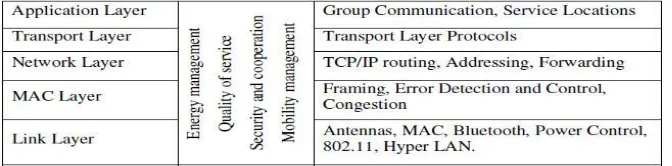
The purpose of CLD is to connect the resources of all communities together to make a network, which is highly adoptive to changing environment and allow sharing of the information between the individual modules in the system. Several functional requirements such as node mobility management, Quality of Service (QoS) awareness, node’s cooperation, energy conservation and security aspects can be effectively implemented by exploiting and combining mechanisms of all the layers of the MANETs. A way to implement this requires removing the rigid layering in which each layer’s protocols are developed in isolation. Approach now needs to use an integrated, intra-dependent and hierarchical framework setup to utilize the advantages of the interdependencies among layers. Type of interactions among layers of the network stack depends on information flow among different layers as illustrated in figure 5.
ISSN (Print) : 2320 – 3765 ISSN (Online): 2278 – 8875
I
nternational
J
ournal of
A
dvanced
R
esearch in
E
lectrical,
E
lectronics and
I
nstrumentation
E
ngineering
(An ISO 3297: 2007 Certified Organization)
Vol. 5, Issue 11, November 2016
CLD methods and evaluation criteria: There are four different approaches in the CLD they are; creation of new interface, layer merging, design coupling, and vertical calibration [18]. The CLD architecture follows three implementations such as; direct communication between layers, a shared database between layers and a completely new abstraction approach. A set of precautionary measures of CLD should be followed while its implementation [19].
The performance of the CLD architecture depends on following criteria:
• Dependency: The CLD architecture contains different types of parameters, which are interrelated. The communication between these parameters is maintained by the dependency graph.
• Unintended interactions: The CLD architecture should maintain the record of interactions between layers. CLD architectures may ignore the failure of interactions between the nonadjacent layers.
• Stability: Evaluation of protocol for stability should take into account the parameters of dependency graph which are usually maintained by two different loops of same protocol.
• Cost: To find the cost benefit of the CLD, following parameters need to be considered: 1. Large delays are involved to evaluate objective function with a large range of variables. 2. It is difficult to optimize a CLD that does not provide a good level of modularity.
3. Communication overhead is involved during the abstraction process that chooses the states information and capabilities of different layers.
The wide diffusion of CLD proposals in applications of MANET indicates the popularity of CLD as KET in the research community. The basic questions in CLD approach are: which layers of the standard reference architecture are considered for cross layer interaction? And how to implement intended interaction between identified layers of standard reference? The reasons for asking these questions are: a comprehensive analysis indicating the benefits and drawbacks that suggest the complexity and achievable performance enhancement are not available. Another issue in CLD approach is to how cross layer interaction based architecture and traditional layered model based architecture can coexist with one another. The existing methods for CLD are normally based on joint a solution which considers at most three bottom layers of standard ISO reference protocol suite.
VII. NATURE INSPIRED METAHEURISTIC APPROACH IN MANETs
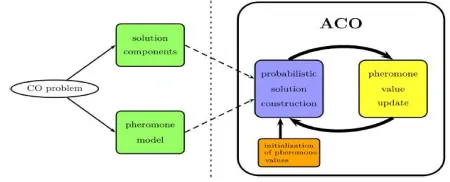
Nature in the form of social insects like ants, wasps, bees and termites offer an inspiration to find solution for issues of MANETs. The peculiar behavioral characteristic of MANETs like: i) Locality of interactions, ii) Existence of more than one paths, iii) Self-organization nature, iv) Backup strategy for failure and v) Quick and robust adaptation measures in changing topological and traffic conditions, can be effectively solved by using metaheuristic approach. Many of complex optimization problems are effectively addressed using Swarm Intelligence (SI) which is a sub field of Computational Intelligence. Some of the metaheuristic algorithms like, Ant Colony Optimization (ACO), Particle swarm optimization and Bee Colony Optimization that are based on population based methods, have been extensively studied for analyzing MANETs global behavior which stems from repetitive local interaction of individual agents with each other and their surroundings [20]. Collective behavior of social insect colonies where each individual though act independently of each other produces planned required output. ACO approach which is a prominent and different flavor of SI paradigm emphasizes on bottom up design method for giving better results in protocols of MANETs. A typical working of ACO algorithm is depicted in figure 6.
ISSN (Print) : 2320 – 3765 ISSN (Online): 2278 – 8875
I
nternational
J
ournal of
A
dvanced
R
esearch in
E
lectrical,
E
lectronics and
I
nstrumentation
E
ngineering
(An ISO 3297: 2007 Certified Organization)
Vol. 5, Issue 11, November 2016
Foraging behavior of real ants when imitated by the artificial ant agents of ACO, high dimension combinatorial optimization problems are solved to greater satisfaction level. Social ants deposit chemical substance called pheromone on the ground when it forages, with the help of this pheromone indirect communication is established between ants. The operators used in ACO are pheromone trail update and pheromone trail evaporation rate. The number of ants and the count of iteration used in the algorithm are used as control parameters in ACO. MANETs use these operators and control parameters of ACO in designing the algorithms by appropriately replicating the foraging behavior.
For large complex problems with greater dimensionality Genetic Algorithm (GA) supported ACO methods are practiced. They help to reduce delay in packet delivery and overcome communication interruption due to node or link failures, by suggesting multiple alternate paths between source and destination pairs in MANETs. Routing protocols with reduced end-to-end delay and route discovery latency are developed when ant agents of ACO are employed to discover and maintain high connectivity paths in unstable natured MANETs. Even for different node densities, data loads and various nodal mobility ACO algorithm based routing protocols of MANETs are capable of achieving enhanced throughput with lesser routing overhead. Energy awareness achieved in routing activity with the use of ACO based algorithms helps to increase the life time of MANETs.
VIII. RESEARCH SCOPE OF KET ENABLED MANETs
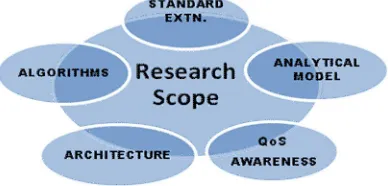
As reported by Cisco, mobile data transfer growth since 2005 is, 1000 fold and is predicted to be 11 fold between 2013 to 2018 [21]. Various applications offered by MANETs need to be geared up to meet this requirements in the predicted new scenario. Both industry and academia have investigated the hot research areas of MANETs from different enabling technology paradigm and suggested many solutions. Specific areas of interest highlighted due to the availability of KETs in MANETs are depicted figure 7. However, these fields further demand conduction of technical feasibility study to identify the suitability in MANETs.
Fig. 7 Future research scopes MANETs with KETs.
Standard extension: A reconfigured standard, that extends the original IEEE 802.11DCF to meet the requirements of
building robust MANETs with support for large number of nodes, enhanced communication range and antenna dependent inter-frame spacing need to be developed [22]. New suggested standards should have new channel access mechanisms for wider channel bands and for new frequencies with backward compatibility features.
Analytical model: Present analytical models analyze MANET protocols with the assumptions of ideal radiation pattern
and flawless channel models. An ideal channel model argues that, smart antenna technology enabled MANETs have assumptions like, easy to use, difficult to adapt to tractable theoretical frame hence, results in failure of capturing realistic node behaviour [23]. Research on developing analytical model that facilitates mathematical derivations which reflect on various scenarios of MANET protocols and proper behaviour of node to gain deeper understanding of offered advantages and limitations is required.
ISSN (Print) : 2320 – 3765 ISSN (Online): 2278 – 8875
I
nternational
J
ournal of
A
dvanced
R
esearch in
E
lectrical,
E
lectronics and
I
nstrumentation
E
ngineering
(An ISO 3297: 2007 Certified Organization)
Vol. 5, Issue 11, November 2016
policing, fairness, adequate bandwidth allocation and reservation etc. to reduce mistakes. Multimedia applications like VoIP, file transfer and live video need uncompromised attention when MANETs are used as an extension of Internet. QoS should take into account directional communication advantages, support for scalability of nodes and spaghetti/ improper implementation of CLD.
Architecture: Developing a flexible and reliable system architecture which makes use of recent advantages of various related technologies is much needed. Investigation of MANET protocols is necessary to incorporate the latest products from different manufactures and available new wireless technological growth [25].
Algorithms: From the literature survey it is seen that existing KET supported algorithms have provided many solutions to data dissemination problems of MANET; it is still difficult to conclude on performance, security and QoS awareness of proposed MANET protocol’s algorithm. The advanced MANET algorithms with lower delay, less communication overhead and minimum complexity need to be developed [26].
IX CONCLUSION
The communication range extension offered by smart antenna technology, fair channel access mechanism facility of MAC protocol, metaheuristic algorithms, effective channel arbitration techniques and cross layer interaction of CLD approach are used to build a robust and adaptive MANET applications that are expected to offer a completely new ways to access information and services. Smart antenna technology significantly reduces the radio interference, which is the main cause for reduction of MANET performance. In unstable topology natured MANETs the adaptation to present network conditions using effective MAC protocol supported by metaheuristic algorithms ensures that critical network resources are not wasted. Efficient routing protocol that tunes itself to underlying MAC protocol having advantages of beamforming smart antenna technology can be designed with CLD approach. With the help of nanotechnology large numbers of electronic devices that are easier to recycle and/or decompose in biological process are combined with ultra small antenna having GHz signal processing capabilities are assembled on an electronic chip. In the context of MANETs, use of KETs is preferred to meet the challenges that applications of MANETs will have to confront during coming years.
REFERENCES
[1] Bangnan X., Hischke S. and B. Walke, “The role of ad hoc networking in future wireless communication,” International Conference on Communication Technology, Vol. 1, pp. 1353-1358, 2003.
[2] Yong-Ling Ban, Chuan Li, Chow-Yen-Desmond Sim, Gang Wu and Kin-Lu Wong, “4G/ 5G Multiple Antennas for Future Multi-Mode Smartphone Applications,” IEEE Access, Vol. 4, pp. 2981-2988, July, 2016.
[3] Lotfi Osman, Imen Sfar and Ali Gharsallah, “Comparative Study of High Resolution Direction-of-Arrival Estimation Algorithms for Array Antenna System,” International Journal of Research and Reviews in Wireless Communications, Vol. 2, no. 1, pp. 1180-1189, March 2012. [4] J. Ward and R. Crompton, “Improving the performance of slotted ALOHA packet radio networks with adaptive arrays,” IEEE Transaction on
Communications, Vol. 40, no. 11, pp. 1716-1724, 1992.
[5]. S. Al-Sultan, M. M. Al-Doori, A. H. Al-Bayatti and H. Zedan, “A comprehensive survey on vehicular Ad Hoc network,” Journal of Network and Computer Applications, Vol. 37, no.1, pp. 380-392, 2014.
[6] Anand Prabhu Subramanian and Samir R. Das, “Addressing Deafness and Hidden Terminal Problem in Directional Antenna based Wireless Multi-Hop Networks,” Vol. 16, Issue 6, pp. 1557-1567, 2010.
[7] Jacir L. Bordim and Koji Nakano, “Deafness resilient MAC protocol for Directional communications,” IEICE Transactions INF. and SYST., Vol. E93-D, no 12, pp. 3243-3250, 2010.
[8] Vahid Pourgolzari and Seyed Ali Ghorashi, “A CDMA Based MAC Protocol for Ad Hoc Networks with Directional Antennas,” International Symposium on Computer Networks and Distributed Systems (CNDS), Vol. 1, pp. 73-77, Feb. 2011.
[9] Milan Kumar Dholey and Asrofi Khatun, “Reduction of Blockage Node and Hidden Terminal Problem of CSMAICA MAC Protocol Using Directional Antenna,” 2nd IEEE International Conference on Parallel, Distributed and Grid Computing, Vol. 1, pp. 741-746, 2012.
[10] Nermin Makhlouf and Pavel Vajsar, “Mac Protocols in Mobile Ad Hoc Networks,” International Journal of Advances in Telecommunications, Electrotechnics, Signals and Systems, Vol. 1, no. 1, pp. 1-4, 2012.
ISSN (Print) : 2320 – 3765 ISSN (Online): 2278 – 8875
I
nternational
J
ournal of
A
dvanced
R
esearch in
E
lectrical,
E
lectronics and
I
nstrumentation
E
ngineering
(An ISO 3297: 2007 Certified Organization)
Vol. 5, Issue 11, November 2016
[14] S. Corson and J. Macker, “MANET: Routing Protocol Performance Issues and Evaluation considerations,” RFC 2501, IETF Network Working Group, January 1999, [Online] available: http://www.ietf.org/rfc/rfc2501.txt. Cited 8th Oct. 2016.
[15] Amjad Ali, Wang Huiqiang, Lv Hongwu and Xiaoming Chen, “A Survey of MAC Protocols Design Strategies and Techniques in Wireless Ad Hoc Networks,” Journal of Communications Vol. 9, no. 1, pp. 30-38, January 2014
[16] Snider G. S. and R. S. Williums, “Nano/CMOS architectures using Field-programmable nanowire interconnect,” Journal of Nanotecnology, Vol. 18, pp. 1-11, January 2007.
[17] Charalampos Kalalas, Linus Thrybom and Jesus Alonso Zarate, “Cellular Communication for Smart Grid Neighborhood Area Networks: A survey,” IEEE Access, Vol. 4, pp. 1469-1493, April, 2016.
[18] V. Srivastava and M. Motani, “Cross layer design: a survey and the road ahead,” IEEE Communication Magazine, Vol. 43, no 12, pp.112-119, 2005.
[19] V. Kavadia and P. R. Kumar, “A Cautionary Perspective on Cross Layer Design,” IEEE Wireless Communication, Vol. 12, no. 1, pp.3-11, Feb. 2005.
[20] Jabbarpour, M. R., Malakooti, H., Noor, R. M., Anuar, N. B. and Khamis, N.,“Ant colony optimization for vehicle transaction systems: applications and challenges,” International Journal of Bio-Inspired Computation, Vol. 6, pp. 32-56, 2014.
[21] Cisco visual networking index, “Global mobile data traffic forecast update, 2013-2018,” February 2014. [Online] available: http://www.cisco.com/c/en/us/solutions /collateral/service-provider/visual-networking-index-vni.html. Cited 1st Nov. 2016.
[22] M. Faezipour, M. Nourani, A. Saeed and S. Addepalli, “Progress and challenges in intelligent vehicle area networks,” Communications of the ACM, Vol. 55, no. 2, pp. 90–100, 2012.
[23] M. Haenggi, J. Andrews, F. Baccelli, O. Dousse and M. Franceschetti, “Stochastic geometry and random graphs for the analysis and design of wireless networks,” IEEE Journal on Selected Areas in Communications , Vol. 27, no. 7, pp. 1029–1046, September 2009.
[24] Meena Rao and Neeta Singh, “Simulation of Various QoS Parameters in a high density MANET set up using AODV nth BR Protocol for Multimedia Transmission, DATA Transmission and under congestion Scenario,” ICTACT Journal on Communication Technology, Vol. 6, Issue 3, pp. 1155-1159, September 2015.
[25] U. D. Prasan and S. Murugappan, “An Analysis on Vehicular Ad-Hoc Networks: Research Issues, Challenges and Applications,” International Journal of Applied Engineering Research, Vol. 11, no. 6, pp. 4569-4575, 2016.
[26] O. Altintas, F. Dressler, H. Hartenstein and O. K. Tonguz, “Inter-vehicular communication, Quo Vadis,” Karlsruhe Institute of Technology (KIT) Dagstuhl Reports, Vol. 3, no. 9, pp. 190–213, 2014.
BIOGRAPHY
Sadanand R. Inamdar received his Bachelors (B.E.) Degrees in Electronics and Communication Engineering from Karnataka University, Dharwad, India in 1994 and Masters (M. Tech.) in Computer Network Engineering from VTU, Belgaum, India in 2004. Currently he is pursuing his Ph. D. from Research Center, CSE, SIT, Tumkur, Karnataka, India. His general research interests are focused on wireless networking. The major topics include wireless Ad hoc networks and quality of service provisioning within these networks. He has also co-authored several research papers.
Dr. B. Sathish Babu received his Ph.D. in Protocol Engineering Technology Unit, Dept. of ECE at Indian Institute of Science, Bangalore. At present he is working as Professor in Computer Science and Engg. Dept., Siddaganga Institute of Technology, Tumkur. His research interests includes Security in mobile communication, Cognitive agents based control solutions for Networks, Grid Computing, Cloud Computing Scheduling and Security Issues, Big Data, Context-aware Trust issues in Ubiquitous Computing, Privacy issues in WSN, and so on. He has published more than 25 international journal/conference papers in his area of research, which includes Elsevier Computer Communications, John Wiley Journal of Security and Communication Networks, InderScience-Journal of Security and its Applications and so on. He has published a book on Mobile and Wireless Network Security (Tata McGrawHill) in the year 2010.