Face Detection and Recognition using Local Binary
Patterns
1 Drakshayani Desai, 2Dr. Ramakrishna Seemakurti.
1 Research scholar, ECE Dept., JJTU, Rajasthan, India, 333001(Associate Professor, SVIT, Secunderabad-500 003) 2 Principal, Ph.D. (Principal, SVIT, Secunderabd, India, 500003) (Approved Research Guide, JJTU, Jhunjhunu-333001,
Rajasthan, India)
E-mail: 1 [email protected], 2 [email protected]
ABSTRACT: The human face conveys a lot of information about identity and emotional state of a person. Face recognition is an interesting and challenging task and impacts important applications in many areas such as identification for law enforcement, authentication for banking and security system access and personal identification. This paper proposes an Automatic Face Verification system using Local Binary Patterns (LBP). It is a texture based algorithm used for face recognition that describes the texture and shape of digital face image. The digital facial image is first divided into small blocks from which Local Binary Patterns are formed and then concatenated into a single feature vector. This feature vector plays an important role in efficient representation of the face and is used to measure similarities by calculating the distance between feature points.
Key Words - Local Binary Pattern (LBP), feature extraction, classification, pattern recognition, histogram, feature vector.
I. INTRODUCTION
Face Recognition is a process of recognizing people with their facial characteristics. Compared to other biometrics, such as fingerprint, DNA, voice etc. face recognition is more natural and can be used without the interaction of the people. Due to powerful computers and recent advances in pattern recognition, face recognition systems can now perform in real-time and achieve satisfying performance under controlled conditions, leading to many potential applications.
Face recognition can be performed in two modes: identification and verification or authentication. A face identification system wills identity a person out of a pool of N people (one-to-N matching).
A face verification system involves confirming or denying the identity claimed by a person (one-to-one matching). The verification and identification often share the same
classification algorithms, both modes target distinct
applications. In verification mode, the main applications concern access control, such as computer or mobile device log-in, building gate control, digital multimedia data access. Over traditional security access systems, face verification has many advantages: the biometric signature cannot be stolen, lost or transmitted, like for ID card, token, badges or forgotten like passwords or PIN codes. In identification mode, potential applications mainly involve video surveillance (public places, restricted areas), information retrieval (police databases, multimedia data management) or human computer interaction (video games, personal settings identification).
II. THE PROCESS OF THE FACE RECOGNITION
An automatic face verification system is composed of two main modules, as shown in Fig. 1.1:
Face detection and face verification. The purpose of the face detection module is to determine whether there are any faces in an image and if so send their position and scale to Face Verification module. The face localization is done when there is only one face in the image. The localization step provides a rough segmentation of the face region. This step involves locating facial features such as eyes, nose, mouth and chin in order to geometrically normalize the face region. Face detection is an important area of research in image processing, because it serves, as a necessary step for any face processing system, such as face recognition, face tracking or facial expression analysis. Most of the techniques assume, in general, that the face region has been perfectly localized. Therefore, their performance significantly depends on the accuracy of the face detection step.
and should be robust to intra-class variability, variation of illumination, expression changes or slight variation of the pose. Furthermore, as real-time operation it is often needed in real-life scenarios.
In the classification step, the extracted features are compared to the face model of the claimed identity and the face access is either accepted or rejected.
The face detection using Local Binary Pattern is an extension of Viola and Jones system [13] based on boosted cascades of Haar-like features. As explained by Zhang et al. [16], these features are very efficient to quickly discard most of the background regions that is considered as noise. However, in the last stages of the cascade, a large number of Haar-like features (several hundred) are necessary to reach the desired detection/false acceptance rate trade-off. It results ina long training procedure and cascades with several dozens of stages which are difficult to design. Further Haar-like features are not robust to local illumination changes. To cope with the limitation of Haar-like features, LBP algorithm is used. This method constructs weak classifiers which are inspired by the work of W. Zhao et.al [8].
III. LOCAL BINARY PATTERNS
There exist several methods for extracting the facial features from face images to perform face recognition. One of these feature extraction methods is the Local Binary Pattern (LBP) method. The LBP operator is a non-parametric 3x3 kernel which summarizes the local facial structure. This relative new approach was introduced in 1996 by Ojala et al[15].With LBP it is possible to describe the texture and shape of a digital image. This is done by dividing an image into several small regions from which the features are extracted as shown in figure 1.2.
These features which are nothing but binary patterns that describe the segmented face regions. The obtained features from the regions are concatenated into a single feature histogram, which forms a representation of the image. Images can then be compared by measuring the similarity between their histograms. According to several studies face recognition using the LBP method provides very good results, in terms of speed, discrimination and performance. Because of the way the texture and shape of images is described, the method seems to be quite robust against face images with different facial expressions, different lightening conditions, image rotation and aging of persons.
IV. PRINCIPLE OF LOCAL BINARY PATTERNS
The LBP operator was introduced by Ojala et al. This operator works with a center pixel and eight neighbor pixels. The center pixel value acts as threshold value. If a neighbor pixel has a higher value (also called as grey value) than the center pixel (or the same gray value) then it gets binary one which is assigned to that pixel, else it gets a binary zero value. The LBP code for the center pixel is then produced by concatenating the eight ones or zeros to a binary code as shown in figure 1.3.
The LBP operator may be extended to use neighborhood segments of different sizes. In this case a circle is made with radius R from the center pixel. P sampling points on the edge of this circle are taken and compared with the value of the center pixel. To get the values of all sampling points in the neighborhood for any radius and any number of pixels interpolation is necessary. For neighborhoods the notation (P, R) is used. Figures 1.4 illustrate LBP for three different values of P and R.
If the coordinates of the center pixel are (xp, yp) then the
coordinates of its P neighbors (xp, yp) on the edge of the circle
with radius R can be calculated with the sines and cosines:
If the gray value of the center pixel is gc and the gray values of
his neighbors are gp, with p = 0, 1, 2, 3...., P − 1, then the
texture T in the local neighborhood of pixel (xc, yc) can be
defined as:
from the values of the points on the circle. In this way the local texture is represented as a joint distribution of the value of the center pixel and the differences:
Although invariant against gray scale shifts, the differences are affected by scaling. To achieve invariance with respect to any monotonic transformation of the gray scale, only the signs of the differences are considered. This means that in the case a point on the circle has a higher gray value than the center pixel, a one is assigned to that point, and else it gets a zero:
In the last step to produce the LBP for pixel (xc, yc) a binomial
weight 2p is assigned to each sign s(gp – gc). These binomial
weights are summed to get better image representation:
V. FACE RECOGNITION BY LOCAL BINARY
PATTERNS
The LBP-method can be used to extract facial features from digital images. These features can be used to get a measure for the similarity between the images stored in the database. The main idea behind this is that for every pixel of an image the LBP-code is calculated. The occurrence of each possible pattern in the image is kept up.
The histogram of these patterns, also called as labels, forms a feature vector, which is a representation for the texture of the image. These histograms can then be used to measure the similarity between the images, by calculating the distance between the histograms.
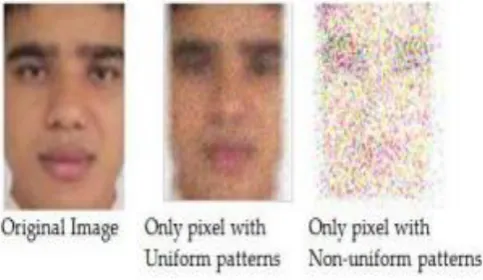
Figure 1.5: Face image split in an image with only pixels with uniform patterns and in an image with only non-uniform patterns.
Figure 1.5 shows an image which is split into an image with only pixels. The first one is an original image, second is pixel with uniform patterns and third is only pixel with non-uniform patterns. These images are created by using the LBP operator. It occurs from the figure that the image having only pixels with uniform patterns still contains a considerable amount of
pixels, namely 99 % of the original image. So, 99% of the pixels of the image have uniform patterns. Another important fact is that, by taking only the pixels with uniform patterns, the background is also preserved. This is because the background pixels all have the same color (hence same gray value) and thus their patterns contain zero transitions. It also seems that most of the pixels around the mouth, the noise and the eyes have uniform patterns.
VI. FACE RECOGNITION ALGORITHM
To implement the face recognition, in this paper the Local Binary patterns methodology is proposed. Local Binary Pattern works on local features that uses LBP operator which summarizes the local special structure of a face image. LBP is defined as a set of binary comparisons of pixels intensities between the center pixels and its eight surrounding pixels. Local Binary Pattern do this comparison by applying the following formula:
Where ic corresponds to the value of the center pixel and in
corresponds to outside pixels and xc, yc are corresponding
intensities. Feature extracted matrix originally of size 3 x 3, the values are compared by the value of the center pixel, then binary pattern code is produced and also LBP code is obtained by converting the binary code into decimal one.
The Face Recognition Algorithm
Input: Training Image set.
Output: Feature extracted from face image and compared with center pixel and recognition with unknown face image is done.
1. Initialize temp = 0
2. For each image I in the training image set. 3. Initialize the pattern histogram, H = 0.
4. For each pixel in a cell, compare the pixel to each of its 8 neighbors.
5. Follow the pixels along a circle, i.e. clockwise or counter-clockwise.
6. Where the center pixel's value is greater than the neighbor's value, write "0". Otherwise, write "1". This gives an 8-digit binary number.
7. Compute the histogram. This histogram can be seen as a 256-dimensional feature vector.
8. Find the highest LBP feature for each face image and combined into single vector.
9. Compare with test face image.
10.If it matches it most similar face in database then successfully recognized.
Figure 1.6: Flowchart of the LBP Process of face recognition
VII. RESULTS AND DISCUSSION
This implementation is used to test the performance of the LBP-method on different kind of face images. Several parameters, like the LBP operator (P and R), non-weighted or weighted regions and the dividing of the regions, are varied to see the influence of these parameters on the performance. For this experiment face images are collected from photographs, taken with Power shot camera and some are taken from webcams. And these face images are stored in face data base. Using the proposed algorithm, different types of face images can be recognized.
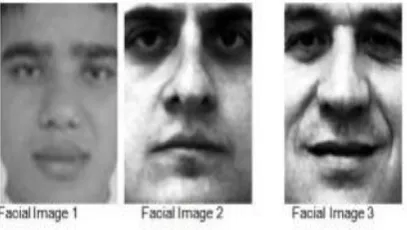
Based on algorithm, the face image of an unknown identity is compared with face images of known individuals from a large database. In the figure 1.7 we can see the input facial images used for input for face recognition module.
Figure 1.7: Different input Facial Images
And also in the figure 1.8 we can see the facial images that are stored in the database which compared with the input facial images. If the input face images are found or the more similarities face images are matched in the database then one can say that face image is successfully recognized.
Figure 1.8: Facial Image from the Database
In the experiment one need to train the face images in the database. Based on the algorithm the input face images are compared with database facial images for identification.
The following table shows overall face recognition rate using LBP.
In the table 1 the recognition rate is 99%. From the experimental result, it is seen that the research satisfies all the requirements to recognize the face images.
VIII. CONCLUSION AND FUTURE IMPROVEMENTS
a) Conclusion: This paper highlights about face recognition using Local Binary Patterns. It mainly consists of three parts, namely face representation, feature extraction and classification. Face representation represents how to model a face and determines the successive algorithms of detection and recognition. The most useful and unique features of the face image are extracted in the feature extraction phase. In the classification the face image is compared with the images from the database. This method represents the local feature of the face and matches it with the most similar face image in database. The accuracy of the system is 99% by the Local Binary Patterns algorithm.
b) Future Improvements: In future to improve the facial pose correction, quality based frame selection, aging correction, and mark based matching techniques can be combined to build a unique system for video based face recognition.
REFERENCES
1. Unsang Park, “Face Recognition: face in video, age
invariance, and facial marks” Michigan State University, 2009
2. T. Ahonen, A. Hadid and M. Pietikainen, “Face
3. T. Ahonen, A. Hadid, M. Pietikainen and T. M aenpaa.“Face recognition based on the appearance of local regions”, In Proceedings of the 17th International Conference on Pattern Recognition, 2004.
4. R. Gottumukkal and V.K. Asari, “An Improved Face
Recognition Technique Based on Modular PCA Approach” Pattern Recognition Letters, vol. 25, pp. 429- 436, Mar. 2004.
5. T. Ojala, M. Pietikainen and D. Harwood, “A
comparative study of texture measures with classification based on feature distributions” Pattern Recognition vol. 29, 1996.
6. M. Turk and A. Pentland, “Eigenfaces forrecognition”, Cognitive Neuroscience, 3:72-86, 1991.
7. M. Kirby and L. Sirovich, “Application of the
Karhunen-Loeve procedure for the characterization of human faces” IEEE Transactions on Pattern Analysis and Machine Intelligence, 12(1):103-108, 1990.
8. W. Zhao, R. Chellappa, P. J. Phillips, and A.
Rosenfeld,“Face recognition: A literature survey” ACM Computing Surveys (CSUR), 35(4):399-458, 2003.
9. S. Z. Li and A. K. Jain (eds.), “Handbook of Face Recognition” Springer-Verlag, Secaucus, NJ, 2005.
10. W. Zhao and R. Chellappa “Robust face recognition using
symmetric shape from-shading” Technical Report, Center for Automation Research, University of Maryland, 1999.
11. T. Chen, Y. Wotao, S. Z. Xiang, D. Comaniciu, and T. S.
Huang, “Total variation models for variable lighting face recognition” IEEE Transactions on Pattern Analysis and Machine Intelligence, 28(9):1519 -1524, 2006.
12. M. Grudin, “On internal representation in face
recognition systems”. Pattern Recognition, 33(7):1161 1177, 2000.
13. P. A. Viola and M. J. Jones, “Robust real-time face detection”. International Journal of Computer Vision, 57(2):137-154, 2004.
14. http://fei.edu.br/~cet/facedatabase.html
15. T. Ojala, M. Pietik¨ainen and D. Harwood, “A
comparative study of texture measures with classification based on feature distributions” Pattern Recognition vol. 29, 1996.
16. Zhihong Zeng, MajaPantic, Glenn I. Roisman and