
Generic Constructions of Parallel Key-Insulated Encryption:
Stronger Security Model and Novel Schemes
∗Goichiro Hanaoka1, Jian Weng2
1National Institute of Advanced Industrial Science and Technology, Tokyo, Japan
2Department of Computer Science, Jinan University, Guangzhou 510632, P.R. China
Abstract
Exposure of a secret key is a significant threat in practice. As a notion of security against key exposure, Dodis et al. advocated key-insulated security, and proposed concrete key-insulated encryption (KIE) schemes in which secret keys are periodically updated by using a physically “insulated” helper key. For significantly reducing possibility of exposure of the helper key, Hanaoka et al. further proposed the notion of parallel KIE (PKIE) in which multiple helper keys are used in alternate shifts. They also pointed out that in contrast to the case of the standard KIE, PKIE cannot be straightforwardly obtained from identity-based encryption (IBE). In this paper, we first discuss that previous security models for PKIE are somewhat weak, and thus re-formalize stronger security models for PKIE. Then we clarify that PKIE can be generically constructed (even in the strenghthened security models) by using a new primitive which we call one-time forward secure public key encryption (OTFS-PKE) and show that it is possible to construct OTFS-PKE from arbitrary IBE or hierarchical IBE (without degenerating into IBE). By using our method, we can obtain various new PKIE schemes which yield desirable properties. For example, we can construct first PKIE schemes from lattice or quadratic residuosity problems (without using bilinear maps), and PKIE with short ciphertexts and cheaper computational cost for both encryption and decryption. Interestingly, the resulting schemes can be viewed as the partial solutions to the open problem left by Libert, Quisquarter and Yung in PKC’07.
Keywords: key exposure, parallel key-insulated encryption, one-time forward secure public key encryption, identity-based encryption.
1
Introduction
Background. Nowadays, there is a growing tendency for cryptographic systems to be deployed on inexpensive, lightweight and mobile devices. In such a situation, a secret key is more casually and frequently used, and thus, both damage and possibility of key exposure increase significantly. Key-insulated cryptography, introduced by Dodis, Katz, Xu and Yung [21], is a useful tech-nique to mitigate the potential damage caused by key exposure. In a key-insulated encryption (KIE) scheme, the lifetime of the system is divided into discrete periods, and the pubic key remains fixed throughout the lifetime. Each user keeps two kinds of secrets which are called user secret key and helper key. The user secret key is used for decrypting ciphertexts, and the helper key is used for updating the user secret key. Since the user secret key is periodically updated (without changing the public key), its exposure compromises only security during its corresponding time period, and security of other time periods (including past ones) are still maintained. Furthermore, the helper key is stored in a dedicated device named helper, which is kept isolated from the network except when it is used for updating the user secret key, and thus we can assume that possibility of its exposure is very low.
∗A preliminary version of this paper will be presented atSeventh Conference on Security and Cryptography
The key-insulation paradigm is an effective solution to the key exposure problem. However, we also notice that it is not easy to simultaneously handle (1) reducing damage by exposure of the user secret key, and (2) reducing possibility of exposure of the helper key. Namely, if we update the user secret key more frequently, then exposure of the user secret key compromises security for only a shorter time period. But, this also increases frequency of the helper’s connection to insecure environments, and hence increases the risk of helper key exposure. We note that exposure of the helper key may compromise security of alltime periods.
To address the above problem, Hanaoka, Hanaoka, and Imai [26] introduced the concept of parallel key-insulated encryption (PKIE), where two (or more) distinct helpers are alternately used to update the user secret keys. As indicated in [26], PKIE allows frequent updating of the user secret key, and at the same time reduces the risk of the helper key exposure. Namely, assuming that in some time period, the user secret key is updated by using one of two helper keys, next updating procedure cannot be carried out without using the other helper key. Therefore, even if one of helper keys is exposed, its damage is still very limited.
Based on Boneh-Franklin identity-based encryption (IBE) scheme [8], Hanaoka et al. [26] also proposed a concrete PKIE scheme (referred to as HHI scheme) in the random oracle model [5]. Later, based on Boneh-Boyen IBE scheme [6], Libert, Quisquater and Yung [36] further proposed another PKIE scheme (referred to as LQY scheme) without using random oracles.
Libert et al. also pointed out an important fact that in contrast to the standard KIE, it is not straightforward to construct PKIE from IBE. Actually, it has not been known if it is possible to generically construct PKIE from any IBE or not, and therefore, we cannot flexibly design PKIE schemes according to individual system requirement.
Our Results. In this paper, we first discuss that previous security models for PKIE are somewhat weak, and thus re-formalize stronger security models for PKIE. Next, we show that it is possible to generically construct a PKIE scheme (even in the strengthened security models) from an arbitrary IBE scheme, and give various useful instantiations. Specifically, we first introduce a new primitive named one-time forward secure public key encryption (OTFS-PKE), and then present a generic construction of PKIE from OTFS-PKE. Furthermore, we present two generic constructions of OTFS-PKE: one is from standard IBE, and the other is from two-level hierarchical identity-based encryption (2-HIBE). We note that IBE can be trivially obtained from 2-HIBE, but our generalization based on OTFS-PKE yields more flexibility which results in a wider range of applications.
First examples of instantiations of our generic construction are PKIE schemes from various assumptions. Namely, by converting lattice-based IBE schemes [16, 24, 37] into OTSF-PKE schemes, we immediately have PKIE schemes based on difficulty of lattice problems. These schemes can be considered as the first “post-quantum” PKIE schemes. Similarly, based on the quadratic-residuosity-based IBE schemes [9, 17], we can easily construct PKIE schemes from the same underlying assumptions. These are the first PKIE schemes from a factoring-related problem. We stress that all previously known PKIE schemes depend on pairings, and thus the above schemes can also be the first PKIE schemes without pairings.
Second examples are PKIE schemes with better efficiency in comparison to existing schemes (e.g. [36]) in some aspects. For instance, based on Boneh-Boyen IBE [6], we can construct a new PKIE scheme with shorter ciphertexts and cheaper computational cost for encryption and decryption. For another instance, based on Boneh-Boyen-Goh HIBE [7], we can also construct a new PKIE scheme which yields cheaper computation for helpers. This scheme is useful when helpers are computationally weak devices (e.g. smart cards). Surprisingly, when our Boneh-Boyen-based scheme is extended to support multiple helpers, its public key size, ciphertext size, encryption cost and decryption cost are all constant and independent with the number of helpers. This scheme can be viewed as a (partial) solution to the open question left by Libert et al. in PKC’07.
KIE scheme based on Boneh-Franklin IBE scheme, and they also presented the generic construc-tion of (non-strong key-insulated) KIE from IBE. We remark that these generic construcconstruc-tions cannot be applied to PKIE systems. Hanaoka et al. [27] studied KIE in the unconditional settings, and proposed a dynamic and mutual KIE scheme.
Phan et al. [38] generalized the notion of PKIE and introduced a new paradigm called key-insulated public key encryption with auxiliary helper. Weng et al. [43] extended PKIE to identity-based scenarios, and proposed an identity-based PKIE scheme without random oracles. However, the efficiency of their scheme also degrades with the number of helpers. Hanaoka et al. [29] introduced the paradigm of hierarchial key-insulation, and presented the constructions of identity-based hierarchial KIE. Weng et al. [44] introduced the notion of threshold key-insulation, and proposed an identity-based threshold KIE scheme.
There exist some other related techniques to deal with the key exposure problem. Forward secure cryptography [1, 3, 12, 14, 32, 35] can ensure that, exposure of the current key does not render usages of previous keys insecure, but security of the future periods is lost. Intrusion-resilient cryptography [18, 19, 31] strengths the key-insulated security in the sense that, the system remains secure even after arbitrarily many compromises of both helper key and user secret keys, as long as the compromises are not simultaneous.
2
Preliminaries
2.1 Notations
For a bit flg∈ {0,1},flg denotes 1−flg. For a finite set S,x← S$ means choosing an element
x from S with a uniform distribution. For a string x, |x| denotes its bit-length. We use A(x, y,· · ·) to denote thatAis an algorithm with the input (x, y,· · ·), and usez← A(x, y,· · ·) to denote the running of A(x, y,· · ·) with the output z. For AO1,O2,···(x, y,· · ·), it means
thatA is an algorithm with the input (x, y,· · ·) and can access to oraclesO1,O2,· · ·. By z← AO1,O2,···(x, y,· · ·), we denote the running ofAO1,O2,···(x, y,· · ·) with the outputz. Throughout
this paper, we use M to denote the message space of the encryption schemes. A function
F :N→[0,1] is said to benegligible if for allc∈Nthere exists akc ∈Nsuch thatF(k)< k−c
for all k > kc.
2.2 Public Key Encryption
A public key encryption (PKE) scheme PKE = (KGen,Enc,Dec) consists of three algorithms: The key generation algorithm (pk, sk) ← KGen(λ), taking as input a security parameter λ, outputs a public/secret key pair (pk, sk). Theencryption algorithmC←Enc(pk, M), on input a public key pk and a message M ∈ M, outputs a ciphertext C. The decryption algorithm
M ←Dec(sk, C), on input a cipertextC and the secret keysk, outputs a plaintextM (or “⊥”
ifC is invalid).
Next, we review the definition of semantic security [25] for PKE, i.e. IND-ATK [2, 22, 40] where ATK ∈ {CPA,CCA}. Let B be an adversary running in two stages find and guess. Consider the following experiment:
ExpIND-ATKB,PKE (λ):[(pk, sk)←KeyGen(λ); (M0, M1)← BOd (·)
find (pk); δ
$
← {0,1}; C∗←Enc(pk, Mδ); δ′← BguessOd(·)(C∗, pk); return 1 if δ=δ′, or 0 otherwise
]
,
Definition 1 We say that a PKE scheme is IND-CCA (resp. IND-CPA) secure, if there exists no probabilistic polynomial time (PPT) adversary B who has advantage AdvINDB,PKE-CCA(λ) (resp. AdvINDB,PKE-CPA(λ)).
2.3 Hierarchical Identity-Based Encryption
Hierarchical identity-based encryption (HIBE) is a generalization of IBE that mirrors an or-ganizational hierarchy. An HIBE scheme HIBE = (Setup,Extract,Enc,Dec) consists of four algorithms: The setup algorithm (param, msk) ← Setup(λ, l), run by the private key gener-ator (PKG), on input a security parameter λ and the maximum hierarchy depth l, outputs the public parameters param and the master secret key msk. The key extraction algorithm
skID ← Extract(param, skID|k−1,ID), on input param, an identity ID = (ID1,· · ·,IDk) of depth k≤l, and the secret keyskID|k−1 of the parent identityID|k−1 = (ID1,· · · ,IDk−1), outputs the
secret key skID for ID. The encryption algorithm C ←Enc(param,ID, M), on input param, a message M ∈ M and an identityID with a depth equal or less thanl, outputs a ciphertext C. The decryption algorithm m ← Dec(skID, C), on input a secret key skID and a ciphertext C, outputs a plaintext M (or “⊥” if C is invalid).
Note that when the maximal hierarchy depth in HIBE degenerates to a single level, it yields an IBE system. For IBE, we useSetup(λ) instead of Setup(λ, l) to denote its setup algorithm. Next, we review the definition of semantic security for HIBE/IBE, i.e. IND-ID-ATK where
ATK={CPA,CCA}. For an adversaryA, we consider the following experiment:
ExpIND-ID-ATKA,HIBE/IBE(λ):[(param, msk)←Setup(λ, l); (M0, M1,ID∗)← AfindOext(·),Od(·,·)(param); δ $
← {0,1}; C∗←Enc(param,ID∗, Mδ);δ′← AOext
(·),Od(·,·)
guess (param, C∗); return 1 ifδ=δ′ or 0 otherwise
]
,
whereOext(·) is a key extraction oracle which for givenIDreturnsskID←Extract(param, msk,ID), and Od(·,·) is a decryption oracle which for given (ID, C) returns M ← Dec(skID, C) ifATK=
CCA, or “⊥” if ATK=CPA. It is required that |M0|=|M1|,Acannot submit ID∗ nor a prefix ofID∗ to oracleOext, and Acannot submit (ID∗, C∗) to oracleOd. We defineA’s advantage as AdvIND-ID-ATKA,HIBE/IBE(λ) =Pr[ExpAIND-ID-ATK,HIBE/IBE(λ) = 1]−12.
Definition 2 An HIBE/IBE scheme is said to be IND-ID-CCA (resp. IND-ID-CPA) secure, if there exits no PPT adversary A who has non-negligible advantage AdvAIND,HIBE-ID-/CCAIBE(λ) (resp. AdvINDA,HIBE-ID-/CPAIBE(λ)).
Remark 1. Canetti, Halevi, and Katz [14] defined a weaker notion of security for HIBE/IBE (i.e., IND-sID-CCA,IND-sID-CPA), in which the adversary must declare the identity ID∗ he in-tends to attack before seeing the public parameters of the system.
2.4 Parallel Key-Insulated Encryption
In this subsection, we first review the definition of PKIE systems as defined in [26, 36], with slight notational differences. Then, we further re-formalize the security model for PKIE which is stronger than previous one [26, 36].
Formally, a PKIE scheme consists of the following algorithms:
• KeyGen(λ): The key generation algorithm, on input a security parameter λ, outputs a public key pk, an initial user secret key usk0 and two helper keys (mst1,mst0). Hereusk0 is kept by the user, while mst1 and mst0 are kept by the first and the second helper respectively. We write (pk,usk0,(mst1,mst0))←KeyGen(λ).
• ∆-Gen(t,mstt mod 2): The helper key-update algorithm is run by the helpers at the be-ginning of each period. On input a period index t and the corresponding helper key
• Update(t,uskt−1,hskt): Theuser key-update algorithm is run by the user at the beginning
of each period. Taking as input a period index t, the user secret key uskt−1 for period
t−1 and the update key hskt, it returns the user secret key uskt for period t. We write
uskt←Update(t,uskt−1,hskt).
• Enc(pk, t, m): Theencryption algorithm takes as input the public keypk, a period index
tand a message m∈ M. It outputs a ciphertextCT. We write CT←Enc(pk, t, m). • Dec(uskt,CT): Thedecryption algorithm takes as input a ciphertextCTunder period index
t, and the matching user secret keyuskt. It outputs a plaintextm(or “⊥” ifCTis invalid). We writem←Dec(uskt,CT).
Key-insulated security. This security notion captures the intuition that, if an adversary does not compromise the helper, exposure of the user secret keys for some periods does not affect other periods; furthermore, if a single helper is broken into while a given period t is exposed, only one other period adjacent totis exposed (recall that even strong key-insulated KIE schemes collapse in this scenario). We refer to this security as IND-KI-ATK where ATK∈ {CCA,CPA}. For an adversaryA, we consider the following experiment:
ExpIND-KI-ATKA,PKIE (λ):[(pk,usk0,(mst1,mst0))←KeyGen(λ); (m0, m1, t∗)← AfindOu(·),Oh(·),Od(·,·)(pk); β← {$ 0,1};CT∗←Enc(pk, t∗, mβ); β′ ← AOu
(·),Oh(·),Od(·,·)
guess (pk,CT∗); return 1 ifβ =β′ or 0 otherwise
]
,
whereOu(·) is a user secret key oracle which for given a period indext returns the user secret key uskt, Oh(·) is a helper key oracle which for given an index i ∈ {0,1} returns the helper key msti, and Od(·,·) is a decryption oracle which for given (t,CT) returnsm ← Dec(uskt,CT) if ATK = CCA, or “⊥” if ATK = CPA. It is mandated that |m0| = |m1| and the following requirements are satisfied:
(1). Acannot issue the user secret key queryOu(t∗);
(2). Acannot issue both queries Ou(t∗−1) and Oh(t∗ mod 2); (3). Acannot issue both the helper key queriesOh(1) andOh(0); (4). if ATK=CCA,A cannot issue the decryption queryOd(t∗,CT∗).
We define A’s advantage as AdvIND-KI-ATKA,PKIE (λ) =Pr[ExpIND-KI-ATKA,PKIE (λ) = 1]−12.
Remark 2. This experiment considers two kinds of adversaries: Type I attackers who do not corrupt helpers during the simulation. In contrast, Type II adversaries corrupt exactly one helper without corrupting a user secret key that would trivially expose the target periodt∗.
Remark 3. In the previous security model for PKIE [26, 36], it is additionally required that the adversary cannot issue both queries Ou(t∗+ 1) and Oh((t∗+ 1) mod 2). We also notice that, in previous PKIE schemes [26, 36], the adversary is able to derive uskt∗ if she corrupts both uskt∗+1 and mst(t∗+1) mod 2. However, according to the definition of PKIE, corruption of
uskt∗+1 and mst(t∗+1) mod 2does not inherently mean the exposure of uskt∗. So, in our security
model, we do not impose this restriction on the adversary. As can be seen later, in our PKIE schemes, it is impossible for the adversary to derive uskt∗ even if she corrupts both uskt∗+1 and
mst(t∗+1) mod 2.
Definition 3 A PKIE scheme is said to beIND-KI-CCA(resp. IND-KI-CPA) secure, if there ex-ists no PPT adversaryAwho has non-negligible advantageAdvINDA,PKIE-KI-CCA(λ)(resp. AdvINDA,PKIE-KI-CPA(λ)).
Strong key-insulated security. Key-insulated security can be further enhanced to cover the compromise of both helper keys. To define this security notion, we first define the notion of
Expstrong-IND-KI-ATKA,PKIE (λ):[(pk,usk0,(mst1,mst0))←KeyGen(λ); (m0, m1, t∗)← AfindOd(·,·)(pk,mst1,mst0); β← {$ 0,1};CT∗←Enc(pk, t∗, mβ); β′ ← AOd
(·,·)
guess (pk,mst1,mst0,CT∗); return 1 ifβ =β′ or 0 otherwise
]
,
whereOd(·,·) is the same as in experimentExpIND-KI-ATKA,PKIE (λ). It is mandated that|m0|=|m1|, and if ATK = CCA then A cannot issue the decryption query Od(t∗,CT∗). We define A’s advantage as Advstrong-IND-KI-ATKA,PKIE (λ) =Pr[ExpAstrong-IND-KI-ATK,PKIE (λ) = 1]−12.
Definition 4 We say that a PKIE scheme is strong-IND-KI-CCA (resp. strong-IND-KI-CPA) secure, if there is no PPT adversaryAwho has non-negligible advantageAdvAstrong,PKIE-IND-KI-CCA(λ) (resp. AdvstrongA,PKIE-IND-KI-CPA(λ)).
Definition 5 We say that aPKIEscheme is strongly key-insulated secure under chosen-ciphertext attack (resp. chosen-plaintext attack), if it is both IND-KI-CCA secure (resp. IND-KI-CPA se-cure) and strong-IND-KI-CCA secure (resp. strong-IND-KI-CPA secure).
2.5 Bilinear Pairings and Related Complexity Assumptions
In this subsection, we review the definition of bilinear pairings and some related complexity assumptions on which the security of our concrete PKIE schemes are based.
Let Gand GT be two cyclic multiplicative groups with the same prime order p. A bilinear
pairing is a mape:G×G→GT with the following properties:
• Bilinearity: ∀g1, g2 ∈G,∀a, b∈Z∗p, we have e(ga1, g2b) =e(g1, g2)ab; • Non-degeneracy: There existg1, g2 ∈Gsuch thate(g1, g2)̸= 1;
• Computability: There exists an efficient algorithm to computee(g1, g2) for ∀g1, g2 ∈G. Definition 6 The decisional bilinear Diffie-Hellman (DBDH) problem in groups (G,GT) is,
given a tuple (g, ga, gb, gc, Z) ∈ G4 ×GT with unknown a, b, c
$ ← Z∗
p, to decide whether Z = e(g, g)abc. A polynomial time algorithm B has advantage ϵ in solving the DBDH problem in groups (G,GT), if
Pr[B(g, ga, gb, gc, Z =e(g, g)abc) = 1]−Pr[B(g, ga, gb, gc, Z =e(g, g)d) = 1]≥ϵ,
where the probability is taken over the random choices of a, b, c, din Z∗p, the random choice of g
in G, and the random bits consumed by B.
We say that the DBDH assumption holds in groups (G,GT), if there exists no polynomial
time algorithm B that has non-negligible advantage in solving the DBDH problem in (G,GT).
Definition 7 The ℓdecisional bilinear Diffie-Hellman exponentiation (ℓ-DBDHE) assumption in groups (G,GT) is, given a tuple (g, h, ga,· · · , ga
ℓ
, gaℓ+2,· · · , ga2ℓ, Z) ∈G2ℓ+1×GT with
un-knowna←$ Z∗p, to decide whetherZ =e(g, h)aℓ+1. A polynomial time algorithmBhas advantage
ϵin solving the ℓ-DBDHE problem in groups (G,GT), if
Pr[B(g, h, ga,· · · , gaℓ, gaℓ+2,· · · , ga2ℓ, Z =e(g, h)aℓ+1) = 1] −Pr[B(g, h, ga,· · ·, gaℓ, gaℓ+2,· · ·, ga2ℓ, Z =e(g, g)b) = 1]≥ϵ,
where the probability is taken over the random choices of a, b in Z∗p, the random choices of g
and h in G, and the random bits consumed by B.
We say that theℓ-DBDHE assumption holds in groups(G,GT), if there exists no polynomial
3
Generic Construction of Parallel Key-Insulated Encryption
In this section, we first explain the difficulties in generic constructions of PKIE. Then we introduce a new primitive named one-time forward secure public key encryption (OTFS-PKE). Based on this new primitive, we present a generic construction of PKIE.
3.1 Difficulties in Generic Constructions of PKIE
In [21], Dodis et al. showed that an IBE scheme can be converted to a KIE scheme, by viewing the period index as an “identity” and having the PKG as the helper. However, Hanaoka et al. [26] pointed out that it is non-trivial to construct a PKIE scheme from IBE systems.
To illustrate the difficulties, two important facts should first be kept in mind: On the one hand, according to the definition of PKIE, only one (not both) of the helper keys are used to update the user secret key in each period. On the other hand, the user secret key should simultaneously contain the update keys generated bymst0 andmst1; otherwise, the compromise of a single helper and some periods will harm other periods.
Next, let’s review a unsuccessful solution which was previously discussed by Libert et al. [36]. To construct a PKIE scheme by combining two IBE schemes, this solution uses the two PKGs to alternatively act as the helpers for even and odd periods, taking the period indices as identities. For example, a user secret key for an even period indextconsists ofuskt= (skt−1, skt), where skt−1is the secret key generated by the first PKG in the previous period for identity “t−1”, and
skt is the secret key generated by the second PKG in current period for identity “t”. At first
glance, such a solution appears to be feasible. Unfortunately, this is not necessary true, since the user secret key for periodtwill be exposed by corrupting periodst−1 andt+1. More specifically,
uskt= (skt−1, skt) can be derived bycombining skt−1, picked fromuskt−1 = (skt−2, skt−1), and
skt, picked fromuskt+1= (skt, skt+1).
The insecurity of the above solution lies in the fact that, the two components generated by distinct PKGs can be individually extracted from the user secret keys, which enables the adversary to assemble another user secret key. Based on this observation, Libert et al. [36] pointed out an intuitive relation between secure PKIE and a category of IBE systems whose key extraction algorithm can be viewed as a signature supporting aggregation. Now, the user secret key of the resulting PKIE scheme is the aggregation of two components generated by distinct helpers, so that the individual component cannot be extracted. In fact, both HHI scheme [26] and LQY scheme [36] follow this intuition. However, both HHI scheme and LQY scheme are only concrete, and the aggregation property is not generally satisfied in all IBE systems, e.g. [6, 9, 17, 23, 42]. Furthermore, both HHI scheme and LQY scheme cannot satisfy our strengthened security notion, since the adversary is able to derive the user secret keyusktif she corrupts bothuskt+1 andmstj. For example, in HHI scheme, the user secret key for period
t is defined to be uskt =H(t−1)mstjH(t)msti, wherej = (t−1) mod 2 and i= t mod 2. If
the adversary corrupts uskt+1 = H(t)mstiH(t+ 1)mstj and mstj, then she can derive the user
secret key for periodtby computinguskt=uskt+1·H(t−1)
mstj
H(t+1)mstj =H(t−1)
mstjH(t)msti. Thus the
above intuition cannot be utilized to generic construction of PKIE fromany IBE systems, and we must find a different way.
3.2 A New Primitive: One-Time Forward Secure Public Key Encryption
can be evolved or not. Concretely, in the beginning of a periodtwheret mod 2 =flg, the user regenerates a new secret key dt (refer to it as an evolvable secret key), which can be further
evolved in the next period t+ 1. While for a period index t where t mod 2 = flg, the secret key dt is evolved from the previous secret key, and cannot be further evolved (refer to it as an
evolved secret key). Formally, an OTFS-PKE scheme consists of the following algorithms: • Setup(λ,flg): The setup algorithm takes as input a security parameter λ and a bitflg ∈
{0,1}. It returns a public key P K and a master key M K. We write (P K, M K) ←
Setup(λ,flg). (Without loss of generality, we assume flg is included inP K.)
• KeyGen(P K, M K, t): Thekey generation algorithm takes as inputP K,M Kand a period indextwheret mod 2 =flg. It outputs an evolvable secret keydt for periodt. We write dt←KeyGen(P K, M K, t).
• Upd(P K, t, dt−1): The key update algorithm takes as input P K, a period index t where
t mod 2 = flg, and the evolvable secret key dt−1 of the previous period. It returns the evolved secret keydtfor periodt. We write dt←Upd(P K, t, dt−1).
• Enc(P K, t, M): The encryption algorithm takes as input P K, a period index t and a
message M ∈ M. It returns a ciphertext C (or “⊥” if C is invalid). We write C ← Enc(P K, t, M).
• Dec(dt, C): Thedecryption algorithm takes as input the secret keydtand a ciphertextC.
It returns a message M (or “⊥” if C is invalid). We writeM ←Dec(dt, C).
The correctness of OTFS-PKE means that, for any M ∈ M and any periods t1 (where t1 mod 2 =flg) and t2 (where t2 mod 2 =flg), it holds that
Dec(KeyGen(P K, M K, t1),Enc(P K, t1, M)) =M,
Dec(Upd(P K, t2,KeyGen(P K, M K, t2−1)),Enc(P K, t2, M)) =M.
Roughly speaking, the security requirements for an OTFS-PKE scheme should capture the following intuitions: For a periodt∗ wheret∗ mod 2 =flg, exposure of the secret key dt∗ does
not affect any other period (in particular, it is impossible for an adversary to derive the previous secret key dt∗−1); while exposure of the secret key of period t∗ where t∗ mod 2 = flg should merely affect periods t∗ and t∗+ 1. Next, we begin to define the formal semantic security for OTFS-PKE, and we refer to it asIND-FS-ATKwhereATK={CCA,CPA}. For an adversaryB, we consider the following experiment:
ExpIND-FS-ATKB,OTFS-PKE (λ):[flg← B(λ);(P K, M K)←Setup(λ,flg); (M0, M1, t∗)← BOke
(·),Od(·,·)
find (P K);
θ← {$ 0,1};C∗←Enc(P K, t∗, Mθ); θ′← BguessOke(·),Od(·,·)(P K, C∗); return 1 ifθ =θ′ or 0 otherwise
]
,
whereOke(·) is a key-exposure oracle which on input indextreturnsdt←KeyGen(P K, M K, t)
if t mod 2 = flg or dt ← Upd(P K, t,KeyGen(P K, M K, t−1)) if t mod 2 = flg, and Od(·,·) is a decryption oracle which on input (t, C) returns m ← Dec(dt, C) if ATK = CCA, or “⊥”
if ATK = CPA. It is mandated that |M0| = |M1|, and the following requirements should be satisfied:
(1). Bcannot issue the key-exposure query Oke(t∗);
(2). Ift∗ mod 2 =flg,B cannot issue the key-exposure queryOke(t∗−1); (3). IfATK=CCA,Bcannot issue the decryption queryOd(t∗, C∗).
We define B’s advantage as AdvIND-FS-ATKB,OTFS-PKE (λ) =Pr[ExpIND-FS-ATKB,OTFS-PKE (λ) = 1]−12.
3.3 Generic Construction of PKIE from OTFS-PKE
In this section, we first show how to generically construct a chosen-plaintext secure PKIE scheme from OTFS-PKE and PKE. Then we discuss how to achieve the chosen-ciphertext security.
3.3.1 CPA-Secure Construction
Basic Idea. We first explain how to use two OTFS-PKE schemes to construct a PKIE scheme with (non-strong) key-insulated security. The basic idea of our construction is as follows. We use two OTFS-PKE schemes: OTFS-PKE1 withflg= 1 andOTFS-PKE0 withflg= 0. The master key M K1 (resp. M K0) in OTFS-PKE1 (resp. OTFS-PKE0) acts as the helper key mst1 (resp.
mst0) for the resulting PKIE scheme. In a given period t (let i = t mod 2 and j = (t−1) mod 2), the user secret key is of the formuskt= (dj,t, di,t), where di,t is anevolvable secret key
directly generated bymsti, anddj,tis anevolved secret key evolved fromdj,t−1, which is directly
generated bymstj in the previous period. In the next periodt+ 1, the helper keymstj generates a new evolvable secret keydj,t+1, whiledi,t evolves into anevolved secret key di,t+1. And hence the user secret key for period t+ 1 is uskt+1 = (di,t+1, dj,t+1). Due to the “forward security” of the OTFS-PKE scheme, it is impossible to derive di,t from di,t+1, thus it implies that: (1)
unlike the unsuccessful solution mentioned in Section 3.1, even if both uskt−1 = (di,t−1, dj,t−1) and uskt+1 = (di,t+1, dj,t+1) are corrupted,uskt= (dj,t, di,t) are still unexposed; (2) unlike HHI
scheme and LQY scheme, even if the adversary corruptsuskt+1 = (di,t+1, dj,t+1) and mstj, it is
still impossible to derive uskt= (dj,t, di,t).
The above resulting PKIE scheme cannot achieve the strong key-insulated security, since the corruption of both helper keys means all the periods will be exposed. To achieve the strong key-insulated security, we use an additional PKE scheme. Suppose the secret key of the PKE scheme issk, then the user secret key for periodtis of the formuskt= (sk, dj,t, di,t). Now, even
if both of the helper keys are corrupted, the security of all the periods are still ensured, since
sk is unknown to the adversary. The detailed construction is shown in Figure 1.
KeyGen(λ): Given a security parameterλ,
1. choose a PKE schemePKEand two OTFS-PKE schemesOTFS-PKE1andOTFS-PKE0,
2. run (pk, sk)←PKE.KGen(λ) ,(P K1, M K1)←OTFS-PKE1.Setup(λ,1) and (P K0, M K0)←OTFS-PKE0.Setup(λ,0),
3. rund1,−1←OTFS-PKE1.KeyGen(P K1, M K1,−1),d1,0←OTFS-PKE1.Upd(P K1,0, d1,−1) and d0,0←OTFS-PKE0.KeyGen(P K0, M K0,0),
4. outputpk= (pk, P K1, P K0),usk0= (sk, d1,0, d0,0),mst1=M K1 andmst0=M K0.
∆-Gen(t,mstt mod 2): To generate the update keyhskt
with the matching helper keymstt mod 2,
1. leti=t mod 2,
2. rundi,t←OTFS-PKEi.KeyGen(P Ki,msti, t),
3. output the update key for periodtashskt=di,t.
Update(t,uskt−1,hskt): In periodt, to update the user
secret key fromuskt−1 touskt,
1. leti=t mod 2 andj= (t−1) mod 2,
2. parseuskt−1as (sk, di,t−1, dj,t−1) andhsktasdi,t,
3. rundj,t←OTFS-PKEj.Upd(P Kj, t, dj,t−1),
4. returnuskt= (sk, dj,t, di,t).
Enc(pk, t, m): In periodt, to encrypt a messagem
under public keypk,
1. leti=t mod 2 andj= (t−1) mod 2,
2. pickM′, Mj′← M$ , and setMi′=m⊕Mj′⊕M′, 3. runC←PKE.Enc(pk, M′),
Cj←OTFS-PKEj.Enc(P Kj, t, Mj′), Ci←OTFS-PKEi.Enc(P Ki, t, Mi′),
4. returnCT= (C, Cj, Ci).
Dec(CT,uskt): To decrypt a ciphertextCTwith the
matching user secret keyuskt,
1. leti=t mod 2 andj= (t−1) mod 2, 2. parseCTas (C, Cj, Ci) andusktas (sk, dj,t, di,t),
3. runM′←PKE.Dec(sk, C),
Mj′←OTFS-PKEj.Dec(dj,t, Cj), Mi′←OTFS-PKEi.Dec(di,t, Ci),
4. returnm=M′⊕Mj′⊕Mi′.
Figure 1: Generic Construction of PKIE from OTFS-PKE and PKE
standard KEM/DEM framework to satisfy this requirement.
Theorem 1 The abovePKIEscheme is strongly key-insulated secure under chosen-plaintext at-tack, if the underlyingPKEscheme isIND-CPA-secure and the underlyingOTFS-PKEschemes are IND-FS-CPA-secure.
Theorem 1 follows directly from the following Lemmas 1 and 2.
Lemma 1 The abovePKIEscheme isIND-KI-CPAsecure, if theOTFS-PKEschemesOTFS-PKE1 and OTFS-PKE0 are IND-FS-CPA secure.
Proof. Given a t-time adversary A who can break the IND-KI-CPA security of our generic PKIE scheme with advantageϵ, we indicate that we can construct a (t+quτku)-time adversary B that can break theIND-FS-CPA-security of the OTFS-PKEschemes with advantageϵ/8, where
τku denotes the running time of algorithms KeyGen and Upd in the OTFS-PKE schemes, andqu
denote the number of oracleOu queries. Here B act as two principals: on the one hand, he is
the challenger for adversary A in the experiment ExpIND-KI-CPAA,PKIE ; on the other hand, he is the adversary in the experiment ExpIND-FS-CPAB,OTFS-PKE .
As explained in Remark 2, two kinds of adversaries should be distinguished. So, before starting the simulation, B first tosses a coin COIN ← {$ 0,1} to guess which kind of adversary A will be. If COIN = 0, it expects to face a Type I adversary. If COIN = 1, it forecasts a Type II adversary.
IfCOIN = 0, below shows howB acts as the challenger and provides the simulations for Ain the experimentExpIND-KI-CPAA,PKIE , with the help of his challenger in the experimentExpIND-FS-CPAB,OTFS-PKE : Init Stage. Bfirst picks a random bitc← {$ 0,1}to guesst∗ mod 2 =c, wheret∗ is the target period index output by A later. In the following, B will challenge with the OTFS-PKE schemeOTFS-PKEc withflg=c, and thenBis given the public keyP Kc. Bchooses a PKE
scheme PKE and another OTFS-PKE scheme OTFS-PKEc, where c denotes 1−c. Then
B runs (P Kc, M Kc) ← OTFS-PKEc.Setup(λ, c) and (pk, sk) ← PKE.KeyGen(λ). Finally, B
givespk, P Kc and P Kc as the public key pk toA, and keeps sk and M Kc to himself.
Find Stage. In this stage, A issues a series of queries, andB responds as follows:
• User secret key oracleOu(t): B responds to this query as follows:
1. Issue a key-exposure queryOke(t) to his challenger, and then is given the secret keydc,t.
2. Ift mod 2 =c, rundc,t←OTFS-PKEc.KeyGen(P Kc, M Kc, t), and return uskt=
(sk, dc,t, dc,t) to A.
3. Otherwise, first rundc,t−1←OTFS-PKEc.KeyGen(P Kc, M Kc, t−1), and then run dc,t←OTFS-PKEc.Upd(P Kc, t, dc,t−1). Return uskt= (sk, dc,t, dc,t) to A.
• Helper key query Oh(i) with i∈ {0,1}: B outputs a random bit and aborts, since it means that B guessed the wrongCOIN.
Challenge. OnceAdecides that guess stage is over, he outputs a target period indext∗and two equal-length plaintextsm0, m1 ∈ Mon which it wishes to be challenged. Ift∗ mod 2 =c, Boutputs a random bit andaborts, since it means thatBguessed the wrongc. Otherwise, B performs the following steps:
1. Randomly choose M′, Mc′ ∈ M, and set Mc,0 = m0 ⊕M′⊕Mc′ and Mc,1 = m1⊕
M′⊕Mc′.
2. Submit (Mc,0, Mc,1) and t∗ to his challenger, and then is given the corresponding
3. Compute Cc←OTFS-PKEc.Enc(P Kc, t∗, Mc′) and C←PKE.Enc(pk, M′).
4. Finally, return CT∗= (C, Cc, Cc∗) to A.
Guess stage. A continues to adaptively issue additional queries as in find stage, and B also responds as in find stage.
Output. Finally, Aoutputs a guessβ′ ∈ {0,1}. ThenBsimply outputs θ′=β′ as his guess for his experimentExpIND-FS-CPAB,OTFS-PKE .
IfCOIN = 1,B provides the simulation for Aas follows:
Init Stage. B first picks a random bit b ← {$ 0,1} to guess that A will corrupt the helper key mstb, where b denotes 1−b. In the following, B will challenge with the OTFS-PKE schemeOTFS-PKEb withflg=b, and thenBis given the public keyP Kb. Bchooses another
OTFS-PKE system OTFS-PKEb as well as a PKE system PKE, and runs (P Kb, M Kb) ← OTFS-PKEb.Setup(λ, b) and (pk, sk)←PKE.KeyGen(λ). Then, Bgivespk, P Kb andP Kb as
the public key pk toA, and keepssk and M Kb to himself.
Find Stage. In this stage, A issues a series of queries, andB responds as follows:
• User secret key oracleOu(t): B responds to this query for Aas follows:
1. Issue a key-exposure queryOke(t) to his challenger, and then is given the secret keydb,t.
2. Ift mod 2 =b, rundb,t←OTFS-PKEb.KeyGen(P Kb, M Kb, t), and return uskt=
(sk, db,t, db,t) to A.
3. Otherwise, first run db,t−1 ← OTFS-PKEb.KeyGen(P Kb, M Kb, t−1), and then
db,t←OTFS-PKEb.Upd(P Kb, t, db,t−1). Return uskt= (sk, db,t, db,t) to A.
• Helper key queryOh(i) withi∈ {0,1}: Ifi=b,Boutputs a random bit andaborts. Otherwise, B returnsmsti =M Kb toA.
Challenge. Once A decides that guess stage is over, he outputs a target period index t∗ and two equal-length plaintexts m0, m1 ∈ M on which it wishes to be challenged. Then B performs the following steps:
1. Randomly choose M′, M′
b ∈ M, and set Mb,0 = m0 ⊕M ′⊕M′
b and Mb,1 = m1⊕
M′⊕M′
b.
2. Submit (Mb,0, Mb,1) and t∗ to his challenger, and then is given the corresponding challenge ciphertextCb∗.
3. Compute Cb←OTFS-PKEb.Enc(P Kb, t∗, M′
b) andC ←PKE.Enc(pk, M′).
4. If t∗ mod 2 = b then return CT∗ = (C, Cb, Cb∗) to A; otherwise return CT∗ = (C, Cb∗, Cb) toA.
Guess stage. A continues to adaptively issue additional queries as in find stage, and B also responds as in find stage.
Output. Finally, Aoutputs a guessβ′ ∈ {0,1}. ThenBsimply outputs θ′=β′ as his guess for his experimentExpIND-FS-CPAB,OTFS-PKE .
Analysis: The simulations provided forA are perfect, unless the following events happens:
E1: a helper key queryOh(i) was issued whenCOIN = 0
E2: the helper key query Oh(b) was issued whenCOIN = 1
H1: B successfully guesses the kind of attack produced byA
H2: B successfully guesses the value oft∗ mod 2 when COIN = 0
H3: B luckily predicts which helper’s key is exposed whenCOIN = 1
Clearly, we have Pr[H1] = Pr[H2] = Pr[H3] = 1/2. Also, we have H1 ∧H2 ∧H3 ⇒ ¬E1 ∧ ¬E2 ∧ ¬E3. The conjunction of events H1, H2 and H3 is readily seen to occur with probability greater than 1/8, and hence B’s advantage is greater thanϵ/8. It is also clear that B’s running time is bounded by t+quτku. Thus the proof of Lemma 1 is concluded. ⊔⊓
Lemma 2 The above PKIE scheme is strong-IND-KI-CPA secure, if the PKE scheme PKE is
IND-CPA secure.
Proof. Suppose that there exists a t-time adversary A that breaks the strong-IND-KI-CPA
security of our generic PKIE scheme with advantageϵ, then we can make use ofAto construct a t-time adversary B that can break the IND-CPA-security of the PKE scheme PKE with the same advantage. Given the public keypkof the PKE schemePKE,Bacts as the challenger and provides the simulations forA in the experimentExpstrong-IND-KI-CPAA,PKIE as below:
Init Stage. B first chooses two OTFS-PKE schemes OTFS-PKE1 and OTFS-PKE0, and runs (P K1, M K1)←OTFS-PKE1.Setup(λ,1) and (P K0, M K0)←OTFS-PKE0.Setup(λ,0). Then, B gives the public key pk= (pk, P K1, P K0) as well as the two helper keys mst1 =M K1 and mst0 =M K0 toA.
Challenge. A outputs a target period index t∗ and two equal-length plaintexts m0, m1 ∈ M. B performs the following steps:
1. B randomly chooses two equal-length messages M0′, M1′ ∈ M, and defines M0 =
m0⊕M0′ ⊕M1′ and M1 =m1⊕M0′⊕M1′.
2. B submits (M0, M1) and t∗ to his challenger, and then is given the corresponding challenge ciphertextC∗.
3. BcomputesC1 ←OTFS-PKE1.Enc(P K1, t∗, M1′) andC0 ←OTFS-PKE0.Enc(P K0, t∗, M0′). 4. If t∗ mod 2 = 1, then B returns CT∗ = (C∗, C0, C1) to A; else returns CT∗ =
(C∗, C1, C0) to A.
Output. Finally, Aoutputs a guessβ′ ∈ {0,1}. ThenB simply outputsδ′=β′ as his guess for his experimentExpIND-FS-CPAB,OTFS-PKE .
Clearly, the simulations provided for A are perfect. It is also clear that B’s advantage is ϵ,
and his running time is bounded by t. ⊔⊓
3.3.2 Chosen-ciphertext Security
In our generic PKIE scheme, the algorithm Enc is a multiple encryption, and only achieves the chosen-plaintext security. Using Dodis et al.’s technique [20], we can readily achieve the chosen-ciphertext security for our scheme. Since this is straightforward, we here do not provide the detailed construction.
3.4 Generic Constructions of OTFS-PKE
3.4.1 Construction of OTFS-PKE from IBE
In this subsection, we demonstrate a generic construction of OTFS-PKE from arbitrary IBE. Our basic idea is as follows. We set the public parameter param and the master secret key mskin the IBE scheme as the public keyP K and the master key M K in the OTFS-PKE scheme, respectively. In period t where t = flg, the evolvable secret key is dt = (skt, skt+1),
which consists of two secret keys for identities “t” and “t+ 1”. Encryption is only carried under identity “t”, and hence the decryption only involves skt while skt+1 is merely used for evolution. That is, in the next period, the secret key evolves to be dt+1=skt+1, whereskthas
been deleted. Observe that from dt+1=skt+1, it is impossible to derive the decryption keyskt
in the previous secret key. Therefore, the security of periodtis still ensured even if the period
t+ 1 is exposed. Recall that this is exactly the requirement for asecure OTFS-PKE scheme. Detailed construction is presented in Figure 2.
Setup(λ,flg): Given a security parameterλand a bitflg∈ {0,1},
1. run (param, msk)←IBE.Setup(λ), and returnP K= (param,flg) andM K=msk.
KeyGen(P K, M K, t): To generate an evolvable secret key for periodt(wheret mod 2 =flg),
1. runskt←IBE.Extract(P K, M K, t), skt+1←IBE.Extract(P K, M K, t+ 1),
2. returndt= (skt, skt+1).
Upd(P K, t, dt−1): In period t where t mod 2 = flg, to generate an evolved secret key for periodt,
1. parsedt−1 as (skt−1, skt),
2. returndt=skt.
Enc(P K, t, m): In period t, to encrypt a message m
under public keyP K,
1. runC←IBE.Enc(P K, t, m),
2. return the ciphertextC.
Dec(dt, C): To decrypt a ciphertextC using secret keydt,
1. parsedtasdt=skt(ift mod 2 =flg)
ordt= (skt, skt+1) (ift mod 2 =flg),
2. returnm←IBE.Dec(skt, C).
Figure 2: Generic Construction of OTFS-PKE from IBE
Theorem 2 The aboveOTFS-PKEscheme isIND-FS-ATKsecure, if the underlyingIBEscheme IBE isIND-ID-ATK secure, whereATK∈ {CPA,CCA}.
Proof. Suppose that there exists at-time adversaryBwho can break theIND-FS-ATK-security of our IBE-based generic OTFS-PKE scheme, then we can make use of B to construct a t -time adversary A who can break the IND-ID-ATK-security of the IBE scheme with the same advantage. Aprovides the simulations forB as follows:
Init Stage. Bfirst commits to a bitflg∈ {0,1}. ThenAobtains the public parameterparam
from his challenger, and forwardsP K= (param,flg) to B.
Find Stage. In this stage, B issues a series of queries, andA responds as follows:
• Key-exposure oracleOke(t): To answer this query, two cases should be distinguished: – t=flg: Aissues an extraction queryOext(t) andOext(t+1) to his challenger, and then is given the secret keysskt andskt+1 for identitiestand t+ 1 respectively. ThenA forwardsdt= (skt, skt+1) to B.
– t = flg: A issues an extraction query Oext(t), and obtains the secret key skt.
ThenA forwardsdt=skt toB.
IfATK=CCA,A is additionally allowed to issue the following decryption queries. • Decryption queryOd(t, C): Takingtas an identity,Asubmits (t, C) to his challenger
as a decryption query, and then forwards the result toB.
Guess stage. B continues to adaptively issue additional queries as in find stage, and A also responds as in find stage. Note that, ifATK=CCA,Bis not allowed to issue the decryption queryOd(t∗, C∗).
Output. Finally, B outputs a guess θ′ ∈ {0,1}. Then A simply outputsδ′ =θ′ as his guess for his experiment ExpIND-ID-ATKA,IBE .
Clearly, the simulations provided for B are perfect, and A has the same advantage as B within the same time bound. Thus it completes the proof of Theorem 2. ⊔⊓
3.4.2 Construction of OTFS-PKE from 2-HIBE
It is well known that forward secure public key encryption can be obtained by using HIBE [14]. Therefore, our next direction for designing OTFS-PKE is to directly use HIBE as a building block. Since in the previous approach, we can also construct OTFS-PKE from standard IBE (see Sec. 3.4.1), one might think that our HIBE-based construction is not necessary. However, due to the difference between these two approaches, there are concrete OTFS-PKE schemes with interesting properties which cannot be obtained without using our HIBE-based construction (see Sec. 4.2.2). Thus, we consider that HIBE-based construction is worth discussing despite of existence of IBE-based one.
Our basic idea is as follows. For a given 2-HIBE scheme, we have its public parameter
param and the master secret key msk as the public keyP K and the master key M K for the
OTFS-PKE scheme, respectively. In the beginning of a periodt(where t mod 2 =flg), taking the index t as a one-level identity, we use the master secret keymsk to generate a secret key
skt, which is viewed as anevolvable secret key for periodt. In the next periodt+ 1, we useskt
to generate a secret key sk(t,t+1) for the two-level offspring identity “(t, t+ 1)”. Here sk(t,t+1)
is viewed as an evolved secret key for period t+ 1. Note that according to the property of HIBE, from sk(t,t+1), it is impossible to derive the pervious secret keyskt. This is exactly the
requirement for a secure OTFS-PKE scheme. The encryption and decryption algorithms can be accordingly designed. Figure 3 gives our construction:
Setup(λ,flg): Given a security parameterλand a bitflg∈ {0,1},
1. run (param, msk)←HIBE.Setup(λ,2), and returnP K= (param,flg) andM K=msk.
KeyGen(P K, M K, t): To generate an evolvable secret key for periodtwheret mod 2 =flg,
1. runskt←HIBE.Extract(P K, M K, t),
2. returndt=skt.
Upd(P K, t, dt−1): In period twhere t mod 2 =flg, to generate an evolved secret key for periodt,
1. runsk(t−1,t)←HIBE.Extract(P K, dt−1,(t−1, t)),
2. returndt=sk(t−1,t).
Enc(P K, t, m): In period t, to encrypt a message m
under public keyP K,
1. if t mod 2 = flg, run C ← HIBE.Enc(P K, t, M); else runC←HIBE.Enc(P K,(t−1, t), M),
2. return the ciphertextC.
Dec(dt, C): To decrypt a ciphertextC using the secret
keydt,
1. computeM ←HIBE.Dec(dt, C),
2. returnM.
Figure 3: Generic Construction of OTFS-PKE from 2-HIBE
Remark 5. The above 2-HIBE scheme is assumed to have a property that, the intermediate nodes’ keys can be used not only for key derivation but also for decryption. Such a property is shared by most of the existing HIBE schemes. We notice that Horwitz and Lynn [30] defined another model for HIBE where the intermediate nodes’ keys are only used for key derivation. Note that, by appending a dummy identity (e.g., “0· · ·0”) to a one-level (intermediate) identity, our generic construction can be easily modified to be compatible with this model. Concretely, if one wants to encrypt a message to the one-level identity “t”, he encrypts it under the two-level identity “(t,0· · ·0)”. The decryption can be done by first deriving the secret keysk(t,0···0) from
Theorem 3 The above OTFS-PKE scheme is IND-FS-ATK secure, if the underlying HIBE scheme HIBE is IND-ID-ATK secure, whereATK∈ {CPA,CCA}.
Proof. Suppose that there exists at-time adversaryBwho can break theIND-FS-ATK-security of our HIBE-based generic OTFS-PKE scheme with advantage ϵ, then we can make use of B to construct a t-time adversaryA who can break theIND-ID-ATK-security of theHIBE scheme with the same advantage. A provides the simulations forBas below:
Init Stage. Bfirst commits to a bitflg∈ {0,1}. ThenAobtains the public parameterparam
from his challenger, and forwardsP K= (param,flg) to B.
Find Stage. In this stage, B issues a series of queries, andA responds as follows:
• Key-exposure oracleOke(t): To answer this query, two cases should be distinguished: – t=flg: Aissues an extraction queryOext(t) to his challenger, and then is given
the secret keyskt for identityt. Asimply forwards dt=skt toB.
– t=flg: A issues an extraction query Oext((t−1, t)), and obtains the secret key
sk(t−1,t) for the two-level identity (t−1, t). Then A returnsdt=sk(t−1,t) toB. IfATK=CCA,A is additionally allowed to issue the following decryption queries. • Decryption queryOd(t, C): Takingtas an identity,Asubmits (t, C) to his decryption
oracle in the experiment ExpIND-ID-ATKA,HIBE , and then forwards the result toB.
Challenge. OnceBdecides that guess stage is over, he outputs a target period indext∗and two equal-length plaintextsM0, M1 ∈ M. Aprepares the challenge ciphertext forBaccording to two cases:
• t∗ = flg: A submits the identity t∗ and (M0, M1) to his challenger, and obtains a challenge ciphertextC∗, which is then forwarded toB.
• t∗=flg: Asubmits the two-level identity (t∗−1, t∗) and (M0, M1) to his challenger, and obtains a challenge ciphertextC∗, which is then forwarded toB.
Guess stage. B continues to adaptively issue additional queries as in find stage, and A also responds as in find stage. Note that, ifATK=CCA,Bis not allowed to issue the decryption queryOd(t∗, C∗).
Output. Finally, B outputs a guess θ′ ∈ {0,1}. Then A simply outputsδ′ =θ′ as his guess for the experimentExpIND-ID-ATKA,HIBE .
Obviously, the simulations provided for Bare perfect. Hence it is clear thatAhas the same advantage asB, and his running time is bounded byt. Thus Theorem 3 is proved. ⊔⊓
4
Instantiations of Our Generic Constructions
Previous section indicates that PKIE schemes can be generically constructed from IBE or 2-HIBE. Thus, from existing IBE and HIBE schemes with specific properties, we can construct PKIE schemes with a variety of features which previous PKIE schemes cannot have. In this section, we show such instantiations. There are mainly two kinds of instantiations: (1) con-structions from various assumptions, and (2) concon-structions with better efficiency in certain aspects.
4.1 Instantiations from Various Assumptions
For example, based on the lattice-based IBE schemes [16, 24, 37], we can construct PKIE schemes by assuming only difficulty of certain types of lattice problems, e.g. the learning with error problem [41]. These are considered as the first “post-quantum” PKIE schemes.
Furthermore, based on the quadratic-residuosity-based IBE schemes [9,17], we can construct PKIE schemes under the decisional quadratic residuosity assumption. These are considered as the first PKIE schemes based on the factoring problem.
4.2 Efficient Instantiations from Pairings
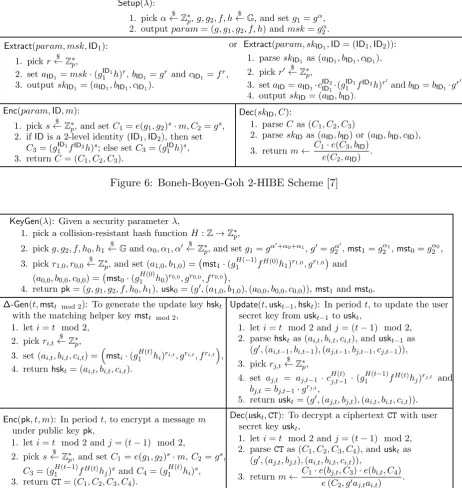
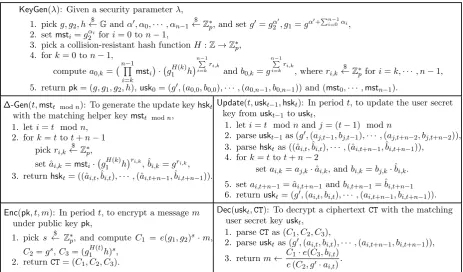
For example, our IBE-based construction from Boneh-Boyen IBE [6] yields shorter ciphertexts and cheaper cost for encryption and decryption. Furthermore, our HIBE-based construction from Boneh-Boyen-Goh HIBE [7] yields cheaper cost for ∆-Gen algorithm, and this is useful when a helper is a cheap device, e.g. a smart card. It should be also noticed that in terms of computational cost for ∆-Gen, our Boneh-Boyen-Goh-based scheme is more efficient than both the LQY scheme and our Boneh-Boyen-based scheme, and this implies that our HIBE-based generic construction is still useful despite of existence of our IBE-based generic construction.
We remark that, in this subsection, we shall only present the CPA-secure instantiations, since their CCA-security can be achieved by applying the generic techniques in [10, 15] or the direct technique in [11].
In the rest of this paper, we shall use the bilinear groups (G,GT) with prime order p≥2λ,
whereλis the security parameter, and there exists a bilinear map e:G×G→GT.
4.2.1 Efficient Instantiation from Boneh-Boyen IBE
LQY scheme is based on Boneh-Boyen IBE scheme [6] which is reviewed in Figure 4. Interest-ingly, when our IBE-based generic construction is instantiated with Boneh-Boyen IBE scheme, we can make use of its algebraic property to obtain a PKIE scheme more efficient than LQY scheme.
Setup(λ):
1. pickα←$ Z∗p,g, g2, h $
←G, and setg1=gα, 2. outputparam= (g, g1, g2, h) andmsk=gα2.
Extract(param, msk,ID):
1. pickr←$ Z∗p,
2. outputskID= (aID, bID) = (
msk·(gID
1 h)r, gr
)
.
Enc(param,ID, m):
1. picks←$ Z∗p,
2. computeC1=e(g1, g2)s·m, C2=gsandC3= (gID1 h)s, 3. returnC= (C1, C2, C3).
Dec(skID, C):
1. parseC as (C1, C2, C3) andskIDas (aID, bID),
2. returnm←C1·e(C3, bID) e(C2, aID)
.
Figure 4: Boneh-Boyen IBE scheme [6]
Our concrete PKIE scheme consists of two Boneh-Boyen IBE systems, which share the same the public parameters g, g2 and h. The master secret keys of the two systems aremst1=
gα1
2 and mst0 = g2α0 respectively, which act as the two helper keys for the PKIE scheme and alternately update the user secret keys. It is worth noting that, Boneh-Boyen IBE system has a distinguished aggregation property, i.e., a product of secret keys for the same ID under different master keys also works as the secret key for that ID under another master key (which is the product of these underlying master keys). Based on this observation, we product the parameters (i.e., gα1 and gα0) of the two systems into a single g
1 = gα1+α0 (this parameter will be further changed, which will be clear later). Also, two secret keys for the same identity are aggregated into a single one. For example, in the initial user secret key usk0, the secret key (mst1·(gH1 (0)h)r1,0, gr1,0
)
, generated by the master secret key mst1 for identity “0”, and the secret key (mst0·(g1H(0)h)r0,0, gr0,0
)
, generated bymst0 for identity “0”, are integrated into (a0,0, b0,0) =
(
mst1mst0·(g1H(0)h)r1,0+r0,0, gr1,0+r0,0 )


![Figure 4: Boneh-Boyen IBE scheme [6]](https://thumb-us.123doks.com/thumbv2/123dok_us/1870821.1243430/16.595.75.530.443.552/figure-boneh-boyen-ibe-scheme.webp)

![Table 1: Comparisons between our concrete schemes and LQY schemes [36]](https://thumb-us.123doks.com/thumbv2/123dok_us/1870821.1243430/28.595.73.524.211.312/table-comparisons-concrete-schemes-lqy-schemes.webp)