Rebound Attack on the Full Lane Compression
Function
?Krystian Matusiewicz1, María Naya-Plasencia2, Ivica Nikoli¢3,
Yu Sasaki4, and Martin Schläer5
1 Department of Mathematics, Technical University of Denmark, Denmark 2 INRIA project-team SECRET, France
3 University of Luxembourg, Luxembourg 4 NTT Corporation, Japan
5 IAIK, Graz University of Technology, Austria
[email protected],[email protected], [email protected],[email protected],
Abstract. In this work, we apply the rebound attack to the AES based SHA-3 candidate Lane. The hash function Lane uses a permutation based compression function, consisting of a linear message expansion and 6 parallel lanes. In the rebound attack on Lane, we apply several new techniques to construct a collision for the full compression function of Lane-256 and Lane-512. Using a relatively sparse truncated dieren-tial path, we are able to solve for a valid message expansion and collid-ing lanes independently. Additionally, we are able to apply the inbound phase more than once by exploiting the degrees of freedom in the parallel AES states. This allows us to construct semi-free-start collisions for full Lane-256 with296 compression function evaluations and288 memory,
and for full Lane-512 with2224 compression function evaluations and
2128memory.
Keywords: SHA-3, LANE, hash function, cryptanalysis, rebound at-tack, semi-free-start collision
1 Introduction
In the last few years the cryptanalysis of hash functions has become an important topic within the cryptographic community. The attacks on the MD4 family of hash functions (MD5, SHA-1) have especially weakened the condence in the security of this design strategy [14,15]. Many new and interesting hash function designs have been proposed as part of the NIST SHA-3 competition [12]. The large number of submissions and dierent design strategies require dierent and improved cryptanalytic techniques as well.
?This work was supported in part by the European Commission through the ICT
programme under contract ICT-2007-216676 ECRYPT II. The authors would like to thank Janusz Szmidt and Florian Mendel for useful discussions.
At FSE 2009, Mendel et al. published the rebound attack [10] - a new tech-nique for analysis of hash functions which has been applied rst to reduced ver-sions of the Whirlpool [2] and Grøstl [4] compression functions. Recently, the rebound attack on Whirlpool has been extended in [8], which in some parts is similar to our attack. The main idea of the rebound attack is to use the available degrees of freedom in the internal state to eciently fulll the low probability parts in the middle of a dierential trail. The straight-forward application of the rebound attack to AES based constructions allows a quick and thorough analysis of these hash functions.
In this work, we improve the rebound attack and apply it to the SHA-3 can-didate Lane. The hash function Lane [5] uses an iterative construction based on the Merkle-Damgård design principle [3,11] and has been rst analyzed in [16]. The permutation based compression function consists of a linear message ex-pansion and 6 parallel lanes. The permutations of each lane are based on the round transformations of the AES. In the rebound attack on Lane, we rst search for dierences and values, according to a specic truncated dierential path. This truncated dierential path is constructed such that a collision and a valid expanded message can be found with a relatively high probability. By using the degrees of freedom in the chaining values, we are able to construct a
semi-free-start collision for the full versions of Lane-256 with 296 compression
function evaluations and memory of288, and for Lane-512 with2224
compres-sion function evaluations and memory of2128. Although these collisions on the
compression function do not imply an attack on the hash functions, they violate the reduction proofs of Merkle and Damgård, and Andreeva [1].
2 Description of Lane
The cryptographic hash function Lane [5] is one of the submissions to the NIST SHA-3 competition [12]. It is an iterated hash function that supports four digest sizes (224, 256, 384 and 512 bits) and the use of a salt. Since Lane-224 and Lane-256 are rather similar except for truncation, we write Lane-256 whenever we refer to both of them. The same holds for Lane-384 and Lane-512.
The hashing of a message proceeds as follows. First, the initial chaining value
H−1, of size 256 bits for Lane-256, and 512 bits for Lane-512, is set to an initial
value that depends on the digest sizenand the optional salt valueS. At the same
time, the message is padded and split into message blocksMi of length 512 bits
for Lane-256, and 1024 bits for Lane-512. Then, a compression function f is
applied iteratively to process message blocks one by one asHi=f(Hi−1, Mi, Ci),
where Ci is a counter that indicates the number of message bits processed so
2.1 The Compression Function
The compression function of Lane-256 transforms 256 bits (512 in the case of Lane-512) of the chaining value and 512 bits (resp. 1024 bits) of the message block into a new chaining value of 256 bits (512 bits). It uses a 64-bit counter
value Ci. For the detailed structure of the compression function we refer to
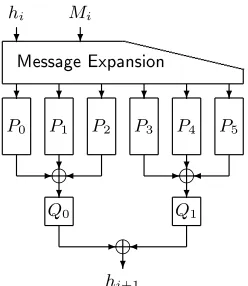
the specication of Lane [5]. First, the chaining value and the message block are processed by a message expansion that produces an expanded state with doubled size. Then, this expanded state is processed in two layers. The rst
layer is composed of six permutation lanesP0,. . . ,P5 in parallel, and the second
layer of two parallel lanesQ0, Q1.
P2
P1
P0
f f
-? -?
? ? ? ? ? ?
? ?
f
-
?
? ?
hi Mi
hi+1
P3 P4 P5
Q0 Q1
Message Expansion
Fig. 1. The compression func-tion of Lane.
function Round(r,X)
X←SubBytes(X)
X←ShiftRows(X)
X←MixColumns(X)
X←AddConstant(r,X)
X←AddCounter(r,X)
X←SwapColumns(X)
end function
Fig. 2. Pseudocode for the round transfor-mation used in the Lane permutations.
2.2 The Message Expansion
The message expansion of Lane takes a message blockMi and a chaining value
Hi−1 and produces the input to six permutationsP0,. . . ,P5. In Lane-256, the
512-bit message block Mi is split into four128-bit blocks m0, m1,m2, m3 and
the 256-bit chaining value Hi−1 is split into two 128-bit words h0, h1 as
fol-lows m0||m1||m2||m3 ← Mi, h0||h1 ← Hi−1. Then, six more 128-bit words
a0, a1, b0, b1, c0, c1 are computed
a0=h0⊕m0⊕m1⊕m2⊕m3, a1=h1⊕m0⊕m2 ,
b0=h0⊕h1⊕m0⊕m2⊕m3, b1=h0⊕m1⊕m2 ,
c0=h0⊕h1⊕m0⊕m1⊕m2, c1=h0⊕m0⊕m3 .
(1)
Each of these 128-bit values, as in AES, can be seen as 4×4 matrix of bytes.
In the following, we will use the notion x[i, j] when we refer to the byte of the
The valuesa0||a1,b0||b1,c0||c1,h0||h1,m0||m1,m2||m3become inputs to the
six permutationsP0, . . . , P5 described below. The message expansion for larger
variants of Lane is identical but all the values are doubled in size.
2.3 The Permutations
Each permutation lanePioperates on a state that can be seen as a double AES
state (2×128-bits) in the case of Lane-256 or quadruple AES state (4×128
-bits) for Lane-512. The permutation reuses the transformationsSubBytes(SB),
ShiftRows(SR) andMixColumns(MC) of the AES with the only exception, that
due to the larger state size, they are applied twice or four times in parallel. Additionally, there are three new round transformations introduced in Lane.
AddConstantadds a dierent value to each column of the lane state andAddCounter
adds part of the counterCito the state. Since our attacks do not depend on these
functions, we skip their details here. The third transformation isSwapColumns
(SC) - used for mixing parallel AES states. Letxi be a column of a lane state.
In Lane-256, SwapColumns swaps the two right columns of the left half-state
with the two left columns of the right half-state, and in Lane-512,SwapColumns
ensures that each column of an AES state gets swapped to a dierent AES state:
SC256(x0||x1||. . .||x7) =x0||x1||x4||x5||x2||x3||x6||x7
SC512(x0||x1||. . .||x15) =x0||x4||x8||x12||x1||x5||x9||x13||
x2||x6||x10||x14||x3||x7||x11||x15 .
The complete round transformation consists of the sequential application of all
these transformations in the given order. The last round omitsAddConstantand
AddCounter. Each of the permutations Pj consists of six rounds in the case of
Lane-256 and eight rounds for Lane-512.
The permutations Q0 and Q1 are irrelevant to our attack because we will
get collisions before these permutations. An interested reader can nd a detailed
description ofQ0 andQ1 in [5].
3 The Rebound Attack on Lane
In this section rst we give a short overview of the rebound attack in general and then, describe the dierent phases of the rebound attack on Lane in detail.
3.1 The Rebound Attack
The inbound phase is an ecient meet-in-the-middle phase, which exploits the available degrees of freedom in the middle of a dierential path. In the mostly probabilistic outbound phase, the matches of the inbound phase are computed backwards and forwards to obtain an attack on the hash or compression function. Usually, the inbound phase is repeated many times to generate enough starting points for the outbound phase. In the following, we describe the inbound and outbound phase of the rebound attack on Lane.
3.2 Outline of the Rebound Attack on Lane
Due to the message expansion of Lane, at least 4 lanes are active in a dierential attack. We will launch a semi-free-start collision attack, and therefore we assume
the dierences in(h0, h1)to be zero. Hence, laneP3is not active and we choose
P1 and thus, (b0, b1) to be not active as well. The active lanes in our attack
on Lane are P0, P2, P4 and P5. The corresponding truncated dierential path
for the P-lanes of Lane-256 is shown in Fig. 4. This path is very similar to the truncated dierential path for Lane-256 shown in the Lane specication [Fig. 4.2, page 33], but turned upside-down. The truncated dierential path used in the attack on Lane-512 is the same as in the Lane specication [Fig. 4.3, page 34] and shown in Fig. 5. The main idea of these paths is to use dierences in only one of the parallel AES states for the inbound phases. This allows us to use the freedom in the other states to satisfy the outpound phases. Since we search for a collision after the P-lanes, we do not need to consider the Q-lanes.
The main idea of the attack on Lane is that we can apply more than one ecient inbound phase by using the degrees of freedom and the relatively slow diusion due to the 2 (or 4) parallel AES states of Lane-256 (or Lane-512). The positions of the active bytes of two consecutive inbound phases are chosen such that when merging them, the number of the common active bytes of these phases is as small as possible. Since we can nd many independent solutions for these inbound phases, we store them in some lists to be merged. In the outbound phase of the attack we merge the results of the inbound phases and further, merge the results of all active P-lanes. Note that the merging of two lists can be done eciently. In each merging step, a number of conditions need to be fullled for the elements of the new list. We merge the lists in a clever order, such that we nd one colliding pair for the compression function at the end.
In more detail, we rst lter the results of each inbound phase for those solutions, which can connect both inbound phases (see Fig. 4). Then, we merge the resulting lists of two lanes such that we get a collision after the P-lanes, and parts of the message expansion are fullled. Finally, we lter the results of
the left P-lanes(P0, P2)and the right P-lanes(P4, P5), such that the conditions
on the whole message expansion are fullled. In the attack, we try to keep the size of the intermediate results at a reasonable size. We need to ensure, that the
complexity of generating the lists is below2n/2, but still get enough solutions in
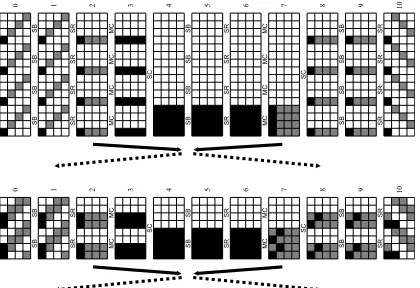
0 0 S B S B S B S B S B S B 1 1 S R S R S R S R S R S R 2 2 M C M C M C M C M C M C 3 3 S C S C 4 4 S B S B S B S B S B S B 5 5 S R S R S R S R S R S R 6 6 M C M C M C M C M C M C 7 7 S C S C 8 8 S B S B S B S B S B S B 9 9 S R S R S R S R S R S R 10 10
Fig. 3. The inbound phase for Lane-256 (left) and Lane-512 (right). Black bytes are active, gray bytes xed by solutions of the inbound phase.
3.3 The Inbound Phase
In the rebound attack on Lane, we rst apply the inbound phase for a number of times. Therefore, we will explain this phase and the corresponding probabilities in detail here. In the inbound phase, we search for dierences and values conform-ing to the truncated dierential path for Lane-256 or Lane-512 shown in Fig. 3, with active bytes marked by black bytes. We only describe the application of one inbound phase here. In the example of Fig. 3, we have 16 active S-boxes between
state #4 and state #5. It follows from the MDS property of MixColumns, that
this path has at least one active byte in each of the 4 corresponding columns
prior to the rst, and after the secondMixColumnstransformation (state #2 and
state #7). Note that the active bytes in state #2 and state #7 can also be at any position marked by gray bytes.
In the inbound phase, we rst choose random dierences for the 4 active
bytes after the secondMixColumnstransformation (state #7). These dierences
are linearly propagated backward to 16 active bytes at the output of the previous
SubByteslayer (state #5). Next, we take random dierences for the 4 active bytes
prior to the rst MixColumnstransformation (state #2) and linearly propagate
forward to 16 active bytes at the input of SubBytes (state #4). Then, we need
to nd a match for the input and output dierences of all 16 active S-boxes. For a single S-box, the probability that a random S-box dierential exists is about one half, which can be veried easily by computing the dierential distribution table of the AES S-box (see [10] for more details).
For each matching S-box, we get at least two (in some cases 4) possible
byte values such that the S-box dierential holds. Hence, we get at least 216
possible values for one full AES state, such that the dierential path for the chosen dierences in state #2 and state #7 holds. In other words, after trying
216 non-zero dierences of state #2 and state #7, we get at least216 solutions
average complexity to nd one solution for the inbound phase (dierences and values) is about 1. Note that this holds for both, Lane-256 and Lane-512.
3.4 The Outbound Phase
After we have found dierences and values for each inbound phase of the active lanes, we need to connect these results and propagate them outwards in the outbound phase. In backward direction, we need to match the message expansion at the input of each lane. In forward direction, we need to match the dierences of two P-lanes on each side to get a collision. We describe the conditions for these two parts according to our truncated dierential path in the following.
The Message Expansion. After the inbound phases, we get values and
dier-ences at the input and output of the 4 active lanesP0,P2,P4and P5. Since we
have zero dierences in(h0, h1)and(b0, b1), we get using the message expansion
for lane P1 (see Equation (1)):
∆b0= 0 =∆m0⊕∆m2⊕∆m3, ∆b1= 0 =∆m1⊕∆m2
Hence, we get the following relation for the message dierences inm0,m1,m2,
andm3:
∆m1=∆m2=∆m0⊕∆m3 (2)
Using (1) we get for the dierences in the expanded message words(a0, a1)and
(c0, c1):
∆a0=∆m1, ∆a1=∆m3, ∆c0=∆m0, ∆c1=∆m2 (3)
and thus, the following relations betweena0,a1,c0, andc1:
∆a0=∆c1=∆a1⊕∆c0 (4)
Beside the dierences, we also need to match the values of the message ex-pansion. Since we aim for a semi-free-start collision, we can freely choose the
chaining value(h0, h1)such that the conditions on(a0, a1)are satised:
h0=a0⊕m0⊕m1⊕m2⊕m3, h1=a1⊕m0⊕m2
That means we have conditions on the input(c0, c1)left, which we need to match
with the message wordsm0,m1,m2 andm3. Since we can vary lanesP0,P2and
P4,P5 independently in the following attacks, we can satisfy these conditions by
merging the results of both sides. Using the equations of the message expansion,
we get for(c0, c1)using the values of (a0, a1):
c0=a0⊕a1⊕m0⊕m2⊕m3, c1=a0⊕m1⊕m2
We can rearrange these equations in order to have all terms corresponding to
P0,P2 on the left side and all terms ofP4,P5 on the right side:
For merging the two sides, we will compute, store and compare the following values of each list:
v1=c0⊕a0⊕a1, v2=c1⊕a0, v3=m0⊕m2⊕m3, v4=m1⊕m2
Colliding P-Lanes. In the forward direction, we need to nd a collision for the
dierences inP0 andP2, such that∆P0⊕∆P2= 0and for the dierences inP4
andP5, such that∆P4⊕∆P5= 0. Note that we can swap the order of the last
MixColumnswith the XOR operation of the P-lanes since both transformations
are linear. Hence, we only need to match the dierences after the last SubBytes
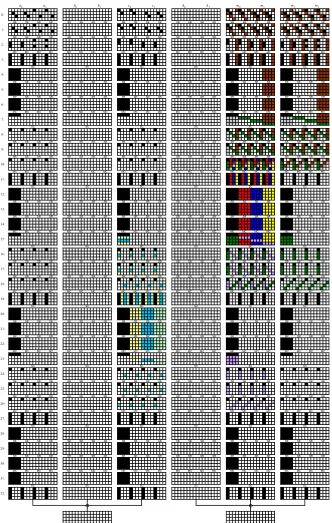
layer in each of the two active lanes. The blue bytes in Fig. 4 of Lane-256, or the red, blue and yellow bytes in Fig. 5 of Lane-512 are independent of the inbound phase. Hence, we can use the freedom in these bytes to nd a collision after the P-lanes.
4 Semi-Free-Start Collision for Lane-256
In the rebound attack on Lane-256, we construct a semi-free-start collision for
the full compression function using 296 compression function evaluations and
memory requirements of288. We will use the 6-round truncated dierential path
given in Fig. 4 which is very similar to the one shown in the Lane specication [Fig. 4.2, page 33]. We search for a collision after the P-lanes of Lane and use
the same truncated dierential path in the 4 active lanesP0,P2,P4andP5. Since
we do not consider dierences in h0 and h1, but we x their values, the result
will be a semi-free-start collision. The attack on Lane-256 consists basically of the following parts:
1. First Inbound Phase: Apply the inbound phase at the beginning of the
truncated dierential path (state #2 to state #7) for each laneP0, P2,P4,
P5 independently.
2. Second Inbound Phase: Apply the inbound phase in the middle of each lane again (state #10 to state #15).
3. Merge Inbound Phases: Merge the results of the two inbound phases (state #7 to state #10).
4. Merge Lanes: Merge the two neighboring lanesP0,P2andP4,P5and satisfy
according dierences of the message expansion.
5. Message Expansion: Merge the two sides(P0, P2)and(P4, P5)and satisfy
the remaining conditions on the message expansion (dierences and values). 6. Find Collisions: Choose remaining free values (neutral bytes) to nd a
collision for each side(P0, P2)and(P4, P5)independently.
7. Message Expansion: Merge the two sides(P0, P2)and(P4, P5)and satisfy
0:
SB SB SB SB SB SB SB SB SB SB SB SB
1:
SR SR SR SR SR SR SR SR SR SR SR SR
2:
MC MC MC MC MC MC MC MC MC MC MC MC
3:
SC SC SC SC SC SC
4:
SB SB SB SB SB SB SB SB SB SB SB SB
5:
SR SR SR SR SR SR SR SR SR SR SR SR
6:
MC MC MC MC MC MC MC MC MC MC MC MC
7:
SC SC SC SC SC SC
8:
SB SB SB SB SB SB SB SB SB SB SB SB
9:
SR SR SR SR SR SR SR SR SR SR SR SR
10:
MC MC MC MC MC MC MC MC MC MC MC MC
11:
SC SC SC SC SC SC
12:
SB SB SB SB SB SB SB SB SB SB SB SB
13:
SR SR SR SR SR SR SR SR SR SR SR SR
14:
MC MC MC MC MC MC MC MC MC MC MC MC
15:
SC SC SC SC SC SC
16:
SB SB SB SB SB SB SB SB SB SB SB SB
17:
SR SR SR SR SR SR SR SR SR SR SR SR
18:
MC MC MC MC MC MC MC MC MC MC MC MC
19:
SC SC SC SC SC SC
20:
SB SB SB SB SB SB SB SB SB SB SB SB
21:
SR SR SR SR SR SR SR SR SR SR SR SR
22:
MC MC MC MC MC MC MC MC MC MC MC MC
23:
SC SC SC SC SC SC
24:
P0 P1 P2 P3 P4 P5
a0 a1 b0 b1 c0 c1 h0 h1 m0 m1 0m20 0m30
F irs t In bound S ec ond Inbound
Find Collision Find Collision
M
er
ge
Inbound
Merge Lanes Message Expansion Merge Lanes
4.1 First Inbound Phase
We start the attack on Lane-256 by applying the rst inbound phase to each
of the 4 active lanesP0,P2,P4,P5 independently. In each lane, we start with 5
active bytes in state #2 and 8 active bytes in state #7 and choose 296 random
non-zero dierences for these 13 bytes (note that we could choose up to 2104
dierences). We propagate backward and forward to 16 active bytes at the input
(state #4) and output (state #5) of theSubBytes layer in between. We get at
least296solutions for the inbound phase with a complexity of296(see Sect. 3.3).
For each result, only the red and black bytes in Fig. 4 are determined, i.e. the dierences as well as the actual values of the bytes are found. Note that we have chosen the position of active bytes in state #0, such that at least one term of Equation (2) or (4) is zero for each byte. At this point, we can compute backwards to state #0 and independently verify the condition on one byte of the input dierences:
P0: ∆a0[0,0] =∆a1[0,0], P4: ∆m0[2,3] =∆m1[2,3]
P2: ∆c0[2,3] =∆c1[2,3], P5: ∆m2[0,0] =∆m3[0,0]
The condition on each of these bytes is fullled with a probability of2−8and we
store the 288 valid results of each lane P0, P2, P4 and P5 in the corresponding
lists L0, L2, L4 and L5. Note that we store the values and dierences of state
#10 (red and black bytes) in these lists, since we need to merge these bytes with the second inbound phase in the following. For an ecient merging step, the lists are stored in hash tables (or sorted) according to the bytes to be merged (diences and values of active bytes in state #10).
4.2 Second Inbound Phase
Next, we apply the inbound phase again to match the dierences at SubBytes
between state #12 and state #13. We start with264 dierences in the 8 active
bytes of state #10 and232dierences in the 4 active bytes of state #15. Hence,
we get about 296 solutions for the second inbound phase with a complexity of
296. For each result, the gray and black values in Fig. 4 between state #7 and
state #18 are determined. Again, this means we x the actual values of these bytes. The results of the second inbound phase for each lane are stored in lists
L00,L02,L04andL05. A node of each lists holds the values and dierences of state
#10 (gray and black bytes). Again, the lists are stored in hash tables (or sorted) according to the bytes (black bytes) to be merged.
4.3 Merge Inbound Phases
The two previous inbound phases overlap in 8 active bytes (state #7 to state #10). We connect the two inbound phases by checking the conditions on the overlapping bytes of state #10. Since both values and dierences need to match,
phase and296results of the second inbound phase to get288×296×2−128= 256
dierential paths for each lane. A pair connecting both inbound phases is found
trivially. For each node of the rst list (for exampleL0), we check the overlapping
bytes against the values of the second list (L00). Since the second list is a hash
table, the eort for producing all256 valid pairs is288 hash table lookups.
Note that for each pair which satises and connects both inbound phases, the dierences and values between state #0 and state #18 (black, red and gray
bytes) are determined. We compute and store the256input values and dierences
of state #0 in listsL0,L2,L4 andL5. Altough we still do not know half of the
state, each of these input pairs conforms to the whole truncated dierential path from state #0 to state #24 with a probability of 1. In other words, we know that in state #24, there are at most the given bytes active.
4.4 Merge Lanes
Next, we continue with merging the solutions of each lane by considering the
message expansion. We rst combine the inputs of lane P0 andP2 by merging
listsL0 andL2. When merging these lists, we need to satisfy the conditions on
the dierences of the message expansion. We have conditions on 5 active bytes
of state #0 in laneP0 andP2(see Fig. 4). Remember that we have chosen the
position of these active bytes, such that at least one term of Equation (2) or (4) is zero. Hence, we only need to check if two corresponding byte dierences are equal. Since we have already veried one byte dierence (see Sect. 4.1), we have 4 byte condition left:
∆a0[0,0] =∆c1[0,0], ∆a1[0,1] =∆c0[0,1] (6)
∆a1[1,1] =∆c0[1,1], ∆a0[2,3] =∆c0[2,3] (7)
These conditions are fullled with a probability of2−32and by merging two lists
(L0 and L2) of size256, we get 256×256×2−32 = 280 valid matches which we
store in listL02. We repeat the same for laneP4 andP5by merging listsL4and
L5. We get 280 matches for list L45 as well, since we need to fulll the 32-bit
conditions on the dierences of the following 4 bytes:
∆m1[0,0] =∆m2[0,0], ∆m0[0,1] =∆m3[0,1] (8)
∆m0[1,1] =∆m3[1,1], ∆m0[2,3] =∆m2[2,3] (9)
Again, if we use hash tables or the previous lists are sorted according to the bytes to match, the merge operation can be performed very eciently. Hence,
the total complexity to produce the listsL02andL45is determined by their nal
size and requires an eort of around 280 computations.
4.5 Message Expansion
For all entries of the listsL02 andL45, the values in 32 bytes and dierences in
black bytes in state #0 of Fig. 4). Note that the conditions on the dierences of
each side on its own have already been fullled (P0↔P2andP4↔P5). Hence,
if we just fulll the conditions on the remaining dierences between P0 ↔P4,
then the conditions on P2 ↔P5 are satised as well. Using Equations (2)-(4),
the position of active bytes in Fig. 4 and the already matched dierences of Sect. 4.1 and Sect. 4.4, we only have the following 4 byte conditions left:
∆a0[0,0] =∆m1[0,0], ∆a1[0,1] =∆m0[0,1]
∆a1[1,1] =∆m0[1,1], ∆a0[2,3] =∆m0[2,3]
Note that we also need to fulll the conditions on the values of the states.
Remember that we can freely choose the chaining values(h0, h1)to satisfy the
values in the rst 16 bytes of the message expansion(a0, a1). To fulll the
con-ditions on the 16 bytes of (c0, c1) we need to satisfy Equation (5) using the
corresponding valuesv1, v2,v3 andv4. Hence, we need to nd a match for the
following values and dierences by merging listsL02andL45:
8 bytes ofv1 fromL02withv3 fromL45,
8 bytes ofv2 fromL02withv4 fromL45,
4 bytes of dierences inL02 and in L45.
Since we have280 elements in each list and conditions on 160 bits, we expect to
nd280×280×2−160= 1result. This result satises the message expansion for
all lanes and is a solution for the truncated dierential path of each active lane between state #0 and state #24. However, we do not get a collision at the end of the P-lanes yet, since we do not know the dierences of state #24.
4.6 Find Collisions
In this phase of the attack, we search for a collision at the end of the P-lanes
(P0, P2)and(P4, P5)using the remaining freedom in the second half of the state.
Note that the 16-byte dierence in state #24 is obtained from 8-byte dierence
in state #22 with the linear transforms MixColumnsand SwapColumns. Hence,
the collision space (the 16 bytes where the two lanes dier) has only264distinct
elements. If we take a look at Fig. 4, we get for the values in state #7:
The black, red and gray bytes represent values which have already been determined by the previous parts of the attack.
The blue bytes represent values not yet determined and can be used to vary the dierences in state #22.
To nd a collision between two lanes, we can still choose264 values for the blue
bytes in state #7 of each lane and store these results in lists L0, L2, L4 and
L5. Note that for these 264 values, we get only232 dierent values for the two
free bytes in the rst and fth column of state #18. Hence, we can only iterate
through 232 dierences in state #22 for each lane. However, this is enough to
nd one colliding dierence for each side, since232×232×2−64= 1. By repeating
this step 232 times for each side, we expect264×264×2−64 = 264 results for
4.7 Message Expansion
Finally, we need to match the message expansion for the remaining 32 bytes of each side. Hence, we just repeat the same procedure as we did for the rst half of state #0, except that we only need to match the values of 32 bytes but
no dierences. Again, we can use the remaining bytes of (h0, h1) to fulll the
conditions on 16 bytes of(a0, a1). Since, we have 264 solutions in each list L02
and L45, we expect to nd264×264×2−128= 1 colliding pair for (c0, c1)and
thus, a collision for the full compression function of Lane-256.
4.8 Complexity
Let us nd the complexity of the whole attack. The rst inbound phase requires
296computations and288memory, the second inbound requires296computations
and296 memory, and the merging of the inbound phases requires288hash table
lookups and 256 memory. Obviously, the second inbound phase and the merge
inbound phases can be united to lower the memory requirement of these three
steps. Namely, we create the listsL0,L2,L4andL5in the rst inbound phase.
Then, for each dierential path of the second inbound phase, instead of storing it in a list, we immediately check if it can be merged with some dierential from the lists. Only if it can be merged, we do the outbound phase and compute state
#0. Hence, the rst three steps of our attack require around296 computations
and288 memory. The merge lanes step requires280 computations and memory.
The message expansion steps require280 computations, while the nd collisions
steps require 232 computations. Hence, the total attack complexity is around
296 computations and 288 memory. Note that the cost of each computation is
never greater than the cost of one compression function evaluation. Therefore, the complexity to nd a semi-free-start collision for all 6 rounds of Lane-256 is
about296 compression function evaluations and288memory.
5 Semi-Free-Start Collision for Lane-512
In the rebound attack on Lane-512, we construct a semi-free-start collision for
the full, 8-round compression function using 2224 compression function
evalu-ations and memory requirements of 2128. We use the same iterative truncated
dierential path as shown in the specication of Lane-512 [Fig. 4.3, page 34], which is given in Fig. 5. Similar to the attack on Lane-256, we search for a collision after the P-lanes and use the same truncated dierential path in the 4
active lanesP0,P2,P4andP5. The attack on Lane-512 consists basically of the
following parts:
1. First Inbound Phase: Apply the inbound phase at the beginning of the
truncated dierential path (state #2 to state #7) for each laneP0, P2,P4,
P5 independently.
2. Merge Lanes: Merge the two neighboring lanesP0,P2andP4,P5and satisfy
3. Message Expansion: Merge the two sides(P0, P2)and(P4, P5)and satisfy
the remaining conditions on the message expansion (dierences and values). 4. Second Inbound Phase: Apply the inbound phase in the middle of each
lane again (state #10 to state #15).
5. Merge Inbound Phases: Merge the results of the two inbound phases. 6. Starting Points: Choose random values for the brown bytes in state #7 to
get enough starting points for the subsequent phases.
7. Merge Lanes: Merge the values of the starting points for the two
neigh-boring lanes P0,P2 and P4,P5 and satisfy the according dierences of the
message expansion.
8. Message Expansion: Merge the two sides(P0, P2)and(P4, P5)and satisfy
the remaining conditions on the message expansion (dierences and values) for the starting points.
9. Third Inbound Phase: Apply the inbound phase at the end of each lane for a third time (state #18 to state #23).
10. Merge Inbound Phases: Merge the results of the three inbound phases and use the remaining freedom in between.
11. Find Collisions: Merge the corresponding two lanes to nd a collision for
each side(P0, P2)and(P4, P5)independently.
12. Message Expansion: Merge the two sides(P0, P2)and(P4, P5)and satisfy
the conditions on the message expansion of the remaining bytes.
5.1 First Inbound Phase
We start the attack on Lane-512 by applying the rst inbound phase to each
of the 4 active lanesP0,P2,P4,P5 independently. In each lane, we start with 8
active bytes in state #2 and 4 active bytes in state #7 and choose 284 random
non-zero dierences for these 12 bytes (note that we could choose up to 296
dierences). We propagate backward and forward to 16 active bytes at the input
(state #4) and output (state #5) of theSubBytes layer in between. We get at
least284matches for the inbound phase with a complexity of284(see Sect. 3.3).
For each result, the gray and black bytes in Fig. 5 are determined. Hence, we can already verify the condition on one byte of the input dierences for each lane by computing backwards to state #0:
P0:∆a0[2,2] =∆a1[2,2], P0:∆a0[2,6] =∆a1[2,6]
P2:∆c0[1,1] =∆c1[1,1], P2:∆c0[1,5] =∆c1[1,5]
P4:∆m0[1,1] =∆m1[1,1], P4:∆m0[1,5] =∆m1[1,5]
P5:∆m2[2,2] =∆m3[2,2], P5:∆m2[2,6] =∆m3[2,6]
The conditions on each of the lanes are fullled with a probability of2−16and we
store the268valid matches of each laneP
0,P2,P4 andP5 in the corresponding
5.2 Merge Lanes
Next, we continue with merging the solutions of each lane by considering the
message expansion. We rst combine the results of laneP0 and P2 by merging
listsL0 andL2. When merging these lists, we need to satisfy the conditions on
the dierences of the message expansion for the following 6 bytes:
∆a1[0,0] =∆c0[0,0], ∆a1[0,4] =∆c0[0,4]
∆a0[1,1] =∆c0[1,1], ∆a0[1,5] =∆c0[1,5]
∆a0[2,2] =∆c1[2,2], ∆a0[2,6] =∆c1[2,6]
Since this match is fullled with a probability of2−48and we merge two lists of
size268, we get268×268×2−48= 288valid matches which we store inL02. We
repeat the same for lane P4 and P5 merge listsL4 and L5. We get 288 matches
for listL45, since we need to fulll conditions on dierences of 6 bytes as well:
∆m0[0,0] =∆m3[0,0], ∆m0[0,4] =∆m3[0,4]
∆m0[1,1] =∆m2[1,1], ∆m0[1,5] =∆m2[1,5]
∆m1[2,2] =∆m2[2,2], ∆m1[2,6] =∆m2[2,6]
5.3 Message Expansion
For all entries of listsL02 and L45, the values in 32 bytes and dierences in 16
bytes of each of (a0, a1, c0, c1) and(m0, m1, m2, m3) have been xed (gray and
black bytes in state #0 of Fig. 5). Since the conditions on the dierences of each side on its own have already been fullled, we just need to match the conditions
on the remaining 6-byte dierences between each side(P0, P2)and(P4, P5):
∆a1[0,0] =∆m0[0,0], ∆a1[0,4] =∆m0[0,4]
∆a0[1,1] =∆m0[1,1], ∆a0[1,5] =∆m0[1,5]
∆a0[2,2] =∆m1[2,2], ∆a0[2,6] =∆m1[2,6]
Remember that we can freely choose the chaining values(h0, h1)to satisfy the
values in the rst 16 bytes of the message expansion(a0, a1). To fulll the
condi-tions on the 16 bytes of(c0, c1)we need to nd matches for the following values
and dierences using listsL02 andL45:
8 bytes ofv1 fromL02withv3 fromL45,
8 bytes ofv2 fromL02withv4 fromL45,
6 bytes of dierences inL02 and in L45.
Since we have288 elements in each list and conditions on 176 bits, we expect to
nd288×288×2−176= 1result. This result satises the message expansion for
5.4 Second Inbound Phase
Next, we apply the inbound phase again to match the dierences at SubBytes
between state #12 and state #13. After the rst inbound phase, the values of 16 bytes in state #10 (black and gray bytes), and the dierence in 16 bytes (1st AES-block) of state #12 (black bytes) have already been xed. Hence we can
start with 232 possible 4-byte dierences in state #15, compute backwards to
state #13 and need to match the dierences in the SubBytes layer. We expect
to nd at least232 solutions for the second inbound phase (see Sect. 3.3).
5.5 Merge Inbound Phases
The result of the second inbound phase are 232 values for the 16 bytes in state
#10 (green and black bytes). From the rst inbound phase, we have obtained one solution for 16 bytes in state #10 (gray and black bytes) as well. In these 16 bytes, the values of the 4 active bytes (black) overlap between both inbound
phases and the probability for a successful match is2−32. Among the232results
of the second inbound phase, we expect to nd one solution to match the values of state #10. Once we have found a match, we can compute the values of the newly determined 12 bytes in state #7, marked by green bytes in Fig. 5.
5.6 Starting Points
In this phase of the attack, we will compute a number of starting points which we will need for the subsequent steps. For each lane, we choose random values for the 12 bytes in state #7 (marked by brown bytes in Fig. 5) and compute
the corresponding 16-byte values in state #0. We repeat this step264times and
store the results in the corresponding listsL00,L02,L04 orL05.
5.7 Merge Lanes
Next, we merge listsL0
0 andL02 to get the listL002, consisting of2128values for
the 32 newly determined bytes of(m0, m1, m2, m3)(brown bytes of state #0 in
lane P0 and P2). Further, we merge lists L40 and L05 to get the list L045 of size
2128containing the 32 byte values of(a
0, a1, c0, c1).
5.8 Message Expansion
Finally, we satisfy the conditions of the message expansion on(a0, a1)using the
values of(h0, h1), and use the two listsL002andL045 to satisfy the conditions on
(c0, c1). Since we need to match 16 bytes of (c0, c1)and have 2128 elements in
both lists, we expect2128×2128×2−128= 2128 matching pairs which we store
5.9 Third Inbound Phase
Now, we extend the truncated dierential path by applying a third inbound phase between state #18 and state #23 for each active lane. Note that the values in 16 bytes of state #18 (black and green bytes), and the dierences in 16 bytes (1st AES-block) of state #20 (black bytes) have already been xed due to the second inbound phase. Similar to the second inbound phase, we start with
2324-byte dierences in state #23 and compute backwards to state #21 to get
a match for theSubByteslayer. Since we have232starting dierences, we expect
to nd232 results for the third inbound phase, with xed values and dierences
for the 16 bytes in state #15 (purple and black bytes).
5.10 Merge Inbound Phases
The values of the second and the third inbound phase overlap in 4 active bytes
(black) of state #18. Since we have 232 results of the third inbound phase, we
expect to nd one solution after merging the two phases. Once we have found a match, we can compute the values of the newly determined 12 bytes in state #15, marked by purple bytes in Fig. 5. Next, we need to connect all three inbound phases. For all possible 8-byte values of state #10 marked by red bytes, we compute the 16 corresponding bytes in state #15 (2nd AES-block). If the computed values satisfy the 4 bytes in state #15 marked by purple, we store
the result of each lane in the corresponding lists La
0, La2, La4 and La5. In total,
we obtain 264·2−32= 232 entries in each list. We repeat the same for the bytes
marked by blue and yellow, and generate the lists Lb
i and Lci for each of the
active lanes with index i ∈ {0,2,4,5}. For each lane, we merge the three lists
Lai,Lbi andLci and store the 296 results in listsL∗i. Note that for each entry in
these lists, we can determine all values and dierences of the corresponding lane.
5.11 Find Collisions
In this phase of the attack, we nally search for a collision at the end of the
P-lanes(P0, P2)and(P4, P5)using the elements of listsL∗i. To nd a collision at
the end of the P-lanes, we need to match the 16 byte dierences in state #32 of
the two corresponding active lanes such that∆(P0⊕P2) = 0and∆(P4⊕P5) = 0.
Note that we can satisfy these conditions independently for each side (P0, P2)
and(P4, P5). Since we need to match 128 bits and we have296elements in each
listL∗i, we expect to nd296·296·2−128= 264 collisions for each side. We store
the corresponding inputs (a0, a1, c0, c1) for the collisions between lane P0 and
P2in listL∗02and the inputs(m0, m1, m2, m3)for the collisions between laneP4
andP5in list L∗45.
5.12 Message Expansion
part of state #0, except that we only need to match the values of 32 bytes
but no dierences. Again, we use the values of(h0, h1)to satisfy the conditions
on (a0, a1) rst. Then, we match the values of the 32 bytes in (c0, c1). Since
we only have 264 entries in both of L∗
02 and L∗45, the success probability for a
match is 264·264·2−256 = 2−128. However, we can still repeat from Sect. 5.6
using a dierent starting point stored in listLs. Since we have2128elements in
listLs, we can repeat the previous steps up to2128 times. Hence, we expect to
nd one valid match for the message expansion and thus, a collision for the full compression function of Lane-512.
5.13 Complexity
The total complexity of the rebound attack on Lane-512 is determined by the
merging step after the third inbound phase. This step has a complexity of 296
compression function evaluations and is repeated 2128 times. The memory
re-quirements are determined by the largest lists, which areL002 and L045 (or Ls)
with a size of2128. Hence, the total complexity to nd a semi-free-start collision
for Lane-512 is about 2128·296 = 2224 compression function evaluations and
2128in memory.
6 Conclusion
In this work, we have applied the rebound attack to the hash function Lane. In the attack we use a truncated dierential path with dierences concentrating mostly in one part of the lanes. Due to the relatively slow diusion of parallel AES rounds, we are therefore able to solve parts of the lanes independently. First, we search for dierences and values (for parts of the state) according to the truncated dierential path and also satisfy the message expansion. Then, we choose values which can be changed such that the truncated dierential path and according message expansion still holds. The freedom in these values is then used to search for a collision at the end of the lanes without violating the dierential path or message expansion.
In the rebound attack on Lane, we are able to construct semi-free-start
col-lisions for full round Lane-224 and Lane-256 with 296 compression function
evaluations and memory of280, and for full round Lane-512 with complexity of
2224compression function evaluations and memory of2128. Although these
colli-sions on the compression function do not imply an attack on the hash functions, they violate the reduction proofs of Merkle and Damgård, or Andreeva in the case of Lane. However, due to the limited degrees of freedom, a collision attack on the hash function seems to be dicult for full round Lane.
References
2. Barreto, P.S.L.M., Rijmen, V.: The Whirlpool Hashing Function. Submitted to NESSIE, September 2000, revised May 2003. Available online at http://www.larc. usp.br/~pbarreto/WhirlpoolPage.html
3. Damgård, I.: A Design Principle for Hash Functions. In: Brassard, G. (ed.) CRYPTO. LNCS, vol. 435, pp. 416427. Springer (1989)
4. Gauravaram, P., Knudsen, L.R., Matusiewicz, K., Mendel, F., Rechberger, C., Schläer, M., Thomsen, S.S.: Grøstl a SHA-3 candidate. Available online at http://www.groestl.info (2008)
5. Indesteege, S.: The LANE hash function. Submission to NIST (2008), Available on-line at: http://www.cosic.esat.kuleuven.be/publications/article-1181.pdf 6. Knudsen, L.R.: Truncated and Higher Order Dierentials. In: Preneel, B. (ed.)
FSE. LNCS, vol. 1008, pp. 196211. Springer (1994)
7. Knudsen, L.R., Rechberger, C., Thomsen, S.S.: The Grindahl Hash Functions. In: Biryukov, A. (ed.) FSE. LNCS, vol. 4593, pp. 3957. Springer (2007)
8. Lamberger, M., Mendel, F., Rechberger, C., Rijmen, V., Schläer, M.: Rebound Distinguishers: Results on the Full Whirlpool Compression Function. In: Matsui, M. (ed.) ASIACRYPT. LNCS, Springer (2009), to appear.
9. Matusiewicz, K., Naya-Plasencia, M., Nikoli¢, I., Sasaki, Y., Schläer, M.: Re-bound Attack on the Full LANE Compression Function. In: Matsui, M. (ed.) ASI-ACRYPT. LNCS, Springer (2009), to appear
10. Mendel, F., Rechberger, C., Schläer, M., Thomsen, S.S.: The Rebound Attack: Cryptanalysis of Reduced Whirlpool and Grøstl. In: Dunkelman, O. (ed.) FSE. LNCS, vol. 5665, pp. 260276. Springer (2009)
11. Merkle, R.C.: One Way Hash Functions and DES. In: Brassard, G. (ed.) CRYPTO. LNCS, vol. 435, pp. 428446. Springer (1989)
12. National Institute of Standards and Technology: Announcing Request for Candi-date Algorithm Nominations for a New Cryptographic Hash Algorithm (SHA-3) Family. Federal Register Notice (November 2007), http://csrc.nist.gov 13. Peyrin, T.: Cryptanalysis of Grindahl. In: Kurosawa, K. (ed.) ASIACRYPT. LNCS,
vol. 4833, pp. 551567. Springer (2007)
14. Wang, X., Yin, Y.L., Yu, H.: Finding Collisions in the Full SHA-1. In: Shoup, V. (ed.) CRYPTO. LNCS, vol. 3621, pp. 1736. Springer (2005)
15. Wang, X., Yu, H.: How to Break MD5 and Other Hash Functions. In: Cramer, R. (ed.) EUROCRYPT. LNCS, vol. 3494, pp. 1935. Springer (2005)
0:
SB SB SB SB SB SB SB SB SB SB SB SB SB SB SB SB SB SB SB SB SB SB SB SB 1:
SR SR SR SR SR SR SR SR SR SR SR SR SR SR SR SR SR SR SR SR SR SR SR SR 2:
MC MC MC MC MC MC MC MC MC MC MC MC MC MC MC MC MC MC MC MC MC MC MC MC 3:
SC SC SC SC SC SC
4:
SB SB SB SB SB SB SB SB SB SB SB SB SB SB SB SB SB SB SB SB SB SB SB SB 5:
SR SR SR SR SR SR SR SR SR SR SR SR SR SR SR SR SR SR SR SR SR SR SR SR 6:
MC MC MC MC MC MC MC MC MC MC MC MC MC MC MC MC MC MC MC MC MC MC MC MC 7:
SC SC SC SC SC SC
8:
SB SB SB SB SB SB SB SB SB SB SB SB SB SB SB SB SB SB SB SB SB SB SB SB 9:
SR SR SR SR SR SR SR SR SR SR SR SR SR SR SR SR SR SR SR SR SR SR SR SR 10:
MC MC MC MC MC MC MC MC MC MC MC MC MC MC MC MC MC MC MC MC MC MC MC MC 11:
SC SC SC SC SC SC
12:
SB SB SB SB SB SB SB SB SB SB SB SB SB SB SB SB SB SB SB SB SB SB SB SB 13:
SR SR SR SR SR SR SR SR SR SR SR SR SR SR SR SR SR SR SR SR SR SR SR SR 14:
MC MC MC MC MC MC MC MC MC MC MC MC MC MC MC MC MC MC MC MC MC MC MC MC 15:
SC SC SC SC SC SC
16:
SB SB SB SB SB SB SB SB SB SB SB SB SB SB SB SB SB SB SB SB SB SB SB SB 17:
SR SR SR SR SR SR SR SR SR SR SR SR SR SR SR SR SR SR SR SR SR SR SR SR 18:
MC MC MC MC MC MC MC MC MC MC MC MC MC MC MC MC MC MC MC MC MC MC MC MC 19:
SC SC SC SC SC SC
20:
SB SB SB SB SB SB SB SB SB SB SB SB SB SB SB SB SB SB SB SB SB SB SB SB 21:
SR SR SR SR SR SR SR SR SR SR SR SR SR SR SR SR SR SR SR SR SR SR SR SR 22:
MC MC MC MC MC MC MC MC MC MC MC MC MC MC MC MC MC MC MC MC MC MC MC MC 23:
SC SC SC SC SC SC
24:
SB SB SB SB SB SB SB SB SB SB SB SB SB SB SB SB SB SB SB SB SB SB SB SB 25:
SR SR SR SR SR SR SR SR SR SR SR SR SR SR SR SR SR SR SR SR SR SR SR SR 26:
MC MC MC MC MC MC MC MC MC MC MC MC MC MC MC MC MC MC MC MC MC MC MC MC 27:
SC SC SC SC SC SC
28:
SB SB SB SB SB SB SB SB SB SB SB SB SB SB SB SB SB SB SB SB SB SB SB SB 29:
SR SR SR SR SR SR SR SR SR SR SR SR SR SR SR SR SR SR SR SR SR SR SR SR 30:
MC MC MC MC MC MC MC MC MC MC MC MC MC MC MC MC MC MC MC MC MC MC MC MC 31:
SC SC SC SC SC SC
32:
a0 a1 b0 b1 c0 c1 h0 h1 m0 m1 0m20 0m30
Fig. 5. The truncated dierential path for 8 rounds of Lane-512. LaneP0shows