Secret Handshake:
Strong Anonymity Definition and Construction
Yutaka Kawai1, Kazuki Yoneyama1?, and Kazuo Ohta1 The University of Electro-Communications 1-5-1 Chofugaoka, Chofu-shi, Tokyo
182-8585, Japan
{kawai,yoneyama,ota}@ice.uec.ac.jp
Abstract. Secret handshake allows two members in the same group to authenticate each other secretly. In previous works of secret handshake schemes, two types of anonymities against the group authority (GA) of a groupGare discussed: 1)Even GA cannot identify members, namely nobody can identify them (No-Traceability), 2)Only GA can identify members (Traceability). In this paper, first the necessity of tracing of the identification is shown. Second, we classify abilities of GA into the ability of identifying players and that of issuing the certificate to mem-bers. We introduce two anonymitiesCo-TraceabilityandStrong Detector Resistance. When a more strict anonymity is required ever for GA, the case 2) is unfavorable for members. Then, we introduceCo-Traceability
where even ifA has GA’s ability of identifying members or issuing the certificate,Acannot trace members identification. However, if a scheme satisfies Co-Traceability, GA may be able to judge whether handshake players belong to the own group. Then, we introduce Strong Detector Resistancewhere even if an adversaryAhas GA’s ability of identifying members,Acannot make judgments whether a handshaking player be-longs toG. Additionally, we propose a secret handshake scheme which satisfies previous security requirements and our proposed anonymity re-quirements by using group signature scheme with message recovery.
keywords: secret handshake, anonymity, traceability, privacy
1 Introduction
1.1 Background
A secret handshake scheme (SHS), introduced by Balfanz et al. [3], allows two members of the same group to authenticate each other secretly, in the sense that each party reveals his affiliation information to the other only if the other party belongs to the same group. For example scenario: a CIA agent Alice wants to authenticate to Bob, but only if Bob is also
?
a CIA agent. In addition, if Bob is not a CIA agent, Alice does not want to reveal her affiliation information, whether Alice is a CIA agent or not, for Bob.
Balfanz, et al. [3] constructed a 2-party SHS by adapting the key agreement protocol of Sakai, et al. [10]. Its security rests on the hardness of the Bilinear Diffie Hellman (BDH) problem. Subsequently, Castelluccia, et al. [6] developed a more efficient 2-party SHS through the use of so-called CA-oblivious encryption. It is secure under Computational Diffie Hellman (CDH) assumption.
Both previous works satisfy the basic security properties of secret handshake system; correctness, impersonator resistance,and detector re-sistance. Recently, theunlinkabilityis added to the basic security require-ment. Unlinkability means that two occurrences of handshaking by the same party cannot be linked with each other by anyone. In [3, 6], however, the member sends one’s ID information in a handshake protocol. Thus, the construction of [3, 6] does not satisfyunlinkabilityunless members use one-time certificate (i.e. member change IDs whenever members execute handshake protocol.).
Xu and Yung [11] constructed a secret handshake scheme which achieves weaker unlinkability “k-anonymity” with reusable certificate, instead of one-time certificates. Members can reuse their certificate because they always authenticate as someone among kusers.
The work of [1] presented the first construction ofSHSwith unlinkabil-ity using reusable certificate in the standard model. The scheme in [1] al-lows each participant to specify the role and group of the other party and thus add flexibility to the authentication rules. Moreover, they achieve attribute-based secret handshakes using fuzzy identity-based-encryption.
1.2 Anonymity against Group Authority
Motivation: Let us consider the case in which whistle-blowing the system of company is troublesome. In this case the GA is a manager of company and the members are employees of the company and the authorized per-sons of the company (e.g. lawyer). When the employee uses this system, he executes a secret handshake with the lawyer in order to pass on the whistle-blowing. The employee wants to tell to only his company’s lawyer about exposure. The lawyer should only know the fact that the employee belongs to his company. In above scenario, a secret handshake scheme is very useful.
schemes, GA can identify handshake players (player’s names, IDs, etc). In this scenario, the employees, who want to exposure, want to execute a secret handshake to remain anonymous. If an employee is not guaranteed anonymity, he will not blow the whistle in the fear of the dismissal etc. However, for example in [6], a handshake player must send own ID to a handshake partner. IDs are registered to GA, when a member joins to the group. So, GA can identify handshake players by referring ID list and watching the transcript of handshake.
From the above reason, the previous schemes are not applicable to this case. So in this paper, we will define new security requirements about anonymities against GA. We introduce two new anonymities Co-Traceability and Strong Detector Resistance. Strong Detector Resistance means that even if an adversary A, who does not belong to G, has GA’s ability of identifying members,Acannot make judgments whether a hand-shaking player belongs toG.Co-Traceabilitymeans that GA alone cannot reveal members identification.
Co-Traceability can never be satisfied against GA with all of abilities, since if U belongs to G, U might be revealed identification executing a handshake protocol with a dummy member D whom GA creates using an ability to issue a user. Then, GA can identifyU by using the informa-tion of D and the ability of identifying members. Also, Strong Detector Resistance can never be satisfied against GA with all of the abilities. The reason is that if U belongs to G,U outputs accept certainly executing a handshake protocol with a dummy member D whom GA creates using an ability to issue a user.
Therefore, in order to discuss the anonymity against GA, we split the role of GA into the two; issue authority and trace authority. The issue authority (IA) issues the certificate to users. The trace authority (TA) has an ability to identify a member. Co-Traceability is defined against an adversary who has an ability of either TA or IA. Strong Detector Resis-tance is defined against an adversary who has an ability of TA.
Co-Traceability:If a secret handshake scheme adopt whistle-blowing, hand-shake players do not want to reveal own identification against even GA. However, tracing of handshake players is useful for the handshake player in case the evidence of handshaking is required.
execute a secret handshake, TA alone cannot identify Alice and Bob, but if TA cooperates with Alice, TA could identify Bob.
At the same time, in this paper, we will define this algorithm ” SHS.Co-Trace”. This new algorithm is useful in the situation which a handshake player wants to know the other handshake partner when the output of the protocol isaccept. In previous secret handshake schemes, identifications of handshake players always reveal against everyone. By usingSHS.Co-Trace, a handshake player can execute a handshake protocol hiding own identi-fication and can know the identiidenti-fication of the other handshake player by revealing own identification to TA.
Strong Detector Resistance: In previous works, in Secret Handshake sys-tem, information about the group of the player must not be leaked, if players does not belong to the same group. There are the cases that a player wants to hide the information of his own group from TA as well as members and users. If TA can know whether a handshake player be-longs to his own group G or not, GA might examine the frequency that a member of groupG executes a handshake protocol. This consideration leads to the new security property,Strong Detector Resistance.
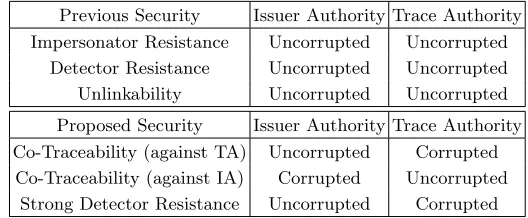
In this paper, we discuss the anonymity and groups which members belong to in the case TA or IA is corrupted. Here, “TA (IA) is corrupted” means that an adversaryAcan get a secret key of TA (IA). The levels of trust for each authority for each requirement are summarized in Table1.2.
Table 1.Levels of trust in authorities for each of security requirements Previous Security Issuer Authority Trace Authority Impersonator Resistance Uncorrupted Uncorrupted
Detector Resistance Uncorrupted Uncorrupted Unlinkability Uncorrupted Uncorrupted
Proposed Security Issuer Authority Trace Authority Co-Traceability (against TA) Uncorrupted Corrupted Co-Traceability (against IA) Corrupted Uncorrupted
Strong Detector Resistance Uncorrupted Corrupted
SHS.Co-TraceandCo-Traceabilitywith a secret key to executeSHS.Co-Trace sep-arately by GA and a handshake player.
2 Definition of Secret Handshake
2.1 Entity
In SHS, there exist three entities in the groupG as follows.
User: the entity which does not belong to the group.A /∈Gmeans that the userA does not belong to the group G.
Member: the entity which is made belong to the group, by the Group Authority.A∈Gmeans that the memberA belongs to the groupG. GA (Group Authority): the manager of a group. GA is responsible for adding users into the group he manages. GA maintains a list L, which includes certificates and registration data of all members.
2.2 The Model of Secret Handshake
A secret handshake schemeSHSconsists of the following five algorithms:
SHS.Setup: generates the public parameters paramwhich is common to all groups.
SHS.CreateGroup: generates a key pair gpk (group public key) and gsk
(private key for GA), usingparam.SHS.CreateGroupis run by GA. SHS.AddMember: is executed between a player U and a GA of some
group. Inputs ofSHS.AddMemberare gsk,param, andgpk, and out-puts are a membership certificate (certU) and a secret key (skU) SHS.Handshake: is the authentication protocol executed between U and
V, based on the public input param. The group public keys (gpkU,
gpkV) and certificates ((certU, skU), (certV, skV)) of U and V are input to handshake protocol. The result of the algorithm is either reject or accept.U Handshake←→ V means the above situation.
SHS.Trace: , given gpk,gsk and a transcriptT of the handshaking of U
andV, outputs the memberU (orV).
2.3 Security Properties of SHS scheme
– OCG(·) :This oracle, given an identity of GA, outputsgpk, gsk, namely SHS.CreateGroup.
– OAM(·,·) : This oracle, given an identity of group G and a user U, executesSHS.AddMember.
– OHS(·) :This oracle, given a member U, executes SHS.Handshake as honest membersU betweenA. The honest members executes accord-ing to the protocol.
– OCO(·) :This oracle, given a memberU, outputs U’s current internal information including secrets.
Correctness: If honest membersU,V of the same group run handshake protocol, then both players always output “accept”.
Impersonator Resistance (IR): IRdemands that the adversaryA, who does not belong to a group G, is not able to authenticate an honest who belongs toG.
Formally, we say that SHS guarantees IR if the following function AdvIRA(k) is negligible for any polynomially-bounded adversaryA.
AdvIRA(k) = Pr[ExpIRA(k) = 1]
Experiment ExpIRA(k)
param← SHS.Setup(k)
(gpk, gsk)←SHS.CreateGroup(param);
(certU, skU)←SHS.AddMember(param, gpk, gsk, U) (certV, skV)←SHS.AddMember(param, gpk, gsk, V) honest(param, gpk, skU, certU)
Handshake
←→ AO(param, gpk, cert
V) Ifhonestoutputsaccept, outputs 1.
Otherwise outputs 0.
Detector Resistance (DR): DR demands that the adversary A, who does not belong to a groupG, is not able to distinguish whether some honestis a member of some groupG.
Formally, we say that SHS guarantees DR if the following function AdvDRA (k) is negligible for any polynomially-bounded adversary A.
ExperimentExpDRA (b, k)
param← SHS.Setup(k)
(gpk, gsk)←SHS.CreateGroup(param);
(skU, certU)←SHS.AddMember(param, gpk, gsk, U) playerb:=honest(param, gpk, skU, certU);
player1−b :=SIM(param)
player0 Handshake←→ AO(param, gpk) player1 Handshake←→ AO(param, gpk)
b0← AO(param, gpk) Returnb0
Unlinkability (Unlink): Unlinkdemands that the adversaryA, who does not belong to a groupG, is not able to decried whether two executions of the handshake protocol were performed by the same party or not, even if both of them were successful.
Formally, we say thatSHSguaranteesUnlinkif the following function AdvUnlinkA (k) is negligible for any polynomially-bounded adversary A.
AdvUnlinkA (k) =Pr[ExpUnlinkA (1, k) = 1]−Pr[ExpUnlinkA (0, k) = 1]
Experiment ExpUnlinkA (b, k)
param← SHS.Setup(k)
(gpk, gsk)←SHS.CreateGruop(param); Ifb= 0 thenplayerU =playerV; OtherwiseplayerU 6= playerV; playerU Handshake←→ AO(param, gpk) playerV Handshake←→ AO(param, gpk)
b0 ← AO(param, gpk) Return b0
3 Anonymity against Group Authority
3.1 Issue authority and Trace authority
In this subsection, let us classify the GA from the view point of abilities. GA has the two abilities. First ability is to issue the certificate to users. Second ability is to trace handshake players. We call the authority with the former abilityIssue authority (IA). and the authority with the latter abilityTrace authority(TA). IA has a public and secret key (ipk, isk) and TA has a public and secret key (tpk, tsk)1.
3.2 Co-Traceability
In previous works of secret handshake schemes, two types of anonymities against the GA are discussed from the view point of revealing the identi-fication of handshake players: 1)EvenGA cannot identify players, namely nobody can identify them, 2)Only GA can identify players.
Tracing of handshake players is useful for the handshake player in case the evidence of handshaking is required. However when the anonymity is preferred as the case of prosecution from inside, a more strict anonymity is required ever for GA.
In the way of SHS.Trace, members except TA cannot join SHS.Trace process. From the view point of power of TA, this situation could be troublesome for members. Then, we introduce a new security requirement Co-Traceability. Intuitively, Co-traceability means that TA alone cannot identify handshake players.
Co-Traceability can never be satisfied against GA with all abilities, since if U belongs to G, U might be revealed identification executing a handshake protocol with a dummy memberD who GA creates using an ability to issue a user. So, two different types of adversarys, AT and AI, should be concerned. The difference betweenAT andAIis the input. The input of AT is param, gpk and tsk. The input of AI is param,gpk and
isk. The formal definition of Co-traceability is as follow:
Definition 1 (Co-Traceability).Co-Traceability (Co-Trace) means that an adversary Awho has GA’s secret key (iskortsk) cannot identify the player which execute SHS.Handshake even thoughA is not a member of
G. Formally, we say that SHSguarantees Co-Trace if the following func-tion AdvCoA−Trace(k)is negligible. Let a member which executes according to the protocol behonest. We consider a PPT adversaryAthat can access to the oracles O.
1
Formally, we say thatSHSguarantees Co-Traceif the following func-tion AdvCoA−Trace(k) is negligible for any PPT adversary A= (AT,AI).
AdvCoA−Trace(k) = Pr[ExpCoA−Trace(k) = 1]
Experiment ExpCoA−Trace(k)
param← SHS.Setup(k)
(ipk, tpk, isk, tsk)←SHS.CreateGroup(param);
(certU, skU)←SHS.AddMember(param, ipk, tpk, isk, U) honest(param, gpk, skU, certU)
Handshake
←→ AO
U0 ← AO
IfU =U0, outputs 1. Otherwise outputs 0.
3.3 Strong Detector Resistance
If a secret handshake scheme satisfies Co-Traceability, TA alone cannot identify handshake players. However, GA may be able to identify whether handshake players belong to the own group. Then, GA can know the frequency that members of own group execute handshake. In order to achieve high anonymity against GA, even the frequency of handshake should be hidden for GA.
We then introduce the concept ofStrong Detector Resistancein order to cope with this requirement. Intuitively, Strong Detector Resistance means that even if an adversaryA∈/ Ghas all the ability of revealing the identity of members, A cannot make judgment whether a handshaking player belongs to Gor not.
Strong Detector Resistance never satisfies against IA, since if U be-longs to G, U outputs accept executing a handshake protocol with a dummy member who GA creates using an ability to issue a user. The formal definition of Strong Detector Resistance is as follow:
Definition 2 (Strong Detector Resistance). Strong Detector Resis-tance (SDR) demand that an adversary A who have “the all ability of revealing the identity of members” (e.g. trace key, member-listL) cannot distinguish whether some honest player, who is a member of group G, even though A is not a member of G. SDR is easier security goal than SDR for an adversaryA.
Formally, we say that SHS guarantees SDR if the following function AdvSDRA (k) is negligible for any polynomially-bounded adversary A.
SDR has a close relationship to the SHS.Trace algorithm. If GA can re-veal an identify ID of a member [6, 3], an adversary can break SDR by executingSHS.Trace. On the other hand, ifSHSdoes not have algorithm revealing an identify [1], SDR is equivalent toDR.
Experiment ExpSDRA (b, k)
param← SHS.Setup(k)
(ipk, tpk, isk, tsk)←SHS.CreateGroup(param);
(certU, skU)←SHS.AddMember(param, ipk, tpk, isk, U) playerb :=honest(param, gpk, skU, certU);
player1−b :=SIM(param)
player0 Handshake←→ AO(param, gpk, tsk) player1 Handshake←→ AO(param, gpk, tsk)
b0 ← AO(param, gpk, tsk) Returnb0
4 Proposed Scheme
4.1 Preliminaries
Definition 3 (Bilinear map). This paper follows the notation regard-ing bilinear groups Let (G1,G2) be bilinear groups as follows:
– G1,G2 are two cyclic groups of prime orderp. – G1 is a generator of G1 and G2 is a generator of G2.
– ψis a computable isomorphism from G2 toG1, withψ(G2) =G1.
– eis a non-degenerate bilinear mape:G1×G2→GT.
– e, ψ and the group action in G1, G2 and GT can be computed effi-ciently.
In this paper, we adopt a setup algorithm Seton input a security param-eter, outputsG1 =hG1i,G2 =hG2iof prime order pthat have a bilinear
map eande(G1, G2) generatesGT.
Definition 4 (Descrete Logarithm (DL) Assumption).
For all PPT algorithmA, the following function AdvDLA (l) is negligible.
AdvDLA (l) = Pr [A(param, xP, P) =x:x∈Zp, P ∈G1]
Definition 5 (Decisional Linear Diffie-Hellman (DLDH) assump-tion [5]).
For all PPT algorithmA, the following functionAdvDLDHA (l) is negligible. Here,U, V, H, Q←RG1, a, b←Zp
AdvDLDHA (l) =|Pr [(A(param, U, V, H, aU, bV,(a+b)H) =yes]
−Pr [(A(param, U, V, H, aU, bV, Q)) =yes]|
whereparam=(p,G1,G2,GT, G1, G2, G, ψ, e)←Set(k).
4.2 Group Signature with Message Recovery (GSMR) [12]
Our proposed SHS, including SHS.Co-Trace algorithm and satisfied Co-Traceability and Strong Detector Resistance, is based on the SHS using GSMR (Group Signature with Message Recovery) [12].
A group signature, first introduce by Chaum and van Heyst [7] and followed by [2, 8], allows a member which belong to a group to sign mes-sages on behalf of the group without a member reveal own identity. In group signature system, as the same secret handshake systems, there ex-ists a manager (authority) of group. A manager, in the case of a dispute, can reveal an identity of any group signature make valid group signa-tures A standard group signature scheme involves consists of five algo-rithms GS.KeyGen, GS.Join, GS.Sign, GS.Verify, GS.Open. GS.KeyGen ,is a key generation algorithm, is given security parameter and outputs a group public key gpk and a group manager secret key gmsk. GS.Join, givengmskand a member secret keysk, outputs membership certificate. GS.Sign, given gpk, a member secret keysk and a messagem, outputs a group signature σ.GS.Verify, given gpk,m, and σ, outputs accept ifσ is valid formwith respect togpk.GS.Open, givenm, σ, andgmsk, outputs signer’s identity. The security requirements of a group signature scheme are traceability, anonymity, and non-frameability[4].
4.3 Construction of Proposed Scheme
We show the construction of proposed SHS scheme. Our GSMR scheme is based on [8]. We assume that G1 =hG1i,G2 = hG2i of prime order p
that have a bilinear mapeande(G1, G2) generatesGT. Here, (G1,G2) is bilinear groups.
SHS.Setup:Given a security parameterk, generates (p,G1,G2,GT, G1, G2, e)
and chooses hash functionsH:{0,1}∗→G1 andG :{0,1}∗→Zp. SHS.CreateGroup: First, IA chooses w ←R Zp and H ←R G1 and gen-erates W = wG2. IA outputs isk = w, ipk= (H, W). Next, TA chooses
(t, s) ←R (Zp)2 and generatesT, S such that H =sS =tT. TA outputs
tsk= (t, s), tpk= (T, S).
SHS.AddMember: First, user U, who wants to join to the group, chooses (x0, z) ←R (Zp)2 and generates H0 = x0H +zG1. U sends H0 to IA.
Next, IA chooses (x00, z0) ←R(Zp)2 and sends (x00, z0) toU. U generates
xU = x0x00+z0 and HU = xUH. U sends HU to IA. U proves in zero-knowlege to IA the knowledge of xU and x00z satisfying HU =xUH and
x00H0+z0H−HU =x00zG1. Finally, IA choosesyU ←RZp and generates
AU = w+1yU(G1−HU). IA sends (AU, yU) to U. IA adds (U, AU, yU) to the group member-list L.
GSMR(param, gpk, sk, cert, m)→σ:
1. U choosess0, t0, S0, T0, H0 s.t. s0S0 =t0T0 =H0 ((s0, t0)∈(Zp)2, (S0, T0, H0) ∈(G1)3). If U will want to executeSHS.Co-Trace,U has to memorize their parameters.
2. U chooses (α, β, α0, β0)←RZ∗pand generatesR1=αT, R2=βS, R3=
α0T0, R4 =β0S0 and R5 = (α+β)H+ (α0+β0)H0+AU
3. Uchooses (rx, ry, rα, rβ, ryα, ryβ, rα0, rβ0, ryα0, ryβ0)←R(Z∗p)10and gen-erate R01 =rαT, R02=rβS, R03 =rα0T0, R04 =rβ0S0,
R05 =e(R5, G2)rye(H, W)−(rα+rβ)e(H0, W)−(rα0+rβ0)e(H, G2)−(ryα+ryβ)+rx
e(H0, G2)−(ryα0+ryβ0), R06 = ryR1 −ryαT, R07 = ryR2 −ryβS, R08 =
ryR3−ryα0T0 and R09=ryR4−ryβ0S0
4. Ugeneratesc0 =H(param, gpk, R1, R2, R3, R4, R5, R01, R02, R03, R40, R05,
R06, R07, R08, R09) and c=c0⊕m.
5. U generates sx := rx +cxU, sy := ry +cyU, sα := rα +cα, sβ :=
rβ+cβsyα:= ryα+c(yα), syβ := ryβ+c(yβ), sα0 := rα0 +cα0, sβ0 :=
rβ0+cβ0, syα0 :=ryα0+c(yα0) andsyβ0 :=ryβ0 +c(yβ0)
6. Uoutputsσ = (R1, R2, R3, R4, R5, sx, sy, sα, sβ, syα, syβ, sα0, sβ0, syα0, syβ0, c) MR:(param, gpk, σ)→m
2. V generatesR10 =sαT−cR1, R02=sβS−cR2, R03 =sαT0−cR3, R04=
sβS0−cR4, R05 =e(R5, G2)sye(H, W)−(sα+sβ)e(H, G2)−(syα+syβ)+sx
e(H0, W)−(sα0+sβ0)e(H, G
2)−(syα0+syβ0) (
e(R5,G2)
e(G1,G2) )c
, R06 =syR1−syαT,
R07 =syR2−syβS, R08 =syR3−syα0T0,and R09 =syR4−syβ0S0 3. V generatesc0=H(param, gpk, R1, R2, R3, R4, R5, R01, R02, R03, R04, R50,
R06, R07, R08, R09) and m=c⊕c0.V outputsm.
SHS.Handshake:Suppose the memberU with certificatecertU = (AU, yU) and secret key skU = xU , and the member V with certificate certV = (AV, yV) and secret key skV =xV, engage in handshake protocol.
1. U and V generates (s0U, tU0 , SU0 , TU0, HU0 ), (s0V, t0V, S0V, TV0, HV0 ) s.t.s0USU =t0UT =HU0 , s0VSV =t0VT =HV0
(s0U, t0U, s0V, t0V ∈(Zp)4, SU0 , TU0, HU0 , SV0 , TV0 , HV0 ∈G1). 2. U choosesrU ←RZp∗ and generatesmU :=rUG1 and
σU←GSMR(param, gpkU, skU, certU, mU).U send σU toV 3. V chooses rV ←RZp∗ and generates mV :=rVG1,
σV←GSMR(param, gpkV, skVcertV, mV) andm0U←MR(param, gpkV,
σU).V sendσV toU
4. U generatesm0V←MR(param, gpkU, σV) andrespU :=G(rUm0V, mU) and sendrespU toV.
5. V generates respV := G(rVm0U, mV). If respU = G(rVm0U, m0U), V outputsacceptand sendrespV toU. OtherwiseV outputsreject. 6. If respV = G(rUmV0 , m0V), U outputs accept. Otherwise U outputs
reject.
SHS.Co-Trace:Suppose the member U withcertU = (AU, yU), secret key
skU =xU, and the parameters (s0U, t0U, SU0 , TU0, HU0 ) used inSHS.Handshake. 1. TA is givencertU = (AU, yU), skU =xU fromU.
Ife(A, W)e(H, G2)xe(A, G2)y =e(G1, G2), TA executes the following.
Otherwise TA outputs⊥.
2. TA is givenσV(=RV1, RV2, RV3, RV4, RV5, sV x, sV y, sV α, sV β, sV yα,
sV yβ, sV α0, sV β0, sV yα0, sV yβ0, cV) (in the transcript ofSHS.Handshake) and computesRV5−(tRV1sRV2+t0RV3s0RV4) =AV and outputs V such that (V, AV, yV)∈ L.
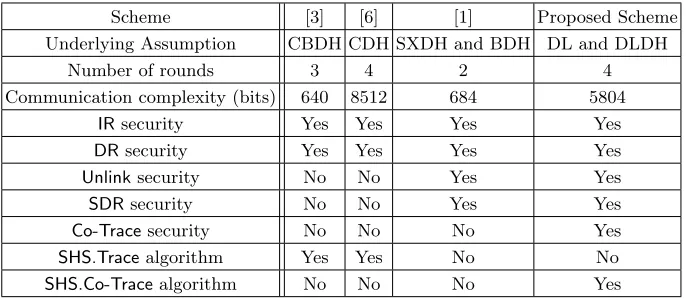
Among SHS, we show the comparisons with respect to important factors in Table4.3. [3], [1] and proposed scheme use bilinear maps. We assume that G1 6=G2 such that the representation of G1 can be a 172-bit prime
proposed scheme, a member has own ID. On the other hand, in [1], a member does not have ID, so [1] can not include both SHS.Trace and SHS.Co-Trace.
Table 2.Comparison amongSHS
Scheme [3] [6] [1] Proposed Scheme Underlying Assumption CBDH CDH SXDH and BDH DL and DLDH
Number of rounds 3 4 2 4
Communication complexity (bits) 640 8512 684 5804
IRsecurity Yes Yes Yes Yes
DRsecurity Yes Yes Yes Yes
Unlinksecurity No No Yes Yes
SDRsecurity No No Yes Yes
Co-Tracesecurity No No No Yes
SHS.Tracealgorithm Yes Yes No No
SHS.Co-Tracealgorithm No No No Yes
Our proposed scheme is secure under discrete logarithm assumption and Decisional Linear Diffie-Hellman (DLDH) assumption[5].
Theorem 1. The proposed scheme has Impersonator Resistance prop-erty, if the discrete logarithm problem is hard to solve.
Theorem 2. The proposed scheme has Strong Detector Resistance, Un-linkability and Co-Traceability property, if the Decisional Linear Diffie-Hellman (DLDH) problem is hard to solve.
References
1. G. Ateniese, M. Blanton, and J. Kirsch. Secret handshakes with dynamic and fuzzy matching. InNetwork and Distributed System Security Symposium, 2007. 2. G. Ateniese, J. Camenisch, M. Joye, and G. Tsudik. A practical and provably
secure coalition-resistant group signature scheme. In Advances in Cryptology CRYPTO2000, volume 1880 of LNCS, pages 255–270. Springer, 2000.
3. D. Balfanz, G. Durfee, N. Shankar, D.K. Smetters, J. Staddon, and H. C. Wong. Secret handshakes from pairing-based key agreements. In IEEE Symposium on Security and Privacy, 2003, pages 180–196. IEEE Computer Society, 2003. 4. M. Bellare, H. Shi, and C. Zhang. Foundations of group signatures: The case of
5. D. Boneh, X. Boyen, and H. Shacham. Short group signatures. In Advances in Cryptology Crypto 2004, volume 3152 of LNCS, pages 41–55. Springer, 2004. 6. C. Castelluccia, S. Jarecki, and G. Tsudik. Secret handshakes from ca-oblivious
encryption. InAdvances in Cryptology ASIACRYPT2004, volume 3329 of LNCS, pages 293–307. Springer, 2004.
7. D. Chaum and E. Van Heyst. Group signatures. InAdvances in Cryptology EU-ROCRYPT 1991, volume 265 of LNCS, pages 257–265. Springer, 1991.
8. J. Furukawa and H. Imai. An efficient group signature scheme from bilinear maps. InInformation Security And Privacy, ACISP 2005, volume 3574 of LNCS, pages 455–467. Springer, 2005.
9. D. Pointcheval. Security arguments for digital signatures and blind signatures. In
Journal of Cryptology, volume 13, pages 361–396. Springer, 2000.
10. R. Sakai, K. Ohgishi, and M. Kasahara. Cryptosystems based on pairing. Inthe Symposium on Cryptography and Information Security , SCIS 2000, 2000. 11. S. Xu and M. Yung. k-anonymous secret handshakes with reusable credentials.
In Proceedings of the 11th ACM conference on Computer and communications security, pages 158–167. ACM, 2004.
12. Takeshi Yamashita and Misuru Tada. How to construct secret handshake schemes (in japanese). InComputer Security Symposium 2007, CSS2007, pages 321–326, 2006.
A Security Proof
Theorem 1.The proposed scheme has Impersonator Resistance property, if the discrete logarithm problem is hard to solve.
Proof.We show that if there exists an adversaryAbreaks Imperson-ator Resistance, then an algorithmBwhich solves the discrete logarithm problem can be constructed usingAas a black-box. We show the descrip-tion ofB as follow:
AlgorithmBis given (param, H, Y =xUH). First,Bgenerates (isk, ipk) = (w,(H, W = wG2)) s.t. w ∈ Zp, H ∈ G1 and (tsk, tpk) = ((s, t),(S, T)) s.t. s, t∈Zp, sS =tT =H ∈G1 according toSHS.CreateGroup. Next, B generates a member-listL.Bchooses (xU, yU, yV)←R(Zp)3and (xi, yi)←R (Zp)2(i= 1, ..., n) and generatesAU = w+1yU(G1−xUH), AV = w+1yV(G1−
Y), andAi = w+1yi(G1−xiH).Badds (i, Ai, yi)(i= 1, ..., n), (U, AU, yU), and (V, AV, yV)to L. Also B generates a list L0 including a secret key
ski =xiand an internal informationIi (e.g. random numbers which were used when a member i executed SHS.Handshake). Elements of list L0 is (i, xi, Ai, yi, Ii)(i= 1, ...n, U) and (V,⊥, AV, yV,⊥).
Ais given (param, H, W, S, T, certV(=yV, AV)) byB. WhenAaccess
OAM, OCG, OHS, OCO, random oracle OH, and random oracle OG, B behaves as follow:
– OCG: WhenAquerys an identity ofGA,BexecutesSHS.CreateGroup. – OHS: When A querys a member ID i,B executesSHS.Handshake as a member iaccording to the scheme. If (i,∗,∗)∈ L/ ,B outputs ⊥. If
Aquery V,Babort. The probability that this case occurs is 21k.
– OCO WhenAquerys a member IDi,Breturn a secret keyskiand an internal information Ii s.t. (i, xi, Ai, yi, Ii) ∈ L0. If (i, xi, Ai, yi, Ii) ∈/
L0,Breturn⊥. IfA queryV,Babort. The probability that this case
occurs is 21k.
– OH: When Aquerys (param, gpki, Ri1, ..., Ri5, R0i1, ..., R0i9),
if its query is first, B chooses c0i ←R Zp and return it to A and add (i, gpki, Ri1, ..., Ri5, R0i1, ..., R0i9, c0i) in H-List. if (i, gpki, Ri1, ..., Ri5,
R0i1, ..., R0i9, ci0)∈H-List,Breturnc0i.
– OG: WhenAquerys (M1i, M2i), if its query is first,Bchoosesrespi ←R
G1 and return it toA and add (i, respi, M1i, M2i) in G-List. If (i, respi, M1i, M2i)∈G-List,B returnrespi.
When B, as honest, executes SHS.Handshake with A, B behaves as follow:
– Bgenerates (s0B, t0B, SB0 , TB0, HB0 ) s.t.s0BSB=t0BT =HB0 . – Bchooses rU ←RZp and generates mU =rUG1 and generate
– BreceivesσA= (RA1, ..., RA5, sAx, sAy, sAα, sAβ, sAyα, sAyβ, sAα0,
sAβ0, sAyα0, sAyβ0, cA) and executesm0A←MR(param, gpk, σA).B gen-eraterespB=G(rBm0A, mB) and sends it to A.
– B receives respA = G(rAmV, mA) = G(rVm0A, m0A). (Since A can breakIR,respA=G(rAmV, mA) =G(rVm0A, m0A).)
If (rAmV, mA, respA)∈/G-Listor , (i, gpk, RA1, ..., RA5, R0A1, ..., R0A9, c0A)∈/ H-List Babort.
Then, from the Forking Lemma [9] by rewindingAand choosing other random oracle OH,B is given two set as follows:
{R1, R2, R3, R4, R5, R01, R02, R03, R04, R50, R06, R07, R08, R09,
s(1)x , s(1)y , s(1)α , s(1)β , s(1)yα, s(1)yβ, s(1)α0 , s(1)β0 , syα(1)0, s(1)yβ0, c(1)}
{R1, R2, R3, R4, R5, R01, R02, R30, R04, R50, R06, R07, R08, R09,
s(2)x , s(2)y , s(2)α , s(2)β , s(2)yα, s(2)yβ, s(2)α0 , s(2)β0 , syα(2)0, s(2)yβ0, c(2)}
such that
6
= (s(2)x , s(2)y , sα(2), s(2)β , s(2)yα, s(2)yβ, s(2)α0 , s(2)β0 , syα(2)0, s(2)yβ0, c(2)) and
R01=s(1)α T−c(1)R1 =s(2)α T−c(2)R1
R02=s(1)β S−c(1)R2 =s(2)β S−c(2)R2
R03=s(1)α T−c(1)R3 =s(2)α T−c(2)R3
R04=s(1)β S−c(1)R4 =s(2)β S−c(2)R4
R05=e(R5, G2)s (1)
y e(H, W)−(s (1)
α +s(1)β )e(H, G 2)−(s
(1)
yα+s(1)yβ)+s(1)x
e(H0, W)−(s
(1) α0+s
(1)
β0)e(H, G 2)−
(s(1)
yα0+s (1) yβ0)
(
e(R5, G2)
e(G1, G2) )c(1)
=e(R5, G2)s (2)
y e(H, W)−(s (2)
α +s(2)β )e(H, G 2)−(s
(2)
yα+s(2)yβ)+s (2) x
e(H0, W)−(s
(2) α0+s
(2)
β0)e(H, G 2)−(s
(2) yα0+s
(2) yβ0)
(
e(R5, G2)
e(G1, G2) )c(2)
R06=s(1)y R1−syα(1)T =s(2)y R1−s(2)yαT
R07=s(1)y R2−syα(1)S=s(2)y R2−s(2)yαS
R08=s(1)y R1−s(1)yαT0 =s(2)y R1−s(2)yαT0
R09=s(1)y R2−s(1)yαS0 =s(2)y R2−s(2)yαS0
then B can compute xV = s
(1) x −s(2)x
c(1)−c(2). This solves the discrete logarithm
problem.
The success probability ofBis as followes; Here,εAandεB are success probabilities of A and B, and qh is the number of query to OH. From similar discussion of [9],εB = 14ε2Aq1
h(1− 1
2k)−2k1−1.2
Theorem 2.The proposed scheme has Strong Detector Resistance, Un-linkability and Co-Traceability property, if the Decisional Linear Diffie-Hellman (DLDH) problem is hard to solve.
Lemma 1. The proposed scheme has Strong Detector Resistance prop-erty, if the Decisional Linear Diffie-Hellman (DLDH) problem is hard to solve.
An algorithmBis given (param, T0, S0, H0, aT0, bS0, Q). Here, (T0, S0, H0, aT0, bS0, Q) is DLDH instance. First,Bgenerates (isk, ipk) = (w,(H, W = wG2)) s.t. w ∈ Zp, H ∈ G1 and (tsk, tpk) = ((s, t),(S, T)) s.t.
s, t ∈ Zp, sS = tT = H ∈ G1 according to SHS.CreateGroup. B chooses (xU, yU)←R(Zp)2and (xi, yi)←R(Zp)2(i= 1, ..., n) and generatesAU =
1
w+yU(G1−xUH) andAi = 1
w+yi(G1−xiH).Badds (i, Ai, yi)(i= 1, ..., n)
and (U, AU, yU) to a member-list L. AlsoB generates a list L0 including a secret keyski =xi and an internal informationIi . Elements of listL0 is (i, xi, Ai, yi, Ii)(i= 1, ...n, U).
Ais given (param, H, W, S, T, s, t) andLbyB. WhenAaccessOAM,
OCG,OHS, random oracleOH, and random oracle OG,Bsimulates them
by the way same as the proof of IR. The method of simulatingOCO is as follows (A querysi). if i=U,B abort. If the length of ID is kbits, the probability that this case occurs is 21k. If (i, xi, Ai, yi, Ii) ∈ L0, B returns
ski, Ii. If (i, xi, Ai, yi, Ii)∈ L/ 0,B returns ⊥.
Bpicks up b←R{0,1}.B executeshandshakewith A, 1) when b= 0 asU for the first time and as SIM for the second time, 2) whenb= 1 as SIM for the first time and asU for the second time.
WhenB, ashonestU, executesSHS.HandshakewithA,Bbehaves as follow:
– Bsends (T0, S0, H0) to A and receives (TA0, SA0 , HA0) from A.
– Bchooses choosesrU ←RZp and generatesmU =rUG1. WhenB
gen-eratesσB using GSMR, B generates R3 :=aT0, R4 :=bS0, R5 = (α+
β)H+Q+AU. So,BgeneratesσB ←GSMR(param, gpk, certU, skU, mU).
Bsends it toA.
– B receives σA and executes mA0 ← MR(param, gpk, σA).B generate
respB=G(rBm0A, mB) and sends it to A. – BreceivesrespA.
WhenB, asSIM, executesSHS.HandshakewithA,Bbehaves as follow:
– B chooses (TSIM0 , SSIM0 , HSIM0 ) ←R (G1)3 and sends it to A and re-ceives (TA0, S0A, HA0 ) fromA.
– Bchooses (RSIM1, RSIM2, RSIM3, RSIM4, RSIM5, cSIM)←R(G1)6and (sSIM x, sSIM y, sSIM α, sSIM β, sSIM yα, sSIM yβ, sSIM α0, sSIM β0, sSIM yα0,
sSIM yβ0)←R(Zp)10.
Bsends it toA.
– B receives σA and executes m0A ← MR(param, gpk, σA). B chooses
A outputsb0. If (T0, S0, H0, aT0, bS0, Q) is satisfied Q = (a+b)H0, A can distinguish U and SIM, since B can completely simulate honest U. Then, if b = b0, B outputs yes, otherwise outputs no. This solves the DLDH problem.
Here,εAandεBare success probabilities ofAandB. If (T0, S0, H0, aT0, bS0, Q) is the random tuple, the probability thatb=b0is 12. Also, if (T0, S0, H0, aT0, bS0, Q) is the DLDH tuple, the probability thatb=b0 isεA+12. So, the advantage
of B isεB =εA+12 −12 −21k =εA− 1
2k. So, if εA is non-negligible,εB is
non-negligible.2
Lemma 2. The proposed scheme has Unlinkability property, if the Deci-sional Linear Diffie-Hellman (DLDH) problem is hard to solve.
Proof. We show that if there exists an adversary Abreaks Unlinkability, then an algorithmBwhich solves the DLDH problem can be constructed using Aas a black-box. We show the description of B as follow:
Algorithm B is given (param, T, S, H, aT, bS, Q). First, B generates
(isk, ipk) = (w,(H, W = wG2)) s.t. w ∈ Zp, H ∈ G1 according to
SHS.CreateGroup and tpk= (S, T) (itk is unknown by B).
Next, B generates a member-list L. B chooses (xU, yU, xV, yV) ←R (Zp)4 and (xi, yi) ←R (Zp)2(i= 1, ..., n) and generatesAi = w+1yi(G1−
xiH)(i = 1, . . . , n, U, V). B adds (i, Ai, yi)(i = 1, ..., n), (U, AU, yU) and (V, AV, yV) to a member-list L. Also B generates a list L0 including a secret key ski = xi and an internal information Ii Elements of listL0 is (i, xi, Ai, yi, Ii)(i= 1, ...n, U, V).
Ais given (param, H, W, S, T) byB. WhenAaccessOAM,OCG,OHS,
OCO random oracleOH, and random oracleOG,Bsimulates them by the way same as the proof of SDR.
Bpicks up b←R{0,1}.B executeshandshakewith A, 1) when b= 0 twice asU, 2) whenb= 1 asU for the first time and as V for the second time.
When B, as honest, executes SHS.Handshake with A, B behaves as follow: (In the following behavior, B carries out SHS.Handshake as U. When B carry it out as V, it is similar.)
– Bgenerates (s0B, t0B, SB0 , TB0, HB0 ) s.t.s0BSB=t0BT =HB0 .
– Bchooses choosesrU ←RZp and generatesmU =rUG1. WhenB
gen-eratesσB using GSMR, B generates R3 :=aT0, R4 :=bS0, R5 = (α+
β)H+Q+AU. So,BgeneratesσB ←GSMR(param, gpk, certU, skU, mU).
Bsends it toA.
– B receives σA and executes mA0 ← MR(param, gpk, σA). B generate
– BreceivesrespA.
Finally, A output b0. If b = b0, B outputs yes, otherwise outputs no. This solves the DLDH problem.
Here, εA and εB are success probabilities of A and B. By the same discussion of Lemma 1, The advantage of B is εB =εA+ 12 − 12 −21k =
εA−21k. So, if εA is non-negligible,εB is non-negligible.
2
Lemma 3. The proposed scheme has Co-Traceability property, if the De-cisional Linear Diffie-Hellman (DLDH) problem is hard to solve.
Proof.We show that if there exists an adversaryAbreaks Co-Traceability, then an algorithmBwhich solves the DLDH problem can be constructed using Aas a black-box. We show the description of B as follow:
An algorithmBis given (param, T0, S0, H0, aT0, bS0, Q). First,B gener-ates (isk, ipk) = (w,(H, W =wG2)) s.t.w∈Zp, H∈G1and (tsk, tpk) = ((s, t),(S, T)) s.t.s, t∈Zp, sS=tT =H∈G1according toSHS.CreateGroup.
Next,Bgenerates a member-listL.Bchooses (xU, yU)←R(Zp)2 and (xi, yi)←R(Zp)2(i= 1, ..., n) and generates AU = w+1yU(G1−xUH) and
Ai = w+1yi(G1−xiH).Badds (i, Ai, yi)(i= 1, ..., n) and (U, AU, yU) toL. Also,Bgenerates a list L0 including a secret keyski =xi and an internal information Ii. Elements of list L0 is (i, xi, Ai, yi, Ii)(i=1,...n,U).
A is given (H, W, S, T, w, s, t,L) by B. When A access OAM, OCG,
OHS,OCO random oracle OH, and random oracleOG,B simulates them
by the way same as the proof of SDR.
When B, as honest, executes SHS.Handshake with A, B behaves as follow:
– Bsends (T0, S0, H0) to A and receives (TA0, SA0 , HA0) from A.
– Bchooses choosesrU ←RZp and generatesmU =rUG1. WhenB
gen-eratesσB using GSMR, B generates R3 :=aT0, R4 :=bS0, R5 = (α+
β)H+Q+AU. So,BgeneratesσB ←GSMR(param, gpk, certU, skU, mU).
Bsends it toA.
– B receives σA and executes m0A ← MR(param, gpk, σA). B generate
respB=G(rBm0A, mB) and sends it to A.
– BreceivesrespA=G(rAmV, mA) =G(rVm0A, m0A).
A output (U0, AU0, yU0) ∈ L. If U0 = U, B outputs yes, otherwise outputsno. This solves the DLDH problem.