Collaborative, Privacy-Preserving Data Aggregation
at Scale
Haakon Ringberg
∗, Benny Applebaum
∗, Michael J. Freedman
∗, Matthew Caesar
†, Jennifer Rexford
∗∗
Princeton University,
†University of Illinois at Urbana-Champaign
ABSTRACT
Combining and analyzing data collected at multiple locations is critical for a wide variety of applications, such as detecting and diagnosing malicious attacks or computing an accurate estimate of the popularity of Web sites. However, legitimate concerns about privacy often inhibit participation in collaborative data-analysis systems. In this paper, we design, implement, and evaluate a practical solution for privacy-preserving collaboration among a large number of participants. Scalability is achieved through a “semi-centralized” architecture that divides responsibility between a proxy that obliviously blinds the client inputs and a database that identifies the (blinded) keywords that have values satisfying some evaluation function.
Our solution leverages a novel cryptographic protocol that prov-ably protects the privacy of both the participants and the key-words. For example, if web servers collaborate to detect source IP addresses responsible for denial-of-service attacks, our protocol would not reveal the traffic mix of the Web servers or the iden-tity of the “good” IP addresses. We implemented a prototype of our design, including an amortized oblivious transfer protocol that substantially improves the efficiency of client-proxy interactions. Our experiments show that the performance of our system scales linearly with computing resources, making it easy to improve per-formance by adding more cores or machines. For collaborative di-agnosis of denial-of-service attacks, our system can handle millions of suspect IP addresses per hour when the proxy and the database each run on two quad-core machines.
1.
INTRODUCTION
Many important data-analysis applications must combine and analyze data collected by multiple parties. Such distributed data analysis is particularly important in the context of security. For ex-ample, victims of denial-of-service (DoS) attacks know they have been attacked but cannot easily distinguish the malicious source IP addresses from the good users who happened to send legitimate requests at the same time. Since compromised hosts in a botnet often participate in multiple such attacks, victims could potentially identify the bad IP addresses if they combined their measurement data [34]. Cooperation is also useful for Web clients to recognize they have received a bogus DNS response or a forged self-signed certificate, by checking that the information they received agrees with that seen by other clients accessing the same Web site [29, 39]. Collaboration is also useful to identify popular Web content by having Web users—or proxies monitoring traffic for an entire organization—combine their access logs to determine the most fre-quently accessed URLs [1]. In this paper, we present the design, implementation, and evaluation of an efficient, privacy-preserving system that supports these kinds of data-analysis operations.
Today, these kinds of distributed data-analysis applications lack privacy protections. Existing solutions often rely on a trusted (typ-ically centralized) aggregation node that collects and analyzes the raw data, thereby learning both the identity and inputs of partici-pants. There is good reason to believe this inhibits participation. ISPs and Web sites are notoriously unwilling to share operational data with one another, because they are business competitors and are concerned about compromising the privacy of their customers. Many users are understandably unwilling to install software from Web analytics services such as Alexa [1], as such software would otherwise track and report every Web site they visit. Unfortunately, even good intentions do not necessarily translate to good security and privacy protections, only too-well demonstrated by the fact that large-scale data breaches have become commonplace [30]. As such, we believe that many useful distributed data-analysis appli-cations will not gain serious traction unless privacy can be ensured. Fortunately, many of these collaborative data-analysis applica-tions have a common pattern, such as computing set intersection, finding so-called icebergs (items with a frequency count above a certain threshold), or identifying items that in aggregate satisfy some other statistical property. We refer to this problem as
privacy-preserving data aggregation (PDA). Namely, each participantpj
has an input set of key-value tuples, hki, vi,ji, and the protocol
outputs a keykiif and only if some evaluation functionf(∀j|vi,j)
is satisfied. For example, the botnet anomaly-detection application is an instance of the iceberg problem where the goal is to detect keys that occur more than some thresholdτtimes across then par-ties. In this scenario, the keyskirefer to IP addresses, each value
vi,jis 1, andf is defined to bePnj=1vi,j ≥τ (implemented, in fact, as simply keeping a running sum per key). In other words, such a protocol performs the equivalent of a database join (union) across each participant’s input (multi)set, and outputs those IP ad-dresses that appear more thanτ times. In our system, keys can either be arbitrary-length bitstrings or can also be drawn from a limited domain (e.g., the set of valid IP addresses). However, we restrict our consideration of values to those drawn from a more re-stricted domain—such as an alphanumeric score from 1 to 10 or A to F—a limitation for privacy reasons we explain later. Thisfcould as easily perform other types of frequency analysis on keys, such as median, mode, or dynamically setting the thresholdτbased on the set of inputs—for example, if there exists some appropriate “gap” between popular and unpopular inputs—as opposed to requiringτ be set a priori and independent of the inputs.
Informally, PDA should provide two privacy properties: (1)
Key-word privacy requires that no party should learn anything aboutki
which participant. In our example of collaborating DoS victims, keyword privacy means nobody learns the identity of good IP ad-dresses or which Web sites they frequent, and participant privacy means a Web site need not worry that its mix of clients would be revealed. In our example of collaborating Web clients, the privacy guarantees mean that a Web user need not worry that other users know what Web sites he accesses, or whether he received a bo-gus DNS response or a forged certificate. We believe these privacy properties would be sufficient to encourage participants to collab-orate to their mutual benefit, without concern that their privacy (or the privacy of their clients) would be compromised. Our goal, then, is to design a system that provably guarantees these properties, yet is efficient enough to be used in practice.
Ideally, we would like a system that can handle hundreds or thou-sands of participants generating thouthou-sands of key-value tuples. Un-fortunately, fully-distributed solutions do not scale well enough, and fully-centralized solutions do not meet our privacy require-ments. Simple techniques like hashing input keys [12, 2], while efficient, cannot ensure keyword and participant privacy. In con-trast, the secure multi-party computation protocols from the cryp-tographic literature [42, 9, 25, 21, 11, 10, 20, 23, 3] would allow us to achieve our security goals, but are not practical at the scale we have in mind. [40] has a similar intent to our work, but pro-vides much weaker privacy properties (e.g., keys are known by the system) and was not evaluated in a distributed setting. Finally, few of these systems have ever been implemented [23, 13, 3], let alone operate in the real world [4] and at scale. So, a meta-goal of our work is to help bring multi-party computation to life.
In this paper, we design, implement, and evaluate a viable al-ternative: a “semi-centralized” system architecture, and associated cryptographic protocols, that provides privacy-preserving data ag-gregation without sacrificing efficiency. Rather than having a sin-gle aggregator node, the data analysis is split between two sepa-rate parties—a proxy and a database. The proxy plays the role of obliviously blinding client inputs, as well as transmitting blinded inputs to the database. The database, on the other hand, builds a table that is indexed by the blinded key. For each row of this ta-ble whose values satisfyf, the database shares this row with the proxy, who unblinds the key. The database subsequently publishes its non-blinded data for that key.
The resulting semi-centralized system provides strong privacy guarantees provided that the proxy and the database do not
col-lude. In practice, we imagine that these two components will be
managed either by the participants themselves that do not wish to see their own information leaked to others, perhaps even on a ro-tating basis, or even third-party commercial or non-profit entities tasked with providing such functionality. For example, in the case of cooperative DoS detection, ISPs like AT&T and Sprint could jointly provide the service. Or, perhaps even better, it could be of-fered by third-party entities like Google (which already plays a role in bot and malware detection [15]) or the EFF (which has funded anonymity tools such as Tor [7]), who have no incentive to col-lude. Such a separation of trust appears in several cryptographic protocols [6], and even in some natural real-world scenarios, such as Democrats and Republicans jointly comprising election boards in the U.S. political system. It should be emphasized that the proxy and database are not treated as trusted parties: we only assume that they will not collude. Indeed, jumping ahead, our protocol does not reveal sensitive information to either party.
Using a semi-centralized architecture greatly reduces operational complexity and simplifies the liveness assumptions of the system. For example, clients can asynchronously provide their key-value tuples without our system requiring any complex scheduling.
De-spite these simplifications, the cryptographic protocols necessary to provide strong privacy guarantees are still non-trivial. Specifically, our solution makes use of oblivious pseudorandom functions [27, 10, 16], amortized oblivious transfer [26, 17], and homomorphic encryption with re-randomization.
We formally prove that our system guarantees keyword and par-ticipant privacy. We first show a protocol that is robust in the
honest-but-curious model (where, informally, each party can
per-form local computation on its own view in an attempt to break pri-vacy, but still faithfully follows the protocol). Then, we show how, with a few modifications to our original protocol, to defend against
any coalition of malicious participants. In addition, the protocols
are robust in the face of collusion between either proxy/database and any number of participants.
The remainder of the paper is organized as follows. Section 2 de-fines our system goals and discusses why prior techniques are not sufficient. Section 3 describes our PDA protocols and sketches the proofs of their privacy guarantees. Section 4 describes our imple-mentation, and Section 5 evaluates its performance. We conclude the paper in Section 6.
2.
DESIGN GOALS AND STATUS QUO
This section defines our goals for practical, large-scale privacy-preserving data aggregation (PDA), and we discuss how prior pro-posals failed to meet these requirements. We then expand on our security assumptions and privacy definitions.
2.1
Design Goals
In the privacy-preserving data aggregation (PDA) problem, a col-lection of participants (or clients) may autonomously make obser-vations about values (vi) associated with keys (ki). These
observa-tions may be, for example, the fact that an IP address is suspected to have performed some type of attack (through DoS, spam, phish-ing, and so forth), or the number of participants that associate a particular credential with a server. The system jointly computes a two-column input tableT. The first column ofTis a set comprised of all unique keys belonging to all participants (the key column). The second column is comprised of a valueT[ki]that is the
aggre-gation or union of all participant’s values forki(the value column).
The system then defines a particular functionfto be evaluated over each row’s value(s). For simplicity, we focus our discussion on the simple problem of over-threshold set intersection forf: If clients’ inputs of the formhki,1iare aggregated asT[ki]←T[ki] + 1, is
T[ki]≥τ?
A practical PDA system should provide the following:
• Keyword privacy: We say a system satisfies keyword privacy
if, given the above aggregated tableT, at the conclusion of the protocol all involved parties learn only the keyskiwhose
corresponding aggregate valueT[ki] ≥ τ. In addition, we
might also have parties learn the valuesT[ki], i.e., the
en-tire value column ofT, even if the corresponding keys re-main unknown. We discuss later why we may reveal the keyless value column (a histogram of frequencies in the threshold set intersection example) in addition to those over-threshold keys.
• Participant privacy: We say a system satisfies participant privacy if, at the conclusion of the protocol, nobody can learn
the inputs{hki, vi,ji}of participantpjother thanpjhimself
is standard in secure multi-party computation; further details can be found in [14].
• Efficiency: The system should scale to large numbers of
par-ticipants, each generating and inputting large numbers of ob-servations (key-value tuples). The system should be scalable both in terms of the network bandwidth consumed (com-munication complexity) and the computational resources needed to execute the PDA (computational complexity).
• Flexibility: There are a variety of computations one might
wish to perform over each key’s valuesT[ki], other than the
sum-over-threshold test. These may include finding the max-imum value for a given key, or checking if the median of a row exceeds a threshold. Rather than design a new protocol for each functionf, we prefer to have a single protocol that works for a wide range of functions.
• Lack of coordination: Finally, the system should operate
without requiring that all participants coordinate their efforts to jointly execute some protocol at the same time, or even all be online around the same time. Furthermore, no set of participants should be able to prevent others from executing the protocol and computing their own results (i.e., a liveness property).
As we discuss next, existing approaches fail to satisfy one or more of these goals.
2.2
Limitations of Existing Approaches
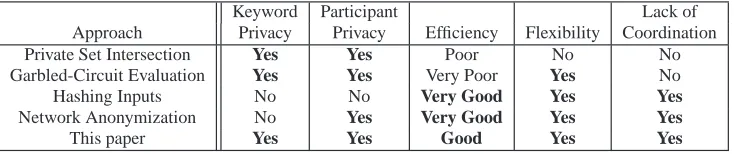
Having defined these five goals for PDA, we next consider sev-eral possible solutions from the literature. We see that prior se-cure multi-party computation protocols achieve strong privacy at the cost of efficiency, flexibility, or ease of coordination. On the other hand, simple hashing or network-layer anonymization ap-proaches fail to satisfy our privacy requirements. Our protocol, which leverages insights from both approaches, combines the best of both worlds. Table 1 summarizes the discussion in this section.
Set-Intersection Protocols. Freedman et al. [11] proposed a specially-designed secure multi-party computation protocol to compute set intersection between the input lists of two parties. It represented each party’s inputs as the roots of an encrypted nomial, and then had the other party evaluate this encrypted poly-nomial on each of its own inputs. While asymptotically optimized for this setting, a careful protocol implementation found two sets of 100 items each took 213 seconds to execute (on a 3 GHz Intel machine) [13]. Kissner and Song [20] extended and further im-proved this polynomial-based protocol for a multi-party decentral-ized setting, yet their computational complexity remainsO(nℓ2
) and communication complexity isO(n2
ℓ), wherenis the num-ber of participants andℓis the number of input elements per party. Furthermore, after a number of pairwise interactions between par-ticipants, the system needed to coordinate a group decryption pro-tocol between all parties. Hence, this prior work on set-intersection faces scaling challenges on large sets of inputs or participants, and it also requires new protocol design for each small variant of the set-intersection or threshold set-intersection protocol.
Secure Multi-Party Computations using Garbled Circuits. In
1982, Yao [42] proposed a general technique for computing any two-party computation privately, by building a “garbled circuit” in which one party encodes the function to be executed and his own input, and the other party obliviously evaluates her inputs on this
circuit. Very recently, the Fairplay system [23, 3] provided a high-level programming language for automatically compiling specified functions down into garbled circuits and generating network proto-col handlers to execute them. While such a system would provide the privacy properties we require and offer the flexibility that hand-crafted set-intersection protocols lack, this comes at a cost. These protocols are even more expensive in both computation and com-munication, requiring careful coordination as well.
Hashing Inputs. Rather than building fully decentralized protocols—with the coordination complexity and quadratic over-head (inn) this entails—we could aggregate data and compute re-sults using a centralized server. One approach is to simply have clients first hash their keys before submitting them to the server (e.g., using SHA-256), so that a server only seesH(ki), notki
it-self [2]. While it may be difficult to find a pre-image of a hash function, brute force attacks are still always possible: In our col-laborating intrusion detection application, for instance, a server can simply compute the hash values of all four billion IP addresses and build a simple lookup table. Thus, while certainly efficient, this approach fails to achieve either of our privacy properties. An al-ternative that prevents such a brute-force attack would be for all participants (clients) to coordinate and jointly agree on some secret keys, then use instead a keyed pseudorandom function on the input key, i.e.,Fs(ki). This would satisfy keyword privacy, until a single
client decides to shareswith the server, a brittle condition for sure.
Network Anonymization through Proxying. In the previous proposal, the server received inputs directly from clients. Thus, the server was always able to associate a row of the database with a particular client, whether or not its key is known. One solution would be to simply proxy a client’s request through one or more intermediate proxies that hides the client’s identity (e.g., its own IP address), as done in onion routing systems such as Tor [7]. Of course, this solution still does not achieve keyword privacy.
Although the prior approaches have their limitations, they also offer important insights that inform our design. First, a more centralized aggregation architecture avoids distributed coordination and communication overhead. Second, proxying can add partic-ipant privacy when interacting with a server. And third, a keyed pseudorandom function (PRF) can provide keyword privacy. Now, the final insight to our design is, rather than have all participants
jointly agree on the PRF secrets, let it be chosen by and remain known only to the proxy. After all, the proxy is already trusted
not to expose a client’s identity to the server (database), so let’s trust it not to expose this secretsto the database as well. Thus, prior to proxying (roughly) the tuplehFs(ki), vii, the proxy
exe-cutes a protocol with a client to blind its input keykiwithFs. This
blinding occurs in such a way that the client does not learnsand the proxy does not learnki.1 This completes the loop, having a
proxy play a role in providing both keyword and participant pri-vacy, while the database offers flexibility in any computation over a key’s valuesT[ki]and scalability through traditional replication
and data-partitioning techniques (e.g., consistent hashing [19]).
2.3
Security Assumptions and Definitions
We now motivate and clarify some design decisions related to our security assumptions and privacy definitions. Roughly speak-ing, our final protocol defends against malicious participants and non-colluding honest-but-curious databases and proxies.
1We note that oblivious pseudorandom function evaluation had
Keyword Participant Lack of Approach Privacy Privacy Efficiency Flexibility Coordination
Private Set Intersection Yes Yes Poor No No
Garbled-Circuit Evaluation Yes Yes Very Poor Yes No
Hashing Inputs No No Very Good Yes Yes
Network Anonymization No Yes Very Good Yes Yes
This paper Yes Yes Good Yes Yes
Table 1: Comparison of proposed schemes for privacy-preserving data aggregation
Honest-but-curious parties. In our model, both proxy and database are expected to act as honest-but-curious (also called
semi-honest) participants. That is, each party can perform local
computation on its own view in an attempt to break privacy, but is assumed to still faithfully follow the protocol when interacting with other parties. We believe this model is very appropriate for our semi-centralized system architecture. In many deployments, the database and proxy may be well-known and trusted to act on their good intentions to the best of their abilities, as opposed to sim-ply another participant amongst a set of mutually distrustful par-ties. Thus, other than fully compromising a server-side component and secretly replacing it with an actively malicious instance, data breaches are not possible in this model, as participants never see privacy-comprising data in the first place. In addition, the honest-but-curious model is one of the two standard security models in multi-party computation protocols—the other being the (obviously stronger) assumption of full malicious behavior. Unfortunately, se-curity against fully malicious behavior comes at a great cost, as each party needs to prove at each step of the protocol that it is faith-fully obeying it. For example, the proxy would need to prove that it does not omit any submitted inputs while proxying, nor falsely open blinded keys at the end of the protocol; the database would need to prove that it faithfully aggregates submitted values, and doesn’t omit any rows inTthat satisfyf. These proofs, typically done in zero-knowledge, greatly complicate the protocol and im-pact efficiency.
We will, however, present a protocol that is robust against any coalition of malicious participants. After all, the same trust as-sumptions that hold for the proxy and database does not extend to the potentially large number of participants.
Security against coalitions. Another important aspect of secu-rity is the ability to preserve privacy even when several adversarial players try to break security by sharing the information they gained during the protocol. In this aspect, we insist on providing security against any coalition of an arbitrary number of participants together with the database. This is essential as otherwise the database can perform a Sybil attack [8], i.e., create many dummy participants and use their views, together with his own view, to reveal sensitive information. Similarly, we require security against any coalition of the proxy and the participants. On the other hand, in order to have an efficient and scalable system, we are willing to tolerate vulnera-bility against a coalition of the database and the proxy, which could otherwise break participant and keyword privacy.
Releasing the value column. Our protocol releases those keys whose values satisfyf, but the database also learns the entire value column (T[ki],∀i), even though it learns no additional information
about the correspondingki’s. This asymmetric design was chosen
as revealing allT[ki]may be seen as a privacy violation.
That said, in other settings it may be acceptable to release the entire value column, so that all parties see identical information. This also serve another practical purpose, as it may be hard to fully
specifyfa priori to collecting clients’ inputs. For example, how
should an anomaly detection system choose the appropriate fre-quency thresholdτ? In some attacks, 10 observations about a par-ticular IP address may be high (e.g., suspected phishing), while in others, 1000 observations may be necessary (e.g., for bots partici-pating in multiple DoS attacks). Furthermore, a dataset may natu-rally expose a clear gap between frequency counts of normal and anomalous behavior; the very reason data operators like to “play” with raw data in the first place.
We also note that the acceptable set of input values and the sys-tem’s security assumptions has some bearing here. If the domain
Dof possible values is large, a client can try to “mark” a keyk by submitting it together with an uncommon valuew ∈ D. If a value column that somehow includeswis revealed, the client can discover other clients’ values for that same key. That said, a simi-lar problem exists when the value column is not released and one is concerned about collusions between a client and database (who can search for theT[k]that includesw). This problem does not arise when the domain is relatively small (e.g., when values are grades over some limited scale).
We mention that this asymmetry and/or security issue can be completely eliminated by first having participants encrypt their val-ues under the public keys of both proxy and database, and by then using additional cryptographic protocols for the aggregation of the values. While these tools are relatively expensive, the structure of our system allows us to employ them only for the two-party case (for the proxy and database) which results in a significant efficiency improvement over other more distributed solutions.
3.
OUR PDA PROTOCOL
In this section, we describe our protocol and analyze its secu-rity. Section 3.1 describes a simplified version of the protocol that achieves somewhat weaker security properties. This version will be extended to support a stronger notion of security in Section 3.2. Our protocol employs several standard cryptographic tools (e.g., public-key encryption schemes, pseudorandom functions, and the oblivious evaluation of a pseudorandom function). We will elab-orate on these tools and suggest concrete instantiations in Sec-tion 3.3. More details about the extended protocol and sketches of formal security proofs are given in the Appendix.
3.1
The Basic Protocol
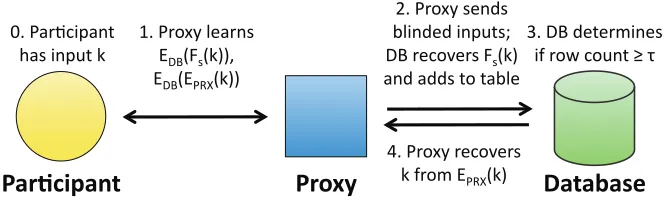
Our protocol consists of four basic steps (see Figure 1). In the first two steps, the proxy interacts with the participants to collect the blinded keys together with their associated values encrypted under the database’s public-key, and then passes these encrypted values on to the database. Then, in the third step, the DB aggre-gates the blinded keys together with the associated values in a table and decides which rows should be revealed according to a prede-fined functionf. Finally, the DB asks the proxy to unblind the cor-responding keys. Since the blinding schemeFsis not necessarily
!"#$%&'"()*
!#+,-*
.")"/"01*
!"#$%&'()*%+,# -%.#)+*/,#0#
1"#$&234#56%&+.# 789:;.:0<<=# 789:7$>?:0<<#
@"#$&234#.6+A.# B5)+A6A#)+*/,.C# 89#&6(2D6&.#;.:0<# %+A#%AA.#,2#,%B56#
E"#89#A6,6&F)+6.# )G#&2H#(2/+,#I#J#
K"#$&234#&6(2D6&.# 0#G&2F#7$>?:0<#
Figure 1: High-level system architecture and protocol.Fsis a keyed hash function whose secret keysis known only to the proxy.
• Parties: Participants, Proxy, Database.
• Cryptographic Primitives: A pseudorandom functionF, whereFs(ki)denotes the value of the function on the input
kiwith a keys. A public-key encryptionE, whereEK(x)
denotes an encryption ofxunder the public key K.
• Public Inputs: The proxy’s public keyPRX, the database’s public keyDB.
• Private Inputs. Participant: A list of key-value pairs hki, vii. Proxy: keysof PRFF and secret key forPRX;
Database: secret key forDB.
1. Each participant interacts with the proxy as follows. For each entryhki, viiin the participant’s list, the participant and the
proxy run a sub-protocol for oblivious evaluation of the PRF (OPRF). At the end of this protocol, the proxy learns nothing and the participant learns only the valueFs(ki)(and nothing
else, not even the keysof the PRF). The participant com-putes the valuesEDB(Fs(ki)),EDB(vi), andEDB(EPRX(ki)),
and it sends them to the proxy. (The last entry will be used during the revealing phase.) The proxy adds this triple to a list and waits until most/all participants send their inputs.
2. The proxy randomly permutes the list of triples and sends the result to the DB. The DB uses its private key to decrypt all the entries of each triple. Now, it holds a list of triples of the formDFs(ki), vi, EPRX(ki)
E
. The DB inserts these values into a table which is indexed by the (blinded) key Fs(ki). At the end, the DB has a table of entries of the form
D
Fs(ki),T[ki],E[ki]
E
, whereT[ki]is (in general) a list of
all thevi’s that appeared with this key (or simply the number
of times a client inputtedkiin the case of threshold set
inter-section), andE[ki]is a list of values of the formEPRX(k).
3. The DB uses some predefined functionfto partition the ta-ble into two parts:R, which consists of the rows whose keys should be revealed, andH, which consists of the rows whose keys should remain hidden. Then, it sends all the rows ofR to the proxy.
4. The proxy goes over the received tableRand replaces all the encryptedEPRX(ki)entries with their decrypted keyki. Then
it publishes the updated table.
Variants. One may consider several variants in which different information is released to the participants by the database. For example, it is possible to release only the keyskiwhich are
cho-sen by the functionfwithout the corresponding valuesT[ki]. On
the other extreme, the DB can release more data by publishing the pairs(ki,T[ki])for theki’s that are selected byf, together with
the valuesT[ki]of the keys that were not selected byf without
the corresponding keys (i.e., the entriesT[ki]of the tableH). This
might be useful to the participants and, in some scenarios, the ad-ditional information might not constitute a privacy violation (in the “real-world” sense). Consider, for example, the case where the val-ues are always one, i.e., the participants only want to increment a counter for some key. In this case, the tableRsimply consists of keys and their frequencies, andHis simply a frequency table of all the unrevealed keys.
Security Guarantees. We claim that this protocol guarantees privacy against the following attacks:
Coalition of honest-but-curious participants. Consider the view
of an honest-but-curious participant during the protocol. Due to the security of the OPRF sub-protocol, a single participant sees only a list of pseudorandom values of the formFs(ki), and therefore
it learns nothing beyond the output of the protocol (formally, this view can be easily simulated by using truly random values). The same holds for a coalition of participants.
In fact, this protocol achieves a reasonable level of security against malicious participants as well. Recall that the interaction of the proxy with a participant is completely independent of the inputs of other participants. Hence, even if the participants are malicious, they still learn nothing about the data of other honest participants. Furthermore, even malicious participants will be forced to choose their inputs independently of the inputs of other honest participants. For example, they cannot duplicate the input of some other hon-est participant. (Similar security definitions were also considered in [26, 16].) However, malicious participants can still violate the
correctness of the above protocol. This issue will be fixed in the
extended protocol.
Honest-but-curious proxy. The proxy’s view consists of three parts: (1) the view during the execution of the OPRF protocol—this gives no information due to the security of the OPRF; (2) the tuples that the participants send—these values are encrypted under the DB’s key and therefore reveal no information to the proxy; and (3) the values that the DB sends during the last stage of the protocol— these are just key-value pairs (encrypted under the proxy’s key) that should be revealed anyway, and thus they give no additional information beyond the actual output of the protocol.
Honest-but-curious coalition of proxy and participants. The
above argument generalizes to the case where the proxy colludes with honest-but-curious participants. Indeed, the joint view of such coalition reveals nothing about the inputs of the honest participants.
Honest-but-curious database. The DB sees a blinded list of keys
encrypted under his public keyDB, without being able to relate the blinded entries to their owners. For each blinded keyFs(ki), the
DB also sees the list of its associated valuesT[ki]and encryptions
sees the output of the protocol. The valuesFs(ki)andEPRX(k)bear
no information due to the security of the PRF and the encryption scheme. Hence, the DB learns nothing but the value table of the inputs (i.e., theT[ki]’s for allki’s).2
3.2
The Full-Fledged Protocol
In the following, we describe how to immunize the basic protocol against stronger attacks.
Honest-but-curious coalition of participants and database. A careful examination of the previous protocol shows that it is vul-nerable against such coalitions for two main reasons.
First, a participant knows the blinded versionFs(ki)of its own
keyski, and, in addition, the DB can associate all the valuesT[ki]
to their blinded keysFs(ki). Hence, a coalition of a participant and
a DB can retrieve all the valuesT[ki]that are associated with a key
kithat the participant holds, even if this key should not be revealed
according tof. To fix this problem, we modify the first step of the protocol. Instead of using an OPRF protocol, we will use a different sub-protocol in which the participant learns nothing and the proxy learns the valueEDB(Fs(ki))for eachki. This solves the problem
as now that participant himself does not know the blinded version of his own keys. To the best of our knowledge, this version of encrypted-OPRF protocol (abbreviated EOPRF) has not appeared in the literature before. Fortunately, we are able to construct such a protocol by carefully modifying the OPRF construction of [10] and combining it with El-Gamal encryption (see Section 3.3).
Second, we should eliminate subliminal channels, as these can be used by participants and the database to match the keys of a par-ticipant to their blinded versions (that were forwarded to the DB by the proxy). Indeed, public-key encryption schemes use randomness (in addition to the public key) to encrypt a message, and this ran-domness can be used as a subliminal channel. To solve this prob-lem, we use an encryption scheme that supports re-randomization of ciphertexts; that is, given an encryption ofxwith randomnessb, it should be possible to recompute an encryption ofyunder fresh randomnessb′
(without knowing the private key). Now we elimi-nate the subliminal channel by asking the proxy to re-randomize the ciphertexts—EDB(Fs(ki)), EDB(vi), and EDB(EPRX(ki))—which
are encrypted under the DB’s public key (at Step 1). Furthermore, we should be able to re-randomize the internal ciphertextEPRX(ki)
of the last entry as well (we will show that this can be achieved through variant of El-Gamal encryption).
A coalition of malicious participants. As we already observed,
malicious participants can violate the correctness of our protocol. Specifically, they might try to submit ill-formed inputs. Recall that the participant sends to the proxy triplesha, b, ci, where in an hon-est execution we havea = EDB(Fs(ki)), b = EDB(vi)andc =
EDB(EPRX(ki))for somekiandvi. However, a cheating participant
might provide an inconsistent tuple, in whicha = EDB(Fs(ki))
whilec=EDB(EPRX(k′i))for someki′6=ki. We can prevent such
an attack by asking the proxy to apply a consistency check toR in the last step of the protocol and to make sure thatEPRX(k
′
i)and
Fs(ki)match. The proxy omits all the inconstant values (if there
are any) and asks the DB to check again if the corresponding row should be revealed after the omission. (This modification suffices as long as the functionf is local, i.e., it is applied to each row separately. See appendix for more details.)
Another thing that a cheating participant might do is to replace
2
Formally, we define a functionality in which this additional in-formation is given to the database as part of its output. See the appendix for details.
bwith some “garbage” valueb′ =E
DB(v′)for which he does not
know the plaintextv′
(while this might not seem to be beneficial in practice, we must prevent such an attack in order to meet our strong definitions of security). To prevent such attack, we ask the participant to provide a zero-knowledge proof that shows that he knows the plaintextvto which thatbdecrypts. As seen in the next section, this does not add too much overhead.
Finally, our sub-protocol for the EOPRF should be secure against malicious participants in the following sense: a malicious partici-pant should not be able to generate a blinded valueEDB(Fs(ki))
for a keykithat he does not know.
In the appendix, we show that our modifications guarantee full security against malicious participants.
3.3
Concrete Instantiation of the
Crypto-graphic Primitives
In the following section, we assume that the input keys are rep-resented bym-bit strings. We assume thatmis not very large (e.g., less than 192–256); otherwise, one can hash the input keys and ap-ply the protocol to resulting hashed values.
Public Parameters. Our implementation mostly employs Discrete-Log based schemes. In the following,gis a generator of a multiplicative groupGof prime orderpfor which the decisional Diffie-Hellman (DDH) assumption holds. We publish(g, p)during initialization and assume the existence of algorithms for multipli-cation (and thus also for exponentiation) inG. We letZpdenote the field of integers modulop, the set{0,1, . . . , p−1}with mul-tiplication and addition modulop. We will letZ∗
pdenote the
multi-plicative group of the invertible elementsZp.
El-Gamal Encryption. We will use El-Gamal encryption over the group G. The private key is a random element a fromZ∗
p,
and the public key is the pair(g, h =ga). To encrypt a message
x∈G, we choose a randombfromZ∗pand compute(gb, x·hb).
To decrypt the ciphertext (A, B), compute B/Aa = B·A−a
(where−a is the additive inverse ofa inZp). In case we wish to “double-encrypt” a messagex∈Gunder two different public-keys(g, h)and(g, h′)
, we will choose a randombfromZ∗
pand
compute(gb, x·(h·h′)b). This ciphertext as well as standard
ci-phertexts can be re-randomized by multiplying the first entry (resp. second entry) bygb′
(resp.hb′
) whereb′
is chosen randomly from
Z∗
p. Finally, a zero-knowledge proof for knowing the decryption
of a given ciphertext is described in [36]. The scheme adds only 3 exponentiations and does not increase the overall round complexity as it can be applied in parallel to the EOPRF protocol.
Naor-Reingold PRF [27]. The key s of the function Fs :
{0,1}m →Gcontainsmvalues(s
1, . . . , sm)chosen randomly fromZ∗
p. Givenm-bit stringk=x1. . . xm, the value ofFs(k)is gQxi=1si
, where the exponentiation is computed in the groupG.
Oblivious-Transfer [31, 26]. To implement the sub protocol of Step 1, we will need an additional cryptographic tool called Obliv-ious Transfer (OT). In an OT protocol, we have two parties: sender and receiver. The sender holds two strings(α, β), and the receiver has a selection bitc. At the end of the protocol, the receiver learns a
single string:αifc= 0, andβifc= 1. The sender learns nothing (in particular, it does not know the value of the selectorc).
3.3.1
The Encrypted-OPRF protocol
• Parties: Participant, Proxy.
• Inputs. Participant: m-bit stringk = (x1. . . xm); Proxy: secret keys= (s1, . . . , sm)of a Naor-Reingold PRFF.
1. Proxy choosesmrandom valuesu1, . . . , um fromZ∗pand
an additional randomr ∈ Z∗p. Then for each1 ≤i ≤m, the proxy and the participant invoke the OT protocol where proxy is the sender with inputs(ui, si·ui)and receiver uses
xias his selector bit. That is, ifxi= 0, the participant learns
uiand otherwise it learnssi·ui. The proxy also sends the
valueˆg=gr/Πui
. (These steps can be done in parallel.)
2. The participant multiplies together the values received in the OT stage. LetMdenote this value. Then, it computesˆgM = (gΠ
xi=1si)r = F
s(k)r. Finally, the participant chooses a
random elementafromZ∗pand encryptsFs(k)r under the
public key DB = (g, h)of the database. The participant sends the result(ga, F
s(k)r·ha)to the proxy.
3. The proxy raises the received pair to the power ofr′, where r′
is the multiplicative inverse ofr modulo p. It also re-randomizes the resulting ciphertext.
Correctness. Recall thatGhas a prime orderp. Hence, when the pair(ga, F
s(x)r·ha)is raised to the power ofr′ =r−
1 , the result is(gar′, Fs(k)·har
′
), which is exactlyEDB(Fs(k)). Thus,
the protocol is correct.
Privacy. All the proxy sees is the random tuple(u1, . . . , um, r) andEDB(Fs(k)r). This view gives no additional information
ex-cept ofEDB(Fs(k)). (Formally, the view can be perfectly
sim-ulated givenEDB(Fs(k)).) On the other hand, we claim that all
the participant sees is a sequence of random values and there-fore it also learns nothing. Indeed, the participant sees the vector (sx1
1 ·u1, . . . , sxmm ·um), whose entries are randomly distributed overG, as well as the valuegˆ= (g1/Πui
)r. Sinceris randomly
and independently chosen fromZ∗p, and sinceGhas a prime order p, the elementgˆis also uniformly and independently distributed overG. The protocol supports security against malicious partici-pants (in the sense that was described earlier) as long as the under-lying OT is secure against a malicious receiver.
3.3.2
Implementing Oblivious Transfer
In general, oblivious transfer is an expensive public-key opera-tion (e.g., it may take two exponentiaopera-tions per single invocaopera-tion). In the above protocol, then, we execute an OT protocol for each bit of the participants inputk(which would result, for example, in 64 exponentiations just to input a single IP address). However, Ishai et
al. [17] show how to reduce the amortized cost of OT to be as fast
as matrix multiplication. This “batch OT” protocol uses a standard OT protocol as building block. We implemented this batch OT pro-tocol on top of the basic OT propro-tocol of [26].3
3.4
Efficiency of our Protocol
In both the basic and extended protocol, the round complexity is constant, and the communication complexity is linear in the num-ber of items. The protocol’s computational complexity is domi-nated by cryptographic operations. For eachm-bit input key, we have the following amortized complexity: (1) The participant who
3The “batch OT” protocol also has a version which preserves
se-curity against a malicious receiver. This increases the number of multiplications by a multiplicative factor, but does not affect the number of expensive public-key operations.
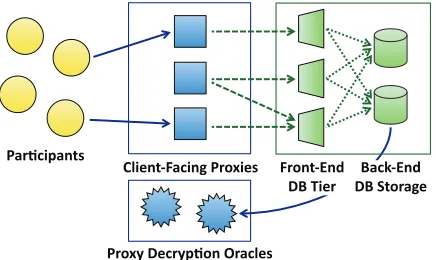
!"#$%&'"()*+
,-&.()/0"%&(1+!#23&.*+
!#234+5.%#4'$2(+6#"%-.*+
0#2()/7(8+ 59+:&.#+
9"%;/7(8+ 59+<)2#"1.+
Figure 2: Distributed proxy and database architecture
holds the input key computes 3 exponentiations in the basic proto-col (respectively 8 in the extended protoproto-col), as well asO(m) mod-ular multiplication / symmetric-key operations in both versions. (2) The proxy computes 5 exponentiations in the basic protocol (resp. 12 in the extended protocol) andO(m)modular multiplication / symmetric-key operations. (3) The database computes 3 exponen-tiations in the basic protocol (resp. 5 in the extended protocol).
4.
DISTRIBUTED IMPLEMENTATION
In our system, both the proxy and database logical components can be physically replicated in a relatively straightforward man-ner. In particular, our design can scale out horizontally to handle higher loads, by increasing the number of proxy and/or database replicas, and then distributing requests across these replicas. Our distributed architecture is shown in Figure 2. Our current imple-mentation covers all details described in the basic protocol, as well as some security improvements of the extended version (e.g., in-cluding the EOPRF, but not ciphertext re-randomization, proofs of knowledge, or the final consistency check).
4.1
Proxy: Client-Facing Proxies and
Decryp-tion Oracles
One administrative domain can operate any number of proxies. Each proxy’s functionality may be logically divided into two com-ponents: handling client requests, and serving as decryption oracles for the database when a particular key should be revealed. None of these proxies need to interact, other than having all client-facing proxies use the same secretsto key the pseudorandom functionF and all decryption-oracle proxies use the same public/private key
PRX. In fact, these two proxies play different logical roles in our system and could even be operated by two different administrative domains. In our current implementation, all proxies register with a single group membership server, although a distributed group membership service could be implemented for additional fault tol-erance [5, 41].
To discover a client-facing proxy, a client contacts this group membership service, which returns a proxy IP address in round-robin order (this could be replaced by any technique for server selection, including DNS, HTTP redirection, or a local load balancer). To submit its inputs, a client connects with this proxy and then executes an amortized Oblivious Transfer (OT) protocol on its input batch. This results in the proxy learn-ingDEDB(Fs(ki)), EDB(vi), EDB(EPRX(ki))
E
be RSA, which we use in our implementation.) When this queue reaches a certain length (10,000 in our implementation), the proxy randomly permutes (shuffles) the items in the queue, and sends them to a database server.
The database, upon determining that a keyki’s value satisfiesf,
sendsEPRX(ki)to a proxy-decryption oracle. The proxy-decryption
oracle decryptsEPRX(ki)and returnskito the database for storage
and subsequent release to other participants in the system.
4.2
Database:
Front-end Decryption and
Back-end Storage
The database component can also be replicated. Similar to the proxy, we separate database functionality into two parts: the
front-end module that handles proxy submissions and decrypts inputs,
and a back-end module that acts as a storage layer. Each logical module can be further replicated in a manner similar to the proxy.
The servers comprising the front-end database tier do not need to interact, other than being configured with the same pub-lic/private keypairDB. Thus, any front-end database can decrypt theEDB(Fs(ki))input supplied by a proxy, and the proxies can
load balance input batches across these database servers.
The back-end database storage, on the other hand, needs to be more tightly coordinated, as we ultimately need to aggregate all Fs(ki)’s together, no matter which proxy or front-end database
processed them. Thus, the back-end storage tier partitions the keyspace of all 1024-bit strings over all storage nodes (using con-sistent hashing [19]). All such front-end and back-end database instances also register with a group membership server, which the front-end servers contact to determine the list of back-end storage nodes. Upon decrypting an input, the front-end node determines which back-end storage node is assigned the resulting keyFs(ki),
and sends the tuple
D
Fs(ki), vi, EPRX(ki)
E
to this storage node. As these storage nodes each accumulate a horizontal portion of the entire tableT, they test the value column for their local table to see if any keys satisfyF. For each such row, the storage node sends the tupleDFs(ki), T[ki], EPRX(ki)
E
to a proxy-decryption oracle.
4.3
Prototype Implementation
Our design is implemented in roughly 5,000 lines of C++. All communication between system components—client, front-end proxy, front-end database, back-end database storage, and proxy-decryption oracle—is over TCP using BSD sockets. We use the GnuPG library for large numbers (bignums) and cryptographic primitives (e.g., RSA, ElGamal, and AES). The Oblivious Trans-fer protocol (and its amortized variant) were implemented from scratch, and comprised a total of 625 lines of code. All RSA en-cryption used a 1024-bit key, and ElGamal used a corresponding 1024-bit group size. AES-256 was used in the batch OT and its un-derlying OT primitive. The back-end database simply stores table rows in memory, although we plan to replace this with a durable key-value store (e.g., BerkeleyDB [28]).
5.
PERFORMANCE EVALUATION
We wish to evaluate our system along three primary dimensions. (a) Given fixed computing resources, what is the throughput of our system as a function of the size of the input set? (b) What are the primary factors limiting throughput? And, (c) how does the throughput scale with increasing computing resources? In each case, we are concerned with both (1) how long it takes for clients to send key-value pairs to the proxy during the OT phase (proxy
throughput) and (2) how long it takes for the DB to decrypt and
identify keys with values that satisfy the functionf(DB
through-put). We have instrumented our code to measure both. For a given
experiment requiring the proxy to processnkeys, proxy throughput is defined asndivided by the time it takes between when the first client contacts any client-facing proxy and when the last key is pro-cessed by some client-facing proxy. Similarly, database throughput is defined as the number of keys processed between when the first client-facing proxy forwards keys to some DB front-end and when the DB back-end storage processes the last submitted keys.
Our experiments were run on multiple machines. The servers (proxy and DB) were run on HP DL160 servers (quad-core Intel Xeon 2 GHz machines with 4 GB RAM running CentOS Linux). These machines can perform a 1024-bit ElGamal encryption in 2.2 ms, ElGamal decryption in 2.5 ms, RSA encryption in 0.5 ms, and RSA decryption in 2.8 ms. Due to a lack of homogeneous servers, the clients were run on different machines depending on the experiment. The machines used for the clients were either (A) of the same configuration as the servers, or one of either (B) Sun SunFire X4100 servers with two dual-core 2.2 GHz Opteron 275 processors (four 64-bit cores) with 16GB RAM running CentOS, or (C) Dell PowerEdge 2650 servers with two 2.2 GHz Intel Xeon processors and 5 GB of memory, also running Linux.
As noted in the introduction, our system can be used in differ-ent contexts. One of the most promindiffer-ent is that of anomaly detec-tion: specifically, networks collaborating to identify attacking IP addresses—e.g., belonging to a botnet—with greater confidence. Modern botnets can range up to roughly 100,000 unique hosts [32], and we would like our system to be able to correlate suspicions of hundreds of participating networks within some numbers of hours. In order to support such a usage scenario, our implementation will need to be able to process millions of keys in the span of hours or many hundreds of keys per second. We will revisit the feasibil-ity of our implementation for our supporting applications in Sec-tion 5.2, but these numbers should provide rough expectaSec-tions for the throughput numbers to be presented in Section 5.1.
5.1
Scaling and Bottleneck Analysis
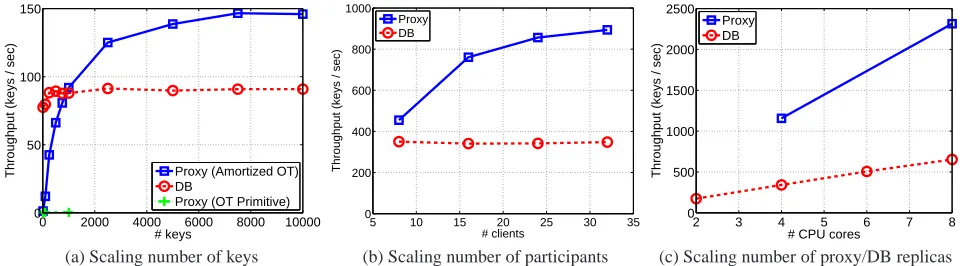
Effect of number of keys (Figure 3a). The input trace to our
sys-tem is parameterized by the number of clients and by the number of keys they each submit. In Figure 3a, we measure the throughput of our system as a function of the number of keys. More precisely, we run a single client, a single proxy, and a single DB in order to measure single-CPU-core proxy throughput and single-CPU-core DB throughput. The top solid curve shows proxy throughput when the proxy and client utilize the amortized OT protocol, the middle dashed curve shows DB throughput, and the bottom partial curve shows proxy throughput when the proxy and client utilize only the standard OT primitive, which does not include our amortization-based extensions. The throughput of the OT primitive is exceed-ingly low (less than one key per second), which is why it was not evaluated on the full range of x-values.
Proxy throughput scales well with the number of incoming keys when the client and proxy utilize the amortized OT protocol. Throughput increases with increasing numbers of keys per batch, as the amortized OT calls the primitive OT a fixed number ofk times regardless of the number of input keysn. With smalln(e.g., up to 1000), the cost of these calls to the primitive OT dominate overall execution time and leave the proxy underutilized. However, as the size of the input set increases, the cost of encrypting keys on the client becomes the primary bottleneck, which is the plot shows minimal increase in throughput aboven= 8000.
num-# keys
Throughput (keys / sec)
0 2000 4000 6000 8000 10000
0 50 100 150
Proxy (Amortized OT) DB
Proxy (OT Primitive)
(a) Scaling number of keys
# clients
Throughput (keys / sec)
5 10 15 20 25 30 35
0 200 400 600 800 1000
Proxy DB
(b) Scaling number of participants
# CPU cores
Throughput (keys / sec)
2 3 4 5 6 7 8
0 500 1000 1500 2000 2500
Proxy DB
(c) Scaling number of proxy/DB replicas
Figure 3: Scaling: Effect of (a) number of keys, (b) number of participants, and (c) number of proxy/database replicas.
ber of keys. The reason for this is that the intensive work on the DB is decryption, which is performed in batch, and it is therefore entirely CPU limited. The DB becomes CPU limited at 10 keys and remains CPU limited at 10,000 keys (i.e., latency goes up and throughput remains constant). We noted earlier that the machines on which the DB and proxy run require 2.5 ms per decryption. Since the DB has to perform 3 decryptions per key, the DB there-fore has a maximum throughput of 135 keys per second on a single CPU core. Figure 3a shows that our DB implementation achieves throughput of roughly 90 keys per second.
The amortized OT protocol [17] introduces a trade-off between the message overhead and memory consumption. The memory footprint of this protocol per client-proxy interaction forn keys isn×32×2×1024/8 = 8196nbytes (i.e., we assume 32 bits per key, the 2 values for the OT primitive, 1024-bit keys, and 8 bits per byte). Forn = 10,000keys, for example, this requires 82 MB on both the proxy and the client. A proxy communicating with 100 clients would therefore require in excess of 8GB of mem-ory. A user of the protocol could choose to execute the amortized OT protocol in stages, however, by sendingkkeys at a time, which would reduce the memory footprint. Our system is parameterized to support this, and because Figure 3a shows that there is little to gain from batch sizes in excess of 5,000 keys, the remainder of our experiments will use batch sizes of 5,000 keys.
Our architecture is designed to maximize throughput, not min-imize latency. In fact, providing a meaningful measure of la-tency is challenging for multiple reasons: (a) the DB processes fdef= T[ki]≥τonce everytseconds (i.e., not upon arrival, which
wouldn’t make sense unlessτ= 1); (b) the proxy batches and ran-domly permutes/shuffles key-value pairs for security; and (c) the substantial benefit of the amortized OT (over the OT primitive: see again Figure 3a) is lost if the client submits only a1key-value pair, which is required for a “true” latency experiment. These qualifiers notwithstanding, Figure 3a does provide a form of “mean” latency. That is, a single client with 5000 keys would see mean proxy la-tency of 7.2 milliseconds per key and mean DB lala-tency of 11.1 milliseconds per key.
Effect of number of participants (Figure 3b). Here we eval-uate the throughput of our system as a function of the number of clients sending keys. In this experiment, we limit the proxy and DB to one server machine each. Four client-facing proxy processes are launched on one machine and four front-end DB processes are launched on the other. They can therefore potentially utilize all eight cores on these two machines. Figure 3b shows that the proxy scales well with the number of clients. Proxy throughput increases by nearly a factor of two between 8 and 32 clients. This signifies
Global Within amortized OT
wait encrypt wait pow AES arith other OT
60% 1% 0% 16% 4% 4% 6% 7%
Table 2: Breakdown of proxy resource usage
Global Within amortized OT
wait encrypt wait pow AES arith other OT
0% 40% 31% 16% 2% 1% 3% 7%
Table 3: Breakdown of client resource usage
that, when communicating with a single client, a proxy spends a substantial fraction of its time idling. The four proxies in this ex-periment are not CPU limited until they handle 32 clients, at which time the throughput approaches 900 keys per second. The DB, on the other hand, is CPU-bound throughout. It has a throughput of about 350 keys per second, independent of the number of clients.
Effect of number of replicas (Figure 3c). Finally, we wish to analyze how our distributed architecture scales with the available computing resources. In this experiment, we provide up to 8 cores across two machines to each of the proxy and DB front-ends. While the proxy is evaluated on 64 clients, computing resource constraints meant that the DB is evaluated on 32 clients.
Both our proxy and DB scale linearly with the number of CPU cores allocated to them. Throughput for the DB with 2 cores when handling 32 clients was over 173 keys per second, whereas at 8 cores the throughput was 651 keys per second: a factor of 3.75 increase in throughput for a factor of 4 increase in computing re-sources. The proxy has throughput of 1159 keys per second when utilizing 4 cores and 2319 when utilizing 8 cores: an exact factor of 2 increase in throughput for an equal increase in computing re-sources. This clearly demonstrates that our protocol, architecture, and implementation can scale up to handle large data sets. In par-ticular, our entire system could handle input sizes on the order of millions of keys in hours.
At the highest level, we split the tasks performed into (a) waiting (called “wait”), (b) encrypting or decrypting values (“encrypt”), or (c) engaging in the amortized OT protocol. We further split work within the amortized OT protocol into time spent waiting, perform-ing modulo exponentiations (“pow”), callperform-ing AES256, performperform-ing basic arithmetic such as multiplication, division, or finding mul-tiplicative inverses (“arith”), calling the OT primitive (“OT”), and any other necessary tasks (“other”) such as XOR’ing numbers, gen-erating random numbers, allocating or de-allocating memory, etc.
Table 2 shows that when communicating with a single client, the client-facing proxy spends more than 60% of its time idling while waiting for the client—it is more than 60% because some part of the 7% of time spent within the OT primitive is also idle time. The 60% idle time is primarily due to waiting for the client to encryptki andFs(ki). The single largest computational expense
for the proxy is performing powmods at 16%; the remaining non-OT tasks add up to 15%. In order to make the proxy more efficient, therefore, utilizing a bignum library with faster exponentiation and basic arithmetic would be advantageous.
The client also spends a non-trivial amount of time waiting— 31% of total execution time—but substantially less than the proxy. It spends 40% of its time encrypting values. The reason this 40% does not match up with the 60% idle time of the proxy is because the proxy finishes its portion of the amortized OT before the client does its portion. That is, 20 out of the proxy’s 60% idle time is due to the client processing data sent by the proxy in the last stage of the amortized OT protocol, and the remaining 40 is due to the client en-crypting its values. A with the proxy, the client would benefit from faster exponentiations, but encryption is clearly the major bottle-neck. We noted before that the GnuPG cryptographic library we use performed public-key operations in approximately 2.5–2.8 ms. On the same servers, we benchmarked the Crypto++ library to per-form RSA decryption in only 1.2 ms, increasing speed by 130%. Crypto++ would also allow us to take advantage of elliptic curve cryptography, which would increase system throughput. In future work, we plan to modify our implementation to use this library.
5.2
Feasibility of Supporting Applications
In this section, we revisit several potential applications of our system. We consider our results in light of their potential demands on request rate: the number of requests per unit time that must be satisfied, the number of keys which must be stored in the system, and the number of participants.
Anomaly detection. Network operators commonly run systems to detect and localize anomalous behavior within their networks. These systems dynamically track the traffic mix—e.g., the volume of traffic over various links or the degree of fanout from a particular host—and detect behavior that differs substantially from the statis-tical norm. For example, Mao et al. [24] found that most DDoS attacks observed within a large ISP were sourced by fewer than 10,000 source IPs, and generated 31,612 alarms over a four-week period (0.8 events per hour). In addition, Soule et al. [37] found that volume anomalies occurred at a rate of four per day on aver-age, most of which involved fewer than several hundred source IPs. Finally, Ramachandran et al. [33] found were able to localize 4,963 Bobax-infected host IPs sending spam from a single vantage point. We envision our system could be used to improve accuracy of these techniques by correlating anomalies across ISP boundaries. We found our system could handle 10,000 IP addresses as keys, with a request rate of several hundred keys per second, even with several hundred participants. Given our system exceeds the requirements of anomaly detection, our system may enable the participants to
“tune” their anomaly detectors to be more sensitive, and reduce false positive rates by leveraging other ISPs’ observations.
Cross-checking certificates. Multiple vantage points may be used
to validate authenticity of information (such as a DNS reply or ssh certificate [29, 39]) in the presence of “man-in-the-middle” attacks. Such environments present potentially larger scaling challenges due to the potentially large number of keys that could be inserted. According to [18], most hosts execute fewer than 15 DNS lookups per hour, and according to [35], ssh hosts rarely authenticate with more than 30 remote hosts over long periods of time. Here, we en-vision our system could simplify the deployment of such schemes, by reducing the amount of information revealed about clients’ re-quest streams. Under this workload (15 key updates per hour, with 30 keys per participating host), our system scales to support several hundred hosts with only a single proxy. Extrapolating out to larger workloads, our system can handle tens of thousands of clients stor-ing tens of thousands of keys with under fifty proxy/database pairs.
Distributed ranking. Search tools such as Alexa and Google Toolbar collect information about user behavior to refine search re-sults returned to users. However, such tools are occasionally la-beled as spyware as they reveal information about the contents of queries performed by users. Our tool may be used to improve pri-vacy of user submissions to these databases. It is estimated that Alexa Toolbar has 180,000 active users, and it is known that av-erage web users browse 120 pages per day. Here, the number of participants is large, but the number of keys they individually store in the system is smaller. Extrapolating our results to 180,000 par-ticipants, and assuming several thousands of keys, our system can still process several hundred requests per second (corresponding to several hundred thousand clients) per proxy/database pair.
6.
CONCLUSIONS
In this paper, we presented the design, implementation, and eval-uation of a collaborative data-analysis system that is both scalable and privacy preserving. Since a fully-distributed solution would be complex and inefficient, our design divides responsibility between two independent parties—a proxy that obliviously blinds the client inputs and a database that identifies the (blinded) keys that have val-ues satisfying an evaluation function. The functionality of both the proxy and the database can be easily distributed for greater scalabil-ity and reliabilscalabil-ity. Experiments with our prototype implementation show that our system performs well under increasing numbers of keys, participants, and proxy/database replicas. The performance is well within the requirements of our motivating applications, such as collaborating to detect the malicious hosts responsible for DoS attacks or to validate the authenticity of information in the presence of man-in-the-middle attacks.