THE BLOCK CIPHER NSABC (PUBLIC DOMAIN)
ALICE NGUYENOVA-STEPANIKOVA (*) AND TRAN NGOC DUONG (**)
Abstract. We introduce NSABC/w Nice-Structured Algebraic Block Ci-pher usingw-bit word arithmetic, a4w-bit analogous of Skipjack [NSA98] with
5w-bit key. The Skipjack's internal 4-round Feistel structure is replaced with aw-bit, 2-round cascade of a binary operation(x, z)7→(x z)≪(w/2)that
permutes a text wordxunder control of a key wordz. The operation , sim-ilarly to the multiplication in IDEA [LM91, LMM91], bases on an algebraic group over w-bit words, so it is also capable of decrypting by means of the inverse element ofz in the group. The cipher utilizes a secret4w-bit tweak an easily changeable parameter with unique value for each block encrypted under the same key [LRW02] that is derived from the block index and an additional4w-bit key. A software implementation for w = 64takes circa 9
clock cycles per byte on x86-64 processors.
1. Introduction
In the today's world full of crypto algorithms, one may wonder what makes a block cipher attractive.
In the authors' opinion, the answer to the question is one word: elegance. If something looks nice, then there is a big chance that it is also good.
An elegant specication makes it easier to memorize. Memorability makes it easier to realize and to analyze, that allows for fruitful cryptanalytic results, leading to deeper understanding which, in turn, makes greater condence in the algorithm.
The elegance comprises the following features:
• Few algebraic operations. Using of many operations results in
hardly-tractable and possibly undesirable interactions between them.
• Simple and regular key schedule. A complex key schedule, which eectively
adds another, unrelated, function to the cipher, results in hardly-tractable and possibly undesirable interactions between the functions.
IDEA, a secure block cipher designed by Xuejia Lai and James L. Massey [LM91, LMM91] is an example of elegance. Besides being elegant with an ecient choice and arrangement of algebraic operations, it is elegant for some more features:
• The use of incompatible group operations, where incompatible means there
are no simple relations (such as distributivity) between them. The in-compatibility eliminates any exploitable algebraic property thus makes it infeasible to solve the cipher algebraically.
• The use of modular multiplication. Multiplication produces huge
mathe-matical complexity while consuming few clock cycles on modern processors. It thus greatly contributes to security and eciency of the cipher.
Date: May 8th, 2011. This is version 2 of the algorithm, superseding version 1 that was published on Usenet July 2010.
Key words and phrases. block cipher, tweakable, algebraic, multiplication, IDEA, Skipjack.
(*) Hradcany, Praha, Czech Republic.
However, IDEA uses multiplication modulo the Fermat prime 2w+ 1 which does not exist forw= 32orw= 64, making it not extendable to machine word lengths nowadays. Furthermore, its key schedule is rather irregular due to the rotation of the primary key.
Skipjack, a secure block cipher designed by the U.S. National Security Agency [NSA98], is another example of elegant design. Besides being elegant with an ecient, simple and regular key schedule, it is elegant for one more feature: the use of two ciphers an outer cipher, or wrapper, consisting of rst and last rounds, and an inner cipher, or core, consisting of middle rounds.
The terms core and wrapper were introduced in the design rationale of a struc-tural analogous of Skipjack: the block cipher MARS [IBM98]. MARS's designers justify this two-layer structure by writing that it breaks any repetitious property, it makes any iterative characteristic impossible, and it disallows any propagation of eventual vulnerabilities in either layer to the other one, thus making attacks more dicult. The wrapper is primarily aimed at fast diusion and the core primarily at strong confusion. As Claude E. Shannon termed in his pioneer work [Sha49], diusion here refers to the process of letting each input bit aect many output bits (or, equivalently, each output bit be aected by many input bits), and confusion here refers to the process of letting that aection very involved, possibly by doing it multiple times in very dierent ways. If a cipher is seen as a polynomial map in the plaintext and the key to the ciphertext, then the methods of diusion and confusion can be described as the eort of making the polynomials as complete as possible, i.e. such that they contain virtually all terms at all degrees. This algebraic approach is very evident in the structure of Skipjack (see Figure 5.1). Skipjack (as opposed to MARS) was moreover sought elegant as the wrapper there is, in essence, the inverse function of the core.
However, Skipjack uses an S-box that renders it rather slow, hard to program in a secure and ecient manner, and not extendable to large machine word lengths, as such.
This article describes an attempt to combine the elegant idea of using incompat-ible and complex machine-oriented algebraic operations in IDEA with the elegant structure of Skipjack into a scalable and tweakable block cipher called NSABC Nice-Structured Algebraic Block Cipher.
NSABC is scalable. It is dened for every even word length w. It encrypts a 4w-bit text block under a 5w-bit key, thus allows scaling up with 8-bit increment in block length and 10-bit increment in key length.
NSABC is tweakable. It can use an easily changeable 4w-bit parameter, called tweak [LRW02], to make a unique version of the cipher for every block encrypted under the same key. Included in the specication is a formula for changing the tweak.
NSABC makes use of entirely the overall structure of Skipjack, including the key schedule, and only replaces the internal 4-round Feistel structure of Skipjack with another structure. The new structure consists of two rounds of the binary operation(x, z)7→(x
ez)≪(w/2), that encrypts a text word x using a key word z and a key-dependent word e. The operation
e is derived from an algebraic group over w-bit words takingeas the unit element, so it is also capable of decrypting by
means of the inverse element of z in the group. The two rounds are separated by an exclusive-or (XOR) operation that modies the current text word by a tweak word.
steps to make sure the use is free of legal issues. We (the designers of NSABC) are not aware of any patent related to other parts of the design.
The rest of the article is organized as follows. Section 2 denes operations and notations. Section 3 species the cipher. Section 5 gives numerical examples. Section 4 suggests some implementation techniques. Section 6 concludes the article. Source code of software implementations are given in the Appendices.
2. Definitions
2.1. Operations on words. Throughout this article, w denotes the machine word length. We use the symbols , , and (.)−1 to denote addition, subtraction
(and arithmetic negation), multiplication and multiplicative inversion, respectively, modulo2w(unless otherwise said). We use the symbols¬and⊕to denote bit-wise
complement and exclusive-or (XOR) on w-bit operands (unless otherwise said). We write x≪ n to denote leftward rotation (i. e. cyclic shift toward the most
signicant bit) of x, that is always a w-bit word, by n bits. For even w, the symbol (.)S denotes swapping the high and low order halves, i.e. xS=x
≪(w/2).
Let's dene binary operationby
xy= 2xyxy
and binary operation by
x y= 2xyxy
The bivariate polynomials on the right hand side are permutation polynomials in either variable for every xed value of the other variable [Riv99]. In other words,
and are quasi-group operations.
Furthermore,is a group operation over the set of w-bit numbers1. This fact
be-comes obvious by considering an alternative denition for theoperation [Mey97]:
it can be done by dropping the rightmost bit, which is always 1, of the product modulo2w+1 of the operands each appended with an 1 bit. Symbolically,
xy= [(2x+ 1)(2y+ 1)−1]/2 (mod2w)
The group dened by is thus isomorphic to the multiplicative group of odd
integers modulo2w+1, via the isomorphism
x7→2x+ 1
The unit (i.e., identity) element of the group is 0. The inverse element of x, denoted x¯, is
¯
x=x(2x1)−1 The following relations are obvious.
xy=[(x) y]
x y=[(x)y]
Since the unary operatoris an involution, the following relations hold.
(x y) z=x (yz)
x 0 = 0
Notice that 0 is the right unit element w.r.t. the operation . Hence
(x y) y¯=x
which means thaty¯is also the right inverse element of y w. r. t. the operation. Since(¬x)x=1holds for every x, the following relations hold.
(¬x)y=¬(xy)
(1x) y= 1(x y)
Let e be a xed w-bit number. Let's dene binary operations
e and e by
x
ey = (xe)(ye)e= 2xy(1−2e)(x+y−e)
x
ey = (xe) (ye)e= 2xy(1−2e)(x−y+e) Then
e and e are quasi-group operations over the set of w-bit numbers. This follows from a more general fact that the right-hand side trivariate polynomials are permutations in either variable while keeping the other two xed [Riv99]. Actually, the symbols
e and e each denes an entire family of binary operations, of which each is uniquely determined by e.
Furthermore, from the denition it immediately follows that
e is a group oper-ation, namely, the group is isomorphic to one dened byvia the isomorphism
x7→xe
The unit element of the group is e.
The inverse element of x in the group, denoted e x, is
e
x=xee= [(2e−1)x2e(e−1)] [2(x−e)1]
−1
Simple calculation proves the following relations.
x
e
y=h(x) e y
i
x
e y=
(x)
e y
(12ex)
e y= 12e(x ey)
(x
e y) e z=x e (ye
z)
(x
e y) e
e y =x
Notice that e is also the right unit element w. r. t.
e, and e
y also the right inverse element of y w. r. t.
2.2. Order notations. We write multi-part data values in string (or number) notation or tuple (or vector) notation. In string notation, the value is written as a sequence of symbols, possibly separated by space(s) that are insignicant. In tuple notation, the value is written as a sequence, in parentheses, of comma-separated symbols.
For examples, z y x and 43 210 are in string notation,(x, y, z)and(0,1,2,3,4) are in tuple notation.
The string notation indicates high-rst order: the rst (i.e. leftmost) symbol denotes the most signicant part of the value when it is interpreted as a number.
Conversely, the tuple notation indicates low-rst order: the rst symbol denotes the least signicant part of the value when it is interpreted as a number.
For examples, to interpret a 3-word number, x2 denotes the most signicant
word ofx2x1x0 andx0denotes the least signicant word of(x0, x1, x2).
The same value may appear in either notation. Thus, for example, for every a, b, c and d,
a b c d= (d, c, b, a)
The term part introduced above usually refers to word, but it may also refer to digit [of a number], component [of a tuple or vector], as well as group thereof. If, for example x, y, z, t are 1-digit, 2-digit, 3-digit and 4-digit values respectively, then(x, y, z, t) = 9876543210meansx= 0,y= 21,z= 543 andt= 9876.
Note that the string notation and number notation being used as synonyms does not mean that big-endian data ordering is mandated. In order to avoid security irrelevant details, we do not specify endianess. We nevertheless provide a reference implementations in C++, where every octet string is considered as a [generally multi-word] number with the rst octet taken as the least signicant one. The implementation thus interprets octet strings as numbers in little-endian order. 2.3. Operations on word strings. Let(.)Rdenote the permutation that reverses
the word order of a non-empty word string. For example, forw= 8,
0x0123ABCDR=0xCDAB2301
Let(.)Sdenote the permutation that swaps the high order and low order halves
of every word of a non-empty word string. For example, for w= 8,
0x0123ABCDS=0x1032BADC
The operator⊕on word strings denote word-wise application of⊕. For example,
(a0, a1, a2, ...)⊕(b0, b1, b2, ...) = (a0⊕b0, a1⊕b1, a2⊕b2...)
Unless otherwise said, operators and on word strings denote word-wise
modular addition and subtraction, respectively. For example,
(a0, a1, a2, . . .)(b0, b1, b2, . . .) = (a0b0, a1b1, a2b2, . . .)
(a0, a1, a2, . . .)(b0, b1, b2, . . .) = (a0b0, a1b1, a2b2, . . .)
Let(¯.)denote the word-wise application of the inversion operator(¯.)on a word string. For example,
Given word strings E and X of the same length, let E
X denote the word-wise application of the inversion operator e
x on every word x of X with the index-matching word of E taken as the [right] unit element e. For example,
(e1, e2, e3, . . .)
(x1, x2, x3, . . .)
=
e
1
x1
, e2 x2
,e3 x3
, . . .
Operations on word strings are used in this article only to express the decryption function explicitly.
3. Specification
This section provides details of NSABC/w. From now on w, the word length, must be even.
Throughout this article, X denotes a 4w-bit plaintext block, Y a 4w-bit cipher-text block, Z a 5w-bit key, T a 4w-bit secret tweak, i.e., a value that is used to encrypt only one block under the key, U a w-bit unit key, i.e. an additional key that generates right unit elements for the underlying quasi-groups.
Tweaking is optional. It may be disabled by keeping T constant (like Z and U ) while encrypting many blocks. When tweaking is disabled, NSABC becomes a conventional, non-tweakable, block cipher.
Mathematically, the cipher is given by two functions,
ENCRYPT(X, Z, T, U), which encrypts X under control of Z, T and U, DECRYPT(Y, Z, T, U), which decrypts Y under control of Z, T and U, satisfying the apparent relation
DECRYPT(ENCRYPT(X, Z, T, U), Z, T, U) =X
The function ENCRYPT is dened in terms of four functions:
CRYPT, a text encryption function that encrypts a plaintext block using a key schedule, a unit schedule and a tweak schedule;
KE, a key expansion function, that generates the key schedule from Z ; UE, a unit element function, that generates the unit schedule from U ; and TE, a tweak expansion function, that generates the tweak schedule from T. Algorithm 1 Function ENCRYPT
Input:
X 4w-bit plaintext block
Z 5w-bit key
T 4w-bit tweak
U w-bit unit key Output:
Y 4w-bit ciphertext block Relation:
ENCRYPT(X, Z, T, U) = CRYPT(X,KE(Z),UE(U),TE(T))
An explicit relation for ENCRYPT is given in Algorithm 1. An explicit relation for DECRYPT is given in Algorithm 7.
Mechanically, encryption is performed on a conceptual processor with a 4-word text register (x0, x1, x2, x3), a 5-word key register (z0, z1, z2, z3, z4), a 4-word tweak
register (t0, t1, t2, t3)and a word unit register u. The key register is initially loaded
A
B u(18)
G
G
z4(2) z3(2) z2(2) z1(2) z0(2)
z4(16) z3(16) z2(16) z1(16) z0(16)
z4(18) z3(18) z2(18) z1(18) z0(18)
z4(17) z3(17) z2(17) z1(17) z0(17)
z4(64) z3(64) z2(64) z1(64) z0(64)
x2(1) x1(1) x0(1)
x3(1)
x3(8) x2(8) x1(8) x0(8)
x0(32)
x1(32)
x2(32)
x3(32)
x3(9) x2(9) x1(9) x0(9)
z4(0) z3(0) z2(0) z1(0) z0(0)
z4(1) z3(1) z2(1) z1(1) z0(1)
x3(0) x2(0) x1(0) x0(0)
t0(0)
t1(0)
t2(0)
t3(0)
t0(1)
t1(1)
t2(1)
t3(1)
t0(8)
t1(8)
t2(8)
t3(8)
t0(9)
t1(9)
t2(9)
t3(9)
t0(32)
t1(32)
t2(32)
t3(32)
u(64) u(0) u(1) u(2) u(17) u(16) 2U+1
Figure 3.1. Representative rounds.
The concrete, vector, notation here species the order of words so, for example,
x0is initially loaded with the least signicant word of X and nally it contains the
least signicant word of Y.
3.1. Text encryption. The text register(x0, x1, x2, x3)is initially loaded with the
plaintext block X and nally it contains the ciphertext block Y.
Text encryption proceeds in 32 rounds of operations. A round is of either type A or type B. The rounds are arranged in four passes: rstly eight rounds of type A, then eight rounds of type B, then eight rounds of type A again, nally eight rounds of type B again.
For k-th round, 0≤k≤31, the text word x0 is permuted, i.e. it is updated by
an execution unit called G-box that implements a permutation G on the set of word values, and the contents of the text wordx0are mixed, by exclusive-or (XOR), into
an other text word that is either x1or x3. The order of operations and the target
of mixing depend on the round type:
• For an A-typed round (see Figure 3.1 part A), G applies rst, then the
mixing takes place and targetsx1. That is, the contents ofx0enters the
G-box, the output value of the G-box is stored back tox0, then the contents
ofx0andx1 are XOR'ed and the result is stored tox1. The wordsx2and
x3 are left unchanged.
• For a B-typed round (see Figure 3.1 part B), the mixing takes place and
targets x3 rst, then G applies. That is, the contents of x0 and x3 are
XOR'ed and the result is stored to x3, then the contents of x0 enters the
G-box, the output value of the G-box is stored back to x0. The wordsx1
andx2 are left unchanged.
Besides the text input, the G-box also takes as its inputs an ordered pair of w-bit key words (K2k, K2k+1)(depicted by/ in Fig. 3.1 and 3.2), an ordered pair
of w-bit unit words (L2k, L2k+1) (depicted by in Fig. 3.1 and 3.2), and a w-bit
Algorithm 2 Function CRYPT (text encryption) Input:
X 4w-bit plaintext block K 64w-bit key schedule L 64w-bit unit schedule C 32w-bit tweak schedule Output:
Y 4w-bit ciphertext block Pseudo-code:
(x0, x1, x2, x3)←X
for k←0,1,2, . . . ,31 loop
if 06k <8 ∨ 166k <24 then
x0←G(x0,(K2k, K2k+1),(L2k, L2k+1), Ck)
x1←x1⊕x0
elsif 86k <16 ∨ 246k <32 then
x3←x3⊕x0
x0←G(x0,(K2k, K2k+1),(L2k, L2k+1), Ck) end if
(x0, x1, x2, x3)←(x1, x2, x3, x0)
end loop
Y ←(x0, x1, x2, x3)
Relations:
Y = (x(32)0 , x(32)1 , x(32)2 , x(32)3 ) For 06k <8 ∨ 166k <24:
x(0k+1)=x(1k)⊕g(k)
x(1k+1)=x(2k) x(2k+1)=x(3k) x(3k+1)=g(k)
For 86k <16 ∨ 246k <32:
x(0k+1)=x(1k) x(1k+1)=x(2k) x2(k+1)=x3(k)⊕x(0k) x(3k+1)=g(k)
For 06k <32:
g(k)=G(x(k)
0 ,(K2k, K2k+1),(L2k, L2k+1), Ck) (x(0)0 , x(0)1 , x(0)2 , x(0)3 ) =X
(K0, K1, K2, . . . , K63) =K
(L0, L1, L2, . . . , L63) =L
(C0, C1, C2, . . . , C31) =C
The encryption round is completed with a rotation by one word toward the least signicant word on the text register, i.e. the text register is modied by simultaneous loading the word x0 with the contents of the word x1, x1 with the
contents ofx2,x2 with the contents ofx3, andx3 with the contents ofx0.
3.2. Tweak schedule. The tweak register(t0, t1, t2, t3)is initially loaded with the
tweak T. The tweak words are generated in 32 rounds of operations.
For k-th round,0≤k≤31, the value of the wordt0of the tweak register is taken
Algorithm 3 Function TE (tweak expansion) Input:
T 4w-bit tweak
Output:
C 32w-bit tweak schedule Pseudo-code:
(t0, t1, t2, t3)←T
for k←0,1,2, . . . ,31 loop
Ck←t0
(t0, t1, t2, t3)←(t1, t2, t3, t0)
end loop Relations:
C= (C0, C1, C2, . . . , C31)
For 06k <32:
Ck=t
(k) 0
t(0k+1)=t(1k) t(1k+1)=t(2k) t(2k+1)=t(3k)
t(3k+1)=t(0k)
(t(0)0 , t(0)1 , t(0)2 , t(0)3 ) =T
similarly to the text register, the tweak register is rotated by one word toward the least signicant word (see Figure 3.1).
NOTE. ForT3T2T1T0=T, the tweak schedule is
TE(T) = (T0, T1, T2, T3, T0, T1, T2, T3, . . . , T0, T1, T2, T3)
3.3. Key schedule. The key register(z0, z1, z2, z3, z4)is initially loaded with the
key Z. The key words are generated in 64 rounds of operations.
For k-th round, 0≤k≤63, the value of the wordz3 of the key register is taken
as the key wordKk [which enters the G-box of the k/2-th encryption round as the rst key word if k is even, or as the second key word if k is odd]. The key register is then rotated by one word toward the least signicant word. The rotation is similar to that on the text register and the tweak register. (See Figure 3.1.)
NOTE. ForZ4Z3Z2Z1Z0=Z, the key schedule is
KE(Z) = (Z3, Z4, Z0, Z1, Z2, Z3, Z4, Z0, Z1, Z2, . . . , Z3, Z4, Z0, Z1)
3.4. Unit schedule. The unit register u is initially loaded with the unit key U. Unit words are generated in 64 rounds of operations.
For k-th round, 0 ≤ k ≤ 63, the value of the unit register u is taken as the unit word Lk [which, similarly to the key word Kk, enters the G-box of k/2-th encryption round as the rst unit word if k is even, or as the second unit word if k is odd]. The register is then added modulo 2w by the [key-dependent] constant 2U1to become ready for the next round. (See Figure 3.1.)
NOTE. Given unit key U, the unit schedule is
Algorithm 4 Function KE (key expansion) Input:
Z 5w-bit key
Output:
K 64w-bit key schedule Pseudo-code:
(z0, z1, z2, z3, z4)←Z
for k←0,1,2, . . . ,63 loop
Kk←z3
(z0, z1, z2, z3, z4)←(z1, z2, z3, z4, z0)
end loop Relations:
K= (K0, K1, K2, . . . , K63)
For 06k <64:
Kk=z
(k) 3
z0(k+1)=z1(k) z1(k+1)=z2(k) z2(k+1)=z3(k)
z3(k+1)=z4(k) z4(k+1)=z0(k)
(z0(0), z1(0), z2(0), z3(0), z4(0)) =Z
Algorithm 5 Function UE (unit element) Input:
U w-bit unit key Output:
L 64w-bit unit schedule Pseudo-code:
u←U
for k←0,1,2, . . . ,63 loop
Lk ←u
u←u2U1 end loop
Relations:
L= (L0, L1, L2, . . . , L63)
For k= 0,1,2, . . . ,63:
Lk =u(k)
u(k+1)=u(k)
2U 1
u(0)=U
Or, equivalently, for every k: u(k)=Uk
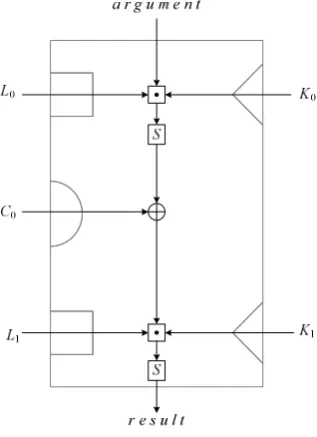
3.5. G-box. The G-box implements a permutation G (see Figure 3.2) that takes as argument a text word and is parametrized by an ordered pair of key words (K0, K1), an ordered pair of unit words(L0, L1)and a tweak word C0 to return
Figure 3.2. Permutation G. rounds, each consisting of an operation
e followed by a half-word swap S. The two rounds are separated by an exclusive-or (XOR) operation.
For the rst round, the operation
e takes the contents of the register as the left operand, K0 as the right operand, and L0 as its right unit element. The result
is stored back to the register. The register is then modied by operation S, i.e. swapping the contents of its high and low order halves.
For the inter-round XOR operation, the register is modied by XOR'ing its contents with the tweak wordC0and storing the result back to it.
For the second round, the register is processed similarly to the rst round with
K1 andL1 being used instead ofK0 andL0, respectively.
NOTES.
(1) The cipher uses 64 distinct instances from the family of operations e. (2) Alternatively, it may be seen as using 64 identical instances of the single
operation or , but operands and result of each instance are biased
by adding or subtracting the constant L0 (or L1) that is specic to the
instance, and furthermore, being seen as, the left operand enters and the
result leaves it in altered sign.
(3) Like Skipjack, the G-box permutesK0 (orK1) while keepingxand other
parameters xed. Unlike Skipjack, the G-box doesn't permute the word (Hi(K0),Lo(K1)) where Hi(.) and Lo(.) stand for the high and the low
order half respectively.
(4) Unlike Skipjack, diusion in the G-box is incomplete, i.e. not every input bit aects all output bits. Indeed, the v-th bit of the argument, with
v > w/2, aects only all bits of the low order half and bits v throughw−1 of the result; bitsw/2throughv−1remain unaected.
(5) If(K0, K1) = (L0, L1) ∧ C0= 0then G becomes the identity.
3.6. Decryption. Decryption can be easily derived from encryption. Namely, if
Algorithm 6 Permutation G Input:
x w-bit text word (K0, K1) pair of w-bit key words
(L0, L1) pair of w-bit unit words
C0 w-bit tweak word
Output:
y w-bit text word Pseudo-code:
x←x
L0 K0
x←xS
x←x⊕C0
x←x
L1 K1
x←xS y←x
Relation:
G(x,(K0, K1),(L0, L1), C0) = (((x
L0
K0)S⊕C0)
L1 K1)S
Algorithm 7 Function DECRYPT Input:
Y 4w-bit ciphertext block
Z 5w-bit key
T 4w-bit tweak
U w-bit unit key Output:
X 4w-bit plaintext block Relation:
DECRYPT(Y, Z, T, U) = CRYPT(YRS,UE(U)
R
KE(ZR),UE(U) R
,TE(TRS))RS
then it immediately follows that
CRYPT(YRS,UE(U)
R
KE(ZR),UE(U) R
,TE(TRS)) =XRS
In other words, encrypting the cipher block in reverse half-word order (YRS)
using the tweak in reverse half-word order (TRS), the unit schedule in reverse word
order (UE(U)R), and the key schedule consisting of inverse words of one expanded
from the key in reverse word order (ZR), where the inversions are of the
quasi-groups dened by the operation e and each quasi-group is uniquely given by its right unit that is the index-matching word of the encryption unit schedule in reverse word order (UE(U)R), recovers the plain block in reverse half-word order (XRS).
NOTES.
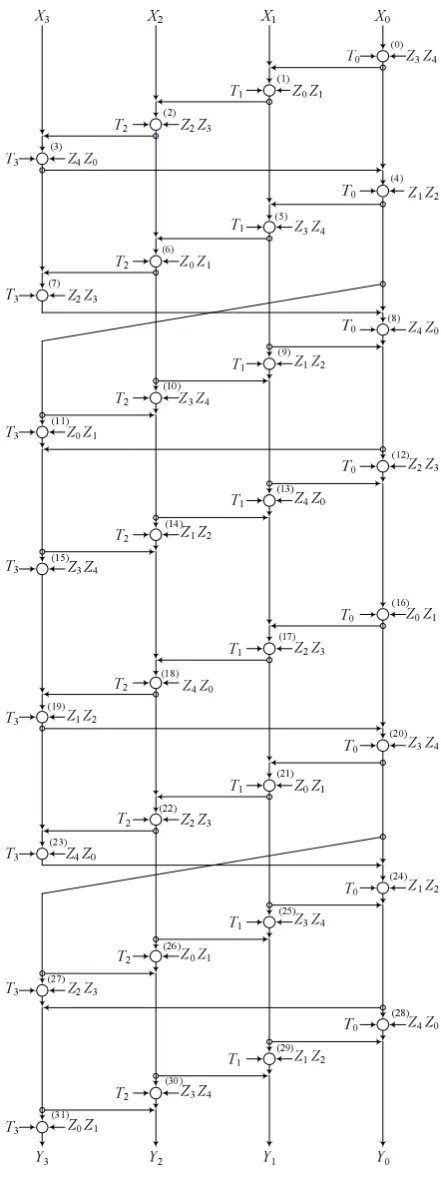
(1) The full cipher is illustrated in Figure 3.3, whereX3X2X1X0=X,Y3Y2Y1Y0=
Y, Z4Z3Z2Z1Z0 = Z and T3T2T1T0 = T (the unit schedule is omitted).
(2) The overall structure is up to word indexing identical to that of Skipjack. The word re-indexing, which is cryptographically insignicant, was intro-duced to ease description and illustration.
(3) Like Skipjack, decryption is similar to encryption. To decrypt with Skip-jack, one swaps adjacent words in the cipher and the plain block and swaps adjacent word pairs in the key. To decrypt with NSABC, one reverses the word order, i.e., swaps the rst and the last words as well as the second rst and the second last ones in the text block, the tweak and the key. For Skipjack, one also swaps high and low order halves of every word. For NSABC, one swaps high and low order halves of every word but that of the key.
(4) Unlike Skipjack, just swapping the words and half-words doesn't turn en-cryption into deen-cryption one needs to invert key words too. Thus although ENCRYPT and DECRYPT can be expressed explicitly in terms of CRYPT, DECRYPT cannot be expressed explicitly in terms of ENCRYPT.
3.7. Tweak derivation. The 4w-bit secret tweak T is used to encrypt only one block [under a given key Z and unit key U ]. In order to encrypt multiple blocks the tweak is derived from the block index and a 4w-bit [additional] key, called tweak key, as follows. LetT(j) denote the tweak used to encrypt j -th block. For the rst
block (j= 0), the tweak key is used as the tweak directly:
T(0)= tweak key
The subsequent tweak is computed from the current tweak by the recurrent relation:
T(j+1)=T(j)2T(0)1 or, equivalently,
T(j)=T(0) j
where all operands are regarded as 4w-bit numbers and all operators are dened on 4w-bit arithmetic, i.e. mod24w.
NOTES.
(1) The third relation, whereT(0)conveniently designates the [unnamed] tweak
key, is meant for random access. The family of functions
T : j7→T(0)j ,
parametrized by the tweak key T(0), is not -almost 2-XOR universal
ac-cording to denition in [LRW02]. Eventual application of this family in the Liskov-Rivest-Wagner construction, i.e. encryption by CRYPT(X ⊕
T(j),KE(Z),0,UE(U))⊕T(j), is therefore impossible.
(2) For ecient random access, applications may opt to use non-at spaces of the block index j. For example, an application that encrypts relational databases may dene the index in the format j=j4j3j2j1j0, wherej4 is
database number,j3is table number within the database,j2is row number
within the table,j1is eld number within the row and j0is block number
within the eld.
(3) Tweaking must be disabled when the cipher is used as a permutation, i. e. to generate a sequence of unique numbers.
4. Example An encipherment in NSABC/16 with
X =0x0123456789ABCDEF
Z=0x88880777006600050000
T =0x0001002203334444
U =0x1998 results in
Y =0x88B14E700F51921E
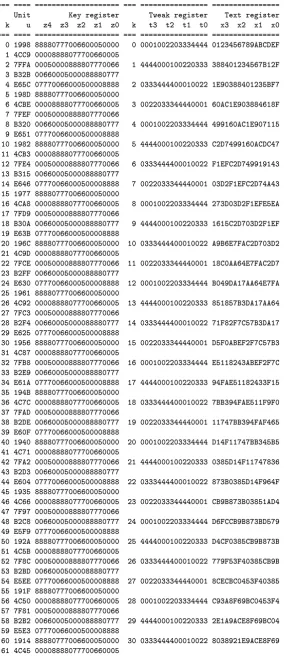
Table 1 lists states of the [conceptual] processor during the encipherment, i.e. the contents of all registers at the start of round k for k = 0, 1, 2, ..., 64 for key schedule and unit schedule, and k = 0, 1, 2, ..., 32 for tweak schedule and text encryption. The start of round 64 (32) conveniently means the end of round 63 (31), which is that of the entire algorithm.
5. Notes on implementation
This section provides methods for ecient software implementation for two types of environment: constrained, such as embedded computers, and memory-abundant, such as servers and personal computers.
5.1. Memory-constrained environment. The function ENCRYPT can be im-plemented without using any writeable memory on a processor with at least 16 word registers:
• 4 for (x0, x1, x2, x3) text register • 5 for (z0, z1, z2, z3, z4) key register • 4 for (t0, t1, t2, t3) tweak register • 1 for u unit register,
• 1 for the constant value2U1, and
• 1 for k round index.
Indeed, the schedules K, L and C can vanish because every word of them, once produced, can be consumed immediately, provided that the functions KE, TE, UE and CRYPT are programmed to run in parallel and synchronized with each increment of k. Source code of this implementation is given in Appendix A.
Unlike ENCRYPT, DECRYPT needs memory for the key schedule because on-the-y modular multiplicative inversion is too slow to be practical. In this envi-ronment, modes of operation that avoid DECRYPT (i.e. ones using ENCRYPT to decrypt) are thus preferable.
5.2. Memory-abundant environment. The quasi-group operation
e can be evaluated by only one multiplication and one addition. Indeed,
x
e z=mxn where x is a text word, z key word, and
m= 2(z−e)1
n= (2e−1)(z−e)
Table 1. Processor states during an encipherment by NSABC/16
=== ==== ==================== === ================ ================ Unit Key register Tweak register Text register k u z4 z3 z2 z1 z0 k t3 t2 t1 t0 x3 x2 x1 x0 === ==== ==================== === ================ ================ 0 1998 88880777006600050000 0 0001002203334444 0123456789ABCDEF 1 4CC9 00008888077700660005
2 7FFA 00050000888807770066 1 4444000100220333 388401234567B12F 3 B32B 00660005000088880777
4 E65C 07770066000500008888 2 0333444400010022 1E90388401235BF7 5 198D 88880777006600050000
6 4CBE 00008888077700660005 3 0022033344440001 60AC1E903884618F 7 7FEF 00050000888807770066
8 B320 00660005000088880777 4 0001002203334444 499160AC1E907115 9 E651 07770066000500008888
10 1982 88880777006600050000 5 4444000100220333 C2D7499160ACDC47 11 4CB3 00008888077700660005
12 7FE4 00050000888807770066 6 0333444400010022 F1EFC2D749919143 13 B315 00660005000088880777
14 E646 07770066000500008888 7 0022033344440001 03D2F1EFC2D74A43 15 1977 88880777006600050000
16 4CA8 00008888077700660005 8 0001002203334444 273D03D2F1EFE5EA 17 7FD9 00050000888807770066
18 B30A 00660005000088880777 9 4444000100220333 1615C2D703D2F1EF 19 E63B 07770066000500008888
20 196C 88880777006600050000 10 0333444400010022 A9B6E7FAC2D703D2 21 4C9D 00008888077700660005
22 7FCE 00050000888807770066 11 0022033344440001 18C0AA64E7FAC2D7 23 B2FF 00660005000088880777
24 E630 07770066000500008888 12 0001002203334444 B049DA17AA64E7FA 25 1961 88880777006600050000
26 4C92 00008888077700660005 13 4444000100220333 851857B3DA17AA64 27 7FC3 00050000888807770066
28 B2F4 00660005000088880777 14 0333444400010022 71F82F7C57B3DA17 29 E625 07770066000500008888
30 1956 88880777006600050000 15 0022033344440001 D5F0ABEF2F7C57B3 31 4C87 00008888077700660005
32 7FB8 00050000888807770066 16 0001002203334444 E5118243ABEF2F7C 33 B2E9 00660005000088880777
34 E61A 07770066000500008888 17 4444000100220333 94FAE51182433F15 35 194B 88880777006600050000
36 4C7C 00008888077700660005 18 0333444400010022 7BB394FAE511F9F0 37 7FAD 00050000888807770066
38 B2DE 00660005000088880777 19 0022033344440001 11747BB394FAF465 39 E60F 07770066000500008888
40 1940 88880777006600050000 20 0001002203334444 D14F11747BB345B5 41 4C71 00008888077700660005
42 7FA2 00050000888807770066 21 4444000100220333 0385D14F11747836 43 B2D3 00660005000088880777
44 E604 07770066000500008888 22 0333444400010022 873B0385D14F964F 45 1935 88880777006600050000
46 4C66 00008888077700660005 23 0022033344440001 CB9B873B03851AD4 47 7F97 00050000888807770066
48 B2C8 00660005000088880777 24 0001002203334444 D6FCCB9B873BD579 49 E5F9 07770066000500008888
50 192A 88880777006600050000 25 4444000100220333 D4CF0385CB9B873B 51 4C5B 00008888077700660005
52 7F8C 00050000888807770066 26 0333444400010022 779F53F40385CB9B 53 B2BD 00660005000088880777
54 E5EE 07770066000500008888 27 0022033344440001 8CECBC0453F40385 55 191F 88880777006600050000
56 4C50 00008888077700660005 28 0001002203334444 C93A8F69BC0453F4 57 7F81 00050000888807770066
58 B2B2 00660005000088880777 29 4444000100220333 2E1A9ACE8F69BC04 59 E5E3 07770066000500008888
60 1914 88880777006600050000 30 0333444400010022 8038921E9ACE8F69 61 4C45 00008888077700660005
62 7F76 00050000888807770066 31 0022033344440001 D4BE0F51921E9ACE 63 B2A7 00660005000088880777
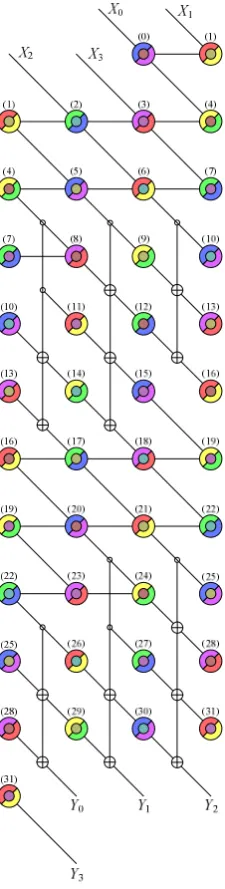
The cipher is parallelizable. The following procedure executes all 32 rounds in 20 steps, of which half performing two or three parallel evaluations of G. Recall that g(k)is the result of G in round k.
(1) Computeg(0)
(2) Computeg(1)
(3) Computeg(2)
(4) Computeg(3)
(5) Computeg(4)
(6) Computeg(5),g(11) in parallel
(7) Computeg(6),g(9) in parallel
(8) Computeg(7),g(10),g(13) in parallel
(9) Computeg(8),g(14) in parallel
(10) Computeg(12),g(15) in parallel
(11) Computeg(16)
(12) Computeg(17)
(13) Computeg(18)
(14) Computeg(19)
(15) Computeg(20)
(16) Computeg(21),g(27) in parallel
(17) Computeg(22),g(25) in parallel
(18) Computeg(23),g(26),g(29) in parallel
(19) Computeg(24),g(30) in parallel
(20) Computeg(28),g(31) in parallel
The procedure becomes evident by examining the dataow graph of the cipher, shown in Figure 5.1, which is obtained by unrolling the one in Figure 3.3. Here unrolling means introducing a rotation so that the G-boxes with congruent round indices (mod 3) lay on a straight line.
On a x86-64 processor in 32-bit mode (w= 32), the procedure takes about 256 clock cycles, i.e. 256/16 = 16 clock cycles per byte encrypted. (The source code of this implementation is given in Appendix B.) In 64-bit mode (w= 64), it takes about 384 clock cycles, i.e. 384/32 = 12 clock cycles per byte.
The procedure may be also coded twice, i.e. it may be run in two instances in parallel on a single core of the processor, with the second instance delayed by a few steps after the rst, to encrypt two blocks possibly under dierent tweaks and/or keys. This method has shown to be eective for x86-64 processors in 64-bit mode, resulting in about 9 clock cycles per byte.
6. Conclusion
We dened NSABC, a block cipher utilizing a group operation that is essentially modular multiplication of machine words, a powerful operation available on many processors.
NSABC was meant to be elegant. It uses no S-boxes or magic constants. It uses only machine word-oriented algebraic operations. It makes use of the simple and regular structure of Skipjack which has become publicly known for over a decade sucient time to be truly understood. It is elegant to be easily memorizable, realizable and analyzable.
Figure 5.1. The full cipher, by another unrolling.
In cipher design there is always a trade-o between security and eciency, and designers always have to ask: What do we want, a very strong and fairly fast cipher, or fairly strong but very fast?
NSABC reects the authors' view on the dilemma. If Skipjack is regarded as very strong and just fairly fast, then NSABC may be regarded as a design emphasizing the second aspect make it very fast, abeit just fairly strong. For w-bit word length, NSABC key length is 5w bits, optionally plus 5w bits more, whilst the true level of security is yet to be determined. On the other hand, on a modern 64-bit processor it takes only 9 clock cycles to encrypt a byte.
References
[IBM98] Burwick C., Coppersmith D., D'Avignon E., Gennaro G., Halevi S., Jutla C., Matyas S. M. Jr., O'Connor L., Peyravian M., Saord D., Zunic N.: MARS a candidate cipher for AES. 1998.
[LM91] Lai X., Massey J. L.: A proposal for a new block encryption standard. 1991. [LMM91] Lai X., Massey J. L., Murphy S.: Markov ciphers and dierential cryptanalysis. 1991. [LRW02] Liskov M., Rivest R. L., Wagner D.: Tweakable block ciphers. 2002.
[Mey97] Meyers J. H.: Modifying IDEA. Discussion on Usenet. 1997. [NSA98] National Security Agency: Skipjack and KEA specication. 1998. [Riv99] Rivest R. L.: Permutation polynomials modulo2w. 1999. [Sha49] Shannon C. E.: Communication theory of secrecy systems. 1949.
APPENDIX A. A reference implementation of NSABC/32 ENCRYPT only
1 typedef uint32_t word ;
2 //---3 static word o( word x, word y, word e)
4 {
5 return 2*x*y + (1 - 2*e )*( x - y + e); 6 }
7 //---8 static word G( word x, word z0 , word z1 , word u0 , word u1 , word t) 9 {
10 x = o(x,z0 ,u0 ); 11 x = _rotl (x ,16);
12 x ^= t;
13 x = o(x,z1 ,u1 ); 14 x = _rotl (x ,16); 15 return x; 16 }
17 //---18 void encrypt ( word Y[4] , word const X[4] , word const Z[5] ,
19 word const T[4] , word U )
20 {
21 word
22 x0 = X[0] , x1 = X[1] , x2 = X[2] , x3 = X[3] ,
23 z0 = Z[0] , z1 = Z[1] , z2 = Z[2] , z3 = Z[3] , z4 = Z[4] , 24 t0 = T[0] , t1 = T[1] , t2 = T[2] , t3 = T[3] ,
25 u0 = U,
26 u1 = u0 + 2*U + 1; 27 for ( int k = 0; k < 32; k ++)
28 {
29 if(k & 8) // B- round
30 {
31 x3 ^= x0;
32 x0 = G(x0 , z3 , z4 , u0 , u1 , t0 );
33 }
34 else // A- round
35 {
36 x0 = G(x0 , z3 , z4 , u0 , u1 , t0 );
37 x1 ^= x0;
38 }
39 word x = x0; x0 = x1; x1 = x2; x2 = x3; x3 = x;
40 word z = z0; z0 = z2; z2 = z4; z4 = z1; z1 = z3; z3 = z; 41 word t = t0; t0 = t1; t1 = t2; t2 = t3; t3 = t;
42 u0 = u1 + 2*U + 1; 43 u1 = u0 + 2*U + 1;
44 }
45 Y [0] = x0; Y [1] = x1; Y [2] = x2; Y [3] = x3; 46 }
APPENDIX B. An optimized implementation of NSABC/32
1 void expandkey ( word M[64] , word N[64] , word const Z[5] , word U) 2 {
5 for ( int k =0; k <64; k++ )
6 {
7 M[k] = 2*( z3 - u) + 1; 8 N[k] = (2* u - 1)*( z3 - u);
9 u += 2*U + 1;
10 word z=z0; z0=z1; z1=z2; z2=z3; z3=z4; z4=z;
11 }
12 }
13 //---14 static inline
15 word G( word x, word t, word m0 , word m1 , word n0 , word n1 ) 16 {
17 x *= m0; 18 x += n0;
19 x = _rotl (x ,16);
20 x ^= t;
21 x *= m1; 22 x += n1;
23 x = _rotl (x ,16); 24 return x; 25 }
26 //---27 void crypt ( word Y[4] , word const X[4] , word const T[4] ,
28 word const M[64] , word const N [64]) 29 {
30 // Step 1
31 word const g0 = G(X[0] , T[0] , M[0] , M[1] , N[0] , N [1]); 32 // Step 2
33 word const g1 = G(X [1]^ g0 , T[1] , M[2] , M[3] , N[2] , N [3]); 34 // Step 3
35 word const g2 = G(X [2]^ g1 , T[2] , M[4] , M[5] , N[4] , N [5]); 36 // Step 4
37 word const g3 = G(X [3]^ g2 , T[3] , M[6] , M[7] , N[6] , N [7]); 38 // Step 5
39 word const g4 = G(g0^g3 , T[0] , M[8] , M[9] , N[8] , N [9]); 40 // Step 6
41 word const g5 = G(g1^g4 , T[1] , M[10] ,M[11] ,N[10] ,N [11]); 42 word const g11 = G(g4 , T[3] , M[22] ,M[23] ,N[22] ,N [23]); 43 // Step 7
44 word const g6 = G(g2^g5 , T[2] , M[12] ,M[13] ,N[12] ,N [13]); 45 word const g9 = G(g5 , T[1] , M[18] ,M[19] ,N[18] ,N [19]); 46 // Step 8
47 word const g7 = G(g3^g6 , T[3] , M[14] ,M[15] ,N[14] ,N [15]); 48 word const g10 = G(g6 , T[2] , M[20] ,M[21] ,N[20] ,N [21]); 49 word const g13 = G(g6^g9 , T[1] , M[26] ,M[27] ,N[26] ,N [27]); 50 // Step 9
51 word const g8 = G(g4^g7 , T[0] , M[16] ,M[17] ,N[16] ,N [17]); 52 word const g14 = G(g4^g10 , T[2] , M[28] ,M[29] ,N[28] ,N [29]); 53 // Step 10
54 word const g12 = G(g5^g8 , T[0] , M[24] ,M[25] ,N[24] ,N [25]); 55 word const g15 = G(g5^g8^g11 , T[3] , M[30] ,M[31] ,N[30] ,N [31]); 56 // Step 11
57 word const g16 = G(g6^g9^g12 , T[0] , M[32] ,M[33] ,N[32] ,N [33]); 58 // Step 12
59 word const g17 = G(g4^ g10 ^ g13 ^g16 , T[1] , M[34] ,M[35] ,N[34] ,N [35]); 60 // Step 13
61 word const g18 = G(g5^g8^ g11 ^ g14 ^g17 , T[2] , M[36] ,M[37] ,N[36] ,N [37]); 62 // Step 14
63 word const g19 = G( g15 ^g18 , T[3] , M[38] ,M[39] ,N[38] ,N [39]); 64 // Step 15
65 word const g20 = G( g16 ^g19 , T[0] , M[40] ,M[41] ,N[40] ,N [41]); 66 // Step 16
67 word const g21 = G( g17 ^g20 , T[1] , M[42] ,M[43] ,N[42] ,N [43]); 68 word const g27 = G(g20 , T[3] , M[54] ,M[55] ,N[54] ,N [55]); 69 // Step 17
70 word const g22 = G( g18 ^g21 , T[2] , M[44] ,M[45] ,N[44] ,N [45]); 71 word const g25 = G(g21 , T[1] , M[50] ,M[51] ,N[50] ,N [51]); 72 // Step 18
75 word const g29 = G( g22 ^g25 , T[1] , M[58] ,M[59] ,N[58] ,N [59]); 76 // Step 19
77 word const g24 = G( g20 ^g23 , T[0] , M[48] ,M[49] ,N[48] ,N [49]); 78 word const g30 = G( g20 ^g26 , T[2] , M[60] ,M[61] ,N[60] ,N [61]); 79 Y [1] = g20 ^ g26 ^ g29 ;
80 // Step 20
81 word const g28 = G( g21 ^g24 , T[0] , M[56] ,M[57] ,N[56] ,N [57]); 82 word const g31 = G( g21 ^ g24 ^g27 , T[3] , M[62] ,M[63] ,N[62] ,N [63]); 83 Y [2] = g21 ^ g24 ^ g27 ^ g30 ;
84 // Step 21
85 Y [0] = g22 ^ g25 ^ g28 ; 86 Y [3] = g31 ;
87 }
88 //---89 // Multiplicative inverse of x ( mod 2**32) , x odd .
90 // Source code by Thomas Pornin , Usenet 2009. 91 word inverse ( word x)
92 {
93 word y = 2 - x; // xy == 1 mod 4 94 y *= 2 - x*y; // xy == 1 mod 16 95 y *= 2 - x*y; // xy == 1 mod 256 96 y *= 2 - x*y; // xy == 1 mod 65536 97 y *= 2 - x*y; // xy == 1 mod 4294967296 98 return y;
99 }
100 //---101 void invertkey ( word iM [64] , word iN [64] ,
102 word const M[64] , word const N [64] ) 103 {
104 // M, N, iM , iN must not overlap ! 105 for ( int k =0; k < 64; k ++)
106 {
107 iM[k] = inverse ( M[63 -k] ); 108 iN[k] = - N[63 -k] * iM[k];
109 }
110 }
111 //---112 void icrypt ( word X[4] , word const Y[4] , word const T[4] ,
113 word const iM [64] , word const iN [64] ) 114 {
115 word Xrs [4] , Trs [4]; 116 Trs [0] = _rotl (T [3] ,16); 117 Trs [1] = _rotl (T [2] ,16); 118 Trs [2] = _rotl (T [1] ,16); 119 Trs [3] = _rotl (T [0] ,16); 120 Xrs [0] = _rotl (Y [3] ,16); 121 Xrs [1] = _rotl (Y [2] ,16); 122 Xrs [2] = _rotl (Y [1] ,16); 123 Xrs [3] = _rotl (Y [0] ,16); 124 crypt ( Xrs , Xrs , Trs , iM , iN ); 125 X [0] = _rotl ( Xrs [3] ,16); 126 X [1] = _rotl ( Xrs [2] ,16); 127 X [2] = _rotl ( Xrs [1] ,16); 128 X [3] = _rotl ( Xrs [0] ,16); 129 }
130 //---131 // Testing against the reference implementation
132 void test () 133 {
134 int const nTimes = 10000; 135 int const nRep = 100;
136 word X[4] , Y[4] , T[4] , Z[5] , M[64] , N[64] , iM [64] , iN [64]; 137 for ( int i =0; i <5; i ++)
138 Z[i] = random_word (); 139 for ( int i =0; i <4; i ++) 140 T[i] = random_word (); 141 word U = random_word ();
142 // correctness of the optimized implementation 143 expandkey ( M, N, Z, U );
145 {
146 for ( int i =0; i <4; i ++) 147 X[i] = random_word (); 148 memcpy ( Y, X, sizeof (X) ); 149 for ( int m= nRep ; m; m --)
150 {
151 encrypt ( X, X, Z, T, U ); 152 crypt ( Y, Y, T, M, N );
153 }
154 if( memcmp (Y,X, sizeof (X)) !=0 )
155 cout << " crypt : incorrect encryption !" << endl ;
156 }
157 // invertibility of the optimized implementation 158 invertkey ( iM , iN , M, N );
159 for ( int n= nTimes ; n; n --)
160 {
161 for ( int i =0; i <4; i ++) 162 X[i] = random_word (); 163 memcpy ( Y, X, sizeof (X) ); 164 for ( int m= nRep ; m; m --) 165 crypt ( Y, Y, T, M, N ); 166 for ( int m= nRep ; m; m --) 167 icrypt ( Y, Y, T, iM ,iN ); 168 if( memcmp (Y, X, sizeof (X)) !=0 )
169 cout << " icrypt : incorrect decryption !" << endl ;
170 }
171 }