Improved Side Channel Cube Attacks on PRESENT
XinJie Zhao1, Tao Wang1, ShiZe Guo2,3
1(Department of Computer Engineering, Ordnance Engineering College, Shijiazhuang 050003, China)
2(The Institute of North Electronic Equipment, Beijing 100083, China)
3(School of Information Engineering, Beijing University of Posts and Telecommunications, Beijing 100876, China)
Abstract: The paper presents several improved side channel cube attacks on PRESENT based on single bit leakage model. Compared with the previous study of Yang et al in CANS 2009 [30], based on the same model of single bit leakage in the 3rd round, we show that: if the PRESENT cipher structure is unknown, for the leakage bit 0, 32-bit key can be recovered within
27.17
chosen plaintexts; if the cipher structure is known, for the leakage bit 4,8,12, 48-bit key can be extracted by 211.92
chosen plaintexts, which is less than 215 in [30]; then, we extend the single bit leakage model to the 4th round, based on the two level
“divide and conquer” analysis strategy, we propose a sliding window side channel cube attack on PRESENT, for the leakage bit 0, about 215.14
chosen plaintexts can obtain 60-bit key; in order to obtain more key bits, we propose an iterated side channel cube attack on PRESENT, about 28.15 chosen plaintexts can obtain extra 12 equivalent key bits, so overall 215.154 chosen
plaintexts can reduce the PRESENT-80 key searching space to 28
; finally, we extend the attack to PRESENT-128, about 215.156 chosen plaintexts can extract 85 bits key, and reduce the PRESENT-128 key searching space to 243. Compared with the
previous study of Abdul-Latip et al in ASIACCS 2011 [31] based on the Hamming weight leakage model, which can extract 64-bit key of PRESENT-80/128 by 213
chosen plaintexts, our attacks can extract more key bits, and have certain advantages over [31].
Keywords: Side channel attacks, Cube attack, black box attack, divide and conquer, sliding window; iterated attack, PRESENT-80/128
0
Introduction
PRESENT[1] is an ultra-lightweight block cipher
designed by Bogdanov et al. aimed at restricted applications such as RFID tags and sensor networks in CHES 2007. Due to its impressive hardware performance and the strong security, PRESENT has drawn a lot of attentions from the lightweight cryptographic community. On the other hand, the cryptanalysis on PRESENT has been also actively performed so far, it can be mainly divided into three types: mathematics based cryptanalysis
[2], leakage based cryptanalysis [3], combining based
cryptanalysis [4].
Mathematics based cryptanalysis treats PRESENT
cipher implementation as a black box, combing the cipher input, output and design structure, uses differential cryptanalysis[5][6][7], linear cryptanalysis[8][9][10], saturation
cryptanalysis[11], related-key cryptanalysis[12], algebraic
cryptanalysis[13] etc mathematical methods to deduce the
key. Due to the strong security of PRESENT design, such
attacks mainly focus on reduced-round variants of
PRESENT, thus pose no real threat to its security.
Leakage based cryptanalysis, which is also named as
implementation attack or side channel attack. It treats cipher implementation as a gray box, assuming that: besides the plaintexts or ciphetexts, the extra physical
information leakage (such as executing timing[14], power
consumption[15], electromagnetic emission[16], sound[17],
fault[18]) during the cipher implementation can be
measured and used to deduce the cipher intermediate states. Since more information is available to the attacker, leakage based attacks are potentially much easier than mathematics based attacks. For now, there are several published papers on power[19] and fault[20][21][22] based attacks on PRESENT. Due to the limitation of its analysis method, current leakage based cryptanalysis mainly focuses on the first or last few rounds of ciphers, it can not make full use of the information leakages in deeper rounds, and different information leakage usually adopt different analysis strategy.
Combining based cryptanalysisbands the above two
recently emerged algebraic side channel attack[23][24]
(ASCA, combined algebraic attack[25] and side channel
attack[3]) and side channel cube attack[26] (SCCA,
combined cube attack[27][28] and side channel attack[3]). What’s more, it can be extended to the more complicated attacking scenarios. The most interesting part of the ASCA method is that it can be applied to unknown plaintext and ciphertext scenarios [24], only one sample is enough to obtain the full bits of the secret key at the extreme cases, and the SCCA method can be applied to
unknown cipher inner structure scenarios [29], limited
chosen plaintexts are enough to obtain the secret key. This related research is a hot spot of cryptographic research in recent years. Until now, there are limited
papers of ASCA [24] and SCCA [30] on PRESENT. This
paper mainly focuses on improving the SCCA methods on PRESENT cipher.
In CANS 2009, Yang et al [30] proposed the first side
channel cube attack on PRESENT-80. The attack assumes that the PRESENT structure is known and any output bit of the third round is leaked, for any bit leakage of the first S-box lookup 4-bit output in the third PRESENT-80 round, at most 32-bit key can be recovered, and especially for the first bit leakage of the 2nd, 3rd, 4th
S-box lookup output in the third round, 215 chosen
plaintexts analysis can recover 48-bit of master key, and reduce the master key searching space to 232.
In ASIACCS 2011, Abdul-Latip et al[31] proposed the
an extended side channel cube attack by extracting low degree non-linear equations, based on the Hamming weight leakage model, they applied the attack to
PRESENT-80/128, and showed that about 213 chosen
plaintexts can recover 64-bit of master key for both PRESENT/80 and PRESENT./128.
In the pioneering side channel cube attack idea proposed by Dinur et al. in [26], they presented many open problems for future research. An important one is how to find the best maxterms of the multivariate polynomial for ciphers, and improve the attack efficiency at the least costs. Motivated by the ideas above, this paper tries to find some more efficient side channel cube
attacks on ciphers, and apply it to PRESENT [30]. Be
different with Abdul-Latip et al [31] based on the
Hamming weight leakage model to improve the attacks by extracting low degree non-linear equations of PRESENT. This paper takes another approach, also based on the same single bit leakage model as [30], we try to
find the best maxterms of PRESENT under the 3rd round
leakage model to reduce the sample size, and then extend
the attack to the 4th round leakage model to extract more
key bits, and find out a more efficient attack on PRESENT-128.
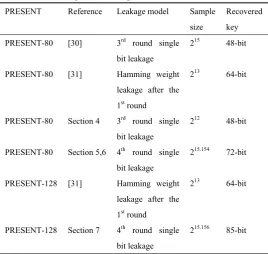
This paper presents several improved side channel cube attacks on PRESENT. Table 1 demonstrates the improvements of the attacks in this paper over several previous attacks.
Table 1. Comparison with previous SCCA on PRESENT
PRESENT Reference Leakage model Sample size
Recovered key PRESENT-80 [30] 3rd round single
bit leakage
215 48-bit
PRESENT-80 [31] Hamming weight leakage after the 1st round
213 64-bit
PRESENT-80 Section 4 3rd round single
bit leakage
212 48-bit
PRESENT-80 Section 5,6 4th round single
bit leakage
215.154 72-bit
PRESENT-128 [31] Hamming weight leakage after the 1st round
213 64-bit
PRESENT-128 Section 7 4th round single
bit leakage
215.156 85-bit
The main contributions of this paper are listed as follows:
(1) Based on the same leakage model of [30],
assuming that single bit information of the 3rd round
S-box lookup output can be leaked, we propose a black box side channel cube attack PRESENT-80. Under the assumption that the internal cipher design of PRESENT
is unknown, and the attacker can only observe the 1st bit
of the first S-box lookup output in the 3rd PRESENT
round, we show that about 32 bits key can be obtained by 27.17 chosen plaintexts.
(2) Based on the 3rd round leakage model of [30], we
get some new results of side channel cube attack on PRESENT-80. Experiment shows that: when the first bit
of the first S-box lookup output is leaked, 27.17 chosen
plaintexts can obtain 32-bit key; when the 2nd, 3rd or 4th bit of the first S-box lookup output is leaked, 28.59 chosen plaintexts can obtain 32-bit key; when the first bit of the 2nd, 3rd, 4th S-box lookup output is leaked, approximately 211.92 chosen plaintexts can obtain 48-bit key, which is
smaller than 215 in [30]. And we provide concrete cube
indexes and key bit related linear equations.
analysis strategy, we propose a new sliding window side channel cube attack on PRESENT, and extend the attack to the 4th round under the single bit leakage model. About 215.14 chosen plaintexts analysis can obtain 60-bit PRESENT-80 key.
(4) Based on the 4th round leakage model, combined
the obtained 60-bit key, we propose a new iterated side channel cube attack on PRESENT. We iterate the recovered key bits into the first round polynomial, and
about 28.15 chosen plaintexts can obtain the extra 12
equivalent key bits, so overall 215.154 chosen plaintexts
can obtain 72-bit key, and reduce the PRESENT-80 master key searching space to 28.
(5) Based on the 4th round leakage model, we extend
the above attacks to PRESENT-128. About 215.156 chosen
plaintexts can obtain 85-bit key, and reduce the
PRESENT-128 master key searching space to 243.
Organization of the Paper. This paper is organized as
follows: A review on the cube attack and the side channel cube attack is briefly presented in Section 1, and the PRESENT cipher is described in Section 2. Then a black box side channel cube attack on PRESENT-80 is proposed in Section 3, the improved side channel cube
attack on PRESENT-80 based on the 3rd round single bit
leakage model is presented in Section 4, and the two extended attacks based on the 4th round single bit leakage model are proposed in Section 5 and Section 6, then the extended attack on PRESENT-128 is proposed in Section 7. Finally, the conclusions and future directions are given in section 8.
1
A Review on the Cube Attack and
Side Channel Cube Attack
1.1. Cube Attack
Cube attack was announced by Dinur and Shamir in
2008[27], and published at EUROCRYPT 2009[28]. The
ideas behind cube attack can be found in several pervious works [32][33]. Cube attack is a generic key-recovery attack that can be applied to cryptosystems under a black-box setting, that is, the internal structure of the target cipher is unknown. It can be used to attack cryptosystem in which the output can be represented as a low-degree decomposition multivariate polynomial by the public variables and the key variables.
As to the m-bit public variables V = {v1, .., vm} and the
n-bit secret key K = {k1, ..., kn} of a cipher, let X = V U
K, then the 1 bit output of a cryptosystem can be
described by a multivariate master polynomial, which is also defined as function f. Suppose I is a subset of V. The
output function f can be written as
f(X)=f(v1, .., vm, k1, ..., kn)=tI•pS(I) + qI (X)
I is called the cube, the index of the subset I is defined
as cube index. tI is the multiple of all variables whose
indexes are in I, pS(I) is called the superpoly, qI contains
any and all terms that are not divisible by tI.
For example, considering a polynomial of degree 3 in 6 variables
f(v1, v2, v3, k1, k2, k3) = v1v2k1 + v1v2k3 + v1v3k2 + v1v2 +
k1k2 + v3 + 1 (1)
Let I ={1,2} be an index subset of size 2. We can
represent f as:
f(v1, v2, v3, k1, k2, k3) = v1v2(k1 + k3+1) +(v1v3k2 + k1k2 +
v3 + 1) (2)
And tI= v1v2, pS(I) = k1 + k3+1, qI = v1v3k2 + k1k2 + v3 + 1
If the subset of variables in the term tI are assigned by
all the possible 0/1 values, and iterated it into f to
compute the polynomial output, then the symbolic sum over GF(2) of all the derived polynomials f is exactly pS(I),
which is the superpoly of tI in f(X). As to the equation
above, the result of this summation is the superpoly of tI,
pS(I) = k1 + k3+1. tI is named as a maxterm of f(X), a linear
polynomial which is not a constant. Applying the above method, a series of linear equations on secret key can be found, and combining the equation solver, the secret key can be recovered.
The cube attack can be divided into two phases: the preprocessing phase and the online phase. In the first phase, the attacker finds maxterms of the master polynomial, the main challenge of the attacker in this phase is how to find many maxterms with linearly independent superpolys sufficiently. The attacker
randomly chooses a subset I of public variables and uses
efficient linearity tests to check whether its superpoly is linear. In case the subset I is too small, the superpoly is likely to be nonlinear and less superpolys can be found,
then the attacker adds a public variable to I and repeats
the process. In case I is too large, the sum will be a
constant function and the required test timing is quite long, in this case the attacker drops one of the public
variables from I and repeats the process. While finding
such linear superpolys can be a challenging preprocessing task, once they are found for a particular cryptosystem, we can repeatedly use them to find any secret key easily during the online phase by summing the outputs of the cryptosystem for every possible assignment to the public
variables V which correspond to one of its maxterms and
K.
1.2. Side Channel Cube Attack
With the increase of the rounds, the degree of the multivariate polynomial grows exponentially. It’s quite difficult to express and store such huge polynomial, how to find sufficient maxterms in a short time is also a tough problem. For now, standard pure cube attacks are only effective to the reduced round variants of stream cipher and block cipher. With the introduction of the side channel attack, the attacker can obtain either the plaintext/ciphertext or the internal state for any intermediate round of block cipher, which is far more information than standard cube attack. However, as for attacks on block cipher, traditional side channel attacks usually focus on the first and last few rounds of block cipher, many information leakages of the deeper intermediate round are not explored in the cryptanalysis, which limits the power of the side channel attack.
Side channel cube attack[26] combines the cube attack
and side channel attack together, besides holding the advantages of the two attacks above, it can use the intermediate round information leakage to satisfy the precondition of the standard cube attack against full rounds cryptosystem and extend the attack to the deeper round of the side channel attack, thus pose real threats to
many block ciphers, such as PRESENT[30][31],
NOEKEON[35] and KATAN[36].
2
A
Brief
Description
of
the
PRESENT Block Cipher
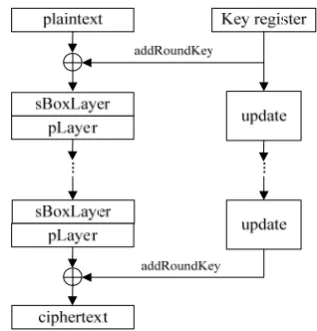
PRESENT is a 31-round SPN structure block cipher with block size of 64 bits, the cipher is described in Figure 1. It supports 80 and 128-bit secret key. Firstly, the plaintext Xored subkey K1 as the input of the 1st round,
after 31 rounds iterations, the 31th round output Xored
with the subkey K32 is the ciphertext.
Encryption procedure:
Each encryption round consists of the following 3 steps:
(1) addRoundKey—AK: At the beginning of each
round, 64 bits output of the last round function is Xored with the subkey.
(2) sBoxlayer—SL. The SL function {0,1}4→{0,1}4
maps input (x0, x1, x2, x3) to output (y0, y1, y2, y3), 16
identical 4-bit to 4-bit S-boxes are used in parallel. The boolean function of S-box is
0 0 2 3 1 2
1 1 3 1 3 2 3 0 1 2 0 1 3 0 2 3
2 2 3 0 1 0 3 1 3 0 1 3 0 2
3 0 1 3 1 2 0 1 2 0 1 3 0 2 3
1 1
y x x x x x
y x x x x x x x x x x x x x x x
y x x x x x x x x x x x x x x
y x x x x x x x x x x x x x x
3
= + + +
= + + + + + +
= + + + + + + +
= + + + + + + +
(3)
(3) pLayer—PL: the ith bit is moved to bit position P(i) by a constant permutation table P.
Figure 1. Overview of PRESENT Encryption Algorithm
Key schedule:
PRESENT can take keys of either 80 or 128 bits. Below is the key schedule algorithm of 80-bit version, more information about PRESENT-128 can be found in [1]. The 80-bit key is stored in a register K=k79||k78||…||k0.
At round r (1≤r≤31) the 64-bit round key Kr consists of the 64 leftmost bits of K. After Kr is extracted, K is rotated by 61 bit positions to the left, then S-box is
applied to the left-most 4 bits of K and finally the
round-counter value r is exclusive-ored with bits
k19||k18||k17||k16||k15 of K with the least significant bit of
round_counter on the right.
Some notations:
Here we introduce some notations in order to make our discussion conveniently.
PSI: cube index set of the plaintext
NSI: numbers of the plaintext cube indexes
SSI: summations of the plaintext cube indexes
Ki: the ith bit of the master key
KME: superpoly of PSI, key bit related linear equation
Ii
j: the target
jth bit of the ih round S-box lookup output in cube attack
Nkb: the number of the recovered key bit
+: boolean xor
3
Black box Side channel Cube
Attack on PRESENT
plaintext bits for block ciphers) and solving a linear system of equations on the secret key variables. Inspired by this idea, under the assumption that the internal cipher design is unknown and the attacker can observe its input
and only single bit information leakage in the 3rd round
S-box lookup output, we apply a black box side channel cube attack on PRESENT-80.
Based on the 3rd round single bit leakage model, we
randomly choose m bits (m=1, 2 or 3) of plaintext as the
cube indexes, n bits (n=1 or n=2) of PRESENT first
round key as the target key bits, and select the bit index of the plaintext, key and ciphertext randomly, then test the linearity of the output secret key equations by
Blum-Luby Rubinfeld (BLR) method [37]. So there are
C164, C264 and C364 plaintext index combinations for m=1,
2 and m=3, 2·C164 (ki or 1+ki)and 2·C264 (ki+kj or 1+ki+kj)
combinations of linear key equations for n=1 and n=2, 64 target ciphertext indexes. If the 1st bit of the 1st S-box
look up is leaked in the 3rd round of PRESENT, the attack
results are shown in Table 2.
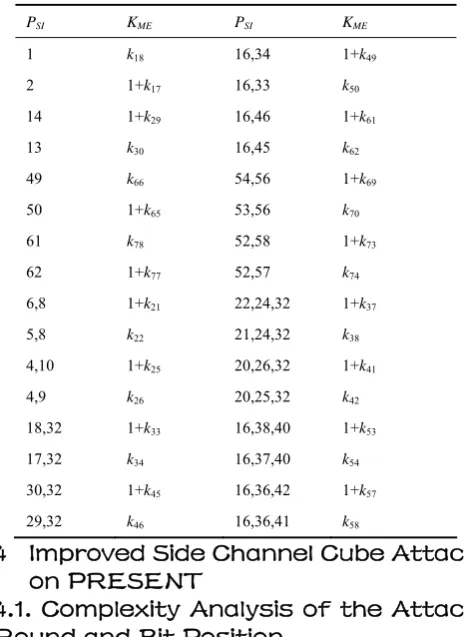
It’s clear to see that about 32-bit of the PRESENT-80 key can be recovered, and the PRESENT-80 master key searching space can be reduced to 248.
Table 2. The 3rd round attack results of I30
PSI KME PSI KME
1 k18 16,34 1+k49 2 1+k17 16,33 k50 14 1+k29 16,46 1+k61 13 k30 16,45 k62 49 k66 54,56 1+k69 50 1+k65 53,56 k70 61 k78 52,58 1+k73 62 1+k77 52,57 k74 6,8 1+k21 22,24,32 1+k37 5,8 k22 21,24,32 k38 4,10 1+k25 20,26,32 1+k41 4,9 k26 20,25,32 k42 18,32 1+k33 16,38,40 1+k53 17,32 k34 16,37,40 k54 30,32 1+k45 16,36,42 1+k57 29,32 k46 16,36,41 k58
4
Improved Side Channel Cube Attack
on PRESENT
4.1. Complexity Analysis of the Attack
Round and Bit Position
In cube attacks on PRESENT, how to choose the attack round r and bit index b is very important. If r is
quite small, such as r=1 and r=2, the complexity of
chosen plaintexts is minimized, however the number of recovered key bits is very small, and the master key
exhaustive searching complexity would be quite high. If r
is quite big, such as r≥4, the maxterms will involve more key bits, but both the degree and number of polynomial will grow exponentially, and the attack complexity would be much higher.
Figure 2. polynomial degree for 64 positions of the rth round S-box lookup output
Figure 2 is the polynomial degree for 64 bit positions
of the rth round PRESENT S-box lookup. It’s clear to see
that with the extending of PRESENT rounds, the degree of the polynomial grows exponentially.
Due to the boolean functions of PRESENT S-box, after
the 1st round S-box lookup, each S-box output bit is
computed by 4 distinct plaintext bits and 4 distinct key bits, and the permutation layer only changes the position
of the state bit without changing its value, after the 2nd
round S-box lookup, each S-box output bit is computed by 16 plaintext bits and 16 distinct key bits, and until the
3rd round S-box lookup, each S-box output bit is begin to
be computed by full 64 plaintext bits and 64 distinct key bits firstly. So considering the recovered key bits number
and polynomial complexity, the 3rd round would be the
best choice for the attacker.
Figure 3. polynomial number for 64-bit positions of the 3rd round S-box lookup
Figure 3 is the sub-polynomial number for 64 bit
positions of the 3rd PRESENT round S-box lookup, it’s
Figure 3, attacking the 1st bit of the S-box 0,1,2,3 would have quite low complexity.
4.2. The Attack Procedure and
Results
In order to reduce the scale of polynomial with the increase of rounds, we adopt the same strategy in [30]. For each round, we reserve these terms involving a key variable and the terms only involving public variables, and discard the terms involving more than one key variable.
According to Figure 2 and Figure 3, we can classify
the side channel cube attack on the 3rd round of
PRESENT-80 into 6 classes; the required sample size and recovered key bit number are shown in Table 3.
Table 3. The 3rd round attack results in this paper
Class Sample size Nkb
Class 1: I30 8·2+16·22+8·23=27.17 32
Class 2: I31, I32, I33 16·22+16·24≈28.59 32
Class 3: I34, I38, I312 12·22+24·25+12·28≈211.92 48
Class 4: I35-7,9-11,13-15 24·28+24·211≈216 48
Class 5: I316,20,..60 24·28+24·217≈222 48
Class 6: I317-19,...,61-63 48·226=232≈232 48
Table 4. The 3rd round attack results in [30]
Class Sample size Nkb
Class 1:I30,I31,I32,I33 32
Class 2: I34, I38, I312 12·(22+25+28+211)≈215 48
Class 3: I35-7,9-11,13-15 24·28+24·211≈216 48
Class 4: I316,20,..60 24·28+24·217≈222 48
Class 5: I317-19,...,61-63 48·226≈232 48
Our classifications and attack results are different with [30] as follows:
(1) Be different from [30] by sorting the attack bits into 5 classes, we sort the bits into 6 classes by different S-box index and S-box output bit position. We discover
that the sample size of attacking the 1st bit of S-box 0
(Table 2) are different with the 2nd, 3rd, and 4th bit of S-box 1 (Appendix Table A.1). When the first bit of the first S-box lookup output is leaked, 27.17 chosen plaintexts can obtain 32-bit key; when the 2nd, 3rd or 4th bit of the first S-box lookup output is leaked, 28.59 chosen plaintexts can obtain 32-bit key.
(2) We show that the least sample size of attacking the
1st bit of S-box 1, 2, 3 is about 211.92, which is much
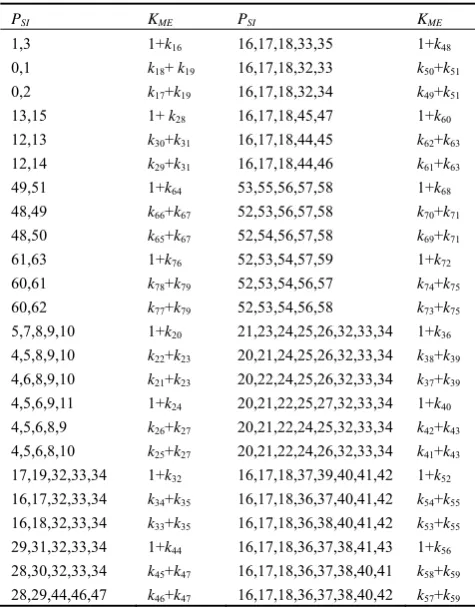
smaller than 215 in [30], the results of attacking the 1st bit of S-box 1 is shown in Table 5, the results of attacking
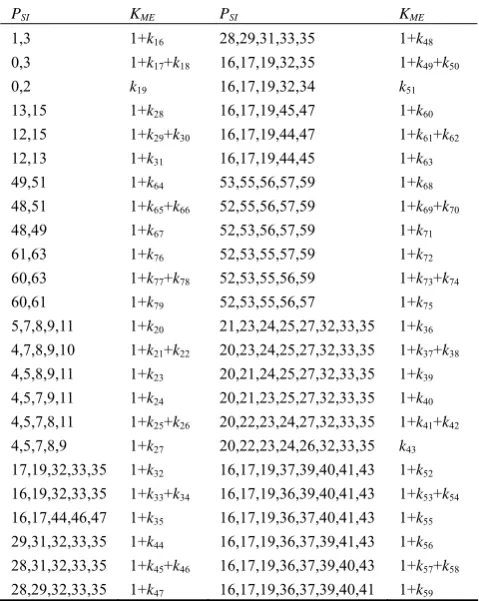
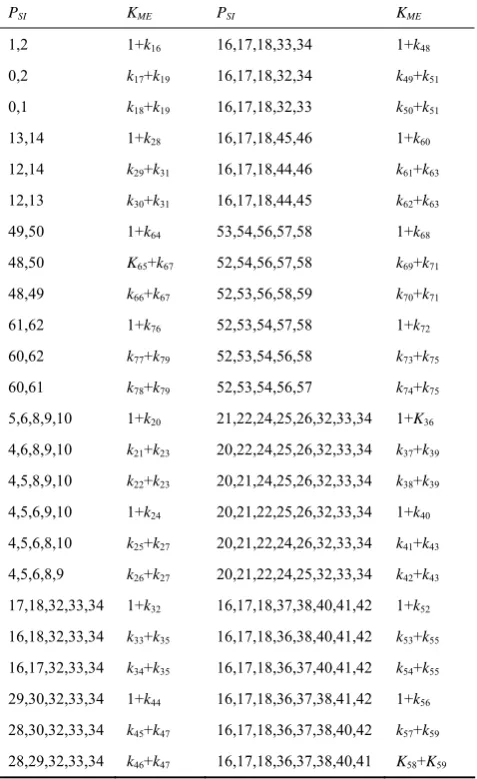
the 1st bit of S-box 2 and 3 are shown in Appendix Table
A.2 and A.3.
Table 5. The 3rd round attack results of I34
PSI KME PSI KME
1,3 1+k16 16,17,18,33,35 1+k48 0,1 k18+ k19 16,17,18,32,33 k50+k51 0,2 k17+k19 16,17,18,32,34 k49+k51 13,15 1+ k28 16,17,18,45,47 1+k60 12,13 k30+k31 16,17,18,44,45 k62+k63 12,14 k29+k31 16,17,18,44,46 k61+k63 49,51 1+k64 53,55,56,57,58 1+k68 48,49 k66+k67 52,53,56,57,58 k70+k71 48,50 k65+k67 52,54,56,57,58 k69+k71 61,63 1+k76 52,53,54,57,59 1+k72 60,61 k78+k79 52,53,54,56,57 k74+k75 60,62 k77+k79 52,53,54,56,58 k73+k75 5,7,8,9,10 1+k20 21,23,24,25,26,32,33,34 1+k36 4,5,8,9,10 k22+k23 20,21,24,25,26,32,33,34 k38+k39 4,6,8,9,10 k21+k23 20,22,24,25,26,32,33,34 k37+k39 4,5,6,9,11 1+k24 20,21,22,25,27,32,33,34 1+k40 4,5,6,8,9 k26+k27 20,21,22,24,25,32,33,34 k42+k43 4,5,6,8,10 k25+k27 20,21,22,24,26,32,33,34 k41+k43 17,19,32,33,34 1+k32 16,17,18,37,39,40,41,42 1+k52 16,17,32,33,34 k34+k35 16,17,18,36,37,40,41,42 k54+k55 16,18,32,33,34 k33+k35 16,17,18,36,38,40,41,42 k53+k55 29,31,32,33,34 1+k44 16,17,18,36,37,38,41,43 1+k56 28,30,32,33,34 k45+k47 16,17,18,36,37,38,40,41 k58+k59 28,29,44,46,47 k46+k47 16,17,18,36,37,38,40,42 k57+k59
5
Sliding Window Side Channel Cube
Attack on PRESENT
5.1. Sliding Window Attack Idea
From above, we can see that, based on the model of
single bit information leakage in the 3rd PRESENT round,
at most 48-bit key can be obtained and reduce the
PRESENT-80 master key search space to 232. In order to
obtain more key bits, we try to extend the attack to the 4th round.
However, as discussed in Section 4.1, both the degree and number of the polynomial grow exponentially with the extending of the rounds. From Figure 2 and Figure 3,
we can see that I40 has the lowest polynomial degree,
which is 24, and the number of its related 4 bit of the 4th
round S-box lookup input (almost the bit 0,4,8,12 of the 3rd round S-box lookup output in Figure 3) is much smaller than others. So we choose I40 as the target bit.
construction of the target bit polynomial, and extract the related maxterms separately within less complexity.
As the scale of the polynomial is reduced rapidly, sliding window side channel cube attack is quite efficient under deeper rounds leakge model, and can extract the maxterms more efficiently, the same idea is also proposed in [34].
(1) First level divide and conquer strategy
According to the cube plaintext index number NSI, we
divide the attack into 23 cases for NSI =i(i=[1,23]. And for
each NSI candidate, for each encryption round, we reserve
these terms involving at most one key variable and public variables number smaller than or equal to NSI, and discard
the terms involving more than one key variable or public variables number bigger than NSI.
(2) Second level divide and conquer strategy
For each candidate of NSI=i, according to all the
possible plaintext cube index sum SSI=i(i=[0,63·NSI], we
propose sliding window size L as one time processing SSI
candidate number, and divide the attack into
N=(1+63·NSI)/L cases, compute all the possible cube
index set PSI, and verify PSI for about 100 random
generated keys and PSI related tweakable plaintext
encryptions by BLR tests[37].
5.2. Proposed Attack and Results
Based on the 4th round single bit leakage model,
applying the sliding window side channel cube attack, we set L=16, compute the 11 cases for NSI =i(i=[1,11], and
then execute the attack. The cube index set PSI and related
linear key equations are shown in Table 6.
Table 6. The 4th round attack results of I40
PSI KME PSI KME
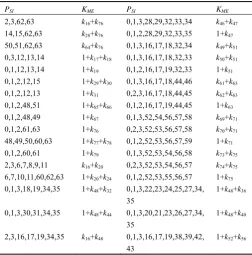
2,3,62,63 k16+k76 0,1,3,28,29,32,33,34 k46+k47 14,15,62,63 k28+k76 0,1,2,28,29,32,33,35 1+k47 50,51,62,63 k64+k76 0,1,3,16,17,18,32,34 k49+k51 0,3,12,13,14 1+k17+k18 0,1,3,16,17,18,32,33 k50+k51 0,1,12,13,14 1+k19 0,1,2,16,17,19,32,33 1+k51 0,1,2,12,15 1+k29+k30 0,1,3,16,17,18,44,46 k61+k63 0,1,2,12,13 1+k31 0,2,3,16,17,18,44,45 k62+k63 0,1,2,48,51 1+k65+k66 0,1,2,16,17,19,44,45 1+k63 0,1,2,48,49 1+k67 0,1,3,52,54,56,57,58 k69+k71 0,1,2,61,63 1+k76 0,2,3,52,53,56,57,58 k70+k71 48,49,50,60,63 1+k77+k78 0,1,2,52,53,56,57,59 1+k71 0,1,2,60,61 1+k79 0,1,3,52,53,54,56,58 k73+k75 2,3,6,7,8,9,11 k16+k20 0,2,3,52,53,54,56,57 k74+k75 6,7,10,11,60,62,63 1+k20+k24 0,1,2,52,53,55,56,57 1+k75 0,1,3,18,19,34,35 1+k48+k32 0,1,3,22,23,24,25,27,34,
35
1+k48+k36
0,1,3,30,31,34,35 1+k48+k44 0,1,3,20,21,23,26,27,34, 35
1+k48+k40
2,3,16,17,19,34,35 k16+k48 0,1,3,16,17,19,38,39,42, 43
1+k52+k56
PSI KME PSI KME
0,1,3,18,19,46,47 1+k32+k60 0,1,3,18,19,36,37,39,42, 43
1+k32+k56
0,1,3,54,55,58,59 1+k72+k68 0,1,3,20,22,24,25,26,32, 33,34
k37+k39
2,3,52,53,55,58,59 k16+k72 0,1,3,20,21,24,25,26,32, 33,34
k38+k39
0,1,3,4,6,8,9,10 k21+k23 0,1,2,20,21,24,25,27,32, 33,35
1+k39
0,1,3,4,5,8,9,10 k22+k23 0,1,3,20,21,22,24,26,32, 33,34
k41+k43
0,1,2,4,5,8,9,11 1+k23 0,1,3,20,21,22,24,25,32, 33,34
k42+k43
0,1,3,4,5,6,8,10 k25+k27 0,1,2,20,21,23,24,26,32, 34,35
k43
0,1,3,4,5,6,8,9 k26+k27 0,1,3,16,17,18,36,38,40, 41,42
k53+k55
0,1,2,4,5,7,8,9 1+k27 0,1,3,16,17,18,36,37,40, 41,42
k54+k55
0,1,3,16,18,32,33,34 k33+k35 0,1,2,16,17,19,36,37,40, 41,43
1+k55
0,1,3,16,17,32,33,34 k34+k35 0,1,3,16,17,18,36,37,38, 40,42
k57+k59
0,1,2,16,17,32,33,35 1+k35 0,1,3,16,17,18,36,37,38, 40,41
k58+k59
0,1,3,28,30,32,33,34 k45+k47 0,1,2,16,17,19,36,37,39, 40,41
1+k59
It’s clear to see that when NSI =4,5,7,8,10,11, we can
obtain 60 linear key equations, and recover 60-bit of the master key within 3·24+9·25+8·27+24·28+4·210+12·211
≈215.14 chosen plaintexts. Note that we can only obtain k17+k18, k29+k30, k65+k66, k77+k78, but without known the
exact value of k17, k18, k29, k30, k65, k66, k77, k78.
6
Iterated Side Channel Cube Attack
on PRESENT
6.1. Iterated Attack Idea
From section 5, we can obtain 60-bit of the PRESENT master key, in order to recover the exact value
of ki (i ∈A, and A={17,18,29,30,65,66,77,78}), we
propose a new iterated side channel cube attack on PRESENT.
The main idea of iterated side channel cube attack on PRESENT is to iterate the recovered key bits into the former polynomial, and apply a extended side channel cube attack, it can reduce the degree and number of the polynomial, and deduce more key bits related equations, And the chosen plaintext cube variable can make a small change here, as to ki , if i A, we still choose Pi as the
tweakable cube variable, but if i A, we can choose Pi
⊕k16+i as the equivalent extended tweakable cube
variable.
∈
∉
6.2. Proposed Attack and Results
(1) Iteration based attack 1
PRESENT, choose related Pi⊕k16+i as the equivalent
tweakable cube, and apply the cube attack on the 4th
round of PRESENT. The k17, k18, k29, k30, k65, k66, k77, k78
can be recovered by following cube indexes, as shown in Table 7.
Table 7. Results of iterated attack 1 on I40
PSI KME PSI KME
0,2,12,13,15 k17 0,1,3,48,50 k65 0,3,12,13,14 1+k17+k18 0,1,3,48,49 1+k66 0,1,3,12,14 k29 0,1,3,60,62 k77 0,1,3,12,13 1+k30 0,1,3,60,61 1+k78
(2) Iteration based attack 2
After k17, k18, k29, k30, k65, k66, k77, k78 are recovered,
in order to obtain ki, i∈[0,15], we can iterate all 64-bit ki,
i∈[16,79] into the first 4 rounds polynomial of
PRESENT, and choose the first round output(PL(SL(AK(P,K1)))) bit as the equivalent tweakable cube variable, then apply the attack. As shown in Table 8, we can recover 8 extra key bits: k0,k1,k4,k5,k8,k9,k12,k14.
Table 8. Results of iterated attack 2 on I40
PSI KME PSI KME
50 1+k4 54,56 1+k8
49 k5 53,56 k9
16,46 1+k0 52,58 1+k12 16,45 k1 52,57 k13
So after 2 iteration based attacks, using about 282≈28.14 choosing plaintexts, we can obtain 12-bit key.
Combing the 60-bit key extracted in Section 5, totally
about 215.154 chosen plaintexts can reduce the
PRESENT-80 master key searching space from 280 to 28.
7
Side Channel Cube attack on
PRESENT-128
Note that the two attack methods above can be
easily extended to PRESENT-128. Based on the 4th round
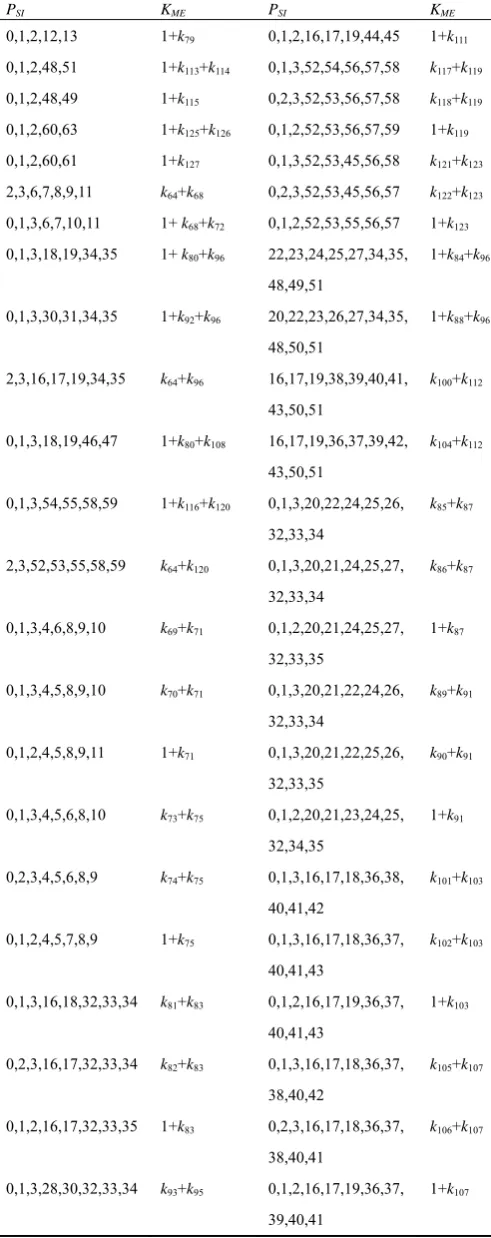
leakage model, applying the sliding window side channel cube attack of Section 5, we extend the attack to PRESENT-128 and recover 60-bit key, as is shown in Table 9.
Table 9. The 4th round attack results of
I40(PRESENT-128)
PSI KME PSI KME
2,3,14,15 k64+k76 0,2,3,28,29,32,33,34 k94+k95 2,3,50,51 k64+ k112 0,1,2,28,29,32,33,35 1+k95 2,3,62,63 k64+k124 0,1,3,16,17,18,32,34 k97+k99 1,2,12,13,15 k64 0,2,3,16,17,18,32,33 k98+k99 0,3,12,13,14 1+k65+k66 0,1,2,16,17,19,32,33 1+k99 0,2,12,13,14 K67 0,1,3,16,17,18,44,46 k109+k111 0,1,2,12,15 1+k77+k78 0,2,3,16,17,18,44,45 k110+k111
PSI KME PSI KME
0,1,2,12,13 1+k79 0,1,2,16,17,19,44,45 1+k111 0,1,2,48,51 1+k113+k114 0,1,3,52,54,56,57,58 k117+k119 0,1,2,48,49 1+k115 0,2,3,52,53,56,57,58 k118+k119 0,1,2,60,63 1+k125+k126 0,1,2,52,53,56,57,59 1+k119 0,1,2,60,61 1+k127 0,1,3,52,53,45,56,58 k121+k123 2,3,6,7,8,9,11 k64+k68 0,2,3,52,53,45,56,57 k122+k123 0,1,3,6,7,10,11 1+ k68+k72 0,1,2,52,53,55,56,57 1+k123 0,1,3,18,19,34,35 1+ k80+k96 22,23,24,25,27,34,35,
48,49,51
1+k84+k96
0,1,3,30,31,34,35 1+k92+k96 20,22,23,26,27,34,35, 48,50,51
1+k88+k96
2,3,16,17,19,34,35 k64+k96 16,17,19,38,39,40,41, 43,50,51
k100+k112
0,1,3,18,19,46,47 1+k80+k108 16,17,19,36,37,39,42, 43,50,51
k104+k112
0,1,3,54,55,58,59 1+k116+k120 0,1,3,20,22,24,25,26, 32,33,34
k85+k87
2,3,52,53,55,58,59 k64+k120 0,1,3,20,21,24,25,27, 32,33,34
k86+k87
0,1,3,4,6,8,9,10 k69+k71 0,1,2,20,21,24,25,27, 32,33,35
1+k87
0,1,3,4,5,8,9,10 k70+k71 0,1,3,20,21,22,24,26, 32,33,34
k89+k91
0,1,2,4,5,8,9,11 1+k71 0,1,3,20,21,22,25,26, 32,33,35
k90+k91
0,1,3,4,5,6,8,10 k73+k75 0,1,2,20,21,23,24,25, 32,34,35
1+k91
0,2,3,4,5,6,8,9 k74+k75 0,1,3,16,17,18,36,38, 40,41,42
k101+k103
0,1,2,4,5,7,8,9 1+k75 0,1,3,16,17,18,36,37, 40,41,43
k102+k103
0,1,3,16,18,32,33,34 k81+k83 0,1,2,16,17,19,36,37, 40,41,43
1+k103
0,2,3,16,17,32,33,34 k82+k83 0,1,3,16,17,18,36,37, 38,40,42
k105+k107
0,1,2,16,17,32,33,35 1+k83 0,2,3,16,17,18,36,37, 38,40,41
k106+k107
0,1,3,28,30,32,33,34 k93+k95 0,1,2,16,17,19,36,37, 39,40,41
1+k107
During the attack ,we choose the cube plaintext index
number NSI =4,5,7,8,10,11, and obtain 60 linear key
equations, finally recover 60-bit of the master key within
about 215.14 chosen plaintexts. Note that we can only
obtain k65+k66, k77+k78, k113+k114, k125+k126, but without
known the exact value of k65,k66,k77,k78,k113,k114,k125,k126.
apply the iterated attack 1 in Section 6, and obtain the other 8 undetermined key bits, as is shown in Table 10.
Table 10. Results of iterated attack 1 on I40(PRESENT-128)
PSI KME PSI KME
0,2,12,13,15 k65 0,1,3,48,50 k113 0,3,12,13,14 k128+k65+k66 0,1,3,48,49 k128+k114 0,1,3,12,13 k128+k78 0,1,3,60,62 k125 0,1,2,12,15 k128+k77+k78 0,1,3,60,61 k128+ k126
Then we apply the iterated attack 2 in Section 6, and obtain other 21 key bits, as is shown in Table 11. It’s clear to see that we can extract extra 21 key bits, which is more than 8 key bits of attack on PRESENT-80. This is mainly caused by the subtle difference between the key schedule of PRESENT-80 and PRESENT-128.
Table 11. Results of iterated attack 2 on I40(PRESENT-128)
PSI KME PSI KME PSI KME
1 k5 6,8 1+k8 16,33 k37 2 1+k4 4,9 k13 16,34 1+k36 13 k17 4,10 1+k12 16,45 k49 14 1+k16 17,32 k21 16,46 1+k48 49 k53 18,32 1+k20 53,56 k57 50 1+k52 29,32 k33 54,56 1+k56 5,8 k9 30,32 1+k32 16,37,40 K41
So after 2 iteration based attacks, using about 326≈28.35 choosing plaintexts, we can obtain 25-bit key.
Combing the 60-bit key above, totally about 215.156
chosen plaintexts can reduce the PRESENT-128 master key searching space from 2128 to 243.
8
Conclusion and Future Research
Under the novel precondition of obtaining accurate single bit information leakage model, this paper proposes some improved side channel cube attacks on PRESENT. Our best result is that: based on the 4th round single bit
leakage model, about 211.92 chosen plaintexts can extract
48-bit PRESENT-80; based on the 4th round single bit
leakage model, by applying the sliding window and iteration based attack strategies of this paper, about 215.154
and 215.156 chosen plaintexts can extract 72-bit
PRESENT-80 and 85-bit PRESENT-128 key. As far as we know, this is the most efficient side channel cube attack on PRESENT-80/128.
The further research can be planned as follows: (1) Identify resistant S-boxes against side channel cube attacks
(2) Physical side channel cube attacks based on different leakage models
(3) Nonlinear equation based side channel cube attacks
(4) Error resistant side channel cube attacks
References
[1] Bogdanov, A., Knudsen, L.R., Leander, G., Paar, C., et al. PRESENT: An Ultra-Lightweight Block Cipher[A]. In: Paillier, P., Verbauwhede, I. (eds.) CHES 2007[C]. LNCS, vol. 4727, 2007, pp. 450–466.
[2] Bruce Schneier. Applied Cryptography[B], 1996.
[3] Jean-Jacques Quisquater, Math RiZK. Side channel attacks-State-of-the-art[R]. October 2002.
[4] YongBin Zhou, DengGuo Feng. Side-Channel Attacks: Ten Years After Its Publication and the Impacts on Cryptographic Module Security Testing. Cryptology ePrint Archive, Report 2005/388, 2005.
[5] Wang, M.Q.: Differential Cryptanalysis of Reduced-Round PRESENT[A]. In: Vaudenay, S. (ed.) AFRICACRYPT 2008[C]. LNCS, vol. 5023, 2008, pp. 40–49.
[6] Albrecht, M., Cid, C. Algebraic Techniques in Diferential Cryptanalysis[A]. In: Dunkelman, O. (ed.) FSE 2009[C]. LNCS, vol. 5665, 2009, pp. 193–208.
[7] Manoj Kumar, Pratibha Yadav, Meena Kumari. Flaws in Differential Cryptanalysis of Reduced Round PRESENT [EB/OL]. Cryptology ePrint Archive, Report 2010/407, 2010.
[8] Ohkuma, K. Weak keys of reduced-round PRESENT for linear cryptanalysis[A]. In: Preproceeding of SAC 2009[C], 2009. [9] Jorge Nakahara Jr., Pouyan Sepehrdad, Bingsheng Zhang,
and Meiqin Wang. Linear (Hull) and Algebraic Cryptanalysis of the Block Cipher PRESENT[A]. J.A. Garay, A. Miyaji, and A. Otsuka (Eds.): CANS 2009[C], LNCS 5888, 2009, pp. 58–75. [10] Cho, J. Linear Cryptanalysis of Reduced-Round PRESENT.
In: Topics in Cryptology-CT-RSA 2010, The Cryptographers' Track at the RSA Conference 2010, San Francisco, CA, USA, March 1-5, 2010, Springer (2010)
[11] Collard, B., Standaert, F.X. A Statistical Saturation Attack against the Block Cipher PRESENT. In: CT-RSA 2009. LNCS, vol. 5473, 2009, pp. 195–210.
[12] Onur Ozen, Kerem Var, Cihangir Tezcan, and C¸ elebi Kocair. Lightweight Block Ciphers Revisited: Cryptanalysis of Reduced Round PRESENT and HIGHT[A]. C. Boyd and J. Gonz´alez Nieto (Eds.): ACISP 2009[C], LNCS 5594, 2009, pp. 90–107.
[13] BU Fan, JIN Chen-hui. Algebraic Attack on Low—round PRESENT(In Chinese). Computer Engineering, 2010, 36(6):128-130.
[14] Paul C. Kocher. Timing Attacks on Implementations of Diffie-Hellman, RSA, DSS, and Other Systems [A]. CRYPTO 96[C], LNCS 1109, 1996, pp.104–113.
[15] P. Kocher, J.Jaffe, B. Jun. Differential power analysis[A]. CRYPTO '99[C] (M. Wiener, ed.), LNCS 1666, 1999, pp. 388-397.
[16] J. J. Quisquater, D. Samyde. A new tool for non-intrusive analysis of smart cards based on electro-magnetic emissions: the SEMA and DEMA methods[EB/OL]. Eurocrypt rump session, 2000.
[17] Shamir, A. and Tromer, E. Acoustic cryptanalysis: On nosy people and noisy machines[EB/OL]. Avaiable at http://www.wisdom.weizmann.ac.il/~tromer/acoustic/, 2004. [18] D.Boneh, R.A.DeMillo, R.J.Lipton. On the Importance of
[19] Carsten Rolfes. Side-Channel Analysis Aspects of Lightweight Block Ciphers. Diploma Thesis of Ruhr-University Bochum, February 28, 2009.
[20] Li, J.R., Gu, D.W. Differential Fault Analysis on PRESENT[A]. CHINACRYPT 2009[C](in chinese), 2009, pp.3-13.
[21] Wang, G.L., Wang, S.S. Differential Fault Analysis on PRESENT Key Schedule[A]. In Proc of International Conference on Computational Intelligence and Security (CIS 2010[C]), 2010, pp.362-366.
[22] XinJjie Zhao, Tao Wang, ShiZe Guo. Fault Propagate Pattern Based DFA on SPN Structure Block Ciphers using Bitwise Permutation, with Application to PRESENT and PRINTcipher[EB/OL]. Cryptology ePrint Archive, Report 2011/089, 2011.
[23] Andrey Bogdanov, Andrey Pyshkin. Algebraic Side-Channel Collision Attacks on AES[EB/OL], Cryptology ePrint Archive, Report 2007/477, 2007.
[24] M. Renauld, F.-X. Standaert. Algebraic Side-Channel Attacks[EB/OL], Cryptology ePrint Archive, Report 2009/279, 2009.
[25] N.T.Courtois, J.Pieprzyk. Cryptanalysis of block ciphers with over-defined systems of equations[A]. In Y. Zheng (Ed.): ASIACRYPT 2002[C], LNCS 2501, 2002, pp.267–287.
[26] Dinur, I., Shamir, A. Side Channel Cube Attacks on Block Ciphers[EB/OL]. Cryptology ePrint Archive. Report 2009/127. [27] Dinur, I., Shamir, A. Cube Attacks on Tweakable Black Box
Polynomials. Cryptology ePrint Archive, Report 2008/385, 2008. [28] Dinur, I., Shamir, A. Cube Attacks on Tweakable Black Box Polynomials[A]. In: Joux, A. (ed.) EUROCRYPT 2009[C]. LNCS, vol. 5479, 2009, pp. 278–299.
[29] Aumasson, J.-P., Dinur, I., Meier, W., Shamir, A. Cube Testers and Key Recovery attacks on Reduced-Round MD6 and Trivium[A]. In: Dunkelman, O. (ed.) FSE 2009[C]. LNCS, vol. 5665, 2009, pp. 1–22.
[30] Lin Yang, Meiqin Wang, and Siyuan Qiao. Side Channel Cube Attack on PRESENT[A]. In J.A. Garay, A. Miyaji, and A. Otsuka (Eds.): CANS 2009[C], LNCS 5888, 2009, pp. 379–391. [31] Shekh Faisal Abdul-Latip, Mohammad Reza Reyhanitabar,
Willy Susilo and Jennifer Seberry.Extended Cubes: Enhancing the cube attack by Extracting Low-Degree Non-linear Equations [A]. In Bruce Cheung, Lucas Chi Kwong Hui, Ravi Sandhu, Duncan S.Wong (Eds.): ASIACCS 2011[C], 2011, pp.296–305.
[32] Vielhaber, M. Breaking ONE.FIVIUM by AIDA - an Algebraic IV Differential Attack. Cryptology ePrint Archive, Report 2007/413 (2007) http://eprint.iacr.org/.
[33] Lai, X. Higher Order Derivatives and Differential Cryptanalysis. Communications and Cryptography: Two Sides of One Tapestry (1994) pp. 227
[34] Aileen Zhang, Chu-Wee Lim, Khoongming Khoo, Wei Lei, and Josef Pieprzyk. Extensions of the Cube Attack based on Low Degree Annihilators[EB/OL]. Cryptology ePrint Archive. Report 2009/049.
[35] Shekh Faisal Abdul-Latip, Mohammad Reza Reyhanitabar, Willy Susilo, and Jennifer Seberry. On the Security of NOEKEON against Side Channel Cube Attacks[A]. ISPEC 2010[C], LNCS 6047, 2010, pp. 45–55.
[36] Gregory V. Bard, Nicolas T. Courtois, Jorge Nakahara Jr, Pouyan Sepehrdad, and Bingsheng Zhang. Algebraic, AIDA/Cube and Side Channel Analysis of KATAN Family of Block Ciphers[A].
[37] Blum, M., Luby, M., Rubinfeld, R. Self-testing/correcting with applications to numerical problems. In: Proceedings of the twenty-second annual ACM symposium on Theory of computing. STOC '90, New York, NY, USA, ACM (1990) 73-83.
Appendix
Table A.1. The 3rd round attack results of I31
PSI KME PSI KME
2,16,32 1+k17 6,8,16,32 1+k21 1,16,32 k18 5,8,16,32 k22 14,16,32 1+k29 4,10,16,32 1+k25 13,16,32 k30 4,9,16,32 k26 0,18,32 1+k33 0,22,24,32 1+k37 0,17,32 k34 0,21,24,32 k38 0,30,32 1+k45 0,20,26,32 1+k41 0,29,32 k46 0,20,25,32 k42 0,16,34 1+k49 0,16,38,40 1+k53 0,16,33 k50 0,16,37,40 k54 0,16,46 1+k61 0,16,36,42 1+k57 0,16,45 K62 0,16,36,41 k58 0,16,50 1+k65 0,16,54,56 1+k69 0,16,49 k66 0,16,53,56 k70 0,16,62 1+k77 0,16,52,58 1+k73 0,16,61 k78 0,16,52,57 k74
Table A.2. The 3rd round attack results of
I38
PSI KME PSI KME
Table A.3. The 3rd round attack results of I312
PSI KME PSI KME