(Full Version
?)
Felix G¨unther, Mark Manulis, and Thorsten Strufe
TU Darmstadt & CASED, Germany
{guenther, strufe}@cs.tu-darmstadt.de,[email protected]
Abstract. The publication of private data in user profiles in a both secure and private way is a rising problem and of special interest in, e.g., online social net-works that become more and more popular. Current approaches, especially for decentralized networks, often do not address this issue or impose large storage overhead. In this paper, we present a cryptographic approach toprivate profile managementthat is seen as a building block for applications in which users main-tain their own profiles, publish and retrieve data, and authorize other users to access different portions of data in their profiles. In this course, we provide: (i) formalization ofconfidentialityandunlinkabilityas two main security and pri-vacy goals for the data which is kept in profiles and users who are authorized to retrieve this data, and (ii) specification, analysis, and comparison of two private profile management schemes based on different encryption techniques.
1
Introduction
Publishing personal profiles and other means of sharing private data are increasingly popular on the web. Online social networks (OSN) arguably are the most accepted net-worked service, today. Facebook alone, serving a claimed base of over 500 Million active users1, surpassed google, and currently enjoys the highest utilization duration by their users and one of the highest access frequencies of all web sites since January 20102. Its users share 90 pieces of content per month on average, mainly consisting of personally identifiable information. Protecting this data against unauthorized access is of utmost importance, since users store private and sensitive data in their OSN profiles. Theconfidentialityof published data, meant to be shared with only a chosen group of users, is already important in centralized services. Yet, it becomes even more press-ing when establishpress-ing decentralized OSN, which have been proposed recently [8,4,13] in an attempt to avoid the centralized control and omnipotent access of commercial ser-vice providers.Unlinkabilityis the more subtle requirement of protecting the identity of users who are successively interact or access certain chunks of published data. It frequently is missed and only few general solutions achieve this privacy goal [2].
?
A preliminary version of this paper appears in FC 2011, RLCPS Workshop. This is the full version.
1http://www.facebook.com/press/info.php?statistics
, Oct 2010
A serious corpus of solutions has been proposed to address these issues in the past. Yet, there so far exist no appropriate definitions for secure and private management of user profiles, even from the cryptographic point of view, as we show in Section 2.
In this paper, we hence take a cryptographic approach to address the management of user profiles in a secure and privacy-friendly way. To this end, our goal is to come up with a well-defined model and provably secure solutions, both to ensure the confiden-tiality of data, which individually is published by users in their social profiles, as well as for the privacy of the users who are allowed to access this data. For this purpose we formally define confidentiality and privacy in the given context, first. Our model fur-ther addresses several fundamental properties of a profile management scheme (PMS). They comprise of the ability of users (profile owners) to publish and remove data, as well as their ability to grant, modify, and revoke access rights to the published data. In particular, we consider PMS as an independent building block, without relying on the higher-level application or any other parties to perform these tasks.
After the specification of the model, we describe two provably secure solutions that use different techniques: our first solution, called PMS-SK, combines symmet-ric encryption with shared keys that are then distributed amongst the authorized users. Our second solution, called PMS-BE, involves broadcast encryption techniques. Both solutions have their advantages and disadvantages with respect to their performance and privacy, as we show in our subsequent analysis. In particular, PMS-SK provides confidentiality and perfect unlinkability, but imposes an overhead of keys linear in the number of attributes a user is allowed to access, and which have to be stored by her. PMS-BE reduces the key overhead to a constant value at the cost of lower privacy, ex-pressed through the requirement ofanonymity, which we also model and formally relate to the stronger notion of unlinkability. We further discuss the trade-off between privacy and efficiency by evaluating some complexity characteristics of both approaches and suggest several optimizations that could enhance their performance, while preserving their security and privacy guarantees.
The rest of the paper is organized as follows: In Section 2 we discuss previous cryptographic and non-cryptographic work on private management of user profiles. In Section 3, we introduce our formal model for such schemes and define two require-ments: confidentiality and unlinkability. In Sections 4 and 5 we specify our PMS-SK and PMS-BE solutions, evaluate their complexity (including possible optimizations) and formally address their security and privacy properties as well as the notion of anonymity. In Section 6 we discuss the impact of both schemes on real-world online communities such as Facebook, Twitter and Flickr.
2
Related Work
access to private data is modeled using semantic rules taking into account the depth of social relationships and the amount of trust amongst the users. In addition to being semi-centralized, this approach requires synchronous communication — a significant limitation in our case. There exist several cryptographic approaches to improve confi-dentiality and privacy in existing, mostly centralized OSNs: Lucas et. al [16] presented flyByNight, an application to encrypt sensitive data in Facebook. Tootoonchian [21] pro-posed a system calledLockrto improve privacy in both centralized and decentralized social networks. Yet, both approaches are not able to keep security and/or privacy up un-der certain attacks:flyByNightrelies on the Facebook servers as middlemen and thus en-ables them to introduce malicious code or keys whilst inLockrmalicious users are able to reveal relationship keys or disclose relationship metadata for access control, compro-mising privacy properties of the system. Another cryptographic approach isScramble! [19], a Firefox plugin that uses the OpenPGP standard [5] to encrypt data relying on its public-key infrastructure. Moreover, Scramble! tries to achieve recipient anonymity by omitting the public identifiers of recipients in the ciphertext and allows for data storage on third-party storage using “tiny URLs”, thus reducing the size of ciphertexts. Never-theless, the approach implies linear storage overhead and, as it relies on OpenPGP, is vulnerable to active attacks as shown by Barth et al. [2]. A number of solutions aim at binding the access to private data with some fine-grained access policies. For example, Graffi et al. [12] implemented an approach based on symmetric encryption of profile items with independent shared keys, yet without actually specifying or formally ana-lyzing the desired security and privacy properties. OSNPersona, presented by Baden et al. [1], implements ciphertext-policy attribute-based encryption (CP-ABE) [3] for the enforcement of access rules to the encrypted profile data (e.g., “ ’neighbor’ AND ’foot-ball fan’ ”). Their approach aims at confidentiality of attributes but does not guarantee privacy. Similarly,EASiER[15] which in addition to CP-ABE requires a semi-trusted proxy for the update of decryption keys upon revocation events does not consider pri-vacy. Recently, Zhu et al. [25] proposed a collaborative framework to enforce access control in OSNs by the use of a new group-oriented convergence cryptosystem. Their scheme is centralized and focuses on joint publication of data within communities, less on the individual users and protection of their own profiles and data. A somewhat more general construct for privacy-preserving distribution of encrypted content was proposed by Barth et al. [2] using public-key broadcast encryption. Of particular interest is their notion ofrecipient privacy, which is supposed to hide the identities of recipients of the broadcast content and can be applied for the private distribution of shared keys in our PMS-SK approach (cf. Remark 1) at the cost of linear storage overhead in the number of recipients. Their scheme could also be used as a building block for a private pro-file management scheme that would, however, require linear storage overhead for the distribution of ciphertexts.
3
Private User Profiles: Model and Definitions
3.1 Management of User Profiles
that users can create authentic and, if necessary, confidential communication channels. This assumption is motivated by the fact that the profile management scheme will likely be deployed as a building block within an application, like an online social network, where users typically have other means of authentication. In this way we can focus on the core functionality of the profile management scheme, namely the management of and access to the profile data.
Profiles. AprofilePis modeled as a set of pairs(a,d)¯ ∈ I ×{0,1}∗whereI ⊆ {0,1}∗
is the set of possibleattribute indicesaandd¯are correspondingvaluesstored inP. We assume that within a profileP attribute indices are unique. Furthermore, we assume that each profileP is publicly accessible but is distributed in an authentic manner by itsownerUP ∈ U. Also, every userU owns at most one profile and the profile owned by U is denoted PU. The authenticity of profiles means that their content can only be manipulated by their respective owner who is in possession of the corresponding profile management keypmk. Since one of the goals will be to ensure confidentiality of attributes we assume that for each publicly accessible valued¯there exists the actual attributedand that for any pair(a,d)¯ ∈Pthe profile ownerUP can implicitly retrieve the correspondingdas well as the groupG ⊆ Uof users who are currently authorized to accessd. ByG∗
a,P we denote the set of users that have ever been authorized to access the attribute indexed byawithin the profileP(we assume thatUP ∈ Ga,P∗ for all attributes inP).
We are now ready to define the syntax of the profile management scheme.
Definition 1 (Profile Management Scheme).Aprofile management scheme PMS con-sists of the five algorithms Init,Publish,Retrieve,Delete and ModifyAccess
defined as follows:
Init(κ) : On input the security parameterκ, this probabilistic algorithm initializes the scheme and outputs an empty profileP together with the private profile man-agement keypmk.Initis executed by the ownerUP.
Publish(pmk, P,(a, d),G) : On input a profile management keypmk, a profileP, a pair(a, d)∈ I × {0,1}∗(such thatais not yet in the profile), and a group of users
G, this probabilistic algorithm transforms the attributedinto valued¯, adds(a,d)¯ to
P, andGtoG∗
a,P. It outputs the modifiedPand a retrieval keyrkUfor eachU ∈ G (that may be newly generated or modified). Optionally, it updatespmk.Publish
is executed by the ownerUP.
Retrieve(rkU, P, a) : On input a retrieval keyrkU, a profileP, and an attribute index
a, this deterministic algorithm checks whether(a,d)¯ ∈P, and either outputsdor rejects with⊥.Retrievecan be executed by any userU ∈ Ubeing in possession of the key forainrkU.
Delete(pmk, P, a) : On input a profile management keypmk, a profile P, and an
attribute indexa, this possibly probabilistic algorithm checks whether(a,d)¯ ∈P, and if so outputs modified profileP =P \(a,d)¯. Optionally, it updatespmkand
ModifyAccess(pmk, P, a, U) : On input a profile management keypmk, a profileP, an attribute indexa, and some user U ∈ U this probabilistic algorithm checks whether(a,d)¯ ∈Pfor somed¯, and if so finds the setGof users that are authorized to access the attributed. The algorithm then proceeds according to the one of the following two cases:
– IfU ∈ Gthen it updatesG=G \ {U}(i.e., userU is removed fromG).
– IfU 6∈ G then it updatesG =G ∪ {U}andG∗
a,P = Ga,P∗ ∪ {U} (i.e.,U is added to bothGandG∗
a,P).
Finally, the algorithm outputs the modified profileP. Optionally, it updatespmk
and the retrieval keysrkU of allU ∈ G ∪ {U}.ModifyAccessis executed by the ownerUP.
We remark that some profile management schemes may include an additional al-gorithm ModifyAttributeallowingUP to modify the attributedbehind some pair
(a,d)¯ ∈ P in a more efficient way than by consecutive execution of Delete and
Publish. However, for the security treatment of profile management schemes it is suf-ficient to consider onlyDeleteandPublishthat make the modification of attributes possible.
3.2 Adversarial Model
In order to define security and privacy of a profile management scheme PMS we con-sider a PPT adversaryAthat knows all users in the system, i.e., the setU is assumed to be public, and interacts with them via the following set of queries:
Corrupt(U) : This corruption query givesAall secret keys known toU, including the profile management keypmkand all retrieval keysrkU (with whichU can access other users’ profiles).
Uis added to the set of corrupted users that we denote byC ⊆ U.
Publish(P,(a, d),G) : In response,Publish(pmk, P,(a, d),G)is executed usingpmk
ofUP.Ais then given the modified profileP and all updated keys of corrupted usersU ∈ C.
Retrieve(P, a, U) : In response,Retrieve(rkU, P, a)is executed usingrkU ofUand its output is given back toA.
Delete(P, a) : In response, Delete(pmk, P, a)is executed using pmk of UP.A is then given the modified profilePand all updated keys belonging to corrupted users
U ∈ C.
ModifyAccess(P, a, U) : In response,ModifyAccess(pmk, P, a, U)is executed using
pmkofUP.Ais then given the modified profileP and all updated keys belonging to corrupted usersU ∈ C.
3.3 Security and Privacy Requirements
hide information on whether a userU has been authorized to access some attribute in a profile of another userUP, and, moreover, it shouldn’t leak information whether dif-ferent attributes within a profile can be accessed by the same user, even if the adversary has access to these attributes as well.
Confidentiality. We modelconfidentialityin Definition 2 using the standard indistin-guishability approach, similar to the one used in definitions of secure encryption, i.e. it should be computationally infeasible for an adversaryAto decide which attributedis referenced by an indexa.
Definition 2 (Confidentiality).LetPMSbe a profile management scheme from Defi-nition 1 andAbe a PPT adversary interacting with users via queries from Section 3.2 within the following gameGameconfA,PMS:
1. Init(κ)is executed for all usersU ∈ U.
2. Acan execute arbitrary operations and ask queries. At some point it outputs(a, d0),
(a, d1) ∈ I × {0,1}∗,Gt ⊂ U, andUP ∈ U \ Gtsuch that neitherUP nor any
U ∈ Gtis corrupted (i.e.,({UP} ∪ Gt)∩ C =∅) and|d0| =|d1|(i.e.,d0andd1
have the same length).
3. Bitb ∈R {0,1} is chosen uniformly,Publish(pmk, P,(a, db),Gt)withpmk of
UPis executed, and the modifiedPis given toA.
4. Acan execute arbitrary operations and ask queries. At some point it outputs bit
b0∈ {0,1}.
5. Awins, denoted byGameconfA,PMS= 1, if all of the following holds:
– b0 =b,
– UP 6∈ C,
– Adid not queryRetrieve(P, a, U)withU ∈ G∗
a,P.
– G∗
a,P ∩ C = ∅ (users that have ever been authorized to access the attribute indexed byainPare not corrupted).
The advantage probability ofAin winning the gameGameconfA,PMSis defined as
AdvconfA,PMS(κ) :=
PrhGameconfA,PMS= 1 i
−1 2
We say thatPMSprovidesconfidentialityif for any PPT adversaryAthe advantage AdvconfA,PMS(κ)is negligible.
Unlinkability. We model unlinkabilityin Definition 3 using the indistinguishability approach as well, but this timeAmust decide which user,U0orU1, has been authorized
(via PublishorModifyAccess) to access an attribute in a profileP even ifAhas
access toP. Our definition also models access unlinkability of users across different profiles, e.g.P andP0, sinceAcan corrupt the owner of any other profileP0and thus
learn all secrets thatU0andU1might possess in these other profiles.
1. Init(κ)is executed for all usersU ∈ U.
2. Acan execute arbitrary operations and ask queries. At some point it outputsU0,
U1,(a, d), andUP(owner of some profileP). 3. Bitb∈R{0,1}is chosen uniformly and:
– If(a,∗)6∈PthenPublish(pmk, P,(a, d),{Ub})withpmkofUPis executed.
– If(a,∗)∈ P thenModifyAccess(pmk, P, a,{Ub})withpmk ofUP is
exe-cuted.
Ais given the modifiedPand the possibly updated retrieval keysrkUfor allU ∈ C. 4. Acan execute arbitrary operations and ask queries. At some point it outputs a bit
b0∈ {0,1}.
5. Awins, denoted byGameunlinkA,PMS= 1, if all of the following holds:
– b0 =b,
– {U0, U1, UP} ∩ C=∅,
– Aneither queriedRetrieve(P, a, U0)norRetrieve(P, a, U1).
The advantage probability ofAin winning the gameGameunlinkA,PMSis defined as
AdvunlinkA,PMS(κ) :=
PrhGameunlinkA,PMS= 1i−1 2
We say thatPMSprovidesunlinkabilityif for any PPT adversaryAthe advantage AdvunlinkA,PMS(κ)is negligible.
4
Private Profiles with Shared Keys
Our first construction, called PMS-SK, is simple and usesshared keysto encrypt profile attributes for a group of authorized users. An independent symmetric keyKais chosen by the owner of a profileP for each pair(a, d)and distributed to the groupGof users that are authorized to accessd. The key is updated on each modification ofG. We use asymmetric encryption schemeSE = (SE.KGen, SE.Enc, SE.Dec)for which we assume classical indistinguishability against chosen-plaintext attacks (IND-CPA) and denote byAdvINDA,SE−CPA(κ)the corresponding advantage of the adversary.
The distribution ofKa may be performed in two ways:Ka can be communicated to the authorized users online (over secure channels) or offline, e.g., by storing Ka securely (possibly using asymmetric encryption) either within the profile or at some centralized server. Our specification of PMS-SK leaves open how distribution of shared keys is done. In particular, the use of one or another technique may be constrained by the application that will use the scheme.
4.1 Specification of PMS-SK
In our constructions we implicitly assume that the uniqueness of indicesain a profile
P is implicitly ensured or checked by corresponding algorithms.
Publish(pmk, P,(a, d),G) : Ka ←SE.KGen(1κ), add(a, SE.Enc(Ka, d))toP,
KatorkUfor eachU ∈ G, andKatopmk.
Retrieve(rkU, P, a) : Extract Ka fromrkU. If(a,d)¯ ∈ P for some d¯then output
SE.Dec(Ka,d)¯, else⊥.
Delete(pmk, P, a) : Delete(a,d)¯ fromP. DeleteKafrompmk.
ModifyAccess(pmk, P, a, U) : IfU ∈ Gthen removeU fromG, otherwise addU to
G. ExecuteDelete(pmk, P, a)followed byPublish(pmk, P,(a, d),G)whered
is the attribute indexed bya.
The description ofModifyAccessis kept general in the sense that it does not spec-ify how the profile ownerUP reveals an attributedindexed bya. Our scheme allows for different realizations:dcan be stored byUP locally (not as part ofP) or it can be obtained through decryption ofd¯usingKawhich is part ofpmk.
4.2 Complexity Analysis
PMS-SK requires each profile ownerUP to store one key per attribute(a,d)¯ currently published inP. Additionally, each user has to store one key per attribute she is allowed to access in any profile. Therefore, assuming the worst case where all users inU have profiles containing|P|attributes that can be accessed by all other users, PMS-SK re-quires eachU ∈ U to storeN· |P|keys from which|P|keys are stored in itspmkand
(N−1)· |P|in the retrieval keysrkU for all others users’ profiles. For eachPublish
orModifyAccessoperation the profile owner needs further to perform one symmetric
encryption.
4.3 Security and Privacy Analysis
In this section we prove that PMS-SK ensures confidentiality of attributes and provides unlinkability for the authorized users.
Theorem 1 (Confidentiality of PMS-SK).IfSE is IND-CPA secure, thenPMS-SK provides confidentiality from Definition 2, and
AdvconfA,PMS-SK(κ)≤(1 +q)·AdvINDA∗,SE−CPA(κ)
withqbeing the number of invokedModifyAccessoperations per attribute.
Proof. Assume a PPT adversaryAagainst the confidentiality of PMS-SK. We construct a PPT adversaryA∗against IND-CPA security ofSEwhich simulates the execution of
PMS-SK operations and interacts withAas specified inGameconfA,PMS:
After initializing PMS-SK for all users inU,A∗responds to the queries issued by
A, acting on behalf of the respective profile owners as specified for the scheme (e.g., choosing attribute keysKa, changing profiles, etc.).
At some point in time,Aoutputs its challenge(a, d0),(a, d1),Gt, UP.A∗then for-wards(m0, m1) = (d0, d1)as its own IND-CPA challenge and obtains the ciphertextc
P byA∗ as part of theith
ModifyAccessoperation on a. In all other operations on
athe IND-CPA adversaryA∗proceeds according to the specification of PMS-SK by
choosing corresponding keysKaon its own.
A∗continues responding to the queries issued byA. At some point in time,A out-puts a bitb0, whichA∗forwards as its own bitb0to the IND-CPA challenger. Assuming
that Abreaks the confidentiality of PMS-SK the bit b0 forwarded byA∗ is equal to
the bitbchosen by the IND-CPA challenger with probability 1+1q, which is due to the
independence of keysKa chosen byA∗ in all but theithoperation onaand the suc-cessful guess ofA∗with regard toi. In this way we obtain the desired upper-bound for AdvconfA,PMS-SK(κ)which is negligible assuming the IND-CPA security ofSE. ut
Theorem 2 (Unlinkability of PMS-SK). PMS-SK provides perfect unlinkability as defined in Definition 3, i.e.,AdvunlinkA,P M S−SK(κ) = 0.
Proof. The attribute keysKa are statistically independent of the identities of users in
Gwho have been authorized to access the attribute indexed bya. Therefore,Acannot win inGameunlinkA,PMSbetter than by a random guess, i.e., with probability12. ut
Remark 1. The perfect unlinkability property of our PMS-SK construction proven in the above theorem should be enjoyed with caution when it comes to the deployment of the scheme in practice. The reason is that PMS-SK does not specify how shared keys are distributed, leaving this to the application that will use the scheme. One approach to distribute keys in a privacy-preserving manner is given by Barth, Boneh, and Waters [2] and theCCA recipient privacyof their scheme, which however comes with storage overhead linear in the number of recipients and may be undesirable when encrypting small-sized attributes in social profiles. In any case it is clear that the distribution pro-cess will eventually have impact on the unlinkability property of the scheme, maybe to the point of ruling out its perfectness.
4.4 Further Optimizations
Regardless of the question, whether shared keysKa are distributed by the application in an online or an offline fashion, there is a way to further optimize and further improve the actual management of these keys. In our specification of PMS-SK these keys are currently chosen fresh for each modification of the authorized groupG. However, by usinggroup key management schemesthat allow efficient update of group keys such as LKH [23,22] or OFT [6,20,17] with all the resulting efficiency differences, the overhead for the distribution can be further reduced.
Another optimization concerns generation of shared keysKain case a profile owner
We do not analyze the efficiency effects of the proposed optimizations in detail here, as the construction based on broadcast encryption presented in the next section has only a constant overhead of retrieval keys.
5
Private Profiles with Broadcast Encryption
Our second generic construction of a profile management scheme, called PMS-BE, is based on an adaptively secure (identity-based) broadcast encryption scheme, e.g. [9], whose syntax and requirements we recall in the following.
Definition 4 (Broadcast Encryption Scheme [9]). A broadcast encryption scheme
BE = (BE.Setup, BE.KGen, BE.Enc, BE.Dec) consists of the following algo-rithms:
BE.Setup(κ, n, `) : On input the security parameterκ, the number of receiversn, and the maximal size`≤nof the recipient group, this probabilistic algorithm outputs a public/secret key pairhP K, SKi.
BE.KGen(i, SK) : On input an indexi ∈ {1, . . . , n}and the secret key SK, this probabilistic algorithm outputs a private (user) keyski.
BE.Enc(S, P K) : On input a subsetS ⊆ {1, . . . , n}with|S| ≤`and a public key
P K, this probabilistic algorithm outputs a pairhHdr, KiwhereHdris called the header andK∈ Kis a message encryption key.
BE.Dec(S, i, ski, Hdr, P K) : On input a subsetS ⊆ {1, . . . , n} with|S| ≤ `, an indexi∈ {1, . . . , n}, a private keyski, a headerHdr, and the public keyP K, this deterministic algorithm outputs the message encryption keyK∈ K.
Correctness ofBErequires that for allS ⊆ {1, . . . , n}and alli∈S, ifhP K, SKi ←R
BE.Setup(κ, n, `), ski ←R BE.KGen(i, SK), and hHdr, Ki ←R BE.Enc(S,
P K), thenBE.Dec(S, i, ski, Hdr, P K) =K.
The adaptive security ofBEagainst chosen plaintext attacks as defined in [9] can be extended to chosen-ciphertext attacks as follows.
Definition 5 (Adaptive CCA-Security of BE).Let BE be a broadcast encryption scheme from Definition 4 andAbe a PPT adversary in the following game, denoted GameadA,BE,n,`−CCA (κ):
1. hP K, SKi ←RBE.Setup(κ, n, `).Ais givenP K (together withnand`). 2. Aadaptively issues private key queriesBE.KGen(i)fori ∈ {1, . . . , n}and
ob-tains correspondingski. In addition, Ais allowed to queryBE.Dec(S, i, Hdr,
P K)to obtain message encryption keysK.
3. Aoutputs a challenge set of indicesS∗, such that noBE.KGen(i)withi∈S∗was asked. LethHdr∗, K
0i ←RBE.Enc(S∗, P K)andK1 ∈RK. Bitb∈R{0,1}is chosen uniformly andAis given(Hdr∗, K∗)withK∗=Kb.
4. Ais allowed to queryBE.Dec(S, i, Hdr, P K), except on inputs of the formhS∗, i,
5. Aoutputs bitb0 ∈ {0,1}and wins the game, denotedGameadA,BE,n,`−CCA (κ) = 1, if
b0=b.
We defineA’s advantage against the adaptive CCA-security ofBEas
AdvadA,BE,n,`−CCA (κ) =
PrhGameadA,BE,n,`−CCA (κ) = 1i−1 2
We say thatBEisadaptively CCA-secureif for all PPT adversariesAthe advan-tageAdvadA,BE,n,`−CCA (κ)is negligible.
5.1 Specification of PMS-BE
The main idea behind PMS-BE is that each profile ownerUP manages independently its own instance of theBEscheme in the following way:UP assigns fresh indicesi, which we callpseudonyms, to the users fromU (upon their first admission toP) and gives them corresponding private (user) keysski. In order to publish an attributedfor some authorized groupG, the owner encryptsdusing theBE scheme and the set of indices assigned to the users inG. This process allows for very efficient modification of the authorized groupG: In order to admit or remove a memberU with regard todthe profile owner simply adjustsGand re-encryptsd. In particular, there is no need to dis-tribute new decryption keys. However, this flexibility comes at the price of a somewhat weaker privacy, sinceBE schemes include indicesiinto ciphertext headers, which in turn allows for linkability of an authorized userU across multiple attributes withinP. Yet, the use of pseudonyms still allows us to show that PMS-BE satisfies the weaker requirement ofanonymity, which we introduce and formally relate to unlinkability in Section 5.4.
Init(κ) : ExecutehP K, SKi ← BE.Setup(κ, n, `) withn = ` = N 3. Output
P← ∅andpmk← {P K, SK}. Additionally,P Kis made public.
Publish(pmk, P,(a, d),G) : For everyU ∈ Gwithout pseudonym forP pick an
un-used pseudonymiat random from[1, n], extractski ← BE.KGen(i, SK), and define newrkU ← hi, skii. For everyU ∈ Gadd the corresponding pseudonyms to the setS. ComputehHdr, Kai ← BE.Enc(S, P K),dˆ← SE.Enc(Ka, d), and
¯
d ← hHdr, S,diˆ. Add(a,d)¯ toP andKa topmk. OutputP, all newrkU, and
pmk.
Retrieve(rkU, P, a) : Extract(a,d)¯ fromP. Parsed¯ashHdr, S,diˆ. Extracthi, skii fromrkU. SetKa ←BE.Dec(S, i, ski, Hdr, P K)and outputSE.Dec(Ka,d)ˆ.
Delete(pmk, P, a) : Delete(a,d)¯ fromP. DeleteKafrompmk.
ModifyAccess(pmk, P, a, U) : IfU ∈ G removeU fromG; otherwise addU toG.
ExecuteDelete(pmk, P, a)followed byPublish(pmk, P,(a, d),G), wheredis the attribute indexed bya.
3
5.2 Complexity Analysis
PMS-BE requires each profile ownerUP to store one key per index-attribute pair(a,d)¯ currently published inP as well as the key pairhP K, SKi. For each profile containing at least one attribute a user is allowed to access, this user has to store its secret key
hi, skiicontained inrkU. Assuming the worst case where all users inU have profiles containing|P|attributes that can be accessed by all other users, PMS-BE requires each
U ∈ Uto store|P|+N+ 1keys from which|P|+ 2keys are stored inpmkandN−1
secret keyshi, skiiare stored in the retrieval keysrkU of all others users’ profiles. For
eachPublishorModifyAccessoperation the profile owner needs further to perform
one broadcast encryptionBE.Encand one symmetric encryption.
The storage overhead may be reduced by omitting the storage of attribute keysKa inpmkas the profile owner is able to reconstructKaby executingski←BE.KGen(i,
SK)for any indexiin the set of authorized indicesSfora. With the authorized user’s secret keyski, the profile owner is able to executeBE.Dec, receivingKa. That way, the total number of stored keys is reduced by |P| toN + 1, traded in for a higher computation overhead when executingModifyAccess.
Obviously, the main advantage of the PMS-BE construction over the PMS-SK ap-proach is the number of keys that have to be stored inrkU, which is only one in PMS-BE whereas PMS-SK imposes key overhead linear in the number of attributes. However, this efficiency benefit comes at the cost of a weaker privacy, as we discuss below.
5.3 Confidentiality of PMS-BE
We first analyze the confidentiality property of the PMS-BE scheme.
Theorem 3 (Confidentiality of PMS-BE).IfSEis IND-CPA secure andBEis adap-tively CCA-secure,PMS-BEprovides confidentiality from Definition 2, and
AdvconfA,PMS-BE(κ)≤(1 +q)·AdvINDB −CPA
1,SE (κ) +N·Adv
ad−CCA
B2,BE,n,`(κ)
withqbeing a number of invokedModifyAccessoperations per attribute.
Proof. Assume an PPT adversaryAagainst the confidentiality of PMS-BE. We show how to construct an adversaryB1against the IND-CPA security ofSEand an adversary
B2against adaptive CCA-security ofBE.
Construction ofB1.This is similar to the adversaryA∗ against IND-CPA ofSE
in the proof of Theorem 1. While responding to queries issued byAinGameconfA,PMSon behalf of the respective profile owners (by executing all operations honestly as speci-fied for PMS-BE),B1upon receiving the challenge((a, d0),(a, d1),Gt, UP)fromA, forwards(m0, m1) = (d0, d1)as its own challenge to the IND-CPA challenger and
ob-tains a ciphertextc. It then picksj ∈[1, q+ 1]at random, and adds(a,d)¯ ashHdr, S, ci
to the challenge profileP either as part of thePublish(ifj = 1) or as part of thejth
ModifyAccessoperation ona(ifj 6= 1). At the end,B1forwards the output bit ofA
as its own bit in the IND-CPA game.
Construction ofB2.B2receivesP K as part ofGameBad2−,BE,n,`CCA (κ).B2now picks a
attack. For all other usersB2generates all PMS-BE parameters and performs operations
on their behalf honestly by itself. Only for the profileP of selectedUP it responds to the queries ofAusing own oracle access to the underlyingBEscheme, i.e.,
– B2 answersPublish(P,(a, d),G)queries using its ownBE.Enc(S, P K)oracle
with the set of pseudonymsSwhich correspond to the users inG. From the obtained
hHdr, Kaiit then usesKa to encryptdas specified inPublishoperation. Note that the assignment of pseudonymsito usersUis done byB2and thatB2does not
know the private keysski.
– B2 answers Retrieve(P, a, U) queries using its own oracle BE.Dec(S, i, Hdr,
P K)oracle whereiis the pseudonym ofUwithin the profileP, andSandHdris part of the ciphertextd¯indexed witha.
– B2answersCorrupt(U)queries by identifying all indicesithatU has in all other
profilesP0 6=Pand returning correspondingskitoA. For the profileP it queries the oracleBE.KGen(i)to obtainskiofU in that profile and givesski toA. In addition it givesAall retrieval keysrkU ofUfor all the profiles.
– B2answersModifyAccess(P, a, U)queries similarly toPublishqueries above
us-ing itsBE.Enc(S, P K)oracle.
At some point in time,A outputs(a, d0),(a, d1),Gt, UP.UP matches the target user guessed byB2with probability N1. Then,B2assigns to eachU ∈ Gtan unused pseudonymi(unlessU already has a pseudonym forP). Next,B2picksj ∈[1, q+ 1]
at random.
Ifj= 1,B2queries itsBE.KGen(i)oracle with all so-far unassigned pseudonyms
ito obtain private keysski. (Note thatB2does not obtain private keys of users inGtbut can still answerCorruptqueries ofAregarding other users later.) Finally,B2outputs
setS∗containing pseudonyms of users inGtas part ofGameadB2−,BE,n,`CCA (κ), receives the
challenge(Hdr∗, K∗), and usesK∗to encrypt the attributedbfor a random bitbof its choice, i.e.B2adds(a,d)¯ whered¯=hHdr∗, S∗, SE.Enc(K∗, db)itoP.
However, ifj6= 1thenB2replies to the challenge by computing(a,d)¯ still with the
help of itsBE.Encoracle. Later, in response to thejthModifyAccess(P, a, U)query ofAthat leads to thejthupdate of the target groupG
t, it queries itsBE.KGen(i)oracle with all so-far unassigned pseudonymsito obtain private keysski and outputs setS∗ containing pseudonyms of users in the updatedGtas part ofGameadB2−,BE,n,`CCA (κ)to re-ceive the challenge(Hdr∗, K∗), and adds(a,d)¯ whered¯=hHdr∗, S∗, SE.Enc(K∗,
db)itoP. Note that the updated groupGtnever included corrupted users.
In both casesB2continues answering queries ofAas described in the beginning
untilAoutputs its bitb0. Ifb0 =b, meaning thatAwas successful, thenB2outputs 0 in
GameadB−CCA
2,BE,n,`(κ), indicating that the received keyK
∗was real; otherwiseB
2outputs
1. IfAwins thenB2wins with probability N(1+1 q) to account for the correct guess of
the profile ownerUP andj.
By combining the advantages ofB1andB2that both use the confidentiality
5.4 Privacy of PMS-BE
Our PMS-BE construction does not provide unlinkability as defined in Definition 3 since the indices of users are linkable across different published attributes. The at-tack is simple: After initialization of PMS-BE, unlinkability adversaryAoutputs two arbitrary users U0,U1, some pair (a, d) and a profile ownerUP. Then, A executes Publish(P,(a0, d0),{U0})for an arbitrary pair(a0, d0)and extracts the two pairs(a,d)¯
and(a0,d¯0)fromP such thatd¯=hHdr, S,diˆ andd¯0 =hHdr0, S0,dˆ0i). IfS =S0,A
outputs0, otherwise1.
Since PMS-BE has simpler management and distribution of retrieval keys it would be nice to see whether it can satisfy some weaker, yet still meaningful privacy property. It turns out that PMS-BE is still able to provideanonymityof users that are members of different authorized groups G within the same profile, even in the presence of an adversary in these groups.
We formalize anonymity in Definition 6 based on the following intuition: An adver-sary shall not be able to decide the identity of some userUb ∈ {U0, U1}in the setting
where the adversary is restricted to publish attributes or modify access to them either by simultaneously including bothU0andU1into the authorized group or none of them.
This definition rules out linkability of users based on their pseudonyms, while keeping all other privacy properties of the unlinkability definition.
Definition 6 (Anonymity). Let PMS be a profile management scheme from Defini-tion 1 andAbe a PPT adversary interacting with users via queries from Section 3.2 within the following gameGameanonA,PMS:
1. Init(κ)is executed for all usersU ∈ U.
2. Acan execute arbitrary operations and ask queries. At some point it outputsU0,
U1,(a, d), andUP(owner of some profileP). 3. Bitb∈R{0,1}is chosen uniformly and:
– If(a,∗)6∈PthenPublish(pmk, P,(a, d),{Ub})withpmkofUPis executed.
– If(a,∗)∈ P thenModifyAccess(pmk, P, a,{Ub})withpmk ofUP is
exe-cuted.
In both casesAis given the modified profileP and the possibly updated retrieval keysrkU for allU ∈ C.
4. Acan execute arbitrary operations and ask queries. At some point it outputs a bit
b0∈ {0,1}.
5. Awins, denoted byGameanonA,PMS= 1, if all of the following holds:
– b0 =b,
– {U0, U1, UP} ∩ C=∅,
– Aneither queriedRetrieve(P, a, U0)norRetrieve(P, a, U1).
– Publish(P,(ˆa,∗),G)has not been executed withU0 ∈ G butU1 6∈ Gor with
U1∈GbutU06∈ Gfor anyaˆ.
– ModifyAccess(P,a, Uˆ )has not been executed withU =U0orU =U1for any
The advantage probability ofAin winning the gameGameanonA,PMSis defined as
AdvanonA,PMS(κ) :=
Pr
GameanonA,PMS= 1
−1 2
We say thatPMSprovidesanonymityif for any PPT adversaryAthe advantage AdvanonA,PMS(κ)is negligible.
We prove that PMS-BE providesperfect anonymityusing similar arguments as we used for the perfect unlinkability of the PMS-SK scheme. Nevertheless, we observe that our discussion in Remark 1 regarding the potential loss of perfectness for the unlink-ability of PMS-SK when deployed in the concrete application applies to PMS-BE as well, due to the distribution of private user keysski.
Theorem 4 (Anonymity of PMS-BE).ThePMS-BEscheme provides perfect anonymity as defined in Definition 6, i.e.,AdvanonA,PMS-BE(κ) = 0.
Proof. The pseudonymi of a user U ∈ U for a profile P is chosen uniformly by the owner UP from[1, N]and remains independent of the user identityU and other pseudonyms thatU may have in other profiles. As long as the adversaryAdoes not corruptU0,U1, or the profile ownerUP (which is prohibited by Definition 6) and since the bitbchosen inGameanonA,PMSis statistically independent of the identitiesU0andU1,
Acannot infer any information aboutUb by invoking publishing and modification op-erations due to the final two restrictions ofGameanonA,PMS. Therefore,Acannot break the anonymity of PMS-BE better than by a random guess, i.e.,PrGameanonA,PMS= 1=12.
u t
We complete our security analysis by showing that the unlinkability requirement for a profile management scheme is strictly stronger than the anonymity requirement. Our separation result holds unconditionally in that it preserves the properties of the starting scheme.
Theorem 5 (Unlinkability⇒Anonymity).LetPMSbe a profile management scheme from Definition 1 providing unlinkabilityfrom Definition 3. ThenPMSalso provides anonymityfrom Definition 6.
Proof. The construction of an unlinkability adversaryA∗that is given black-box access
to an anonymity adversaryAis straightforward.A∗answers all queries ofAby relaying
them as queries to its own challenger and outputs whateverAoutputs. IfAwins then so doesA∗, i.e.,AdvunlinkA,PMS(κ)≥AdvanonA,PMS(κ). ut
Theorem 6 (Unlinkability:Anonymity).LetPMSbe a profile management scheme from Definition 1. Then there exists a profile management schemePMS0 such that for any adversary A0 against anonymity of PMS0 there exists an adversary A against
Proof. Take any PMS scheme which provides anonymity. PMS can be modified to PMS0 as follows: (i) PMS0.Init ≡ PMS.Init, PMS0.Delete ≡ PMS.Delete; (ii) algorithms PMS0.Publish and PMS.Publish as well as PMS0.ModifyAccess and PMS.ModifyAccessdiffer in that PMS0operations update a profilePwith pairs of the form(a,d¯0)) ∈ P withd¯0 = ¯d||S, whereaandd¯are computed using corresponding PMS operations, and appended setScontains profile-specific indicesiof usersU from the authorized groupG(for the attributed), such that uniqueiis chosen at random from
[1, N]within these operations for eachU ∈ Uupon the first admission ofU toP; (iii) PMS0.Retrieveand PMS.Retrievediffer in that PMS0.Retrievefirst computesd¯
by removingS fromd¯0 and then invoking PMS.Retrieveon the corresponding pair
(a,d)¯.
The PMS0 scheme remains anonymous, as the additional indices inS do not leak any information about the corresponding identities of usersG. The PMS0scheme clearly does not provide unlinkability since the indices of users are linkable across different
published attributes within the profile. ut
6
Analysis and Discussion for Real-World Social Communities
We analyze the impact imposed by PMS-SK and PMS-BE schemes on the most repre-sentative online social communityFacebookas well as the two well-known services Twitter and Flickr, and focus on the main complexity difference between both ap-proaches, namely on the average overhead for the storage of private keys.Being a very general platform for social networking, Facebook users share data with a high amount of contacts. Facebook’s own statistics4indicates an average of 130 contacts per user, while Golder et al. [11] found a mean of about 180. According to Facebook’s statistics, about 500 million active users share more than 30 billion pieces of content (e.g., web links, blog posts, photo albums, etc.) each month. Assuming a rather short lifetime of only three months per item, each user stores on average about 180 pieces of content, i.e., attributes in our profile management scheme.
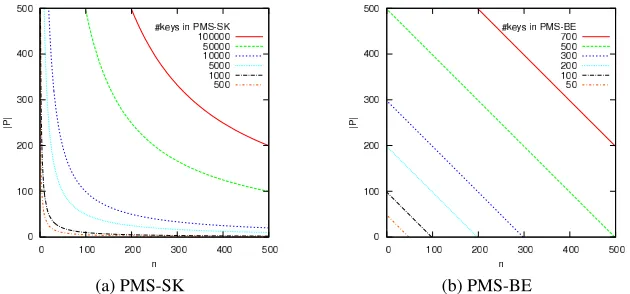
Assuming an average of 150 contacts per user and 180 attributes per profile we obtain 332 keys that have to be stored by each user when using PMS-BE in contrast to over 27000 keys that would be required by PMS-SK. Considering a key length of 192 bits for the private (decryption) key as a basis, this results in a storage overhead of about 8 KB for PMS-BE, compared to about 650 KB for PMS-SK.
Regarding the microblogging service Twitter, where users have on average approxi-mately 50 contacts (“followers”) and publish about 60 attributes (“tweets”) per month5, the number of stored keys per user is 232 in PMS-BE and over 9000 in PMS-SK, result-ing in about 6 KB respectively 220 KB storage overhead (assumresult-ing again a lifetime of three months). Flickr, an online community for image and video hosting, has a very low average of only 12 contacts (“friends”) per user according to a study of Mislove et al. [18] in 2007. Assuming the limit of 200 images for a “free account”6as average number
4http://www.facebook.com/press/info.php?statistics, Oct 2010 5
http://www.website-monitoring.com/blog/2010/05/04/ twitter-facts-and-figures-history-statistics/, Oct 2010
(a) PMS-SK (b) PMS-BE
Fig. 1.Plots of the number of keys each user has to store in PMS-SK resp. PMS-BE, depending on the average number of contactsnand the average number of attributes per profile|P|.
of attributes per profile, the number of keys each Flickr user has to store would be 214 in the PMS-BE construction and 2600 in PMS-SK, which yields a storage overhead of about 5 KB respectively 62 KB.
We observe that in these average settings the absolute difference of both approaches in storage overhead is not very high. Although relatively differing by a factor of roughly 100, the absolute storage overhead for the assumed average parameters remains below 1 MB in all three networks. We observe that these costs are practical not only for desk-top computers but also for modern smart phones. Hence, in practice the two construc-tions PMS-SK and PMS-BE would allow for a trade-off between minimization of the storage overhead and maximization of privacy (as PMS-BE only provides anonymity, but not unlinkability).
On the other hand, when applied to very large profiles (with more contacts and attributes than assumed above) the difference in storage overhead increases rapidly as illustrated in Figure 1. For example, a profile with 300 contacts7 and 2000 attributes leads to the overhead of about 15 MB in PMS-SK compared to only 55 KB in PMS-BE. Therefore, using PMS-BE is advisable in this case.
7
Conclusion and Future Work
Privacy preserving publication of personal data in user profiles is a valuable building block that can be used to boot-strap various collaborative and social data sharing ap-plications. So far, security and privacy of user profiles have been addressed in a rather informal way, resulting in several implementations with unclear requirements.
In this work, we gave a rigorous security model for private user profiles, capturing the confidentiality of profile data and privacy of users that are allowed to retrieve this data. Our model allows for the construction of private profile management schemes,
independently of the social application that will use them. It aims at local schemes, which can be used both in centralized and distributed environments.
Furthermore, we gave two concrete constructions of profile management schemes, using symmetric and broadcast encryption techniques. Our analysis showed that these constructions differ in the privacy guarantees they provide. While one offers strong pri-vacy with the notion of unlinkability, the other represents a trade-off for better efficiency and key management, yet, consequently offers only anonymity of the users.
A couple of interesting open questions regarding the real-world use of profile man-agement schemes still remains:
– Can unlinkability of users being authorized to access different attributes within a profile be achieved with a sub-linear overhead?
– How do concrete implementations of PMS-SK and PMS-BE behave regarding the imposed overhead for retrieval key distribution? This will obviously depend on the used distribution mechanism, which seems more complex in case of PMS-SK.
Acknowledgements
The second author is supported in part by the DAAD PPP grant Nr. 50743263 (Project PACU) and by the BMBF grant AUS 10/046 (Project POC).
References
1. R. Baden, A. Bender, N. Spring, B. Bhattacharjee, and D. Starin. Persona: an online so-cial network with user-defined privacy. InACM Conference on Applications, Technologies, Architectures, and Protocols for Computer Communications (SIGCOMM 2009), pages 135– 146, 2009.
2. A. Barth, D. Boneh, and B. Waters. Privacy in encrypted content distribution using private broadcast encryption. In10th International Conference on Financial Cryptography and Data Security (FC 2006), pages 52–64, 2006.
3. J. Bethencourt, A. Sahai, and B. Waters. Ciphertext-policy attribute-based encryption. In 2007 IEEE Symposium on Security and Privacy (S&P 2007), pages 321–334, 2007. 4. S. Buchegger, D. Schi¨oberg, L.-H. Vu, and A. Datta. PeerSoN: P2P social networking: early
experiences and insights. InProceedings of the Second ACM EuroSys Workshop on Social Network Systems (SNS 2009), pages 46–52, 2009.
5. J. Callas, L. Donnerhacke, H. Finney, D. Shaw, and R. Thayer. OpenPGP Message Format. RFC 4880 (Informational), 2007.
6. R. Canetti, J. A. Garay, G. Itkis, D. Micciancio, M. Naor, and B. Pinkas. Multicast secu-rity: A taxonomy and some efficient constructions. In18th IEEE Conference on Computer Communications (INFOCOM 1999), pages 708–716, 1999.
7. B. Carminati, E. Ferrari, and A. Perego. Enforcing access control in web-based social net-works.ACM Transactions on Information and System Security, 13(1), 2009.
8. L. A. Cutillo, R. Molva, and T. Strufe. Safebook: A privacy-preserving online social net-work leveraging on real-life trust. ”IEEE Communications Magazine”, Vol 47, Issue 12, Consumer Communications and Networking Series, 2009.
10. M. Gjoka, M. Kurant, C. T. Butts, and A. Markopoulou. Walking in Facebook: A Case Study of Unbiased Sampling of OSNs. In29th IEEE Conference on Computer Communications (INFOCOM 2010), pages 2498–2506, 2010.
11. S. A. Golder, D. M. Wilkinson, and B. A. Huberman. Rhythms of social interaction: Messag-ing within a massive online network. InCommunities and Technologies 2007, pages 41–66. 2007.
12. K. Graffi, P. Mukherjee, B. Menges, D. Hartung, A. Kovacevic, and R. Steinmetz. Practical security in p2p-based social networks. In34th Annual IEEE Conference on Local Computer Networks (LCN 2009), pages 269–272, 2009.
13. K. Graffi, S. Podrajanski, P. Mukherjee, A. Kovacevic, and R. Steinmetz. A distributed platform for multimedia communities. In10th IEEE International Symposium on Multimedia (ISM 2008), pages 208–213, 2008.
14. R. Gross and A. Acquisti. Information revelation and privacy in online social networks. In 2005 ACM Workshop on Privacy in the Electronic Society (WPES 2005), pages 71–80, 2005. 15. S. Jahid, P. Mittal, and N. Borisov. EASiER: Encryption-based access control in social networks with efficient revocation. In6th ACM Symposium on Information, Computer and Communications Security (ASIACCS 2011), 2011. To appear.
16. M. M. Lucas and N. Borisov. flyByNight: mitigating the privacy risks of social networking. In5th Symposium on Usable Privacy and Security (SOUPS 2009), 2009.
17. D. A. McGrew and A. T. Sherman. Key establishment in large dynamic groups using one-way function trees. Technical Report No. 0755, TIS Labs at Network Associates, Inc., Glen-wood, MD, May 1998.
18. A. Mislove, M. Marcon, P. K. Gummadi, P. Druschel, and B. Bhattacharjee. Measurement and analysis of online social networks. In7th ACM SIGCOMM Conference on Internet Measurement 2007, pages 29–42, 2007.
19. PrimeLife. Scramble! http://www.primelife.eu/results/opensource/ 65-scramble, September 2010.
20. A. T. Sherman and D. A. McGrew. Key establishment in large dynamic groups using one-way function trees.IEEE Transactions on Software Engineering, 29(5):444–458, 2003. 21. A. Tootoonchian, S. Saroiu, Y. Ganjali, and A. Wolman. Lockr: better privacy for social
networks. In2009 ACM International Conference on Emerging Networking Experiments and Technologies (CoNEXT 2009), pages 169–180, 2009.
22. D. Wallner, E. Harder, and R. Agee. Key Management for Multicast: Issues and Architec-tures. RFC 2627 (Informational), 1999.
23. C. K. Wong, M. G. Gouda, and S. S. Lam. Secure group communications using key graphs. InACM Conference on Applications, Technologies, Architectures, and Protocols for Com-puter Communications (SIGCOMM 1998), pages 68–79, 1998.
24. E. Zheleva and L. Getoor. To join or not to join: the illusion of privacy in social networks with mixed public and private user profiles. In18th International Conference on World Wide Web (WWW 2009), pages 531–540, 2009.