Available Online atwww.ijcsmc.com
International Journal of Computer Science and Mobile Computing
A Monthly Journal of Computer Science and Information Technology
ISSN 2320–088X
IMPACT FACTOR: 6.017
IJCSMC, Vol. 6, Issue. 3, March 2017, pg.9 – 13
Optimized Service Oriented Request and
Compliance Management Application
Dev Anand L
1, Arumugam P
2, Harini J
3, Chithambarathanu M
4¹Computer Science and Engineering & Rajalakshmi Engineering College, India
2
Computer Science and Engineering & Rajalakshmi Engineering College, India
3
Computer Science and Engineering & Rajalakshmi Engineering College, India
4
Assistant Professor, Computer Science and Engineering & Rajalakshmi Engineering College, India
1
[email protected]; 2 [email protected]; 3 [email protected]; 4 [email protected]
Abstract— The goal of this application is to provide solutions for managing the services in an organization that helps in creating service request processes to monitor and deliver requirements easily. In most organizations the employees/members have access to core services and requestable services. The core services manage the physical IT facilities. The requestable services provides the employees/members to request services such as installing a intercom, changing a password, providing computer or some technical issues. The main objective of this project is to provide solutions for managing the services in an organization. It deals with the automation of processing and analyzing the service requests. Service request an-d compliance management application helps the IT administrators to process the service request easily and effectively.
Keywords— Service Request, Management, Efficiency, Notification, Compliance, Analysis, Quality Service, Android Application
I. INTRODUCTION
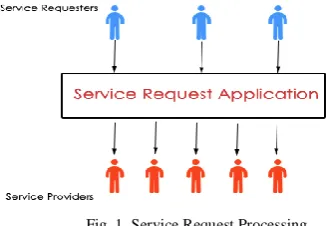
When an organisation is small, it’s simple for someone to just walk over to your desk with a requirement and you can set about fulfilling it. But the larger your organisation gets, the service request process gets complicated, thus opting for service request management application to automatically route the requests through an appropriate process for approval and reliable service delivery.
Fig. 1. Service Request Processing
In general service requests are often lower risk which makes sure that the users in an organization have easy access to the services they need to get their tasks done.
II. IMPLEMENTATION
This concept is implemented as an android application so that it provides ad-hoc users to make request anywhere and at anytime through internet. The implementation is done in such a way that it reduces load on the service desk by assigning and prioritizing the requests made by the users.
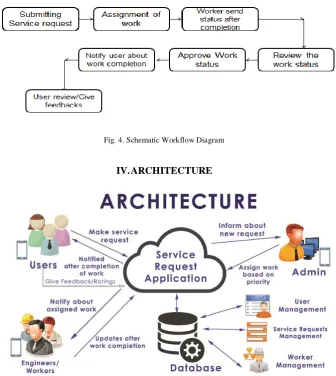
The most important feature in this application is notifying the users, administrators as well as the engineers about the assignment of work and status of the submitted request. Notification feature is done with the help of Firebase Cloud Messaging technology that sends push notifications whenever necessary. The application notifies the admin when there is a new request from the user and after admin assigns the work to the corresponding engineer, it notifies the engineer about the assignment of work. Users will be notified about the status of work before and after the work is completed. The database tool used for the application is MySQL 5.5 which is connected to android application using Hypertext Preprocessor (PHP) scripts. Firebase is a real-time database in which data is stored as JSON and it is used for managing notifications.
Fig. 2. Firebase Cloud Messaging Architecture
III.WORKFLOW
Workflow is the start-to-finish process from the service request registering to the service request closing. The flow of this project begins with the user making a new service request, once the user submits the request it notifies admin about the request. Admin views the requests from the users and assigns it to the engineers based on the availability. High priority works are assigned first followed by assignment of low priority works.
Fig. 3. Basic Flow
Admin reviews the work status and sends user about the completion of work. If admin is not satisfied with the work done he can re-assign the work to the engineer. User can review the work and give feedbacks based on the quality of work completed which is used in calculating the efficiency of the engineers.
Workflow Diagram
Fig. 4. Schematic Workflow Diagram
A. Important Features
Notifying about the assignment of work, status and completion of work
Assigning work to the engineers in a effective way
Analyze the engineer history and feedbacks from user to calculate efficiency of the engineers
Track request status and request processed based on priorities
Classifying service requests and request fulfillment
B. Service Request Info
The Service Request Information is the record holding any management relevant information about the service requested by the users.
It consist of the following fields,
Service Request ID
Date and Time of request
Requested user details
Service description
Location
Priority
Status
V. ALGORITHM
Algorithm to assign work effectively Create workdetails
Initialise workcount = 0 If workcount < 3
work can be assigned to a corresponding engineer Else
assign work to next engineer satisfying the condition End
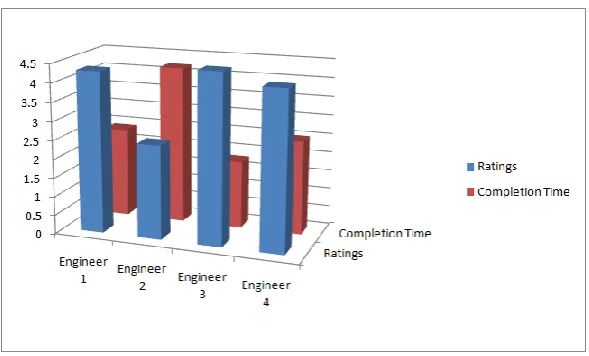
To analyse engineer efficiency a. Collect engineer details
b. Determine the points for each engineer based on cumulative ratings/feedbacks c. Calculate the time taken for the work completed by each engineer
d. Calculate min(worktime) among the engineers e. Assign work frequently based on above results f. End
VI.TABLEDESIGN
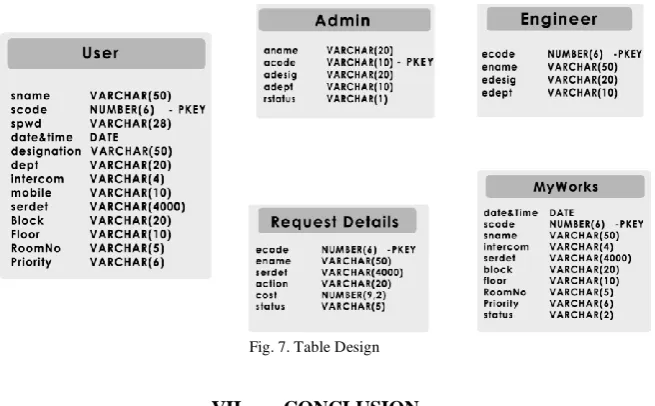
Table design gives the details about the tables that are used in the application. The table design for this application is given as follows
Fig. 7. Table Design
VII. CONCLUSION
The service request management process that includes receiving a user enquiry and has a special feature of notifying about the progress of work as well as calculating the efficiency of the workers, it provides more benefits than the existing applications. It mainly focuses on providing better service to the users, thereby managing the time effectively and efficiently.
ACKNOWLEDGEMENT
The service request procurement is fulfilled once user needs are met. The workflow reaches completion and acknowledgement is sent via notification/mail to the respective users.
We have taken efforts in this application. However, it would not have been possible without the kind support and help of our institution which provided data for this project. We highly indebted to Mr. Chithambarathanu M for his guidance and constant supervision as well as for providing necessary information regarding the application and also his support in completing the project. The authors are thankful and gratefully acknowledge all reviewers for their valuable suggestions for enriching the quality of the paper.
REFERENCES
[1] ―A dynamic request dispatching system for IT service management‖ by David Loewenstern and Yixin Diao. Published year: 2012
[2] ―Meeting the challenge of service request management‖ – BMC software
[3] IT Service Management- The role of service request management-- Prepared by Rick Leopoldi, June 1,2007. [4] S.Kumaran, P.Bishop, T.Chao, P.Dhoolia, P.Jain, R.Jaluka, H.Ludwig, A.Moyer and A.Nigam, ―Using a Model-driven Transformation Approach and Service-Oriented Architecture for service delivery management,‖ IBM Systems Journal 46, no.3 ***_*** (2007, this issue).
[5] Heiko Ludwig, John Hogan, Rajesh Jaluka, David Loewenstern, ―Catalog based service request management,‖ IBM Systems Journal 46, (2007, this issue).
[6] Ying Li, Kaan Katircioglu, ―Measuring and Applying Service Request Effort Data in Application Management Services‖ Services Computing(SCC) IEEE International Conference, (2013).
[7] ISO/IEC 20000-1:2005 – Information Technology - Service Management- Part 1: Specification, ISO/IEC, Dec 2005.