Efficient Multicast Key Distribution Using
HOWP-based Dynamic Group Access
Structures
Jing Liu, Qiong Huang, Bo Yang, and Yang Zhang
Abstract— When assigning personal keys, stateful multicast key distribution (MKD) protocols usually rely on some type of dynamic group access structure which helps achieve a better tradeoff among storage, communication and computation overheads. However, there exist some stateful MKD protocols whose personal key assignments are based on two static group access structures called Dual Hash Chain (DHC) and Binary Hash Tree (BHT). We introduce two new types of group access structures called Dual Homomorphic One-way Function Chain (D-HOFC) and Top-Down Homomorphic One-way Function Tree
(TD-HOFT). Both can be regarded as dynamic counterparts of DHC and BHT, respectively. Our research motivation is to investigate what benefits these two new dynamic structures will bring for MKD protocols compared with their static counterparts. Using D-HOFC, we propose a time-based MKD protocol that counters the rejoining member attack on a DHC-based protocol, and a stateful user-based MKD protocol that has a lower computational overhead for Group Controller (GC) than the DHC-based protocol. Using TD-HOFT, we design a stateful user-DHC-based MKD protocol that outperforms the original EKT protocol. Performance comparisons and experiment results show that our protocols based on dynamic structures have their own advantages compared with those based on the corresponding static counterparts.
Index Terms— multicast key distribution, group access structure, homomorphic one-way permutation (HOWP)
—————————— ——————————
1 INTRODUCTION
1.1 The Problem of Multicast Key Distribution
With rapid evolution of Internet, more and more group-oriented applications have been emerging, for instance, IPTV, DVB (Digital Video Broadcast), videoconferences, interactive group games, collaborative applications, stock quote streaming, and so on. These applications all require a one-to-many or many-to-many group communication mechanism. Providing security services for group com-munication such as traffic integrity, authentication, and confidentiality usually requires securely establishing a group-shared key called group key among privileged group members. This problem is called group key estab-lishment in the literature [1]. Compared to its two-party counterpart, secure group key establishment in a dynamic group is more challenging. Group key establishment may be broadly categorized as group key exchange/agreement and group key distribution (also called multicast key distribu-tion). In group key exchange protocols [2],[3], each group member contributes an equal share to the common group key (which is then computed as a function of all members’ contributions). In (centralized) multicast key distribution (MKD) protocols, a trust third party called group
control-ler (GC) is responsible for creating a new group key when some change in group membership happens, and secure-ly transferring it to all privileged group members over a broadcast channel. MKD protocols usually aim to solve a more specific problem called immediate group rekeying. For security-sensitive commercial applications (e.g. pay-per-view, video-on-demand, and highly classified confe-rences), each message sent to a group is encrypted with a group key, and the group key must be changed for every membership change. To prevent a new member from de-coding messages exchanged before it joins a group, a new group key must be distributed to the group when a new member joins. This security requirement is called group backward secrecy. On the other hand, to prevent a depart-ing member from continudepart-ing access to the group’s com-munication, the key should be updated as soon as a member leaves. This security requirement is called group forward secrecy. To provide both group backward secrecy and group forward secrecy, the group key must be up-dated (or rekeyed) upon every single change in group membership, and the updated group key must be distri-buted to all legitimate members. This process is referred to as immediate group rekeying in the literature. MKD has been well studied since late 1990s (see [4] for an excellent survey, and more recent surveys are available in [5] and [6]). To the best of our knowledge, tree-based MKD pro-tocols are the most efficient ones to date. Immediate group rekeying following these protocols has O(log2n) communication complexity, and O(log2n) computational and storage complexity for users, where n is group size. The first tree-based MKD protocol is the one based on Logical Key Hierarchies (LKH), which was independently ————————————————
J. Liu is with the School of Software, Yunnan University, Kunming 650091, China. E-mail: [email protected].
Q. Huang is with the College of Informatics, South China Agricultural University, Guangzhou 510642, China. E-mail:
B. Yang is with the School of Computer Science, Shaanxi Normal Universi-ty, Xi'an, 710062, China. E-mail: [email protected].
Y. Zhang is with the School of Information Science and Technology, Sun Yat-Sen University, Guangzhou, 510006, China.
suggested by Wong et al. [7], Wallner et al. [8], and Ca-ronni et al. [9]. Since then, a variety of MKD protocols based on LKH [10],[1],[11],[12] have been proposed.
1.2 Static vs. Dynamic Group Access Structures
MKD protocols can be subdivided into two categories: the stateful and the stateless. For stateful MKD protocols, re-ceivers must remain online and keep updating their in-ternal states as long as they still stay attached to the group. If a receiver happens to be off-line when a group rekeying operation occurs, or current rekey message was lost due to a network failure, the receiver will not be able to decipher any future group keys from rekey messages. A successful decipher of current group key depends on successfully receiving all of past rekey messages. Most MKD protocols [7],[8],[9],[10],[1],[11],[12] are stateful. On the contrary, for stateless MKD protocols [13],[14], receiv-ers are not allowed to maintain any internal state. Preceiv-erson- Person-al keys are given to registered receivers or reserved for prospective receivers in a setup phase and remain un-changed thereafter. Statelessness property is very desira-ble for application scenarios where no feedback channel exists (e.g., encrypted DVD distribution) or group mem-bers go off-line frequently or communication channel is lossy. Typical stateless MKD protocols are those based on the subset cover framework [13]: the complete sub-tree (CS) protocol [13], the subset difference (SD) protocol [13], and the layered subset difference (LSD) protocol [14].
When assigning personal keys to group members, effi-cient stateless (resp. stateful) MKD protocols usually rely on some type of static (resp. dynamic) cryptographic structures such as key chains or logic key trees, which helps achieve an ideal tradeoff among storage, communi-cation and computational overheads. We call these cryp-tographic structures group access structures to distinguish them from traditional access structures (e.g., secret sharing) [15]. A stateful (resp. stateless) user-based MKD protocol can be regarded as consisting of a personal key assign-ment algorithm based on certain type of dynamic (resp. static) group access structures, and join/leave rekeying algorithms (resp. broadcast encryption algorithm) that are again based on the personal key assignment algorithm. Therefore, group access structures are fundamental to MKD protocols. This fresh view centered on group access structures helps us gain an insight into modular design of MKD protocols.
For most stateless MKD protocols, assignment of per-sonal keys to registered and prospective users in the se-tup phase is usually based on some kind of pre-specified group access structures. Typical group access structures used by stateless MKD protocols are complete sub-tree [13], subset difference [13],[14], flat table [16],[17], polynomial in-terpolation [18],[19],[20], Chinese remainder theorem [21], dual hash chain [22],[23] and top-down one-way function tree [13],[24]. These group access structures must be pre-specified in the setup phase and then remain unchanged irrespective of group dynamics. That is why we say they are static. Shares or nodes (i.e., personal keys) associated with these group access structures cannot be reassigned to other users even if their holder has left the group,
oth-erwise group backward secrecy would be violated. There-fore, these static group access structures must be big enough to accommodate all future/prospective users at the very beginning. For large and dynamic groups, that may cause huge storage and computational requirements both for GC and end users.
For stateful MKD protocols, assignment of personal keys to a joining user is on-the-fly, and usually based on some kind of dynamically-changing group access struc-tures. Typical group access structures used by stateful
MKD protocols are logic key hierarchies
[7],[8],[9],[10],[11],[12], bottom-up one-way function tree [1],[25], flat table [12],[26],[27], dual hash chain [28],[23] and top-down one-way function tree [29],[23]. When a user joins the group, GC needs to first create one or several new nodes/shares on these group access structures for it, and then update relevant keys before assigning them to the joining member to ensure group backward secrecy. When a user leaves the group, GC needs to delete its associated node from these group access structures, and then update those keys held by the evictee (thus all information about the group access structure held by the evictee is invali-dated) to ensure group forward secrecy. In a word, these group access structures keep expanding, contracting, and changing as members join or leave. Their current size ex-actly corresponds to the current number of group mem-bers. That is why we say they are dynamic. Therefore, most stateful MKD protocols based on dynamic group access structures are more suitable for immediate rekey-ing for large and dynamic groups than those stateless MKD protocols based on static group access structures.
1.3 User-Based MKD Protocols and Time-based Ones
Access to group keys can be controlled through two me-thods — the user-based one [7],[8],[9],[1],[11],[12] and the time-based one [30],[24]. The former is more intuitive and traditional. A current group key should be only accessible to current legitimate members, which is achieved by per-forming group rekeying upon every change in group membership. On the other hand, if every user’s departure time can be predetermined at the time of join, GC can divide the group’s lifetime into time slots and for every time slot, generate a unique group key that is used to en-crypt application data transmitted during that period. When a new member joins the group, it will be provided with some intermediate seeds that can be used to derive those group keys corresponding to the predetermined duration over which it will stay attached to the group. In contrast to traditional user-based MKD protocols, group rekeying following this way is automatic (i.e., irrespective of membership dynamics), stateless, and requires trans-mitting no rekey message. These merits are collectively referred to as zero side-effect by Briscoe [24]. We also call this type of group rekeying automatic group rekeying.
1.4 Research Motivation and Contributions
cen-tered on group access structures. This view helps gain an insight into MKD protocol design. We also revealed the subtle differences between dynamic group access struc-tures and static group access strucstruc-tures.
Some of existing stateless and stateful MKD protocols are based on two useful types of static group access struc-tures — Dual Hash Chain (DHC) [24],[28] and Binary Hash Tree (BHT) [31],[24]. In this paper, we introduced two new types of group access structures based on Homomor-phic One-Way Functions (HOWFs): Dual Homomorphic One-way Function Chain (D-HOFC) and Top-Down Homomor-phic One-way Function Tree (TD-HOFT), both of which can be regarded as the dynamic counterparts of DHC and BHT, respectively. We introduced two structure-preserving operations — chain product and tree product— for updating these structures without compromising their structures. For a particular type of TD-HOFT called exclu-sive key tree (EKT), we introduced an operation called tree blinding.
In this paper, we want to investigate what benefits these two new types of dynamic structures — D-HOFC and TD-HOFT — will bring for MKD protocols based on them compared with their static counterparts (DHC and BHT). Our following research results show that these structures have their own advantages over their static counterpart in designing efficient and secure MKD proto-cols: (1) Employing D-HOFC, we are able to propose a stateful time-based MKD protocol that counters the rejoining member attack on a DHC-based protocol, and a stateful user-based MKD protocol has a lower computa-tional overhead for Group Controller (GC) than the cor-responding DHC-based protocol in 60% time of a MBone audio session; (2) Taking full advantage of TD-HOFT, we designed a stateful user-based MKD protocol called EKT+ which outperforms the original EKT protocol; (3) We made both quantitative and qualitative comparisons be-tween our proposed protocols based on dynamic group access structures and those based on the corresponding static counterparts. To further investigate how perfor-mance changes with time in practice for every related user-based MKD protocol, we also performed an experi-ment using MBone user activity data. Both the compari-sons and experimental results show that: (a) protocols based on tree-based group access structures have a better performance than those based on chain-based structures; (b) compared with the protocol based on BHT, protocols based on the corresponding dynamic counterpart — TD-HOFT — are more collusion-resistant and have a scalable storage overhead while maintaining computational effi-ciency comparable to the former; (4) Dynamic structures, D-HOFC and TD-HOFT, are more suitable for designing a hybrid stateful MKD protocol with collusion-bandwidth tradeoffs than their static counterparts, DHC and BHT. In addition, we extended a recently-proposed symbolic security model for user-based MKD protocols to support time-based MKD protocols. We presented rigor-ous security proofs for all proposed protocols in a sym-bolic security model.
The rest of this paper is organized as follows. In Section 2, we introduce two general types of group access
struc-tures, D-OFC and TD-OFT, and review some of existing MKD protocols based on certain instantiations of them. Section 3 introduces two new types of group access struc-tures — D-HOFC and TD-HOFT, and related operations on them. In Section 4, employing dynamic D-HOFC, we propose both a stateful time-based MKD protocol and a stateful user-based MKD protocol. Taking full advantage of TD-HOFT, we propose a stateful user-based MKD tocol called EKT+ that outperforms the original EKT tocol. Section 5 gives rigorous security proofs for our pro-tocols in a symbolic security model. In Section 6, we give comprehensive comparisons between our protocols based on dynamic group access structures, and those based on corresponding static counterparts. We also perform an experiment to show how performance changes with time in practice for every related user-based MKD protocol. Section 7 concludes this paper and gives some interesting topics for future research.
2 TWO TYPES OF GROUP ACCESS STRUCTURES
AND
1-R
ESILIENTMKD
P
ROTOCOLSB
ASED ONTHEM
We first introduce a concept called 1-resilient that will be used throughout the rest of this paper. According to the concept of k-resilience given by Fiat and Naor [31], a pro-tocol is called 1-resilient if it is secure against any single-user attack, but a coalition of two single-users might break its security.
In the rest of this paper, we denote by U the universe of all users by U = {1, 2,…, n}. Denote the privileged sub-set of users at time t by S(t)U, and the complement of set S(t) with respect to U by R(t). For an arbitrary set S, we use |S| to denote the order of S. The group key used to en-crypt those data sent to S(t) is denoted by GK(t). We use {M}K to denote the encryption of M by K. In addition, we
denote “multicast” by “”and “secure unicast” by “”. In the following, we first introduce two general types of group access structures, respectively called Dual One-way Function Chain (D-OFC) and Top-down One-way Func-tion Tree (TD-OFT). Then we review those 1-resilient MKD protocols based on certain instantiations of them.
2.1 D-OFC
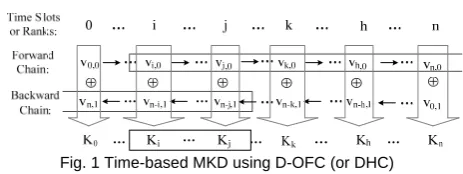
Referring to Figure 1, Dual One-way Function Chain (D-OFC) is composed of two one-way function chains: a for-ward chain and a backfor-ward chain. Both chains are de-rived respectively from two different initial seeds, say v0,0 and v0,1, by repeatedly applying a one-way function h. That is, the (i+1)-th intermediate seed vi+1,B is computed as vi+1,B=h(vi,B) (i=0,…,n; B=0, 1). Note that specific
way hash function, a homomorphic one-way function (HOWF) or any other particular type of one-way function. Each intermediate seed on a forward/backward chain can be used to compute a group key Ki in a time-based MKD
protocol as illustrated in Figure 1 or be assigned to a user as its personal key in a user-based MKD protocol (see Figure 2).
2.1.1 A time-based MKD protocol
Briscoe [24] proposed a structure called Bi-directional Hash Chain that can be regarded as a hash-based instantiation of D-OFC since it is derived by using a one-way hash function in the same manner as above. In the rest of this paper, we would rather call it Dual Hash Chain (DHC) because we found the meaning of the original term is somewhat self-contradictory (a hash chain must be one-way). In [24], Briscoe also proposed a time-based MKD protocol based on DHC which allows different portions of a key sequence to be reconstructed from combinations of two intermediate seeds. For convenience, we call it the DHC protocol. We denote the group key used to encrypt those data transmitted during the i-th time slot by Ki. As
illustrated in Figure 1, if we want to restrict a joining member ui to the data transmitted from time slot i up to
time slot j which it has paid for, GC only needs to supply it with two intermediate seeds vi,0 and vn-j,1 (called control pair) when it joins the group. With this pair, i can derive the contiguous key sequence from Ki to Kj by itself. For
convenience, we denote the time slot interval from i to j by [i, j], and call it the authorized time slot interval for ui.
However, any member cannot be granted access to multiple disjoint sub-sequences of the same key sequence, otherwise this protocol is not secure even in the presence of a single user (i.e., not 1-resilient). Suppose that we want to grant a member ui two disjoint authorized time
slot intervals [i, j] and [k, h] (k>j), it will be supplied with two control pairs {vi,0,vn-j,1} and {vk,0,vn-h,1} according to the protocol. With these control pairs, the longest possible key sequence that ui is able to reconstruct is the one from Ki straight to Kh, which however contains a sub-sequence
from Kj+1 to Kk-1 unauthorized for ui. For the same reason,
a previously evicted member is disallowed to rejoin a group. For convenience, we call this type of attack rejoining member attack. This attack renders the DHC pro-tocol useless in practice. Also for a similar reason, collu-sion between an arbitrary pair of users would also break security of the DHC protocol. Therefore, the DHC proto-col is 1-resilient.
Another drawback with this protocol is that the life-time of a group must be pre-specified in the setup phase, and it cannot be extended thereafter even when all time slots are used up. Because the backward hash chain of a DHC cannot be extended in the reverse direction.
2.1.2 User-based MKD protocols
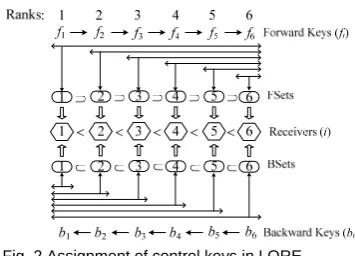
Fan et al. [28] proposed a 1-resilient user-based stateful MKD protocol called Linear Ordering of REceivers (LORE). We first introduce its personal key assignment algorithm that is based on DHC. Let N denote the total number of prospective receivers. Suppose that the entire receivers
are already linearly ordered as in Figure 2. Each receiver i holds a set of forward keys, denoted by FSet(i), and a set of backward keys, denoted by BSet(i). Both sets of keys are called control keys. According to the key assignment algorithm as illustrated in Figure 2, for receiver i, we have FSet(i) = {fk | ikN} and BSet(i) = {bk | 1k i}. The
effect of such control key assignment is that for any for-ward key fi, it is known only to receivers with rank no
more than i, and for any backward key bi, it is known only
to receivers with rank no less than i. However, this kind of key assignment algorithm requires GC to generate and manage a huge number of keys. One simple solution to this problem is to derive all forward keys (resp. backward keys) from a single seed f1 (resp. bN) by repeatedly
apply-ing a one-way hash function like DHC.
Now we describe its group rekeying algorithms. When receiver i joins the group at time t, GC sends the follow-ing rekey message: GCi: GK(t+1), {fi, bi}. With control pair {fi, bi}, receiver i can derive all its control keys. For the
re-maining receivers, GC simply broadcasts the following rekey message:
All receivers except i can extract the new group key GK(t+1) from this message. When receiver i leaves the group at time t, GC multicasts the following rekey message:
According to the assignment of control keys, all current members except i can extract the new group key GK(t+1) from this message after double decryption.
A coalition of an arbitrary pair of members can break group forward secrecy of the LORE protocol. Suppose that members i (with rank i) and j (with rank j >i) are both member of S(t). According to personal key assignment algorithm, i’s (resp. j’s) control pair is (fi,bi) (resp. (fj, bj)).
Colluding with j, member i can exchange its forward key fi for j’s backward key bj. Thus, when member i (resp. j)
leaves the group at a later time t’ (t’>t), it can use bj (resp. fi) to derive bi+1 (resp. fj-1), and then obtain the new group key GK(t’+1) by double decrypting the second (resp. first) part of the rekey message transmitted by GC at time t’. For the same reason, a rejoining member is not allowed to
Fig. 2 Assignment of control keys in LORE
GCS(t+1): i,
{
{
}
}
( ) 1
( 1) ( )
t i t
f GK
GK if i N
-+ < ,
{
}
{
1}
( )( 1) ( 1)
t i t
b GK
GK if i
+
+ > , where S(t+1)=S(t)-i.
GCS(t+1): i,
( )( 1) t
t GK
be assigned a new rank. In fact, this kind of collusion at-tack is inherent with the D-OFC based personal key as-signment algorithm. For convenience, we call this type of collusion attack member collusion attack.
In addition, the LORE protocol is also vulnerable to another type of collusion attackcalled non-member collu-sion attack. We analyze this type of attack through the fol-lowing two cases:
1) Coalition between an arbitrary pair of evictees — Suppose that user i (with rank i) left the group at the current time t and user j (with rank j<i) had left before time t. We denote by M(t) the rekey message transmitted by GC when i left at time t. Colluding with j, user i can first decrypt the outer encryption of the first part of
M(t) (i.e., ) to get , and
then transfer it to user j who can decrypt it to get GK(t+1) (note that user j can derive fi-1 from its forward control key fj since i>j). Thus, the group forward
secrecy is broken;
2) Coalition between a former evictee and a later-joining member — Suppose that user i left the group at time t and user j joined at time t+1. Using a similar argu-ment as above, it is readily seen that collusion be-tween user i and user j is also successful. In this case both group forward secrecy (with regard to the evic-tee i) and group backward secrecy (with regard to the joining member j) are broken.
In either case, both i and j are non-members with re-spect to the privileged user set S(t+1). Therefore, we call this type of collusion attack non-member collusion attack. In a word, collusion between an arbitrary pair of non-members will break the security of the LORE protocol.
2.2 TD-OFT
As illustrated in Figure 3, a Top-Down One-way Function Tree (TD-OFT) is a balance binary tree which is derived from a single root seed S0,0 in a top-down manner such that Si+1,2j= fL(Si,j), Si+1,2j+1= fR(Si,j) (i=0,1,…)
where fL and fR denote
two distinct one-way functions respectively, and Si+1,2j and Si+1,2j+1 the left child and the right child of a seed Si,j respectively. Each leaf
node Slogn,i (n is the group size) of a TD-OFT will be
asso-ciated with a user ui in a user-based MKD protocol, or
represent a group key corresponding to a time slot in a time-based MKD protocol.
Briscoe [24] proposed a top-down binary tree structure called Binary Hash Tree (BHT) which can be regarded as a hash-based instantiation of TD-OFT since it is derived by using one-way hash functions in the same manner as TD-OFT. Employing BHT, Briscoe [24] proposed a 1-resilient time-based MKD protocol that overcomes some draw-backs with the DHC protocol.
Liu and Wang [23] proposed a 1-resilient stateful user-based MKD protocol user-based on BHT. For convenience, we
call their protocol the LW protocol. The LW protocol is based on a BHT-based personal key assignment algo-rithm that is similar to the one originally suggested by Fiat and Naor [31]. This algorithm assigns personal keys or seeds to users simply as follows. As illustrated in Fig-ure 3, when a user ui joins the group, GC associates it
with a free leaf node, say Slogn,i on the BHT tree, and
sup-plies it with all seeds associated with the siblings of the nodes on its path to the root. Given these seeds, ui can
compute all the seeds except those on its path to the root. It is readily seen that according to this algorithm, Slogn,i is
shared by all users except ui, and thus can be used to
ex-clude ui from the group. It is based on this sense that Slogn,i
is called an exclusive key for ui by Kim et al. [29]. For
ex-ample, user u2 associated with S3,2 is supplied with S3,3, S2,0, and S1,1. And S3,2 is an exclusive key for u2 that is shared by all users except u2. When a user ui leaves the
group, GC multicasts the following rekey message:
According to the personal key assignment algorithm, all current members except ui can extract the new group
key GK(t+1) from this message. Using a similar argument as given in the end of Section 2.1.2, it is readily seen that the LW protocol is also vulnerable to both member collu-sion attack and non-member collucollu-sion attack as the LORE protocol.
Kim et al. [29] proposed a 1-resilient stateful user-based MKD protocol with similar personal key assign-ment as that of the LW protocol except that instead of using one-way hash functions, they chose to use HOWFs to facilitate updating the whole TD-OFT when a member leaves or joins the group. For convenience, we call their protocol the Exclusive Key Tree (EKT) protocol since it is based on an important idea called exclusive key [29],[23]. In contrast to BHT used by the LW protocol, TD-OFT used by the EKT protocol is dynamic. The leave rekeying algorithm of the EKT protocol is similar to that of the EKT+ protocol (refer to Section 4.3). Its join rekeying al-gorithm is similar to that of the LORE protocol except that the whole TD-OFT must be updated, and a root incre-mental seed used to update TD-OFT is also encrypted in a rekey message besides the new group key. The EKT pro-tocol suffers similar member collusion attack as the LORE and LW protocols, but a particular type of non-member collusion attack is prevented. Since both the EKT and EKT+ protocols suffer the same collusion attack, we defer further discussion to Section 4.3.
Because both DHC and BHT are derived in either a chain manner or a top-down tree manner by using one-way hash functions, we cannot update any node of them without replacing the whole chain or tree with a new one. In this sense, we can regard DHC as a static instantiation of D-OFC, and BHT as a static instantiation of TD-OFT.
{
}
{
1}
( )( 1)
t i t
f GK
GK
-+
{
}
1
( 1)
i t
f
GK
-+
Fig. 3 TD-OFT (or BHT)
GCS(t+1):
( ) log ,
( 1)
, t
n i
t
i S GK
u GK
, where ‘’
3 D-HOFC AND TD-HOFT
Recall that a one-way function is a function that is easy to compute on every input, but hard to invert given the im-age of a random input. In this section, we instantiate D-OFC and TD-OFT by using HOWFs to obtain two new types of group access structures, respectively named dual homomorphic one-way function chain (D-HOFC) and top-down homomorphic one-way function tree (TD-HOFT). Up-dating D-HOFC (resp. TD-HOFT) can be easily achieved by performing a chain product (resp. a tree product) of the original structure and a corresponding incremental struc-ture. Before we give their formal definitions, let’s review some basic mathematical concepts about homomorphism. We use (G, ) to denote a group G with its algebraic op-eration “”. Given two groups (G, ) and (H, ·), a group homomorphism from (G, ) to (H, ·) is a function f : G→H such that for all u and v in G, it holds that f(uv) = f(u)·f(v). A self-homomorphism is a group homomorphism that maps a group G to itself. If a self-homomorphism is a one-to-one mapping, we call it homomorphic one-way permutation (HOWP). If every node of a structure is an element of a group G, we say this structure is defined overG.
3.1 HOFC and D-HOFC
Definition 1 HOFC — An HOFC of length N defined over
a group(G, ) and an HOWP f is a one-way chain that is computed by repeatedly applying f in a forward manner as follows. For an arbitrary node xi in an HOFC X, its
suc-ceeding node xi+1 = f(xi) (i = 0,…, N-2).
Definition 2 Chain product — Given two arbitrary
HOFCs of the same length, X and Y, defined over a group (G, ) and a HOWP f, a chain product of X and Y, denoted by XY, is computed by multiplying their corresponding nodes.
Theorem 1: Given two arbitrary HOFCs of the same length,
X and Y, both defined over a group (G, ) and an HOWP f, the result of a chain product X Y is also an HOFC.
Proof: Let Z be the result of a chain product of X and Y, i.e., Z = XY. We prove for an arbitrary i (0iN-1), zi+1 = f(zi). Then the theorem would follow immediately
accord-ing to Definition 1. In fact, we have zi+1= xi+1yi+1=f(xi) f(yi)=f(xiyi)=f(zi).
Definition 3 D-HOFC — D-HOFC of length N, defined
over a group(G, ) and an HOWP f, consist of a forward HOFC and a backward HOFC, both of length N and de-fined over the group(G, ) as well as the HOWP f.
3.2 TD-HOFT
Definition 4 TD-HOFT — A TD-HOFT defined over a
group(G, ) and two HOWPs fL and fR is a balanced
bi-nary tree that is derived in the following top-down man-ner: for an arbitrary node xi in an HOFT X, suppose its
left child and right child are denoted by x2i and x2i+1 re-spectively, then we have x2i = fL(xi) and x2i+1= fR(xi).
To be used as an access control structure, TD-HOFT must at least satisfy the following two conditions: (1) its leaf nodes must be collision-free; (2) its leaf nodes must be independent (from an arbitrary set of leaf nodes, it is
com-putationally infeasible to compute any leaf node outside this set).
Definition 5 Tree product — Given two arbitrary
TD-HOFTs of the same depth, X and Y, both defined over a (G, ) and two HOWPs fL and fR, a tree product of X and Y,
denoted by XY, is computed by multiplying their corre-sponding nodes.
Theorem 2: Given two arbitrary TD-HOFTs X and Y with
the same depth, both defined over a group (G, ) and two HOWPs fL and fR, the result of a tree product X Y is also a TD-HOFT.
Proof: Let Z = XY. For an arbitrary node secret ziZ,
we have z2i=x2iy2i=fL(xi)fL(yi)= fL(xiyi)= fL(zi). For the
same reason, we have z2i+1= fR(zi). Thus, Z is a TD-HOFT
according to Definition 4.
Definition 6 Tree blinding — Given an arbitrary
TD-HOFT X, a tree blinding of X maps X to another key tree Y, denoted by Y=B(X) such that (1) Y is still a TD-HOFT, (2) from any set of nodes of Y, it is computationally infea-sible to compute any node of X.
For an arbitrary type of HOWP-based TD-HOFT, a tree blinding operation may or may not exist. Theorem 3 (re-fer to Section 4.3.1) shows that it does exist for a particu-lar type of TD-HOFT — the Blum-Williams function based one.
Theorem 1 and Theorem 2 show that both chain prod-uct and tree prodprod-uct are structure-preserving operations. A tree blinding operation on a TD-HOFT helps conceal in-formation about its every node without using any addi-tional incremental structure and compromising its struc-ture.
3.3 Efficient Candidates for HOWP
Considering computational efficiency, Rabin function (modular squaring) [32] and RSA function [33] with small encryption exponent (e.g., 3) are both good candidates for homomorphic one-way functions. Rabin function is more computationally-efficient than RSA function. However modular squaring is not a permutation on Zn*, it is in fact
a 4-to-1 mapping. But a variant of Rabin function — the Blum-Williams function is a trapdoor permutation on QR(n) where QR(n) denotes the set of all quadratic residues modulo n. Blum-Williams function is defined as follows: for an integer xZn*, compute y = x2 mod n, where n is a Blum integer (i.e., n is a product of two distinct primes each congruent to 3 modulo 4). In a word, the Blum-Williams function is the best candidate for HOWP.
4 MKD
P
ROTOCOLSB
ASED OND-HOFC
ANDTD-HOFT
As discussed in Section 1.2, when assigning personal
structures (D-HOFC and TD-HOFT) will bring for MKD protocols based on them compared with their static coun-terparts. We use D-HOFC to design both a stateful time-based MKD protocol and a stateful user-time-based MKD pro-tocol. The former counters the rejoining member attack on the DHC-based protocol. One of our experiment results given in Section 6.4 shows that the latter has a lower computational overhead for GC than the corresponding DHC-based protocol in 60% time of a MBone audio ses-sion. We also take full advantage of TD-HOFT to design a stateful user-based MKD protocol called EKT+ that out-performs the original EKT protocol. In the end of this sec-tion, we reveal that 1-resilient stateful MKD protocols based on dynamic group access structures are more suit-able for constructing a hybrid stateful MKD protocol with collusion-bandwidth tradeoffs than those based on static group access structures.
4.1 The Stateful Time-Based MKD Protocol — Protocol I
To counter the rejoining member attack on the DHC pro-tocol that renders it useless, the idea is that whenever detecting a former evictee ui is rejoining the group at time
slot c, GC updates both the forward HOFC and the back-ward HOFC (excluding all those nodes on both chains belonging to the past time slot interval [0, c-1]) by multip-lying them by a corresponding incremental HOFC before supplying ui with its new control pair. To allow other
le-gitimate members to update their control pairs, GC only needs to broadcast two incremental root seeds. In this way, GC establishes a whole new D-HOFC among the group without rekeying the entire group (i.e., sending each member its new control pair). Since the two control pairs held by the rejoining member now belong to differ-ent D-HOFC, it cannot use them to derive any unautho-rized group key. Thus, the rejoining member attack is prevented. However, the same method also causes a drawback that GC must record a long history revocation list during the group’s lifetime for detecting a rejoining member.
4.1.1 Rejoin rekeying
Since the following group rekeying operation is per-formed by GC when a former evictee rejoins the group, we call our algorithm rejoin rekeying. As illustrated in
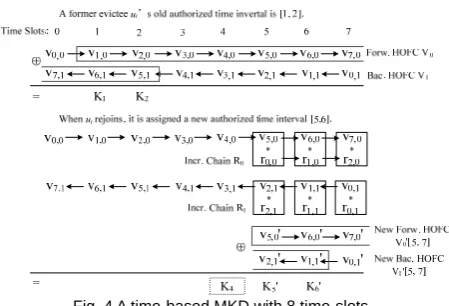
Fig-ure 4, suppose that the group’s lifetime is l time slots, and the corresponding D-HOFC consists of a forward HOFC V0 and a backward HOFC V1. When a former evictee ui
rejoins the group (suppose that its old authorized time slot interval is [a, b]), GC detects it is a rejoining member and assigns it a new authorized time slot interval [c, d]. After that, GC performs the following steps to complete rejoining rekeying: (1) Updating the D-HOFC by chain
products — GC derives two incremental HOFCs of length
l-c, say R0 and R1, respectively from two randomly-chosen seeds r0,0 and r0,1. For any chain V0, we denote its sub-chain confined in time slot interval [a, b] by V0[a, b]. As illustrated in Figure 4, GC could update sub-chain V0[c, l
-1](resp. sub-chain V1[c, l-1]) by performing a chain prod-uct as V0’[c, l-1]=V0[c, l-1]R0 (resp. V1’[c, l-1]=V1[c, l -1]R1). However, it is not necessary for GC to update whole D-HOFC in such a computationally-intensive way. According to Theorem 1, performing such chain products is equivalent to first computing both the new forward root control key as vc,0’= vc,0 r0,0 and the new backward root control key as vl -1,1’= vl -1,1 r0,1, and then deriving any control key on V0’[c, l-1] (resp. V1’[c, l-1]) from vc,0’ (resp. vl -1,1’) when needed; (2) Sending rekey messages — GC derives ui’s new backward control key vl-d-1,1’ from vl -1,1’ (note that ui’s new control pair is {vc,0’,vl-d-1,1’}) and then sends the following message: GC ui: c,d,{vc,0’,vl-d-1,1’}. With this control pair, ui is able to derive group keys from Kc’ to Kd’. For the remaining members, GC simply sends
the following message by multicast:
Note that every member who is granted access to any group key of the key sequence from Kc to Kd can derive vl -c-1,1. Therefore, these members can extract r0,0 and r0,1 from this message, update their control key pair by multiplying them by the corresponding incremental keys derived from either r0,0 or r0,1 according to Theorem 1, and then compute their new authorized group keys as illustrated in Figure 4.
If the time when another former evictee rejoins after time slot c and the new authorized time slot interval as-signed to it, say [r, s], can be a priori known when ui
rejoins the group, then GC only needs to update sub-chains V0[c, γ-1] and V1[c, γ-1] instead of V0[c, l-1] and V1[c, l-1]. Thus, a lot of computational overhead will be saved for both GC and end user.
4.1.2 Improved rejoin rekeying
In above rejoin rekeying, the computational overhead of each user is O(l) modular multiplications if the next rejoin event is unpredictable. This is a huge computational overhead for end users when l is big. We provide the fol-lowing algorithm that achieves efficiency comparable to the original DHC protocol for end users by transferring most amount of computational overhead from end user side to GC side. Suppose ui rejoins the group and GC
as-signs it a new authorized time slot interval [c, d]. Also suppose that when another former evictee rejoins after time slot c, the new authorized time slot interval assigned Fig. 4 A time-based MKD with 8 time-slots
GCU: c,d,
1,10,0, 0,1 l c
v
r r
GCS(t+1): k,
{
}
( ) 1
( 1) ( ) ( )
1,0 1,1
, , t
k
t t t
n f
GK r r
-+
( )if k <n ,
{
}
( )1
( 1) ( ) ( )
1,0 1,1
, , t ( 1)
k
t t t
n b
GK r r if k
+ +
- >
where S(t+1) = S(t)-ui. to it is [r, s]. We denote an HOWP by f. GC first generates
a random seed r0,0 (resp. rl-c-1) for deriving the forward chain (resp. the backward chain in a reverse direction). For each time slot j where cjγ, GC first derives the cor-responding forward incremental seed rj-c,0 from its prede-cessor rj-c-1,0, and the backward incremental seed rl-j-1 re-versely from its successor rl-j as rl-j-1= f -1(rl-j), and then
sends the following message by multicast at the begin-ning of the j-th time slot:
We call it the j-th rekey message for short. GC (or multi-cast sender) may transmit the j-th rekey message by pig-gybacking it on the application data transmitted during the j-th time slot. Upon receipt of this message, every legi-timate user who is granted access to the j-th time slot can extract both incremental seeds from it and compute the corresponding group key Kj as
Compared to above rejoin rekeying algorithm, for a us-er with authorized time slot intus-erval [α, α+m] (cα<α+m γ), its total overhead for computing authorized group keys is reduced from (l-c+m+1) modular multiplications plus 2 decryptions to 2m decryptions plus 4m modular multiplications.
Interestingly, the improved rekeying algorithm has a nice property called self-healing [34] in the sense that a user can obtain missing group keys on its own without requesting a retransmission from GC. Denote the i-th re-key message by Mi. Suppose that a user u with authorized
time slot interval [α, β] (cα<βγ) got both Mi (α<i<β) and Mj+1 (i<j<β). Then even if all rekey messages within time slot interval [i+1, j] are missing, u is still able to recover all group keys within time slot interval [i+1, j], because u can derive all forward incremental seeds within time slot in-terval [i+1, j] from ri-c,0 extracted from Mi, and all
back-ward incremental seeds within time slot interval [i+1, j] from rl-j-2,1 extracted from Mj+1.
Existing HOWPs (e.g., Rabin functions or RSA func-tions) are usually trapdoor functions. D-HOFC based on them can be extended in a reverse direction by GC, if it knows the trapdoor information. Thanks to that, for Pro-tocol I, the lifetime of a group can be extended as needed. Of course, GC must protect the private trapdoor informa-tion from every group members.
Remark 1: Compared with the DHC protocol, Protocol
I is stateful. Every member must remain online in order to ensure receiving each rekey message and updating its control pair accordingly, otherwise it will be unable to compute any future group key.
Remark 2: To save GC from storing and managing a
long history revocation list, one solution is to let GC up-date sub-chains of D-HOFC whenever a member (no mat-ter whether it is a fresh new one or a former evictee) joins the group.
4.2 The Stateful User-Based MKD Protocol — Protocol II
In this section, we use D-HOFC to design a stateful user-based MKD protocol. One of the experimental results given in Section 6.4 shows that it has a lower computa-tional overhead for GC than the corresponding DHC-based protocol in 60% time of a MBone audio session. The idea is that when a member joins/leaves the group, GC extends/contracts the D-HOFC accordingly, updates them by chain products, and then broadcasts an en-crypted rekey message containing the new group key and two incremental root keys such that all current members except the joining/departing member can extract them and then update their control pairs accordingly using these incremental root keys. In this way, both group for-ward and backfor-ward secrecy are ensured.
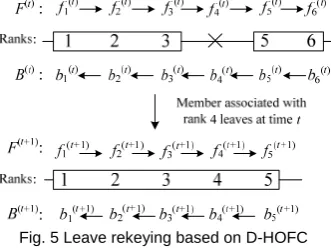
Referring to Figure 5, we denote the forward HOFC derived from a root key f1(t) at time t by F(t) and the back-ward HOFC derived from a root key bn(t) at time t by B(t).
The control pair associated with rank k at time t are de-noted by {fk(t), bk(t)}. Given an arbitrary D-HOFC, its ranks
can be deleted, added, and reassigned unlike a DHC. Suppose that the current length of a D-HOFC defined over a HOWP g is n. When a member ui with rank k
(1kn) leaves the group at time t, GC performs the fol-lowing steps to complete leave rekeying: (1) Contracting
and updating the D-HOFC — GC generates two random
incremental root keys r1,0(t) and rn-1,1(t), and computes a new forward root control key (resp. a new backward root control key) as f1(t+1)=g(f1(t))r1,0(t) (resp. bn-1(t+1)=g(bn(t))rn -1,1(t)). GC is now able to derive a new (n-1)-length D-HOFC consisting of a new forward chain F(t+1) and a new backward chain B(t+1). The former is derived from f1(t+1) and the latter from bn-1(t+1). Referring to Figure 5, the effect of such operations is equivalent to contracting the original D-HOFC by one rank through chain products; (2)
Multi-casting a rekey message — GC derives fk-1(t) and bk+1(t)
re-spectively from f1(t) and bn(t) and then generates a new
group key GK(t+1). At last, GC sends the following rekey message by multicast:
(1)
Every member except ui can extract GK(t+1), r1,0(t) and rn
-Fig. 5 Leave rekeying based on D-HOFC
GCU: j,
1,1
,0, 1,1 l c
j c l j v
r r
.
,0 ,0 1,1 1,1
( ) ( )
j j j c l j l j
1,1(t) from either the first part or the second part of this message, and then run Algorithm I to update their control pairs. Any former evictee cannot decrypt the above mes-sage, because its control pair had been invalidated by a chain update operation when it left the group and thus it can derive neither of the two control keys used to encrypt the rekey message.
For leave rekeying, the computational cost of GC in-cludes 6 encryptions, n-1 evaluations of an HOWP for computing encryption keys for rekey message, and 2 evaluations of an HOWP plus 2 modular multiplications for updating both root control keys. The computational cost of each group member includes n-1 evaluations of an HOWP for computing decryption keys for rekey message in worst case, 3 decryptions, and n-1 evaluations of an HOWP plus 2 modular multiplications for updating its control keys. The multicast size includes 6 encrypted keys. Note that we do not count the bandwidth cost of user id or rank id in a rekey message.
Suppose the current length of D-HOFC is n. When a new member ui joins the group at time t, GC performs the
following steps to complete join rekeying: (1) Extending
the D-HOFC — GC adds a new rank n+1 at the tail of the
D-HOFC, and computes its associated control pair as bn+1(t)=g-1(bn(t)) and fn+1(t)=g(fn(t)). The effect of such an
oper-ation is equivalent to extending the original D-HOFC at its tail by one rank; (2) Updating the extended D-HOFC
by chain products — GC generates two random
incre-mental root keys r1,0(t) as well as rn+1,1(t), and compute a new forward root control key as f1(t+1)=f1(t)r1,0(t) as well as a new backward root control key as bn+1(t+1)=g -1(bn(t))rn+1,1(t) . With these new root control keys, GC can derive a new (n+1)-length D-HOFC; (3) Sending rekey
messages — GC generates a new group key GK(t+1) and
sends the following message: GC ui: n+1, GK(t+1), {fn+1(t+1), bn+1(t+1)}. For members except ui, GC simply sends the
fol-lowing rekey message by multicast:
Every members except ui can decrypt this message to
ob-tain the new group key GK(t+1), r1,0(t) and rn+1,1(t), and up-date their control keys by multiplying them by the cor-responding incremental keys deriving from either r1,0(t) or rn+1,1(t).
For join rekeying, the computational cost of GC in-cludes 3 encryptions, 1 calculation of modular square root, 1 modular multiplication for updating the forward root
control key, and 2 modular multiplications plus n evalua-tions of an HOWP for computing the control key pair for the joining member. The computational cost of each group member includes 3 decryptions, and n evaluations of an HOWP plus 2 modular multiplications for updating its control pair. The multicast size includes 3 encrypted keys and unicast size includes 3 keys.
Protocol II is vulnerable to the same member collusion attack as the LORE protocol. But for non-member collu-sion attack, a coalition between a former evictee and a later-joining member is useless. Suppose that a user ui
with rank k left the group at time t, and a user uj joined at
time t+1 and was assigned with rank n>k. The rekey mes-sage M(t) transmitted by GC when ui left at time t is as (1). The first part (resp. the second part) of M(t) was encrypted by a forward control key fk-1(t) (resp. bk+1(t)). When uj joined
the group at time t+1, uj was provide by GC with control
key {fn(t+2), bn(t+2)}. According to Protocol II, the forward
control keys fk-1(t) and fn(t+2) (resp. backward control keys bk+1(t) and bn(t+2)) belong to different forward chains F(t) and F(t+2) (backward chains B(t) and B(t+2)), respectively. Since neither of fk-1(t) and bk+1(t) can be derived from the collective control key pairs of ui and uj, i.e., { fk(t), bk(t), fn(t+2), bn(t+2)},
both M(t) (containing GK(t+1)) and M(t+1) (encrypted by GK(t+1)) are indecipherable to ui and uj .
4.3 The EKT+ Protocol
In this section, we first prove the existence of a tree blind-ing operation for a particular type of TD-HOFT called Exclusive Key Tree (EKT). Then we introduce group rekey-ing algorithms based on tree blindrekey-ing and tree product.
4.3.1 Existence of a tree blinding operationfor EKTs We first introduce HOWPs used by the EKT protocol, and then prove the existence of a tree blinding operation for EKTs. Given two Blum integers with the same bit lengths, say mL and mR, we use mLR to denote mLR = mLmR. The
two HOWPs fL(x) and fR(x) used by the EKT protocol are
defined as fL(x) = (x2 mod mLR) mod mL, and fR(x) = (x2
mod mLR) mod mR, respectively. We denote the key
asso-ciate with a node ni by EKi in below. GC chooses a
ran-dom root seed EK1 ZmLR
and derives the whole key tree using fL(x) and fR(x) in a top-down manner as discussed in
Section 2.2. Recall that each leaf key EKi is called an
exclu-sive key for the user associated with ni. In this sense, we
call a TD-HOFT derived in the above manner an exclusive key tree (EKT). It is readily seen that given an arbitrary EKT, its leaf keys satisfy the two sufficient conditions for a TD-HOFT to be used as an access control structure: colli-sion-freeness and independence.
Theorem 3:For an arbitrary EKT X, a tree product of X and
itself (i.e., self tree product) is a tree blinding operation.
Proof: For an arbitrary EKT X, let Y = XX. According to Theorem 2, Y is also an EKT. For an arbitrary node xi
(resp. yi) in an EKT X (resp. Y), we denote its left child
and right child by x2i (resp. y2i) and x2i+1 (resp. y2i+1), re-spectively. According to Definition 5, y1 is computed as y1 = x12 mod mLR. Given i>1, if i is even, yi is computed as yi = xi2 mod mL, otherwise yi = xi2 mod mR. Because all three
ALGORITHM I—UPDATING CONTROL PAIR
For an arbitrary member uj (ji), suppose its
associated rank is α (αk), if α<k, then
uj computes its new control pair as
f(t+1)
α = g(f(αt+1) )r(αt,0) and b(t+1)
α = b(αt) r(αt,1) ; else (i.e., α>k),
uj first reduces its rank by one and then
com-putes its new control pair as f(t+1)
α-1 = f(αt) r(αt-1,0) and b(t+1)
α-1 = g(b (t)
α)r
(t)
α-1,1.
GCS(t+1): n+1,
( )
( 1) ( ) ( )
1,0 1,1
, , t
t t t
n GK
modular square functions are one-way, it is computation-ally infeasible to compute any node of X from all nodes of Y. Therefore, according to Definition 6, a self-tree product is a tree blinding operation.
4.3.2 Group rekeying algorithms
We improve the EKT protocol from the following two aspects: (1) introducing simple operations for add-ing/deleting nodes to/from an EKT; (2) using a tree blinding operation to design a join rekeying algorithm that improves the computational performance of the EKT protocol. We call the improved protocol EKT+.
First recall that the personal key of each user, say ui,
includes those keys associated with siblings of those nodes in its path to the root. For con-venience, we call these keys sibling keys of ui. Denote by EKi(t) the key associated with node ni at time t. For
exam-ple, referring to Figure 6, u5 got three sibling keys EK2(t), EK6(t) and EK14(t) when it joined the group at time t.
When a new member ui joins the group at time t, GC
performs the following steps to complete join rekeying: (1)
Performing a tree-growth operation (as illustrated in
Figure 6) — GC first finds a shallowest leaf node, say nk
(suppose it is currently associated with user uj), then adds
a left child node n2k and a right child node n2k+1 to nk, and
derives their corresponding exclusive keys EK2k(t) and EK2k+1(t) as EK2k(t)=fL(EKk(t)) and EK2k+1(t)=fR(EKk(t)),
respec-tively. After those operations, GC associates users uj and ui with n2k and n2k+1, respectively; (2) Performing a tree
blinding operation — To ensure group backward secrecy,
GC needs to perform a tree blinding operation on the ex-panded key tree. For an arbitrary exclusive key EKi(t), we
denote its blinded version by EKi(t+1). In fact, it is not
ne-cessary for GC to actually perform a tree blinding opera-tion on the whole key tree. According to Theorem 3, GC only needs to compute its blinded root exclusive key EK1(t+1) as EK1(t+1)=(EK1(t))2 mod mLR, and then derive those
sibling keys for the joining member ui from EK1(t+1); (3)
Sending rekey messages — GC derives the new group key
GK(t+1) from current group key GK(t) as GK(t+1)=h(GK(t)) where h is a public hash function, and sends the following messages:
GC ui: n2k+1,GK(t+1), sibling keys for ui,
GC uj: n2k+1,EK2k+1(t+1).
For remaining members, GC simply sends the following message by multicast:
GCS(t+1): a rekey notification.
After receiving this notification, all members except ui can
update the group key as GC does, and update their own sibling keys by modular square operations as described in the proof of Theorem 3.
For join rekeying, the computational cost of GC includes 1 evaluation of a hash function for computing the up-dated group key, 1 evaluations of an HOWP for updating the root exclusive key, and 2log2n evaluations of an
HOWP for computing all blinded sibling keys for the joining member and a new blinded sibling key for the sibling of the joining member. The computational cost of each group member includes 1 evaluation of a hash func-tion for computing the updated group key and log2n evaluations of an HOWP for updating its sibling key. The multicast size includes one notification message and un-icast size includes log2n+2 keys.
When a member ui (suppose that it is associate with
node n2k+1) leaves the group at time t, GC performs the following steps to complete leave rekeying: (1) Perform-ing a tree-contraction operation (as illustrated in Figure 6) — GC deletes both n2k+1 and its sibling n2k, and then
associates the sibling user of ui (who was associated with
node n2k ) with nk; (2) Updating the shrunk key tree by a
tree product — GC generates a random incremental root
seed r1(t). From r1(t), it could derive the whole incremental key tree T in a top-down manner. Now, to ensure group forward secrecy, GC may update the shrunk key tree by performing a tree product of it and T. However, it is not necessary for GC to update the whole shrunk key tree in such way. According to Theorem 2, GC only needs to compute the updated root exclusive key EK1(t+1) as EK1(t+1)= EK1(t) r1(t), and then derive the exclusive key EK2k+1(t) for the departing member ui from EK1(t); (3)
Multi-casting a rekey message — GC generates a random new
group key GK(t+1) and sends the following rekey message by multicast:
Every member except ui can extract GK(t+1) and r1(t) from this message, and then update its own sibling keys by multiplying them by their corresponding incremental key derived from r1(t). For example, if i is even, EKi(t+1) is
com-puted as EKi(t+1)= EKi(t)ri(t) mod mL.
For leave rekeying, the computational cost of GC in-cludes 2 encryptions, 1 modular multiplication for com-puting updated root exclusive key, and log2n evaluations of an HOWP for computing the encryption key for rekey message. The computational cost of each group member includes log2n evaluations of an HOWP for computing decryption key for rekey message in worst case, 2 decryp-tions, 2log2n evaluations of an HOWP for computing the incremental keys corresponding to its sibling keys, and log2n modular multiplications for updating its sibling keys. The multicast size includes 2 encrypted keys.
Both the EKT and EKT+ protocols are vulnerable to the same member collusion attack as the LW protocol. But for non-member collusion attack, using a similar argument as given in the end of Section 4.2, it is readily seen that a coalition between a former evictee and a later-joining member is useless for both the EKT and EKT+ protocols. Both the EKT and EKT+ protocols can be easily extended to support batch group rekeying by using one of the sub-set-cover techniques [13] as Liu and Wang dealt with the LW protocol [23].
4.4 From a 1-Resilient MKD Protocol to a Hybrid MKD Protocol with Collusion-Bandwidth Tradeoffs
According to a recent research result by Liu and Wang GCS(t+1): n2k+1,
( ) 2 1 ( 1) ( )
1
, t
k
t t
EK
GK r
where S(t+1)=S(t)-u i.