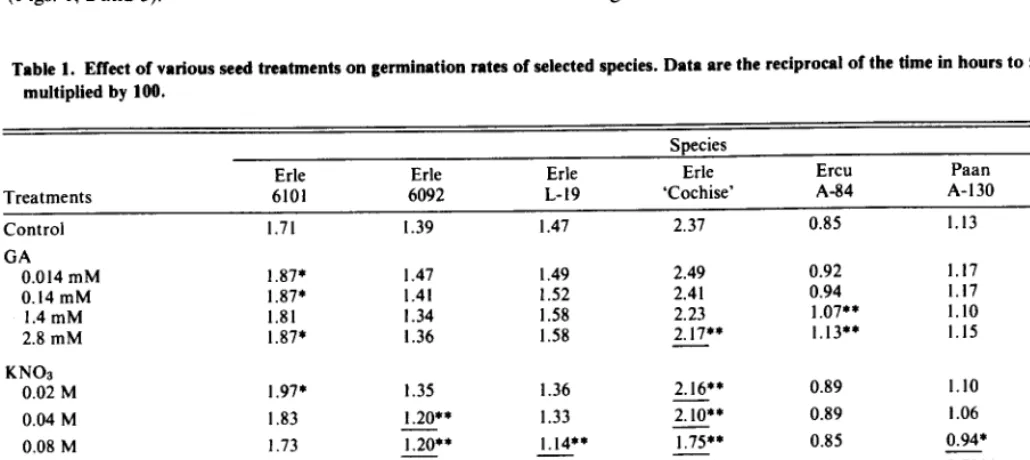
TABLE OF CONTENTS:
Vol. 38, No. 5, September 1985
ARTICLESRange Improvement
386 Leafy Spurge Control and Improved Forage Production with Herbicides by R.G. Lym and C.G. Messersmith
391 Controlling Shrubs in the Arid Southwest with Tebuthiuron by Carlton H. Herbel, Howard L. Morton, and Robert P. Gibbens
395 The Influence of Several Range Improvements on Estimated Carrying Capacity and Potential Beef Production by Tony Svejcar and Martin Vavra
Plant Establishment
400 Seed Predation, Seedling Emergence, and Rbizome Characteristics of American Licorice by A. Boe and R. Wynia
403 Productivity of Russian Wildrye and Crested Wheatgrass and Their Effect on Prairie Soils by S. Smoliak and J.F. Dormaar
406 Seasonal Nitrogen Translocation in Big Bluestem During Drought Conditions by D.C. Hayes
410 Green Needlegrass and Blue Grama Seedling Growth in Controlled Environments by Timothy E. Fulbright, A.M. Wilson, and Edward F. Redente
415 Effects of Selected Seed Treatment on Germination Rates of Five Range Plants by Larrye C. Weaver and Gilbert L. Jordan
Predation
418 Sheep Losses to Predators on a California Range, 1973-1983 by Jerry H. Scrivner, Walter E. Howard, Alfred H. Murphy, and John R. Hays
Range Assessment
421 Video Imagery: A New Remote Sensing Tool for Range Management by J.H. Everitt and P.R. Nixon
425 Comparison of the Reference Unit Method and Dimensional Analysis Methods for Two Large Shrubby Species in the Caatinga Woodlands by Rob&t D. Kirmse and Brien E. Norton
428 Use of Power Curves to Monitor Range Trend by William C. Tanke, and Charles D. Bonham
Forage-Quality. Selection, Production 432
435
440
l 443
450
455
458
Browse Quality Response to Forest Fertilization to Soils in Florida by John M. Wood and George W. Tanner
Dietary Overlap Among Axis, FaHow, and Black-tailed Deer and Cattle by Henry W. Elliott III and Reginald H. Barrett
Cattle Diets in a Ponderosa Pine Forest in the Northern Black Hills by Daniel W. Uresk and Wayne W. Paintner
Cattle Diets on Shortgrass Ranges with Different Amounts of Fourwing Saltbush by M.C. Shoop, Richard C. Clark, W.A. Laycock, and Richard M. Hansen Evaluation of Fecal Indices to Predict Cattle Diet Quality by Helen Wofford, Jerry
L. Holechek, M.L. Galyean, Joe D. Wallace, and Manuel Cardenas
N, P, and K Fertilization of Tall Fescue (Festucu urundinacea Schreb.) Overseeded Range in Eastern Oklahoma by R.L. Mitchell, A.L. Ewing, and W.E. McMurphy Site Variation in Forage Qualities of Mountain Mahogany and Serviceberry by
Roland C. Kufeld, Marilyn L. Stevens, and David C. Bowden
Published bimonthly-January, March, May, July, September, November
Copyright 1985 by the Society for Range Manage- ment
INDIVIDUAL SUBSCRIPTION IS by membership in the Society for Range Management.
LIBRARY or other INSTITUTIONAL SUBSCRIP- TIONS on a calendar year basis are $56.00 for the Untted States postpaid and $66.00 for other coun- tries, postpaid. Payment from outside the United States should be remitted in US dollars by interna- tional money order or draft on a New York bank. BUSINESS CORRESPONDENCE, concerning sub- scriptions, advertising, reprints, back issues, and related matters, should be addressed to the Manag- ing Editor, 2760 West Fifth Avenue, Denver, Colo. 80204.
EDlTORlALCORRESPONDENCE,concerningmanu- scriptsorothereditonal matters, should beaddressed to the Editor, 2760 West Fifth Avenue, Denver, Colo. 80204.
INSTRUCTIONS FOR AUTHORS appear on the inside back cover of each issue. A Style Manual is also available from the Society for Range Manage- ment at theaboveaddress @$1,25forsinglecopies; $1.00 each for 2 or more.
THE JOURNAL OF RANGE MANAGEMENT (ISSN 0022-409X) is published six times yearly for $56.00 per year by the Socrety for Range Management, 2760 West Fifth Avenue. Denver, Cola. 80204. SECOND CLASS POSTAGE pard at Denver, Cola. POSTMASTER: Return entlre journal with address change-RETURN POSTAGE GUARANTEED-to Society for Range Management, 2760 West Fifth Avenue, Denver, Colo. 80204.
461
466
468
Long-term Residual Effects of Nitrogen Fertilization on Western Wheatgrass by Larry M. White
Effects of Controlling Black-tailed Prairie Dogs on Plant Production by Daniel W. Uresk
An Energy Model for Adult Female Caribou of the Denali Herd, Alaska by Rodney D. Boertje
TECHNICAL NOTES
474 Cannula Adaptations for Esophageally Fistulated Cattle by J.R. Forwood, J.L. Ortbals, G. Zinn, and J.A. Paterson
VIEWPOINTS
477 Viewpoint: Forage and Range Research Needs in the Central Great Plains by K.P. Vogel, H.J. Gorz, and F.A. Haskins
BOOK REVIEWS
479 Winter Ecology of Small Mammals. Edited by Joseph F. Merritt; Developing Strategies for Rangeland Management. National Research Council/ National Academy of Sciences, B. Delworth Gardner, Committee Chairman; International Rangeland Resources Development Symposium Proceedings. 1985. Edited by Larry White and James A. Tiedeman; Responses of Plants to Environmental Stresses. Water Relations of Plants. by Paul J. Kramer.
Managing Editor PETER V. JACKSON Ill
2760 West Fifth Avenue Denver, Cola. 80204 Editor
PATRICIA G. SMITH
Society for Range Management 2760 West Fifth Avenue Denver, CO 80204 Book Review Editor GRANT A. HARRIS
Forestry and Range Management Washington State University Pullman, Wash. 99164-6410 The Journal of Range Management serves
as a forum for the presentation and discussion of facts, ideas, and philosophies pertaining to the study, management, and use of range- lands and their several resources. Accord- ingly, all material published herein is signed and reflects the individual views of the authors and is not necessarily an official position of the Society. Manuscripts from any source- nonmembers as well as members-are wel- come and will be given every consideration by the editors. Submissions need not be of a technical nature, but should be germane to the broad field of range management, Editor- ial comment by an individual is also welcome and subject to acceptance by the editor, will be published as a “Viewpoint.”
ASSOCIATE EDITORS E. TOM BARTLETT
Dept. of Range Science Colorado State University Fort Collins, CO 80523 GARY FRASIER
780 West Cool Drove Tucson, AZ 85704 G. FRED GIFFORD
Dept. of Range Wildlife, and Forestry University of Nevada
Rena. Nev. 89506 THOMAS A. HANLEY
Forestry Sciences Lab. Box 909
Juneau, Alaska 99802 N. THOMPSON HOBBS
Colorado Div. of Wildlife 317 W. Prospect Fort Colhns. Colo. 80526
LYMAN MCDONALD Statistics Department
College of Commerce and Industry University of Wyoming
Laramie. WY 82071 ROBERT MURRAY
US Sheep Experiment Station Dubois. ID 83423
DARREL UECKERT
Texas Agricultural Experiment Station 7887 N. Highway 87
San Angelo, TX 76901 BRUCE WELCH
Shrub Science Laboratory 735 N 500 E
Provo, UT 84701 LARRY M. WHITE
USDA ARS
S. Plains Ranae Research Station 2000 18th St. -
Woodward. OK 73801 JAMES YOUNG
USDA ARS
Renewable Resource Center Rena, NV 89512
W.K. LAUENROTH
SOCIETY FOR
RANGE MANAGEMENT
President
EDWARD A. MCKINNON Box 3474 Sta. B.
Calgary, Alta., Canada T2M2Ml 1st Vice-President
F.E. “FEE” BUSBY 1203 Park, Laramie, WY 82070
2nd Vice-President JACK R. MILLER
7 Azalea Ct. Petaluma, Calif. 94952
Executive Vice-President PETER V. JACKSON III
Society for Range Management 2760 West Fifth Ave.
Denver, Colo. 80204 (303) 571-0174
Directors 1983-85 PAT 0. CURRIE
Livestock and Range Research Station Miles City, Montana
DAVID A. FISCHBACH Box 218
Faith, South Dakota 57626 1984-1986
JOHN R. HUNTER Range & Wildlife Dept. Texas Tech University Lubbock, Texas 79409 DICK WHETSELL
P.O. Box 1209 Pawhuska, OK 74056 1985-1987
REX CLEARY P.O. Box 1090 Susanville, Calif. 96130 ROBERT ROSS
306 E. Story
Bozeman, Mont. 59715
The term of office of all elected officers and directors begins in February of each year during the Society’s annual meeting.
Contribution Policy
The Society for Range Management may accept donations of real and/or personal property, subject to limitations imposed by State and Federal Law. All donations shall be subject to control by the Board of Directors and their discretion in utilization and application of said donations. However, consideration may be given to the donor’s wishes concerning which particular fund account and/or accounts the contribution would be applied.
We recommend that donor consult Tax Advisors in regard to any tax consideration that may result from any donation. Donations may be made by bequests, legacies, devises or transfers from private individuals, partnerships. corporations, foundations, sections, organizations, estates, and trusts, or a memorial fund established as an expression of remembrance to members of real and/ or personal property. Donations can be sent to the Society for Range Management, Executive Vice-President, 2760 West Fifth Avenue, Denver, Colorado 80204.
The Society for Range Management, founded in 1948 as the American Socier! of Range Munugemenr, is a nonprofit association incorporated under the laws of the State of Wyoming. It is recognized exempt from Federal income tax, as a scientific and educa- tional organization, under the provisions of Section 501(c)(3) of the Internal Revenue Code, and also is classed as a public foundation as described in Section 509(a)(2) of the Code. The name of the Society was changed in 1971 by amendment of the Articles of Incorporation.
The objectives for which the corporation is established arc:
--to develop an undersfanding qf range ecosysrems and of the principles upplic~ahle 10 the management of range resources;
-to assisr all who work with range resources to keep ahreusr c?l‘rrr,~~./b~tlrt~gs ontt techniques in the science and art of range managemenr:
-to improve the effectiveness of range management IO ohruin,from range resources rhe products and values necessary for mon :v welfare;
-to create a public appreciation of the economic and ,sociul henq/i’rs IO he ohrtiined from the range environment;
--to promote professional development q/its members
Leafy Spurge Control and Improved Forage Produc-
tion with Herbicides
R. G. LYM AND C. G. MESSERSMITH
Abstract
An experiment to evaluate 59 long-term leafy spurge (Euphorbia es& L.) management alternatives with resulting forage produc- tion was established at 4 sites in North Dakota in 1980. The herbicides applied included 24-D [(2,4_dicblorophenoxy)acetic acid], dicamha (3,6-dichloro-2-metboxybenzoic acid), and piclo- ram (4amino-3,5,6-trichloro-2-pyridinecarboxylic acid). Picloram was applied as the liquid spray, granules or using a roller or pipe-wick reduced volume applicator. All original treatmentsapp- lied in 1980 reduced leafy spurge density 65% or more but required retreatments in 1981 and 1982 to maintain good control. Picloram sprayed at 2.2 kg/ha followed by a herbicide retreatment provided the best leafy spurge control at 84% after 3 years, but resulted in only intermediate annual forage production. Picloram roller app- lied provided 84% initial leafy spurge control and increased forage production an average of 28%, but control declined rapidly with- out retreatment. Picloram pipe-wick applied gave poor leafy spurge control and no increase in forage production. The most cost effective treatments for both leafy spurge control and high forage production were annual applications of picloram at 0.28 kg/ha or picloram plus 24-D at 0.28 plus 1.1. kg/ha. These treatments increased annual forage production by 64 and 71$, respectively, and reduced leafy spurge production by 96% compared to the untreated control. Annual application of 2,4-D did not reduce the leafy spurge density but did control the top growth long enough to allow increased forage production. Several long-term management alternatives provide a choice for leafy spurge control depending on geographical location, neighboring vegetation, and economic considerations.
Leafy spurge (Euphorbiu esulu L.) infests over 320,000 ha in North Dakota causing an estimated total annual loss of nearly I3 million dollars (Messersmith and Lym 1983). Loss of hay and beef cattle production is estimated at 7 million dollars annually and is due to reduced forage production from leafy spurge competition and cattle avoiding grazing in leafy spurge infested areas. Leafy spurge contains a toxic substance that causes scours and weakness in cattle and may result in death (Selleck et al. 1962).
Control of perennial weeds in pasture and rangeland with herbi- cides often increases forage production. Elwell (1964) found that applications of 2,4,5-T [(2,4,5trichlorophenoxy)acetic acid], sil- vex [2-(2,4,5trichlorophenoxy)propanoic acid], or 2,4-D [(2,4- dichlorophenoxy)acetic acid] at rates which provided at least 50% oak brush (Quercus spp.) control increased production of native grasses an average of 2,362 kg/ ha in Oklahoma. In Arizona, native perennial grasses produced nearly 3 times more herbage per hec- tare than the control 1 year following treatment with 2,4,5-T at 0.84 kg/ ha to control velvet mesquite [Prosopisj~lzj7oru var. velutina
(Woot.) Sarge.] (Cable and Tschirley 1961). Five years following treatment with 2,4,5-T at 4.8 kg/ ha for brush control in Missouri, total herbage yield was 12,300 kg/ ha greater than control areas (Ehrenreich and Crosby 1960). In North Dakota, forage produc- tion was increased 23% following annual application of 2,4-D at
Authors are assistant professor and professor of Agronomy, North Dakota State University. Fargo 58105.
This article is published with the approval ofthe Director. Agricultural Experiment StatIon. North Dakota State University. as Journal Article No. 1399. Cooperative investigation by North Dakota Agr. Exp. Sta. and the U.S. Dep. Agr., Agr., Res. Serv.
Manuscript accepted January 28. 1985.
1.1 kg/ha to control broadleaf weeds in rangeland (Mitich 1965). However, increased forage production is not always large or rapid following herbicide application in rangeland. Robertson (1969) found that crested wheatgrass (Agropyron desertorum
Roemer and Schultes) production was less than the check I year following 2,4-D application for big sagebrush (Artemisia triden- tutu Nutt.) control and no significant increase occurred until the third year after treatment. Prickly pear (Opunriu polyucunthu
Haw.) removal did not increase blue grama [Boutelouu grucilis
(H.B.K.) Lag. ex. Steud] yield but made forage available to cattle (Bement 1968). Yields of perennial grass were not increased until at least 30% control of mesquite [Prosopis julifroru (Swartz) DC.] was maintained over several years in New Mexico (Herbel et al. 1983). However, once control is achieved, increased forage produc- tion can last as long as 20 years (Cable 1976).
Herbicides generally used for leafy spurge control include dicamba (3,6dichloro-2-methoxybenzoic acid), picloram (4-amino- 3,5,6-trichloro-2-pyridinecarboxylic acid) and 2,4-D. The high rates of dicamba and picloram needed for long term leafy spurge control make these herbicides uneconomical for large areas in pasture and rangeland, and 2,4-D provides only short term control of shoots (Lym and Messersmith 1983).
Herbicide treatments that provide satisfactory leafy spurge con- trol when applied either with low volume applicators or sprayed annually at below maximum use rates would be economical alter- natives to high rate treatments and also would reduce the ecologi- cal risk associated with herbicide residues in the environment. The purpose of this study was to evaluate leafy spurge management alternatives with herbicides for leafy spurge control and forage production. Herbicides were evaluated as singular or repetitive treatments either spray applied or with reduced volume applicators.
Materials and Methods
An experiment to evaluate long term leafy spurge management alternatives with herbicides and resulting forage production was established at 4 sites in North Dakota in 1980. The sites included a bluegrass pasture near Sheldon, an exclosure area on the Sheyenne National Grasslands near McLeod, and 2 sites on a federal game management area near Valley City. The main population of grasses was several bluegrasses (Pou spp.) with occasional crested wheat- grass, western wheatgrass (Agropyron smithii Rydb.), smooth brome (Bromus inermis Leyss.), and big bluestem (Andropogon gerurdii Vitman). All sites had at least an 80% ground cover of leafy spurge and were sparsely infested with other perennial plants like western snowberry (Symphoricurpos occident&s Hook.) and Arkansas rose (Rosa arkansana Porter).
The herbicides included 2,4-D dimethylamine, dicamba, piclo- ram liquid (2s). picloram 2% a.e. granules (2G), and picloram 2s applied using a roller or pipe-wick reduced volume applicator. The conventional sprayed treatments were applied using a tractor- mounted sprayer delivering 75 L/ha water at 240 kPa. A granular applicator was used to apply the picloram 2G formulation. The primary component of the roller applicator was a 20 cm diameter pipe covered with a 1.2 cm thick carpet (Messersmith and Lym
1985). The carpet was uniformly treated with herbicide applied through a plastic pipe located above the roller. The roller rotated counter-clockwise at approximately 50 rpm, and the ground speed
of the applicator was 4.8 km/h. The pipe-wick consisted of 2 parallel wick bars 2. I m long and 0.3 m apart, each constructed from 1.9 cm PVC pipe with 0.3-cm holes drilled every 5 cm and covered with polyfoam and canvas (50% cotton-50% polyester) (Messersmith and Lym 198la). Liquid in a storage tank flowed into the wicks as the canvas contacted plant stems with flow rate dependent on weed density. The roller and pipe-wick applicator height was adjusted to treat the top one-half of the tallest leafy spurge stems. Solution concentration on the roller was picloram at 30 gae/ L; this is the same solution concentration as picloram at 2.2 kg/ha sprayed at 75 L/ha. The solution concentration was increased for the pipe-wick applicator to picloram at 60 g ae/ L, since the pipe-wick applied about half the total volume per hectare as the roller applicator. The roller and wick generally apply SOand 75%, respectively, less picloram than spray treatments of 2.2 kg/ ha in 80% or greater cover of leafy spurge (Lym and Messersmith 1980). The additive in the roller and pipe-wick treatments was an oil concentrate (83% paraffin based petroleum oil + 15% emulsi- fier) at 5% (v/v).
The experiment was established in June 1980 with 2 replications at each of the 4 sites. The design was a split plot with a factorial arrangement of treatments. The whole plots treated in June 1980 were 4.6 by 46 m and consisted of 10 initial alternatives ranging from no treatment to comparatively inexpensive treatments of %lO/ ha to expensive herbicide treatments of $16O/ha or more (Table 1). The IO initial treatments applied to the whole plots included an untreated control, 2.4-D at 2.2 kg/ ha, picloram 2G and 2s at I. 1 and 2.2 kg/ ha, and roller and pipe-wick application of picloram alone and picloram plus 5% oil concentrate. Each whole plot was divided into six 2.3 by 15.3-m subplots in June I98 1, and retreatment alternatives were randomly applied within each whole plot. The six follow-up treatments included no retreatment, 2,4-D at I.1 kg/ha, dicamba at I.1 and 2.2 kg/ ha, picloram 2s at 0.28 kg/ ha, and picloram 2s plus 2,4-Dat 0.28 plus 1.1 kg/ha. The retreatments ranged in cost from $5 to $50/ha/yr for 2,4-D and dicamba at 2.2 kg/ha, respectively. Each subplot received an identical retreatment in June of 1982 and 1983. Leafy spurge control was evaluated between June 10 and 25 in 1981,
1982, and 1983, and was based on visual estimates of percent leafy spurge density reduction as compared to the untreated control with 0% being no change in the number of stems and 100% being complete absence of leafy spurge stems. Retreatments were applied immediately after leafy spurge control evaluations had been made each year.
Forage yield was determined in July 1981, 1982, and 1983 by harvesting 0.9 by 6 m in each plot with a rotary mower. Three 0.2 by 0.3-m samples also were taken by hand along each harvested strip and separated into forage and leafy spurge components so percent leafy spurge and forage weight in the mowed sample could be calculated. The samples were oven dried at 60 “C and are reported with a 12% moisture content. The entire plot was mowed after harvest each year to remove dead leafy spurge stems and other plant material for improved forage measurement and maintenance of plot uniformity. The data for leafy spurge control and forage production were analyzed using the general linear models proce- dure (Stat. Anal. Syst. 1982).
Results and Discussion Leafy Spurge Control
Whole plots were treated in 1980 and visually evaluated 12 months after treatment before any retreatments were applied in 1981. The first evaluation (June 198 I) represented the leafy spurge control obtained on the whole plots with the initial treatment (Table 2). Picloram 2G at 2.2 kg/ ha, picloram 2s at 1.1 and 2.2 kg/ ha, or picloram roller-applied at 30 g/L provided excellent leafy spurge control from 84 to 99% I2 months after application. Picloram 2G at I. 1 kg/ ha, picloram pipe-wick applied at 60 g/ L with and without oil concentrate, and picloram roller applied at 30 g/L with oil concentrate provided leafy spurge control from 69 to 76%. The 2,4-D at 2.2 kg/ ha provided only 25% leafy spurge control I year after application. Leafy spurge control from the sprayed and granular treatments was consistent with the 20-year averages from these herbicides (Lym and Messersmith 1985) although the 1980 growing season was very dry, which often results in poor herbicide absorption and translocation. The experimental sites received below normal precipitation in 1980, ranging from -6.27 cm at Valley City to I I .46 cm at Sheldon (Table 3). Leafy spurge grew under dry conditions much of the growing season and was 30 to 45 cm shorter than normal.
The initial 1980 treatments were evaluated in 1982 and 1983 as subplots without a herbicide retreatment (Table 2). Picloram 2s at 2.2 kg/ ha maintained 75 and 76% leafy spurge control in I982 and 1983, respectively, but all other 1980 single treatments declined to 58 and 4 1% control or less in 1982 and 1983, respectively. The rapid decline was not typical, especially for picloram at 2.2 kg/ ha, which generally maintains leafy spurge control at 85% or better for 18 to 24 months in North Dakota (Lym and Messersmith 1983). The
Table 1. Herbicide cost for 10 original herbicide treatments applied in 1980 and five annual retreatments applied in 1981 through 1983 in 1984 dollars.
198 I to 1983 herbicide and rate (kg/ ha)/annual cost’ 1980
2 2,4-D
Application Sol’n 1.1
Treatment Method Rate cont. Cost” (SW yr)
‘W:“’ &Lo”) (.%/ha)
2.4-D Sprayed 10 25
Picloram 2G Broadcast I.1 160 175
Picloram 2G Broadcast 2.2
.;;’
320 335
Picloram 2s Sprayed I.1 100 115
Picloram 2S Sprayed 2.2 30 200 210
Picloram Roller . 30 100 115
Picloram + 5%
oil conc.b Roller . 30 loo 115
Picloram Pipe-wick . 60 50 65
Picloram+S%
oil cont. Pipe-wick . 60 50 65
Control . . . . 0 15
Dicamba I.1
($25/yr)
85 235 395 175 270 175
175 125
125 75
Dicamba Picloram Picloram + 2,4-D
2.2 0.28 0.28 + 1.1
WO/ yr) (W/yr) ($301 yr)
(total’ $/ha)
160 85 10
310 235 250
470 395 410
250 175 190
350 275 290
250 175 190
250 175 190
200 125 140
200 125 140
150 75 90
‘Costs do not include application costs which vary depending on location and equipment used. Estimated herbicide cost: 2.4-D = $51 kg ai. picloram 2s = $lOO/kg ai, picloram 2%G = $16O/kg ai. dicamba = $25/kg ai.
b83% paraflin based petroleum oil + IS% emulsifier. Total cost of 1980 treatment plus 3 annual retreatments.
Table 2. Leafy spurge control from 10 original herbicide treatments spray, roller or pipe-wick applied in June 1980 and five annual retreatments in June 1981 and 1982 averaged over four locations in North Dakota.
Treatment
1980
Application
method Rate
Solfi cont.
Treated
in 1980
only
I98 I and 1982 herbicide and rate (kg/ ha)
Picloram Retreat- 2.4-D Dicamba Dicamba Picloram +2,4-D ment
I.1 I.1 2.2 0.28 0.28+ I. I mean
Evaluated June 198 I
LSD 2,4-D
(0.05) Sprayed Picloram 2G Broadcast Picloram 2G Broadcast Picloram 2S Sprayed Picloram 2S Sprayed
Picloram Roller
Picloram + 5%
oil cont.’ Roller Picloram Pipe-wick Picloram + 5%
oil cont. Pipe-wick Control
LSD (0.05) j&O L‘ij
Evaluated June 1982
2.4-D Sprayed
Picloram 2G Broadcast Picloram 2G Broadcast Picloram 2S Sprayed Picloram 2S Sprayed
Picloram Roller
Picloram + 5%
oil cont. Roller Picloram Pipe-wick Picloram + 5%
oil cont. Pipe-wick Control . . . . . Mean
LSD (0.05) ;&j $;‘1’9** = 4;
Evaluated June 1983
2.4-D Sprayed
Picloram 2G Broadcast Picloram 2G Broadcast Picloram 2S Sprayed Picloram 2S Sprayed
Picloram Roller
Picloram + 5%
oil cont. Roller Picloram Pipe-wick Picloram + 5%
oil cont. Pipe-wick
Control . . .
Mean . . .
(kg/ha)
w
L)2.2 60
I.1 .
2.2
I. I ‘;5’
2.2 30
. 30
30 60
60 .
2.2 60
I.1 . . . . 2.2
.
I.1 i5’
2.2 30
. 30
. . 30 26 24 24 28 36 41 31
60 IO II 9 9 23 21 15
60 . .
198O’X’l981 = I;; ‘.
2.2 60
I.1 .
2.2
I.1 .i5’
2.2 30
30
4 14 34 25 59 65 39
IO I7 9 44 59 75 41
41 52 65 60 69 74 64
39 53 50 72 52 66 59
76 84 87 89 87 83 86
31 20 31 44 63 60 44
30 21 31 34 53 63 71 50
60 5 8 17 43 49 55 35
8 17
1980=9; 1981 & l982=7; 1980X(1981 & 1982)=22;
24 33 74 61
0 IO IO 36 22 38
24 31 37 50 60 65
. 60
. . . . . . . .
(Percent control)b
25
76 . .
98 . .
97 .
99 .
84 . .
. . . . . . . . . . . . . . . . . . . . . . . . . . . .
70 .
69 . .
. .
71
0 .
. . . .
. .
I IO 8 9 26 28 I6
14 I8 I4 29 35 35 26
58 54 60 57 69 67 61
43 39 42 51 46 52 46
75 84 16 91 93 80 85
28 20 27 24 31 45 29
I3 II 24 28 46 34 29
0 3 2 6 I5 20 9
27 28 29 34 42 43 9
42 23
‘83% paraffin based petroleum oil + 15% emulsifier.
bEvaluations were 12 months after treatment and immediately prior to the retreatment applied for the year.
picloram 2s formulation provided an average of 23 and 32% better leafy spurge control than the 2G formulation at 24 and 36 months following application, respectively. Picloram 2s and 2G generally provide similar leafy spurge control in North Dakota but the dry conditions of 1980 may have resulted in inadequate activation of the granules for leafy spurge control. Also, the dry conditions reduced plant vigor and probably caused poor absorption and translocation of foliarly applied picloram. The leafy spurge top- growth was too short for good contact with the roller or pipe-wick applicators, resulting in poor long-term control. Leafy spurge control is enhanced when most of the topgrowth is treated as
compared to treating only the upper half of most stems (Messer- smith and Lym 1985).
Both retreatments in 198 1 that included picloram at 0.28 kg/ ha and dicamba at 2.2 kg/ ha increased leafy spurge control compared
Table 3. Total precipitation and departure from normal at four experi- mental sites from 1980 to 1983.
Year
Site and precipitation”
McLeod Sheldon Valley Cityb
Received Deuart. Received Deoart. Received Deoart.
(cm)
1980 43.26 -6.43 38.38 -I 1.46 43.16 -6.27 1981 58.24 +8.6 I 59.20 + 9.31 44.98 -4.46 1982 51.46 +I.78 51.30 + 1.47 45.38 -4.04 I983 46.25 -2.64 43.56 - 6.27 44.65 -2.10
‘Seventy-five percent of the annual precipitation occurs during the growing season bApril !o September).
Two snes were located near Valley City.
to no retreatment when evaluated in 1982 (Table 2). The retreat- ments did not maintain control at the 1981 level except 2 retreat- ments following picloram 2s at 2.2 kg/ ha which maintained 92 and 93% control, respectively, compared to picloram 2s alone, which provided 75% leafy spurge control. Leafy spurge control with picloram roller-applied at 30 g/L in 1980 declined from 84% in 1981 to 28% in 1982. Leafy spurge control with picloram applied at 60 g/L in a pipe-wick with and without oil concentrate, declined from 69 and 71% control in 1981, respectively, to 13 and 10% control, respectively, in 1982. None of the retreatments maintained leafy spurge control higher than 46% with any roller or pipe-wick applied original treatment. Additives with picloram roller or pipe- wick applied did not improve leafy spurge control. Retreatment with 2,4-D or dicamba at I. 1 kg/ ha did not improve leafy spurge control regardless of the original 1980 treatments.
In general, leafy spurge control from the retreatments improved in 1983 compared to 1982 (Table 2). The enhanced control proba- bly was due both to the improved growing conditions during 1982, which increased the susceptibility of leafy spurge to herbicide injury, and to a gradual loss of vigor in the leafy spurge plant following 3 years of annual treatment. Picloram 2s at 2.2 kg/ ha was the only 1980 initial treatment without retreatment to main- tain satisfactory (76%) leafy spurge control by 1983, and control was increased to 86% when averaged across the 5 herbicide retreatments. Leafy spurge control from picloram 2s at 1. I kg/ ha applied in 1980 had declined to 39% in 1983, but control was increased to 72 and 66% with retreatments of dicamba at 2.2 kg/ ha or picloram plus 2,4-D at 0.28 plus I. I kg/ ha, respectively. Piclo- ram 2G at 2.2 kg/ ha without retreatment provided only 41% leafy spurge control in 1983, but control was 64% averaged over the 5 retreatments. Picloram 2G at 1.1 kg/ ha applied in 1980 provided only 10% leafy spurge control in 1983 but control increased to 75% with 2 annual retreatments of picloram plus 2,4-D at 0.28 plus I. 1 kg/ ha.
Picloram roller or pipe-wick applied and 2,4-D at 2.2 kg/ ha in 1980 provided 21% or less leafy spurge control in 1983 (Table 2).
Annual retreatment of picloram at 0.28 kg/ha or picloram plus 2,4-D at 0.28 plus I. I kg/ ha over the roller and pipe-wick treat- ments gave an average of 62% leafy spurge control. Thus even with an annual retreatment, the roller and pipe-wick treatments did not provide long-term satisfactory leafy spurge control.
Dicamba at 2.2 kg/ ha, picloram at 0.28 kg/ ha, and picloram plus 2,4-D at 0.28 plus I. 1 kg/ ha provided 34, 42, and 43% leafy spurge control, respectively, in 1982 and 50, 60, and 65%, respec- tively, in 1983 when averaged across all original 1980 treatments (Table 2). Dicamba or 2,4-D each at 1.1 kg/ ha were less effective than the other retreatments, because leafy spurge top growth was prevented for only 1 to 2 months.
The best leafy spurge control after 3 years was 83 to 89% from picloram 2s at 2.2 kg/ha followed by any retreatment. The best leafy spurge control in plots treated with picloram in a reduced volume applicator was from roller application at 30 g/L with annual retreatments of picloram plus 2,4-D at 0.28 plus I. 1 kg/ ha at 7 1% and pipe-wick application at 60 g/L with oil concentrate followed by annual retreatments of picloram at 0.28 kg/ ha at 74%. The roller applicator applied 60% less herbicide than the sprayer applicator when using similar application conditions (Messersmith and Lym 1985) so the initial treatment with a reduced volume applicator may result in an economic advantage even though the leafy spurge control was less than from a sprayed or granular treatment.
Forage Production
Forage and leafy spurge production was consistent by location and year and were combined for discussion. Forage production increased for 27 of the 59 herbicide treatments and leafy spurge production was decreased by all treatments compared to an aver- age of I,3 14 and 1,490 kg/ ha, respectively, for the untreated con- trol (Table 4). It was expected that leafy spurge production would be low because harvest was 3 to 4 weeks after herbicide application each year. Even when herbicides were applied only in 1980, all treatments reduced leafy spurge production compared to the untreated control.
Table 4. Mean forage and leafy spurge production following leafy spurge control with 10 original herbicide treatments applied in June 1980 and five annual retreatments applied in June 1981 through 1983 at four sites in North Dakota.
Treatment
1981 to 1983 herbicide and rate (kg/ha)
Picloram
No 2,4-D Dicamba Dicamba Picloram + 2,4-D
1980 retreatment I.1 I.1 2.2 0.28 0.28 + 1.1 Mean
Application method
Sol’n For- Leafy For- Leafy For- Leafy For- Leafy For- Leafy For- Leafy For- Leafy Rate cont. age spurge age spurge age spurge age spurge age spurge age spurge age spurge Total
(kg/ha) (g/L) (kg/ha)
2,4-D Sprayed 2.2 60 1867 662 1999 102 1624 234 1970 216 2156 105 1648 130 1877 242 2119 Picloram 2G Broadcast I.1 1814
: : :: 1683
465 1878 78 1591 333 1689 135 1810 79 2037 59 1803 192 1995
Picloram 2G Broadcast 2.2 I91 2134 91 2177 73 1716 70 1829 72 1613 59 1859 93 1952
Picloram 2S Sprayed I.1 I5 1904 92 1493 59 2093 74 1821 59 1577 59 2194 59 1847 67 1914 Picloram 2S Sprayed 2.2 30 1601 61 1663 59 1587 59 1709 59 1749 59 1822 59 1689 59 1748 Picloram Roller . . 30 1942 370 2047 100 1928 113 1851 109 2222 94 1823 62 1969 I41 2110 Picloram+S%
oil conc.b Roller
: : :
30 1832 263 1664 86 1724 164 1646 137 1717 63 1441 59 1671 129 1780 Picloram Pipe-wick 60 1447 446 1976 76 1798 203 1660 158 1906 100 1666 59 1742 174 1916 Picloram+S%
oil cont. Pipe-wick . . 60 1313 270 1739 59 1644 148 1666 120 1400 59 1478 59 1540 II9 1659 Control . . . . . 1314 1490 1771 218 1702 603 1707 403 2150 58 2247 58 1815 472 2287
Mean . . . . . . . . . . 1672 431 1836 93 1789 200 1744 147 1852 75 1797 60 Leafy
Forage spurge Total
LSD (0.05) 1980 = 196
1981 to 1983 q ISI
5”3 206
1980 X (1981 to 1983) = 475 165
~Total = Forage plus leafy spurge production. 83% paraffin based petroleum oil + 15% emulsifier.
Total dry matter production for all 1980 picloram treatments was reduced compared to the control except roller application without a surfactant (Table 4). The reduction was due mainly to leafy spurge control but some treatments also reduced grass pro- duction. Total dry matter production was lowest for picloram 2s at 2.2 kg/ ha, and picloram roller and pipe-wick applied both with an oil concentrate. These treatments probably caused the greatest retention of picloram on grass leaves, which apparently resulted in grass injury; the forage production averaged 1,633 kg/ ha for these treatments compared to 1,844 kg/ ha for the other five 1980 piclo- ram treatments. Thus, all 1980 picloram treatments resulted in greater forage production than the untreated control, but grass injury prevented increases as large as for some other treatments.
Leafy spurge control does not have to be long-term to provide increased forage production. Five treatments applied in 1980 with no retreatment had an increase in forage production of 500 kg/ ha or more than the untreated control. Even a single treatment of 2,4-D at 2.2 kg/ ha resulted in an increased forage yield despite the highest leafy spurge production among treated areas. The 4 treat- ments that did not significantly increase forage production, i.e., both picloram at 2.2 kg/ ha and both pipe-wick treatments, appar- ently can be attributed to grass injury since they had less leafy spurge production than the 2,4-D treatment. These results suggest that an irregular herbicide application program involving treat- ment at 2- or 3-year intervals should result in improved forage production even though the reduction of leafy spurge density will be low; however, the herbicide treatment must not cause grass injury.
The annual retreatments reduced leafy spurge yield when com- pared to subplots receiving only 1980 treatments, except for the three 1980 treatments that provided the best leafy spurge control when applied alone, namely picloram 2G at 2.2 kg/ ha and 2s at I. 1 and 2.2 kg/ ha (Table 4). Picloram at 0.28 kg/ ha and picloram plus 2,4-D at 0.28 plus 1.1 kg/ ha resulted in 2 of the highest forage yields and lowest leafy spurge yields when applied as annual treat- ments even with no 1980 treatment. These treatments provided 22 and 38 leafy spurge control, respectively, in 1983 (Table 2), but averaged about 2200 kg/ ha forage production (Table 4). Thus a program that gradually reduces a leafy spurge infestation with an annual application of a relatively inexpensive herbicide combina- tion can be most cost effective for forage production and weed control than a single expensive treatment (Table 1).
Dicamba at 1.1 and 2.2 kg/ ha applied as annual retreatments alone resulted in 1,702 and 1,707 kg/ ha of forage and 603 and 403 kg/ ha of leafy spurge, respectively (Table 4). The 2.4-D at 1.1 kg/ ha resulted in I,77 1 and 2 18 kg/ ha of forage and leafy spurge, respectively and is more economical than either dicamba treatment (Table 1), so it usually would be the preferred retreatment. Some grass species such as smooth brome are more susceptible to dicamba than bluegrass (McCarty and Scifres 1968, Morton et al. 1967, Vanden Born 1965) and may produce less forage after dicamba application than this study estimated. Dicamba is metab- olized rapidly by bluegrass (Broadhurst et al. 1966) which may minimize injury to this species.
Herbicide treatments that provided the best leafy spurge control did not necessarily provide the highest forage production. Piclo- ram 2s at 2.2 kg/ha which maintained 76 to 89% leafy spurge control (Table 2) was not among the highest yielding treatments (Table 4). Picloram roller-applied at 30 g/L alone and with retreatments provided only moderate leafy spurge control (Table 2), but was among the highest yielding of the 59 herbicide treat- ment combinations (Table 4). The dry conditions of 1980 may have increased plant susceptibility to picloram (Arnold and Santelmann
1966), resulting in reduced forage production. Picloram roller- applied mostly contacted leafy spurge topgrowth, so injury that would affect forage production was minimized.
Application of 2,4-D at 2.2 kg/ ha in 1980 and at 1.1 kg/ha annually thereafter provided one of the highest annual forage
productions of any treatment at 1,999 kg/ ha (Table 4), despite consistently poor leafy spurge control (Table 2). The 2,4-D applied to leafy spurge controls the topgrowth but has minimal control of the root system, so leafy spurge reinfests in 2 to 3 months to densities equal to or higher than the original stand (Bybee 1979, Messersmith and Lym 198lb). However, 2,4-D applied in June reduced leafy spurge competition long enough to allow increased forage production.
Picloram pipe-wick applied at 60 g/ L generally gave slight or no increase in forage production compared to the control regardless of the retreatment (Table 4). Pipe-wick treatments also were among the lowest in leafy spurge control, so they are not desirable for long-term leafy spurge management.
Higher grass density was observed in the untreated control plots than in the leafy spurge infested areas adjacent to the experiment as the experiment progressed. Thus the increase in forage production due to herbicide treatment may have been underestimated. The entire experiment was mowed immediately after harvest to provide a uniform cutting across all plots and to remove all plant material to facilitate the next year’s harvest. Perhaps mowing alone allowed the grass to better compete with leafy spurge.
Several long-term management alternatives provide a choice of herbicide, application method, duration of acceptable control, and forage production in leafy spurge infested areas. If leafy spurge is in an area that can be treated annually with relatively low application costs, then picloram at 0.28 kg/ ha or picloram plus 2,4-D at 0.28 plus 1.1 kg/ ha should be the most cost effective treatments when considering both leafy spurge control and forage production. The leafy spurge stand can be reduced gradually (Lym and Messer- smith 1983) while the forage production is maximized. If leafy spurge is located in terrain where annual application is very expen- sive than picloram at 2.2 kg/ ha could be used to provide long-term leafy spurge control. Although 2,4-D is a more economical herbi- cide than picloram, annual 2,4-D applications will cause minimal reduction of the original infestation but should reduce spreading. The roller applicator is practical only in areas of even terrain such as abandoned crop fields or roadsides.
Literature Cited
Arnold, W.R., and P.W. Santelmann. 1966. The response of native grasses to picloram. Weeds 1474-76.
Bement, R.E. 1968. Plains pricklypear: Relations to grazing intensity and blue grama yield on the Central Great Plains. J. Range Manage. 21:83-86.
Broadhurst, N.A., M.L. Montgomery, and V.H. Freed. 1966. Metabolism of 2-methoxy-3,6-dichlorobenzoic acid (dicamba) by wheat and blue- grass plants. J. Agr. Food. Chem. 14585-588.
Bybee, T.A. 1979. Factors affecting leafy spurge control including leafy spurge reestablishment, herbicide application dates. herbicide transloca- tion, and root carbohydrates. Ph.D. Thesis. North Dakota State Univ. 80 p, Univ. Microfilms. Ann Arbor, Mich. (Diss. Abstr. 7922217). Cable, D.R. 1976. Twenty years of changes in grass production folowing
mesquite control and reseeding. J. Range Manage. 29:286-289. Cable, D.R., and F.H. Tschirley. 1961. Response of native and introduced
grasses following aerial spraying of velvet mesquite in Southern Arizona. J. Range Manage. 14:155-159.
Ehrenreich, J.H., and J.S. Crosby. 1960. Forage production in sprayed and burned areas in the Missouri Ozarks. J. Range Manage. 13:68-70. Elwell, H.M. 1964. Oak brush control improves grazing lands. Agron. J.
56:41 I-415.
Herbel, C.H., W.L. Gould, W.F. Leikste, and R.P. Gibbens. 1983. Herbi- cide treatment and vegetation response to treatments of mesquite in Southern New Mexico. J. Range Manage. 36:149-151.
Lym, R.G., and C.G. Messersmith. 1980. Reduction in herbicide applied using the roller and wick applicators. Res. Rep. North Cen. Weed Control Conf. 37:56.
Lym, RX., and C.G. Messersmith. 1983. Control of leafy spurge with herbicides. North Dakota Farm Res. 40:16-19.
Lym, R.G., and C.G. Messersmith. 1985. Leafy spurge control with herbi- cides in North Dakota: 20year summary. J. Range Manage. 38: 149-154.
McCarty, M.K., and C.J. Scifres. 1968. Smooth bromegrass response to herbicides as affected by time of application in relation to nitrogen fertilization. Weed Sci. 16:443-446.
Messersmith, C.G., and R.G. Lym. 1981~. A pipe-wick herbicide applica- tor for perennial weed control in pastures. Res. Rep. North Cen. Weed Control Conf. 38:36-37.
Messersmith, C.G., and R.C. Lym. 1981b. Long term management of leafy spurge in pasture and rangeland-year one. Res. Rep. North Cen. Weed Control Conf. 38:38-40.
Messersmith, C.G., and R.G. Lym. 1983. Distribution and economic impacts of leafy spurge in North Dakota. North Dakota Farm Res. 40:8-13.
Messersmith, C.G., and R.G. Lym. 1985. Roller application of picloram for leafy spurge control in pasture. Weed. Sci. 33:2X&262.
Mitich, L.W. 1965. Pasture renovation with 2,4-D in North Dakota. Down to Earth 20:26-28.
Morton, H.L., E.D. Robison,and R.E. Meyer. 1967. Persistence of 2,4-D, 2,4,5-T and dicamba in range forage grasses. Weeds 15268-271. Robertson, J.H. 1969. Yield of crested wheatgrass following release from
sagebrush competition by 2.4-D. J. Range Manage. 22:287-288. Selleck, G.W., R.T. Coupland, and C. Frankton. 1962. Leafy spurge in
Saskatchewan. Ecol. Monographs 32:1-29.
Statistical Analysis System Institute. 1982. SAS User’s Guide: Statistics. Cary, NC.
Controlling Shrubs in the Arid Southwest with Tebu-
thiuron
CARLTON H. HERBEL, HOWARD L. MORTON, AND ROBERT P. GIBBENS
Abstract
Various rates of tebuthiuron pellets were aerially applied on rangelands in the Southwest to determine effects on noxious shrubs. Creosotebush (Larrea tridentata) and tarbush (Flourensia cernua) shrubs were controlled with 0.4 and 0.3 kg active ingre- dient (a.i.)/ha, respectively, of tebuthiuron pellets. About 1.1 kg a.i./ha of tebuthiuron pellets controlled honey mesquite (Prosopis glandulosa) growing on loamy sands or sandy loams. About 0.6 and 0.5 kg a.i./ha of tebuthiuron pellets controlled whitethorn acacia (Acacia constricta) and desert zinnia (Zinnia pumila), respectively. Higher rates of tebuthiuron are needed to control those shrubs on deep, fine textured soils than on shallow, coarse textured soils.
Woody plants have rapidly invaded new areas in the Southwest (Buffington and Herbel 1965, York and Dick-Peddie 1969). Some woody plants are responsible for reduced forage production and have other adverse effects on livestock operations (Herbel et al. 1983). Dense stands have harmful effects on the environment because of accelerated wind or water erosion in arid areas (Gould
1982). It is estimated that mesquite (Proso@ spp. L.) occurs on 37.7 mil ha, creosotebush (Larrea tridenrara [DC.] Cov.) on 18.8 mil ha, and tarbush (Flourensiu cernua DC.) occurs on 5.4 mil ha in the U.S. (Platt 1959). Various methods have been used to reduce the density and distribution of these plants (e.g., Fisher et al. 1959, Herbel and Gould 1970, Martin 1975, and Scifres 1977).
Tebuthiuron m-(5{ 1, I dimethylethyl~l,3,4-thiadiazol-2-yl)-N,N’di- methylurea] is effective for chemical control of many woody plants. In Texas, it killed 80, 70, and 8670, respectively, of live oak (Quercus virginiana Mill.), whitebrush (Aloysiu lycioides Cham.), and sand shinnery oak (Q. havurdii Rydb.) at I. 1 kg active ingre- dient (a.;.)/ ha; and 45 and 60% of Macartney rose (Rosa brucreatu
Wendl.) and blackbrush acacia (Acacia rigidulu Benth.), respec-
Authors are range scientist. P.O. Box 3JER. Las Cruces. N. Mex. 88003: plant physiologist. Tucson. Ark.: and range scientist. Las Cruces, Agr. Res. Serv. U.S. Dep. Agr.
Cooperative investigations of Agr. Res. Serv.. U.S. Dep. Agr.. and N. Mex. Agr. EXP. Sta. Mention of trade names or oromietarv products does not constitute endor- senkt by the USDA and does noi &ply its-approval to the exclusion of other products that may be suitable. This paper is Journal Article No. 1066, Agr. Exp. Sta.. N. Mex. State Univ.. Las Cruces 88003.
Manuscript accepted February I. 1985.
JOURNAL OF RANGE MANAGEMENT 38(5), September 1985
tively, at 2.2 kg a.i./ ha (Meyer and Bovey 1979, 1980a, and 1980b; and Jacoby and Meadors 1982).
Meyer and Bovey (1979) reported 95, 50, and 85% of honey mesquite (Prosopis glundufosu Torr.) plants killed on a clay loam site in south central Texas with subsurface applications of the wettable powder of tebuthiuron at 9 kg a.i./ ha applied April 1973, April and December 1974, respectively. Jacoby et al. (1982) reported creosotebush kills of 86 and 91% with applications of 0.5 and 0.7 kg a.i./ ha of tebuthiuron on gravelly loams in the eastern portion of the Trans-Pecos area in Texas. Tarbush kills of 68 and 95% were obtained with the use of 0.5 and 0.8 kg a.i./ha of tebuthiuron on silty clay loams in the western part of the Edwards Plateau in Texas (Ueckert et al. 1982). Morton et al. (1978) reported that pelleted tebuthiuron treatments applied to a sandy loam soil in southern Arizona at rates of 0.56, 1.12, and 2.24 kg a.i./ha killed 77, 97, and 99% of creosotebush and 78, 100, and
100% of velvet mesquite (P. velurinu Wooton) plants, respectively. This study determined effects of various rates of tebuthiuron on honey mesquite, cresotebush, tarbush, and other associated woody plants.
Methods and Materials
Six range areas were treated with tebuthiuron in southern New Mexico and Arizona. A major part of the study was conducted on 2 sites on the Jornada Experimental Range, 35 km north of Las Cruces, N. Mex. Annual rainfall at the Jornada Headquarters averages 230 mm and the elevation is 1,260 m. One of the areas treated was a sandy range site dominated by mesquite. The soil is an Onite-Pintura complex (Bullock and Neher 1980). Onite is a coarse-loamy, mixed, thermic Typic Haplargid, and Pintura is a loamy, mixed, thermic Typic Torripsamment. The second treated area was a loamy range site dominated by creosotebush and tar- bush. The soil is a Berino-Dona Ana association. They are both fine-loamy, mixed, thermic Typic Haplargids.
Tebuthiuron pellets were aerially applied on 5-ha plots at var- ious rates on each of the sites for4 years, 1977-80 (see Tables I and 2 for actual rates). Applications were made in early summer each year. At treatment, mesquite leaves were mature and beans were ripening. Creosotebush was fruiting, while tarbush was in the leaf stage. Each plot was 62 X 800 m with an untreated area 12 m wide
Table 1. Mortality of honey mesquite 28 months after application of pelleted tebuthiuron on a sandy site on the Jornada Experimental Range.’
Rate2
kg/ha 0.31
0.48
Year applied
1980
1977
Dead plants
% 5P
23’
0.58 1978 55”
1.02 1977 60b
1.03 1980 64b
1.27 1980 77=
1.49 1978 74=
I .49 1979 95d
I .68 1977 93d
2.16 1979 98d
2.24 1978 81’
2.96 1979 99d
‘All trials were with pellets containing 20% active ingredient. *Active ingredient.
‘Means followed by the same letter are not significantly different (K.05).
between treatments. Treatments were applied with a Piper Pawnee “C” equipped with a Transland spreader and a slotted metering plate in the herbicide hopper. The plane flew at a height of 15 m and the swath width was 12.4 m. The equipment was calibrated with pelleted formulation of tebuthiuron available that year. The flow rates of various formulations dirfered. Thus, the same application rates from year to year were not always achieved. Beginning and ending weights determined amounts of tebuthiuron applied to each plot. Pellet counts and vegetation responses showed that uniform applications occurred across the plot. Plots were evaluated 28 months after application by counting dead plants. Six to 19, IOO- plant groups were counted on each plot, depending on plant density.
Another study site was on the Goodsite Ranch, 30 km north of Deming, N. Mex. The elevation is 1,280 m and annual average rainfall is 230 mm; however, during the 3 years of the study, rainfall was below average with only 520 mm falling from the time of treatment on June 17,198O until final evaluation on Ma! 16,1983. Soil on the site is an Upton sandy loam, mixed Typic Haplargid. Creosotebush was the dominant shrub and broom snakeweed
Table 2. Mortality of creosotebush and tarbush with broadcast aerial applications of pelleted tebuthiuron on the Jorneda Experimental Range.
Year Percent active Dead
applied ingredient Rater creosotebush tarbush
1977 20
20
20
1978 20
20
20
1979 20
20
20
1980 10
10 10 20 k/ha 0.20 0.56 1.28 0.29 0.38 1.34 0.57 1.14 3.28 0.28 0.62 1.14 0.34
7% dead-
76”95”’ 98b
91d 9gb
37=
88d
98” -
93d” loo3
97” 100
99f 100
80’ -
76’
96” 1
75’
-
IActive ingredient.
2Means followed by the same letter within a column are not significantly different (K.05).
‘Estimated only (small numbers of tarbush plants in the plots treated in 1979).
(Xanthocephalum sarothrae [Pursh] Shinners) was abundant. Numerous pricklypear cactus (Opuntia spp. Mill.) and an occa- sional soaptree yucca (Yucca eIata Engelm.) were present. Tebu- thiuron pellets containing 20% a.i. were applied to 8-ha plots at 0.3 1, 0.93, and 1.25 kg a.i./ ha with a Piper Pawnee “C” aircraft. Plots were evaluated for brush kill 35 momhs after application.
Three more sites were in Cochise County, Ariz. Two were in the San Pedro Valley on the Little Boquillas Ranch. One site near Fairbanks was dominated by creosotebush and whitethorn acacia (A,acia constricta Gray). Tarbush, mariola (Parthenium incanum H. B. K.), and desert zinnia (Zinnia acerosa [DC.] Gray) were also present at lower densities. Soils at this site are shallow, well- drained, nearly to moderately steep, medium textured over a lime- cemented hardpan of the Kimbrough-Cave Association (Rich- mond 1971). Kimbrough is a loamy, mixed, thermic shallow Petrocalcic Calciustoll. Cave is a loamy, mixed, thermic shallow Typic Paleorthid.
The second site, near Hereford, was dominated by whitethorn acacia with desert zinnia, broom snakeweed, honey mesquite, and burro!\eed (Haplopappus tenuisectus [Greene] Blake) present. Soils at this site are deep, well-drained, nearly level to hilly, fine- textured, of the White-House-Tubac-Forrest Association. White House and Forrest are fine, mixed, thermic Ustollic Haplargids, and Tubac is a fine, mixed, thermic Typic Paleargid. The eleva- tions are 1,220 and 1,300 m at the Fairbanks and Hereford sites, respectively.
The third site on the Cook Ranch is about 10 km east of Douglas-Bisbee International Airport at an elevation of about 1,375 m. Creosotebush, whitethorn acacia, and honey mesquite were the most abundant woody plants on the site, with tarbush, mariola, desert zinnia, broom snakeweed, skunkbush (Rhus trifo- bata Nutt.), and ocotillo (Fouquieria spfendens Engelm.) less abundant. Soils at the Cook Ranch study al ea are shallow, well- drained sandy loams on the upper shjpes and ridges belonging to the Kimbrough-Cave Association and the Comoro-Anthony- Grabe Association in the bottomland portions. Comoro and Grabe are coarse-loamy, mixed, thermic Cumulic Haplustolls, and Anthony is a coarse-loamy, mixed (calcareous), thermic Typic Torrifluvent. All 3 sites are in the Southeastern Arizona Basin and Range Resoure area and the Chihuahuan semidesert grassland environmental zone.
Tebuthiuron pellets containing 20% a.i. were applied on June 19, 1978, at Fairbanks and Hereford with a Thrush Commander equipped with a Transland spreader and slotted metering plate in the hopper. Treatments at Douglas were applied with a Piper Pawnee “C” on July 21, 1978. Rates of application at Fairbanks were 0.24, 0.64, and 1.25 kg a.i./ ha. At Hereford they were 0.55,
I. 10, and 1.65 kg a.i./ ha; and at Douglas they were 0.28, 1.12, and 2.22 kg a.i./ ha. Plots at the Hereford and Douglas sites were 8.0 ha and those at Fairbanks were 4.7 ha. Plots were evaluated 39 months after application by \!etermining dead plants within each plot. Percentages of dead plants were subjected to analyses of variance, and means evaluated using Duncan’s multiple range test (P<O.O5) on all tests. We used variability within plots f$lr our statistical comparisons because limited amounts of herbicide pre- vented replications.
Results and Discussion
On the Jornada sandy site, except the 0.48 kg a.i./ha rate, all treatments killed 55% or more of the honey mesquite (Table 1). Areas treated in 1977 and 1978 were dominated by mesquite sand dunes with occasional broom snakeweed. We observed that rates of 1.49 kg/ ha or higher of tebuthiuron inhibited the growth and development of mesa dropseed (Sporobolus ji’exuosus [Thurb.] Rydb.) that normally increases when mesquite is controlled on sandy range sites (Herbel et al. 1983). Plots treated in 1979 and 1980 had a scattered stand of mesquite, some on dunes, but inter- mingled with mesa dropseed. Observations indicated that estab-