IN SELECTED SCHOOLS FOR LEARNERS WITH VISUAL IMPAIRMENTS, WEST POKOT AND SIAYA COUNTIES, KENYA
WILLIAM TATAKA REG: E55/CE/22939/2010
A THESIS SUBMITTED TO THE SCHOOL OF EDUCATION IN PARTIAL FULFILLMENT FOR THE REQUIREMENTS FOR THE AWARD OF THE DEGREE OF MASTER OF EDUCATION (SPECIAL NEEDS EDUCATION) OF
KENYATTA UNIVERSITY
DECLARATION
I confirm that this thesis is my original work and has not been presented for a degree in any other university/institution. The thesis has been complemented by referenced works duly acknowledged. Where text, data, graphics, pictures or tables have been borrowed from other works- including the internet, the sources are specifically accredited through referencing in accordance with anti-plagiarism regulations.
Signature: ……… Date : ………...…………. William Tataka
Reg: E55/CE/22939/2010
We/I confirm that the work reported in this thesis was carried out by the candidate under our supervision as University supervisors.
Signature: ………. Date: ……….……… Dr. Margaret Murugami
Department of Special Needs Education School of Education
Kenyatta University
Signature: ………. Date: ………..…… Dr. Chomba Wa Munyi
Department of Special Needs Education School of Education
DEDICATION
ACKNOWLEDGEMENT
Despite the fact that my name shows up on the front of this thesis, many individuals have added to its last production.
I owe incredible appreciation to each one of those individuals who have made this thesis. My most profound appreciation is to my supervisors, Dr. Murugami and Dr. Chomba. I have been amazingly blessed to have advisors who gave me the liberty to explore all by myself and at the same time the steering to recover whilst my steps became unstable. Dr. Murugami’s and Dr. Chomba’s insightful remarks and positive criticisms at numerous stages of my research were thought-provoking and that they helped me focus my thoughts. I wish to extend my utmost extreme gratitude to all the participants for their exceptional participation and cooperation.
I would also want to thank my dear parents, brother and sisters. They were continually supportive and empowering me with their best wishes.
Subsequently, I desire to express my heartfelt love to my wife, Christine and children; Cheruto, Poriot, Plimo, Chepoghisyo, Chenang’at, Kibet, Msto and Chemtai for adapting to the undue paternal deprivation during the course of my study. They were always there cheering me up and stood by me through the good and bad times.
TABLE OF CONTENTS
DECLARATION ... ii
DEDICATION ... iii
ACKNOWLEDGEMENT ... iv
TABLE OF CONTENTS... v
LIST OF FIGURES ... x
ABBREVIATIONS ... xi
ABSTRACT ... xii
CHAPTER ONE: INTRODUCTION ... 1
1.0 Introduction ... 1
1.1 Background to the study ... 1
1.2 Statement of the Problem ... 7
1.3 Purpose of the Study ... 8
1.4 Objectives of the Study ... 8
1.5 Research Questions ... 9
1.6 Assumptions ... 9
1.7 Limitations of the Study ... 9
1.8 Delimitations ... 10
1.9 Significance of the Study ... 10
1.10 Theoretical framework ... 11
1.11 Conceptual Framework ... 13
1.12 Operational Definitions of key Terms ... 16
CHAPTER TWO: REVIEW OF RELATED LITERATURE ... 18
2.0. Introduction ... 18
2.1. Orientation and mobility instruction ... 18
2.2 Time ... 20
2.2.1 Time ... 20
2.4 Teacher-pupil ratio and orientation and mobility ... 24
2.5. Teachers’ Perceptions toward Orientation and Mobility Instruction ... 25
2.6. Learners’ Perceptions towards Orientation and Mobility Instruction ... 27
2.7 Summary ... 30
CHAPTER THREE: RESEARCH METHODOLOGY ... 32
3.0 Introduction ... 32
3.1 Research Design ... 32
3.1.1 Variables ... 33
3.2 Location of the Study ... 33
3.3 Population ... 34
3.4.0 Sampling Techniques and Sample Size determination ... 34
3.4.1 Sampling Techniques ... 34
3.4.2 Sample Size Determination ... 35
3.5 Research Instruments ... 35
3.5.1 Pilot Study ... 36
3.5.2 Validity... 37
3.5.3 The Reliability of Instruments ... 37
3.6 Data Collection ... 38
3.7 Data Analysis ... 39
3.8 Logistical and Ethical Considerations... 40
CHAPTER FOUR: FINDINGS, INTERPRETATION AND DISCUSSIONS ... 42
4.0. Introduction ... 42
4.1 General and Demographic Information ... 42
4.1.1. Demographic data ... 43
4.1.2. The Nature of Learners that Participated in the Study (N=19). ... 45
4.1.3. Influence of Teacher Training on Teaching of Orientation and Mobility . 46 4.2: Timetabling of Orientation and Mobility Training ... 47
4.2.2. Administrator’s responses to orientation and mobility lessons allocated on the
school timetable ... 50
4.3. Administrative Support Available for the Instruction of Orientation and Mobility51 4.3.1. Support provided by the administration in the teaching of orientation and mobility ... 53
4.4. Teacher-Pupil Ratio in the Teaching of Orientation and Mobility ... 54
4.4.1. Number of learners assigned to a teacher to be taught orientation and mobility ...54
4.5 Teachers’ Perceptions on Teaching Orientation and Mobility ... 56
4.5.1 Perception of Administrators on the Teaching of Orientation and Mobility to Learners with Visual Impairments ... 56
4.5.2 Administrators’ Preferred Times for Teaching Orientation and Mobility ... 58
4.5.2. Mechanisms put in place by Curriculum Developers ... 59
4.6. Perceptions of Learners towards Orientation and Mobility ... 62
4.6.0. Analysis of Interview Schedule Responses by learners ... 62
4.6.1. Movement in the School Compound ... 62
4.6.2. Learner’s use of the white cane... 63
4.6.3 What the learners use at home to move about ... 65
4.6.4. Learner’s Preferred times for Teaching Orientation and Mobility ... 66
4.6.5. Reasons for the learners’ preferred times ... 66
4.6.6. Importance of Orientation and Mobility Skills ... 67
4.6.7 Challenges experienced by orientation and mobility instructors. ... 68
4.8 Analysis of Observation Schedules ... 71
4.8.1 Availability of white canes to be used by the learners in the school ... 71
4.8.2. Adaptation of the school environment ... 72
4.8.3. Movement of learners within the school ... 73
4.9 Conclusion ... 74
5.1 Summary of Findings ... 75
5.2 Conclusion ... 78
5.3 Recommendations ... 79
5.3.1 Policy Recommendations ... 80
5.3.2. Recommendations for Further Studies ... 82
REFERENCES ...83
APPENDICES ...92
Appendix i : Interview Schedule For The Head/Deputy Headteacher ...92
Appendix ii : Questionnaire For Teachers ...93
Appendix iii : Interview Schedule For Learners ...95
Appendix iv : Observation Schedule ...96
Appendix v : Authorization Letter From Nacosti ...97
LIST OF TABLES
Table 3.1: Sample matrix ... 35
Table 4.1. Gender, age of teachers and administrators. ... 43
Table 4.2: Teachers' qualifications and working experience. ... 44
Table 4.3. The class, nature, gender and age of learners who participated in the study (N=19). ... 45
Table 4.4: Teachers responses on exclusion of orientation and mobility in the timetable49 Table 4.5: Teacher’s responses on administrative support available. ... 52
Table 4.6: Teachers responses on lack of assignment of learners to be taught orientation and mobility ... 55
Table 4.7: Mechanisms developed by curriculum developers ... 60
Table 4:8: Reasons for lack of mechanism put in place by curriculum developers. ... 61
Table 4.9: Learners movement in the school compound ... 62
Table 4.10: Learner’s use of white cane ... 63
Table 4.11: What the learners use at home to move about ... 65
Table 12: challenges experienced by orientataion and mobility instructors. ... 68
LIST OF FIGURES
Figure 1.1: Conceptual framework. ... 13 Figure 4.1: Teachers and administrators trained in orientation and mobility ... 46 Figure 4.2: Teacher’s responses on orientation and mobility lessons allocated on the school
ABBREVIATIONS AFB American Foundation for the Blind CBM Christoffel Blinden Mission
KESSP Kenya Education Sector Support Programme KICD Kenya Institute of Curriculum Development KIE Kenya Institute of Education
KISE Kenya Institute of Special Education SNE Special Needs Education
ABSTRACT
CHAPTER ONE INTRODUCTION 1.0 Introduction
The study aimed at assessing curriculum barriers to teaching orientation and mobility in selected schools for learners with visual impairments in West Pokot and siaya counties in Kenya. This chapter, therefore, endeavours to provide the background of the study, statement of the problem, purpose, research objectives and questions, significance, delimitation and limitations, assumptions of the study, the theoretical and conceptual framework and operational definitions of terms.
1.1 Background to the study
Visual system is one of our most critical sensory systems. It is the essential means of coordination among persons and the external situations. Accordingly, in children with visual impairment this can incredibly influence their capacity to walk securely and autonomously within the environment (Gilbert &Foster, 2001). The formal and coordinated endeavours among professionals to train individuals with visual impairments in orientation and mobility were initiated in the 1940s after the start of the Second World War, when United States’ soldiers, who were blinded in the battlefield, were dispatched to hospitals at Valley Forge. They had been at first restrained in rehabilitation centres at Avon, Connecticut. The rehabilitation was demanding with both exclusive requirements and guidelines. The long cane idea, created by Richard Hoover at Valley Forge Hospital, was established, refined and extended by the staff. Amid the following couple of years, a methodical approach to deal with independent travel using the long cane strategy turned into the establishment of the new instruction in orientation and mobility. It was from that point that the requirement for orientation and mobility training was realized. At first, teaching individuals with visual impairment to walk about freely was by no means done. Individuals with visual impairments needed to discover ways of moving about independently by themselves (Blesdoe, 1980).
concerned, it is therefore, vital for learners with visual impairments to develop independence and a sense of self mastery (Gray, 2008). It is through implementation of orientation and mobility curriculum that these skills may be achieved in addition to the provision of special equipment such as white canes (Farrell, 2006).
Orientation and mobility are learning areas that learners with visual impairments require in addition to the regular academic curriculum (Sapp & Hatlen, 2010). Despite these recommendations and the well-established importance of orientation and mobility instruction as discussed by Sapp and Hatlen, (2010), the provision of orientation and mobility instruction within the education sector remains inconsistent particularly in the United Kingdom. Therefore, lately there has been expanding concern over the inconsistent nature and quality of provision of orientation and mobility support for learners in the schools within the United Kingdom (Franklin, Keil, Crofts, & Cole-Hamilton, 2001). In regard to this, the implementation of orientation and mobility curriculum in educational settings can prove challenging.
gracefully through all appropriate environments. These skills as part of the school curriculum are more generally accepted and understood within special settings such as schools for the visually impaired. The need for orientation and mobility experience within the setting makes sense. What is needed next is the evidence to support specific curriculum barriers in regard to the teaching of orientation and mobility.
The earliest documentation of orientation and mobility training in Kenya dates back to 1976 whilst Christoffel Blinden Mission (CBM), a private worldwide association from West Germany, organized the first workshop on the preparation of orientation and mobility instructors. This association held the workshop at the request of the Ministry of Education to instruct a gathering of teachers in Kenya’s schools for learners with visual impairments on orientation and mobility. The mobility instructor, Theodore Reusch, facilitated the training (Nasimiyu, 2008). After the teachers’ workshop, it was expected that the instructors would instruct other teachers and learners in orientation and mobility competencies. Be that as it may, without an orientation and mobility instructional programme, an inspector to carry out an enforcement of the instruction of the abilities and a training establishment to prepare extra teachers, it was challenging for orientation and mobility instruction to become noteworthy (Tooze, 1981).
Education issued a work license to Inge Danielcek, who was by then a CBM mobility instructor. Danielcek was sent to St. Lucy School wherein taught orientation and mobility untill 1985 (Nasimiyu, 2008). And, after it’s all said and done, it was impractical to adequately impact the Ministry of Education authorities together with the schools to incorporate mobility training in the schools’ educational programmes (Mullen, 1989). In January 1983, the Ministry of Education once more issued a work license to Edward Mullen, who was a CBM representative, from the United States of America. His primary obligation was to instruct Kenyan teachers on the concepts and aptitudes (skills) of orientation and mobility (Mullen, 1989).
Mullen worked closely with the special education inspectorate section for three years, specifically facilitating in-service courses in orientation and mobility in schools for the learners with visual impairments and making plans for the establishment of orientation and mobility teacher training course. In 1986, a teacher training course was held at the Kenya Institute of Curriculum Development, sponsored by both the Ministry of Education and CBM. Immediately after the completion of the training, the graduates returned to their particular schools to execute an orientation and mobility programme (Nasimiyu, 2008).
institute to spearhead the training. For orientation and mobility training to achieve success it has been observed that team work is indispensable in its advancement and execution. The orientation and mobility trainer is supposed to work together with all the members of the team to deal with the remarkable orientation and mobility problems experienced by the learner (Gense, & Gense, 2004).
The state of mind of the administrator of the school toward the teaching of orientation and mobility may be one of the numerous elements influencing the achievement or disappointment of endeavours to offer orientation and mobility training (Gense, & Gense, 2004). The administrator’s state of mind impacts the demeanour of others consequently, making an atmosphere of acknowledgement or of disappointment. An administrator believing in the teaching of orientation and mobility will assist in organizing a programme through providing resources both material and human resources. The administrator may possibly offer avenues for instructors to interact together and offer networking time (Gense, & Gense, 2004).
It is, nonetheless, disturbing that in various schools and institutions in Kenya and in several other developing nations, the teaching of orientation and mobility receive casual consideration. Saya (2002) proposes that a comprehensive way to deal with instruction requires great orientation and mobility abilities’ preparation which must be incorporated into the teaching and curriculum programmes. This might empower the learners to profit through the aggregate learning encounters the same way their sighted companions advantage from theirs. In consideration of this then, the study was conducted to assess the curriculum barriers to the teaching of orientation and mobility and make possible recommendations pertinent to the findings.
1.2 Statement of the Problem
spite of the fact that there are trained workforces who are capable of training learners in orientation and mobility. Learners with visual impairments have immediate issues like getting to and from school, to and from transportation destinations, in addition outdoor and indoor movements, for example, visiting or even going for shopping outside the school compound. Thus, the need to undertake this study to assess curriculum barriers to the teaching of orientation and mobility in selected special schools for learners with visual impairment.
1.3 Purpose of the Study
The purpose of the study was to assess the curriculum barriers to the teaching of orientation and mobility in selected Schools for learners with visual impairments in West Pokot and Siaya Counties in Kenya.
1.4 Objectives of the Study The objectives of the study were to;
1. Explore why orientation and mobility was not being treated as part of the official school timetable.
2. Identify the administrative support available for the instruction of orientation and mobility skills.
3. Determine the teacher-pupil ratio in the teaching of orientation and mobility. 4. Identify the perceptions of teachers towards the teaching of orientation and
mobility.
1.5 Research Questions
1. What were the reasons for orientation and mobility not being treated as a part of the official school timetable?
2. What type of administrative support was available for the instruction of orientation and mobility skills?
3. What was the teacher-pupil ratio in the teaching of orientation and mobility?
4. What were the perceptions of teachers towards the teaching of orientation and mobility?
5. What were the perceptions of learners towards orientation and mobility training? 1.6 Assumptions
It was assumed that:
1. All participants would answer all the inquiries genuinely and to the best of their capacities.
2. Learners were not effectively trained in orientation and mobility.
1.7 Limitations of the Study
1.8 Delimitations
The study confined itself to schools for Learners with Visual Impairments in West Pokot and Siaya Counties. Participation in this study was delimited to learners with visual impairments (those with low vision and those who were totally blind) who required orientation and mobility training. It was additionally delimited to teachers who had been trained in orientation and mobility and the administrators of the schools (the head and the deputy-head teachers) since they were individuals who had the information on various components that influence orientation and mobility curriculum implementation. This study concentrated on the curriculum barriers to teaching orientation and mobility.
1.9 Significance of the Study
through appropriate Orientation & Mobility implementation.
1.10 Theoretical Framework
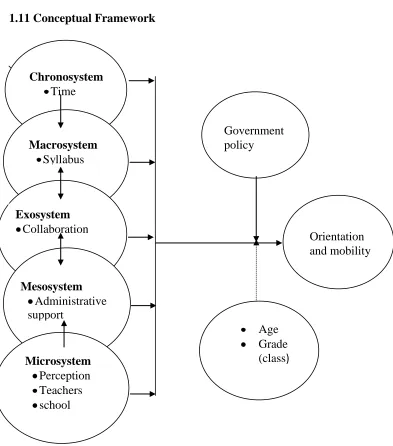
The ecological frameworks theory created by Bronfenbrenner (1979) guided the study. This theory concentrates on the way that learners develop at the focal point of interconnected relationships and environments that all impact their development. In this study, the environment was the school and it goes about as a framework involving components which work in agreement amid the process of orientation and mobility training.
Bronfenbrenner (1979) accorded moderately equal significance to both the environment and the developing individual; for him development was adequately the developing cooperation between the variables. In connection to this, it was viewed that for adequate learning and training in orientation and mobility, various variables needed to cooperate for its success. This incorporated time, joint effort, administration, perceptions and policies. The fundamental unit of investigation for Bronfenbrenner was the two-person framework, a fact which it showed a sense of duty regarding not seeing the subject of development in social segregation.
Microsystem; This alluded to the exercises and connections that happen in the individual’s prompt setting. Learners are impacted by the general population in their Microsystems. In this sense, the perception of the learner towards orientation and mobility was of prime significance as this would make the child be inspired or not to be trained to acquire the skills of independent travel. Exosystem; Teamwork was imperative in the advancement as well as execution of orientation and mobility instruction.
Mesosystem; This implied to the affiliations or interrelations among such Microsystems as homes, school and peer group. Bronfenbrenner contended that development was inclined to be improved by solid, steady connections among Microsystems. This was the place where the teacher-pupil ratio falls.
1.11 Conceptual Framework
(Source: Adapted from Bronfenbrenner model, 1979) Figure 1.1: Conceptual framework.
The significant measurement used to gauge the accomplishment of any training is the execution of the skills learned. The achievement would be achieved after the different inputs are set up. In orientation and mobility training, the accomplishment of the training
Government policy
Age Grade (class)
Orientation and mobility Chronosystem
Time
Macrosystem Syllabus
Exosystem Collaboration
Mesosystem Administrative support
was a function of how these variables cooperated. In the event that the interplay was healthy, then execution would be great and the other way around.
and casual activities of school boards, resources, professional development and changes in the teaching staff.
1.12 Operational Definitions of key Terms
In this research the accompanying terms were operationally defined as follows:- Barriers: An obstruction to advance or access.
Curriculum: Organized experiences that schools provide to help learners learn and develop. It includes the subjects taught, the content, the school environment and other organized learning enhancement activities that take place outside the classroom. KICD Act (Republic of Kenya, 2013) defines curriculum as all planned learning programmes that facilitate formal, non-formal and informal learning and/or a programme of instruction which the learners are expected to undertake in their training under the guidance of schools’ policies.
Curriculum barriers: Obstacles that impedelearners getting a full extent of training. Curriculum implementation: This is active training in a set programme of activities such as in orientation and mobility curriculum
Expanded core curriculum: Refers to concepts and skills that often require specialized instruction with students who are blind or visually impaired and incorporates orientation and mobility skills.
Mobility: Impliesto one’s self-propelled movement using body mechanisms or mobility aids through the environment.
Orientation: Is the capacity of an individual to figure out where one is and where one intends to go.
CHAPTER TWO
REVIEW OF RELATED LITERATURE 2.0. Introduction
This section first explores on orientation and mobility instruction. Then, review of related literature was carried out on orientation and mobility instruction, administrative support, time (chronosystem), teacher-pupil ratio and finally on teachers’ and learners’ perceptions towards orientation and mobility instruction.
2.1. Orientation and mobility instruction
designed to augment the coordination of all available supportive networks (Bozeman, & McCauley, 2010). According to Bronfenbrenner’s theory, this ought to include all levels of the framework to enable success of the programmes set up, for example, orientation and mobility training.
Regardless of the way that it is achievable for a learner with a visual impairment to acquire a significant number of the same skills as a learner with normally created vision, numerous elements affect the event and sequence of ability fulfilment (Ferrell, 1996). The administrative support, particular guidelines, utilization of specialized resources and accessibility, development of compensatory skills and significant encounters within the environment assume critical roles. Through significant encounters with their surroundings and others, learners with visual impairments can expand their opportunities for development and learning. Subsequently, it is critical that the learners should be given suitable guidelines to address their requirements of mobility (Bischof, 2008).
the need to explore whether learners with visual impairment experience similar issues or even worse than what is accounted for by Cameto and Nagle (2007).
2.2 Time
Time has a noticeable place in orientation and mobility training. In this section, a brief description of the component in connection to orientation and mobility training was done.
2.2.1 Time
Research that was based on National Longitudinal Survey data undertaken by AFB in the United States on transition to work among learners aged 13 to 16 years shows significant connections between learners’ successful transitions to work and learners’ being trained in even only a few of the content areas of the orientation and mobility curriculum. The research, notwithstanding, additionally demonstrated that instruction in the orientation and mobility curriculum was not generally offered in a coordinated way (Sacks, & Rothstein, 2010). This demonstrated the need to explore whether this was the situation for learners with visual impairments in Kenya.
academic abilities focused in the current curriculum (Koenig, & Holbrook, 2003). Securing of very single central ability and learning require a tremendous measure of time and exertion (Iowa Department of Education, 2007).
As a way to acquire the greatest independence feasible, learners need the opportunity to develop proficiency in the skills unique to those required by learners with visual impairments and this includes orientation and mobility skills. This requires a colossal measure of time (Pogrund, & Fazzi, 2002; Fazzi, & Petersmeyer, 2001). Time is essential as it involves the designing of events in the environment (Watts, Cockcroft, & Duncan, 2009). Bronfenbrenner (1979) additionally considers the measure of time (chronosystem) as a basic component that influence on the direction of development. The number and nature of the interplay between the settings in which a learner invests time additionally have essential ramifications for development. The components within this system might be either outside, for instance, timing of the training. The important aspect of the Microsystem is the immediate contact and interplay with the learner for a significant time frame (Pena, 2009). Hence, there was a need to explore the sort of consideration accorded to orientation and mobility training locally and particularly in the schools under study.
2.3 Administrative Support
Klingner, Arguelles, Hughes, & Vaughin, 2001). Along these lines, the degree of support from the administration influences how much teachers create and actualize mediations intended to improve performance of the learner (Embich, 2001).
A research by Gerstein, Keating, Yovanoff and Harniss (2001) in three large Urban school districts in Arizona among special educators on components that improve special instructors’ intent to stay, observed that established support from administrators had strong effects on “practically all basic aspects of (a specialized curriculum) educators’ working conditions” (p.551). Effective supervision, administration and encouragement guarantees that instructors cooperate to actualize successful teaching programmes and monitor learner performance continuously (Thomas, Correa, & Morsink, 2001; Walther-Thomas, Korinek, McLauglin, & Williams, 2000).
concerning issues, for instance, the role of the orientation and mobility teacher (DiPaola, & Walther-Thomas, 2003). The administrator is frequently in-charge of decisions in regard to accessing materials, schedules, acknowledgement of staff, encouraging cooperation among staff and shared basic leadership (Billingsley, Carlson, & Klein, 2004).
Moreover, none of the nations in sub-Saharan Africa has specialized curriculum or other enactment ordering that learners with unique instructive requirement get the necessary services they require (Reynolds, & Fletcher-Janzen, 2007). In spite of the way that governments in Sub-Saharan Africa embraced specialized curriculum policies, services are not accessible to by far most of the learners in the countries (Reynolds, & Fletcher-Janzen, 2007). Emotionally supportive networks are essential if such programmes are to be successful.
study were putting forth to encourage orientation and mobility instructions for learners with visual impairment.
2.4 Teacher-Pupil Ratio and Orientation and Mobility
Research has established that the teacher-pupil ratio is 1:70 in some schools, which is a long way past the prescribed most extreme proportion of 1:40. Such high ratio presents difficulties as teachers think that it is difficult to give individualized attention on all learners in regular schools particularly the learners with specific learning difficulties (Aduda, 2012, November 18). Teacher-pupil ratios have an influence on perception of teachers which therefore have an impact on teaching of learners. This is so critical considering that apart from most nations persistently insisting on proper teaching of learners, most governments in Sub-Saharan Africa especially Kenya, are introducing other subjects in the education programme, thus expanding the workload of the regular subjects. The Government of Kenya has embarked on capacity building for primary school teachers in special needs curriculum. In addition, university programmes have been preparing teachers for all levels of education with a purpose of enhancing the essential countrywide capacity to deal with special needs education (Njoka, et al., 2012). The Kenya government has additionally put resources into in-service training of teachers to boost special needs education (NSNE, 2009).
2014. In Qatar, the difficulty of preparing, employing and retaining special education workforce are embedded into the complexities of national reform endeavours. In the Gulf state Pupil-Teacher Ratio is reported to be 40:1 in 2005 (UNESCO, 2008). According to Knott (2002) different learners need levels of services, so caseloads differ depending on the learners’ needs. Likewise orientation and mobility instructors offer services straightforwardly, generally working one-on-one with learners and periodically with small groups. Similarly, in typical orientation and mobility training settings in which there are ever-present dangers, it is essential to give one-on-one training particularly tailored to meet the exceptional requirements of a learner instead of a gathering. Stoler (2007) noted that teachers make either positive or negative perceptions in light of the extent of their classes. The researcher notes that when such classes are large, the learners do not get extra consideration needful for their positive academic results. At the point when such a situation is presented, teachers eventually feel the weight of potential inadequacy and their perception turns out to be unavoidably negative.
This study investigated the current teacher-pupil ratio in the schools particularly while undertaking orientation and mobility training in addition to establishing whether shortage of teachers who can teach orientation and mobility additionally influences the Pupil-Teacher Ratio.
2.5. Teachers’ Perceptions toward Orientation and Mobility Instruction
objectives, and skills (Wall Emerson and Corn, 2006). For the orientation and mobility instructor a consideration of the relationship with the student may be the first step in effective instruction. Such a relationship requires a respect for diversity and is quite necessary in all types of instructions and learner interaction (Weiner, Welsh and Blasch, 2010).
Providing learners with visual impairments with an opportunity to participate in planning their own lessons communicates respect for students and for their input. This reinforces the basic perception of respect for diversity (Weiner, 2010). Given the low prevalence of this population of learners, it is likely that administrators will have almost no information or no knowledge of or special training in the area of visual impairments. If this is the case, they may not be prepared to plan and administer programmes for learners who are visually impaired (Holbrook, 2003). Caseloads designed for teachers in special education programmes often exceed reasonable numbers. Circumstances such as these can place teachers in the uncomfortable position of addressing needs in a superficial manner (Holbrook, 2003).
Correspondingly, the researcher observed that some orientation and mobility instructors considered the white cane as an instrument for accomplishing objectives for the children they work with through the fostering of independence as opposed to viewing the white cane as a possibly socially negative identifier of visual impairment. The surroundings in any learning situation can influence one’s accomplishment either positively or negatively. Perceptions have the capability of sending a positive or negative signal to the learner and could influence their mental perceptions to the instruction. Perceptions of instructors are particularly significant in light of the fact that instructors are in charge of instructing learners with visual impairments and preparing them for transition into the adult world.
Within the orientation and mobility instruction, Soodak, Erwin, Winton, Brotherson, Turnbull, Hanson and Brault, (2002) distinguish that co-operative action includes encouraging shared perceptions with all people involved with the child and building up a feeling of moral obligation toward activities guaranteeing the programme’s prosperity. Where instructional objectives are not supported or cannot be accomplished O’Connor (2008) affirms that instructors encounter negative perceptions. Perceptions are as essential to instructor practise as the ability to apply practical instructional techniques (Denzin, 2009). This proved the need to investigate the perceptions of teachers toward orientation and mobility instruction and whether this was the case for teachers in Kenya.
2.6. Learners’ Perceptions towards Orientation and Mobility Instruction
maintain that motivation and perceptions have an immediate relationship on the performance of the learners. It was sensible to assume that orientation and mobility are variables that may influence motivation and perceptions and along this line performance (Wiener, Welsh, & Blasch, 2010). As expressed in the theory by Bronfenbrenner’s, Microsystem influences activities and associations happening in the prompt setting of the learner. For this situation, perceptions of a learner towards orientation and mobility training can either motivate or discourage the need to gain orientation and mobility skills.
in the shock, withdrawal, denial, lamenting, and discouragement stages ordinarily will not present themselves for training.
In South Africa a study by Perla and O’Donnell (2004) on encouraging problem solving in orientation and mobility demonstrates that moving into the unknown can be exceptionally terrifying for some learners with visual impairments and simply confidence and trust in the instructor and in the immediate environment would enable them to reach out and interact. This implied that learners fear walking alone without a guide hence orientation and mobility instruction would help eliminate this fear of the unknown. This fear may hinder the development of orientation and mobility instruction.
A few studies have been published regarding orientation and mobility issues. However, omitted in the research are data regarding the curriculum barriers to teaching orientation and mobility. A need existed for a detailed assessment of the curriculum barriers to teaching orientation and mobility in the schools for learners with visual impairments.
2.7 Summary
The previous section had looked into the important literature on orientation and mobility training. Essential viewpoints which had been covered in the section included orientation and mobility instruction, administrative support, time and teacher-pupil ratio, perception of teachers and learners towards orientation and mobility training.
In consideration of the literature reviewed, it had been found out that orientation and mobility training had been downplayed. Despite the fact a few investigations had been carried out on orientation and mobility in parts of the nations in the world, for instance, practises for deciding the provision of orientation and mobility instruction for students with low vision in Florida, in the United States, little had been done on the same in Kenya. It was conceivable that if similar studies would be done in Kenya comparable outcomes would be realized. While it was obvious that timetabling plays a pivotal part of orientation and mobility training, it was not clear why orientation and mobility training was excluded in the official school timetable in Kenyan schools for learners with visual impairments.
towards orientation and mobility instruction. However, such studies had not been done in Kenya in connection with the teaching of orientation and mobility, hence the need to look into the issues within the Kenyan setting.
Numerous researchers globally have done investigations regarding the subject of orientation and mobility training with recommendations in light of the findings however learners still experience difficulties of independent and safe travel. However, omitted in the research were information in regards to curriculum barriers to teaching orientation and mobility to learners with visual impairments. As a result of this review, gaps were identified. This data was utilized to guide the research design with the point of developing new knowledge and cultivating greater understanding in regard to curriculum barriers to teaching orientation and mobility to learners with visual impairments in the Kenyan setting.
CHAPTER THREE RESEARCH METHODOLOGY 3.0 Introduction
This section of the study discussed research design, the variables, locale of the study, target population, sampling techniques and the sample size, the pilot study, the construction of the research instruments, validity and reliability of instruments, data collection techniques and data analysis procedures and the logistical and ethical considerations.
3.1 Research Design
3.1.1 Variables
The dependent variable in the study was the acquisition of orientation and mobility skills. The independent variables in the study were as follows: time allocation, administrative support, teacher-pupil ratio and perception of teachers and learners towards orientation and mobility training.
3.2 Location of the Study
3.3 Population
The target population included only teachers teaching in the selected schools (51), administrators (4), and learners (412) (those with low vision or with total blindness).
3.4.0 Sampling Techniques and Sample Size determination
In the study, the researcher used purposive and stratified sampling techniques to identify the sample. Purposive sampling was utilised since the researcher only sought cases rich in information for study in depth. In the study the sample participants were selected basing on their knowledge, sufficient and relevant work experience and expertise in regard to the instruction of orientation and mobility. A stratified sampling procedure was used for selecting the learners. The technique was employed to ensure a fairly equal representation of the learners for the study. Below is the description of the sampling techniques and the sample size.
3.4.1 Sampling Techniques
3.4.2 Sample Size Determination
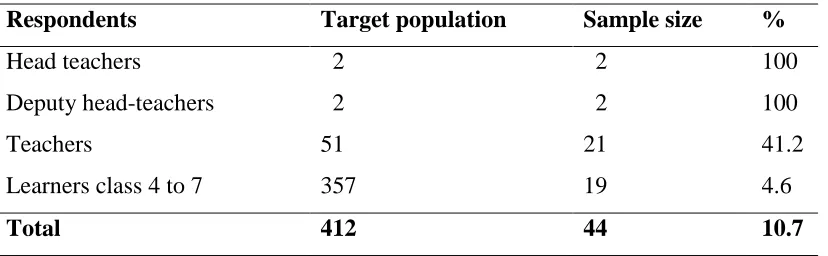
The sample size was composed of 21 teachers, administrators (the head teachers and the deputy head teachers) (two from each school), and 19 from class four to seven were identified for the interview. They were purposively identified since only those who needed orientation and mobility were to be chosen as respondents. The sample matrix yielded a sample size of 44.
Table 3.1: Sample matrix
Respondents Target population Sample size %
Head teachers 2 2 100
Deputy head-teachers 2 2 100
Teachers 51 21 41.2
Learners class 4 to 7 357 19 4.6
Total 412 44 10.7
3.5 Research Instruments
A semi-structured interview guide with open-ended question format was considered appropriate for the administrators and the learners. These were considered ideal for the learners because they had varied ages and low literacy levels to read, interpret and react to a questionnaire (Orodho, 2009). The semi-interview guide was appropriate for the head teachers and the deputy head teachers to enable collection of in-depth information from the administrators on their perception, time, administrative support, and the teacher-pupil ratio towards orientation and mobility training.
Observation schedule was also designed for the researcher to collect information on resources required in relation to orientation and mobility activities within the school in the natural setting. This was to permit the researcher to record the resources required in the instruction and the adaptation of the school environment. This method was utilized in order to obtain a logical, well-established knowledge base about the curriculum barriers to teaching orientation and mobility instruction. The results were analysed using tables and frequencies and were also thematically analysed.
3.5.1 Pilot Study
carried out by the researcher to clarify instructions, determine appropriate levels of independent variables, and determine reliability and validity of the instruments. The results were utilized to make changes in the instruments. The results were analysed to recognize any shortcomings in the instruments. Ambiguities identified in the research instruments were corrected to upgrade their reliability before field administration.
3.5.2 Validity
The validity of the study was content validity. This was utilized on the grounds that it measured the degree to which the sample of the items represented the content that the instruments were intended to measure. For this situation the researcher sought the supervisors’ view on the nature of the instruments developed. The goal was to approve the instruments as measuring instruments with the end goal for them to be appropriate tools. The supervisors examined the instruments independently and gave their input. The suggestions offered were incorporated in the final research instruments before they were pre-tested.
3.5.3 The Reliability of Instruments
0.78 was established. The Pearson moment correlation was used to carry out the correlation.
3.6 Data Collection
The data collection techniques included interview guides which were also prepared for the administrators. Firstly, the administrators were asked for permission to collect data from the school after presentation of the relevant documents from the government authorities granting permission to conduct the research. After explaining to the administrators the purpose, significance of the study and the procedure of the interview, the researcher requested for an interview with the administrators which they granted. The aim was to allow the administrators to facilitate the meeting with the teachers. The researcher recorded each response on the blank spaces in the interview guide.
Secondly, the administrators were asked to assemble the teachers who had undergone training in orientation and mobility. After explaining how to answer the questions, the questionnaires were distributed to the teachers with the help of one research assistant per school. The research assistant collected them after ensuring that all had been filled.
interview guides for their perceptions towards orientation and mobility training since some of them were not able to read and responded to a questionnaire. The interviews with the learners were conducted in a private office where no third person could hear the discussion or conversation going on. The responses were recorded in the spaces in the interview guides.
Fourthly, the observation schedule was administered by the researcher who recorded each and every observation with the help of the research assistant for consistency. This was conducted to provide a well substantiated knowledge base about the curriculum barriers to the teaching of orientation and mobility
3.7 Data Analysis
Data obtained from the questionnaires were screened for completeness and analysed utilizing the descriptive and inferential statistics in the statistical packages for social sciences (SPSS). Interview and observation responses were put into themes and were analysed qualitatively using content analysis. These were preferred in light of their effectiveness and capacity to deal with large amounts of information. It involved description of data as indicated by the responses, data analysis and processing of the information.
utilization of frequency tables, graphs, pie-charts, computation of percentages and tabulating them appropriately (Gay, 1992). Lastly, a brief discussion of the findings was done.
3.8 Logistical and Ethical Considerations
It is essential that every researcher is aware of legal and ethical considerations. In the research the following were considered.
Permission
The researcher got the endorsement to collect information from the participants of the study from the National Council for Science and Technology, County Commissioners and County Directors of Education, Siaya and West Pokot Counties. Administrators of the schools were likewise requested to consent to conduct the study in the respective schools for learners with visual impairments.
Respect for people as autonomous individuals
clarifications. At the end of the clarifications, the participants were humbly requested to give their consent.
Confidentiality and anonymity
In this research, anonymity was accomplished by not indicating the names of the respondents on the questionnaire. The researcher toward the end did not link any information to any respondent. The interviews were conducted in a private office where no third person could hear the discussion or conversation going on.
Avoiding harm
In this study, psychological harm through circumstances of long waiting and keeping up secrecy and anonymity was the presumable risk the participants could have experienced. The time of interviewing the participant was minimized. Keeping up privacy, secrecy and anonymity amid the interview likewise, counteracted psychological harm.
Informed consent
After a full clarification of the nature of the research, participants were requested to give verbal consent of their willingness to take part in the research.
Conclusion
CHAPTER FOUR
FINDINGS, INTERPRETATION AND DISCUSSIONS 4.0. Introduction
In this part the results of the study are depicted. The purpose or motivation behind the study was to assess curriculum barriers to the teaching of orientation and mobility. The data were gathered and afterward presented in response to the following study’s objectives:
1. To explore why orientation and mobility was not being treated as part of the school timetable,
2. To identify the availability of administrative support,
3. To determine the teacher-pupil ratio in orientation and mobility instruction
4. To identify the perceptions of teachers and also assess the perceptions of learners towards the teaching of orientation and mobility.
The methodology discussed earlier in chapter three gave the baseline to data gathering. The following were utilized to carry out the analysis of the data; sample description, main results, discussion, presentation and the interpretation of the results of the research. The following section provides the attributes of the sample.
4.1 General and Demographic Information
schools for learners with visual impairments in West Pokot and Siaya Counties in Kenya. Their response rate was 100%.
4.1.1. Demographic data
The first item was to explore the gender, age, teacher training and experience in order to establish their influence on teaching orientation and mobility. The respondents were requested to provide their gender, age, training and working experiences. The responses from the participants were as indicated below.
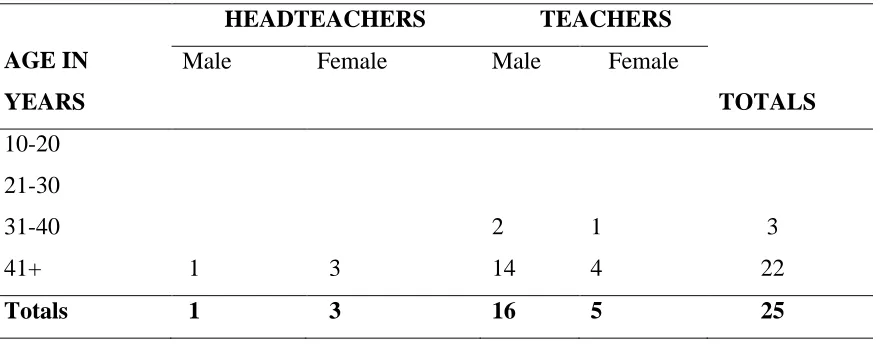
Table 4.1. Gender, age of teachers and administrators.
AGE IN YEARS
HEADTEACHERS TEACHERS
TOTALS
Male Female Male Female
10-20 21-30
31-40 2 1 3
41+ 1 3 14 4 22
Totals 1 3 16 5 25
majority of the respondents were well exposed to issues of curriculum barriers to the teaching of orientation and mobility.
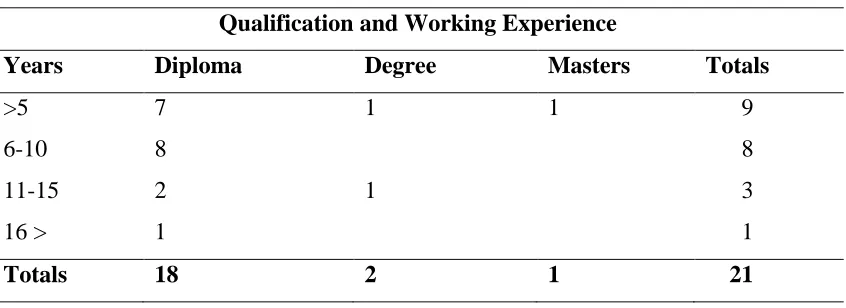
Table 4.2: Teachers' qualifications and working experience. Qualification and Working Experience
Years Diploma Degree Masters Totals
>5 7 1 1 9
6-10 8 8
11-15 2 1 3
16 > 1 1
Totals 18 2 1 21
The greater numbers of the teachers were diploma holders while degree holders formed the minority with only one teacher who had attained Masters Degree in Special Needs Education. However, the fact that majority of the respondents had diploma certification or more inferred that they had the qualifications to reliably answer questions about the curriculum barriers. This revealed that there were enough teachers that possessed the necessary qualifications to conduct training in orientation and mobility yet they were not actively engaged in the teaching. Therefore, when a significant number of teachers are trained yet orientation and mobility services are not being effectively implemented, then there must be some overriding issues which need to be addressed to make teaching of orientation and mobility practical in schools.
period of between 11-15 years. Considering that the larger part of the teachers had worked in the schools for the duration of between five to ten years they would have been great advocates for incorporation of orientation and mobility training in the official educational timetable by Kenya Institute of Curriculum Development.
4.1.2. The Nature of Learners that Participated in the Study (N=19).
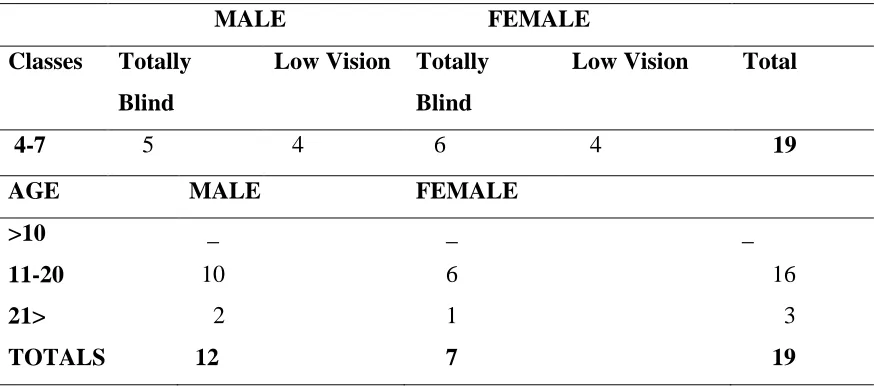
The following are the number of learners that were sampled because they required orientation and mobility training.
Table 4.3. The class, nature, gender and age of learners who participated in the study (N=19).
MALE FEMALE Classes Totally
Blind
Low Vision Totally Blind
Low Vision Total
4-7 5 4 6 4 19
AGE MALE FEMALE
>10 _ _ _
11-20 10 6 16
21> 2 1 3
TOTALS 12 7 19
provision of orientation and mobility skills. This necessitated the provision of instruction in orientation and mobility to the learners with low vision to allow them move about safely and confidently. The learners with total blindness were included by virtue of their nature as orientation and mobility allows them to move safely and confidently within the environment. Majority of the learners were male aged between 10-20 years while a third were girls aged between 10-20 years. This inferred that most of the learners could understand issues related to orientation and mobility instruction.
4.1.5. Influence of Teacher Training on Teaching of Orientation and Mobility
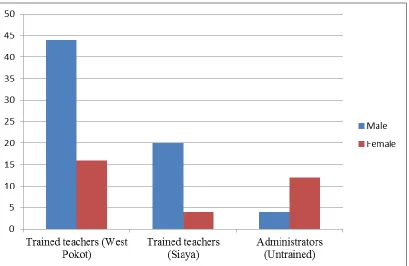
The first item was to explore the teacher training and establish their influence on teaching orientation and mobility. The results were as seen in Figure 4.1.
From the Figure 4.1, it showed that majority of the teachers had received formal training in orientation and mobility. This information revealed that lack of training in orientation and mobility was not an impediment to instruction. However, the head teachers and their deputies in both schools had not received any form of training. The data revealed that if the administrators in each school would appoint one teacher as a full-time outdoor instructor of orientation and mobility travel skills, the two would still be backed by a strong team of trained teachers that would enhance orientation and mobility by integrating the skills in their subject areas. Such efforts are backed by literature which supports teamwork in the instruction in orientation and mobility (Bozeman, & McCauley, 2010).
4.2: Timetabling of Orientation and Mobility Training
The first objective in this research was to explore the reasons why orientation and mobility training was not being taught in the selected schools. Teachers and administrators were asked the reasons why orientation and mobility instruction was not included in the official school timetable. The following were the results of the study.
4.2.1. Allocation of Lessons for Teaching Orientation and Mobility
Figure 4.2: Teacher’s responses on orientation and mobility lessons allocated on the school timetable
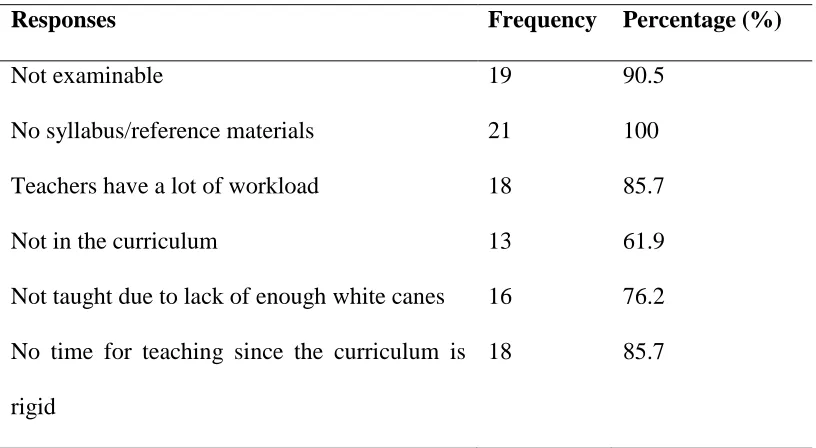
Table 4.4: Teachers responses on exclusion of orientation and mobility in the timetable
Responses Frequency Percentage (%)
Not examinable 19 90.5
No syllabus/reference materials 21 100
Teachers have a lot of workload 18 85.7
Not in the curriculum 13 61.9
Not taught due to lack of enough white canes 16 76.2 No time for teaching since the curriculum is
rigid
18 85.7
developers. This was as serious as Van Reusen, Shoho, and Barker, (2001) observed that apart from most government insisting on proper teaching of learners with visual impairments, most governments in Sub-Saharan Africa especially Kenya were introducing other subjects in the education programme, thus bulging the workload of the regular subjects. With such a situation, teachers viewed the instruction in orientation and mobility as an additional load. Consequently, it can be said that their perception cannot be further from negative. This suggested that it was a great challenge to fit these programmes into the average school day. These reasons given inferred that there was no teaching of orientation and mobility being carried out in the schools for the learners with visual impairments. Thus, there was no plan being made by the Kenya Institute of Curriculum Development to make sure that it was incorporated into the official school timetable.
4.2.2. Administrator’s responses to orientation and mobility lessons allocated on the school timetable (N=4)
The head teachers and their deputies raised numerous reasons that had made orientation and mobility to be excluded in the official timetable. From the study the following verbal quotes were the responses to the above:
“This is not an examinable subject and it is not put on the official timetable” (Administrator A)
“The subject is not in the syllabus”. (Administrator B)
The reasons provided by the administrators inferred that the teaching of orientation and mobility was not being carried out in the schools. Thus, there was no plan by the administration to make sure that it was taught. This concurs with Gense and Gense (2004) who observed that the perception of the administrator of the school in regard to the instruction of orientation and mobility might be one of the numerous elements influencing the achievement or disappointment of endeavours to carry out orientation and mobility instruction. The administrator’s perception impacts the demeanour of others accordingly making an atmosphere of acknowledgement or of refusal. An administrator who believes in the instruction in orientation and mobility will support the setting up of a programme by providing resources both material and human to provide the needed training. These reasons given inferred that there was no teaching of orientation and mobility being carried out in the schools for the learners with visual impairments. Thus, there was no plan being made by the school administration to make sure that it was incorporated into the official school timetable and it was actually taught.
4.3. Administrative Support Available for the Instruction of Orientation and Mobility
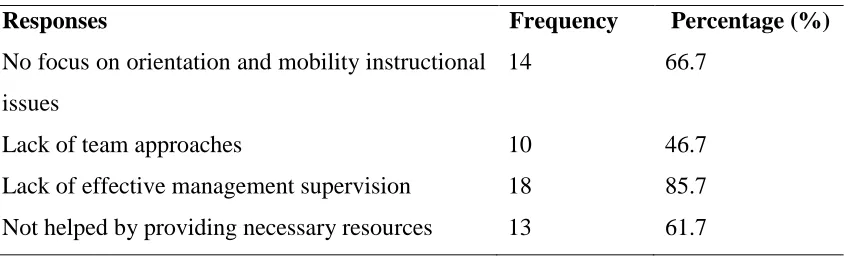
Table 4.5: Teacher’s responses on administrative support available.
Responses Frequency Percentage (%)
No focus on orientation and mobility instructional issues
14 66.7
Lack of team approaches 10 46.7
Lack of effective management supervision 18 85.7 Not helped by providing necessary resources 13 61.7
conditions for the instructors. This implied that lack of conducive school organization could result into a curriculum barrier to the teaching of orientation and mobility. A study by Gerstein and colleagues (2001) found that support from administrators had a strong influence on “every basic part of teachers’ working conditions” and in this way lack of it causes problems.
4.3.1. Support provided by the administration in the teaching of orientation and mobility (N=4).
The researcher sought to investigate the support the school administration availed towards orientation and mobility training.
The administrators indicated that the supports they provided included the following as illustrated by the following verbal quotes:
“The school provides white canes” (Administrator A)
“We provide optical devices from the Sabatia Eye Hospital”, (Administrator B) “Timetable in lower primary and books”. (Administrator C)
“Though the subject is included in the timetable, there is no one who teaches”. (Administrator D)
administrators are not trained there can never be successful teaching in orientation and mobility. The researcher suggests that lack of training has made the administrators unaware of what to do in relation to orientation and mobility training.
4.4. Teacher-Pupil Ratio in the Teaching of Orientation and Mobility
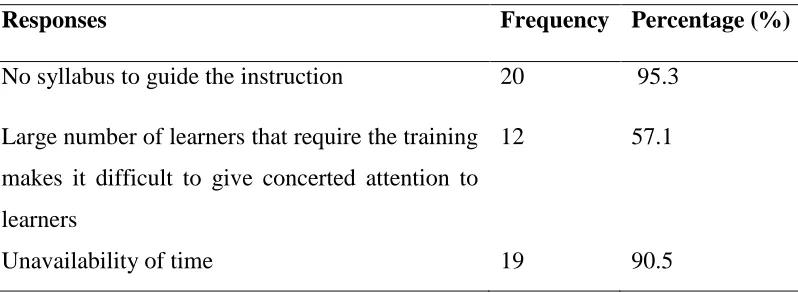
The third objective sought to explore teacher-pupil ratio in regard to the teaching of orientation and mobility. The teachers were requested to give information on the number of learners they were assigned to be taught orientation and mobility. The outcomes are provided below.
Table 4.6: Teachers responses on lack of assignment of learners to be taught orientation and mobility
Responses Frequency Percentage (%)
No syllabus to guide the instruction 20 95.3
Large number of learners that require the training makes it difficult to give concerted attention to learners
12 57.1
Unavailability of time 19 90.5
From the data collected majority of the teachers indicated that, despite their willingness to teach, there was no syllabus to guide the instruction and unavailability of time. As demonstrated by Bronfenbrenner, in the Macrosystem we might discover policies, laws, curriculum and syllabus. These determines what ought to be taught in a school and at what time and duration. Therefore, without proper guidelines it becomes difficult for orientation and mobility to be conducted in the schools.
Teachers make either positive or negative perceptions in light of the size of their classes (Stoler, 2007). The researcher observed that when such classes have many learners, the learners with visual impairments do not get additional consideration needful for their positive academic results. At the point when such a situation is presented, teachers eventually feel the weight of potential incompetence and their perception turns out to be definitely negative. Large classes may be seen as an obstacle to the effective teaching of orientation and mobility (Stoller, 2007).
Lastly, the above data may be inferred that teacher-pupil ratios play a critical role in ensuring that adequate teaching of orientation and mobility is accomplished. In Kenya, it is approximated that the ratio of learners with special needs to a teacher trained in special needs is 20:1 in special institutions for learners with visual impairments. The suggested pupil-teacher ratio (PTR) is 1:5 (UNESCO, 2008). Large pupil teacher ratio suggests a lowered quality of instruction in schools.
4.5 Teachers’ Perceptions on Teaching Orientation and Mobility
4.5.1 Perception of Administrators on the Teaching of Orientation and Mobility to Learners with Visual Impairments (N=4).
The researcher sought to establish the perception of the administrators on the teaching of orientation and mobility to the learners with visual impairments. The following verbal quotes emerged from the study were the results.
“Orientation and mobility instruction to learners with visual Impairments is good for them since it will make learners be independent”. (Administrator C)
“Will make learners not to cling to others as they move about in the school compound” (Administrator D)
From the study it showed that the administrators agreed that it was necessary to teach orientation and mobility to learners with visual impairments. The responses from the respondents indicated that it was quite necessary for the learners to be offered orientation and mobility training.
In order to get in-depth information, the administrators were further asked to give their perceptions in relation to the teaching of orientation and mobility to learners with visual impairments. The following verbal quotes were given as the importance.
“This will help learners move alone within the school compound and at their homes”. “They will not fall into holes or pits”. (Respondent A).
“It will improve their walking posture”. (Respondent B).
“This will enhance their self-esteem”. (Respondent C). “Will enhance their socialization skills”. (Respondent D).
increase the learner’s familiarity with the environment, bringing about increased motivation, freedom and safety. Similarly it concurs with Anthony, Lowry, Brown, and Hatton (2004) who expressed that learners with visual impairments do not reach or move independently towards objects until they develop and achieve the conceptual understanding of people and objects within the surrounding. Therefore, formative readiness in orientation and mobility is an essential component that must be taken into account for a child’s instruction.
4.5.2 Administrators’ Preferred Times for Teaching Orientation and Mobility The researcher intended to establish the preferred times for carrying out the teaching of orientation and mobility by the administrators. The administrators were asked to state their preferred times for carrying out the instruction of orientation and mobility. The outcomes of the information gathered are indicated below in Figure 4.4.
Figure 4.3: Time for the instruction of orientation and mobility 25%
75%
Afternoon
From the Figure 4.3, it indicated that three-quarters of the administrators preferred the teaching of orientation and mobility after classes compared with a quarter who preferred teaching in the afternoon. A number of them, similarly to the above, replied that it additionally, depended on time available to teach orientation and mobility. The researcher probed, in addition, to find out the reasons for the times preferred. From the study the following verbal quotes were provided as their responses to the issue of time for the instruction:
“The regular subjects would have been taught after classes” (Administrator A) “Teachers are free together with learners after classes”. (Administrator B)
“Life skills may be used by teachers to teach orientation and mobility” (Administrator C)
“Games, clubs and societies’ periods can be used to instruct orientation and mobility”. (Administrator D)
From the responses it suggested that there had been preference for teaching orientation and mobility after the official school-time. There was absence of priority given to its teaching that was why great attention was accorded to the regular subjects at the expense of orientation and mobility.
4.5.2. Mechanisms put in place by Curriculum Developers