Available Online at www.ijcsmc.com
International Journal of Computer Science and Mobile Computing
A Monthly Journal of Computer Science and Information Technology
ISSN 2320–088X
IMPACT FACTOR: 6.199IJCSMC, Vol. 8, Issue. 6, June 2019, pg.66 – 71
VIRTUAL REALITY SIMULATION
Tummala Charan Reddy
1; Gudivada Rupesh
2; Prof. Rajani Shree
31
Department of CSE, School of Engineering and Technology-Jain University, Bangalore, India
2
Department of CSE, School of Engineering and Technology-Jain University, Bangalore, India
3
Department of CSE, School of Engineering and Technology-Jain University, Bangalore, India
1
[email protected], 2 [email protected], 3 [email protected]
Abstract- In recent time, the reports that each year nearly five thousand pedestrians die in motor vehicle-related accidents. This technology has planned in study in different condition how human being will react at the time accident. It is based on Virtual Reality (VR).In this different person is studied under virtual environment where some simulation is going on. In this simulation they will be real time things like road, street lights, houses, people, tress and atmosphere. Selected people will go in simulation when subject is meet with accident they will study about how subject posture changes.
Keywords - Virtual Reality, Simulation, Virtual Environment
I. INTRODUCTION
Virtual reality rooms were the initial chance for facultative virtual surroundings. Before the shrinking of show technologies which may support by VR headsets, virtual reality simulation rooms are used to bring a 360° visual experience. “Virtual Reality” combat flight employment developed decade’s agony for the use of North American nation army used in display encompassing simulation of fighter jet by the army pilot. The constant technology were used in displays and rooms with projectors. VR rooms supported projectors are usually remarked as “CAVEs” [3].
Fig.2 VR Room (Source: www.mashable.com)
II. LITERATURE SURVEY
In this paper, a set of virtual auxiliary surgery system based on VR is designed and implemented.[6] The research and implementation of the key issues from the overall design to the whole system involved, finally using modular design idea of virtual design on assisted surgery system were constructed to start UI and the virtual scene and interaction, the independent unit and integration testing, to ensure the system running free error and smooth implementation of the virtual surgery system, the original design scheme of auxiliary. The virtual assistant surgery system designed and implemented in this paper has achieved the basic application needs. However, due to the more number of important points involved, some parts of the system need further improvement or improvements.
In this paper, the posture of body is evaluated during collision. In order to get information they are using “Virtual Reality”. In this simulation they use simulation room where participants will simulate traffic scenario. Motion sensors are connected to the body of participants. They use “Xsens” sensors and “MVN studio” for connecting sensors. By this it is used to calculate average body and segment orientation at time of collision.[1]
In various case studies are taken into consideration and the usage and effect of virtual reality simulation on each scenario have been explained. Certain points like how it has changed the previously used methods are discussed and how this process is made more efficient using this technology. They have covered domains such as Animation, image processing, motion sensors, and VR room.
III. METHODOLOGY
A. 1) Pedestrian Simulator: The study is conducted in an exceedingly virtual surrounding through the utilization of a particularly created pedestrian simulation machine, that permits subject to maneuver in an exceedingly need virtual traffic situation.
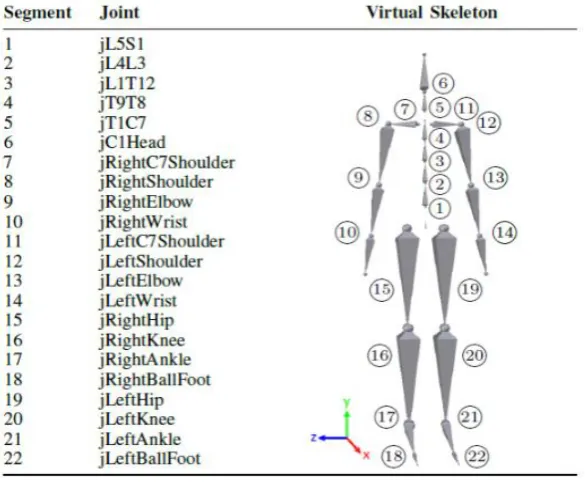
a) Motion Capture System: There are total twenty two motion sensors around the body as shown in fig 3. From below picture observed that at every joint motion sensors are implanted on spinal cord four sensors are arranged by this every motion is capture accurately. The sensors are placed with suits and straps all relevant to human body parts like neck, spinal cord, elbows lower and upper legs, hands and shoulders, feet, upper and fore arms. The Xsens is the sensors module [4] that is used to capture motion from sensors. Based on this sensor input it is used to calculate the position of the body during an automobile collision. “MVN Studio” is a software program which is used to controls the motion capture system. The joints between the spinal core are jL5S1, jL4L3, jL1T12 and jT9T8 are not measured directly, they are interpolated in “MVN Studio” using a model of the spin.
Fig. 3 Sensor location in body
b) Simulation Software: The “virtual Reality” surroundings is Planned to use the simulation package “IPG carmaker”. This software package is specially developed for virtual check driving with careful automobile models that correspond to the behavior of automobile as well as extremely flexible and intelligent driver and manipulatable road elements.
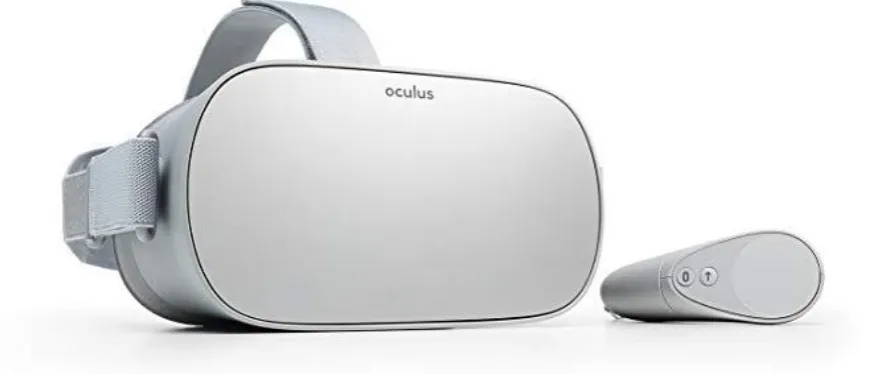
c) VR - Glasses: For the visual feedback to the test subject, the Oculus Go is used. Oculus Go is equipped with an additional 3D inertial sensor for motion detection. The Oculus Go produces a stereoscopic image with two screens with a resolution of 2,560 x 1,440 pixel per screen, a 180-degree field of view and an image refresh rate of 72 Hz.
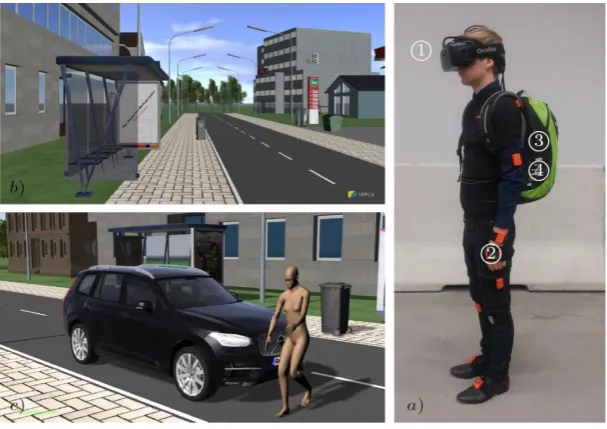
2)System Setup: Fig. 5 shows the simulator setup, which consist of VR-glasses (1), 17 small and lightweight inertial motion capture sensors (2), a motion data receiver (3) and a notebook with simulation software (4).
3) System Configuration: The design concept of the virtual reality of pedestrian collision simulation is illustrated in fig 4. In order to achieve real-time simulation orientation of animation in Carmaker interface align perfectly to VR glasses otherwise, they may be motion sickness. The Motion sensors transmit the current position at the speed of 60 Hz to the “CarMaker” interface.
Fig. 4 Design idea of the pedestrian simulator
B. Participants: In this group of participate age between 20 to 80 taken in simulation in the study. For the most effective motion capture sensor result, there are connected to the body of the participants. All participants must were tight clothes where motion sensors are fixed and sports shoes.
C. Experimental Setup
1) Virtual Environment: The virtual atmosphere in carmaker was designed as a district of a little town. It had been aimed to present the virtual town as realistic as attainable to the check subjects. To accomplish this goal, the surroundings was designed with completely different buildings like homes, trees, office and state buildings, a petroleum station and traffic signs as shown in Fig. 5. For the city traffic situation, a 2 lane street was enforced with a breadth of six meters. The road phase wherever the check eventualities materialized was a straight road with a length of one hundred meters. On both sides of the road were sidewalks with a breadth of three meters.
2) “Finite element re-analysis”-Simulation: In this phase two similar simulation are run Virtual Reality rooms. The main reasons for this simulation are to do quantify and research the influence of the posture of pedestrian during impact.
IV. SYSTEM IMPLEMENTATION
The prototype of the virtual reality room proposed in this paper consists of three components. For every component, certain characteristics, as well as protocols, are followed. In system setup in the paper, they are using oculus drift dk2 which is upgraded to oculus Go which has more features than oculus drift dk2. The “Oculus Go” specifications are an LED display where in the headset with a screen resolution of 2,560 x 1,440 per pixel. The display will run at 72Hz, which means the screen will show up to seventy-two pictures per second, making the sleek visual expertise that’s vital for "VR". A 100 degree view. This will increase the better quality of animation in simulation.
Fig. 5 Oculus Go (Source: www.amazon.com)
Also, for the proposed system in the system configuration to new features which is not addressed in the paper, they sound control, temperature control and air control in the virtual reality environment. With this virtual reality environment will be more realistic real-world movements and actions.
V. CONCLUSION
In this paper, a virtual reality environment is proposed which is used for studying how pedestrian will react when to meet with a car accident while crossing road. The idea is upgrading to Oculus go which is better than Oculus drift dk2 and with embedded sound, temperature and air control will make a simulation even more realistic. We tried our level best overcome almost all the problems from the previously proposed system. The study shows the indication of the pedestrian position at the time of the collision or accident with an automobile which identifies a measurable influence on the mechanics of the pedestrian and therefore it necessary to take steps to prevent accidents [2].
REFERENCES
[1] T. Holdgrün et al., "A Virtual Reality based Approach for Researching Pedestrian to Vehicle Collisions," 2018 IEEE Intelligent Vehicles Symposium (IV), Changshu, 2018, pp. 1318-1325 doi: 10.1109/IVS.2018.8500524
[2] W. H. Organization, Global Status Report on Road Safety 2015 -. Geneva, Switzerland: World Health Organization, 2015.
[3] [Online] available: http://www.visbox.com/products/cave/
[5] Y. Han, J. Yang, K. Nishimoto, K. Mizuno, Y. Matsui, D. Nakane, S. Wanami, and M. Hitosugi, “Finite element analysis of kinematic behaviour and injuries to pedestrians in vehicle collisions,” International Journal of Crashworthiness, vol. 17, no. 2, pp. 141–152, 2012. [Online]. Available: https://doi.org/10.1080/13588265.2011.632243