A New Analytically Regularizing Method for the Analysis of the
Scattering by a Hollow Finite-Length PEC Circular Cylinder
Mario Lucido*, Marco D. Migliore, and Daniele Pinchera
Abstract—In this paper, a new analytically regularizing method, based on Helmholtz decomposition and Galerkin method, for the analysis of the electromagnetic scattering by a hollow finite-length perfectly electrically conducting (PEC) circular cylinder is presented. After expanding the involved functions in cylindrical harmonics, the problem is formulated as an electric field integral equation (EFIE) in a suitable vector transform (VT) domain such that the VT of the surface curl-free and divergence-free contributions of the surface current density, adopted as new unknowns, are scalar functions. A fast convergent second-kind Fredholm infinite matrix-operator equation is obtained by means of Galerkin method with suitable expansion functions reconstructing the expected physical behaviour of the unknowns. Moreover, the elements of the scattering matrix are efficiently evaluated by means of analytical asymptotic acceleration technique.
1. INTRODUCTION
Integral equation formulations, in both spatial and spectral domains, are very frequently adopted when dealing with the analysis of the electromagnetic scattering by finite objects in non-shielded media [1–38]. EFIE formulation is particularly suited for the analysis of the scattering by PEC surfaces, assuming the surface current density as unknown [39]. However, due to the first-kind nature of such kind of integral equations with a singular kernel, the approximate solutions obtained by using general discretization schemes cannot converge to the solution of the problem, and the sequence of condition numbers of truncated system can be divergent [40, 41].
Methods to overcome the problems mentioned above are collectively called methods of analytical regularization [42]. They are based on the conversion of a first-kind integral equation in a second-kind Fredholm integral equation (at which Fredholm theory can be applied [43]), which can be done by inverting the most singular part of the integral operator (containing the leading singularities of the kernel). It is interesting to observe that the regularizing procedure is in general neither trivial nor unique, and that the computational cost of numerical algorithm is strictly related to the selected regularizing scheme. As a matter of fact, different solutions have been proposed in the literature, ranging from the explicit inversion of the most singular part of the integral operator [14, 22–24, 29] to the adoption of a Nystrom-type discretization scheme [17, 25, 30].
Moreover, Galerkin method with a complete set of expansion functions which makes the most singular part of the integral operator invertible with a continuous two-side inverse immediately results in a regularized discretization scheme. This approach has been implemented in [4– 6, 9, 12, 13, 15, 16, 18, 20, 21, 26–28, 31–38] devoted to the analysis of propagation, radiation, and scattering by PEC/dielectric polygonal cross-section cylinders and canonical shape PEC surfaces, by choosing basis functions reconstructing the expected physical behaviour of the fields. As a consequence, few expansion functions are needed to achieve accurate results, and the convolution integrals are reduced
Received 14 August 2016, Accepted 18 October 2016, Scheduled 19 October 2016
* Corresponding author: Mario Lucido ([email protected]).
to algebraic products. Moreover, suitable techniques have been developed to make the matrix coefficients rapidly converging integrals.
In this paper, the analysis of the electromagnetic scattering by a hollow finite-length PEC circular cylinder is carried out by means of a new analytically regularizing method based on Helmholtz decomposition and Galerkin method. After representing all the involved functions as superposition of cylindrical harmonics, the problem is formulated as an EFIE in a suitable VT domain such that the VT of the surface curl-free and divergence-free contributions of the surface current density, adopted as new unknowns, are scalar functions. The obtained integral equation is discretized by means of Galerkin method with a suitable choice of the expansion basis. First of all, the expansion functions used form a complete set of orthogonal eigenfunctions of the most singular part of the integral operator leading to a second-kind Fredholm infinite matrix-operator equation. Secondly, they reconstruct the expected physical behaviour of the surface current density, i.e., few expansion functions are needed to achieve highly accurate results. Moreover, they have closed-form spectral domain counterparts and, hence, the elements of the scattering matrix result to be single improper integrals of oscillating functions efficiently evaluable by means of analytical asymptotic acceleration technique.
This paper is organized as follows. In Sections 2 and 3, the formulation and proposed solution of the problem are presented. The fast convergence of the method and comparisons with the literature and the commercial software CST-MWS are shown in Section 4, while the conclusions are summarized in Section 5.
2. FORMULATION OF THE PROBLEM
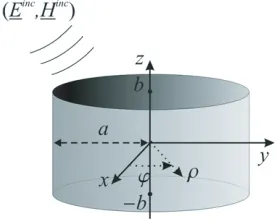
The geometry of the problem, depicted in Figure 1, shows a hollow finite-length PEC circular cylinder (of radiusaand length 2b) in vacuum.
Figure 1. Geometry of the problem.
Let us denoteε0,μ0 andk0 = 2π/λ=ω√ε0μ0 as the dielectric permittivity, magnetic permeability
and wavenumber of the vacuum, respectively, where λis the wavelength and ω the angular frequency. A Cartesian coordinate system (x, y, z) and a cylindrical coordinate system (ρ, ϕ, z) with x = ρcosϕ and y =ρsinϕ are introduced so that the z axis coincides with the cylinder axis, and the origin is at the centre of the cylinder itself. An incident field (Einc(r), Hinc(r)), wherer=xˆx+yyˆ+zˆz, induces a surface current densityJ(ϕ, z) =Jϕ(ϕ, z) ˆϕ+Jz(ϕ, z)ˆzon the scatterer surface which, in turn, generates a scattered field (Esc(r), Hsc(r)).
The revolution symmetry of the problem at hand with respect to thez axis suggests to expand all the involved functions in cylindrical harmonics, i.e.,
f(ρ, ϕ, z) =
+∞
n=−∞
f(n)(ρ, z)ejnϕ. (1)
Due to the orthogonality of the cylindrical harmonics, in the following we can refer directly to the general (n-th) harmonic whenever possible.
By imposing the tangential component of then-th harmonic of the electric field to be vanishing on the cylinder surface, an EFIE is obtained
for|z| ≤b, where [6]
Einc(n)(a, z) =
Eϕinc(n)(a, z) Ezinc(n)(a, z)
, (3)
Esc(n)(a, z) =
+∞
−∞
˜
G(n)(u)J˜(n)(u)e−juzdu, (4)
the following definition of Fourier transform with respect to thez axis
˜
J(n)(u) = 1 2π
+∞
−∞
J(n)(z)ejuzdz (5)
has been introduced,
J(n)(z) =
Jϕ(n)(z) Jz(n)(z)
, (6)
˜
G(n)(u) = − π 2ωε0a
k20a2A˜(n)(u)−n2B˜(n)(u) nuaB˜(n)(u)
nuaB˜(n)(u) k20a2−u2a2B˜(n)(u) , (7)
˜
A(n)(u) = B˜
(n−1)(u) + ˜B(n+1)(u)
2 , (8)
˜
B(n)(u) = Jn
a
k02−u2 H(2)
n
a
k02−u2 , (9)
Jν(·) is the Bessel function of first kind and orderν, and Hν(2)(·) is the Hankel function of second kind and order ν [44].
Now, an alternative expression for the tangential component of then-th harmonic of the scattered electric field on the cylinder surface (useful for what will be done later) can be obtained by introducing the following vector transform pair of order n(VTn)
˜ ¯
J(n)(u) = 1 2π
+∞
−∞
˜
T(n)(u)J(n)(z)ejzudz ⇔ J(n)(z) =
+∞
−∞
˜
T(n)(u)˜¯J(n)(u)e−jzudu, (10)
where
˜
T(n)(u) = √ 1 n2+u2a2
−n ua
ua n (11)
and the following relation can be readily established
˜ ¯
J(n)(u) =T˜(n)(u)˜J(n)(u) ⇔ J˜(n)(u) =T˜(n)(u)˜¯J(n)(u), (12) which allows us to conclude that the VTn of a vector function exists if and only if the Fourier transform of the same function exists.
Hence, by substituting Eq. (12) in Eq. (4) it is simple to obtain
Esc(n)(a, z) =
+∞
−∞
˜
T(n)(u)G˜¯(n)(u)J˜¯(n)(u)e−jzudu, (13)
where
˜ ¯
G(n)(u)= 1 n2+u2a2
˜
¯
G(CCn)(u) G˜¯(CDn) (u) ˜
¯
G(DCn) (u) G˜¯(DDn) (u)
=− π 2ωε0a
k2
0a2−n2−u2a2 0
0 k20a2 B˜
(n)(u)−πωμ0a
2
n2 −nua −nua u2a2
˜
3. PROPOSED SOLUTION
In this section, starting from the integral equation (2), a second-kind Fredholm infinite matrix-operator equation is obtained by means of the introduction of new unknowns via Helmholtz decomposition and the discretization of the integral equation with a suitable choice of the expansion basis in a Galerkin scheme.
3.1. Change of the Unknowns
The physical behaviour of the components of the surface current density can be readily established starting from Maxwell’s equations and Meixner’s theory [45]
Jt(ϕ, z) = 1−(z/b)
2pt ¯
Jt(ϕ, z) |z|< b 0 |z|> b
, ϕ∈[0,2π) (15)
for t ∈ {ϕ, z}, where pϕ = −1/2, pz = 1/2, and it is supposed to be ¯Jt(ϕ, z) ∈ C(1)([0,2π)×[−b, b]). Hence, by means of Helmholtz decomposition, the surface current density can be written almost everywhere with the superposition of a surface curl-free contribution JC(ϕ, z) = ∇sφC(ϕ, z) and a surface divergence-free contributionJD(ϕ, z) =−ρˆ× ∇sφD(ϕ, z), which we assume as new unknowns, where∇s= ˆϕ1a∂ϕ∂ + ˆz∂z∂, and φC(ϕ, z) and φD(ϕ, z) are suitable potential functions [46].
In order to characterize the functional spaces to which the surface curl-free and divergence-free contributions belong, it is convenient to refer to the general cylindrical harmonic. As a matter of fact, the behaviour in Eq. (15) can be stated even for the components of the n-th harmonic of the surface current density (due to the orthogonality of cylindrical harmonics), i.e.,
Jt(n)(z) = 1−(z/b)
2ptJ¯(n)
t (z) |z|< b
0 |z|> b
(16)
fort∈ {ϕ, z}, which are simply related to then-th harmonic of the potential functions by means of the following relations
Jϕ(n)(z) = jn aφ
(n)
C (z) +
d dzφ
(n)
D (z), (17)
Jz(n)(z) = d dzφ
(n)
C (z)−j
n aφ
(n)
D (z). (18)
Let us consider the case forn= 0. Ifφ(Tn)(z) forT ∈ {C, D}is required to approach zero at infinite, from Eqs. (16), (17) and (18) it is simple to conclude that
φ(Tn)(z)∝e−|n||z|a (19)
for|z|> b. Now, from Eq. (A1), it is not difficult to understand that the following functions have the behaviour in Eq. (19)
ˆ
φ(Cn)(z) = −γϕ(n)
+∞
−∞
J0(bu)
ne−juzdu n2+u2a2 +γ
(n)
z
+∞
−∞
J1(bu)
e−juzdu
n2+u2a2, (20)
ˆ
φ(Dn)(ρ) = γz(n)
+∞
−∞
J1(bu)
ua
ne−juzdu n2+u2a2 +γ
(n)
ϕ
+∞
−∞
J0(bu)
uae−juzdu
n2+u2a2. (21)
that
jn aφˆ
(n)
C (z)+
d dzφˆ
(n)
D (z) =−j
1 aγ
(n)
ϕ
+∞
−∞
J0(bu)e−juzdu=−j
1 aγ
(n)
ϕ ⎧ ⎨ ⎩ 2 b
1−z2b2−1/2 |z|< b 0 |z|> b
,(22)
d dz
ˆ
φ(Cn)(z)−jn a ˆ
φ(Dn)(z) =−j1 aγ
(n)
z
+∞
−∞
J1(bu)
au e
−juzdu=−j1
aγ
(n)
z ⎧ ⎨ ⎩ 2 a
1−z2b21/2 |z|< b 0 |z|> b
, (23)
which agrees with the physical behaviour prescribed for the components of the n-th harmonic of the surface current density.
Therefore, according to Eqs. (16), (17), (18) and (19), a general expression forφ(Tn)(ρ) can be
φ(Tn)(z) = (1−δn,0) ˆφ(Tn)(z) + 1−z
2b2pT φ¯(n)
T (z) |z|< b
0 |z|> b , (24)
where δn,m is the Kronecker delta, pC = 3/2, pD = 1/2, and ¯φT(n)(z) ∈ C2([−b, b]) from which the following behaviour for the surface curl-free and divergence-free contributions can be immediately deduced
J(Cn)(z) = ⎛ ⎜ ⎝ jn a d dz ⎞ ⎟ ⎠ ⎧ ⎨ ⎩−γϕ(n)
+∞
−∞
J0(bu)
ne−juzdu n2+u2a2 +γ
(n)
z
+∞
−∞
J1(bu)
e−juzdu n2+u2a2
+ ⎧ ⎨ ⎩
1−(z/b)2 3/2
¯
φ(Cn)(z) |z|< b 0 |z|> b
⎫ ⎬
⎭, (25)
J(Dn)(z) = ⎛ ⎜ ⎝
d dz
−jn a ⎞ ⎟ ⎠ ⎧ ⎨ ⎩γz(n)
+∞
−∞
J1(bu)
ua
ne−juzdu n2+u2a2 +γ
(n)
ϕ
+∞
−∞
J0(bu)
uae−juzdu n2+u2a2
+ ⎧ ⎨ ⎩
1−(z/b)2 1/2
¯
φ(Dn)(z) |z|< b 0 |z|> b
⎫ ⎬
⎭. (26)
It is simple to understand that expressions (25) and (26) can be immediately extended to the case forn= 0 by means of analytical continuation.
3.2. Discretization of the Integral Equation
Weiestrass approximation theorem allows us to state that the function ¯φ(Tn)(z), defined for |z| ≤ b, can be represented by a uniformly convergent series of polynomials. Gegenbauer polynomials
{Ch(pT+1/2)(z/b)}+h=0∞ are best suited for the case at hand since they form an orthogonal basis in the weighted Hilbert spaceL2pT([−b, b]) with inner product
f, g=
b
−b
1−(z/b)2 pT
f(z)g∗(z)dz. (27)
Hence, suitable expansion basis reconstructing the physical behaviour of then-th harmonic of the surface curl-free and divergence-free contributions are the following
J(Tn)(z) =
+∞
h=−2
forT ∈ {C, D}, where γC(n,−2) =γ(Dn,−1)=γϕ(n),γC(n,−1) =γD(n,−2)=γz(n),
f(Cn,h)(z) = ⎛ ⎜ ⎝ jn a d dz ⎞ ⎟
⎠fC(n,h)(z), (29)
f(Dn,h)(z) = ⎛ ⎜ ⎝
d dz
−jn a
⎞ ⎟
⎠fD(n,h)(z), (30)
and the expressions of fT(n,h)(z) are in Eqs. (A4)–(A9), so that the sequence {γT(n,h)}+h=0∞ belongs
to the space l2pT = {xh:
+∞
h=0
|xh|2h!
(h+2pT)! <∞}. Since h ! Γ(h+2pT)!
h→+∞ ∼ 1
h2pT, it is simple to note that
l2 =l20 ⊂l2pD ⊂l2pC.
Remembering Eq. (A2), VTn of Eq. (28) can be expressed in closed form
˜ ¯
J(Cn)(u) = −j
√
n2+u2a2
a
˜ φ(Cn)(u) 0
, (31)
˜ ¯
J(Dn)(u) = −j
√
n2+u2a2
a
0
˜ φ(Dn)(u)
, (32)
where
˜
φ(Tn)(u) =
+∞
h=−2
γT(n,h)f˜T(n,h)(u), (33)
and the expressions of ˜fT(n,h)(u) are in Eqs. (A10)–(A14).
By projecting the EFIE in Eq. (2) onto the expansion functions in Eqs. (29) and (30), the following linear system of algebraic equations can be readily obtained
M(CCn) M(CDn) M(DCn) M(DDn)
γC(n) γD(n)
=
b(Cn) b(Dn)
, (34)
where the elements of the symmetric scattering matrix (due to reciprocity) are in Eqs. (A15)–(A19), while the unknown coefficients and the constant terms are, respectively,
γT(n)
−1 = γ (n,−1)
T , (35)
γT(n)
h = γ
(n,h)
T , (36)
b(Tn)
−1 = b
(n,−1)
T =−
1 2π
+∞
−∞
f(Tn,−1)(z) H
+
f(T¯n,−2)(z) H!
Einc(n)(a, z)dz, (37)
b(Tn)
k = b
(n,k)
T =−
1 2π +∞ −∞
f(Tn,k)(z) H
Einc(n)(a, z)dz (38)
fork, h≥0.
3.3. Second-kind Fredholm Nature of the Infinite Matrix-Operator Equation
The general element of the scattering matrix can be written as
M(T Sn)
k,h= +∞ −∞ ˜
fork, h≥ −1, where the kernels ˜KT S(n,k,h)(u) are in Eqs. (A20)–(A28). Observing that
˜
A(n)(u),B˜(n)(u)|u|→∼+∞j 1
π|u|a +O
1
|u|3 , (40) ˜
A(n)(u)−B˜(n)(u)|u|→∼ −+∞ j 1
2π|u|3a3 +O
1
|u|5 , (41) the asymptotic behaviour of the kernel of the integral in Eq. (39) reported in Eqs. (A29)–(A33) can be readily established.
Formulas (A29), (A30), (A31) and the Weber-Schafheitlin discontinuous integral in Eq. (A3) allow us to conclude that
+∞
−∞ ˜
KCC,(n,k,h∞)(u)Jk+2(bu)Jh+2(bu)du=
j 1
ωε0a4
h=k
0 h=k
(42)
fork, h≥ −1,
+∞
−∞ ˜
KCD,(n,k,∞−1)(u)Jk+2(bu)J0(bu)du= 0 (43)
fork≥0,
+∞
−∞ ˜
KDD,(n,k,h∞)(u)Jk+1(bu)Jh+1(bu)du=
−jωμ0
a2 h=k
0 h=k (44)
for k, h≥ −1 and k+h ≥ −1, where ˜KT S,(n,k,h∞)(u) denotes the zero-order asymptotic behaviour of the general kernel. Hence, the matrix Equation (34) can be rewritten as follows
x(n)+A(n)x(n) =b(n), (45) where
A(n) = ⎡ ⎢ ⎢ ⎢ ⎣
−jωε0a4
M (n)
CC −ja3
%ε
0
μ0
M (n)
CD
ja3 %
ε0
μ0
M (n)
DC j a
2
ωμ0
M (n)
DD
⎤ ⎥ ⎥ ⎥
⎦, (46)
x(n) = ⎡ ⎢ ⎢ ⎣
1 a2√ωε
0
γC(n)
√ωμ 0
a γ
(n)
D
⎤ ⎥ ⎥
⎦, (47)
b(n) = ⎡ ⎣ −ja
2√ωε0b(n)
C
j√a ωμ0
b(Dn)
⎤
⎦, (48)
and the elements of the matrix operator A(n) are in Eqs. (A34)–(A39).
Now, the kernel of the general element of the matrix operator A(n), K˜¯T S(n,h,k)(u), decays
asymptotically at least as 1/|u|3(with the exception of the kernel of (M (n)
DD)−1,−1). Therefore, observing
from Eq. (A3) that
+∞
0
Jh2+ν(αt) tβ dt
h→+∞ ∼ O
1
for{β}>0 and α >0, and using the Cauchy-Bunjakovskii inequality, it is possible to state that )) )) )) +∞ −∞ ˜ ¯
KT S(n,k,h)(u)Jk+pT+1/2(bu)Jh+pS+1/2(bu)du
)) )) )) 2 ≤ +∞ −∞ ))
)K˜¯(n,k,h)
T S (u))))
2
|u|5−εdu ·
+∞
−∞ Jk2+p
T+1/2(bu) |u|(5−ε)/2 du ·
+∞
−∞ Jh2+p
S+1/2(bu) |u|(5−ε)/2 du
= α(T Sn) (k+pT + 1/2)
+∞
−∞ Jk2+p
T+1/2(bu) |u|(5−ε)/2 du
* +,
-k→+∞∼ O 1 k(3−ε)/2
· (h+pS+ 1/2)
+∞
−∞ Jh2+p
S+1/2(bu) |u|(5−ε)/2 du
* +,
-h→+∞∼ O 1 h(3−ε)/2
(50)
for k+pT + 1/2, h+pS+ 1/2 > (3−ε)/4, where α(T Sn) is a bounded parameter and 0 < ε < 1, from which it is immediate to establish that
+∞
p,q=0
)) ))A(n)
p,q
))
))2<∞. (51)
The condition in Eq. (51) is a sufficient condition for the compactness of the matrix-operatorA(n)
inl2. Ifb(n) ∈l2 thenx(n) ∈l2 ⊂l2pD ⊂l2pC since the scattering matrix is asymptotically diagonal, and the matrix Equation (45) is a Fredholm equation of the second kind in the spacel2 which can be solved
via truncation method.
4. NUMERICAL RESULTS
In order to show the accuracy and efficiency of the presented technique, let us assume as incident field a plane wave impinging onto the scatterer surface, i.e., Einc(r) = E0e−jk·r where k =
−k0(sin ¯ϑcos ¯ϕˆx+ sin ¯ϑsin ¯ϕˆy+ cos ¯ϑˆz).
It is shown that the elements of the constant term in Eqs. (37) and (38) become
b(Cn,−1) = −e−jϕn¯ jnJ1
k0bcos ¯ϑ
k0acos ¯ϑ
Jnk0asin ¯ϑ
E0incz , (52)
b(Dn,−1) = −e−jϕn¯ jnJ0
k0bcos ¯ϑ
.1 2Jn−1
k0asin ¯ϑ E0incx −jEinc0y
ejϕ¯
+1 2Jn+1
k0asin ¯ϑ E0incx +jE0incy
e−jϕ¯
/
, (53)
b(Cn,k) = e−jϕn¯ jnf˜C(n,k)−k0cos ¯ϑ
·n
2Jn−1
k0asin ¯ϑ E0incx −jE0incy
ejϕ¯
+n 2Jn+1
k0asin ¯ϑ E0incx +jE0incy
e−jϕ¯+k0acos ¯ϑJn
k0asin ¯ϑ
Einc0z
, (54)
b(Dn,k) = e−jϕn¯ jnf˜D(n,k)−k0cos ¯ϑ
·
.
k0acos ¯ϑ
2 Jn−1
k0asin ¯ϑ E0incx −jE0incy
ejϕ¯
+k0acos ¯ϑ 2 Jn+1
k0asin ¯ϑ E0incx +jE0incy
e−jϕ¯−nJnk0asin ¯ϑ
Einc0z
/
(55)
fork≥0.
The asymptotic expansion for large order of the Bessel functions of the first kind [44] immediately leads to the following asymptotic behaviour
˜
fT(n,h)−k0sin ¯ϑ
h→+∞
∼ √ 1
2π−k0asin ¯ϑ
pT+1/2
−ebk0sin ¯ϑ
2h
h
from which it is simple to conclude that b(n)∈l2.
The elements of the scattering matrix are single improper integrals of oscillating functions. In order to speed up the convergence of such kind of integrals, the analytical asymptotic acceleration technique detailed in [38] is adopted. Thereby, more than 100 integrals per second are evaluated by using a Matlab code implementing adaptive Gauss-Legendre quadrature routine on a PC equipped with an Intel Core 2 Quad CPU Q9550 2.83 GHz, 3.25 GB RAM, running Windows XP.
On the other hand, the symmetries of the scattering matrix allow a dramatic reduction of the number of integrals to be numerically evaluated. As a matter of fact, the number of integrals to be computed isN(2M2+M−1) (despite the overall number of matrix coefficients is 4(2N −1)M2), where 2N −1 is the number of cylindrical harmonics considered for the surface current density and M the number of expansion functions used for each contribution (i.e., surface curl-free and divergence-free contributions) of each harmonic.
The following normalized truncation error is introduced
err (M) = 0 1 1 2 N−1
n=−N+1
33
3x(Mn)+1−x(Mn)3332
4 N−1
n=−N+1
33
3x(Mn)3332 (57)
where · is the usual Euclidean norm andx(Mn) the vector of the expansion coefficients evaluated by usingM expansion functions for each contribution of then-th harmonic, and the number of cylindrical harmonics to be used is estimated following the same line of reasoning reported in [47].
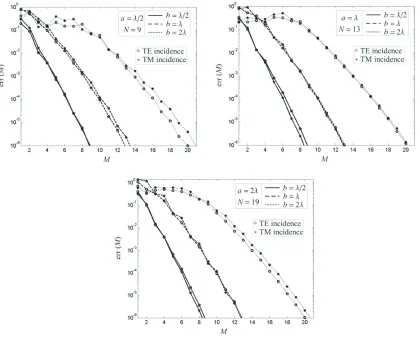
In Figure 2, the normalized truncation error for cylinders of different radii (a=λ/2, λ,2λ) when a
TE (E0 =E0y) or a TM (Hˆ 0 = H0y) incident plane wave (with respect to theˆ z axis) impinges onto
the scatterer surface with ¯ϑ = 45 deg., ¯ϕ = 0 deg. and |H0| = 5ε0/μ0|E0| = 1 A/m, is shown as a
function of M assumingN = 9,13,19 respectively. The convergence is of exponential type in all the
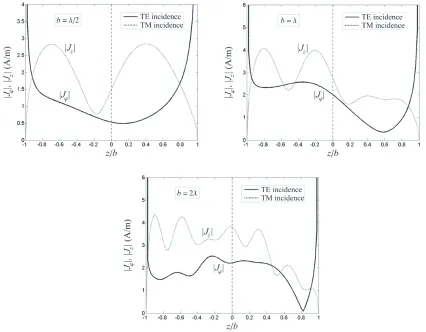
Figure 3. Components of the surface current density on circular cylinders of different lengths, for TE and TM incidence. a=λ, ¯ϑ= 45 deg., ¯ϕ= 0 deg., |H0|= 1 A/m and ϕ= 0 deg..
Figure 4. Components of the surface current density on a circular cylinder of finite length. Solid lines: this method; circles: data from [6]; dotted lines: CST-MWS. k0a = 1, b = 10a, ¯ϑ = 0 deg.,
examined cases. Moreover, an error less than 10−3 can be achieved forM = 5,9,15 respectively, while M = 9, 14,21, respectively, allow us to obtain an error even less than 10−6. The computation time
for the examined cases ranges from 5 secs to 3 mins. In Figure 3, just for the sake of completeness, the components of the surface current density for the case a = λ are plotted as a function of z/b for ϕ= 0 deg.
Comparisons with the literature and the commercial software CST-MWS are shown. In Figure 4, the components of the surface current density on a cylinder, withk0a= 1 andb= 10afor an incident
plane wave with ¯ϑ= 0 deg and H0 = 1ˆyA/m, are plotted as functions of z/b and compared with the results presented in [6], obtained by means of an EFIE formulation for the surface current density discretized by means of an analytically regularizing procedure consisting in Galerkin method with expansion functions reconstructing the physical behaviour of the unknown surface current density, and the results obtained by means of CST-MWS. Assuming N = 2 (only the cylindrical harmonics for n = ±1 contribute to reconstruct the surface current density), M = 16 has to be chosen in order to achieve a normalized truncation error less than 10−3. However, an error less than 10−6 can be achieved forM = 20 with a computation time of about 10 secs. As can be seen, the agreement with the literature is quite good, while the obtained results agree very well with the ones obtained by using CST-MWS. However, CST-MWS requires 4.5 million mesh-cells and a computation time of about 20 mins, while a coarser mesh would lead to unsatisfactory results.
5. CONCLUSIONS
In this paper, a new analytically regularizing method, based on Helmholtz decomposition and Galerkin method, for the analysis of the electromagnetic scattering by a hollow finite-length perfectly electrically conducting (PEC) circular cylinder is presented. As shown in the numerical results section, the presented method is very accurate and efficient in terms of computation time and storage requirement. We are working on the generalization of the method when layered media and closed PEC or dielectric cylinders are involved for which different edge behaviour for the fields have to be considered on the wedges.
APPENDIX A.
- Remarkable identities [48]:
+∞
−∞
Jh+ν(bu)
(ua)ν
a2e−juzdu
n2+u2a2 =
(−jsgn(z))hπa
|n|ν+1 Ih+ν
|n|b a e
−|n||z|a (A1)
for |z|> b, where Jν(·) is the Bessel function of first kind and order ν, sgn(·) is the signum function and Iν(·) is the modified Bessel function of first kind and orderν [44],
+∞
−∞
Jh+ν(bu)
(bu)ν e
−juzdu=
⎧ ⎪ ⎨ ⎪ ⎩
h!2νΓ (ν) jhbΓ (h+ 2ν)
. 1−
z b
2/ν−1/2
Ch(ν) z
b
|z|< b
0 |z|> b
, (A2)
where Γ(·) is the Gamma function andCh(ν)(·) is the Gegenbauer polynomial of order h and parameter ν [44],
+∞
0
Jν(αt)Jμ(αt)dt tβ =
αβ−1Γ (β) Γ
ν+μ−β+ 1 2
2βΓ
−ν+μ+β+ 1
2 Γ
ν+μ+β+ 1
2 Γ
ν−μ+β+ 1 2
(A3)
- Expansion functions in the spatial domain:
fC(n,−2)(z) = −
+∞
−∞
J0(bu)
ne−juzdu
n2+u2a2, (A4)
fC(n,−1)(z) =
+∞
−∞
J1(bu)
e−juzdu
n2+u2a2, (A5)
fD(n,−2)(z) =
+∞
−∞
J1(bu)
ua
ne−juzdu
n2+u2a2, (A6)
fD(n,−1)(z) =
+∞
−∞
J0(bu)
uae−juzdu
n2+u2a2 , (A7)
fT(n,h)(z) = 1−(z/b)
2pTξ(h)
T Ch(pT+1/2)
z
b
|z| ≤b
0 |z|> b , (A8)
ξT(h) = (−j)h 2
pT+1/2bpT−1/2h!5h+p
T + 1/2 apT+1/2(h+ 2p
T)! (A9)
forh≥0.
- Expansion functions in the spectral domain:
˜
fC(n,−2)(u) = − nJ0(bu)
n2+u2a2, (A10)
˜
fC(n,−1)(u) = J1(bu)
n2+u2a2, (A11)
˜
fD(n,−2)(u) = nJ1(bu)
ua(n2+u2a2), (A12)
˜
fD(n,−1)(u) = uaJ0(bu)
n2+u2a2, (A13)
˜
fT(n,h)(u) = 5h+pT + 1/2Jh+pT+1/2(bu)
(ua)pT+1/2 (A14)
forh≥0.
- Elements of the scattering matrix in (34):
M(T Tn)
−1,−1 =
M(T T−n)
−1,−1 =
¯ M(T Tn)
−1,−1+ 2
¯ M(TnT¯)
−1,−2+
¯ M(T¯nT¯)
−2,−2, (A15)
M(TnT)¯
−1,−1 = 0, (A16)
M(T Sn)
−1,h =
M(STn)
h,−1 = (−1)
pT+pS+1M(−n)
T S
−1,h= (−1)
pT+pS+1M(−n)
ST
h,−1
=
¯ M(T Sn)
−1,h+
¯ M(T S¯n)
−2,h, (A17)
M(T Sn)
k,h =
M(STn)
h,k= (−1)
pT+pS+1 M(T S−n)
k,h= (−1)
pT+pS+1 M(ST−n)
h,k
=
¯ M(T Sn)
fork, h≥0,T,T , S,¯ S¯∈ {C, D}, ¯T =T, ¯S =S, being
¯ M(T Sn)
k,h=
1 a2
+∞
−∞ ˜
fT(n,k)(u) ˜G¯T S(n)(u) ˜fS(n,h)(u)du. (A19)
- Kernels of the integrals in (39):
˜
KCC(n,−1,−1)(u)=−π
k02−u2B˜(n)(u) ωε0a3u2
, (A20)
˜
KCC(n,−1,h)(u)= ˜KCC(n,h,−1)(u) =−π
k20a2−n2−a2u2B˜(n)(u) ωε0a5u2
, (A21)
˜
KCC(n,k,h)(u)= ˜KCC(n,h,k)(u) =−
πk02a2−n2−a2u2n2+a2u2B˜(n)(u)+n2k02a2
˜
A(n)(u)−B˜(n)(u)
ωε0a7u4
, (A22)
˜
KCD(n,k,−1)(u)= ˜KDC(n,−1,k)(u) = πn
k20a2A˜(n)(u)−n2+a2u2B˜(n)(u)
ωε0a5u2
, (A23)
˜
KCD(n,−1,h)(u)= ˜KDC(n,h,−1)(u) =−πnωμ0B˜
(n)(u)
a3u2 , (A24)
˜
KCD(n,k,h)(u)= ˜KDC(n,h,k)(u) =
πnωμ0
˜
A(n)(u)−B˜(n)(u)
a3u2 , (A25)
˜
KDD(n,−1,−1)(u)=− π
k02a2A˜(n)(u)−n2B˜(n)(u)
ωε0a3
, (A26)
˜
KDD(n,−1,h)(u)= ˜KDD(n,h,−1)(u) =−πωμ0A˜
(n)(u)
a , (A27)
˜
KDD(n,k,h)(u)= ˜KDD(n,h,k)(u) =− π
k02n2+a2u2B˜(n)(u) +u2k02a2
˜
A(n)(u)−B˜(n)(u)
ωε0a3u2
, (A28)
fork, h≥0.
- Asymptotic behaviour of the kernels in (A20)–(A28)
˜
KCC(n,k,h)(u) = ˜KCC(n,h,k)(u)|u|→∼+∞j 5
(k+ 2) (h+ 2) ωε0|u|a4
, (A29)
˜
KDD(n,k,h)(u) = ˜KDD(n,h,k)(u)|u|→∼+∞jn
2δ
k+h,−2−k20a2
5
(k+δk,−1+ 1) (h+δh,−1+ 1)
ωε0|u|a4
(A30)
fork, h≥ −1,
˜
KCD(n,k,−1)(u) = ˜KDC(n,−1,k)(u)|u|→∼+∞−jn
√
k+ 2 ωε0|u|a4
, (A31)
˜
KCD(n,−1,h)(u) = ˜KDC(n,h,−1)(u)|u|→∼+∞−jnωμ0
√
h+ 1
a4|u|3 , (A32)
˜
KCD(n,k,h)(u) = ˜KDC(n,h,k)(u)|u|→∼ −+∞ jnωμ0 5
(k+ 2) (h+ 1)
2a6|u|5 (A33)
- Elements of the matrix operator in (46):
M(CCn)
k,h
=
M(CCn)
h,k
=
M(CC−n)
k,h
=
M(CC−n)
h,k = +∞ −∞ ˜
KCC(n,k,h)(u)−K˜CC,(n,k,h∞)(u)
Jk+2(bu)Jh+2(bu)du (A34)
fork, h≥ −1,
M(CDn)
−1,−1
=
M(DCn)
−1,−1
= 0, (A35)
M (n)
CD k,−1
=
M (n)
DC
−1,k
=−
M (−n)
CD k,−1
=−
M (−n)
DC
−1,k
= +∞ −∞ ˜
KCD(n,k,−1)(u)−K˜CD,(n,k,∞−1)(u)
Jk+2(bu)J0(bu)du (A36)
fork≥0,
M(CDn)
k,h
=
M(DCn)
h,k
=−
M(CD−n)
k,h
=−
M(DC−n)
h,k
=
M(CDn)
k,h (A37)
fork≥ −1 andh≥0,
M(DDn)
−1,−1
=
M(DD−n)
−1,−1
=
M(DDn)
−1,−1+j
ωμ0
a2 , (A38)
M(DDn)
k,h
=
M(DDn)
h,k
=
M(DD−n)
k,h
=
M(DD−n)
h,k = +∞ −∞ ˜
KDD(n,k,h)(u)−K˜DD,(n,k,h∞)(u)
Jk+1(bu)Jh+1(bu)du (A39)
fork, h≥ −1 and k+h≥ −1.
REFERENCES
1. Mei, K. K. and J. G. Van Bladel, “Scattering by perfectly-conducting rectangular cylinders,”IEEE Trans. Antennas Propag., Vol. 11, No. 2, 185–192, Mar. 1963.
2. Michalski, K. A. and D. Zheng, “Electromagnetic scattering and radiation by surfaces of arbitrary shape in layered media, part I: Theory,” IEEE Trans. Antennas Propagat., Vol. 38, 335–344, Mar. 1990.
3. Michalski, K. A. and D. Zheng, “Electromagnetic scattering and radiation by surfaces of arbitrary shape in layered media, part II: Implementation and results for contiguous half-spaces,” IEEE Trans. Antennas Propagat., Vol. 38, 345–352, Mar. 1990.
4. Eswaran, K., “On the solutions of a class of dual integral equations occurring in diffraction problems,” Proc. Roy. Soc. London, Ser. A, 399–427, 1990.
5. Veliev, E. I. and V. V. Veremey, “Numerical-analytical approach for the solution to thewave scattering by polygonal cylinders and flat strip structures,” Analytical and Numerical Methods in Electromagnetic Wave Theory, M. Hashimoto, M. Idemen, and O. A. Tretyakov (eds.), Science House, Tokyo, 1993.
7. Vitebskiy, S., K. Sturgess, and L. Carin, “Short-pulse plane-wave scattering from buried perfectly conducting bodies of revolution,”IEEE Trans. Antennas Propagat., Vol. 44, 143–151, Feb. 1996. 8. Sheng, X. Q., J. M. Jin, J. M. Song, W. C. Chew, and C. C. Lu, “Solution of combined-field integral
equation using multilevel fast multipole algorithm for scattering by homogeneous bodies,” IEEE Trans. Antennas Propagat., Vol. 46, No. 11, 1718–1726, Nov. 1998.
9. Hongo, K. and H. Serizawa, “Diffraction of electromagnetic plane wave by rectangular plate and rectangular hole in the conducting plate,” IEEE Trans. Antennas Propag., Vol. 47, No. 6, 1029– 1041, Jun. 1999.
10. He, J. Q., T. J. Yu, N. Geng, and L. Carin, “Method of moments analysis of electromagnetic scattering from a general three-dimensional dielectric target embedded in a multilayered medium,” Radio Sci., Vol. 35, 305–313, Mar./Apr. 2000.
11. Geng, N., A. Sullivan, and L. Carin, “Fast multipole method for scattering from an arbitrary PEC target above or buried in a lossy half space,” IEEE Trans. Antennas Propagat., Vol. 49, 740–748, May 2001.
12. Tsalamengas, J. L., “Rapidly converging direct singular integral-equation techniques in the analysis of open microstrip lines on layered substrates,”IEEE Trans. Microw. Theory Tech., Vol. 49, No. 3, 555–559, Mar. 2001.
13. Araneo, R., S. Celozzi, G. Panariello, F. Schettino, and L. Verolino, “Analysis of microstrip antennas by means of regularization via Neumann series,” Review of Radio Science 1999–2002, 111–124, W. R. Stone, Ed., IEEE Press, Wiley Interscience, Piscataway, NJ/newyork, 2002. 14. Ozkan, E., F. Dikmen, and Y. A. Tuchkin, “Scalar wave diffraction by perfectly soft thin¨
circular cylinder of finite length; Analytical regularization method” Turkish Journal of Electrical Engineering, Vol. 10, No. 3, 459–472, 2002.
15. Losada, V., R. R. Boix, and F. Medina, “Fast and accurate algorithm for the short-pulse electromagnetic scattering from conducting circular plates buried inside a lossy dispersive half-space,”IEEE Trans. Geosci. Remote Sensing, Vol. 41, 988–997, May 2003.
16. Lucido, M., G. Panariello, and F. Schettino, “Accurate and efficient analysis of stripline structures,” Microwave and Optical Technology Letters, Vol. 43, No. 1, 14–21, Oct. 2004.
17. Tsalamengas, J. L., “Exponentially converging Nystrom’s methods for systems of singular integral equations with applications to open/closed strip- or slot-loaded 2-D structures,” IEEE Antennas Propag. Mag., Vol. 54, No. 5, 1549–1558, 2006.
18. Hongo, K. and Q. A. Naqvi, “Diffraction of electromagnetic wave by disk and circular hole in a perfectly conducting plane,” Progress In Electromagnetics Research, Vol. 68, 113–150, 2007. 19. Mei, C., M. Hasanovic, J. K. Lee, and E. Arvas, “Electromagnetic scattering from an arbitrarily
shaped three-dimensional inhomogeneous bianisotropic body,” PIERS Online, Vol. 3, No. 5, 680– 684, 2007.
20. Lucido, M., G. Panariello, and F. Schettino, “Electromagnetic scattering by multiple perfectly conducting arbitrary polygonal cylinders,” IEEE Trans. Antennas Propag., Vol. 56, 425–436, Feb. 2008.
21. Lucido, M., G. Panariello, and F. Schettino, “TE scattering by arbitrarily connected conducting strips,”IEEE Trans. Antennas Propag., Vol. 57, 2212–2216, Jul. 2009.
22. Sauleau, R., T. M. Benson, and A. I. Nosich, “Dual integral equations technique in electromagnetic scattering by a thin disk,”Progress In Electromagnetic Research B, Vol. 16, 107–126, 2009. 23. Panin, S. B., P. D. Smith, E. D. Vinogradova, Y. A. Tuchkin, and S. S. Vinogradov, “Diffraction
from arbitrary shaped bodies of revolution: Analytical regularization,” Journal of Engineering Mathematics, Vol. 65, No. 2, 125–141, Oct. 2009.
24. Balaban, M. V., R. Sauleau, T. M. Benson, and A. I. Nosich, “Accurate qualification of the purcell effect in the presence of a dielectric microdisk of nanoscale thickness,”IET Micro and Nano Letters, Vol. 6, No. 6, 393–396, 2011.
Propag., Vol. 60, No. 10, 4710–4718, 2012.
26. Coluccini, G., M. Lucido, and G. Panariello, “TM scattering by perfectly conducting polygonal cross-section cylinders: A new surface current density expansion retaining up to the second-order edge behavior,” IEEE Trans. Antennas Propag., Vol. 60, No. 1, 407–412, Jan. 2012.
27. Lucido, M., “An analytical technique to fast evaluate mutual coupling integrals in spectral domain analysis of multilayered coplanar coupled striplines,” Microwave and Optical Technology Letters, Vol. 54, No. 4, 1035–1039, Apr. 2012.
28. Lucido, M., “A new high-efficient spectral-domain analysis of single and multiple coupled microstrip lines in planarly layered media,” IEEE Trans. Microw. Theory Tech., Vol. 60, No. 7, 2025–2034, Jul. 2012.
29. Balaban, M. V., O. V. Shapoval, and A. I. Nosich, “THz wave scattering by a graphene strip and a disk in the free space: Integral equation analysis and surface plasmon resonances,”IOP Journal of Optics, Vol. 15, No. 11, 114007/9, 2013.
30. Bulygin, V. S., T. M. Benson, Y. V. Gandel, and A. I. Nosich, “Full-wave analysis and optimization of a TARA-like shield-assisted paraboloidal reflector antenna using nystrom-type method,” IEEE Trans. Antennas Propag., Vol. 61, No. 10, 4981–4989, 2013.
31. Coluccini, G., M. Lucido, and G. Panariello, “Spectral domain analysis of open single and coupled microstrip lines with polygonal cross-section in bound and leaky regimes,” IEEE Trans. Microw. Theory Tech., Vol. 61, No. 2, 736–745, Feb. 2013.
32. Lucido, M., “An efficient evaluation of the self-contribution integrals in the spectral-domain analysis of multilayered striplines,” IEEE Antennas and Wireless Propagation Letters, Vol. 12, 360–363, Mar. 2013.
33. Coluccini, G. and M. Lucido, “A new high efficient analysis of the scattering by a perfectly conducting rectangular plate,” IEEE Trans. Antennas Propag., Vol. 61, No. 5, 2615–2622, May 2013.
34. Lucido, M., “Electromagnetic scattering by a perfectly conducting rectangular plate buried in a lossy half-space,”IEEE Trans. Geosci. Remote Sensing, Vol. 52, No. 10, 6368–6378, Oct. 2014. 35. Lucido, M., G. Panariello, and F. Schettino, “An EFIE formulation for the analysis of
leaky-wave antennas based on polygonal cross-section open leaky-waveguides,” IEEE Antennas and Wireless Propagation Letters, Vol. 13, 983–986, May 2014.
36. Lucido, M., “Scattering by a tilted strip buried in a lossy half-space at oblique incidence,”Progress In Electromagnetics Research M, Vol. 37, 51–62, 2014.
37. Corsetti, F., M. Lucido, and G. Panariello, “Effective analysis of the propagation in coupled rectangular-core waveguides,” IEEE Photonics Technology Letters, Vol. 26, No. 18, 1855–1858, Sept. 2014.
38. Di Murro, F., M. Lucido, G. Panariello, and F. Schettino, “Guaranteed-convergence method of analysis of the scattering by an arbitrarily oriented zero-thickness PEC disk buried in a lossy half-space”, IEEE Trans. Antennas Propag., Vol. 63, No. 8, 3610–3620, Aug. 2015.
39. Balanis, C. A.,Advanced Engineering Electromagnetics, Wiley, New York, 1989
40. Dudley, D. G., “Error minimization and convergence in numerical methods,” Electromagnetics, Vol. 5, 89–97, 1985.
41. Hsiao, G. C. and R. E. Kleinman, “Mathematical foundations for error estimation in numerical solutions of integral equations in electromagnetics,” IEEE Trans. Antennas Propag., Vol. 45, 316– 328, Mar. 1997.
42. Nosich, A. I., “The method of analytical regularization in wave-scattering and eigenvalue problems: Foundations and review of solutions,” IEEE Antennas Propag. Mag., Vol. 42, No. 3, 34–49, Jun. 1999.
43. Kolmogorov, A. and S. Fomin, Elements of the Theory of Functions and Functional Analysis, Dover, New York, 1999.
45. Meixner, J., “The behavior of electromagnetic fields at edges,” IEEE Trans. Antennas Propag., Vol. 20, 442–446, 1972.
46. Van Bladel, J., “A discussion of Helmholtz’ theorem on a surface,” AE ¨U, Vol. 47, No. 3, 1993. 47. Geng, N. and L. Carin, “Wide-band electromagnetic scattering from a dielectric BOR buried in a
layered lossy dispersive medium,”IEEE Trans. Antennas Propag., Vol. 47, 610–619, Apr. 1999. 48. Gradstein, S. and I. M. Ryzhik, Tables of Integrals, Series and Products, Academic Press, New