Helpdesk System design and analysis for new module criteria and updated
existing module in PT. SM Life.
Ria Awalliya [email protected]
Master of information system, Business information system Major/program, Gunadarma University.
.
ABSTRACT
Information system and technology is rapidly developing these days. Companies that exist today must have an excellent system in running their business processes in order to surpass their competitors. Therefore, many companies utilizes system and information technology as their core component to achieve their goals. PT. SM Life has several systems that they utilize in their business process and one of them called helpdesk. Despite of the advantages that the system provides, there are also issues on that system that encourage writer to analyze and create a design using a flowchart, DFD, ERD, nominalization and structure table design. The result of this research is a developing system that utilized by PT. SM Life’s staffs as a mediator between user and administrator to receive complaints from user and can be accessed online.
Keywords : System development, helpdesk, flowchart
1.
Foreword
The development of system and information technology is amazingly fast. Every company has to possess an excellent system to execute their business process in order to survive. Therefore, lots of companies utilizes system and information technology as their core component. Furthermore, a website that can connect user and administrator is needed to manage complaints from user that can be accessed online in order to speed up the process and provide the solution faster.
The company that the writer use as a reference for this thesis is PT. SM Life that operates in financial sector. While running its business process, PT. SM Life utilizes several different system and helpdesk is one of them. Helpdesk system is web-based system that receive complaints or problems from user then proceed it to admin to find the best solution possible. The complaints itself is divided into certain criteria, such as : New user, Delete user, Edit/update user, Hardware & Software, Data request, data changes, toner request, error system report, new program/module and update existing program/module. Until now, there are few problems that still exist, such as :
1. There is no SRS (Software requirement specification). This condition complicate
Information technology division to understand and solve user’s issue/s.
2. No verification step for each request from user on helpdesk system. This situation creates a request that is not serve it’s purpose.
3. The pressence of new organization in Information technology division i.e. IT-QA (Quality Assurance). This situation requires admin to arrange or update IT-QA’s role into the system.
4. Insufficient testing process. User still able to find an error message and the system is not running smoothly even after updates is applied.
From the issues list above, writer is interested to research and write a thesis with title “Design and
analysis of helpdesk system for new or updated
existing module on PT. SM Life.”
2.
Literature Review
2.1 System
System is a group of element that is interrelated one to another to achieve one great purpose. From the argument above, we can conclude that a system is a group of elements or components that interrelated, interact and rely to each other to achieve one purpose.
2.2 Information
Information is a classified or interpretation data that is used in a decision making process. Information system processes data into useful information (Sutabri, 2012).
2.3 Information System
Information system is an integrated system inside of an organization that unites daily transaction process and support organization function to provide information and knowledges that is needed (Sutabri, 2012).
2.4 System development methodology
into initiation & planning, analysis, design & development and QA testing. One of the earliest and most utilizes type of SDLC is waterfall method. The sequences are requirement analysis, system design, implementation, integration & testing and Operation & Maintenance.
2.5 Database
According to James Martin (1990), Database can be defined as a group of an integrated data that is stored at a certain media, without concurrently in a certain way, so it can be used and display. Database can be used for one or more than one aplication program. The data can be stored without dependency to a certain program that utilizes it so addition, retrievement and modificaton can be easily executed under control.
2.6 System Design Concept
The system design tools that writer use are listed below :
2.6.1Context Diagram
Context diagram is used to establish the context and boundaries of the system to be modelled: which things are inside and outside of the system being modelled, and what is the relationship of the system with these external entities. External entities can be data source or data recipient.
2.6.2DFD
Data flow diagrams are used to graphically represent the flow of data in a business information system. DFD describes the processes that are involved in a system to transfer data from the input to the file storage and reports generation. DFD can be defined as a tool that is used to explain how data flows from one logical unit to another logical unit. There are 4 elements that compile an DFD such as : Process, Data Flow, Data process and External entity.
2.6.3Flowchart
Flowchart is a type of diagram that represents an algorith, workflow or process that ilustrates a solution model of a given problems (Ladjamudin, 2005). According to Oetomo (2002), Flowchart is a method to represents stages of problem solving with various boxes and their order by connecting the boxes with arrows so it can be easily used and understansd by user.
2.7 Business Process at PT. SM Life
Business strategy at PT. SM Life is to provide highest commitment and best service with customer satisfaction as their primary goal. PT. SM Life is a company that is focused on financial services.
Helpdesk system at PT. SM Life is a system that designed as a bridge between user which consist of PT. SM Life’s employees and administator that consist of Information technology division whose receive every complaints from user and
can be accessed online. Any complaints will be received and send to programmer (Staff of Information Technology PT. Sinarmas MSIG Life) to then provide the solution from the problem given.
3.
Research Methodology
During constructing this thesis, writer manage to compile data as complete as possible. The method that writer used in gathering data are listed below:
3.1 Field Research
Writer conducted field research to gather information and the data needed. As for the technique that writer used is as listed below:
a. Observation
1.Research Location
The location that writer chose during research is PT. SM Life, Wisma Eka Jiwa Ruko 1 Lantai 2. Jl. Mangga Dua Raya, Central Jakarta, 10730.
2.Time of research
The research started on August 4th until Dec 4th, 2014. In 4 months, writer compiled all data that is needed. 3.Division that has been visited During the observation, writer visited Information Technology division that responsible for making and developing helpdesk system.
4.Observation Purpose
The observation process is aiming at workflow of helpdesk system itself, analyzing and creating helpdesk system design.
5.Interview
Writer also conduct meeting and interview with person whose related to this project. Writer interviewed Bapak Ervan Kristanto as a staff of Helpdesk. Interview conducted on October 9th, 2014 at Ruko 1 Lantai 2, Wisma Eka Jiwa.
Table 1. Interview
Research topic
ANALYSIS DAN HELPDESK SYSTEM DESIGN FOR NEW MODULE AND UPDATED EXISTING MODULE AT PT. SM LIFE.
Unit Name
Bpk. Ervan Kristanto ( Helpdesk IT Staff)
Dates of Research
October 9th, 2014
1. What is the main function of Helpdesk System at PT. Sinarmas MSIG Life ?
2. Where can user access Helpdesk System ?
3. When was the first time Helpdesk system launched and how many updated has been implemented since ?
4. How is the procedure of helpdesk system currently ?
5. Would you like to develop Helpdesk system based on current issues? If so, how would you like to develop it?
6. Since the first time its launched, what is the common issues?
7. Who is responsible if there is an issue?
8. Is there any documentation of every issues that appeared?
9. What is the advanatge of Helpdesk system?
10. Is there any report that has been escalated to IT superior?
On Table 1. Interview was conducted with the topic of analysis research and helpdesk system design at PT. SM Life. Interview was conducted on Thursday, October 9th, 2014. There were 10 drafts of questions about issues related to Helpdesk system design, expected outcome, development and benefit of the system.
3.2
Literature Study
The theory that quoted by the writer are taken from Analysis and Information System design, Information system in different perspectives, development of Information system and System design and Analysis. Furthermore, writer used 3 reference journal as a comparison with the research, which are:
1. Helpdesk Design and analysis for students service at FTI Budi Luhur University (Nurwati, Anita Diana, 2012)
2. Web-Based Helpdesk design and analysis at PT. Kertas Nusantara (Dilly, Rachmat, 2008)
3. Service desk aplication design, problem solving and device failure in Information Technology faculty of enginering Tanjungpura University (nurmalasari, 2012).
4.
ANALYSIS AND SYSTEM DESIGN
Before helpdesk system was created at PT. SM Life, analyis was done to the running system at the time. The first Analysis stage that was done to the system was understanding helpdesk system as a whole, identify potential problems in the system that is runnng at the time and then concluded from Analysis process that has been done. From that Analysis process, writer can conclude that:
a. There is no SRS (Software Requirement Specification). This situation troubled information technology Division to understand and provide user’s demands.
b. There is no verification for every request from user through helpdesk system. It leads to requests that is not suitable with its purpose.
c. Presence of a new organization in Information Technology division that called IT-QA (Quality Assurance) that leads to system development to add IT-QA role.
d. The failure of testing process. Eventhough update has been installed, user still find error messages and also the system did not run properly.
4.1 System Design
System design is the process of defining, planning and designing of different elements such as architecture, modules and components, and interfaces into single functional unity. The purpose of the system design is to provide ideas for user and management about the new system that will be implemented and illustrates a complete design for programmer and administrator who will implement it.
4.2 Proposed System Design
DEPARTEMENT HEAD USER
USER DEPARTEMENT HEAD IT PROGRAMMER / IT STAFF QUALITY ASSURANCE
Start
INPUT NIK, Password
Login
INPUT Departement, permohonan, kriteria, cc_email, jenis,
subject, description, dan
SRS
Ajukan Permohonan
Status Akseptasi
Atasan OUTPUT
No. Ticket
INPUT NIK, Password
Login
Akseptasi N
Belum Dikerjakan Y
INPUT NIK, Password
Login
Akseptasi N
Sedang Dikerjakan Y
INPUT NIK, Password
INPUT PIC, dan Tanggal Ekspektasi
Login
Develop Permintaan
User
Internal Testing
INPUT NIK, Password
Login
INPUT Point Testing
User Test (UAT) Testing Testing
INPUT Hasil Testing
Sesuai Dengan Permintaan
Finish Y N
Picture 1. Flowchart helpdesk system that will be develop
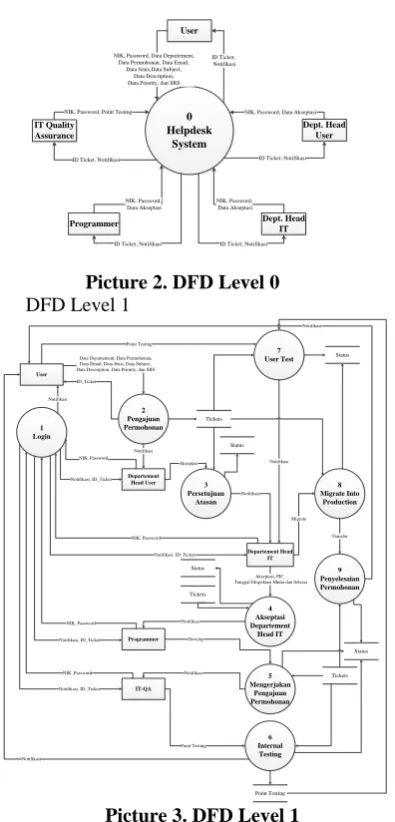
DFD Level 0 0 Helpdesk System User IT Quality Assurance Dept. Head User
Programmer Dept. Head
IT
NIK, Password, Data Departement, Data Permohonan, Data Email,
Data Jenis,Data Subject, Data Description, Data Priority, dan SRS
ID Ticket, Notifikasi
ID Ticket, Notifikasi ID Ticket, Notifikasi
NIK, Password, Data Akseptasi NIK, Password, Point Testing
ID Ticket, Notifikasi ID Ticket, Notifikasi
NIK, Password, Data Akseptasi NIK, Password,
Data Akseptasi
Picture 2. DFD Level 0
DFD Level 1
User 1 Login Departement Head User Departement Head IT Programmer NIK, Password NIK, Password NIK, Password 2 Pengajuan Permohonan
Data Departement, Data Permohonan, Data Email, Data Jenis, Data Subject, Data Description, Data Priority, dan SRS
Notifikasi 3 Persetujuan Atasan Notifikasi, ID_Ticket Notifikasi 4 Akseptasi Departement Head IT Notifikasi, ID_Ticket Notifikasi Akseptasi Akseptasi, PIC, Tanggal Ekspektasi Mulai dan Selesai
Notifikasi 5 Mengerjakan Pengajuan Permohonan Develop IT-QA Notifikasi NIK, Password 6 Internal Testing Point Testing Notifikasi 7 User Test Point Testing 8 Migrate Into Production 9 Penyelesaian Permohonan Notifikasi Migrate Transfer Notifikasi ID_Ticket Notifikasi, ID_Ticket Notifikasi, ID_Ticket Tickets Tickets Tickets Point Testing Status Status Status Status
Picture 3. DFD Level 1
DFD level 2 which is a result from decomposition proses “Superior approval” in DFD level 1 that decomposite into four processes which are Login, checking request info, Helpdesk ticket receipt and not done status change.
4.4 ERD
Karyawan ID_Karyawan ID_Departement Password Email No. Tlp/Ext Active Memilih Jenis Aplikasi Kriteria Priority Attachment Active Aplikasi ID_Aplikasi Kriteria Active ID_Kriteria ID_Priority Active Priority ID_Ticket Create_By NM_File Create_Date Membuat Tickets ID_Ticket Create_Date NIK_Request Estimasi Selesai Estimasi Mulai ID_Priority Phone CC_Email Subject Last_Update Description ID_Status ID_Kriteria NIK_Karyawan Melihat Memasukkan Point Testing Memiliki Merubah Status Departement ID_Ticket Point_Testing Status_UAT No_Urut ID_Status Status Last_Update Active ID_Departement ID_Departement
Departement 1 N 1 1 1 1 1 1 N N N 1 N 1
Picture 4. ERD
4.5
Database Design
Database design is intended to identify contenct or structure from each file that identified as a design in general. Normalization technique will be implemented into database design in details in order to get optimal database in storage, quick access and easy data manipulation. Normalization is an approach in database design by applying few rules and standard criteria in order to produce a normal table structure.
a. First Form Normalization
This Normalization is done by displaying the entire field database so that all field will have only atomic value.
b. Second form Normalization
This normalization depict relation between one field to another.
4.6
Database Table Structure Design
After normalization design phase, the next step is Database design. The purpose of Database design is to design structure table as an information that can be used to input and output data. One of the database design that being used is :
Table 2. HD_Attachments
4.7
Input and Output Design
Col um n Na me I D P k Nul l Data Type D ef au lt Hi st og ra m E nc ry pt io n Al g S a l t ID_ TI CK ET
1 1 N
NUM BER (5) N M_ FIL E
2 2 N
VARCH AR 2 (500 Byte) CR EA TE _D AT E
3 3 N DATE
CR EA TE _B Y
4 Y
Ticket Detail
Path Proses
Logo dan Nama Perusahaan
Home New Request Request Summary Approval Tickets Tickets Report User Login
Persetujuan Atasan Belum Dikerjakan Sedang Dikerjakan Internal Testing User Test / UAT Dokumentasi Mograte Selesai
Permohonan Ticket No.xxxxx
Priority Nama Pemohon / NIK Departement Create Date Tgl Selesai Attachment
xxxxxxxxxxxxx xxxxxxxxxxxxx xxxxxxxxxxxxx xxxxxxxxxxxxx xxxxxxxxxxxxx xxxxxxxxxxxxx
Email No. Tlp /Ext Last Update
xxxxxxxxxxxxxxx xxxxxxxxxxxxxxx xxxxxxxxxxxxxxx
xxxxxxxxxx Permohonan xxxxxxxxxxxxx Kriteria xxxxxxxxxx Cc Email xxxxxxxxxxxxxxxxxxxxxxxxxxxxx
Jenis xxxxxxxxxx Subject xxxxxxxxxxxxxxxxxxxxxxxx Description
xxxxxxxxxxxxxxxxxxxxxxxxxxxx Priority xxxxxxxxxxx Attachment Choose File Departement Dituju
Picture 5. Input and Output Design
5.
CONCLUSION AND SUGGESTION
Based on writer’s research and system design at PT. Sinarmas MSIG Life, we can conclude that :
a. There is no SRS (Software Requirement Specification) so that its hard for Information technology division to understand user’s demand.
b. There is no verification for each request from user through helpdesk system. It leads to requests that is not suitable with its purpose.
c. Presence of a new organization in Information Technology division that called IT-QA (Quality Assurance) that leads to system development to add IT-QA role. d. The failure of testing process. Eventhough
update has been installed, user still find error messages and also the system did not run properly.
From four analysis result, writer created system design with flowchart, DFD, ERD, Normalization and table structure design. Writer created design with added verification using SRS document, adding new organization which is QA (Quality Assurance) in helpdesk system to run the testing.
Analysis and system design only designated for new module and update existing module criteria. Whereas for other helpdesk criteria, analysis and system design has not been done. Furthermore, writer expect that in the future, analysis and helpdesk system design will also be made for other criteria such as new user, deleted user, edit/update, hardware & software, data request, data manipulation, toner request and report error system.
REFERENCES
[1] Abdul Kadir. 2003. Pengenalan Sistem Informasi. ANDI Yogyakarta, Yogyakarta.
[2] Agus Mulyanto. 2009. Sistem Informasi Konsep dan Aplikasi. Pustaka Pelajar.
[3] Al-Bahra bin Ladjamudin. 2005. Analisis dan Desain Sistem Informasi. Yogyakarta : Graha Ilmu
[4] Budi Sutedjo, Dharma Oetomo. 2005. Perancangan dan Pembangunan Sistem Informasi. Yogyakarta : ANDI. [5] Jugiyanto, H.M. 2005. Analisis dan Desain : Sistem Informasi Pendekatan Terstruktur Teori dan Praktek Aplikasi Bisnis. Yogyakarta : ANDI
[6] Martin, James. 1990. Information Engineering, BOOK II : Planning and Analysis.
[7] Mustakini, Jogiyanto Hartono. 2009. Sistem Informasi Teknologi. Yogyakarta: Andi Offset