Security Analysis of Cryptosystems Using Short
Generators over Ideal Lattices
Shinya Okumura1,2, Shingo Sugiyama1,2, Masaya Yasuda1,2, and Tsuyoshi Takagi1,2
1
Institute of Mathematics for Industry, Kyushu University, 744 Motooka Nishi-ku, Fukuoka 819-0395, Japan 2
JST, CREST, 4-1-8 Honcho, Kawaguchi, Saitama, 332-0012, Japan
Abstract. In this paper, we analyze the security of cryptosystems using short generators over ideal lattices such as candidate multilinear maps by Garg, Gentry and Halevi and fully homomorphic encryption by Smart and Vercauteren. Our approach is based on a recent work by Cramer, Ducas, Peikert and Regev on analysis of recovering a short generator of an ideal in theq-th cyclotomic field for a prime powerq. In their analysis, implicit lower bounds of the special values of DirichletL-functions at 1 are essentially used for estimating some sizes of the dual basis in the log-unit lattice of theq-th cyclotomic field.
Our main contribution is to improve Cramer et al.’s analysis by giving explicit lower and upper bounds of the special values of Dirichlet L -functions at 1 for any non-trivial even Dirichlet characters modulo q. Moreover, we give various experimental evidence that recovering short generators of principle ideals in 2k-th cyclotomic fields for k ≥ 10 is
succeeded with high probability. As a consequence, our analysis suggests that the security of the above cryptosystems based on the difficulty of recovering a short generator is reduced to solving the principal ideal problem under the number theoretical conjecture so-called Weber’s class number problem.
Key words: Short generators, Cyclotomic fields, Log-unit lattices, Dirich-letL-functions.
1
Introduction
In recent years, lattice-based cryptography has been paid much attention to as a candidate of post-quantum cryptography. Ideal lattices are in a special class of lattices corresponding to ideals in rings of the form Z[x]/(f(x)) for some irreducible polynomialsf(x), such as f(x) =xn+ 1 for a 2-power integer
proposed a construction of fully homomorphic encryption (FHE) using ideal lattices. After Gentry’s breakthrough, a number of variants of Gentry’s original FHE scheme have been proposed (in particular, variants of [22, 47] are based on ideal lattices). In 2013, Garg, Gentry and Halevi [20] first proposed a candidate of multilinear maps from ideal lattices, called the GGH scheme. In 2014, Langlois, Stehl´e and Steinfeld [27] improved the GGH scheme for both efficiency and security, and their scheme is called GGHLite (see also [3] for implementation of GGHLite).
For a 2-power integern > 1, let K =Q(ζ2n) be the 2n-th cyclotomic field andOK =Z[ζ2n]≃Z[x]/(xn+ 1) its ring of integers, whereζmdenotes a primi-tivem-th root of unity for an integerm >2. In the cryptographic constructions of [20, 27, 47], a certain ‘short’ elementg ∈OK is used as a secret key. In con-trast, someZ-basis of the principal ideal (g), such as the Hermite normal form HNF(g), is used as a public key (e.g. see [13, Section 4] for the definition of HNF(g)). Therefore a part of the security of schemes of [20, 27, 47] relies on the computational hardness of the following problem, introduced in [15, Section 1]:
Problem 1 (Short Generator of a Principal Ideal Problem, SG-PIP) LetK be a number field and OK its ring of integers. Let g be a short element of OK. Given a Z-basis of the principal ideal (g), the problem is to find g itself or a sufficiently short elementg′∈OK satisfying (g′) = (g).
This problem can be divided into the following two problems:
– Principal Ideal Problem (PIP): Given aZ-basis of the principal idealI= (g), find a generatorhofI.
– Short Generator Problem (SGP): Given a generator hofI, recoverg itself or a sufficiently short generatorg′ ofI.
1.1 Recent Progress for PIP and SGP
There are several classes of efficient algorithms for PIP over number fields of large degree in both classical and quantum computing models [7–10, 12, 24]. In [24], Hallgren proposed a polynomial-time quantum algorithm for PIP over num-ber fields of small degree. Biasse and Fieker [7] first proposed a subexponential algorithm for an arbitrary class of number fields under the generalized Riemann hypothesis (see also [8]). For security analysis of cryptosystems of [20, 27, 47], we focus on PIP over cyclotomic fields. For 2k-th cyclotomic fields, Campbell, Groves and Shepherd [12] claimed that there is a polynomitime quantum al-gorithm for PIP, although their claim has not been proved yet. Recently, Biasse [9] announced the same claim as Campbell et al.’s one. In a classical computing model, Biasse [10] also presented a heuristic algorithm to solve PIP over 2k-th cyclotomic fields in time 2N2/3+ϵ forN= 2k and arbitrarily smallϵ >0.
Campbell et al. [12]. Recently, Cramer, Ducas, Peikert and Regev [15] studied the geometry of a sublattice of a log-unit lattice, spanned by the image of the canonical generators of the group of cyclotomic units under the logarithmic embedding. They proved in [15, Theorem 3.1] that the basis of the sublattice has good properties. In [15, Theorem 4.1], they also give an analysis of a previously sketched attack in [6] for SGP over 2k-th cyclotomic fields, under the assumption that Weber’s class number problem holds true (the problem is the conjecture that the class number ofQ(ζq+ζq) is equal to 1 for any 2-power integerq >2). We refer to the attack as the Recovering Short Generators (RSG) attack.
Outline of [15] Here let us review Cramer et al.’s analysis for SGP in more detail. Given a prime power q = pk, let K = Q(ζ
q) be the q-th cyclotomic field and OK =Z[ζq] its ring of integers. Consider the logarithmic embedding Log : K× −→Rφ(q)/2, where φ(q) = #(Z/qZ)× (see Subsection 2.2 below for the definition of the embedding). LetOK× denote the group of units inOK. Then
Λ:= Log(OK×) defines a lattice of rankφ(q)/2−1, called thelog-unit lattice. Set
G= (Z/qZ)×/{±1}. LetΛ′ be the sublattice ofΛ spanned by the basis
B:={bj := Log((ζqj−1)/(ζq−1))|j∈G∖{1}}.
Cramer et al. reduced SGP overKto CVP overΛ′, and they gave a condition for succeeding in solving CVP over Λ′. The success of their attack depends on the size of∥b∨j∥forj∈G∖{1}, whereb∨j’s are the dual basis ofBinRφ(q)/2. They proved in [15, Theorem 3.1] that all ∥b∨j∥ forj ∈G∖{1} are mutually equal, and gave an upper bound of ∥b∨j∥(their attack is implemented over PARI/GP by Schank [43]).
In order to estimate the size of ∥b∨j∥, Cramer et al. analyzed a relation between the size of∥b∨j∥2andL(1, χ) for any non-trivial even Dirichlet character
χ, whereL(s, χ) denotes the DirichletL-function associated withχ. Indeed, they gave an implicit upper bound of∥b∨j∥up to constant [15, Theorem 3.1] by using the following implicit lower bounds [15, Theorem 2.6]:
|L(1, χ)| ≫
1 logfχ
(χ: non-quadratic, primitive),
1
√
fχ
(χ: quadratic, primitive),
(1)
where fχ is the conductor of χ (see Subsection 2.3 for definitions of Dirichlet characters, their conductors and Dirichlet L-functions). Their upper bound of ∥b∨j∥ implies that we have ∥b∨j∥ → 0 as k → ∞for any prime numberp and
q=pk. This is a good property for solving SGP for sufficiently largek. However, we need an explicit bound of L(1, χ) for estimating the size of∥b∨j∥in the case of a fixedkused in cryptography3.
3
In [15, Appendix B], Cramer et al.’s showed data on∥b∨j∥confirming that the RSG
1.2 Our Contributions
Our contributions of this paper are as follows:
• Upper and Lower Bounds of L(1, χ∗): We give explicit upper and lower bounds of L(1, χ∗) for each non-trivial even Dirichlet character χ modulo a prime powerq =pk (Section 5 below). Hereχ∗ is the primitive Dirichlet character inducingχ. We use results on upper and lower bounds ofL(1, χ∗) by [17, 29, 31, 42]. The key point is that we give a lower bound of L(1, χ∗) for any even quadratic Dirichlet character χ moduloq with the aid of the class number formula. Moreover, our bounds are easily computable, namely we can evaluate the sizeL(1, χ∗) for any fixedk≥1 andχ.
• Theoretical Estimation of ∥b∨j∥: We give explicit upper and lower bounds of the size of∥b∨j∥ by using our bounds ofL(1, χ) (Sections 6 and 7 below). Our strategy is to count the exact number of even Dirichlet characters mod-ulo q having any given conductor fχ, while Cramer et al. used a rough estimate of the number of such characters. The asymptotic evaluation of our upper bounds of ∥b∨j∥ has the same order as Cramer et al.’s one. In par-ticular, we have∥b∨j∥ →0 as k→ ∞ for any prime number pandq=pk. Different from Cramer et al.’s evaluation, our bounds of ∥b∨j∥ are explicit for any fixed k. Specifically, our bounds imply that the success probability of their attack becomes much higher forq= 2k withk≥11.
• Experimental Verification: By experiments, we verify the effectiveness of the RSG attack against cryptosystems of [20, 27, 47] for q = 2k and 6 ≤
k ≤ 10 (Section 8 below). In particular, the RSG attack can recover the secret keygwith probability being about 50 % (resp. 85 % and 100 %) when
k= 6 (resp.k= 8 andk= 10). Our experiments also show that the success probability of their attack is independent of distributions for generating keys in cryptosystems of [20, 27, 47] (e.g. uniformly random and discrete Gaussian distributions).
Recall that the security of cryptosystems of [20, 27, 47] is based on the diffi-culty of Problem 1 (SG-PIP), which can be divided into two problems PIP and SGP. By combining our theoretical and experimental results, we expect that SGP over 2k-th cyclotomic fields in cryptosystems of [20, 27, 47] could be solved by the RSG attack ifk≥10, under the assumption that Weber’s class number problem holds true. Note that k≥10 is required for high security (e.g. 80-bit security) of these cryptosystems. Thereby, the security of these cryptosystems relies only on the difficulty of PIP.
2
Mathematical Background
In this section, we prepare mathematical notation for our later discussion. Let
N, Z, R andC be the set of positive integers, the ring of integers, the field of real numbers and the field of complex numbers, respectively. We denote by⟨·,·⟩
We also denote column vectors by lower-case bold letters (e.g.b) and matrices by upper-case bold letters (e.g. B). The symbol #S stands for the cardinality of a setS. For non-negative functionsf andgon a setX, we writef(x)≪g(x) (orf(x) =O(g(x))) if there exists a constantC >0 such thatf(x)≤Cg(x) for allx∈X. Forϵ >0, we writef(x)≪ϵ g(x) if the implied constant depends on
ϵ.
2.1 Lattices and CVP
AlatticeLis a discrete additive subgroup of a finite dimensionalR-vector space
Rn for somen∈N. Therank of Lis defined as dim
RL ⊗ZR. Given any lattice L ⊂ Rn of rank m ≤ n, there exists a set of R-linearly independent vectors B = {b1, . . . ,bm} such that L = L(B) := ∑1≤i≤mZbi. We identify B as an
n×m-matrix, and the matrix is called a basis of L. For any lattice L with basis B = {b1, . . . ,bm}, there exists a set of R-linearly independent vectors B∨ ={b∨1, . . . ,b∨m} ⊂span(B) :=∑1≤i≤mRbi such that ⟨bi,b∨j⟩=δij, where
δij is the Kronecker delta given by δij = 1 (resp. δij = 0) if i = j (resp. otherwise). In other words, Bt·B∨= (B∨)t·Bis equal to the identity matrix. Then L∨ := L(B∨) defines a lattice, called the dual lattice ofL with the dual basis B∨ ofB.
Given a lattice L ⊂ Rn with basis B and a target vector t∈ Rn∖L, the closest vector problem (CVP) is to find a lattice vector v∈ L closest to t. An efficient approach for CVP is the round-off algorithm proposed by Babai [4]. The round-off algorithm forBandtoutputsB· ⌊(B∨)t·t⌉ ∈ L, where the rounding function ⌊c⌉ := ⌊c+ 21⌋ is applied to each entry of (B∨)t·t independently. The following lemma suggests a condition for solving CVP by Babai’s round-off algorithm.
Lemma 1. ([15, Claim 2.1]) LetL ⊂Rnbe a lattice with basisB. Lett=v+e with v ∈ L and e ∈Rn. If ⟨b∨
j,e⟩ ∈
[
−1 2,
1 2
)
for allb∨j ∈ B∨, then v can be recovered by Babai’s round-off algorithm forB andt.
This lemma is a key for solving SGP by the RSG attack (see Section 4).
2.2 Log-Unit Lattice and Cyclotomic Units
For an integerq >2, letζq ∈Cbe a primitiveq-th root of unity. Then the field
K=Q(ζq) is called theq-thcyclotomic field. The fieldKis a Galois extension of
Qof degree [K:Q] =φ(q), where φdenotes the Euler totient function defined byφ(n) = #(Z/nZ)× forn∈N. ThenOK =Z[ζq] is the ring of integers of K. For anyσ ∈Gal(K/Q), we haveσ(ζq) =ζqj for some j ∈Z with gcd(j, q) = 1 sinceσ(ζq) is also a primitive root of unity. In other words, we have
withσj(ζq) =ζqj. SetG:= (Z/qZ)×/{±1}. From now on we fix an enumeration
G∼={1,· · · , φ(q)/2}and define thelogarithmic embedding ofK× by
Log :K×−→Rφ(q)/2, a7→(log|σj(a)|)j∈G.
We have Log(a·b) = Log(a) + Log(b) for any a, b ∈ K×. Let O×K denotes the group of units in OK. By the Dirichlet Unit Theorem (e.g. see [40]), Λ := Log(O×K) gives a lattice of rank φ(q)2 −1, and the kernel of Log|O×
K is µ(K),
whereµ(K) denotes the group of all roots of unity inK. The latticeΛ is called the log-unit lattice of K. It is easy to see that all vectors in Λ are orthogonal to 1:= (1,1, . . . ,1) ∈Rφ(q)/2 sinceNK/Q(ϵ) =
∏
j∈(Z/qZ)×σj(ϵ) =±1 for any
ϵ∈O×K, where NK/Q denotes the norm map fromK× toQ×.
LetAbe the multiplicative subgroup ofK×generated by±ζqandzj :=ζqj−1 for j ∈ G. We have Log(zj) = Log(z−j) since zj =−ζqjz−j, that is, zj ≡z−j (mod µ(K)). The groupC ofcyclotomic unitsis defined as
C:=A∩OK×.
In general, it may not be easy to compute generators ofC. However, whenq=pk for some prime numberp, generators ofCare obtained by the following lemma:
Lemma 2. ([49, Lemma 8.1]) Letq=pk be a prime power andCthe group of cyclotomic units ofq-th cyclotomic field. SetG:= (Z/qZ)×/{±1},zj:=ζqj−1 andbj :=zj/z1 forj∈G∖{1}. Then the groupCis generated by±ζq and the
bj’s forj∈G∖{1}.
We call thebj’s forj∈G∖{1}thecanonical generators ofC. Note that Log(C) is a sublattice ofΛof finite index. More precisely, we have [Λ: Log(C)] =h+(q) for a prime powerq, whereh+(q) is the class number ofK+ :=Q(ζ
q+ζq) (see [49, Exercise 8.5] for details).
2.3 Dirichlet Characters and Dirichlet L-functions
LetGbe a finite abelian group. Thecharacter group ofG, denoted byGb, is the set of group homomorphisms fromGtoC×. It is easy to see thatGb becomes a group with the pointwise product. There is a non-canonical group isomorphism betweenGandGb, and hence #G= #Gb.
Let us introduce Dirichlet characters and DirichletL-functions (e.g. see [16, 40]). For q ∈ N, we consider the group (Z/qZ)×. An element χ ∈ (Z\/qZ)× is called aDirichlet character (or character) moduloq. The characterχis naturally extended to a multiplicative function ˜χonNby
e
χ(n) =
{
χ(nmodq) (gcd(n, q) = 1),
Theconductor fχ ofχis defined as the minimal positive divisordofqsuch that
χfactors through some Dirichlet characterχ′ modulod, that is, we have
χ: (Z/qZ)×↠(Z/dZ)× χ
′
−→C×.
We denote byχ∗the Dirichlet character modulofχ inducingχ. We callχ prim-itive if fχ is exactly equal to q. Notice that χ∗ is primitive. The character χ is called even (resp. odd) if χ(−1) = 1 (resp. χ(−1) = −1), and χ is called quadratic ifχ2is trivial butχ is non-trivial.
LetL(s, χ) denote the Dirichlet L-function associated withχ, defined by
L(s, χ) = ∞
∑
n=1 ˜
χ(n)
ns (Re(s)>1).
The defining series converges absolutely on the region Re(s)> 1. Ifχ is non-trivial, the series L(s, χ) converges on the region Re(s) > 0. It is well-known that L(s, χ) has a meromorphic continuation to the whole planeC. Further, its only possible poles= 1 is simple and occurs only whenχis trivial. We have the relation
L(s, χ) ={∏ p|q p∤fχ
(1−χ∗(p)p−s)}L(s, χ∗) (2)
for any non-trivial characterχmoduloq, wherepruns over all prime divisors of
qsuch thatp∤fχ. By (2), we have easily the following.
Lemma 3. Let χ be a Dirichlet character modulo q. The following are equiva-lent.
1. L(s, χ) =L(s, χ∗).
2. The set of all prime divisors offχ is equal to that of all prime divisors ofq.
In particular, we have L(s, χ) = L(s, χ∗) if q is a prime power and χ is non-trivial.
2.4 Relation between Lower Bounds and Zeros of L-functions
In this subsection, we review upper and lower bounds of L(1, χ) for non-trivial Dirichlet charactersχ, and describe a reason why we have not reached the lower bound
L(1, χ)≫ 1 logq
for quadratic charactersχmoduloq.
Theorem 1. ([16, (13) in p.96])For any non-trivial Dirichlet characterχ mod-ulo q, the estimate
|L(1, χ)| ≪logq
holds with the implied constant independent of χandq.
As for lower bounds, we need to consider the influence of a possible real zero ofL(s, χ) near to 1. The following gives the definition of aSiegel zero.
Theorem 2. ([16, p.93])
1. There exists a constantC >0 such that for any non-trivial Dirichlet char-acter χ modulo q, L(s, χ) does not vanish if s = σ+√−1t (σ, t ∈ R) is contained in the region
σ >1− C log{q(1 +|t|)}
except for at most one real numberβ =βχ∈(1−log{q(1+C |t|)},1). We call the region a zero-free region ofL(s, χ). Such a possible real zeroβ forL(s, χ)is called a Siegel zero(cf. [39, Chapter 2]).
2. The Siegel zeroβ of L(s, χ)does not exist when a non-trivial characterχis not quadratic.
Siegel zeros are not on the vertical strip Re(s) = 1/2 contrary to the gener-alized Riemann hypothesis. The Siegel zero ofL(s, χ) is related to lower bounds ofL(1, χ) as follows.
Theorem 3. ([26])For any non-trivial Dirichlet characterχmoduloq, we have
|L(1, χ)| ≫ 1 logq
unless L(s, χ) has a Siegel zero. Here the implied constant is independent of χ
andq. In particular, the inequality as above holds ifχ is not quadratic.
The existence of Siegel zeros is a deep problem in number theory as it influences a distribution of zeros ofL(s, χ) and lower bounds ofL(1, χ). We have not reached the non-existence of Siegel zeros for DirichletL-functions yet. As for quadratic characters, the best lower bound ofL(1, χ) for quadratic charactersχis currently known as Siegel’s theorem [44]. We refer to [16, Chapter 21] and [39, Chapter 2].
Theorem 4. (Siegel’s theorem [44]) For any ϵ > 0, there exists an ineffective constant Cϵ>0 such that the inequality
L(1, χ)≥ Cϵ
qϵ
holds for any primitive quadratic characterχmoduloq. Here recall thatL(1, χ)>
The primitivity ofχin Siegel’s theorem can be easily dropped out by
L(1, χ)≥ {∏ p|q
(1−p−1)}L(1, χ∗)≫ϵ 1
qϵL(1, χ ∗).
We remark that the constantCϵis ineffective since it may depend on a possible Siegel zeroβ∈(1−ϵ,1).
Siegel’s theorem can be applied to the following two number theoretical prob-lems. First, the class numberhK of an imaginary quadratic fieldK goes to in-finity as the absolute value dK of the discriminant of K/Q tends to infinity. Second, the asymptotics loghK ∼log
√
dK holds asdK → ∞keepingK imag-inary quadratic. It is a spacial case of the Brauer-Siegel theorem (cf. [30]). By this asymptotics, there exist finitely many imaginary quadratic fields K such that hK =nfor any givenn∈N.
Later, an effective version of Siegel’s theorem was given by Tatuzawa [48] with the implied constant effective for any quadratic character χ except for at most one ineffective quadratic character. Although Tatuzawa’s theorem was made explicit by [30] except for one quadratic character, the exceptional one is still ineffective.
In Sections 5 and 6 below, we will give explicit upper and lower bounds of
L(1, χ) for any non-trivial even Dirichlet charactersχmodulo any prime power.
3
Cryptosystems Using Short Generators
As mentioned in Section 1, the security of some cryptosystems [20, 27, 47] relies on the computational hardness of finding a short generator of a principal ideal of a number field from a Z-basis of the ideal. This problem is called the Short Generator of a Principal Ideal Problem (SG-PIP). In this section, we briefly give a relation between these cryptosystems and SG-PIP. These cryptosystems are constructed over the ring R=Z[x]/(xn+ 1) for a given degree parametern of the formn= 2k−1(k >1).
3.1 Smart-Vercauteren FHE Scheme
We explain the somewhat homomorphic encryption (SHE) proposed by Smart and Vercautern [47], which is integrated to the fully homomorphic encryption (FHE) using the bootstrapping. The key generation of the SHE scheme overR
is as follows:
1. Given a parameterη >0, choose a random polynomialG(x) =∑i=0n−1gixi∈
Z[x], such that ∥G(x)∥∞ := maxi|gi| is η-bit, G(x)≡1 (mod 2), andp= |det(Rot(G(x)))| is prime, where Rot(G(x)) denotes the rotation matrix. 2. Compute D(x) = gcd(G(x), xn+ 1) over F
p[x], and take the unique root
3. Apply the XGCD-algorithm over Q[x] to obtainZ(x) =∑i=0n−1zixi ∈Z[x] satisfying Z(x)·G(x) ≡ p (mod xn + 1). Set B = z
0 (mod 2). Then the public key ispk= (p, α), and the secret key issk= (p, B).
The ideal p = (p, x−α) ofR is constructed from pk, and its Hermite normal form (HNF) is given by
p−α· · · −αn−1 0 1 · · · 0 ..
. ... . .. ... 0 0 · · · 1
.
By the construction,pis a principal ideal generated byG(x)∈R. As mentioned in [47], sk can be recovered from the inverse of a small generator of p (since
η≪p). Hence, recoveringskfrom pkis an instance of SG-PIP.
3.2 GGH and GGHLite Schemes
We explain the miltilinear map (GGH scheme) proposed by Garg et al. [20] and its improved version called GGHLite [27]. LetDZ,σdenote the discrete Gaussian distribution overZwith standard deviationσ >0. In the GGH scheme, a secret short element g = ∑ni=0−1gixi ∈ R is randomly chosen with gi ← DZ,σ for 0 ≤ i ≤ n−1 such that ∥g−1∥ ≤ n2 and I = (g) is a prime ideal in R, where g−1∈R⊗
ZQ≃Q(ζ2n) and∥g−1∥is its Euclidean norm. The condition ∥g∥ ≤√n·σis additionally required for the construction of the GGHLite scheme [27]. Moreover, given a modulus parameterq >0, a secret elementzis randomly sampled fromRq =R/qR. In both the GGH and the GGHLite schemes, the pair (g, z) gives a secret key.
Thezeroizing attack, which was first introduced in [20] tries to recover a basis B of the ideal I = (g) from given public parameters such as several encoding of zero and one (See [13, Section 5.1] for details). Therefore, recovering g or a short elementg′from the basisBis an instance of SG-PIP (as mentioned in [13, Section 5.3], recoveringg′∈Rwith∥g′∥< q3/8/(2n)4is sufficient to attack the GGH scheme).
4
Overview of Cramer et al.’s Analysis for SGP
In this section, we briefly review Cramer et al.’s analysis for SGP (defined in Section 1) and give some remarks on their attack.
4.1 Attack Algorithm
For a prime powerq=pk, we use the same notation such asG= (Z/qZ)×/{±1}, the log-unit lattice Λ and the group C of cyclotomic units of the q-th cyclo-tomic field K=Q(ζq) described in Subsection 2.2. For the canonical generator {bj}j∈G∖{1} ofC, set
for j ∈ G∖{1}. Note that {bj}j∈G∖{1} is a basis of Log(C) by Lemma 2. Let g ∈ OK be a short element as in Problem 1. Given a generator h of the principal ideal I = (g), SGP is to find g itself or a sufficiently short generator ofI. Since bothg andhare generators ofI, we haveh=ug for someu∈OK×, and Log(h) = Log(g) + Log(u) with Log(u)∈Λ= Log(O×K). In order to recover Log(u) from Log(h), the RSG attack aims to represent
Log(u) = ∑ j∈G∖{1}
ajbj for some aj∈Z (4)
by using the basis{bj}j∈G∖{1}of Log(C).
For the representation (4), Cramer et al. first assume that the Log(C) is exactly equal to the log-unit latticeΛ:
Assumption 1 We assume Log(C) =Λ.
Moreover, the RSG attack algorithm assumes the following (see [15, Theorem 4.1] for details):
Assumption 2 There is a probabilistic distribution D over K satisfying the following condition: For any unit vectors v1, . . . ,vφ(q)/2−1 ∈Rφ(q)/2 satisfying ⟨vi,1⟩= 0, we have |⟨Log(g),vi⟩|< dq1/2(logq)−3/2 for alliwith probability at leastα >0, whereg is chosen from D anddis a universal constant.
Under Assumptions 1 and 2, the RSG attack algorithm for SGP is as follows (see [15, Theorem 4.1] for details):
Algorithm 1
Input:h=ug(g←D,u←C)
Output:g′ =ug/u′ for someu′∈C or “false”
1. Apply Babai’s round-off algorithm to B:={bj}j∈G∖{1} andt:= Log(h) = Log(u) + Log(g). Letv∈Rφ(q)/2be its output (i.e.v=B· ⌊(B∨)t·t⌉). 2. Compute integersaj ∈Zforj ∈G∖{1} such that v=
∑
j∈G∖{1}ajbj. If there are no such integersaj, then return “false”.
3. Computeu′:=∏j∈G∖{1}baj
j ∈C and outputg′=ug/u′.
Cramer et al. claimed in [15, Theorem 4.1] that the above algorithm outputs
g′=±ζj
q ·g for some 0≤j < q with probability at leastα, under Assumptions 1 and 2.
Note that Assumption 2 comes from the result [15, Theorem 3.1]. More specifically, by [15, Theorem 3.1] there is a constant d′ such that ∥b∨j∥ ≤
d′q−1/2(logq)3/2. Thus, if the universal constant d satisfies d ≤ 2d1′, then we
have
α≤Pr
[
|⟨Log(g),b∨i/∥b∨i∥⟩|< dq1/2(logq)−2/3
]
= Pr
[
|⟨Log(g),b∨i⟩|< dq1/2(logq)−2/3∥b∨i∥ ≤ 1 2
]
This implies that the success probability, that is Pr[|⟨Log(g),b∨i⟩|< 1 2,∀j
]
, is at leastαfor the distributionD satisfying Assumption 2.
Remark 1. Since [Λ: Log(C)] =h+(q), Assumption 1 is related to mathematical problems onh+(q). In particular, whenqis 2-power, Assumption 1 is equivalent to Weber’s class number problem (i.e.h+(q) = 1 for all 2-powerq). In Appendix A below, we will give several results related to Weber’s class number problem.
4.2 Some Remarks
In the first step of Algorithm 1, we are able to compute v= Log(u) by Lemma 1 if the condition
⟨
Log(g),b∨j⟩∈
[
−1 2,
1 2
)
for allj∈G∖{1} (5)
is satisfied. In this case, we have u′ ∈ C satisfying Log(u′) = Log(u) in the second step of Algorithm 1. This implies thatu′has the form±ζj
q·ufor somej since the kernel of Log|O×
K
is equal toµ(K). In other words, under condition (5), Algorithm 1 outputs our desired elementg′=±ζj
q·g(note that we can recoverg fromg′by exhaustive search of the elements±ζqj’s, whose computational cost is negligible). From Cauchy-Schwarz’s inequality|⟨Log(g),b∨j⟩| ≤ ∥Log(g)∥ · ∥b∨j∥, the success of the attack deeply depends on the size of ∥b∨j∥, which will be estimated in Section 6 below.
5
Explicit Upper and Lower Bounds of
L
(1
, χ
∗)
Letq=pk be a prime power and set G= (Z/qZ)×/{±1}. ThenGb is identified with the group of alleven Dirichlet characters modulo q. We set
E(q) := 1 #G
∑
χ∈Gb∖{1} 4
fχ|L(1, χ∗)|2
.
Then,∥b∨j∥ has the following expression in terms of DirichletL-functions. Proposition 1. ([15, Lemma 3.2 and Corollary 3.4])We have
||b∨j||2=E(q).
In particular, ||b∨j|| is independent ofj ∈G∖{1}.
Remark 2. In [15], the special convention in Washington’s book [49, Chapter 3] is adopted, namely, the symbol L(1, χ) in [15] is used in the meaning of
L(1, χ∗). One may confuse Washington’s special convention since the equality
In this section, by using explicit estimates ofL(1, χ∗) (Propositions 2, 3, 4 and 5), we give explicitly computable estimates of E(q), avoiding the use of Siegel’s theorem (Theorem 4). Our estimates are better than [15, Theorem 3.1]. From our result, we can easily compute upper and lower bounds ofE(q). Experimental results will be shown in Subsection 7.1.
5.1 Explicit Lower Bound of L(1, χ∗)
We give explicit lower bounds of L(1, χ∗) = L(1, χ) for any non-trivial even Dirichlet charactersχ moduloq =pk. The evenness ofχ is needed for attacks for SGP. We show propositions for the cases ofp= 2,p≡3 (mod 4), andp≡1 (mod 4), respectively.
Proposition 2 (Case p= 2). Let q = 2k with k ≥3. Let χ be a non-trivial character moduloq. Ifχ is not quadratic, we have
|L(1, χ∗)| ≥ 1 10 log(fχ/π)
.
If χ is even and quadratic, we have
L(1, χ∗) =log(1 + √
2) √
2 .
Proof. The first assertion is obvious from [31, Corollary 2]. The second assertion is also obvious sinceχis the unique even quadratic character withfχ= 8. □ For any odd prime number p, let χp be the primitive quadratic character modulop. Then, there exists a unique quadratic character modulopk, and such a unique quadratic character is induced byχp. Notice thatχpis even if and only ifp≡1 (mod 4).
Proposition 3 (Case p ≡ 3 (mod 4)). Let p be a prime number such that
p ≡ 3 (mod4) and let q = pk with k ≥ 1. Then, for any non-trivial even character χ moduloq, we have
|L(1, χ∗)| ≥ 1 10 log(fχ/π)
.
Proof. Since the unique quadratic character modulo pk is odd, we obtain the
assertion by [31, Corollary 2]. □
Proposition 4 (Case p ≡ 1 (mod 4)). Let p be a prime number such that
p ≡ 1 (mod4) and let q = pk with k ≥ 1. Let χ be a non-trivial character modulo q. If χis not quadratic, we have
|L(1, χ∗)| ≥ 1 10 log(fχ/π)
In particular, the esimtate above holds for any quadraticχ if kχ ≥m(p)with
m(p) = 1 logp
(
1 10L(1, χp)
+ logπ
)
,
wherekχ is the number such thatfχ=pkχ. Furthermore, ifχ is quadratic, we have
L(1, χ∗)≥√2
plog
(√
p−4 +√p
2
)
.
Proof. The assertion is obvious from [31, Corollary 2] in the case whereχis not quadratic.
Consider the case whereχ is quadratic, that is, χ∗ =χp. Lethp and ϵp be the class number and the fundamental unit of Q(√p), respectively. Byhp ≥1,
ϵp ≥ √
p−4+√p
2 and the class number formula for Q( √
p), we have the trivial lower bound
L(1, χ∗) =L(1, χp) = 22h
plogϵp 2√p ≥
2 √plog
(√
p−4 +√p
2
)
.
This completes the proof. □
The second assertion of Proposition 4 is not conditional ifm(p)≤1. Here is a table ofL(1, χp) andm(p) forp≤100.
p L(1, χp) m(p)
5 √2
5log( 1+√5
2 ) 0.856
13 √2
13log( 3+√13
2 ) 0.505
17 √2
17log(4 + √
17) 0.439
29 √2
29log( 5+√29
2 ) 0.388
37 √2
37log(6 + √
37) 0.351
41 √2
41log(32 + 5 √
41) 0.329
53 √2
53log( 7+√53
2 ) 0.335
61 √2
61log(
39+5√61
2 ) 0.304
73 √2
73log(1068 + 125 √
73) 0.280 89 √2
89log(500 + 53 √
89) 0.270 97 √2
97log(5604 + 569 √
97) 0.262
We can generally calculate the valueL(1, χp) with the aid of the expression
L(1, χp) = −1 √p
p−1
∑
a=1
χp(a) log
(
2 sinπa
p
)
5.2 Explicit Upper Bound of L(1, χ∗)
We have explicit upper bounds ofL(1, χ∗) =L(1, χ) for non-trivial even Dirichlet charactersχ. On the contrary to the lower bound, we can state the proposition for any prime power as follows.
Proposition 5. Letχbe a non-trivial even Dirichlet character modulo a prime powerq=pk. Whenp= 2and k≥3, we have
|L(1, χ∗)| ≤ logfχ+ 2 log 2
4 .
Whenp= 3, we have
|L(1, χ∗)| ≤
1
2logfχ (kχ= 2), logfχ+ 1.104888
3 (kχ≥3), wherekχ is the number such thatfχ=pkχ. Whenp≥5, we have
|L(1, χ∗)| ≤ 1 2logfχ.
Proof. The assertion for p= 2 follows from [42, Corollary 3] or [29, Corollary 1.2]. The assertion forp= 3 is given by [42, Corollary 1] and [17, Theorem 1.1]. Remark that (log 3m)/3 + 0.368296≤(log 3m)/2 if and only ifm≥2. Forp≥5,
use [42, Corollary 1]. □
5.3 Summary of this section
Our contribution of this section is to give explicit upper and lower bounds of
L(1, χ∗) = L(1, χ) for any non-trivial even Dirichlet characters χ, as in Propo-sitions 2, 3, 4 and 5, contrary to the implicit bounds (1) used in [15]. Moreover, we remark that our upper and lower bounds ofL(1, χ∗) are computable. As for lower bounds, we give the trivial lower bound ofL(1, χ∗) for quadratic Dirichlet charactersχin order to avoid the ineffectiveness of Siegel’s theorem. The upper and lower bounds ofL(1, χ∗) as above will be used in Section 6.
6
Theoretical Estimation of
∥
b
∨j∥
Lemma 4. Let q=pk be a prime power. For any j ∈N such that1 ≤j ≤k, letN(pj)denote the number of even Dirichlet characters moduloqof conductor
pj. Whenp= 2, we have
N(2j) =
2j−3 (j≥3), 0 (j= 1,2).
Whenpis odd, we have
N(pj) =
(p−1)2
2 p
j−2 (j≥2),
p−3
2 (j= 1).
Proof. Letχbe a Dirichlet character moduloq=pk. Thenχis even if and only if so isχ∗because of χ(−1) =χ∗(−1). Thus N(pj) forj≥3 is evaluated as
N(pj) = #{even character modulopj} −#{even character modulopj−1}
= #((Z/pjZ)×/{±1})−#((Z/pj−1Z)×/{±1}) =φ(p
j)
2 −
φ(pj−1)
2 =
(p−1)2
2 p
j−2.
In the same way, we haveN(2) =N(22) = 0 andN(p) = (p−1)/2−1 for any
odd p. This completes the proof. □
Explicit upper bounds ofE(q) are given as follows.
Theorem 5. 1. Whenp= 2, we have
E(q)≤ 400 2k+1
[
k(k+ 1)(2k+ 1)−84
6 (log 2)
2−(log 2)(logπ){k(k+ 1)−12}
+ (logπ)2(k−3)
]
+ 1
2k−2{log(1 +√2)}2.
2. Whenp≡3 (mod4), we have
E(q)≤ 400(p−1)
pk+1
[
k(k+ 1)(2k+ 1)−6
6 (logp)
2
− {k(k+ 1)−2}(logp)(logπ) + (k−1)(logπ)2
]
+400(p−3)
3. Whenp≡1 (mod4), we have
E(q)≤ 400(p−1)
pk+1
[
k(k+ 1)(2k+ 1)−6
6 (logp)
2
− {k(k+ 1)−2}(logp)(logπ) + (k−1)(logπ)2
]
+400(p−5)
(p−1)pk {log(p/π)}
2+ 8
(p−1)pkL(1, χ p)2
.
and the following computable estimate
E(q)≤ 400(p−1)
pk+1
[
k(k+ 1)(2k+ 1)−6
6 (logp)
2
− {k(k+ 1)−2}(logp)(logπ) + (k−1)(logπ)2
]
+400(p−5)
(p−1)pk {log(p/π)}
2+ 2p (p−1)pk
1 {log(
√ p−4+√p
2 )} 2. Proof. Whenp= 2 and k≥3, we have
E(q)≤ 1 2k−2
∑
χ∈Gb−{1},χ2̸=1
4
fχ|L(1, χ∗)|2 +
4 8{√1
2log(1 + √
2)}2
.
Combining this with Proposition 2 and Lemma 4, the right-hand side is ma-jorized by
1 2k−2
k−2
∑
j=2
N(2j+2)× 4
2j+2{10 log(2
j+2/π)}2+ 1 2k−2 ×
4 8{√1
2log(1 + √
2)}2, which is evaluated as
400 2k+1
k−2
∑
j=2
{(j+ 2) log 2−logπ}2+ 1
2k−2{log(1 +√2)}2. This completes the proof forp= 2.
The second, third and the fourth inequalities are proved in the same way as in the case of p= 2, using Propositions 3 and 4 in place of Proposition 2; we note that there is no even quadratic Dirichlet character modulo q = pk when
p≡3 (mod 4). □
Explicit lower bounds ofE(q) are given as follows.
Theorem 6. Letpbe a prime number andq=pk withk∈N. Whenp= 2with
k≥3, we have
E(q)≥ 8 2k−2(log 2)2
k−2
∑
Whenp= 3, we have
E(q)≥ 8 3k−1
k
∑
j=3
1
(jlog 3 + 1.104888)2 + 8 3k+1(log 3)2.
Whenp≥5, we have
E(q)≥ 16
pk(logp)2
p−1
p
k
∑
j=2 1
j2 +
p−3
p−1
.
Proof. Consider the casep= 2. By Lemma 4 and Proposition 5, we have
E(q)≥ 1 2k−2
k∑−2
j=1
N(2j+2)× 16
2j+2(log(2j+2) + 2 log 2)2,
and hence the assertion forp= 2 follows. We obtain the assertions for any odd
pin a similar fashion by virtue of Proposition 5 and Lemma 4. □
As in the following corollary, our explicit estimates in Theorems 5 and 6 give the same asymptotic estimate||b∨j||2=O(q−1(logq)3) as in [15, Theorem 3.1]. Corollary 1. Let q=pk be a prime power. Then, we have
1
q(logp)2 ≪ ∥b ∨ j∥
2=E(q)≪k(logq)2
q ,
where the implied constant is effective and independent of pandk.
Remark 3. Note that the implied constant in the upper bound as above is effec-tive. By Corollary 1, we see thatE(q)→0 ask→ ∞for any prime numberp. It suggests that the success condition of Algorithm 1 tends to hold askis larger.
7
Table and Figure of
∥
b
∨j∥
for
q
= 2
kSince our estimate of||b∨j||in Section 6 is effective for allkand prime numbers
p, we can show examples of behaviors of||b∨j||. In this section, we consider the case ofp= 2.
7.1 Case of q= 2k
By applying Proposition 1, Theorems 5 and 6 to the case of p= 2, we have the upper and lower bounds of∥b∨j∥as follows:
Elower(k)≤
√
E(2k) =||b∨
Here, we set
Eupper(k) =
{
400 2k+1
[
k(k+ 1)(2k+ 1)−84
6 (log 2)
2−(log 2)(logπ){k(k+ 1)−12}
+ (logπ)2(k−3)
]
+ 1
2k−2{log(1 +√2)}2
}1/2
and
Elower(k) =
8 2k−2(log 2)2
k−2
∑
j=1 1 (j+ 4)2
1/2
.
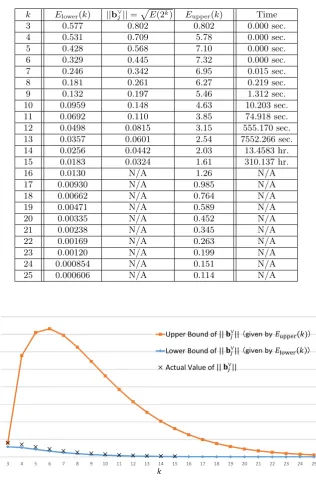
Here are Table 1 and Figure 1 ofElower(k),
√
E(2k) andE
upper(k) for 3≤k≤25. To obtain values of √E(2k), we mainly used a computer with 2.80 GHz CPU (Intel(R) Core(TM) i7-3840QM) and 8GB memory. The OS is Windows 8.1 Pro 64 bit, implementing in Magma V2.19-7. “Time” in Table 1 means the time which it took to compute the actual value of√E(2k) for each 3≤k≤25.
We note that, by applying Corollary 1 to the case ofp= 2, we have
√
1 2k ≪
√
E(2k) =||b∨ j|| ≪
√
k3 2k.
It is easy to compute exact values of Elower(k) and Eupper(k) contrary to ap-proximate values of √E(2k). We calculated the approximate values of √E(2k) up to k= 15 because of the limitations of our computer performance. For ex-ample, it took ten days to compute the approximate value of √E(215) by our implementation in Magma. We stopped to draw values in Figure 1 for k ≥26 since the differenceEupper(k)−Elower(k) is getting small for k≥26.
7.2 Feedback to Hardness of SGP
By Cauchy-Schwalz’s inequality
|⟨log(g),b∨j⟩| ≤ |Log(g)| ||b∨j||,
the success of the attack deeply depends on the size of∥b∨j∥ as in Section 4.2. Now by Figure 1, we get that all Elower(k), ||b∨j|| =
√
E(2k) and E
Table 1.Upper and lower bounds of∥b∨j∥, and actual value of∥b∨j∥forq= 2k with
3≤k≤25 (upper and lower bounds are given byEupper(k) andElower(k) respectively, “Time” means that the time which it took to compute the actual value of∥b∨j∥)
k Elower(k) ||b∨j||=
√
E(2k) E
upper(k) Time
3 0.577 0.802 0.802 0.000 sec.
4 0.531 0.709 5.78 0.000 sec.
5 0.428 0.568 7.10 0.000 sec.
6 0.329 0.445 7.32 0.000 sec.
7 0.246 0.342 6.95 0.015 sec.
8 0.181 0.261 6.27 0.219 sec.
9 0.132 0.197 5.46 1.312 sec.
10 0.0959 0.148 4.63 10.203 sec. 11 0.0692 0.110 3.85 74.918 sec. 12 0.0498 0.0815 3.15 555.170 sec. 13 0.0357 0.0601 2.54 7552.266 sec. 14 0.0256 0.0442 2.03 13.4583 hr. 15 0.0183 0.0324 1.61 310.137 hr.
16 0.0130 N/A 1.26 N/A
17 0.00930 N/A 0.985 N/A
18 0.00662 N/A 0.764 N/A
19 0.00471 N/A 0.589 N/A
20 0.00335 N/A 0.452 N/A
21 0.00238 N/A 0.345 N/A
22 0.00169 N/A 0.263 N/A
23 0.00120 N/A 0.199 N/A
24 0.000854 N/A 0.151 N/A
25 0.000606 N/A 0.114 N/A
0 1 2 3 4 5 6 7 8
3 4 5 6 7 8 9 10 11 12 13 14 15 16 17 18 19 20 21 22 23 24 25
Upper Bound of
Lower Bound of
Actual Value of
(given by ) (given by )
Fig. 1. Upper and lower bounds of ∥b∨j∥, and actual value of ∥b∨j∥forq = 2k with
8
Experimental Verification
In this section, we give our experimental results to verify whether or not Algo-rithm 1 succeeds in recovering short elementsg (or sufficiently small g’s which can break cryptosystems described in Section 3).
We deal with the case ofq= 2k since our targeted cryptosystems [20, 27, 47] are basically constructed over 2k-th cyclotomic fields. From the viewpoint of the efficiency of a key generation, encoding and decoding process in cryptosystems of [20, 27, 47], we usually usekwith 8≤k≤25 in practice. Our theoretical bounds in Subsection 7 allow us to infer that the success probability of Algorithm 1 gets higher as k is greater than 6. Thus, we show our experimental results of the success probability for each k with 6 ≤ k ≤ 10. Set q := 2k, n := 2k−1,
G:= (Z/qZ)×/{±1} andR:=Z[x]/(xn+ 1).
8.1 Parameter Setting for Our Experiments
In order to analyze the security of our targeted cryptosystems [20, 27, 47], we consider the following setting of the secret keyg:
Choice of Distribution of Secret Key g We consider the case where g is randomly chosen from a discrete Gaussian distribution or a uniform distri-bution. Recall thatgis chosen from a discrete Gaussian distribution in GGH and GGHLite schemes, and thatg is uniformly chosen from a certain finite subset ofZ[x] in FHE scheme (see Section 3).
Size of Variance In GGH and GGHLite schemes, spaces of secret keys, that are discrete Gaussian distributions of the mean 0, depend only on their vari-ances andn. (By contrast, in FHE scheme, the space of secret keys depends only onn). Thus, we consider whether the success probability of Algorithm 1 depends on variances of discrete Gaussian distributions by several experi-ments.
Type of Principal IdealsI= (g)(Prime or Non-Prime) In FHE, GGH and GGHLite schemes, secret keys g ∈ R should be prime elements in R
satisfyingR/(g) ≃Fp for some prime number p. However, as we will note below, this condition can be relaxed in cases of GGH and GGHLite. (In addi-tion, it may be also possible that the primality condition ofgcan be relaxed for FHE). Thus, we consider whether the success probability of Algorithm 1 depends on the primality of secret keys.
8.2 Effects of Primality and Variance
Case of Discrete Gaussian Distribution
First, we consider the case where secret keysgare chosen from discrete Gaussian distributions of the mean 0 and given standard deviations σ, which are spaces of secret keys of GGH and GGHLite schemes.
In each cryptosystem, a secret key g is a prime element in R such that N(g) :=|Res(g′(x), xn+ 1)|is a prime number, whereg′ is a polynomial inZ[x] representingginRand Res(g′(x), xn+ 1) is the resultant ofg′andxn+ 1. (The primality ofN(g) is not a necessary condition but a sufficient condition thatgis a prime element inR). The primality ofgwas used in the proof of [20, Lemmas 3 and 4]. In general, it is not efficient to obtain such g for large k, e.g. k≥10 ([47, Section 7], [3, Section 4]). Fortunately, it is proved in [3] that the primality ofgis not necessary to prove these lemmas, and thus the condition ongcan be relaxed. Note that in [3], it is suggested that the primality ofgis still necessary for some cryptographic applications and it may be possible to attack by using the non-primality ofg. Thus, we should experiment whether Algorithm 1 is one of such attacks.
Moreover, from Cramer et al.’s analysis for discrete Gaussian distributions [15, Lemma 5.6], the success probability of Algorithm 1 seems to depend heav-ily on variances of discrete Gaussian distributions. From this, we should also experiment for several variances.
Before we show our experimental results, we recall from Sections 2 and 4 that the canonical generators of the group of cyclotomic units are bj :=
ζj q−1
ζq−1
(j ∈ G∖{1}), and that we set bj := Log(bj) as in (3) in Subsection 4.1. The vectors1:= (1,1, . . . ,1)∈Rφ(q)/2andbj’s areR-linearly independent, and thus they constitute anR-basis ofRφ(q)/2. Thus, for anyg∈R, we have the following unique representation:
Log(g) =a(g)1 1+ ∑ j∈G∖{1}
a(g)j bj.
Note that we identify g ∈ R with the element in Z[ζq] by using the natural isomorphism R≃Z[ζq] in the above equation. It is easy to see
{
a(g)1 = ⟨Log(g),φ(q)/21⟩,
a(g)j =⟨Log(g),bj∨⟩ (j∈G∖{1}).
It implies that if we have|aj|< 12 for all j ∈G∖{1}, then we can computeg by Algorithm 1.
The procedure for our experiment is as follows: 1. Construct the following three finite subsets ofR
SK1:={g∈R|g←DZn,σ andN(g) is a prime number},
SK2:={g∈R|g←DZn,σ and the ideal (g) is not a prime ideal},
SK3:={g∈R|g←DZn,σ},
2. Computebj andb∨j forj ∈G∖{1}, whereG:= (Z/qZ)×/{±1}. 3. Computea(gi)
j satisfying Log(gi) =a (gi)
1 1+
∑
j∈G∖{1}a (gi)
j bjforj∈G∖{1},
g1∈SK1,g2∈SK2 andg3∈SK3. 4. Fori= 1,2,3 andgi∈SKi, compute
a(gi)
max:= max{|a (gi)
j | |j∈G∖{1}},
aave(SKi) := 1 # SKi
∑
gi∈SKi a(gi)
max.
We use the same computer as in Section 7. We use the discrete Gaussian dis-tribution sampler [2], which is implemented in Sage by Martin Albrecht (also see [23]). We implemented in Sage for the first step and implemented in Magma V2.19-7 for the second and the third steps. Wheni= 1 andi= 2, we computed the value ofaave(SKi) only for k= 6,7,8, because of the difficulty of choosing many prime elementsg ∈ R. In addition, we computed the value of aave(SK3) only fork= 9,10.
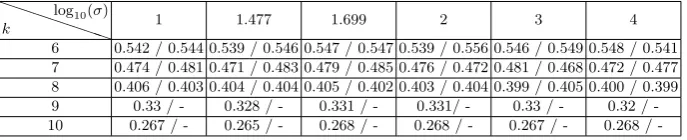
In Table 2, we show our experimental results on the value ofaave(SKi) for
i= 1,2,3.
Table 2.Values ofaave(SKi) for 6≤k ≤10 and i= 1,2,3. The value aave(SK1) is shown on the left side and the valueaave(SK2) is shown on the right side fork= 6,7,8. The valueaave(SK3) is shown on the left side fork= 9,10.
PPP PPPP
k
log10(σ)
1 1.477 1.699 2 3 4
6 0.542 / 0.544 0.539 / 0.546 0.547 / 0.547 0.539 / 0.556 0.546 / 0.549 0.548 / 0.541 7 0.474 / 0.481 0.471 / 0.483 0.479 / 0.485 0.476 / 0.472 0.481 / 0.468 0.472 / 0.477 8 0.406 / 0.403 0.404 / 0.404 0.405 / 0.402 0.403 / 0.404 0.399 / 0.405 0.400 / 0.399 9 0.33 / - 0.328 / - 0.331 / - 0.331/ - 0.33 / - 0.32 / -10 0.267 / - 0.265 / - 0.268 / - 0.268 / - 0.267 / - 0.268 /
-From Table 2, we can infer that the difficulty of solving SGP is independent of the primality of secret keys and variances of discrete Gaussian distributions since the values ofaave(SK1),aave(SK2) andaave(SK3) in Table 2 are almost the same for a fixed kand each σ. In other words, the value ofaave(SKi) seems to depend only on k for i = 1,2,3. Thus, we conclude that the security of GGH and GGHLite schemes against the RSG attack does not depend on the primality of their secret keys and variances of their spaces of secret keys. Our observation above also implies that we can use non-prime elementsgas secret keys in those cryptosystems except for some applications.
Case of Uniform Distribution
secret key gis a prime element inRchosen uniformly from the set
B(η) :=
{
f = 2
(N−1 ∑
i=0
aixi
)
+ 1∈Z[x]|ai| ≤η/2 (i= 1,2, . . . , N −1)
}
In our experiments, we use this method.
In this case, we also experiment whether the primality ofgaffects the success probability of Algorithm 1. Let SK1be the set of polynomials chosen by the above method. Let SK2be the set of polynomials f uniformly chosen fromB(η) such thatf mod (xn+1) does not generate a prime ideal fork= 6,7,8. We also choose
g∈B(η) uniformly without testing the primality ofg fork= 9,10. Let SK3 be the set of such polynomials. We chooseguntill # SK1= # SK2= # SK3= 1000. Fori= 1,2,3, setaave(SKi) as above.
In Table 3, we show our experimental results on the value ofaave(SKi) for
i= 1,2,3.
Table 3.Values ofaave(SKi) for 6≤k ≤10 and i= 1,2,3. The value aave(SK1) is shown on the left side and the valueaave(SK2) is shown on the right side fork= 6,7,8.
k aave(SK1) /aave(SK2)aave(SK3) 6 0.554 / 0.542 -7 0.487 / 0.477 -8 0.402 / 0.404
-9 - 0.334
10 - 0.267
From Table 3, we infer that the primality of g does not affect the difficulty of solving SGP for FHE scheme because of the same reason as in the case of discrete Gaussian distributions. Thus, we conclude that the security of FHE scheme against the RSG attack does not depend on the primality of secret keys, and that we can use non-prime elementsgas secret keys if the condition on the primality is relaxed.
8.3 Success Probability of Algorithm 1
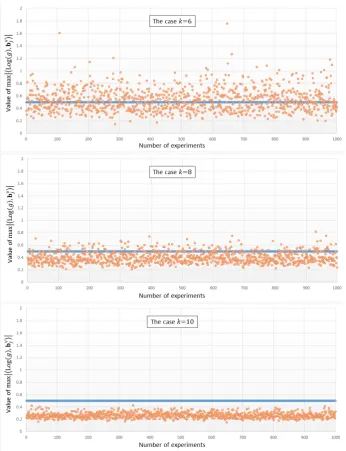
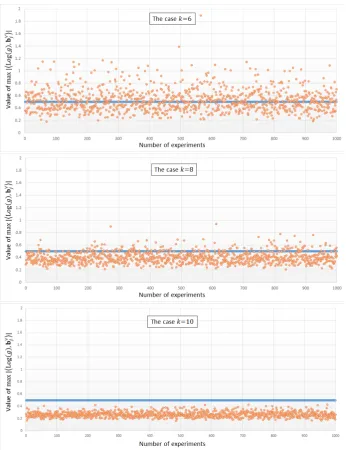
In the last of this section, we show our experimental results on the experi-mental success probability of Algorithm 1 for k = 6,8,10 and σ = 10 in both cases of discrete Gaussian distributions and uniformly distributions, where
σ is the standard deviation of a discrete Gaussian distribution. We experi-mented 1000 times for each parameter. In Figures 2 and 3, we show the value of max{|⟨Log(g),b∨j⟩| |j∈G∖{1}}for eachg.
Fig. 2.Values of max
j∈G∖{1}|⟨Log(g),b ∨
j⟩|forq= 2kwithk= 6,8,10. Note that the RSG
attack for SGP succeeds (resp. fails) if max|⟨Log(g),b∨j⟩| < 12 (resp.> 1
2). For each