Available Online atwww.ijcsmc.com
International Journal of Computer Science and Mobile Computing
A Monthly Journal of Computer Science and Information Technology
ISSN 2320–088X
IMPACT FACTOR: 5.258
IJCSMC, Vol. 5, Issue. 4, April 2016, pg.261 – 270
A Novel Algorithm for RGB
Image Steganography
Mr.C.Thiagarajan1, Ms.N.Aarthi2, Ms.R.Ananthi@Valli3, Ms.R.Anitha4, Ms.A.Ruthira5
1
Assistant Professor (ECE) Sri Ganesh College of Engineering and Technology, Puducherry 2345
B.Tech (ECE) Sri Ganesh College of Engineering and Technology, Pondicherry
[email protected], [email protected], [email protected], [email protected]
Abstract: In steganography, the total message will be invisible into a cover media such as text, audio, video and image in which attackers don’t have any idea about the original message that the media contain and which algorithm use to embed or extract it. In the proposed technique, a new steganography technique is being developed to hide large data in Bitmap image using filtering based on algorithm, which uses MSB bits for filtering purpose. This method uses the concept of status checking for insertion and retrieval of message. This method is an improvement of Least Significant Bit (LSB) method for hiding information in images. It is being predicted that the proposed method will able to hide large data in a single image retaining the advantages and discarding the disadvantages of the traditional LSB method. It efficiently and effectively hides data with the help of a key in RGB colored digital image. Proposed algorithm is capable to hide more data in cover image and require no pre-processing. Image Steganography is one of the common methods used for hiding the information in the cover image. If a person views the object in which the information is hidden inside, he or she will have no indication that there is any hidden information. So the person will not try to decrypt the information. Results show that there is less detectable distortion in the stego image and opens the track for proposed algorithm to be used in data hiding and secure transmission.
Keywords - Steganography, Information Hiding, Pixel Mapping, RGB Image, Cover Image, Method, Optimal Substitution, Stego Image
I.
INTRODUCTION
means to „write‟ and therefore , steganography becomes “covered or secret writing”. The information to be hidden is embedded into the cover object which can be a text matter, some image or some audio/video file in such a way that the very existence of the message is undetected by maintaining the appearance of the resulted object exactly same as the original. The main goal of steganography is to hide that fact the message is present in the transmission. A majority of the messages hidden today are hidden inside digital images, audio files or video files.
Types of Steganography:
1) Text steganography: It is not widely used very often because files have small amount of redundant data.
2) Image steganography: This is used widely for hiding information in the cover image. 3) Audio/Video steganography
CRYPTOGRAPHY VS STEGANOGRAPHY
Cryptography is the science of encrypting data in such a way that one cannot understand the encrypted message, whereas in steganography the mere existence of data is concealed, such that even its presence cannot be noticed.
Using cryptography might raise some suspicion whereas in steganography the existence of secret message is invisible and thus not known.
Fig1: Diagram of Steganography
We can think of steganography as an extension of cryptography, and it is commonly used under the circumstances where encryption is not allowed.
The basic principle of Steganography is carried out into two phases – 1. Sender Side Phase 2.Receiver Side Phase. In Sender Side Phase, Steganography Embedding Algorithm will takes three inputs - i) Secret Message ii.) Cover Image iii.)Stego-Key. After embedding data behind cover image embedding algorithm produce a new Stego image as output.
hiding. Section –III deals with the details of pixel mapping method. Section – IV&V explains the existing and proposed algorithm. Section – VI&VII describe result analysis conclusion.
Steganography is different from cryptography so both can be seen as complement to each other‟s. In cryptography plaintext/secret message is encoded into cipher form so that an attacker cannot easily decode cipher text into original secret message on the other hand Steganography is used to hide the existence of secret payload.
II.
IMAGE STEGANOGRAPHY
As stated earlier, images are the most popular cover objects used for steganography.
In the domain of digital images many different image file formats exist, most of them for specific applications. For these different image file formats, different steganographic algorithms exist.
There are three stages performed in the image steganography. They are:
1. Image definition 2. Image Compression
3. Image and Transform domain
Encoding:
Decoding:
Figure 3: Flowchart of Decoding
Applications
Steganography is applicable to, but not limited to, the following areas. 1) Confidential communication and secret data storing
2) Protection of data alteration
3) Access control system for digital content distribution 4) Media Database systems
Figure 4: Block Diagram of Image Steganography
process is analyzed by Histogram analysis. By doing histogram analysis, we are able to understand whether the information is embedded or not.
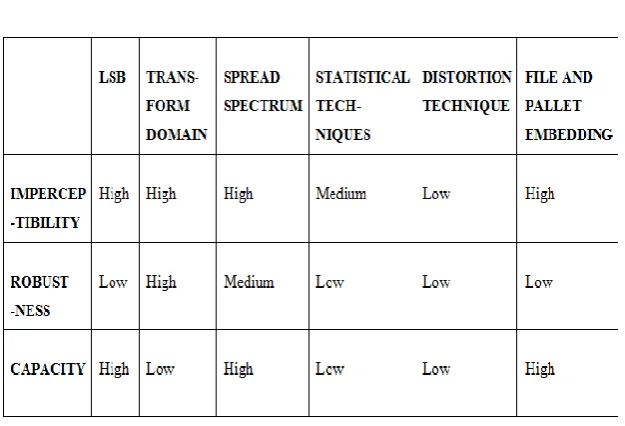
Comparison of Image Steganography Techniques
Table 1: Comparison of Image Steganography Techniques
III.
PIXEL MAPPING
Pixel mapping is a function that maps (transforms)the colors of one (source) image to the colors of another (target) image. A color mapping may be referred to as the algorithm that results in the mapping function or the algorithm that transforms the image colors. Color mapping is also sometimes called color transfer or, when grey scale images are involved, brightness transfer function (BTF).
There are two types of color mapping algorithms: those that employ the statistics of the colors of two images, and those that rely on a given pixel correspondence between the images.
A common algorithm for computing the color mapping when the pixel correspondence is given is building the joint-histogram of the two images and finding the mapping by using dynamic programming based on the joint-histogram values.
to statistics-based algorithms, such as histogram matching. The corresponding regions can be found by detecting the corresponding features.
Pixel aspect ratio (often abbreviated PAR) is a mathematical ratio that describes how the width of a pixel in a digital image compares to the height of that pixel.
Most digital imaging systems display an image as a grid of tiny, square pixels. However, some imaging systems, especially those that must be compatible with standard-definition television motion pictures, display an image as a grid of rectangular pixels, in which the pixel width and height are different. Pixel Aspect Ratio describes this difference.
APPLICATION:
Color mapping can serve two different purposes: one is calibrating the colors of two cameras for further processing using two or more sample images; the second is adjusting the colors of two images for perceptual visual compatibility.
Color calibration is an important pre-processing task in computer vision applications. Many applications simultaneously process two or more images and, therefore, need their colors to be calibrated. Examples of such applications are: Image differencing, registration, object recognition, multi-camera tracking, co-segmentation and stereo reconstruction.
IV.
EXISTING SYSTEM
The existing system on this paper has the following limitations Lesser data hiding
2D algorithm-limited features LSB algorithm
Gray Scale image etc
There are many versions of spatial steganography. All those methods directly change some bits in the image pixel values in hiding data. Least significance bit-based steganography is one of the simplest techniques that hide a secret message in the LSBs of pixel values without introducing many observable distortions. To our human eye, changes in the value of the LSB are unnoticeable. Thus, LSB can be used as an ideal position for hiding information. This does not involve any perceptual change in the cover object. Embedding of message bits can be done either in sequence or at random. This method is an improvement of Least Significant Bit (LSB) method for hiding information in images. It is being predicted that the proposed method will able to hide large data in a single image retaining the advantages and discarding the disadvantages of the traditional LSB method.
V.
PROPOSED SYSTEM
PIXEL SELECTION METHOD
In our proposed technique we are consecutively selecting pixels to embed message bits into chosen pixel. We can also employ an arbitrary function 2r+ 5 % width to choose pixels in random way where r represents row of image. By using arbitrary locations we can develop the protection of clandestine communication. But sometimes, it may degrade the embedding capacity.
FEATURES OF PROPOSED SYSTEM
The following are some of the features of the proposed system: This algorithm provides a useful addition to Secret image processing.
o Analysis in Pixel mapping scheme.
o The work presented was aimed for the processing of pixel.
o Further work is required to evaluate the performance of the algorithm in real-life steganography scenarios.
VI.
RESULTS ANALYSIS
The performance characteristics of the image steganography using pixel mapping are simulated. The various performances namely cover image, secret image, 4-bit image to hide, stego image and also histogram analysis of cover image and stego image are analyzed for the proposed algorithm. This is original image (without hidden information). The file format of this image is BMP (Bitmap Pixels). The extension of this file is .bmp. To embed the text into the original image , get the information from the user in the format file name with extension (.bmp).Usually the information is embedded into the image is in the format of image. Its file extension must be .bmp. The secret information is pixel mapped, so the secret image is changed to 4-Bit Image. Then the image is hidden on the original image. After embedding some information into the original image we get the stego images (with hidden information).Since it is color image the large number of colors (over 16 million) that can be used go well beyond the human visual system (HVS), which makes it very hard to detect once a secret message, has been encoded. The other benefits are that a much larger amount of hidden data can be encoded into a 24-bit digital image. After embedding some information into the original image, the stego image looks very much similar to the original image. Since the color image consists of 24 pixels, there is no fading occurred in the stego image.
For the human vision, there is no difference between original image and stego image. Hence, we are going to check the histograms of both original and stego image. X- axis represents the resolution value of the image and Y- axis represents the intensity of the image. Sudden rise or peak in the histogram denotes that some information has been hidden in the particular pixels.
Fig 6: 4-bit image to hide(left) and Stego image(right)
Fig 7: Histogram analysis for cover Image
Fig 8: Histogram analysis for stego Object
VII.
CONCLUSION
Data hiding is a challenging and most important task in the field of information security. In this paper we have proposed a pixel mapping algorithm which is able to hide secret information in the colored RGB image having 24-bit format. By using this algorithm, we are capable of hiding the more data in which the intruder does not know what information is transferred. For the security purpose only we are going for steganography.
REFERENCES
[1] Fridrich Jessica M. Goljan; D. Soukal (2004). "Searching for the Stego Key" (PDF).Proc. SPIE, Electronic Imaging, Security, Steganography, and Watermarking
of Multimedia Contents VI 5306: 70–82. Retrieved 23 January 2014.
[2] Prashanthi.G,SandhyaRani.K, Deepthi.S “LSB and MSB Based steganography for Embedded Modified DES Encrypted Text”, International Journal of Advanced Research in
Computer Science and Software Engineering, Vol.3,Issue 8,August 2013,pp.788-799.
[3] DeepeshRawat, VijayaBhandari,“Steganography Technique for Hiding Text Information in Color Image using Improved LSB Method”, International Journal of Computer Applications, Vol.67, No.1, April 2013,pp.22-25.
[4] Prince Kumar Panjabi and Parvinder Singh, “ An Enhanced Data Hiding Approach using Pixel Mapping Method with Optimal Substitution Approach”, International Journal of Computer Applications (0975 – 8887) Volume 74– No.10, July 2013.
[5] S. Lyu and H. Farid, “Steganalysis using higher-order image statistics,” IEEE Trans. Inf. Forensics Secure., vol. 1,no. 1, pp. 111–119, Mar. 2006.
[6] Souvik Bhattacharyya and Gautama Sanyal, “Study and analysis of quality of service in different image based Steganography using PMM” International journal of applied information system – foundation of computer science, New York, USA 2012.
[7] T. Morkel, J. H. P. Eloff, M. S. Olivier, "An Overview of Image Steganography", Information and Computer Security Architecture (ICSA) Research Group, Department of Computer Science, University of Pretoria, SA.
[8] Clair, Bryan. "Steganography: How to Send a Secret Message", www.strangehorizons.com / 2001 / 20011008 /steganography.shtmI8Nov.2001.
[9] M.Sivaram B.DurgaDevi J.Anne Steffi, “Steganography of two lsb bits”, International Journal of Communications and Engineering, Vol.1– No.1, Issue: 01, March 2012.
[11] S. Rubab and M. Younus, “Improved Image Steganography Technique for Colored Images using Wavelet Transform”, International Journal of Computer Applications, Volume 39– No.14, pp. 29-32, 2012.
[12] Ravi Kumar, KavitaChoudhary, NishantDubey, “An Introduction of Image Steganographic Techniques and Comparison”, International Journal of Electronics and Computer Science Engineering.
[13] Mamta Juneja, Parvinder S. Sandhu, and EktaWalia,”Application of LSB Based Steganographic Technique for 8-bit Color Images”, World Academy of Science,
Engineering and Technology,2009.
[14] K. Hemp stalk, “Hiding behind corners: using edges in images for better steganography”, Computing Women Congress Conference, Hamilton, New Zealand, 2006.
[15] S. Roy and R. Parekh, “A Secure Keyless Image Steganography Approach for Lossless RGB Images.” Proceedings of International Conference on Communication,