O R I G I N A L R E S E A R C H
Reporting net survival in populations: a sensitivity
analysis in lung cancer demonstrates the
differential implications of reporting relative
survival and cause-speci
fi
c survival
This article was published in the following Dove Press journal: Clinical Epidemiology
Kay See Tan1
Takashi Eguchi2
Prasad S Adusumilli2
1Department of Epidemiology and Biostatistics, Memorial Sloan Kettering Cancer Center, New York, NY 10017, USA;2Department of Surgery, Memorial Sloan Kettering Cancer Center, New York, NY 10065, USA
Background: Net survival is commonly quantified as relative survival (observed survival among lung cancer patients versus expected survival among the general population) and cause-specific survival (lung cancer–specific survival among lung cancer patients). These approaches have drastically different assumptions; hence, failure to distinguish between them results in significant implications for studyfindings. We quantified the differences between relative and cause-specific survival when reporting net survival of patients with non-small cell lung cancer (NSCLC).
Methods: Cases of NSCLC diagnosed between 2004 and 2014 were extracted from the Surveillance, Epidemiology, and End Results database. The net survival of each stage-by-age stratum was expressed as cause-specific survival (Kaplan-Meier approach) and relative survival (Ederer II approach); percentage-point (pp) differences between the survival esti-mates were quantified up to 10 years postdiagnosis.
Results: Analyses included 263,894 cases. Cause-specific survival estimates were higher than relative survival estimates across all strata. Although the differences were negligible at 1 year postdiagnosis, they increased with increasing years of follow-up, up to 9.3 pp at 10 years (eg, aged 60–74 with stage I disease: 53.0% vs 43.7%). Differences in survival estimates between the methods also increased by increasing age groups (eg, at 10 years postdiagnosis: 5.1 pp for ages 18–44, 8.8 pp for ages 45–59, and 9.3 pp for ages 60–74) but decreased drastically for those aged≥75 (3.1 pp).
Conclusion:Relative survival and cause-specific survival are not interchangeable. The type of survival estimate used in cancer studies should be specified, particularly for long-term survival.
Keywords: biostatistics, cancer epidemiology, epidemiological methods, mortality, lung cancer
Introduction
Communication of long-term survival probabilities to patients diagnosed with lung cancer is crucial and challenging. Unfortunately, the seemingly simple concept of survival is complicated by the use of different terminologies and survival measures to
address different questions.1,2Additionally, reporting of survival estimates is often
incomplete or incorrect. For example, the “Lung Cancer Fact Sheet,”published by
the American Lung Association,3states that 5-year survival is 5% for late-stage lung
Correspondence: Kay See Tan Department of Epidemiology and Biostatistics, Memorial Sloan Kettering Cancer Center, 485 Lexington Avenue, New York, NY 10017, USA
Tel +1 646 888 8257 Email [email protected]
Clinical Epidemiology
Dovepress
open access to scientific and medical research
Open Access Full Text Article
Clinical Epidemiology downloaded from https://www.dovepress.com/ by 118.70.13.36 on 20-Aug-2020
cancer. However, it is unclear whether this survival estimate
was based on the relative or cause-specific approach.
Furthermore, in a review examining variations in cancer
survival across Europe,4relative survival was reported as
a proxy for cause-specific survival without assessment of
resulting bias.
We differentiate between survival measures (net vs crude survival) and estimation frameworks (relative vs
cause-specific approaches to estimate survival measures).
When the object of interest is cancer deaths from lung cancer, net and crude survival are distinguished by the manner in which deaths from noncancer causes are con-sidered. Net survival eliminates the impact from deaths from other causes and presents survival in a hypothetical world where lung cancer is the only cause of death. In contrast, crude survival accommodates deaths from other causes and presents cancer survival in the real world,
where the patient may die of other causes.1,2
The focus of this paper is net survival. Historically, net survival was developed to address whether patients have been cured (ie, the expected survival of cancer patients has
returned to the level of the general population).5 Net
survival is independent of death from noncancer causes, an important feature to appropriately track cancer survival across time and compare cancer burden between popula-tions and countries with different life expectancies.
In population-based cancer studies, net survival can be estimated using different approaches, broadly categorized
as relative survival and cancer-specific survival. In
princi-ple, both approaches estimate the same concept of net survival. However, these two constructs have drastically
different assumptions: cancer-specific survival centers on
deaths attributable to cancer, whereas relative survival does not differentiate between causes of death and instead considers all-cause deaths that are in excess of the mortal-ity that would be expected in the general population
with-out cancer.6 With different estimators to determine net
survival, confusion arises in the comparability of the esti-mates from each approach. It is crucial to fully understand the underlying constructs of each method and the subtle-ties of each resulting estimate.
Relative survival is the ratio of the overall survival among patients diagnosed with cancer and the expected survival in a matched general population (the excess mor-tality attributable to cancer):
Observed survival among patients with lung cancer Expected survival of a matched general population
“Matched general population” refers to a subset of the
population with comparable characteristics (eg, sex and age) to the population of patients with lung cancer. Data for the derivation of observed survival and expected sur-vival are generally extracted from cancer registries and
state death files or national mortality registries. The main
advantage of the relative survival approach is that it does not require information on cause of death, which is often
difficult to obtain for every patient. However, the accuracy
of the relative survival approach depends on how closely the composition of the general population matches the composition of the population of patients with lung cancer.
Cause-specific survival focuses on cancer-specific
deaths and uses only the population of patients with lung
cancer. Data for the calculation of cause-specific survival
can be derived from institution-level cancer registries or population-based cancer registries. Unlike relative
survi-val, cause-specific survival does not require
population-level data; hence, it is not necessary to obtain mortality rates on the general population. However, credible
cause-specific survival estimation assumes accurate
cause-of-death classification.
As the methods are calculated differently, they pro-vide different estimates of net survival probabilities.
Howlander et al7studied this topic in a range of cancer
sites using a population-based cancer registry from the Surveillance, Epidemiology, and End Results (SEER)
program.8 However, in their study, all subtypes of lung
and bronchus diagnoses were presented as an aggregate group. In this study, we perform a comprehensive
inves-tigation specific to non-small cell lung cancer (NSCLC;
by stage-and-age strata) and provide insights unique to the context of lung cancer. Through a series of sensitiv-ity analyses, we herein quantify the extent of differences in net survival probability estimates when both relative
and cause-specific survival methods are applied to the
same registry data.
Methods
Study population
Cases of NSCLC were extracted from the SEER database
issued in April 2017.8 SEER is a geographically-defined
population-based cancer registry covering 34.6% of the US population. Patients diagnosed with NSCLC (no prior cancers and no second primaries) between 2004 and 2014 were selected for analysis. Histologic diagnoses were based on the morphologic codes from the International
Clinical Epidemiology downloaded from https://www.dovepress.com/ by 118.70.13.36 on 20-Aug-2020
Classification of Diseases for Oncology (ICD-O-3).9 Histologic types of NSCLC (ICD-O-3 topography code:
C34) included squamous cell carcinoma (8051–2, 8070–6,
8078, 8083–4, 8090, 8094, 8120, 8123), adenocarcinoma
(8015, 8050, 8140–1, 8143–5, 8147, 8190, 8201, 8211,
8250–5, 8260, 8290, 8310, 8320, 8323, 8333, 8401,
8440, 8470–1, 8480–1, 8490, 8503, 8507, 8550, 8570–2,
8574, 8576), large cell carcinoma (8012–4, 8021, 8034,
8082), adenosquamous carcinoma (8560), and other/not
otherwise specified NSCLC (8022, 8030, 8031, 8032,
8033, 8035, 8046, 8200, 8230, 8430, 8441, 8551, 8562, 8575). For each patient, year of diagnosis, stage (based on
the sixth edition of the AJCC Cancer Staging Manual,10
applicable to diagnoses made in 2004 or later), histologic type, age, sex, surgery (yes/no), cause of death, and survi-val duration (from diagnosis to death or last follow-up)
were recorded. The final cohort comprised patients with
NSCLC who were aged≥18 years at the time of diagnosis.
Statistical analysis
Patients were categorized into 16 strata on the basis of
stage (I, II, III, and IV) and age (18–44, 45–59, 60–74, and
≥75 years) at diagnosis. The survival measure of interest
was net survival, expressed as relative survival and
cause-specific survival within each stratum. Both methods were
applied to the same cohort to calculate survival estimates
up to 10 years postdiagnosis. Cause-specific survival was
calculated using the Kaplan-Meier approach from the time
of diagnosis to the time of lung cancer–specific death
(patients were censored otherwise). Deaths due to cancer
were identified by the SEER cause-specific death classifi
-cation variable.7,8 Relative survival was calculated by
dividing all-cause survival among the lung cancer patients by the expected survival of the matched general population
using the Ederer II approach.11 Expected survival was
derived from life tables that matched the study population to the general population by sex, age, and calendar year of diagnosis. As a secondary assessment, the analyses were repeated in the subcohort of patients who underwent sur-gery. In all analyses, the differences between relative and
cause-specific survival estimates at specific time points
were quantified as percentage-points (pp).
A publicly available algorithm was adapted to estimate relative survival using SAS 9.4 (SAS Institute, Cary, NC,
USA), incorporating the Ederer II approach.12,13All other
analyses were conducted using R 3.5.1 (R Core Team,
Vienna, Austria), using the SEERaBomb package14 for
data processing from the SEER database and the
demography package15to extract life tables of the general
population from the National Center for Health Statistics
(NCHS).16
Results
Table 1reports the number of patients in each
stage-and-age stratum. Analyses included 263,894 patients with stage I (20%), stage II (5%), stage III (26%), or stage IV
(49%) NSCLC, of whom 77% were aged ≥60 years and
46% were women.Figure S1A–Dpresents the crude
prob-abilities of death from cancer and noncancer causes;
Figure S2A–D presents these data for the subset of
patients who underwent surgery.
Relative survival versus cause-speci
fi
c
survival
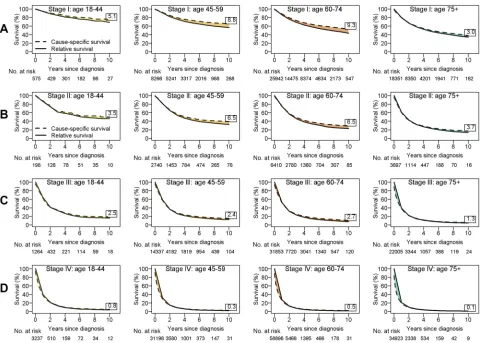
Among stage I patients, estimates of cause-specific
survi-val were higher than estimates of relative survisurvi-val in all
age-by-stage strata, across all years of follow-up
(Figure 1A). Differences between cause-specific and
rela-tive survival estimates were minimal in the short term (ie, 1 year postdiagnosis) but increased in magnitude with
increasing years of follow-up (Table 1). For example,
among those aged 60–74 years, cause-specific survival
was 1.9 pp higher than relative survival at 1 year post-diagnosis (88.5% vs 86.6%). However, the difference increased to 5.7 pp at 5 years postdiagnosis (64.2% vs 58.5%) and 9.3 pp at 10 years postdiagnosis (53.0% vs 43.7%). Examining across increasing age groups, the
dif-ferences between relative and cause-specific survival
esti-mates increased with advancing age, except in the case of
patients aged ≥75 years. For example, at 10 years
post-diagnosis, cause-specific survival was 5.1 pp higher than
relative survival among those aged 18–44 (74.1% vs
69.0%), 8.8 pp higher among those aged 45–59 (65.5%
vs 56.7%), and 9.3 pp higher among those aged 60–74
(53.0% vs 43.7%), whereas the difference was 3.0 pp
among patients aged≥75 (37.3% vs 34.3%).
Overall, survival estimates were lower as stage increased (ie, stage II disease had worse survival estimates than stage I). Results for patients with stage II NSCLC mirrored those for patients with stage I disease: estimates
of cause-specific survival were always higher than estimates
of relative survival (Figure 1B). The differences between
cause-specific and relative survival estimates were less
drastic among patients with stage II disease than among those with stage I disease. For example, among those aged
Clinical Epidemiology downloaded from https://www.dovepress.com/ by 118.70.13.36 on 20-Aug-2020
T able 1 Summar y of clinical data a and sur vival estimates among patients with non-small cell lung cancer Sta g e/Age b Stratum T otal, No . F emale, % All-Cause Death, No . Lung Cancer Death, No . Relativ e Sur vival, % Cause-Speci fi c Sur vival, % Y ears Since Dia gnosis Y ears Since Dia gnosis 1 5 10 1 5 10 I/18 – 44 575 61 122 96 94.6 79.5 69.0 94.8 81.5 74.1 I/45 – 59 8266 54 2548 1838 91.0 67.9 56.7 92.4 73.1 65.5 I/60 – 74 25,942 50 10,813 7268 86.6 58.5 43.7 88.5 64.2 53.0 I/ ≥ 75 18,351 53 10,850 6943 79.8 47.8 34.3 80.2 49.8 37.3 Stage I total 53,134 52 24,333 16,145 II/18 – 44 198 50 86 76 86.6 55.3 46.3 88.2 58.1 49.8 II/45 – 59 2740 44 1448 1231 81.7 42.7 32.6 81.8 46.6 39.1 II/60 – 74 6410 42 3942 3187 74.9 34.2 22.8 76.0 38.1 29.3 II/ ≥ 75 3697 47 2819 2245 61.3 23.3 13.6 60.9 24.9 17.3 Stage II total 13,045 44 8285 6739 III/18 – 44 1264 47 900 844 64.3 22.2 16.1 62.8 23.8 18.6 III/45 – 59 14,337 41 10,600 9743 58.9 18.8 12.7 58.3 20.8 15.1 III/60 – 74 31,853 42 24,921 21,972 52.2 14.6 7.8 52.7 17.0 10.5 III/ ≥ 75 22,005 48 19,123 16,674 39.0 8.7 4.4 38.6 9.1 5.7 Stage III total 69,459 44 55,544 49,233 IV/18 – 44 3237 50 2704 2563 40.0 7.2 3.7 39.0 7.7 4.5 IV/45 – 59 31,198 43 27,485 26,223 32.0 4.3 2.1 30.5 4.7 2.4 IV/60 – 74 58,898 42 52,671 49,445 27.5 3.5 1.4 26.5 4.0 1.9 IV/ ≥ 75 34,923 48 32,294 29,868 21.3 2.7 0.9 20.1 2.7 1.0 Stage IV total 128,256 44 115,154 108,099 Notes: aClinical characteristics w er e extracted fr om the Surveillance, Epidemiology , and End Results data set. bAge, in years, at diagnosis.
Clinical Epidemiology downloaded from https://www.dovepress.com/ by 118.70.13.36 on 20-Aug-2020
60–74 with stage II disease, cause-specific survival was 1.1 pp higher than relative survival at 1 year postdiagnosis (76.0% vs 74.9%) and 6.5 pp higher at 10 years postdiag-nosis (29.3% vs 22.8%). These differences were less pro-nounced than those found in the corresponding patients with stage I disease (1.9 pp and 9.3 pp). The differences between
cause-specific and relative survival estimates were <3 pp
among all patients with stage III disease and <1 pp among
all patients with stage IV disease (Figure 1CandD).
Subcohort analysis among surgical
patients
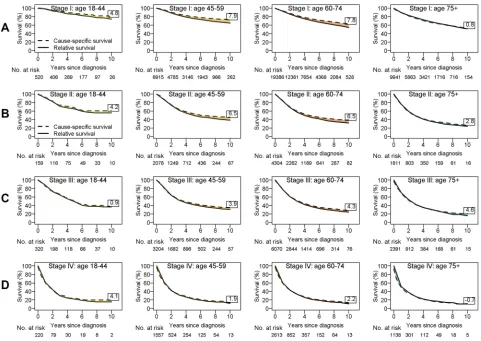
Among the total cohort, 62,627 patients (24%) received surgery; most surgical patients had early-stage disease (69% of stage I and 64% of stage II disease groups, compared with 17% of stage III and 4% of stage IV disease groups). Overall, patients who underwent surgery had better survival than the overall cohort for corresponding strata. As observed
in the total cohort, estimates of cause-specific survival for
patients who underwent surgery were always higher than
estimates of relative survival (Table 2, Figure 2A–D).
Among the stage I and II disease groups, the differences
between cause-specific and relative survival estimates were
similar to those in the overall cohort (in general, they were of a slightly smaller magnitude). As observed in the primary analyses, the difference between the two methods was neg-ligible at 1 year postdiagnosis but increased as years of
follow-up increased. For example, among those aged 60–74
with stage II disease, cause-specific survival was 0.9 pp
higher than relative survival at 1 year postdiagnosis (85.1% vs 84.2%), 3.3 pp higher at 5 years postdiagnosis (48.1% vs 44.8%), and 6.5 pp higher at 10 years postdiagnosis (38.6% vs 32.1%).
Discussion
This study compares two competing conventional estimators
of net survival. Applying both relative and cause-specific
Figure 1Relative and cause-specific survival estimates by age group for patients with stage I (A), stage II (B), stage III (C), and stage IV (D) non-small cell lung cancer. The value in each box reports the percentage-point difference at 10 years since diagnosis (the 10-year cause-specific survival estimate minus the 10-year relative survival estimate).
Clinical Epidemiology downloaded from https://www.dovepress.com/ by 118.70.13.36 on 20-Aug-2020
T able 2 Summar y of clinical data a and sur vival estimates among patients with non-small cell lung cancer who rec eiv ed surger y Sta g e/Age aStratum T otal, No . F emale, % All-Cause Death, No . Lung Cancer Death, No . Relativ e Sur vival, % Cause-Speci fi c Sur vival, % Y ears Since Dia gnosis Y ears Since Dia gnosis 1 5 1 0 151 0 I/18 – 44 520 62 83 62 98.2 85.6 74.3 97.7 87.3 79.1 I/45 – 59 6915 56 1679 1160 95.1 75.8 65.0 96.0 79.8 72.9 I/60 – 74 19,386 52 6405 4003 92.8 70.8 54.8 93.9 74.4 62.6 I/ ≥ 75 9941 53 4791 2608 89.6 67.9 51.5 89.8 66.7 52.3 Stage I total 36,762 53 12,958 7833 II/18 – 44 159 52 57 49 91.1 65.0 56.1 92.7 67.5 60.3 II/45 – 59 2078 46 975 818 87.5 50.0 38.8 87.6 53.6 45.3 II/60 – 74 4304 42 2271 1777 84.2 44.8 32.1 85.1 48.1 38.6 II/ ≥ 75 1811 46 1232 907 76.3 35.9 24.1 76.3 37.7 26.9 Stage II total 8352 44 4535 3551 III/18 – 44 320 53 158 147 87.9 48.9 37.0 84.9 50.0 37.9 III/45 – 59 3204 47 1732 1539 82.5 42.2 31.0 81.7 44.5 34.9 III/60 – 74 6070 45 3576 2995 78.1 37.2 24.3 78.3 39.4 28.6 III/ ≥ 75 2391 49 1677 1324 70.3 31.1 16.2 69.8 30.9 20.8 Stage III total 11,985 47 7143 6005 IV/18 – 44 220 59 157 145 61.0 21.9 15.4 60.9 24.0 19.5 IV/45 – 59 1557 51 1112 1047 62.2 21.8 12.0 61.3 23.3 13.9 IV/60 – 74 2613 48 1863 1682 60.8 21.2 10.9 60.3 22.1 13.1 IV/ ≥ 75 1138 49 894 782 51.4 18.3 11.3 49.7 17.8 10.6 Stage IV total 5528 49 4026 3656 Notes: aClinical characteristics w er e extracted fr om the Surveillance, Epidemiology , and End Results data set. bAge, in years, at diagnosis.
Clinical Epidemiology downloaded from https://www.dovepress.com/ by 118.70.13.36 on 20-Aug-2020
survival methods to the same data, we quantified the differ-ences in net survival estimates between the methods in the context of NSCLC. Results demonstrates that in most
situa-tions, relative survival and cause-specific survival provided
similar estimates of net survival. Negligible differences between the two frameworks in certain scenarios implies that both approaches can be reliably used to estimate net survival in subgroups where cancer survival is poorer (eg, among late-stage disease or older patients) and the interest is in short-term survival. However, our study also highlights situations with major discrepancies between the two methods and cautions against using the two terminologies inter-changeably, especially when focused on long-term follow-up, as both frameworks are vulnerable to errors.
For cause-specific survival, accurate cause-of-death
cod-ing in cancer registries is crucial. The degree of bias in
cause-specific survival estimates depends on the degree of
misclassification of cancer-specific cause of death on death
certificates. Results from lung cancer screening trials
estimated up to 15% under-reporting of lung cancer deaths
due to misclassification.17–19 In this set of analyses, it is
reasonable to assume that the potential for bias due to
misclassification is greater among older patients (among
whom the overall incidence of death is much greater than among younger patients) and lower among those with late-stage disease (among whom a greater proportion of deaths can be assigned to lung-cancer causes, with greater
confidence).
In addition to misattribution of the cause of death,
cause of death may have been recorded as “unknown”
(ie, death cannot be ascribed to lung cancer or to other
causes with certainty). Gamel and Vogel20proposed
parti-tioning these deaths by the ratio of lung cancer–specific
deaths to deaths attributable to other causes. We conducted sensitivity analyses on the basis of this approach (results not shown); owing to the small number of deaths attribu-table to unknown causes in this context, the conclusions were similar.
Figure 2Relative and cause-specific survival estimates by age group for patients who underwent surgery with stage I (A), stage II (B), stage III (C), and stage IV (D) non-small cell lung cancer. The value in each box reports the percentage-point difference at 10 years since diagnosis (the year cause-specific survival estimate minus the 10-year relative survival estimate).
Clinical Epidemiology downloaded from https://www.dovepress.com/ by 118.70.13.36 on 20-Aug-2020
The primary source of error for relative survival is non-comparability between the study population and the general
population used to estimate underlying mortality.2
Comparability implies that if the patient did not have can-cer, then the patient's survival experience (or background mortality) is assumed to match the general population. This assumption is undoubtedly violated in the current context of lung cancer, where patients are more likely to be smokers than the general population. Smoking is a major risk factor for developing lung cancer and consequently dying from
lung cancer.21More importantly, smoking increases the risk
of comorbidities such as chronic respiratory disease,
cardi-ovascular disease and other smoking-related cancers.22–24
Lung cancer patients are therefore more likely to die from other smoking-related comorbidities, so their true back-ground mortality may not be comparable to the general population. In reality, the potential biases resulting from noncomparability could likely explain the differences
between relative and cause-specific survival estimates
observed here: since the life tables used in this study do not account for tobacco-use or smoking-related comorbid-ities, the expected survival may have been overestimated, resulting in underestimation of the relative survival. This potential explanation is further highlighted in the subgroup analysis among surgical patients, where we observed greatly diminished or negligible differences between
rela-tive and cause-specific survival estimates. Patients who are
eligible for surgery tend to have lower rates of comorbid-ities, therefore their background mortality is more
compar-able to the general population. Few studies have quantified
the impact of tobacco-use on relative survival estimates.25
Using the Finnish Cancer Registry, Hinchliffe et al26
showed that the bias in relative survival due to the
non-comparability of smoking patterns was negligible.
However, reporting of tobacco-use is often unreliable. Thorough investigation of the impact of noncomparability requires using smoking-adjusted life tables, as attempted by
several researchers,27,28but such adaptations of life tables
are difficult to implement because the necessary
population-level smoking data linked to mortality data are rarely avail-able. Because the SEER registry does not capture data on tobacco-use or smoking-related comorbidities, we cannot fully address this issue in our current analysis. Future
stu-dies should confirm that the differences in estimates
between the two frameworks can indeed be reduced by using smoking-adjusted life tables or by stratifying analyses by smoking-related comorbidities.
In theory, relative survival requires a comparison group free of the cancer under study. In practice, expected survi-val is typically calculated from general-population life tables, which include people previously diagnosed with cancer. With the inclusion of people previously diagnosed with cancer, the expected survival in the general popula-tion would be underestimated and hence lead to overesti-mation of relative survival. Studies have examined this
issue in the general populations of Finland29 and
Canada.30 These studies concluded that adjustment for
cancer mortality is warranted if relative survival is esti-mated for all cancer sites combined but that the proportion
of deaths attributable to specific cancers, particularly lung
cancer, is too small to affect the relative survival estimates. Although we did not extract lung cancer mortality from the comparison cohort by excluding individuals with lung cancer, we believe that the magnitude of the bias in
rela-tive survival estimation is negligible for lung cancer.31
We assessed two classical methods to estimate net survival; however, other methods with different properties
exist and have been examined,32–34 including a proposed
method by Perme et al.35 In addition, the net survival
estimates we present in this study are in the context of a hypothetical world where cancer is the only cause of
death.1,36 However, specific questions of interest may
require consideration of other causes of death. Hence, instead of net survival, it is more appropriate to present crude survival in those cases. Formal comparisons between these two survival measures can be found
elsewhere.2
Last, the use of the SEER registry allowed us to eval-uate long-term survival among patients with lung cancer. However, such a large, multi-institutional database is sub-ject to the typical limitations associated with any
retro-spective registry-based data involving a group of
heterogenous patients not treated uniformly. Important
covariates such as significant comorbidities, tumor
loca-tions, radiographic results, and treatment of subsequent cancer recurrences were not captured in the SEER registry. Hence, the lack of adjustment for factors associated with prognosis is a limitation we cannot overcome in this study.
Conclusion
Relative survival and cause-specific survival are
comple-mentary but not interchangeable. In general, both frame-works provide similar estimates of net survival. However, differences between the two estimates may still be con-siderable in certain situations, particularly when the focus
Clinical Epidemiology downloaded from https://www.dovepress.com/ by 118.70.13.36 on 20-Aug-2020
is on early-stage disease and long-term survival probabil-ity estimation. Hence, it is crucial to detail the type of survival estimates presented or communicated. With a deliberate focus on obtaining a well-matched comparison cohort and accurate cause-of-death coding, population-based studies should present results from both approaches
and identify differences in study findings, along with the
limitations specific to each method.
Data availability
This paper utilized publicly available data through the Surveillance, Epidemiology, and End Results (SEER) program.
Acknowledgment
This work was supported by the National Institutes of
Health (NIH) Cancer Center Support Grant P30
CA008748. The sponsor played no role in any aspect of the study or manuscript.
Disclosure
The authors report no conflicts of interest in this work.
References
1. Perme MP, Estève J, Rachet B. Analysing population-based cancer survival–settling the controversies.BMC Cancer.2016;16(1):933. doi:10.1186/s12885-016-2967-9
2. Mariotto AB, Noone AM, Howlader N, et al. Cancer survival: an overview of measures, uses, and interpretation.J Natl Cancer Inst
Monogr. 2014;2014(49):145–186. doi:10.1093/jncimonographs/
lgu024
3. American Lung Association. Lung cancer fact sheet. Available from:
http://www.lung.org/lung-health-and-diseases/lung-disease-lookup/lung-cancer/resource-library/lung-cancer-fact-sheet.html. Accessed September 10,2018.
4. Munro AJ. Comparative cancer survival in European countries. Br
Med Bull.2014;110(1):5–22. doi:10.1093/bmb/ldu009
5. Cronin KA, Feuer EJ. Cumulative cause-specific mortality for cancer patients in the presence of other causes: a crude analogue of relative survival.Stat Med.2000;19(13):1729–1740.
6. Sarfati D, Blakely T, Pearce N. Measuring cancer survival in popula-tions: relative survival vs cancer-specific survival.Int J Epidemiol.
2010;39(2):598–610. doi:10.1093/ije/dyp392
7. Howlader N, Ries LA, Mariotto AB, et al. Improved estimates of cancer-specific survival rates from population-based data. J Natl
Cancer Inst.2010;102(20):1584–1598. doi:10.1093/jnci/djq366
8.Surveillance, Epidemiology, and End Results (SEER) Program
Populations (1973–2014). Bethesda (MD): National Cancer
Institute, DCCPS, Surveillance Research Program, Cancer Statistics Branch;2017.
9. Fritz A, Percy C, Jack A, et al. eds.International Classification of
Diseases for Oncology. 3rd ed. Geneva, Switzerland: World Health
Organization;2000. 70–81.
10. Greene FL, Page DL, Fleming ID, et al. AJCC Cancer Staging
Manual. 6th ed. New York (NY): Springer-Verlag;2002.
11. Ederer F, Heise H. The effect of eliminating deaths from cancer on general population survival rates.Meth Note No.1959;11(23):169. 12. Dickman P. Estimating and modelling relative survival using SAS.
Available from: http://www.pauldickman.com/rsmodel/sas_colon/. Accessed May 1,2018.
13. Cho H, Howlader N, Mariotto AB, et al. Estimating relative survival for cancer patients from the SEER program using expected rates based on Ederer I versus Ederer II method. Surveillance Research Program, NCI, Technical Report #2011-01. Available from:https://surveillance.cancer. gov/reports/tech2011.01.pdf. Published 2011. Accessed May 2, 2018. 14. Radivoyevitch T.SEERaBomb: SEER and atomic bomb survivor data
analysis tools. R package version 2017.2. The Comprehensive R Archive Network; 2017. Available from: https://CRAN.R-project. org/package=SEERaBomb. Accessed May 1, 2018.
15. Hyndman RJ.Demography: forecasting mortality, fertility, migration and population data. R package version 1.18. The Comprehensive R Archive Network;2014. Available from:https://CRAN.R-project.org/ package=demography. Accessed May 1, 2018
16. National Center for Health Statistics (NCHS). United States life tables. Available from: https://www.cdc.gov/nchs/products/life_ tables.htm. Accessed May 1, 2018.
17. Doria-Rose VP, Marcus PM. Death certificates provide an adequate source of cause of death information when evaluating lung cancer mortality: an example from the Mayo Lung Project.Lung Cancer.
2009;63(2):295–300. doi:10.1016/j.lungcan.2008.05.019
18. Frost JK, Ball WC, Levin ML, et al. Early lung cancer detection: results of the initial (prevalence) radiologic and cytologic screening in the Johns Hopkins study.Am Rev Respir Dis.1984;130(4):549– 554. doi:10.1164/arrd.1984.130.4.549
19. Tan KS. Misclassification of the actual causes of death and its impact on analysis: a case study in non-small cell lung cancer.Lung Cancer.
2019;134:16–24. doi:10.1016/j.lungcan.2019.05.016
20. Gamel JW, Vogel RL. Non-parametric comparison of relative versus cause-specific survival in Surveillance, Epidemiology and End Results (SEER) programme breast cancer patients.Stat Methods Med Res.
2001;10(5):339–352. doi:10.1177/096228020101000503
21. Molina JR, Yang P, Cassivi SD, et al. Non-small cell lung cancer: epidemiology, risk factors, treatment, and survivorship.Mayo Clin Proc.2008;83(5):Elsevier. doi:10.1016/S0025-6196(11)60735-0 22. Willett WC, Green A, Stampfer MJ, et al. Relative and absolute
excess risks of coronary heart disease among women who smoke cigarettes. N Engl J Med. 1987;317(21):1303–1309. doi:10.1056/ NEJM198711193172102
23. Moore C. Cigarette smoking and cancer of the mouth, pharynx, and larynx: a continuing study.Jama.1971;218(4):553–558.
24. Fuchs CS, Colditz GA, Stampfer MJ, et al. A prospective study of cigarette smoking and the risk of pancreatic cancer.Arch Intern Med.
1996;156(19):2255–2260.
25. Blakely T, Soeberg M, Carter K, et al. Bias in relative survival methods when using incorrect life-tables: lung and bladder cancer by smoking status and ethnicity in New Zealand. Int J Cancer.
2012;131(6):E974–E982. doi:10.1002/ijc.27592
26. Hinchliffe SR, Rutherford MJ, Crowther MJ, et al. Should relative survival be used with lung cancer data? Br J Cancer. 2012;106 (11):1854–1859. doi:10.1038/bjc.2012.182
27. Ellis L, Coleman MP, Rachet B. The impact of life tables adjusted for smoking on the socio-economic difference in net survival for laryn-geal and lung cancer. Br J Cancer. 2014;111(1):195–202. doi:10.1038/bjc.2014.217
28. Rosenberg MA, Feuer EJ, Yu B, et al. Chapter 3: cohort life tables by smoking status, removing lung cancer as a cause of death.Risk Anal.
2012;32(Suppl 1):S25–S38. doi:10.1111/j.1539-6924.2011.01662.x 29. Hinchliffe SR, Dickman PW, Lambert PC. Adjusting for the
propor-tion of cancer deaths in the general populapropor-tion when using relative survival: a sensitivity analysis.Cancer Epidemiol.2012;36(2):148– 152. doi:10.1016/j.canep.2011.09.007
Clinical Epidemiology downloaded from https://www.dovepress.com/ by 118.70.13.36 on 20-Aug-2020
30. Ellison LF. Adjusting relative survival estimates for cancer mortality in the general population.Health Rep.2014;25(11):3–9.
31. Talbäck M, Dickman PW. Estimating expected survival probabilities for relative survival analysis—exploring the impact of including cancer patient mortality in the calculations.Eur J Cancer.2011;47 (17):2626–2632. doi:10.1016/j.ejca.2011.08.010
32. Hakulinen T, Seppä K, Lambert PC. Choosing the relative survival method for cancer survival estimation. Eur J Cancer. 2011;47 (14):2202–2210. doi:10.1016/j.ejca.2011.03.011
33. Seppä K, Hakulinen T, Läärä E, et al. Comparing net survival estimators of cancer patients. Stat Med. 2016;35(11):1866–1879. doi:10.1002/sim.6833
34. Roche L, Danieli C, Belot A, et al. Cancer net survival on registry data: use of the new unbiased Pohar-Perme estimator and magnitude of the bias with the classical methods. Int J Cancer. 2013;132 (10):2359–2369. doi:10.1002/ijc.27830
35. Perme MP, Stare J, Esteve J. On estimation in relative survival.
Biometrics.2012;68:113–120. doi:10.1111/j.1541-0420.2011.01640.x
36. Lambert PC, Dickman PW, Rutherford MJ. Comparison of different approaches to estimating age standardized net survival.BMC Med
Res Methodol.2015;15(1):64. doi:10.1186/s12874-015-0092-0
Clinical Epidemiology downloaded from https://www.dovepress.com/ by 118.70.13.36 on 20-Aug-2020
Supplementary materials
Figure S1Crude mortality from cancer and noncancer causes by age group for patients with stage I (A), stage II (B), stage III (C), and stage IV (D) non-small cell lung cancer. Cumulative incidence of lung-cancer deaths (LC-CID) and cumulative incidence of nonlung-cancer deaths (non-LC-CID) were generated using a competing risk approach. Overall, LC-CID increased with advancing age and stage; similarly, non-LC-CID increased with advancing age and stage. Even though the total number of deaths increased with age, the proportion of deaths attributable to cancer in the older age group decreased because of increased competing causes of death.
Abbreviation:Cum. incidence, cumulative incidence.
Clinical Epidemiology downloaded from https://www.dovepress.com/ by 118.70.13.36 on 20-Aug-2020
Clinical Epidemiology
Dovepress
Publish your work in this journal
Clinical Epidemiology is an international, peer-reviewed, open access, online journal focusing on disease and drug epidemiology, identifi ca-tion of risk factors and screening procedures to develop optimal pre-ventative initiatives and programs. Specific topics include: diagnosis, prognosis, treatment, screening, prevention, risk factor modification,
systematic reviews, risk & safety of medical interventions, epidemiol-ogy & biostatistical methods, and evaluation of guidelines, translational medicine, health policies & economic evaluations. The manuscript management system is completely online and includes a very quick and fair peer-review system, which is all easy to use.
Submit your manuscript here:https://www.dovepress.com/clinical-epidemiology-journal
Figure S2Crude mortality due to cancer and noncancer causes by age group for patients with stage I (A), stage II (B), stage III (C), and stage IV (D) non-small cell lung cancer among patients who underwent surgery.
Abbreviation:Cum. incidence, cumulative incidence.
Clinical Epidemiology downloaded from https://www.dovepress.com/ by 118.70.13.36 on 20-Aug-2020