Available Online at www.ijcsmc.com
International Journal of Computer Science and Mobile Computing
A Monthly Journal of Computer Science and Information Technology
ISSN 2320–088X
IMPACT FACTOR: 5.258
IJCSMC, Vol. 5, Issue. 7, July 2016, pg.264 – 270
Implementation of SVM based
CBIR System using Wavelet
Transform and SIFT Approach
Ms. Yashashree Zambare
1, Prof. Dinesh D. Patil
2¹PG Student, Department of Computer Science and Engineering,
Shri Sant Gadge Baba College of Engineering and Technology, Bhusawal, Maharashtra, India
²Associate Professor and Head, Department of Computer Science and Engineering,
Shri Sant Gadge Baba College of Engineering and Technology, Bhusawal, Maharashtra, India 1
[email protected]; 2 [email protected]
Abstract— Many CBIR systems are implemented in recent years as the need for image retrieval with accuracy has increased. In this paper we proposed a new CBIR system with use of support vector machine and well known descriptor Scale Invariant Transform along with wavelet transform. The combinational approach used in proposed system is for accurate results in terms of image retrieval. SVM is used for the classification of image database for the implementation of CBIR using SIFT Algorithm. The algorithm consists of four major stages: scale-space extrema detection, keypoint localization, orientation assignment, keypoint description. This approach relies on the choice of several parameters which directly impact its effectiveness when applied to retrieve images.The proposed system has demonstrated faster retrieval method on a dataset used for calculation of experimental results. The performance evaluated yields better result as in comparison to the existing systems.
Keywords— CBIR, Image Retrieval, SIFT, SVM, Wavelet transform.
I. INTRODUCTION
Image retrieval is the field of study concerned with searching and browsing digital images from database collection. This area of research is very active research since the 1970s.The purpose of an image database is to store and retrieve an image or image sequences that are relevant to a query. CBIR can be categorized based on the type of features used for retrieval which could be either low level or high level features. Generally, three categories of methods are used for image retrieval are used: text based, content-based and semantic-based [10]. In [1] CBIR using color histograms technique is discussed using grid technique to improve performance of image retrieval. Most probably all image-processing techniques treat image as a 2-dimensional signal and apply standard techniques on it. Most CBIR system that are developed: QBIC [2], MARS [3], PicHunter [4], Photo book [5], NeTra [6] and others, In [7], authors used color feature extraction method in which color features are extracted using three techniques mainly color correlogram, color moment and HSV histogram. The main part is KNN algorithm and relative standard derivation. Use KNN classifier for classifying images and relative standard derivation used for measuring similarity between two images with finally computing value of Precision and Recall. K-Nearest Neighbours Algorithm known as KNN, supervised machine learning method that classifies data, using this classifier, set of data can be classified in order to discover elements from the set of data. In [9], authors proposed a novel image feature representation method, texture structure histogram (TSH) which is an effective image feature used for image retrieval. Some commonly used color descriptors including compact color moments, the color coherence vector, and color correlo-gram [12]. In [13] authors have proposed novel CBIR system with an optimized solution combined to K-means and k-nearest neighbour algorithm (KNN). A creative system flow model with image division and neighbourhood color topology is introduced that is designed for increasing clustering accuracy.
III.PROPOSED SYSTEM
A. Problem formulation
In today’s world important research topic is CBIR, and in this paper our main focus or aim to implement CBIR system based on SIFT and wavelet features based on SVM trained set of images. The performance measurement of proposed system is done using precision and recall method. Our main aim is to improve performance of CBIR system by retrieval of exact images in result for query image. Further in this section we describe few terms.
B. Fundamentals aspects of CBIR
The Content-Based Image Retrieval, also known as query by image content and content-based visual information retrieval. Content based means that the search makes use of the contents of the images themselves, rather than relying on human-input metadata such as captions or keywords.
A content-based image retrieval system (CBIR) is a piece of software that implements CBIR. Content based image retrieval plays a central role in the application areas such as multimedia database systems in recent years. Content-based image retrieval (CBIR) is a technique to search for the most visually similar images to a given query image from a large image database. It has received increasing attentions in recent years.
C. Scale Invariant Feature Transform (SIFT)
The SIFT algorithm consists of following four major steps [];
Scale space extrema detection,
Keypoint localization
Orientation assignment
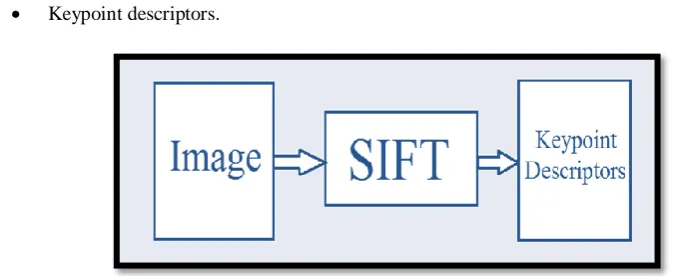
The SIFT algorithm identifies features of an image that are distinct, and these features can in turn be used to identify similar or identical objects in other images. We will here give an introduction to the SIFT algorithm. SIFT has four computational phases. The output of the SIFT algorithm is a set of keypoint descriptors. SIFT takes an image as input and generates a set of keypoint descriptors as output.
D. Wavelet Transform
A multi-resolution approach is provided to texture analysis and classification due to Wavelet transforms. At each level, the signal is decomposed into four frequency sub-bands, LL, LH, HL, and HH, where L denotes low frequency and H denotes high frequency. The computation of the wavelet transforms involves recursive filtering and sub-sampling.
E. Support Vector Machine (SVM)
Support vector machines (SVMs) are supervised learning models with associated learning algorithms that analyze data used for classification and regression analysis. A support vector machine based on simple and initiative concept. They are constructed by locating the set of hyper planes that separate two or more classes of data. Support Vector Machine is a maximal margin hyperplane in feature space built by using a kernel function in gene space. This is kind of black magic we do not know what happens inside the kernel, we just get the output. Still, we have the geometric interpretation of the maximal margin hyperplane, so SVMs are more transparent than e. g. Artificial Neural Networks. The support vector machine is a powerful tool for bi-nary classification, capable of generating very fast classifier functions following a training period.
F. Proposed System
The workflow for proposed system is as stated below
Step 1. Start
Step 2. Firstly input any query image or test image as input to system
Step 3. Once we load query image then accordingly trains the SVM for labelling all images.
Step 4. Next is to separate out all the labelled images from the whole dataset for further feature calculations namely SIFT and Wavelet Transforms to be applied.
Step 5. After SVM training compute SIFT features. Keypoint found are localized. Step 6. Then calculates the wavelet features
Step 7. Apply Level 1 wavelet on query image to decompose into four frequencies LL1, LH1, HL1, and HH1 respectively.
Step 8. Apply Level 2 wavelet on LL1 image to decompose into four frequencies LL2, LH2, HL2, and HH2 respectively.
Step 9. Apply Level 3 wavelet on LL2 image to decompose into four frequencies LL3, LH3, HL3, and HH3 respectively.
Step 10. Next important step is combining features extracted in earlier steps and retrieve images. Step 11. Images are indexed as per number of matches in descending order of matches found. Step 12. At the end relevant images retrieved to query image are shown as result.
Step 13. Continue with another Query Image with repeating above steps or Exit the application
IV.EXPERIMENTAL RESULTS
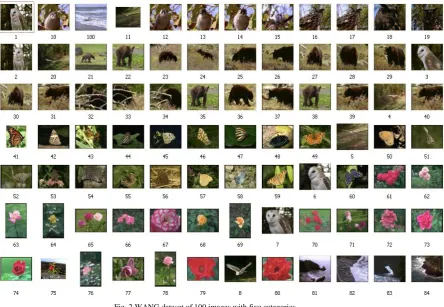
Fig. 2 WANG dataset of 100 images with five categories The query images details used for experimentation are illustrated in Table 1.
TABLEI
DESCRIPTION OF DIFFERENT SAMPLE QUERY IMAGES USED Sr. No. Image title Category Dimensions in pixels
1. 49.jpg Butterfly 128 x 96
2. 94.jpg Beach 128 x 96
3. 12.jpg Bird 128 x 96
4. 71.jpg Flower 128 x 96
5. 35.jpg Animal 128 x 96
Fig. 4 Query image loaded after click on Load Query Image button in GUI
Fig. 5 Wavelet features decomposing image upto level 3
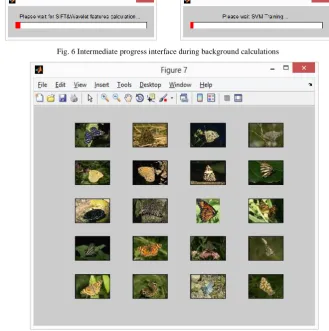
Fig. 6 Intermediate progress interface during background calculations
percent along with SIFT keypoint extracted for relevant image of category by the proposed system. TABLEIII
For Image 49.jpg category - butterfly For Image 94.jpg category - Beach RETRIVED
IMAGES FROM DATASET
KEYPOINTS
FOUND MATCHES
MATCH %
RETRIVED IMAGE
FROM DATASET
KEYPOINTS
FOUND MATCHES
MATCH %
49 96 52 100.00 94 131 94 100.00
51 22 27 51.92 96 108 41 43.62
53 152 24 46.15 89 24 37 39.36
44 75 19 36.54 98 84 31 32.98
50 81 18 34.62 84 95 30 31.91
55 80 18 34.62 86 100 30 31.91
57 185 18 34.62 91 73 30 31.91
59 121 18 34.62 95 153 30 31.91
60 152 18 34.62 93 71 27 28.72
45 79 17 32.69 83 50 26 27.66
48 116 17 32.69 85 110 26 27.66
43 122 16 30.77 87 62 26 27.66
58 139 16 30.77 90 54 26 27.66
42 46 15 28.85 97 98 26 27.66
56 191 14 26.92 100 99 26 27.66
47 63 13 25.00 99 53 25 26.60
52 56 13 25.00 81 63 23 24.47
54 104 13 25.00 82 113 23 24.47
46 84 11 21.15 92 71 23 24.47
41 147 9 17.31 88 45 22 23.40
For performance measurement precision and recall is used, which is calculated using formulas illustrated as below and table 3 shows results of values of precision and recall. Precision is defined as the fraction of retrieved images which is relevant to a query. In contrast, recall measures the fraction of the relevant images which has been retrieved.
Precision=
Recall=
Sr. No. Category Query Image no. Precision Recall
1. Butterfly 49 0.9 0.9
2. Beach 94 0.8 0.8
ACKNOWLEDGEMENT
We would like to articulate our profound gratitude and indebtedness to those persons who helped us in completion of the paper. First and foremost, we would like to convey our gratefulness our Principal Dr. R. P. Singh for his continuing support. We would like to dedicate this work our parents and would like to thank all the staff members from Department of Computer Science and Engineering, SSGBCOET Bhusawal Maharashtra. Also our special thanks to all the writers of reference paper that are referred by us.
R
EFERENCES
[1] A. Ramesh Kumar, D. Saravanan, “Content Based Image Retrieval Using Color Histogram” (IJCSIT) International Journal of Computer Science and Information Technologies, Vol. 4 (2), 2013, 242 – 245 [2] Smeulders, A. W. M., Worring, M., Santini, S., Gupta, A., and Jain, R., “Content-Based Image Retrieval
at the End of the Early Years”, IEEE Trans. on Pattern Analysis and Machine Intelligence, vol. 22, pp.1349-1380, 2000.
[3] D.Saravanan, Dr.S.Srinivasan “Video Image Retrieval Using Data Mining Techniques “JCA, Volume V, Issue 1, 2012.
[4] D.Saravanan, Dr.S.Srinivasan “Video Image Retrieval Using Data Mining Techniques “JCA, Volume V, Issue 1, 2012.
[5] A. Pentland, R.W. Picard, and S. Sclaroff, “Photobook: Content- Based Manipulation for Image Databases,” Int’l J. Computer Vision, vol. 18, no. 3, pp. 233-254, 1996.
[6] D. Saravanan, Dr. S. Srinivasan, “Data Mining Framework for video Data”, RSTCC 2010, Pages 167-17, Nov 2010.
[7] Pragati Ashok Deole, Rushi Longadge, “Content Based Image Retrieval using Color Feature Extraction with KNN Classification” International Journal of Computer Science and Mobile Computing, Vol.3 Issue.5, May- 2014, pg. 1274-1280
[8] T. Dharani, I. Laurence Aroquiaraj, “A Survey on Content Based Image Retrieval,” IEEE-2013 International Conference on Pattern Recognition, Informatics and Mobile Engineering (PRIME), PRIME 2013, 978-1-4673-5845-3/13/2013.
[9] Gang Hou, Qinghe Feng, Xiaoxue Zhang, Jun Kong and Ming Zhang, “Content-Based Image Retrieval Using Texture Structure Histogram”, Atlantis Press, pp. 1356-1363.
[10] Liu G H, Yang J Y. Content-based image retrieval using color difference histogram [J]. Pattern Recognition, 2013, 46(1): 188-198.
[11] R.C. Gonzalez, R.E. Woods, Digital Image Processing, third ed. , Prentice Hall, 2007.
[12] J. Huang, S.R. Kumar, M. Mitra, et al., Image indexing using color correlograms, in: IEEE Conference on Computer Vision and Pattern Recognition, 1997, pp. 762–768.
[13] Ray-I Chang, Shu-Yu Lin, Jan-Ming Ho, Chi-Wen Fann and Yu-Chun Wang, “A Novel Content Based Image Retrieval System using K-means/KNN with Feature Extraction”, ComSIS Vol. 9, No. 4, Special Issue, December 2012, DOI: 10.2298/CSIS120122047C, pp. 1645-1661
[14] Kato, T. Database architecture for content-based image retrieval. Image Storage and Retrieval Systems, 112–123. (1999)
[15] Datta, R., Joshi, D., Li, J., Wang, J. Z.: Image Retrieval: Ideas, Influences, and Trends of the New Age. ACM Computing Surveys, Vol. 40, No. 2, Article 5, April. (2008)
[16] Rui, Y., Huang, T.S., Chang, S. F.: Image Retrieval: Current Techniques, Promising Directions and Open Issues. Journal of Visual Communication and Image Representation, Transaction on Systems, Man, and Cybernetics, vol. 8, 460–472. (1999)
[17] Eakins, John; Graham, Margaret. "Content-based Image Retrieval". University of Northumbria at Newcastle. Retrieved 2014-03-10.
[18] D.G. Lowe, “Distinctive image features from scale-invariant keypoints,” Int. J. Comput. Vision 60 (2), pp. 91–110, 2004.
[19] http://wang.ist.psu.edu/docs/related.shtml. Available on line.