Diffie-Hellman Problem
Fangguo Zhang1,2
1
School of Information Science and Technology, Sun Yat-sen University
2
Guangdong Provincial Key Laboratory of Information Security, Guangzhou 510006, China
Abstract. The Diffie-Hellman problem as a cryptographic primitive plays an
important role in modern cryptology. The Bit Security or Hard-Core Bits of Diffie-Hellman problem in arbitrary finite cyclic group is a long-standing open problem in cryptography. Until now, only few groups have been studied. Hy-perelliptic curve cryptography is an alternative to elliptic curve cryptography. Due to the recent cryptanalytic results that the best known algorithms to at-tack hyperelliptic curve cryptosystems of genusg <3 are the generic methods and the recent implementation results that hyperelliptic curve cryptography in genus 2 has the potential to be competitive with its elliptic curve cryptography counterpart. In this paper, we generalize Boneh and Shparlinksi’s method and result about elliptic curve to the case of Jacobians of hyperelliptic curves. We prove that the least significant bit of each coordinate of hyperelliptic curves Diffie-Hellman secret value in genus 2 is hard as the entire Diffie-Hellman value, and then we also show that any bit is hard as the entire Diffie-Hellman val-ue. Finally, we extend our techniques and results to hyperelliptic curves of any genus.
Keywords: Hyperelliptic curves, Bit Security, Diffie-Hellman Problem.
1 Introduction
The discrete logarithm problem(DLP) and Diffie-Hellman problem(DHP) are basic cryptographic primitives, they play important role in modern cryptology. For example the Diffie-Hellman key exchange [16], the ElGamal encryption [18], the official U.S. Digital Signature Algorithm (DSA) [19], and the BLS short signature scheme [10], etc. Due to Pohlig and Hellman attack [39], it is restricted to groups of prime orderpin this paper, where the DLP is the problem to computex∈Z∗p given (g, gx), and the DHP or computational Diffie-Hellman
reduces the computation of DLP inGto the computation of CDHP in Gif we are able to find an elliptic curve, called auxiliary elliptic curve, over Fp with
smooth order.
From many cryptographic applications, we know it is very important that partial information of the secret key is not computable or predictable with any significant advantage over a random guess. This is related to Bit Security or Hard-Core Bits problem. Informally speaking, the Bit Security or Hard-Core Bits for DLP can be described as follows: given (g, gx), if an adversary can compute certain bits(or more generally, certain predicates) of x? Blum and Micali[6] introduced the concept of hard-core bits for one-way functions and showed the existence of a hard-core predicate for the discrete logarithm function in any group G.
However, for the case of the DHP there is no such result has been proven. Informally speaking, the Bit Security or Hard-Core Bits for DHP or CDHP can be described as follows: given (g, ga, gb), if an adversary can compute certain bits(or more generally, certain predicates) of K =gab? In another word, if the hardness of CDH bits and the entire CDH is same? This is a long-standing open problem in cryptography. Until now, only few groups have been studied: Boneh and Venkatesan [9] formulated the hidden number problem (HNP) and showed that in the multiplicative group of finite field Fp computing
approxi-mately (logp)1/2of the bits of the Diffie-Hellman secret is as hard as computing the entire secret. This result is improved in [25] and [7]. Boneh and Shparlinksi in [8] achieved a breakthrough for the elliptic curve Diffie-Hellman problem(i.e., the CDH problem defined over the group of points of an elliptic curve). By using certain twists of the given curve they showed that predicting the least signif-icant bit of the elliptic curve Diffie-Hellman secret in a family of curves is as hard as computing the entire secret. Alternatively, if one looks for a polynomial time reduction of the DHP to the problem of predicting partial information on the same short Weierstrass model, some results have been established using Gr¨obner bases[29]. Fazio et al. modified Boneh and Shparlinski’s idea and ap-plied it to the case of finite fieldsFp2, they proved the unpredictability of every
single bit of one of the coordinates of the secret Diffie-Hellman value over finite fieldsFp2. Wang, Zhan and Zhang [40] generalised this work to extension
field-s Fpm, where m is polynomial in logp. Li, N¨aslund and Shparlinski [34] have
studied the bit security of CDHP in LUC and XTR. Galbraith, Hopkins and Shparlinski [22] have studied the bit security of bilinear Diffie-Hellman problem in blinear pairing group. About the DHP and its bit security, the Chapter 21 in Galbraith’s book[21] is a good reference.
considered for cryptographic applications. The main advantage of genus gover elliptic curve(genus 1) is that a much smaller base field(about g times fewer bits) with same security level. However, for large genus there are subexponen-tial time attacks on the DLP[1]. For genus 2 curves, just as with their elliptic curve counterpart, the best known algorithms to solve the discrete logarithm in such groups are the generic attacks such as Pollard rho mehtod[24]. The prac-tical potential of genus 2 curves in public-key cryptography has recently been highlighted by the fast performance numbers presented. Especially, Gaudry[23] showed that scalar multiplication on the Kummer surface associated with the Jacobian of a genus 2 curve can be more efficient than scalar multiplication on the Jacobian itself. After that, many papers[5, 11] showed that hyperelliptic curve cryptography in genus 2 has the potential to be competitive with its genus 1 elliptic curve cryptography counterpart.
Our Contributions. In this paper, we study the bit security of CDHP in Jacobian group of hyperelliptic curves. The contribution of the paper is as the following.
1. We firstly generalize Boneh and Shparlinksi’s method to the case of Jaco-bians for genus 2 hyperelliptic curves. We prove that the least significant bit of any coordinate of hyperelliptic Diffie-Hellman value with genus 2 over finite fields is unpredictable.
2. We extend the least significant bit to very bit case, show that for genus 2 hyperelliptic curves, to compute any bit of any coordinate of Diffie-Hellman value is hard as for computing the entire Diffie-Hellman value.
3. We also generalize these results from genus 2 hyperelliptic curves to any genus hyperelliptic curves.
2 Mathematical Preliminaries
2.1 Hyperelliptic Curves and Hyperelliptic Curve Diffie-Hellman Problem
We first introduce the definition and operations of hyperelliptic curves over finite field, more details can be found in references[4, 21]. LetKbe the algebraic closure of the fieldK.A hyperelliptic curveCof genusg≥1 over Kis given by
C:y2+h(x)y =f(x) (1)
where f(x) is a monic polynomial of degree 2g + 1, h(x) is a polynomial of degree at most g, and there are no solutions (x, y) ∈ K×K simultaneously satisfying the equation (1) and the partial derivative equations 2y+h(x) = 0 and h′(x)y−f′(x) = 0. LetP = (x, y) be a finite point on hyperelliptic curve C, the opposite of P is defined as −P = (x,−y−h(x)).
A divisor onC is a finite formal sumD=ΣPmPP , wheremP are integers
that are 0 for almost all P. The degree ofDis defined by degD=ΣPmP. The
set of all the divisors defined over K forms an abelian group with the set of divisors of degree 0 as its subgroup, that isDiv0
C ⊂DivC. The function field of
C over K, denoted K(C), is the field of fraction of the polynomail ringK[C] =
K[x, y]/(y2+h(x)y−f(x)). To every rational functionF ∈K(C), it can associate a divisor via the valuations at all points of the curve:div(F) =ΣP∈C(K)vP(F)P.
These so called principal divisors are of degree zero and form a subgroup of Div0C. We denote the group of principal divisors as P rincC. The Jacobian or
the divisor class group of the curve C is given by JC =DivC0/P rincC.
From the work of Cantor[12] and Koblitz[32], the element D = ΣmiPi −
(Σmi)P∞ (here Σmi ≤ g, Pi = (xi, yi), P∞ is the point at infinity) of JC
has a Mumford representation, D can be only determined by two polynomails u and v in K[x] , where u(x) = Π(x −xi)mi, and u, v satisfy: 1) deg v <
deg u ≤g; 2) v(xi) = yi, for all the ithat made mi 6= 0; 3) v2+vh−f ≡ 0
(modu). In general we writeD= (u(x), v(x)), it can be represented by 2g-tuple (ug−1, ..., u1, u0, vg−1, ..., v1, v0).
We will focus on the most cryptographically common case of genus 2 curves, where C is an imaginary hyperelliptic curve over a large prime field Fp. A
hyperelliptic curve C over Fp with genus 2 is defined by
C: y2 =x5+f3x3+f2x2+f1x+f0 (2)
In this case, any element D = (u(x), v(x)) of the Jacobian group JC(Fp) will
satisfy: u(x) is monic, deg v <deg u≤2 and ui|vi2−f. When degu= 0, this
general case isD= (u(x), v(x)) = (x2+u
1x+u0, v1x+v0), we call the element
with this form a general element. When we randomly choose an elementDfrom JC(Fp), D is a general element with the probability about 1−1p. We also use
(u1, u0, v1, v0) to represent a general element D= (u(x), v(x)).
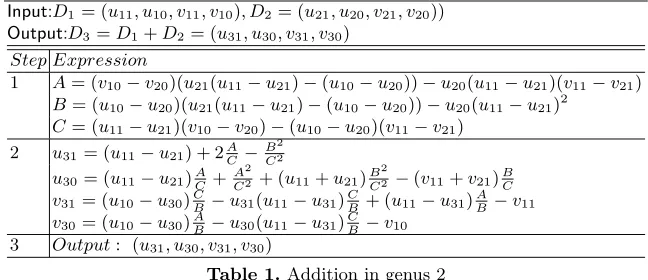
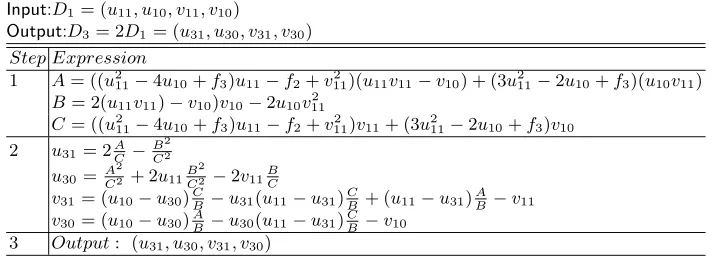
Cantor’s algorithm can perform addition and doubling operations in Jaco-bian group. In this paper, we will need the explicit formulas for the group oper-ations. Harley[26] optimized Cantor’s algorithm and obtained the first practical explicit formulas in genus 2, and then Lange [33] extended it and got signifi-cant improvements. The formulas were subsequently improved by Costello and Lauter[13] through a more direct geometric interpretation of the group law. Diao and Joye[17] presented efficient unified addition formule for hyperellip-tic curve cryptography. Very recently, Hisil and Costello[28] combines several techniques to arrive at explicit formulas in Jacobian coordinates that are sig-nificantly faster than those in previous works. For the genus 2 curves over large prime field Fp, let D1 = (u11, u10, v11, v10) andD2 = (u21, u20, v21, v20) be two
general elements of the Jacobian group. Table 1 and 2 in Appendix A are the explicit affine formulas for general point addition and general point doubling which derived from the results in [13, 28].
LetD∈JC(Fp) be an element of prime orderq. The DLP inJC(Fp) is: given
another element D′ ∈< D >, to determine the integer m such that D′ =mD. We define the hyperelliptic curve Diffie-Hellman function as
DHJ,D(aD, bD) =abD
wherea, bare inFq. The hyperelliptic curve DHP is to computeDHJ,D(D1, D2)
given (C, JC(Fp), D, D1, D2).
2.2 Twisting Hyperelliptic Curves
Let C be a curve with genus g defined over a field K. A curve C′ defined over
Kthat is isomorphic to C over K, is called a twist of C.
For a hyperelliptic curveC of genus 2 over Fp given by the equation
C: y2 =x5+f3x3+f2x2+f1x+f0
For anyλ∈F∗p, we defineφλ(C) to be a twist of C:
φλ(C) : y2 =x5+λ4f3x3+λ6f2x2+λ8f1x+λ10f0
For any point P = (x, y)∈C,φλ(P) = (λ2x, λ5y)∈φλ(C). This curve
isomor-phism can endow an isomorisomor-phism between JC(Fp) and Jφλ(C)(Fp), we denote
The explicit formulas forφ∗
λ is:
φ∗λ :JC(Fp)→Jφλ(C)(Fp)
O(=P∞−P∞)→O′(=P∞′ −P∞′ )
(x1, y1)→(λ2x1, λ5y1)
(u1, u0, v1, v0)→(λ2u1, λ4u0, λ3v1, λ5v0)
Therefore, we have
DHφ∗
λ(J),φ∗λ(D)(φ
∗
λ(D1), φ∗λ(D2)) =φ∗λ(DHJ,D(D1, D2)).
In this paper, we are working with the family of curves {φλ(C)}λ∈F∗
p and
their Jacobians {Jφλ(C)(Fp)}λ∈F∗
p associated with a given curve C and its
Ja-cobiansJC(Fp). Hence, if the hyperelliptic DHP is hard to compute in JC(Fp),
then it is also hard to compute for all{Jφλ(C)(Fp)}λ∈F∗
p.
2.3 HNP-CM Problem and HNP-CMd
Problems
The Hidden Number Problem with Chosen Multiplier(HNP-CM) is a variant of the Hidden Number Problem(HNP) which proposed by Boneh and Shparlin-ski[8].
We denote by LSB(z) the least significant bit of an integer z >0.
Definition 1 (HNP-CM[8]). Fix an ε >0. Let p be a prime. For an α∈Fp
let L:Fp∗ → {0,1} be a function satisfying
Prt∈Fp∗[L(t) =LSB(α·t mod p)]≥
1 2+ǫ
The HNP-CM problem is: given an oracle for L(t), find α in polynomial time. For smallǫthere might be multipleαsatisfying the above condition. In this case the list-HNP-CM problem is to find the list of all such α ∈Fp∗. Due to Alexi, Chor, Goldreich and Schnorr[1], there is an algorithm to solve the list-HNP-CM for any ǫ >0.
Theorem 1. [8] Letp be a n−bit prime and let ǫ >0. Then, given ǫ, the list HNP-CM problem can be solved in expected polynomial time in nand 1/ǫ.
Informally speaking, suppose one has an oracleAsuch thatA(t) = LSB(α·t mod p), then one can compute α usingO(log2(p)) oracle queries.
The HNP-CMd problem is a variant of HNP-CM problem, it is defined as
Definition 2 (HNP-CMd[8]). Fix anε >0. Letp be a prime. For anα∈F p
let L:Fp∗ → {0,1} be a function satisfying
Prt∈Fp∗[L
d(t) =LSB(td·α mod p)]≥ 1
2 +ǫ
The HNP-CMdproblem is: given an oracle forLd(t), findα in polynomial time. For smallǫthere might be multiple α satisfying the condition. In this case the list-HNP-CMd problem is to find all such α ∈ F∗
p. We will use it for d = 2,
d = 3, d= 4 and d = 5 in this paper. About the HNP-CMd problem, Boneh
and Shparlinski gave the following theorem:
Theorem 2. [8] Fix an integer d >1. Let p be a n− bit prime and let ǫ > 0. Then, givenǫ, the HNP-CMdproblem can be solved in expected polynomial time in logp and d/ǫ.
3 Our Results for Least Significant Bit
For any general element D= (u1, u0, v1, v0) ofJC(Fp), we use u1(D) to denote
theu1−coordinate ofD, similarly foru0(D),v1(D) andv0(D). The main result
for the least significant bit of hyperelliptic curve DHP is the following theorem.
Theorem 3. Let p be a prime, and let C be a hyperelliptic curve with genus 2 overFp. LetD∈JC(Fp)be an element of prime order. Given(C, JC(Fp), D, aD, bD),
if there is an efficient algorithm for predicting the least significant bit of any coordinate of abD, then there is an efficient algorithm for computing the DHP on JC(Fp).
Let Au1(C, JC(Fp), D, aD, bD) be an oracle that returns LSB(u1(abD)) where
D∈JC(Fp). Similarly, let Au0(C, JC(Fp), D, aD, bD) be an oracle that returns
LSB(u0(abD)),Av1(C, JC(Fp),D, aD, bD) returns LSB(v1(abD)) andAv0(C, JC(Fp),
D, aD, bD) returns LSB(v0(abD)), respectively. To prove the above theorem, we
need the following lemma.
Lemma 1. Given (C, JC(Fp), D, aD, bD), to compute any one coordinate of
abD is hard as the entire abD.
Proof. Let aD = (ua,1, ua,0, va,1, va,0) , bD = (ub,1, ub,0, vb,1, vb,0) and j(aD) =
(uja,1, uja,0, vja,1, vja,0). Assume thatabD= (uab,1, uab,0, vab,1, vab,0).
Now, we prove that computingu1−coordinate of abD is hard as the entire
Assume that there is an oracle B that given (C, JC(Fp), D, aD, bD) and
returns u1(abD), that is
B(C, JC(Fp), D, aD, bD) =u1(abD) =uab,1.
We rewrite abD = (uab,1,uab,0,vab,1,vab,0), and by the oracle B, uab,1 is al-ready known. Now we show how to find out uab,0,vab,1 and vab,0, therefore the entireabD.
From the Mumford representation of the element in Jacobian group of hy-perelliptic curve with genus 2, forabD= (uab,1, uab,0, vab,1, vab,0) = (x2+uab,1x+
uab,0, vab,1x+vab,0), we have
(vab,1x+vab,0)2−(x5+f3x3+f2x2+f1x+f0)≡0 mod (x2+uab,1x+uab,0).
Replacing x2 with−(uab,1x+uab,0) on the left side,
(vab,1x+vab,0)2−(uab,1x+uab,0)2x+f3(uab,1x+uab,0)x+f2(uab,1x+uab,0)−f1x−f0 = 0.
Comparing the coefficients of xi fori= 1 and 0, we get the following equations
about uab,0,vab,1,vab,0.
vab,02−v 2
ab,1uab,0+ 2uab,1u 2
ab,0+ (f2−uab,1f3−u3ab,1)uab,0−f0 = 0 (3)
2vab,0vab,1−u 2
ab,0−uab,1v
2
ab,1+(f3+3u2ab,1)uab,0+f2uab,1−f3u2ab,1−u4ab,1−f1 = 0 (4) We now callB one more time as follows:
B(C, JC(Fp), D, aD, bD+D) =u1(abD+aD) =uab+a,1
From the explicit formula of general point addition in Jacobian group of hyperelliptic curve with genus 2, we know that uab+a,1 is also a function about uab,0,vab,1,vab,0:
uab+a,1 =uab,1−ua,1
+2(vab,0−va,0)(ua,1(uab,1−ua,1)−(uab,0−ua,0))−ua,0(uab,1−ua,1)(vab,1−va,1) (uab,1−ua,1)(vab,0−va,0)−(uab,0−ua,0)(vab,1−va,1)
−((uab,0−ua,0)(ua,1(uab,1−ua,1)−(uab,0−ua,0))−ua,0(uab,1−ua,1)2)2 ((uab,1−ua,1)(vab,0−va,0)−(uab,0−ua,0)(vab,1−va,1))2
This is:
((uab,1−ua,1)(vab,0−va,0)−(uab,0−ua,0)(vab,1−va,1))2(uab+a,1−uab,1+ua,1)
The equations (3), (4) and (5) form a 3-variates polynomial system. This multivariate polynomial system has total degree 3×2×4 = 24. So, due to the B´ezou Theorem, the number of the solution does not exceed 24. We solve this 3-variates polynomial system and obtain uab,0, vab,1, vab,0 of abD, so the entire
abD.
A detailed Magma[35] implementation for such 3-variates polynomial system according to a genus 2 curve over GF(2127−1) which used in [11] is provided
in Appendix B.
According to our experiments, most cases we can obtain one solution, there-fore the entireabD is obtained. However, sometimes, this 3-variates polynomial system will output more than one solutions. In this case, we can find the correct solution for abD up to at most 24 times testings. In order to avoid these test-ing operations, we can construct an over-defined systems to obtain the unique solution. To do this, we can call B more times
B(C, JC(Fp), D, aD, bD+jD) =u1(abD+jaD) =uab+ja,1,forj=2 to t,
and construct an over-defined systems of multivariate polynomial equations about uab,0,vab,1,vab,0. The number of solutions of an over-defined system will be generally one. Using Courtois et al.’s [14] algorithm, we can efficiently solve this over-defined systems of multivariate polynomial equations and obtain
uab,0, vab,1, vab,0 ofabD.
Before proving the Theorem 3, we can consider a special case of this theorem: p= 2 mod 3. In such case, we have a very simple proof for Theorem 3.
Theorem 4. Suppose p= 2 mod 3. Then the hardness of the least significant bit of any coordinate of abD which given(C, JC(Fp), D, aD, bD) is same as the
entire abD.
Proof. Firstly, we prove that “Predicting LSB(v1(abD)) is hard as v1(abD)”.
Assume that there is an efficient algorithm Av1 for predicting the the least
significant bit of v1−coordinate ofabD, i.e., given (C, JC(Fp), D, aD, bD), Av1(C, JC(Fp), D, aD, bD) = LSB(v1(abD)).
Now, we choose a random numberλ∈F∗p and call the oracle Av1(φλ(C), φ∗λ(JC(Fp)), φ∗λ(D), φ∗λ(aD), φ∗λ(bD))
to get LSB(v1(φ∗λ(abD))) = LSB(λ3v1(abD)). Since gcd(3, p−1) = 1 it follows
andα=v1(abD)). So, in this case, we can getv1from LSB(v1) using the solving
algorithm of HNP-CM.
Then combining this with Lemma 1, we can get the entireabD. So Theorem
4 is proved.
For the general case, similar to Boneh and Shparlinski ’s[8] approach on ellip-tic curve case, we will use the method of Alexi, Chor, Goldreich and Schnorr[3] to deal with it. When λ2, λ3,λ4and λ5 are all not permutation of F∗p, we can
not get vi from LSB(vi) or ui from LSB(ui) using HNP-CM directly. We may
only use someδ−fraction of theλ∈F∗p. Therefore, to prove the Theorem 1, we
will also use the following lemma.
Lemma 2. Letǫ, δ∈(0,1). Letpbe a prime, and letCbe a hyperelliptic curve with genus 2 over Fp. Let D∈JC(Fp)be an element of prime order n. Suppose
there is a t−time algorithm Au1 such that
|P rλ[Au1(φλ(C), Jφλ(C)(Fp), φλ(D), φλ(aD), φλ(bD)) =LSB(λ2u1(abD))]−
1 2|> ǫ
for at least a δ−fraction of the λ∈F∗p.
Then there is an algorithmB for all λ∈F∗p satisfying
P rλ[B(φλ(C), Jφλ(C)(Fp), φλ(D), φλ(aD), φλ(bD)) =LSB(λ2u1(abD))]>
1 2+
ǫδ 8
is true with probability at least ǫδ8 over the choice of a, b in [1, n−1].
Proof. This lemma is the hyperelliptic curve with genus 2 case of Lemma 1 and Lemma 2 in Boneh and Shparlinski ’s[8] paper. Here we will give a sketch of the proof which mostly same as Boneh and Shparlinski ’s proof. For more details to see Boneh and Shparlinski ’s[8] original proof.
According to Boneh and Shparlinski ’s proof, the algorithmB can be con-structed as follows:
Input:C, JC(Fp), D, D1, D2.
Output:Au1(C, JC(Fp), D, D1, D2).
1. Picku= (4/ǫδ)3 random pairsa, bfrom [1, n−1] and runAu1 on all tuples < C, JC(Fp), D, aD, bD >;
2. Letv be the number of runs in whichAu1 correctly outputs LSB(u1(abD));
3. Ifv > u/2 then Boutputs Au1(C, JC(Fp), D, D1, D2);
As same as Boneh and Shparlinski ’s[8] discussion, for at least δ−fraction of the λ∈Fp∗, we have
P ra,b[B(φλ(C), Jφλ(C)(Fp), φλ(D), φλ(aD), φλ(bD)) = LSB(λ2u1(abD))]>
1 2+
ǫ 2
and for the remaining λ∈Fp∗, we have:
P ra,b[B(φλ(C), Jφλ(C)(Fp), φλ(D), φλ(aD), φλ(bD)) = LSB(λ2u1(abD))]> 1
2− ǫδ
4
Then using a standard counting argument, we have
P rλ[B(φλ(C), Jφλ(C)(Fp), φλ(D), φλ(aD), φλ(bD)) = LSB(λ2u1(abD))]>
1 2+
ǫδ 8
is true with probability at least ǫδ8 over the choice of a, b in [1, n−1] for all λ∈F∗p.
Now, we give the proof of Theorem 3.
The proof of Theorem 3:Letpbe a prime, and letCbe a hyperelliptic curve with genus 2 over Fp. Let D∈JC(Fp) be an element of prime order. Suppose
there is an efficient algorithm A for predicting the LSB of any coordinate of abDgiven (C, JC(Fp), D, aD, bD), formally, we assume that there is an expected
t−time algorithm Asuch that
|P rλ[Au1(φλ(C), Jφλ(C)(Fp), φλ(D), φλ(aD), φλ(bD)) = LSB(λ2u1(abD))]−
1 2|> ǫ
for at least aδ−fraction of theλ∈F∗p.
To use the above Lemma 2, we first randomize the hyperelliptic curve DHP (C, JC(Fp), D, aD, bD) by computing D′ = a0aD and D′′ = b0bD for random
a0, b0 ∈[1, n−1]. Then applying Lemma 2, there is an algorithmBfor allλ∈F∗p
satisfying
P rλ[B(φλ(C), Jφλ(C)(Fp), φλ(D), φλ(D′), φλ(D′′)) = LSB(λ2u1(a0b0abD))]>
1 2+
ǫδ 8
is true with probability at least ǫδ8 over the choice ofa0, b0 in [1, n−1].
Define
From the knowledge of probability theory, when we repeat choosing a0, b0
in [1, n−1] randomly ⌈ǫδ8⌉ times, then there is at least one time we have
P rλ[L2(λ) = LSB(λ2u1(a0b0abD))]>
1 2 +
ǫδ 8
with probability 1− (1 − ǫδ8)⌈ǫδ8⌉. This is an HN P − CM2 problem where
u1(a0b0abD) is the hidden number. Therefore, we can use the solving algorithm
of Theorem 2 for all⌈ǫδ8⌉cases to find a list of candidates{(ai, bi), u1(aibiabD)}
forifrom 1 to ⌈ǫδ8⌉.
For any candidates, applying Lemma 1, we can get a candidate valueaibiabD.
There is at least one correct aibiabD with probability 1−(1−ǫδ8)⌈ 8
ǫδ⌉, and then
using ((aibi)−1 mod n)aibiabD, we obtain the entireabD.
4 Extention to Any Bit
For anyz=Pni=0zi2i,biti(z) denotes thei−th bit of the binary representation
of z, so LSB(z) =bit0(z). In this section, we will show that if the hyperelliptic
curve Diffie-hellman problem is hard, then not only the least significant bit, but also every bit (i.e.,biti(z)) of the hyperelliptic curve Diffie-hellman value is
unpredictable.
We have two approaches to achieve this goal.
One approachis from LSB-HNP-CM tobiti-HNP-CM. As generalized by
J.H ˙astad, M. N¨aslund [27] and E. Kiltz[31], HNP-CM can also be defined for every bit of z, and the related theorems also hold, i.e., Fix an ε > 0. Let p be a prime. For an α∈Fp let L:Fp∗ → {0,1} be a function satisfying
Prt∈Fp∗[L(t) =biti(α·t mod p)]≥
1 2+ǫ
Thebiti-NH problem is: given an oracle forL(t), findα in polynomial time. As
claimed in Theorem 5 of [31], for all odd primesp, thebiti-HNP-CM is efficently
solvable for all bits. Therefore, similar to the discussion for LSB case, it is not hard to extend the results of LSB to the case of any i−th bit.
Cf: Accessibility, Concentration and Recoverability, then using Lemma
1 and Theorem 6 of [2], it can be proved that the predicate is hard-core. Following Akavia et al.’s framework, we can generalize the result of Fazio et al. in [20] for every bit of the elliptic curve DHP is hard-core to hyperelliptic curve DHP as follows:
Letp be a prime, and let C be a hyperelliptic curve with genus 2 over Fp.
Let D ∈ JC(Fp) be an element of prime order. The Q = abD is the
Diffie-Hellman secret value of (C, JC(Fp), D, aD, bD). For any λ∈ F∗p, φλ(C) is the
twist of C, Jφλ(C)(Fp) = φ∗λ(JC(Fp)). Let biti :Fp → {0,1} denote the i−th
bit predicate(In [20], they use {±1}, it is just the convention that a 0 bit is encoded as−1).
Consider the codeword:
CQ:Fp → {0,1} defined as CQ(λ) =biti(λu1(Q)).
Similar to the proof in [20] for elliptic curve case, it can be proven that the codeword CQ satisfies the properties of Accessibility, Concentration and Recoverability. Using Theorem 6 and the learning algorithm of [2] , it can be proved that this predicate is hard-core. For more detail, refer to [2] and [20] .
From above discussion, we give the following claim without proof:
Claim 1. Let p be a prime, and let C be a hyperelliptic curve with genus 2 over Fp. Let D ∈ JC(Fp) be an element of prime order. If there is an
ef-ficient algorithm for predicting the any bit of any coordinate of abD given (C, JC(Fp), D, aD, bD), then there is an efficient algorithm for computing the
DHP on JC(Fp).
5 Generalization to General Hyperelliptic Curves
Let C : y2 +h(x)y = f(x) be a hyperelliptic curve of genus g ≥ 1 over
Fq, J(C;Fq) be the Jacobian of C defined over Fq. Let D = (ug−1, ..., u1, u0,
vg−1, ..., v1, v0) be an element ofJ(C;Fq) with ordern. Costello and Lauter[13]
gave an explicit formulas for addition and doubling for any genus hyperelliptic Jacobian group. So, we can define the hyperelliptic DHP on any genus hyper-elliptic Jacobian group as same as genus 2 case: given C, JC(Fp), D, aD, bD, to
compute abD.
For a hyperelliptic curve with genus g over Fp(Similar discussion can be
applied to non-prime fields),
C : y2 =x2g+1+f2g−1x2g−1+f2g−2x2g−2+· · ·+f1x+f0
LetC′ be another hyperelliptic curves with genus g over F
p with equation:
We say that C is isomorphic to C′ if there exists λ ∈ F
p such that fi′ =
λ4g+2−2ifi mod p. The isomorphisms that preserve hyperelliptic curves given
by above equations are all of the form (x, y)→(λ2x, λ2g+1y) for some λ∈F∗p.
We defineφλ : (x, y) →(λ2x, λ2g+1y), thenC′ =φλ(C) is a twist of C. This
curves isomorphism can reduce an isomorphism betweenJC(Fp) andJC′(Fp), we denote this group isomorphism asφ∗λ :JC(Fp)→Jφλ(C)(Fp). Now, we can define
the explicit formulas forφ∗
λ as follows:φ∗λ(O) =O′,φ∗λ(x1, y1) = (λ2x1, λ2g+1y1),
φ∗λ(u(x), v(x)) =φ∗λ(ug−1, ..., u1, u0, vg−1, ..., v1, v0)
=φ∗λ(P1+P2+...+Pg−gP∞) (here Pi = (xi, yi), v(xi) =yi)
=φ∗λ((x1, y1) + (x2, y2) +...+ (xg, yg)−gP∞)
= (λ2x1, λ2g+1y1) + (λ2x2, λ2g+1y2) +...+ (λ2xg, λ2g+1yg)−gP∞′ )
= (
g
Y
i=1
(x−λ2xi), v′g−1xg−1+...+v′1x+v0′)
(here v′(λ2xi) =λ2g+1yi)
= (λ2ug−1, ..., λ2(g−1)u1, λ2gu0, λ3vg−1, ..., λ2g−1v1, λ2g+1v0)
Therefore, we have DHφ∗
λ(J),φ∗λ(D)(φ
∗
λ(D1), φ∗λ(D2)) = φ∗λ(DHJ,D(D1, D2)).
So if the hyperelliptic DHP is hard to compute in JC(Fp), then it is also hard
to compute for all {Jφλ(C)(Fp)}λ∈F∗
p. Similar to the case of g = 2, we can use
HNP-CMdto study the bit security of hyperelliptic curve DHP with any genus.
From above discussion, we give the following claim without proof:
Claim 2.Letp be a prime, and letC be a hyperelliptic curve with genusgover
Fp. LetD∈JC(Fp)be an element of prime order. Given(C, JC(Fp), D, aD, bD),
if there is an efficient algorithm for predicting any one bit of any coordinate of abD, then there is an efficient algorithm for computing the DHP on JC(Fp).
6 Conclusions and Further Works
There are some further works at this topic. Similar to elliptic curve case, we can also define a function whose domain is a subgroup of JC(Fp), such
as hyperelliptic pairing. When we consider the one-way function defined over the Jacobian of hyperelliptic curve, we call such function “hypereelliptic curve based one-way function”, following the approach of Duc and Jetchev[17] for elliptic curve case, it seems that all the bits of hyperelliptic curve based one way functions are hard to compute too.
Jetchev and Venkatesan[30] studied the bits security of elliptic curve Diffie-Hellman secret keys using elliptic curves isogeny theory. The hyperelliptic Ja-cobians also have explicit isogenies, there are some research work on them. An natural question is if we can study the bits security of hyperelliptic curve Diffie-Hellman secret keys using hyperelliptic curves isogeny theory. It seems this can also be done.
Acknowledgements
This work is supported by the National Natural Science Foundation of China (No. 61379154 and U1135001). Part of this work was done during the author was visiting the UbiSeC lab at University at Buffalo, State University of New York.
References
1. L. Adleman, J. De Marrais, M.-D Huang,A Subexponential Algorithm for Discrete Loga-rithms over the Rational Subgroup of the Jacobians of Large Genus Hyperelliptic Curves over Finite Fields, in ANTS-1, Algorithmic Number Theory , Springer-Verlag, LNCS 877, pp. 28-40, 1994.
2. A. Akavia, S. Goldwasser, and S. Safra. Proving hard-core predicates using list decoding. FOCS 2003, pp. 146-157, IEEE Computer Society, 2003.
3. W.Alexi, B.Chor, o.Goldreich and C.Schnorr. RSA and Rabin functions: Certain parts are as hard as the whole. SIAM J. Computing, 17(1988), pp.194-209, Nov. 1988. 4. R.Avanzi, H.Cohen, C.Doche, G.Frey, T.Lange, K.Nguyen and F.Vercauteren, Handbook
of Elliptic and Hyperelliptic Cryptography, Chapman and Hall/CRC, 2006.
5. D. J. Bernstein, C. Chuengsatiansup, T. Lange, and P. Schwabe. Kummer strikes back: new DH speed records. ASIACRYPT 2014, LNCS 8873, pp. 317-337, 2014.
6. M. Blum and S. Micali. How to Generate Cryptographically Strong Sequences of Pseudo-Random Bits. SIAM Journal on Computing, Vol. 13, No. 4:850-864, 1984
7. I. F. Blake, T. Garefalakis, and I. E. Shparlinski. On the bit security of the Diffie- Hellman key. In Appl. Algebra in Engin., Commun. and Computing, volume 16, pages 397-404, 2006.
8. D. Boneh and I. E. Shparlinski. On the unpredictability of bits of the elliptic curve diffie-hellman scheme. CRYPTO 2001, LNCS 2139, pp. 201-212, 2001.
10. D. Boneh, B. Lynn, and H. Shacham,Short signatures from the Weil pairing, Asiacrypt 2001, LNCS 2248, pp.514-532, Springer-Verlag, 2001.
11. J. W. Bos, C. Costello, H. Hisil, and K. Lauter. Fast cryptography in genus 2. In T. Johans-son and P. Q. Nguyen, editors, EUROCRYPT 2013, LNCS 7881, pp.194-210. Springer, 2013
12. D.G. Cantor,Computing in the Jacobian of a hyperelliptic curve, Mathematics of Com-putation, Volume 48, pp.95-101, 1987.
13. C. Costello and K. Lauter. Group law computations on Jacobians of hyperelliptic curves. In A. Miri and S. Vaudenay, editors, Selected Areas in Cryptography, LNCS 7118, pp. 92-117. Springer, 2011.
14. N.Courtois, A. Klimov, J. Patarin, and A. Shamir. Efficient Algorithms for Solving Overdefined Systems of Multivariate Polynomial Equations. Advances in Cryptology-Eurocrypt 2000, LNCS 1807, pp. 392-407, Springer, 2000.
15. O. Diao and M. Joye. Unified addition formulæ for hyperelliptic curve cryptosystems. In 3rd Workshop on Mathematical Cryptology (WMC 2012) and 3rd International Confer-ence on Symbolic Computation and Cryptography (SCC 2012), pages 45-50, 2012. 16. W. Diffie and M. Hellman, New Directions in cryptography, IEEE Transactions on
Infor-mation Theory, volume 22, pp. 644-654, 1976.
17. A. Duc and D. Jetchev. Hardness of computing individual bits for one-way functions on elliptic curves. CRYPTO 2012, LNCS 7417, pp. 832-849, 2012.
18. T. ElGamal, A public-key cryptosystem and a signature scheme based on discrete loga-rithms, IEEE Transactions on Information Theory, volume 31, pp. 469-472, 1985. 19. FIPS 186-2, Digital signature standard, Federal Information Processing Standards
Pub-lication 186-2, February 2000.
20. N. Fazio, R. Gennaro, I. M. Perera, and W. E. Skeith III. Hard-core predicates for a Diffie-Hellman problem over finite fields. CRYPTO 2013, LNCS 8043, pp. 148-165, 2013. 21. S.D. Galbraith, Mathematics of Public Key Cryptography. Cambridge university Press,
2012.
22. S.D. Galbraith, H.J. Hopkins, and I.E. Shparlinski. Secure Bilinear Diffie-Hellman Bits. ACISP 2004. LNCS 3108, pp. 370-378. Springer, Heidelberg (2004)
23. P. Gaudry. Fast genus 2 arithmetic based on theta functions. Journal of Mathematical Cryptology JMC, 1(3):243-265, 2007.
24. P. Gaudry, E.Thom´e, N. Th´eriault and C. Diem. A doule large prime variation for small genus hyperelliptic index calculus. Math. Comp. 76(257), pp.475-492, 2007.
25. M. I. Gonzalez Vasco, M. N¨aslund, and I. E. Shparlinski. New results on the hardness of Diffie-Hellman bits. In PKC 04, LNCS 2947, pages 159-172, 2004.
26. R. Harley. Fast arithmetic on genus 2 curves. See http://cristal.inria.fr/∼harley/hyper
for C source code and further explanations.
27. J.H ˙astad, M. N¨aslund, The security of all RSA and discrete log bits. J ACM 51(2):187-230, 2004.
28. H. Hisil1 and C. Costello. Jacobian Coordinates on Genus 2 Curves, AsiaCrypt 2014, LNCS 8873, pp.338-357, 2014.
29. D. Jao, D. Jetchev and R Venkatesan. On the bits of elliptic curve Diffie-Hellman keys. Indocrypt 2007, LNCS 4859, pp. 33-47, 2007.
30. D. Jetchev and R Venkatesan. Bits security of the elliptic curve Diffie-Hellman secret keys. Crypt 2008, LNCS 5157, pp. 75-92, 2008.
31. E. Kiltz, A primitive for proving the security of every bit and about universal hash func-tions and hard core bits, Proc. of FCT’01, pp.388-391, 2001.
33. Lange, T.: Formulae for Arithmetic on Genus 2 Hyperelliptic Curves. Applicable Algebra in Engineering, Communication and Computing 15(5), pp.295-328 (2005)
34. W.-C. W. Li, M. N¨aslund and I. E. Shparlinski, The hidden number problem with the trace and bit security of XTR and LUC, Crypto2002, LNCS 2442, Springer-Verlag, Berlin, (2002), pp.433-448.
35. MAGMA Computational Algebra System, http://magma.maths.usyd.edu.au/magma/ 36. U. M. Maurer, Towards the equivalence of breaking the Diffie-Hellman protocol and
com-puting discrete logatithms, CRYPTO94, LNCS 839, pp. 271-281, Springer-Verlag, 1994. 37. U. M. Maurer and S. Wolf, The Relationship Between Breaking the Diffie-Hellman
Pro-tocol and Computing Discrete Logarithms, SIAM J. Comput. 28(5): 1689-1721, 1999. 38. P. Morillo, C. R`afols, The Security of All Bits Using List Decoding. PKC 2009. LNCS
5443, pp. 15-33. Springer, 2009.
39. S. C. Pohlig and M. E. Hellman, An improved algorithm for computing logarithms over GF(p) and its cryptographic significance, IEEE-Transactions on Information Theory 24, pp. 106-110, 1978.
40. M. Wang, T. Zhan, and H. Zhang. Bits Security of the CDH Problems over Finite Fields, in Cryptology ePrint Archive, Report 2014/685.
Appendix A: Explicit formulas for addition and doubling in genus 2
Input:D1= (u11, u10, v11, v10), D2= (u21, u20, v21, v20)) Output:D3 =D1+D2= (u31, u30, v31, v30)
Step Expression
1 A= (v10−v20)(u21(u11−u21)−(u10−u20))−u20(u11−u21)(v11−v21)
B= (u10−u20)(u21(u11−u21)−(u10−u20))−u20(u11−u21) 2
C= (u11−u21)(v10−v20)−(u10−u20)(v11−v21)
2 u31= (u11−u21) + 2AC −B
2
C2
u30= (u11−u21)CA+A
2
C2 + (u11+u21)B
2
C2 −(v11+v21)BC
v31= (u10−u30)C
B −u31(u11−u31) C
B + (u11−u31) A B −v11
v30= (u10−u30)AB −u30(u11−u31)CB −v10
3 Output: (u31, u30, v31, v30)
Table 1.Addition in genus 2
From above explicit formulas, the coordinates u3i or v3i for i = 0,1 of D3
can be regarded as a rational function ofu11, u10, v11, v10, u21, u20, v21 andv20.
Appendix B: Magma program
p:=2^127-1; K := GF(p);
P<x> := PolynomialRing(GF(p));
Input:D1= (u11, u10, v11, v10)
Output:D3= 2D1 = (u31, u30, v31, v30)
Step Expression
1 A= ((u2
11−4u10+f3)u11−f2+v 2
11)(u11v11−v10) + (3u 2
11−2u10+f3)(u10v11)
B= 2(u11v11)−v10)v10−2u10v 2 11
C= ((u2
11−4u10+f3)u11−f2+v 2
11)v11+ (3u 2
11−2u10+f3)v10
2 u31= 2A C −
B2 C2
u30=A
2
C2 + 2u11B
2
C2 −2v11B C
v31= (u10−u30)CB −u31(u11−u31)CB + (u11−u31)AB −v11
v30= (u10−u30)A
B −u30(u11−u31) C B −v10
3 Output: (u31, u30, v31, v30)
Table 2.Doubling in genus 2
f1:= 90907655901711006083734360528442376758; f0:= 6667986622173728337823560857179992816;
C := HyperellipticCurve(x^5+f3*x^3+f2*x^2+f1*x+f0); J := Jacobian(C); D:=Random(J);
n:=28948022309329048848169239995659025138451177973091551374 101475732892580332259;
a:=Random(1,n); b:=Random(1,n); A:=a*D;
ua1:=Coefficient(A[1], 1); ua0:=Coefficient(A[1], 0); va1:=Coefficient(A[2], 1); va0:=Coefficient(A[2], 0); B:=b*D; C:=a*B;
M:=(b+1)*A;
uab1:=Coefficient(C[1], 1); uaba1:=Coefficient(M[1], 1);
P3<x,y,z> := PolynomialRing(K, 3);
g1:=z^2-y^2*x+2*uab1*x^2+(f2-uab1*f3-uab1^3)*x-f0;
g2:=2*z*y-x^2-uab1*y^2+(f3 +3*uab1^2)*x+f2*uab1-f3*uab1^2-uab1^4-f1; g3:=((uab1-ua1) *(z-va0) - (x- ua0)* (y-va1))^2*(uaba1- uab1+ua1) -2*((z-va0)*(ua1*(uab1-ua1)- (x- ua0)) - ua0*(uab1-ua1)*(y-va1)) *((uab1-ua1)*(z-va0) - (x- ua0)* (y-va1))+((x- ua0)* (ua1*(uab1-ua1)
- (x- ua0))- ua0*(uab1-ua1)^2 )^2;
I := ideal<P3 | g1, g2, g3>; v := Variety(I, K);