Ciphertext-Policy Attribute-Based Encrypted
Data Equality Test and Classification
?Yuzhao Cui1, Qiong Huang1??, Jianye Huang1, Hongbo Li1, and Guomin Yang2 1 College of Mathematics and Informatics, South China Agricultural University,
Guangzhou 510642, China
2 School of Computing and Information Technology, University of Wollongong,
Wollongong, NSW 2522, Australia
Keywords: Attribute-Based Encryption; Authorization; Classification; Equal-ity Test; Public Key Encryption
Abstract. Thanks to the ease of access and low expenses, it is now popular for people to store data in cloud servers. To protect sensitive data from being leaked to the outside, people usually encrypt the data in the cloud. However, management of these encrypted data becomes a challenging problem, e.g. data classification. Besides, how to selectively share data with other users is also an important and interesting problem in cloud storage. In this paper, we focus onciphertext-policy attribute based encryption with equality test (ABEET). People can use CP-ABEET to implement not only flexible authorization for the access to encrypted data, but also efficient data label classification, i.e. test of whether two encrypted data contain the same message. We construct an efficient CP-ABEET scheme, and prove its security based on a rea-sonable number-theoretic assumption. Compared with the only existing CP-ABEET scheme, our construction is more efficient in key generation, and has shorter attribute-related secret keys and better security.
Keywords. Attribute-Based Encryption, Authorization, Classification, Equality Test, Public Key Encryption
1
Introduction
In the recent years, cloud computing technology has been well studied and is becoming more and more popular in our daily life. Storage as a service (SaaS) is an important component of cloud computing, and is widely used nowadays. ?This work is supported by National Natural Science Foundation of China (Nos.
61872152, 61472146), Guangdong Natural Science Funds for Distinguished Young Scholar (No. 2014A030306021), Guangdong Program for Special Support of Top-notch Young Professionals (No. 2015TQ01X796), and Pearl River Nova Program of Guangzhou (No. 201610010037).
??
People store large amounts of data in cloud to decrease the local storage burden. However, data privacy is under threat because of the openness of public clouds. To protect the user privacy, people are inclined to encrypt the data in. However, encryption would make data process become difficult. After encryption, data structures are usually hidden so that logical operations and other computation operations could not be applied any more. For example, users cannot directly search over encrypted files stored in the cloud. A naive method is to download all the encrypted files from the cloud, decrypt them and then use traditional methods to search over the plaintext files. Although in this way the data can be searched, but it is cumbersome and requires a large computation and storage cost, as well as a high requirement on the bandwidth, which is impractical.
When a company outsources the storage of a large volume of encrypted data to the cloud, the management of these data becomes a complex problem. It is necessary to label the data and classify them into different categories. We need a mechanism to efficiently divide all the encrypted data into groups according to data attributes. Thus, it is interesting and important to study the problem oflabel classification of encrypted data.
On the other hand, access control of (encrypted) data in a company is also a key issue. Each employee in the company has different attributes. Different employees are provided different privileges to access different part of these da-ta. The access privileges are usually authorized according their attributes. For example, tax data of users in the company should only be accessed by an em-ployee associated with attributes “Department of Finance” and “Tax Officer” or an employee with attributes “Finance Manager” , but cannot be accessed by an employee with attributes “Department of R&D” and “Programmer”. How to design a mechanism to effectively manage the access control for all users in the company is thus an important problem.
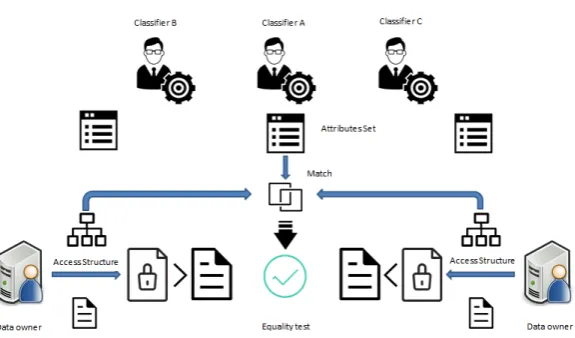
Yang et al. [19] introduced the primitive of public key encryption with equal-ity test (PKEET) which allows anyone to efficiently test if two ciphertexts w.r.t different public keys contain the same message without decryption. This special property makes it suitable for implementing label classification. On the other hand, ABE [13], especially Ciphertext-policy ABE (CP-ABE) [3], is a good u-tility for access control. Ciphertext-policy ABE (CP-ABE) is a variant of ABE, in which an access policy is embedded in a ciphertext while each user a formal set of attributes is embedded in a secret key of each user. A user can decrypt ciphertexts only if the embedded access policy can be satisfied by the user’s attributes. CP-ABE with equality test (CP-ABEET) [15], integrating the ad-vantage of PKEET and CP-ABE, can be used to classify encrypted data, and in the meanwhile, implement flexible control of access to the encrypted data in cloud. Roughly, CP-ABEET works as follows.
Fig. 1.System architecture of CP-ABEET
the company, including the data managers, receive attribute-related secret keys from the regulatory agency. Before uploading to the cloud server, data owner encrypts its data using a block cipher, e.g. AES. It also sets a label for the data, an access policy specifying which data manager(s) can access the data and its label, and encrypts the label using CP-ABEET encryption algorithm. The data classifier obtains trapdoors from different data managers before classifying the data. Given the Tds, it is then able to access the data as long as the attribute sets embedded in the Tds satisfy the access policies embedded in the cipher-texts, and classify these data according to their labels using the test function of CP-ABEET. If two pieces of data are attached with the same label, they will be put into the same category. Besides, the data managers are able to decrypt the ciphertexts to recover the original data (as well as the label) using the decryption function of CP-ABEET. Figure 1 shows the system architecture of CP-ABEET.
(Our Contributions). Although the CP-ABEET scheme proposed by Wang et al. [15] is concrete, it is complex and requires a large computation for the server, which makes it not suitable for practical use, e.g. label classification. Besides, their scheme only achieves CPA-type indistinguishability when the adversary is not given trapdoors, which does not capture some real-life attacks.
test algorithms. Table 1 (page 17) provides a detailed comparison between our scheme and some related schemes, e.g. [9, 15, 20].
Paper Organization. We review related works in Sect. 2. Then in Sect. 3 we introduce the preliminaries which are needed for our construction. In Sect. 4 we define CP-ABEET and its security models. The construction of CP-ABEET is given in 5. The security analysis of CP-ABEET is provided in Sect. 6. We compare our scheme with some related schemes in Sect. 7. Finally, we conclude the paper in Sect. 8.
2
Related Works
(ABE): Sahai et al. initialized the study of fuzzy identity-based encryption, the embryo of ABE, in 2005 [13]. Goyal et al. and Bethencourt et al. presented the first key-policy ABE (KP-ABE) scheme [5] and the first ciphertext-policy ABE (CP-ABE) scheme [3], respectively. There are many follow-ups, e.g. [1,5,7], [4,16], and etc. Based on these ABE schemes, researchers proposed more complex and flexible ABE schemes. However, there are still some issues with these ABE schemes, among which the efficiency is a major one, e.g. ciphertext size and decryption cost. Green et al. [6] gave a new method of efficiently and securely outsourcing the decryption of ABE ciphertexts to a third-party server, which reduces the overhead of users significantly. To further enhance user privacy, in some ABE schemes [8,12], the access policy ishiddenso that an adversary cannot learn anything about the policy from the ciphertexts.
(PKEET): Yang et al. defined the concept of PKEET in 2010 [19] and present-ed a concrete construction which allows to test if two ciphertexts decrypt to a common result without decryption. However, since any entity is able to run the test in their scheme, an adversary may learn some information about the mes-sage from ciphertexts. An authorization mechanism is thus needed to control the access to the test function. Fine-grained authorization policy PKEET (FG-PKEET) was proposed to implement the accurate authorization in PKEET [14], in which only the authorized users can perform the equality test.Public key en-cryption with delegated equality test (PKE-DET) was proposed to optimize the authorization mechanism [11], in which only the delegated party can run the test. Furthermore, a PKEET scheme with flexible authorization was proposed in [10], which further refines the authorization into four types.
the efficiency, Wu et al. reduced the use ofHashToPointfunction in their another IBEET scheme [17], which is time costly. It is restricted in their scheme that only particular keywords can be tested, in order to improve the security level of their scheme.
(ABEET): There are not many schemes focusing on attribute based encryp-tion with equality test(ABEET). Considering the relationship between ABE and IBE, Zhu et al. proposed the firstkey-policy ABEET (KP-ABEET) scheme [20], which provides more flexible authorization than previous works on PKEET and IBEET. Wang et al. presented a ciphertext-policy ABEET (CP-ABEET) [15] very recently. Both of the schemes are complex and suffer from high computa-tional complexity.
3
Preliminaries
In this part we give a brief review of some basic definitions which are necessary for our construction of CP-ABEET.
The following definitions of access structure and linear secret sharing scheme (LSSS) are adapted from [16] and [2], respectively.
Definition 1 (Access Structure, AC [16]). Let P = {Pi}ni=1 be a set of n parties, and A be a subset of 2P. We say A is monotone if ∀S1, S2,(S1 ∈ A)∧(S1 ⊆ S2) → (S2 ∈ A). A monotone collection A ⊆ 2P\{∅} is called a
monotone access structure. Sets inAare authorized, and those outside ofAare
unauthorized.
Definition 2 (LSSS [2]). We say a secret sharing scheme Π over a set of parties Pis linear(overZp) if the following two conditions hold.
1. For each party inP, the secret shares form a vector overZp.
2. There exists a share generating matrixM of size `×n. We use a mapρ(·)
to connect each row of M with its corresponding party in P. Let s∈Zp be
the secret to be shared, andr2,· · · , rn be random elements ofZp. The vector M v, where v= (s, r2,· · ·, rn), contains the shares ofs according to Π, and
(M v)i is the share belonging to party ρ(i).
There is an efficient algorithm which can find a set of constants {wi} for recovering the secrets, e.g.P
i∈Iwiλi=s, whereIis the set of indices of parties in an authorized set and{λi} are valid shares ofs generated by Π [2]. This is known as the linear reconstruction property. Same as [16], we use (1,0,· · ·,0) as the target vector for LSSS. For any satisfying set of rowsIinM, there exists a vectorw s.t.w·(1,0,· · · ,0) =−1 and∀i∈I, w·Mi= 0.
Bilinear Pairing: Given cyclic groupsG,GT of prime orderpand a generator gofG, we saye:G×G→GT is a bilinear pairing if (1)∀g1, g2∈G,∀x, y∈Zp,
e(g1x, g2y) =e(g1, g2)xy; (2)e(g, g) generatesGT; and (3)∀g1, g2∈G,e(g1, g2)
(Decisional q-Parallel BDHE Assumption [16]): Suppose G is a group
of prime orderp, andg is a generator. Choose at random s, a, b1,· · · , bq ∈Zp.
Denote by
y:=g, gs, ga,· · ·, g(aq), , g(aq+2),· · ·, g(a2q);
∀1≤j≤q, gs·bj,
ga/bj,· · · , g(aq/bj), g(aq+2/bj),· · ·, g(a2q/bj); ∀1≤j, k≤q, k6=j, g(a·s·bk/bj),· · ·, g(aq·s·bk/bj).
Decisionalq-parallel Bilinear Diffie-Hellman Exponent problem (BDHE) is that giveny, the adversary could not distinguishe(g, g)aq+1sfrom a random element R∈GT.
Definition 3 (Decisionalq-parallel BDHE Assumption).We say that the Decisionalq-parallel BDHE assumption holds if for any probabilistic polynomial-time (PPT) algorithm A,
|Pr[A(y, T =e(g, g)aq+1s) = 0]−Pr[A(y, T =R) = 0]|
is negligible.
4
CP-ABEET
4.1 Definition
Definition 4 (CP-ABEET). A CP-ABEET scheme consists of PPT algo-rithms(Setup,Encrypt,KeyGen,Trapdoor,Test,Decrypt), as below.
– Setup: Given a security parameter 1k and the maximal number N of at-tributes in the system, it outputs a master public/secret key pair(Mpk,Msk). – Encrypt: GivenMpk, an access structure(M, ρ)and a messagemas input,
it outputs a ciphertextCt.
– KeyGen: GivenMskand an attribute setS, it outputs a secret keySkS for S.
– Trapdoor: GivenMskand an attribute setS, it outputs a trapdoorTdS for S.
– Test: GivenCtA,TdAof userAandCtB,TdB of userB, it outputs 1 ifCtA
andCtB contain the same plaintext, and 0 otherwise.
– Decrypt: GivenCtandSkS, it outputs a messagemor a failure symbol⊥.
4.2 Security Models
We consider two security properties of CP-ABEET. LetAbe an adversary. IfA
is given the trapdoor, we require that it cannot recover the message from a given ciphertext. Otherwise, we require that it cannot distinguish a given ciphertext encapsulates which message. Below we formally define the security properties by two games, whereCis a challenger.
One-wayness against chosen access structure and chosen ciphertext attacks (OW-CAS-CCA):
1. Setup.C prepares a master key pair (Mpk,Msk) and sendsMpkto A. 2. Query Phase 1.Aadaptively issues queries for polynomially many times.
– ExtractQuery.Asubmits a setSof attributes, and is returned a corre-sponding secret keySkS.
– T rapdoorQuery.Asubmits a setS of attributes, and is returned a cor-responding trapdoorTdS.
– DecryptionQuery.Asubmits a ciphertextCtand a setS of attributes, and is returned the corresponding decryption result.
3. Challenge Phase. A submits (M∗, ρ∗) as the challenge access structure such thatAdid not ask an Extract query on input anySsatisfying (M∗, ρ∗) inQuery Phase 1.C chooses a random messagem∗, and computesCt∗←
Encrypt(Mpk,(M∗, ρ∗), m∗). It returns Ct∗ as the challenge ciphertext to
A.
4. Query Phase 2.Aadaptively issues queries as inQuery Phase 1, except that it is not allowed to issue an Extract query on input any S satisfy-ing (M∗, ρ∗), nor to issue a Decryption query (Ct∗, S) for any S satisfying (M∗, ρ∗).
5. Guess. Finally,Aoutputsm0. Ifm0 =m∗,Awins.
A’s advantage AdvOWA -CAS-CCA(k), is its probability of winning the game. Definition 5 (OW-CAS-CCA Security).A CP-ABEET scheme is one-way against chosen access structure and chosen ciphertext attacks (OW-CAS-CCA secure) if there is no PPT adversaryA,AdvOWA -CAS-CCA(k)is non-negligible.
If we limit the adversary to submit its challenge access structure (M∗, ρ∗) in an Init phase before being given the master public key Mpk, we have the following definition.
Definition 6 (OW-SAS-CCA Security). A CP-ABEET scheme is one-way against selective access structure and chosen ciphertext attacks (OW-SAS-CCA secure) if there is no PPT adversaryA,AdvOWA -SAS-CCA(k)is non-negligible.
Indistinguishability against chosen access structure and chosen cipher-text attacks (IND-CAS-CCA): The difference between IND-CAS-CCA and OW-CAS-CCA is that the adversary in the former cannot do equality tests on
1. Setup. Same as in OW-CAS-CCA game.
2. Query Phase 1.Same as in OW-CAS-CCA game.
3. Challenge Phase.Asubmits (M∗, ρ∗) as the challenge access structure a-long with two messagesm0, m1of equal length. It is restricted thatAdid not ask any Extract querySsatisfying (M∗, ρ∗) inQuery Phase 1.Cthen ran-domly chooses a bitβ, and computes Ct∗ =Encrypt(Mpk,(M∗, ρ∗), mβ). It returnsCt∗ toAas the challenge ciphertext.
4. Query Phase 2. Same as in OW-CAS-CCA game, except that A cannot ask any Trapdoor queryS satisfying (M∗, ρ∗) either.
5. Guess. Finally,Aoutputs a bitβ0. Ifβ0 =β,Awins.
A’s advantage AdvINDA -CAS-CCA(k), is the gap between the probability thatβ0=β and 1/2, e.g.|Pr[β0=β]−1/2|. We have the following definition.
Definition 7 (IND-CAS-CCA Security).A CP-ABEET scheme is indistin-guishable against chosen access structure and chosen ciphertext attacks ( IND-CAS-CCA secure) if there is no PPTA,AdvINDA -CAS-CCA(k)is non-negligible.
Similarly, if we limit the adversary to submit (M∗, ρ∗) in anInitphase before being given the master public keyMpk, we have the following definition.
Definition 8 (IND-SAS-CCA Security).A CP-ABEET scheme is indistin-guishable against selective access structure and chosen ciphertext attacks ( IND-SAS-CCA secure) if there is no PPTA,AdvINDA -SAS-CCA(k)is non-negligible.
5
Our CP-ABEET Scheme
5.1 Construction
Our CP-ABEET scheme works as below.
– Setup(1k). The algorithm generates bilinear pairing parameters (
G,GT, p, g, e), randomly chooses α, α0, a∈ Zp and calculates e(g, g)α, e(g, g)α
0
, ga. It also chooses at randomh1,· · · , hN ∈Gto represent theN attributes the system
supports. Besides, it selects two cryptographic hash functions:H1:GT →G
andH2:GT×G∗→ {0,1}l1+l2wherel1andl2are representation lengths of
aGelement and aZpelement, respectively. The algorithm outputs a master key pair (Mpk,Msk), where
Mpk= (g, e(g, g)α, e(g, g)α0, ga, h1,· · · , hN), andMsk= (gα, gα0).
– Encrypt(Mpk,(M, ρ), m). Suppose that M is an `×n matrix and ρ as-sociates rows ofM to attributes. The algorithm chooses a random vector υ= (s, y2,· · · , yn)∈Znp and computesλi=υ·Mi fori= 1,· · · , `. Besides, it randomly choosesu, r1,· · ·, r`∈Zp, and calculates
∀1≤i≤`, Ci=gaλi·h−ri
ρ(i), Di=g ri,
C∗ = (mku)⊕H2(e(g, g)α 0s
, C, C0, C00,E),
whereE= (C1, D1,· · ·, C`, D`). The algorithm outputsCt= (C, C0, C00, C1, D1,· · · , C`, D`, C∗). We implicitly assume that the access structure is contained inCt.
– KeyGen(Msk, S). The algorithm randomly choosest, t0∈Zp, and calculates SK:K=gα·gat, L=gt,{Kx=htx}x∈S,
SK0:K0 =gα0·gat0, L0=gt0,{Kx0 =htx0}x∈S. It outputsSkS = (SK, SK0).
– Trapdoor(Msk, S). The algorithm randomly choosest∈Zp, and calculates
TdS = (K=gα·gat, L=gt,{Kx=htx}x∈S). It outputsTdS.
– Test(CtA,TdSA,CtB,TdSB). Assume that SA (SB, resp.) is an authorized
set of (MA, ρA) ofCtA((MB, ρB) ofCtB, resp.). DefineIA={i:ρA(i)∈SA} and the set of reconstruction constants{wA,i∈Zp}i∈IA. The secretsAcan
be reconstructed assA=P
i∈IAwA,i·λA,i, where{λA,i}are valid shares of
sAw.r.t.MA. We defineIBand{wB,i∈Zp}i∈IB similarly. ParseCtA= (CA,
C0
A, CA00, CA,1, DA,1,· · · , CA,`, DA,`, CA∗) andCtB= (CB, CB0 , CB00, CB,1, DB,1,· · · , CB,`, DB,`, CB∗). The algorithm computes
XsubA= e(C 0 A, KA)
Q
i∈IA(e(CA,i, LA)e(DA,i, KA,ρ(i)))
wA,i
= e(g, g)
αsAe(g, g)asAtA Q
i∈IAe(g, g)
tAaλA,iwA,i =e(g, g)
αsA.
XsubB =e(g, g)αsB is computed similarly. It then calculates
XA= CA
H1(XsubA) andXB = CB H1(XsubB). The algorithm outputs 1 if
e(CA00, XB) =e(CB00, XA) holds, and 0 otherwise.
– Decrypt(Ct,SkS). Parse Ct= (C, C0, C00, C1, D1,· · ·, C`, D`, C∗). The al-gorithm uses SK = (K, L,{Kx}x∈S) (the first part of SkS) to compute Xsub = e(g, g)αs as in Test algorithm, and uses SK0 = (K0, L0,{K0
x}x∈S) (the other part ofSkS) to computeXsub0 =e(g, g)α
0s
similarly. Then it com-putes
mku←C∗⊕H2 Xsub0 , C, C0, C00,E), whereE= (C1, D1,· · · , C`, D`). The algorithm outputsmif
5.2 Correctness
– Test: Let mA, uA (resp.mB, uB) be the message and random number con-tained inCtA(resp.CtB). We have
e(CA00, XB) =e(guA, CB/H1(XsubB))
=e(guA,m
uB
B H1(e(g, g)αsB) H1(e(g, g)αsB)
)
=e(guA, muB
B ), e(CB00, XA) =e(guB, CA/H1(Xsub
A))
=e(guB,m
uA
A H1(e(g, g) αsA)
H1(e(g, g)αsA) )
=e(guB, muA
A ).
If the messages mA = mB and the trapdoors TdA and TdB are honestly generated, the following equation holds:
e(CA00, XB) =e(guA, muB
B ) =e(guB, mu1A
A ) =e(CB00, XA).
This completes the correctness analysis of test algorithm. – Decryption: Denote byE= (C1, D1,· · · , C`, D`). We have
C∗⊕H2(Xsub0 , C, C0, C00,E) =(mku)⊕H2(e(g, g)α
0s
, C, C0, C00,E)
⊕H2(e(g, g)α 0s
, C, C0, C00,E) =mku.
If the following equations
C00=gu andC=mu·H1(Xsub)
hold, the decryption outputs the correct message. This completes the cor-rectness analysis of decryption algorithm.
6
Security Analysis
In this section we analyze the security of our proposed CP-ABEET scheme under the security models given in Sect. 4.2.
Proof. Suppose thatA is a PPT adversary against the OW-SAS-CCA security of our CP-ABEET scheme. We build an algorithm B to solve the decisional q-parallel BDHE problem. B is given a problem instance (y, T) (please refer to Def. 3 for the definition ofy). Define a bitb which is 0 ifT =e(g, g)aq+1s, and 1 if T is randomly selected from GT. B aims to guess the bit b, and works as below.
1. Init.Asends (M∗, ρ∗) toBas the challenge access structure.
2. Setup. B randomly chooses α1, α2 ∈ Zp, and sets e(g, g)α = e(g, g)α1 ·
e(g, gaq) ande(g, g)α0 =e(g, g)α2·e(ga, gaq). This implicitly setsα=α1+aq
andα0=α
2+aq+1. It chooses at randomzx∈Zpfor each attributex. Define a setX∗={i:ρ∗(i) =x}.Bsets hx as
hx=gzx Y
i∈X∗
gaMi,∗1/bi·ga2Mi,∗2/bi· · ·ganMi,n∗ /bi.
It givesMpk= (g, e(g, g)α, e(g, g)α0, ga, h
1,· · · , hN) to A.
3. Query Phase 1. We restrict that the sets of attributes submitted by A
in Extract queries would not satisfy (M∗, ρ∗).B maintains two hash tables HT1, HT2which are initially empty, and works as below.
– H1 Queries. Given an elementQ∈GT,Btraverses the hash tableHT1 to check if there is a tuple (Q, h1) in the table, and returnsh1toAif so; otherwise,Brandomly chooses a valueh1∈G, stores (Q, h1) intoHT1, and returnsh1 toA.
– H2 Queries. Given Q= (Q, C, C0, C00,(C1, D1),· · ·,(C`, D`)) as input,
Btraverses the hash tableHT1to check if there is a tuple (Q, h1) in the table, and returnsh1toAif so; Otherwise, if there is not any (Q, h2) in tableHT2, Bchooses a randomh2∈ {0,1}l1+l2, and stores (Q, h2) into
HT2.Breturnsh2to A.
– Extract Queries. Given an attribute set S, B computes SkS as below. LetI ={i: ρ(i)∈S}. Bchooses at randomr ∈Zp and finds a vector w= (w1=−1, w2,· · · , wn)∈Zpn such thatw·Mi∗= 0 for alli∈I. B firstly calculatesSK0= (K0, L0,{K0
x}) ofSkS.Bimplicitly setst0 as t0=r+w1aq+w2aq−1+· · ·+wnaq−n+1
by computing
L0=gr Y i=1,···,n
(gaq+1−i)wi =gt0.
Then it calculatesK0 as
K0=gα0gat0 =g(α2+aq+1)gat0
=gα2·gar Y
i=2,···,n
Note that the termg−aq+1of componentgat0 which cannot be simulated, will cancel out with the termgaq+1 ofgα0. For anyx∈S, if there is no is.t.ρ(i) =x,Bcomputes
Kx0 =hxt 0
= (gzx)t0 = (gt0)zx =L0zx.
Otherwise, defineX ={i:ρ(i) =x}.BcomputesKx0 as Kx0 =L0zx Y
i∈X
Y
j=1,···,n
g(aj/bi)r
· Y
k=1,···,n k6=j
(gaq+1+j−k/bi)wk
Mi,j∗ .
Note that the termsgaq+1/bi will all cancel out due to thatw·M∗
i = 0. Furthremore,B randomly chooses a new element t∈Zp and computes another partSK= (K, L,{Kx}) ofSkS as follows.
K=gα·gat =g(α1+aq)·gat
=gα1gaq·gat. B then computes L= gt and K
x =hxt for ∀x∈ S. Finally B returns the secret keySkS = (K, L,{Kx}, K0, L0,{Kx0}).
– Trapdoor Queries. Given an attribute set S,B randomly choosest and computesTdS = (K, L,{Kx}) in the same way as above.
– Decryption Queries. Given (Ct, S),BparsesCt= (C, C0, C00, C1, D1,· · ·, C`, D`, C∗), and distinguishes the two cases below.
(a) Case 1: (M∗, ρ∗) is not satisfied byS.Bcomputes the corresponding private key SkS as in dealing with an Extract query, uses SkS to decrypt Ct, and returns the output toA.
(b) Case 2: (M∗, ρ∗) is satisfied byS. In this case,Acould not getSkS.
B firstly computes the trapdoorTdS as above, and computes
Xsub= e(C 0, K)
Q
i∈I(e(Ci, L)·e(Di, Kρ(i)))wi .
Then B traverses the hash table HT1 for the tuple (Xsub, h1) and outputs ⊥ if not found, and traverses HT2 to see if there exits a tuple ((Xsub0 , C, C0, C00, C1, D1,· · ·, C`, D`), h2). If there is no such a tuple inHT2,Boutputs⊥. Otherwise, for each tuple found inHT2,
B computes
mku=C∗⊕h2, and checks whether the following equations hold:
C00=gu andC=mu·H1(Xsub).
4. Challenge.Bchooses at random messagem∗ andu∗∈Zp, and computes
ˆ
C= (m∗)u∗·H1(T·e(gs, gα1)), ˆ
C0 =gs and ˆC00=gu∗.
It randomly choosesy20,· · ·, yn0 and uses vectorv= (s, sa+y20, sa2+y30,· · · , san−1+ y0n) to share the secrets. LetAi={k:k=6 i∧ρ∗(k) =ρ∗(i)}.Bchooses at randomr10,· · · , r`0 ∈Zp, and computes
ˆ Ci=hr
0
i
ρ∗(i)(
Y
j=2,···,n
(ga)Mi,j∗ y
0
j)·(gbi·s)−zρ∗(i)
·(Y k∈Ai
Y
j=1,···,n
(gaj·s·(bi/bk))Mk,j∗ ),
ˆ
Di=g−ri0g−sbi,
and
ˆ
C∗= (m∗ku∗)⊕H2 T·e(gs, gα2),C,ˆ Cˆ0,Cˆ00,
ˆ
C1,D1,ˆ · · ·,C`,ˆ D`ˆ
.
BreturnsCt∗= ( ˆC,Cˆ0,Cˆ00,C1,ˆ D1,ˆ · · ·,C`,ˆ D`,ˆ Cˆ∗) toA.
5. Query Phase 2.BanswersA’s queries as inQuery Phase 1, except that now we restrictAfrom issuing any Extract queryS satisfying (M∗, ρ∗) and any decryption query (S,Ct∗) withS satisfying (M∗, ρ∗).
6. Guess.A outputs a messagem0. B outputsb0 = 0 ifm0 =m∗, andb0 = 1 otherwise.
Below we analyze the probability that B successfully guesses b. If T = e(g, g)aq+1s, the simulation provided by B is perfect, and the view of A is the same as that of a real attack. It holds that Pr[b0= 0|b= 0] = AdvOWA -SAS-CCA(k). IfT is randomly selected fromGT, the challenge ciphertext hidesm∗ perfectly, and the probability that A outputs the correct message is thus negligible, e.g. Pr[b0= 0|b= 1] = negl(k). Therefore, we have the followings.
Pr[b0=b] = Pr[b0= 0∧b= 0] + Pr[b0= 1∧b= 1] =1
2(Pr[b
0= 0|b= 0] + 1−Pr[b0 = 0|b= 1])
=1 2(Adv
OW-SAS-CCA
A (k) + (1−negl(k))) =1
2 + 1 2Adv
OW-SAS-CCA
A (k)−
1
2negl(k).
Theorem 2. If decisionalq-parallel BDHE assumption holds, our CP-ABEET scheme achieves IND-SAS-CCA security.
Proof. Suppose thatAis a PPT adversary against the IND-SAS-CCA security of our CP-ABEET scheme. We build an algorithm B to solve the decisional q-parallel BDHE problem. B is given a problem instance (y, T). Define a bitb which is 0 ifT =e(g, g)aq+1s
, and 1 ifT is randomly selected fromGT.B aims to guess the bit b, and works as below.
1. Init.Asends (M∗, ρ∗) toBas the challenge access structure.
2. Setup.Brandomly choosesα1, α2∈Zp, and computese(g, g)α=e(g, g)α1· e(ga, gaq) ande(g, g)α0 =e(g, g)α2e(ga, gaq). This implicitly sets α=α1+
aq+1 andα0 =α2+aq+1. It chooses at random zx∈
Zp for each attribute x. Define a setX∗={i:ρ∗(i) =x}.Bsets hx as
hx=gzx Y
i∈X∗
gaMi,∗1/bi·ga2Mi,∗2/bi· · ·ganMi,n∗ /bi.
It givesMpk= (g, e(g, g)α, e(g, g)α0, ga, h1,· · · , hN) to A.
3. Query Phase 1. B handlesH1,H2 and Trapdoor queries as in the proof of Theorem 1. Again, we restrict that the sets of attribute submitted by A
in Extract and Trapdoor queries would not satisfy(M∗, ρ∗). B answers the adversary’s Extract and Decryption queries as below.
– Extract Queries. Given an attribute set S, B chooses at random r, v ∈
Zp and finds a vector w = (w1 = −1, w2,· · · , wn) ∈ Zpn such that w·Mi∗ = 0 for all i ∈ I, where I = {i : ρ(i) ∈ S}. It generates SK0 = (K0, L0,{Kx0}) of SkS as in the proof of Theorem 1, and cal-culates another partSK = (K, L,{Kx}) of SkS as follows.B implicitly sets the valuetas
t=v+w1aq+w2aq−1+· · ·+wnaq−n+1 by computing
L=gv Y i=1,···,n
(gaq+1−i)wi=gt.
Then it calculatesK as
K=gαgat=g(α1+aq+1)gat
=gα1·gav Y
i=2,···,n
(gaq+2−i)wi.
Note that the term g−aq+1 of component gat will cancel out with the termgaq+1 ofgα.
For anyx∈S, if there is nois.t.ρ(i) =x,Bcomputes
Otherwise,BcomputesKx as
Kx=Lzx Y
i∈X
Y
j=1,···,n
g(aj/bi)r
· Y
k=1,···,n k6=j
(gaq+1+j−k/bi)wk
Mi,j∗ ,
where X = {i : ρ(i) = x}. Note that the terms gaq+1/bi will all cancel
out due to that w·M∗
i = 0. Finally, B returns the secret key SkS = (K, L,{Kx}, K0, L0,{Kx0}).
– Decryption Queries. Given (Ct, S), parse Ct = (C, C0, C00, C1, D1,· · ·, C`, D`, C∗).B distinguishes the following two cases.
(a) Case 1: (M∗, ρ∗)k is not satisfied byS.Bgenerates the corresponding private key SkS as in dealing with an Extract query, uses SkS to decrypt Ct, and returns the output toA.
(b) Case 2: (M∗, ρ∗)k is satisfied byS. In this case,Acould not getSkS norTdS. Btraverses hash tableHT2 to check if there exists a tuple ((Xsub0 , C, C0, C00, C1, D1,· · · , C`, D`), h2). If there is no such a tuple in HT2, B outputs ⊥. Otherwise, for each satisfied tuple found in HT2, Bcomputes
mku=C∗⊕h2. IfC00=gu holds,B calculatesh0
1=C/mu, and searches hash table HT1 for a tuple (Xsub, h01). If found, B outputs m. Otherwise, B
outputs ⊥. Notice that there is a case in which Xsub is not the correct one used in the generation of Ct. However, because of the randomness of oracle H1, the probability that the adversary uses a correct Xsub value in the generation of a well-formed ciphertext without queryingH1, is negligible.
4. Challenge.Asubmits two messagesm∗0, m∗1 with|m∗0|=|m∗1|.Brandomly choosesβ∈ {0,1} andu∗ ∈Zp, and computes
ˆ
C= (m∗β)u∗·H1(T·e(gs, gα1)), ˆ
C0 =gs and ˆC00=gu∗.
It randomly choosesy20,· · ·, yn0 and uses vectorv= (s, sa+y20, sa2+y30,· · · , san−1+ y0
n) to share the secrets. Denote byAi={k:k6=i∧ρ(k) =ρ(i)}.Bchooses random valuesr0
1,· · ·, r0`, and computes ˆ
Ci=h r0i ρ(i)(
Y
j=2,···,n
(ga)Mi,j∗ y
0
j)·(gbi·s)−zρ(i)
·(Y k∈Ai
Y
j=1,···,n
(gaj·s·(bi/bk))Mk,j∗ ),
ˆ
and ˆ
C∗= (m∗ku∗)⊕H2(T·e(gs, gα2),C,ˆ Cˆ0,Cˆ00,
ˆ
C1,Dˆ1,· · ·,Cˆ`,Dˆ`).
BreturnsCt∗= ( ˆC,Cˆ0,Cˆ00,Cˆ1,Dˆ1,· · ·,Cˆ`,Dˆ`, ˆC∗) toA.
5. Query Phase 2. B answers A’s queries as in Query Phase 1. Now we restrictA from issuing any Extract query and Trapdoor queryS satisfying (M∗, ρ∗), and any decryption query (S,Ct∗) withS satisfying (M∗, ρ∗). 6. Guess.Aoutputs a bitβ0.Boutputsb0= 0 ifβ0 =β, andb0 = 1 otherwise.
Below we analyze the probability thatBsuccessfully guesses b. In caseT = e(g, g)aq+1s
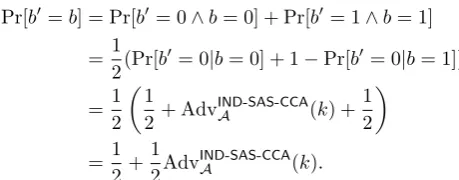
, the simulation provided byBis perfect, and the view ofAis the same as that of a real attack. It holds that Pr[b0 = 0|b= 0] = 12+ AdvINDA -SAS-CCA(k). In caseT is randomly selected fromGT, Ct∗ hides the bit β perfectly, and the probability that Aoutputs the correctβ is 1/2. Thus,B successfully guessesb with probability 1/2, e.g. Pr[b0= 0|b= 1] = 1/2. Therefore, it holds that
Pr[b0=b] = Pr[b0= 0∧b= 0] + Pr[b0= 1∧b= 1] =1
2(Pr[b
0= 0|b= 0] + 1−Pr[b0 = 0|b= 1])
=1 2
1 2+ Adv
IND-SAS-CCA
A (k) +
1 2
=1 2 +
1 2Adv
IND-SAS-CCA
A (k).
If AdvINDA -SAS-CCA(k) is non-negligible, the probability that B solves the deci-sional q-parallel BDHE problem is thus non-negligibly larger than 1/2, which contradicts the decisionalq-parallel BDHE assumption.
7
Comparison
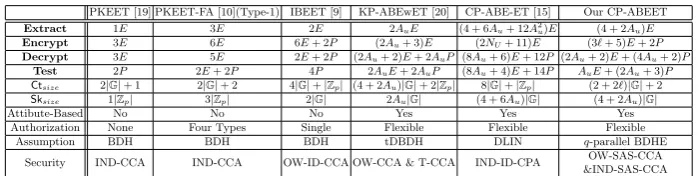
We make a detailed comparison of our CP-ABEET with some related schemes in Table 1 (page 17), in terms of running costs, functional properties, assumptions, security level and etc. In the comparison we mainly consider the dominant com-putation in Extract, Encrypt, Decrypt, and Test algorithms, e.g. bilinear pairing evaluation and exponentiation operation. The second to the fifth rows of Table 1 show the computational costs ofExtract,Encrypt,Decrypt, and Test algorithms. The sizes of a ciphertext and a secret key in the schemes are showed in the sixth and seventh rows. The eighth row indicates whether the scheme is attribute based. The ninth row shows the authorization type of each scheme. The last two rows indicate the underlying assumptions and security levels of the schemes.
Table 1.Performance Comparison with Related Schemes
PKEET [19] PKEET-FA [10](Type-1) IBEET [9] KP-ABEwET [20] CP-ABE-ET [15] Our CP-ABEET
Extract 1E 3E 2E 2AuE (4 + 6Au+ 12A2u)E (4 + 2Au)E
Encrypt 3E 6E 6E+ 2P (2Au+ 3)E (2NU+ 11)E (3`+ 5)E+ 2P
Decrypt 3E 5E 2E+ 2P (2Au+ 2)E+ 2AuP (8Au+ 6)E+ 12P (2Au+ 2)E+ (4Au+ 2)P
Test 2P 2E+ 2P 4P 2AuE+ 2AuP (8Au+ 4)E+ 14P AuE+ (2Au+ 3)P
Ctsize 2|G|+ 1 2|G|+ 2 4|G|+|Zp| (4 + 2Au)|G|+ 2|Zp| 8|G|+|Zp| (2 + 2`)|G|+ 2
Sksize 1|Zp| 3|Zp| 2|G| 2Au|G| (4 + 6Au)|G| (4 + 2Au)|G|
Attibute-Based No No No Yes Yes Yes
Authorization None Four Types Single Flexible Flexible Flexible Assumption BDH BDH BDH tDBDH DLIN q-parallel BDHE
Security IND-CCA IND-CCA OW-ID-CCA OW-CCA & T-CCA IND-ID-CPA OW-SAS-CCA &IND-SAS-CCA
1. T-CCA security of KP-ABEwET meanstestability against chosen-ciphertext at-tack of authorization under the chosen sets of attributes [20].
2. In Wang’s scheme [15],NU is the amount of attributes in their system.
3. We denote byAuthe number of attributes used inExtract,Encrypt,Decrypt
andTestalgorithms, and use|G|and|Zp|to denote the length of element
represen-tation inGandZp, respectively. In our CP-ABEET scheme,`denotes the number
of rows inM.
4. Both the IND-ID-CPA model in [15] and the OW-SAS-CCA and IND-SAS-CCA models in our scheme consider the selective access structure, in which the attacker submits its challenge access structure before seeing public parameters.
Table 1 we know that our CP-ABEET scheme provides the best security guaran-tee among all the three attribute-based encryption schemes supporting equality test. The computational complexity of Encryptalgorithm in our scheme is re-lated to`, number of rows inM. The computational costs ofExtract,Decrypt andTestalgorithms in our scheme are related to the numberAu of attributes, which has the same order of magnitude of the number In of elements in set I defined inDecryptalgorithm. Besides, the storage costs ofCtandSkare relat-ed to` andAu. In Wang et al.’s scheme [15], Au is related toL1, which is the number of wildcards defined in their scheme. The two numbers have the same or-der of magnitude. Besides, our CP-ABEET scheme enjoys OW-SAS-CCA AND IND-SAS-CCA security properties, which are of CCA-type. While Wang et al.’s scheme only achieves IND-ID-CPA security, which is of CPA-type. Notice that, both of the two schemes are provably secure in selective access structure mod-el, in which the adversary is required to submit its challenge access structure before seeing the public parameters. Therefore, our scheme has better security than Wang et al.’s scheme.
the number of attributes is large, which is the price of security improvement of our scheme.
8
Conclusion
We presented a novel construction of CP-ABEET, which combines advantages of both CP-ABE and PKEET. It supports flexible authorization and can be used to implement label classification for encrypted data efficiently. Our construction is more secure than the only known CP-ABEET scheme. Besides, it is more efficient in key generation cost and secret key size. We proved that our CP-ABEET satisfies one-wayness security if adversary has trapdoors, and indistinguishability if adversary is not given trapdoors. Our CP-ABEET scheme is a suitable solution to encrypted data classification with flexible access control.
References
1. N. Attrapadung, B. Libert, and E. D. Panafieu. Expressive key-policy attribute-based encryption with constant-size ciphertexts. In International Conference on Practice and Theory in Public Key Cryptography Conference on Public Key Cryp-tography, pages 90–108, Taormina, March 2011. Springer.
2. A. Beimel. Secure Schemes for Secret Sharing and Key Distribution. Technion-Israel Institute of technology, Faculty of computer science, Technion-Israel, 1996.
3. J. Bethencourt, A. Sahai, and B. Waters. Ciphertext-policy attribute-based en-cryption. InIEEE Symposium on Security and Privacy, pages 321–334, Oakland, May 2007. IEEE Computer Society.
4. V. Goyal, A. Jain, O. Pandey, and A. Sahai. Bounded ciphertext policy attribute based encryption. InInternational Colloquium on Automata, Languages, and Pro-gramming, pages 579–591, Reykjavik, July 2008. Springer.
5. V. Goyal, O. Pandey, A. Sahai, and B. Waters. Attribute-based encryption for fine-grained access control of encrypted data. In ACM Conference on Computer and Communications Security, pages 89–98, Alexandria, October 2006. ACM. 6. M. Green, S. Hohenberger, B. Waters, et al. Outsourcing the decryption of ABE
ciphertexts. In Proceedings of USENIX Security Symposium, pages 34–34, San Francisco, August 2011. USENIX Association.
7. J. Han, W. Susilo, Y. Mu, and J. Yan. Privacy-preserving decentralized key-policy attribute-based encryption. IEEE Transactions on Parallel and Distributed Systems, 23(11):2150–2162, Nov 2012.
8. A. Kapadia, P. P. Tsang, and S. W. Smith. Attribute-based publishing with hidden credentials and hidden policies. In NDSS, volume 7, pages 179–192, San Diego, February 2007. The Internet Society.
9. S. Ma. Identity-based encryption with outsourced equality test in cloud computing. Information Sciences An International Journal, 328(C):389–402, 2016.
10. S. Ma, Q. Huang, M. Zhang, and B. Yang. Efficient public key encryption with equality test supporting flexible authorization.IEEE Transactions on Information Forensics and Security, 10(3):458–470, 2015.
12. T. Nishide, K. Yoneyama, and K. Ohta. ABE with partially hidden encryptor-specified access structure. acns08, lncs 5037, 2008.
13. A. Sahai and B. Waters. Fuzzy identity-based encryption. InInternational Con-ference on Theory and Applications of Cryptographic Techniques, pages 457–473, Aarhus, May 2005. Springer.
14. Q. Tang. Towards public key encryption scheme supporting equality test with fine-grained authorization. In Australasian Conference on Information Security and Privacy, pages 389–406, Melbourne, July 2011. Springer, Springer.
15. Q. Wang, L. Peng, H. Xiong, J. Sun, and Z. Qin. Ciphertext-policy attribute-based encryption with delegated equality test in cloud computing. IEEE Access, 6:760–771, 2018.
16. B. Waters. Ciphertext-policy attribute-based encryption: An expressive, efficien-t, and provably secure realization. In Public Key Cryptography PKC 2011 -14th International Conference on Practice and Theory in Public Key Cryptogra-phy, Taormina, Italy, March 6-9, 2011. Proceedings, pages 53–70, Taormina, March 2011. Springer.
17. L. Wu, Y. Zhang, K. K. R. Choo, and D. He. Efficient identity-based encryp-tion scheme with equality test in smart city. IEEE Transactions on Sustainable Computing, 3(1):44–55, 2018.
18. T. Wu, S. Ma, Y. Mu, and S. Zeng. Id-based encryption with equality test against insider attack. In Australasian Conference on Information Security and Privacy, pages 168–183, Auckland, July 2017. Springer.
19. G. Yang, C. H. Tan, Q. Huang, and D. S. Wong. Probabilistic public key encryption with equality test. InInternational Conference on Topics in Cryptology, volume 5985, pages 119–131, San Francisco, March 2010. Springer.