© 2014, IJCSMC All Rights Reserved
397
Available Online atwww.ijcsmc.comInternational Journal of Computer Science and Mobile Computing
A Monthly Journal of Computer Science and Information Technology
ISSN 2320–088X
IJCSMC, Vol. 3, Issue. 9, September 2014, pg.397 – 403
RESEARCH ARTICLE
Orchestration Of Software-Defined Application
Delivery Networks using Open-Flow Architecture
Raghuram.P
1, G. Praveen Babu
2¹M.Tech, Computer Networks Information Security, School of IT, JNTU ²Associate Professor, School of IT, JNTU
1
[email protected]; 2 [email protected]
Abstract: Computer networks are complex and difficult to manage. They involve many kinds of equip-ment, from routers and switches to middle-boxes such as firewalls, network address translators, server load balancers, and intrusion-detection systems. Creating an application delivery network using such complex and distributed networking approach is very difficult and is often error prone. In this paper we discuss an innovative approach to create application delivery network using software defined networking. With the help of centralized control plane software defined networking (SDN) simplifies the task of creat-ing Switches, routers, firewalls and load balancers etc. and helps in orchestratcreat-ing the application delivery in a very short time and with least amount of resources.
Keywords: SDN, open flow, Firewall, Switches, Routers, Simulation, Automation
I. Introduction
© 2014, IJCSMC All Rights Reserved
398
it comes to the implementation of a change or troubleshooting. We try to solve this using the disruptive SDN technology which converts any open flow enable device into application deliv-ery equipment on demand basis. This there by reduces the CAPex and OPex of application de-livery alongside easing the process.
II. SDN Architecture
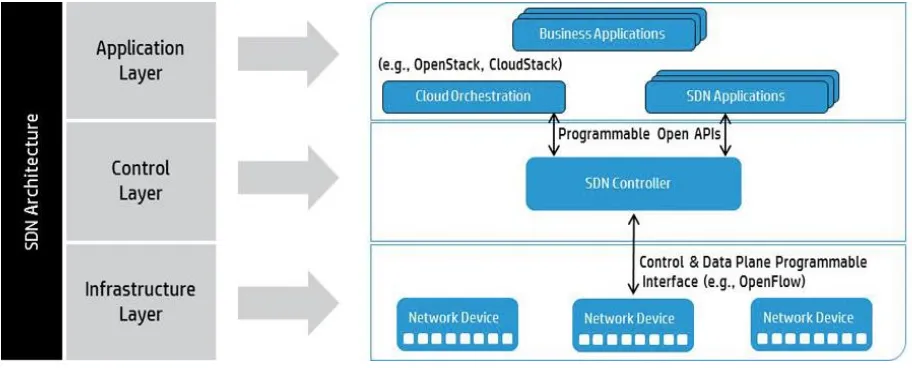
The SDN architecture departs from legacy solutions by building networks from three abstrac-tions or layers. First, the infrastructure layer acts as the foundation for an SDN architecture. The infrastructure consists of both physical and virtual network devices such as switches and routers. These devices implement the OpenFlow protocol as a standards-based method of im-plementing traffic forwarding rules. Second, the control layer consists of a centralized control plane for the entire network. The control plane is decoupled from the underlying infrastructure to provide a single centralized view of the entire network. The control layer utilizes OpenFlow to communicate with the infrastructure layer.
Third, the application layer consists of network services, orchestration tools, and business ap-plications that interact with the control layer. These apap-plications leverage open interfaces to communicate with the control layer and the network state.
Fig. 1 SDN architecture
III.SDN enabled by OpenFlow
At the foundation of enabling SDN is an emerging open standard called OpenFlow, which ultimately allows the network to be more responsive to business needs.
OpenFlow hides the complexity of the individual pieces of network devices. OpenFlow centralizes the control of those devices in a virtualized manner, simplifying network management for network managers.
The OpenFlow protocol uses a standardized instruction set, which means that any OpenFlow con-troller can send a common set of instructions to any OpenFlow-enabled switch, regardless of ven-dor.
© 2014, IJCSMC All Rights Reserved
399
OpenFlow is designed to be programmable. The OpenFlow instruction set allows network manag-ers to try new ideas or create new protocols to solve problems specific to their
organization`s network needs. This allows network architects to experiment with new services and protocols on a real-world network that cannot be simulated in a test lab—or is too risky to under-take in a production network today.
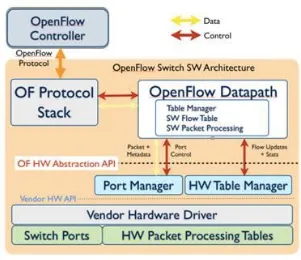
Fig. 2 Openflow protocol
IV.Application delivery blocks
1. Monitoring:
Dashboard is a tool which helps the network administrators and architects to have a real-time health monitoring of controller resources, control, and data channel utilizations, with self-healing capabilities. This is done with the help of open-flow counters. Each open flow enabled device ex-pose specific set of counters which collect the statistics of the device and the network resources. Counters are maintained for each flow table, flow entry, port, queue, group, group bucket, meter and meter band. OpenFlow-compliant counters may be implemented in software and maintained by polling hardware counters with more limited ranges. Duration refers to the amount of time the flow entry, a port, a group, a queue or a meter has been installed in the switch, and must be tracked with second precision. Amongst the available counters in a switch few of the essential fields are used for gathering the appropriate details.
TABLE I
Counters Bits
Reference Count (active entries) 32
© 2014, IJCSMC All Rights Reserved
400
Counters Bits
Packet Matches 64
Received Packets 64
Received Bytes 64
Duration (seconds) 32
Transmitted Bytes 64
Receive Drops 64
Transmit Drops 64
Receive Errors 64
Transmit Errors 64
Based on the user defined network, aggregate stats are constructed and the result is visually dis-played to user using a web interface.
Auto-heal capabilities are employed in the data fabric monitoring. This is achieved by continuous-ly monitoring the receive drops, Transmit drops, receive errors and transmit errors against the set of parameters collected from the user through web interface. Once the threshold is reached, the port of the switch on which the frame rate errors are occurring is restarted
2. Design:
Design module helps the users to identify the whole network topology at once. This is possible with the help of a state table which is constructed from the network map create by the open flow com-mands. Since the controller communicates with all the open flow enabled devices it can have a map of the entire network. Making use of the counters as discussed in the earlier sections, it is al-so possible to generate a visual table depicting all the flows which are existing in that particular switch. This is collected with the help of the controller exposing the rest API.
The second phase of design module is called canvas. This helps users in creating vision type of network diagrams. The advantage here is that users can simulate this in a virtual environment. This helps users in eliminating any kind of errors are design mistakes before the implementa-tion/production phase. HTML5 technology helps us in creating such a canvas.
This is achieved using Mininet which creates a realistic virtual network, running real kernel, switch and application code, on a single machine (VM, cloud or native), in seconds, with a single com-mand. Mininet allows creation of multiple nodes(hosts/switches/controllers) which allows a big network to be simulated on a single PC. This is very useful in experimenting with various topolo-gies and different controllers. Mininet makes use of open virtual switches to create a network schematic in virtual environment. The canvas application converts the vision style diagrams into a python code and then can be implemented using the mininet to create custom topologies.
sudo mn —topo=mytopo —custom ~/demo.py —controller=remote,ip=<controller ip>
© 2014, IJCSMC All Rights Reserved
401
3. Control:
Openflow Action fields help us in dynamically converting any open flow enabled switch into a fiwall module upon requirement. The policy base keeps the track of all the policies which user re-quires to be implemented in their network. The policy base lets users to fetch data from external resources like excel sheets, change request documents, etc. Rule base module keeps track of all the existing rules running live on the network. The policies which are extracted from the user input are constructed into an open flow command are passed into the open flow module of the switch with the help of SDN controller.
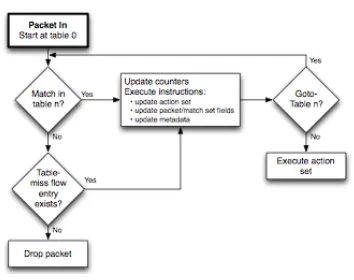
Fig. 3 Control application process flow
© 2014, IJCSMC All Rights Reserved
402
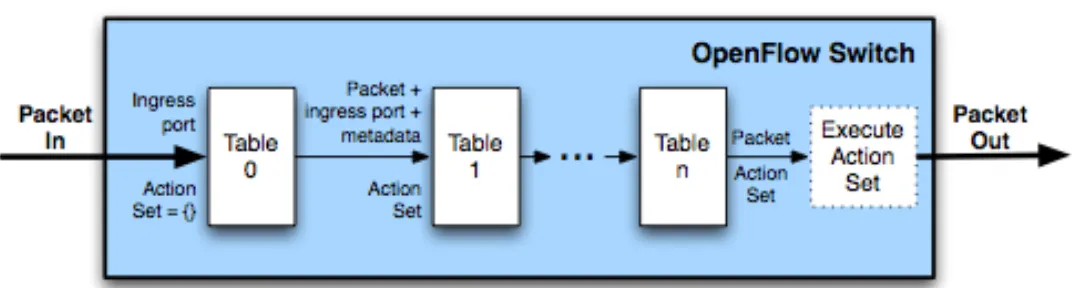
Fig. 4 Control module actiona) User creates a policy using the graphical input form
b) Policy is converted into a open flow command
c) The open flow command is passed to the open flow enabled switch using the controller
d) Once the switch receives a packet is parses through the header or the packet data. Compares it with the flow match parameters. Once a match is found the switch then takes a predefined ac-tion.
e) The action parameters would be either to drop the packets or forward it as usual. This is decid-ed by the user
Another Important of control is the simulation. In traditional networking environment any firewall change or policy change has to be implemented directly on the production network. This is often pretty risky as a single erroneous change can bring down whole network. With the help of mininet as discussed in the design module can be used to created virtual network. We take a snapshot of the live production network and convert it into a state table with the help of controller. The state table is then converted into a python program, which is again implemented using mininet. This helps users in testing all the changes on virtual network before implementing it on the production network.
4. Qos:
© 2014, IJCSMC All Rights Reserved
403
V. ConclusionSDN may sound abstract, but the technology is on target to provide concrete advantages to net-work infrastructure from increased global connectivity to better content delivery.
The concept of the software-defined network (SDN) initially caused some confusion in IT, but the mere outstanding advantages it offers are really placing it amongst the top networking
technolo-gies Similar to network virtualization, SDN allows for the direct network-related abstraction of
ser-vices. This abstraction of services can be accomplished on both logical as well as physical
infra-structures, but is not actually defined by specific physical devices or logical components.
Software-defined technologies are already creating new ways to abstract resources at the enterprise level,
and products are coming onto the market that allows IT departments to benefit from SDN. SDN
orchestration techniques discussed above leverage the power of programmable networks to
facili-tate all the networking functionalities at the fingertips of networking administrators and architects.