Available Online atwww.ijcsmc.com
International Journal of Computer Science and Mobile Computing
A Monthly Journal of Computer Science and Information Technology
ISSN 2320–088X
IMPACT FACTOR: 6.017IJCSMC, Vol. 8, Issue. 4, April 2019, pg.07 – 15
Bio-Inspired Approach to Generate Sink
Mobility in Wireless Sensor Networks
Damyanti Sharma
Research Scholar, Shiva Institute of Engineering and Technology, Himachal Pradesh, India
Er. Rohit Verma
Guest Faculty, Swami Vivekanand Government Degree College, Himachal Pradesh, India
Dr. Pushpender Dhiman
Assistant Professor, NIT Hamirpur, Himachal Pradesh, India
Abstract: The wireless sensor is the decentralized and self configuring type of network in which no central controller is present. The sizes of the sensor nodes are very small and it is generally deployed on the far places due to which energy consumption is the major issue of wireless sensor networks. To reduce energy consumption of the wireless sensor network, whole network is divided into fixed size clusters and in each cluster, cluster heads are selected on the basis of energy and distance. The optimization algorithms are applied within these networks in order to help in controlling the energy consumption. For sparing the energy of sensor nodes one of the clustering methodology is utilized. In every cluster has a cluster head and rest nodes are individual from that cluster. In this work, the multiple mobile sinks are deployed which aggregate data from the cluster heads and movement of the base station decided using bee colony algorithm. The simulation of proposed technique is performed in NS2 and results are analyzed in terms various parameters.
KEYWORDS: Mobile Sink, PSO, Energy Efficient.
Introduction
communication amongst the nodes. The wireless mode of communication is utilized for transmitting the data across the sensor nodes with the help of radio frequencies, infrared etc. and does not include any wired connections within it. A random fashion is set across the nodes and the messages are transferred which thus provides an ad-hoc network environment within the networks [2]. The battery present within the nodes of WSN is of smaller size. Also the nodes are located at really far distances where human is not able to reach. So the major concern within the WSNs is the usage of battery within them. This also affects the overall lifetime of the nodes and thus the deployment of the network. The sizes of various constraints such as battery size, processors, information storing memory and so on are important within these networks. [3] The consumption of energy is required to be advanced within the networks with the help of various optimization algorithms. Various time constraints are present within the detected and routing information sent across the WSNs. Before any alterations, the information can be utilized by the network. For communicating the information across the network, the energy consumed is more as compared to the other executions. Thus, it is very important to address the energy conservation issue in the WSNs. For sparing the energy of sensor nodes one of the clustering methodology is utilized. Through productive network organization every one of the nodes in sensor network can be partitioned into little groups is called clusters. In every cluster has a cluster head and rest nodes are individual from that cluster [4]. Clustering results in a two-level order in which cluster heads shape the higher level while part nodes frame the lower level. The clustering includes grouping nodes into clusters and choosing cluster heads periodically such that individuals from a cluster can speak with their cluster heads and these cluster heads send aggregated data received from its individuals to a base station. Since the cluster head regularly transmit data over longer separations, they lose more energy compared to part nodes. The clustering procedure is utilized to minimize the energy consumption. By utilizing clustering, it reduces the packet collision and channel contention it increases the network throughput under high load. Clustering enhance the network lifetime of the sensor networks. Lifetime is the essential element to assessing the execution of the sensor networks [5]. Clustering algorithms for wireless sensor networks can be further separated into two principle classifications depending on cluster formation criteria and parameters utilized for cluster head election. There are many techniques that are used in clustering these are LEACH, and many more improved forms of LEACH like E- LEACH, LEACH-SM, multi-hop-LEACH, ENCM and so on. LEACH protocol contains two phases [6]. Every one of the nodes pick a random number 0 or 1 for made a decision. A threshold worth is setup, if the quantity of the node is not as much as threshold quality, then the node turns into a cluster head for current round. In Steady phase, the network will enter the steady stage when the cluster head dole out time slots to its individuals for utilizing TDMA mode. The steady stage is isolated into frame, where nodes send their data to the cluster head at most once per frame amid their apportioned transmission slot. RFID (Radio Frequency Identification) is a contactless automatic identification expertise that is based on radio frequency. There are typically two sorts of RFID according to the power source: active RFID and passive RFID [7]. Active RFID is less advantageous than passive RFID in terms of its tag cost, size, and battery management, but more advantages in term of sensing nature, its nature, sensing rate ad sensing distance. RFID is produced so that physical information can be stored and detected for a long time to enhance nature of the framework in addition of fundamental functions. Active RFID/WSN will perform the accessibility of tag-to-tag communication. Active RFID is less advantage than passive because of its tags size, cost, battery management but less advantage in the form of sensing rate, stability, and sensing distance. Active RFID save the energy of tag operate on the tag ID period and data collection period. The active RFID tag utilizes the radio module to deliver the stored physical information to the reader. RFID gives the point-to-multipoint (P2MP) Communication structure where the reader controls the tags.
Literature Review
LI Jian-qi et al. (2013) proposed enhanced clustering routing calculation which need to energy efficiency. To begin with, generate cluster head by random competition in the nodes which have advantage in energy; next determine the internal structure of clusters by calculating dynamically snugness coefficient of every cluster, after that, upgrade transmission path between cluster heads through enhanced multi-objective particle swarm calculation [8].
Yu Wang et al. (2013) proposed energy productive and delay tolerant cooperative transmission calculation which demonstrate simulations approve that EDTCT outperforms the store-hold up forward way regardless of in E2E sleep dormancy and E2E energy consumption. Specifically, our plan is adaptive to thick network and it works effectively in low-obligation cycled WSNs [9].
Dr. M.K Rai (2013) proposed in this paper that the cooperative caching provides minimization of the various parameters within the network such as the non-accessibility of data, energy consumption and so on. The related information is stored within the cache memory of the nodes within this methodology. The benefits of caching on the basis of WSN sensor nodes require less power during the processing. This is less as compared to the data transmission mechanism [10].
about the time and duration of communication advance since it maintain active mode for kept the sleep mode because of other transmission period. RANO Protocol spare the 60 times energy than another protocol [11].
Degan Zhang et al. (2014) proposed a technique forward aware component (FAF-EBRM). This strategy is utilized for the following hop node chose according to the forward energy thickness and link weight .The FAF-EBRM compared with LEACH and EEUC. The proposed technique adjusts the energy reduction, function lifetime and give great nature of service and reduces the likelihood of progressive node breakdown [12].
Nicolas Gouvy et al. [2013) proposed PAMAL (PATH MERGING ALGORITHM) new topographies routing calculation for mobile node .the proposed first routing protocol which is found and uses paths crossing to adapt the topology to reduce the network traffic thusly while still upgrade energy efficiency. The protocol makes the intersection to move far from the destination, getting nearer to the sources, allowing higher data aggregation and energy saving. It enhances the networ k life time 37% than exiting [13].
Research Methodology
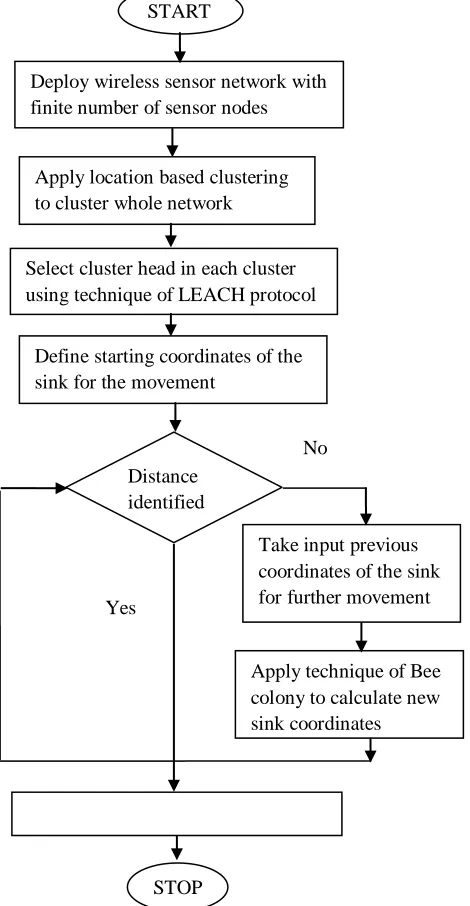
Figure 1: Flow chart of proposed work START
Deploy wireless sensor network with finite number of sensor nodes
Apply technique of Bee colony to calculate new sink coordinates Apply location based clustering
to cluster whole network
Select cluster head in each cluster using technique of LEACH protocol
Define starting coordinates of the sink for the movement
Distance identified
Take input previous coordinates of the sink for further movement
The step-wise mechanism followed to propose novel design is explained below:
1. The wireless sensor network is deployed with the finite number of sensor nodes and deployed network is divided into fixed size clusters using location based clustering.
2. The cluster head is selected in each clustering using the technique of LEACH protocol in which node which has maximum energy and least distance to the other nodes is selected as the cluster head. The other nodes in the cluster will aggregate its data to the cluster head
3. The coordinates of the sink is defined as the initial population for the sink movement. The sink will check the signal strength and change its location of the basis of initial population and aggregate the data from where it get maximum data
4. This step 3 is repeated until required data get aggregated to base station
Experimental Results
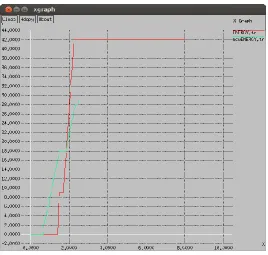
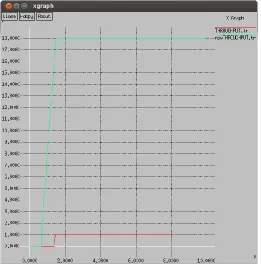
The proposed research is implemented in NS2 and the results are evaluated in terms of comparison graphs as shown below.
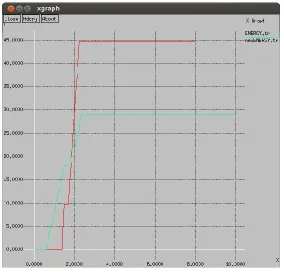
Fig 2: Energy Comparison at node 20
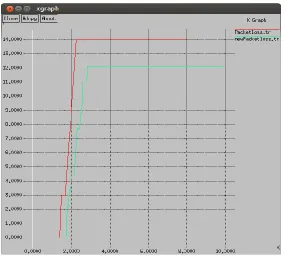
Fig 3: Packet loss Graph at node 20
As shown in figure 3, the packet loss of the proposed and existing scenario is compared. Due to sink base station packet loss is more and when multiple sinks are deployed in the network packet loss is reduced at steady rate in the network.
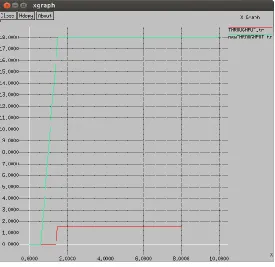
Fig 4: Throughput comparison at node 20
Fig 5: Energy Comparison at node 40
As shown in figure 5, the existing and proposed scenario is compared in terms of energy consumption. In the energy graph it is shown that in the proposed scenario is less due to multiple sink deployment in the network.
As shown in figure 6, the packet loss of the proposed and existing scenario is compared. Due to sink base station packet loss is more and when multiple sinks are deployed in the network packet loss is reduced at steady rate in the network.
Fig 7: Throughput comparison at node 40
As shown in figure 7, the network throughput of the proposed and existing scenario is compared and it is been analyzed that network throughput is increased at steady rate due to multiple sink deployment in the network.
As shown in figure 8, the existing and proposed scenario is compared in terms of energy consumption. In the energy graph it is shown that in the proposed scenario is less due to multiple sink deployment in the network.
Fig 9: Packet loss Graph at node 100
As shown in figure 9, the packet loss of the proposed and existing scenario is compared. Due to sink base station packet loss is more and when multiple sinks are deployed in the network packet loss is reduced at steady rate in the network.
As shown in figure 10, the network throughput of the proposed and existing scenario is compared and it is been analyzed that network throughput is increased at steady rate due to multiple sink deployment in the network.
Conclusion
The aim of the thesis is to develop energy efficient and this work aims to identify the performance of existing single sink mobile technique to reduce energy consumption of the wireless sensor network. To do multiple sinks mobile technique of signal strength and bio-inspired technique to move sinks from one location to another. To improve performance of LEACH protocol for data gathering by deploying multiple sinks. The movements of the sinks are dependent upon the signal strength and bee colony algorithm. By using the proposed technique performance of LEACH protocol is increased. The performance of LEACH protocol is improved by deploying multiple sinks and movement of the sinks are decided using bee colony. By Appling bee colony with LEACH protocol for multiple sink movement various energy parameters are analyzed and compared with existing algorithm. It is seen that energy consumption of the network is reduced and network is performance is increased. The improvement leads to batter data gathering from cluster heads and throughput of the network increased.
References
[1] Oyman, E. I., & Ersoy, C., “Multiple sink network design problem in large scale wireless sensor networks”, In Communications, IEEE International Conference, Vol. 6, pp. 3663-3667, IEEE, 2004.
[2] Sohrabi, K., Gao, J., Ailawadhi, V., & Pottie, G. J., “Protocols for self-organization of a wireless sensor network”, IEEE personal communications, 7(5), 16-27, 2000.
[3] Cheng, Y., Li, H., Wan, P. J., & Wang, X., “Wireless mesh network capacity achievable over the csma/ca mac”, Vehicular Technology, IEEE Transactions on, 61(7), 3151-3165, 2012.
[4] Salzmann, J., Behnke, R., & Timmermann, D., “Hex-MASCLE–hexagon based clustering with self healing abilities”, In Wireless Communications and Networking Conference (WCNC), pp. 528-533, IEEE, 2011.
[5] Xu, J., Jin, N., Lou, X., Peng, T., Zhou, Q., & Chen, Y., “Improvement of LEACH protocol for WSN”, In Fuzzy Systems and Knowledge Discovery (FSKD), 2012 9th International Conference, pp. 2174-2177, IEEE, 2012.
[6] Younis, O., Krunz, M., & Ramasubramanian, S., “Node clustering in wireless sensor networks: recent developments and deployment challenges”, Network, IEEE, 20(3), 20-25, 2006.
[7] Sharma, S., & Kaur, B., “Literature and Solution to packet collision in network in wireless communication”, Networks, 2010.
[8] Jiang, L., Bing Fang, & Li., “Energy optimized approach based on clustering routing protocol for wireless sensor networks”, CCD Conference, IEEE, 2013.
[9] Wang, Y., & Guo, S., “Optimized energy-latency cooperative transmission in duty-cycled wireless sensor networks”, In Mechatronics and Automation (ICMA), 2013 IEEE International Conference on (pp. 185-190), IEEE, 2013.
[10] Rai, M., K., D., (2013) “Dynamic Clustering in Wireless Sensor Network using Neural Network”, International Journal for Advance Research in Engineering and Technology Vol. 1, Issue II , ISSN 2320-6802.
[11] Kaur, K., & Kumari, N., “Evaluation and Analysis of Active RFID Protocol in Wireless Sensor Networks”, International Journal of Innovative Technology and Exploring Engineering (IJITEE), Volume-4 Issue-2, July 2014.
[12] Zhang, D., Li, G., Zheng, K., Ming, X., & Pan, Z. H., “An Energy-Balanced Routing Method Based on Forward-Aware Factor for Wireless Sensor Networks”, Industrial Informatics, IEEE Transactions on, 10(1), 766-773, 2014.