Small Prime Difference
?Mengce Zheng1,2, Noboru Kunihiro2, and Honggang Hu1
1
University of Science and Technology of China, China
The University of Tokyo, Japan
Abstract. In this paper, we study the security of multi-prime RSA with small prime dif-ference and propose two improved factoring attacks. The modulus involved in this variant is the product ofrdistinct prime factors of the same bit-size. Zhang and Takagi (ACISP 2013) showed a Fermat-like factoring attack on multi-prime RSA. In order to improve the previous result, we gather more information about the prime factors to deriversimultaneous modular equations. The first attack is to combine all the equations and solve one multivariate equa-tion by generic lattice approaches. Since the equaequa-tion form is similar to multi-primeΦ-hiding problem, we propose the second attack by applying the optimal linearization technique. We also show that our attacks can achieve better bounds in the experiments.
Keywords: Cryptanalysis·Multi-prime RSA·Small prime difference·Factoring attack·
Lattice-based linearization technique
1 Introduction
1.1 Background
RSA [22] is a famous public key cryptosystem that has been widely used in various settings. However, the original RSA is not fit for some constrained environments. Since people need faster and more efficient RSA encryption/decryption processes, several variants have been proposed and surveyed [3]. In this paper, we focus on a variant called multi-prime RSA. It is described as follows.
Key Generation. Generater distinct primesp1, p2, . . . , prof same bit-size and modulus
N =Qr
i=1pi. Pick a random number that is coprime to ϕ(N) = Qri=1(pi−1) as the public key eand compute the corresponding private keyd=e−1modϕ(N).
Encryption. Transform the message string into an integer M ∈ ZN and compute the ciphertext as C=MemodN.
Decryption. Compute Mi = Cdi modpi for di = dmod (pi−1), 1 ≤ i ≤ r. Combine
Mi’s by the Chinese Remainder Theorem to obtain the plaintext M =CdmodN. This variant modifies the modulus toN =p1p2· · ·prforr ≥3. It was patented by Compaq [5], using a modulus of the form N =p1p2p3. We then discuss the performance of multi-prime RSA. The advantage is the efficiency when using Chinese Remainder Theorem in its decryption process. From [3], we know that the asymptotic speedup over the standard RSA is approximately r42. Moreover, ordinary attacks such as small private exponent attack and partial key exposure attack are less effective as r increases. But r should not be unrestrictedly large because of the Elliptic Curve Method [20]. Since factoring a multi-prime RSA modulus using ECM is much easier with increasingr, one might chooser= 3, 4 and 5 for most settings. Generally speaking, multi-prime RSA with appropriater might be a practical alternative for reducing the decryption costs.
Without loss of generality, we have the following assumption for a multi-prime RSA modulusN withr prime factorsp1 < p2<· · ·< pr,
1 2N
1
r < p1< N 1
r < pr<2N 1 r.
It indicates that the prime factors are balanced, which means that they are roughly of the same bit-size. The prime difference∆is defined as
∆:= max
i6=j |pi−pj|=pr−p1 =N γ
for 0< γ < 1r. The security of multi-prime RSA has been investigated for small private exponent [4,13,14] and for small prime difference [1,24,27,28].
Prime difference was introduced by de Weger [11] to show that one can find an enhanced small private exponent attack with small prime difference. As for multi-prime RSA, it is also applied to obtain some improvements. Thereafter we review some related previous attacks. Suppose thatN is a multi-prime RSA modulus with r prime factors. Lete≈N
be a valid public key andd=Nδ be its corresponding private key.
Bahig-Bhery-Nassr [1]. Given the prime difference ∆=Nγ and the public key (N, e), then multi-prime RSA is insecure ifγ and dsatisfy
2d2+ 1< N 2 r−γ
6r .
Zhang-Takagi [27,28]. Given the prime difference ∆= Nγ and the public key (N, e), thendcan be probabilistically found in time polynomial in logN ifγ and δ satisfy
δ <1−
r
1 +γ−2
r.
The bound was later refined to
δ <1−
r
1 + 2γ− 3
r forγ ≥
3 2r −
1 +δ
4 ,
δ < 3 r −
1
4 −2γ forγ < 3 2r −
1 +δ
4 . They also presented a Fermat-like factoring attack for
γ < 1 r2.
Takayasu-Kunihiro [24]. Given the prime difference∆=Nγ and the public key (N, e), thendcan be probabilistically found in time polynomial in logN ifγ and δ satisfy
δ <1−
r
1 + 2γ−3
r for 3 2 1 r − 1 4
≤γ < 1 r,
δ <1−2
3
s
7 + 8γ−12
r 1 + 2γ−
3
r
−1−2γ+3
r !
forγ < 3
2 1 r − 1 4 .
1.2 Our Contributions
In this paper, we aim to factor the multi-prime RSA modulus with small prime difference. More concretely,N can be factored in polynomial time under which condition when given the multi-prime RSA modulus N that is the product of r distinct primes and its prime differenceNγ.
Let xi = pi−p for i= 1,2, . . . , r with |xi|= |pi−p| < pr−p1 =Nγ for p = [N
1 r].
At ACISP 2013, Zhang and Takagi [27] solvedxi from each equation and computed prime factors bypi =xi+p. In our opinion, they only made use of partial advantage about given information. In contrast, we transform the knowledge of all balanced prime factors with prime difference into the following system of equations,
x1+p=p1,
x2+p=p2, .. .
xr+p=pr.
Furthermore, we can derive the following system of modular equations,
x1+p= 0 modp1,
x2+p= 0 modp2, ..
.
xr+p= 0 modpr.
Our factoring problem is somewhat similar to multi-primeΦ-hiding problem introduced by Kiltz et al. [18] because of the modular equation form. The definition of multi-prime
Φ-hiding problem is given. Let N =p1· · ·pr be a composite integer (of unknown factor-ization) with r distinct prime factors of same bit-size. Given N and a prime e, decide whetheredividespi for 1≤i≤r−1 or not.
In order to solve multi-prime Φ-hiding problem, one can try to solve the following simultaneous equations and then conclude thateisΦ-hidden inN or not.
ex1+ 1 = 0 modp1,
ex2+ 1 = 0 modp2, ..
.
exr−1+ 1 = 0 modpr−1.
There exist some differences between these two problems. In Φ-hiding problem, since it is not necessary to know the exact values of the unknowns but enough to know if the equations can be solved, one can perform a linearization on the product
r−1
Y
i=1
(exi+ 1)
and then decide if Qr−1
Another difference is that we do not have exr+ 1 = 0 modpr in Φ-hiding problem. This special feature can be applied to improve the bound [26]. However we can not directly use the same technique to solve the factoring problem.
Our improvements are based on two ideas. The first one is a direct method by gath-ering all the equations together to solve an r-variate modular (or integer) equation. The drawback of this method is that the running time is exponential in r. Thus, we provide an optimized method by combining fewer equations. Inspired by Tosu and Kunihiro [25], we can benefit from the optimal linearization technique with fewer unknowns and less cost. Thus, we will tobtain a great speedup and efficient performance in the practical implementation.
We show that multi-prime RSA modulus with small prime difference can be efficiently factored in the following cases due to variousr’s.
– Forr = 3, we have
γ < 2 r(r+ 2). – Forr >3 with an optimal l, we have
γ < 2 l+ 1
1
r l+1l
.
– For much largerr with the base of natural logarithm e, we have
γ < 2
er(logr+ 1). 1.3 Organization
The rest of this paper is organized as follows. In Sect.2, we introduce the lattice-based method to solve modular and integer equations. In Sect. 3, we present our improved factoring attacks on multi-prime RSA with small prime difference. In Sect. 4, we verify our attacks by various experiments and comparisons. We conclude the paper in Sect.5.
2 Preliminaries
2.1 Lattice-Based Method
We briefly introduce lattice-based method including the LLL algorithm [19], Coppersmith’s technique [6,7,8], Howgrave-Graham’s lemma [15] and Coron’s reformulation [9,10].
The technique is to construct a set of polynomials modulo R sharing the common roots and then reduce them to the equations over the integers. After transforming known parameters into constructed polynomials’ coefficients that form a lattice basis matrix with dimensionw. One can compute some short lattice vectors whose norm is expected to be sufficiently small by the LLL algorithm. Eventually, one can solve the desired roots. The LLL algorithm proposed by Lenstra, Lenstra and Lov´asz is practically used for finding approximately small lattice vectors.
Lemma 1 (Lenstra-Lenstra-Lov´asz [19]). Let L be a given lattice with determinant
det(L). The LLL algorithm outputs a reduced basis (v1,v2, . . . ,vw) in polynomial time,
and for1≤i≤w, the reduced basis vectors satisfy
kv1k,kv2k, . . . ,kvik ≤2
w(w−1)
The following lemma given by Howgrave-Graham helps us to judge whether the roots of a modular equation are also roots over the integers. To a given polynomial ofnvariables
g(x1, . . . , xn) =
X
ai1,...,inx
i1
1 · · ·xinn, its norm is defined askg(x1, . . . , xn)k2 :=P|ai1,...,in|
2.
Lemma 2 (Howgrave-Graham [15]). Let g(x1, . . . , xn) ∈ Z[x1, . . . , xn] be an integer
polynomial that is a sum of at most m monomials. Suppose that
1. kg(x1X1, . . . , xnXn)k ≤R/
√
m,
2. g(x(0)1 , . . . , x(0)n ) = 0 modR for |x(0)1 | ≤X1, . . ., |x(0)n | ≤Xn.
Then we haveg(x(0)1 , . . . , x(0)n ) = 0 over the integers.
The above fundamental lemmas give us the final condition, which is roughly det(L)< Rw.
Some RSA cryptanalytic applications [2,8,12] are derived from such lattice-based method. But Boneh and Durfee [2] have noted that solving multivariate equations is heuristic because the polynomials derived from lattice reduction algorithms are not guaranteed to be algebraically independent. In order to extract the exact roots in practice, we rely on the following assumption.
Assumption 1. The polynomials derived from the LLL algorithm in lattice-based method are algebraically independent. Furthermore, the solution can be efficiently found by Gr¨obner basis computations.
Our improved attacks can be reduced to solving multivariate linear equations that was studied by Herrmann and May.
Lemma 3 (Herrmann-May [12]).Let >0 and letN be a sufficiently large composite integer (of unknown factorization) with a divisorp≥Nβ. Furthermore, letf(x1, . . . , xn)∈
Z[x1, . . . , xn]be a linear polynomial in nvariables. Under Assumption1, we can find
solu-tions(x(0)1 , . . . , x(0)n )of the equationf(x1, . . . , xn) = 0 modpwith|x(0)1 | ≤Nη1, . . . ,|x (0) n | ≤
Nηn if
n
X
i=1
ηi≤1−(n+ 1)(1−β) +n(1−β)
n+1 n −.
The running time is polynomial inlogN and(e/)n.
The lattice-based algorithm for solving modular equations was later improved by Lu et al. [21] and Takayasu and Kunihiro [23].
Oppositely, we can solve anr-variate integer polynomialf(x1, . . . , xr) by the following lemma. LetXi for positive integerN and real positive numberηi be the upper bounds on the unknown variables fori= 1,2, . . . , r. We also definekf(·)k∞ as the largest coefficient (in absolute value form) of all the monomials in polynomialf(·).
Lemma 4 (Jochemsz [16]). Given an r-variate integer polynomial
f(x1, x2, . . . , xr) = r
Y
i=1
For any > 0 with sufficiently large N and W = kf(x1X1, x2X2, . . . , xrXr)k∞, the root (x(0)1 , x(0)2 , . . . , x(0)r ) satisfying |x(0)i | ≤Xi for i= 1,2, . . . , r can be found if
X1X2· · ·Xr < W
2 r+1−.
The running time is polynomial inlogN and(1/)r.
One can refer to [16] for detailed analysis. One special case was showed by Coppersmith in [8] for finding the boundXY < W23 of the polynomialf(x, y) = (p0+x)(q0+y)−N in
order to factor the modulusN with known bits of prime factors. Later, Jochemsz [16,17] provided a generic strategy for finding roots of integer (and also modular) polynomials. Since our cryptanalysis is based on approximations, we neglect the lower order terms and remove in our methods for simplicity.
2.2 Some Notations
We introduce the following notations for our methods.
– p denotes the value of rounding N1r to the nearest integer and it is mentioned above
asp= [N1r].
– σik denotes the elementary symmetric polynomial in k variables y1, . . .,yk of degree i and it is defined by
σik:= X
λ⊂{1,2,...,k},|λ|=i
Y
j∈λ
yj
.
– Qkdenotes the product ofkprime factors that are chosen fromp1, p2, . . . , prand hence
Qk is a divisor ofN.
– Q0k denotes the numerical value of the left side after solving the equation and hence
Q0k is a multiple of Qk.
3 Improved Factoring Attacks
3.1 The Direct Method
As mentioned before, we gather all the equations together to solve an r-variate modular (or integer) equation. More concretely, we present the following factoring attack.
Proposition 1. Let N =p1· · ·pr be a multi-prime RSA modulus for p1 <· · · < pr and
pr −p1 = Nγ for 0 < γ < 1r. Then under Assumption 1, N can be factored in time
polynomial inlogN but exponential inr if γ < 2
r(r+ 1).
Our approach utilizes the equation form of multi-primeΦ-hiding problem. Letebe the inverse ofp modulo N, namelye=p−1 modN. Then yi+p= 0 modpi can be rewritten aseyi+ 1 = 0 modpi and we obtain
ey1+ 1 = 0 modp1, ..
.
Combining all equations together gives us r
Y
i=1
(eyi+ 1) = r
X
i=1
eiσri + 1 = 0 modN.
We have e = p−1 modN that is equivalent to ep = 1 modN. It can be reduced to
Pr
i=1eiσri +ep= 0 modN and further r
X
i=1
ei−1σir+p= 0 modN.
Regarding eachσri as a new variable makes Pr
i=1e i−1σr
i +p a linear equation. We then figure out each ηi of |σir|< Nηi fori= 1, . . . , r and apply Lemma 3 withβ = 1. It is not hard to know thatηi =iγ for 1≤i≤r. Thus, the final condition is Pri=1iγ <1, which can be simplified to
γ < 2 r(r+ 1).
After solving the linear equation, we obtain the values of σr
1, . . . , σrr. Then we extract
x1, . . . , xrby solvingxr−σ1rxr−1+· · ·+(−1)rσrr= 0 over the integers. Finally, we compute the prime factorsp1, . . . , pr forpi =xi+p. The full description of the algorithm is given below.
Algorithm 1
Input: Multi-prime RSA modulusN withrand small prime differenceNγ.
Output: The factorizationN =p1· · ·pr.
1: Computep= [Nr1] ande=p−1modN.
2: Construct the linear modular equation with unknown variablesσr i:
σr1+e 1
σr2+· · ·+e r−1
σrr+p= 0 modN.
3: Figure outηi’s that are related to the boundsNηi onσir for 1≤i≤r:
|σri|< N iγ
.
4: Extract eachσri by applying Lemma3.
5: Solvexr−σr 1x
r−1+· · ·+ (−1)rσr
r = 0 over the integers.
6: Setpi=p+xiin increasing order with rootsxi for 1≤i≤r.
However, we observe that the experimental results are always a certain distance away from the asymptotic predictions. In this case, solving an integer polynomial gives us a more precise and credible condition. Thus, we present a revised and corrected factoring attack.
Proposition 2. Let N =p1· · ·pr be a multi-prime RSA modulus for p1 <· · · < pr and
pr −p1 = Nγ for 0 < γ < 1r. Then under Assumption 1, N can be factored in time
polynomial inlogN but exponential inr if γ < 2
r(r+ 2). In fact, we have
f(x1, x2, . . . , xr) = r
Y
i=1
(xi+p)−N = r
Y
i=1
fpi(xi)−N =
r
Y
i=1
Before we apply Lemma4to above polynomial, we must figure outηi(satisfyingXi =Nηi) fori= 1, . . . , randW. It is clear thatηi =γ since|xi|=|pi−p|< pr−p1 =Nγ. However, it may be a little complicated forW. We roughly have W = max{N−pr, pr−1Nγ}by its definition. Since all primes have a small differenceNγ,N andpr differ from each other in
Nγr least significant bits. Hence, it can be easily inferred that
W = max{Nγr, Nr−r1+γ}=N r−1
r +γ.
From Lemma4, the condition reduces to (we omit the tiny term )
γr < 2 r+ 1
r−1
r +γ
,
that is
γ
r(r+ 1)
2 −1
< r−1 r .
Thus, the final condition is
γ < 2 r(r+ 2).
For the completeness, we provide the concrete lattice construction for solving above integer polynomial
f(x1, x2, . . . , xr) = r
Y
i=1
(xi+p)−N. Define two setsS andSR for a positive integers s.
S =[ nxi1
1 x i2
2 · · ·xirr :x i1
1 x i2
2 · · ·xirr is a monomial off s−1o,
SR=
[ n xi1
1 x i2
2 · · ·x ir
r :xi11x i2
2 · · ·x ir
r is a monomial offs
o .
By calculating the expansion offs−1 (and fs), we know the relation of every element in
S (andSR) to its exponentij forj = 1,2, . . . , r.
xi1
1x i2
2 · · ·xirr ∈S:ij = 0, . . . , s−1, forj= 1,2, . . . , r,
xi1
1x i2
2 · · ·x ir
r ∈SR:ij = 0, . . . , s, forj= 1,2, . . . , r. ForR=W Qr
i=1X s−1 i =N
r−1
r +γ+γr(s−1), we define f0 = (pr−N)−1f modR
and the following shift polynomials,
g:xi1
1x i2
2 · · ·xirrf
0· R
WQr
j=1X ij
j
, forxi1
1x i2
2 · · ·xirr ∈S,
g0:xi1
1x i2
2 · · ·x ir
r ·R, forxi11x i2
2 · · ·x ir
r ∈SR\S.
Notice that above shift polynomialsg and g0 modulo R are equal to zero. Afterwards, we use the LLL algorithm to search several integer linear combinations of g and g0, whose norm is ensured to be sufficiently small. (This has been mentioned in Sect.2.) The lattice
Table 1.A toy example of the lattice basis matrix fors= 1 andr= 3 1 x1 x2 x3 x1x2 x1x3 x2x3 x1x2x3
g0,0,0 1 – – – – – – –
g01,0,0 RX1
g00,1,0 RX2
g00,0,1 RX3
g01,1,0 RX1X2
g01,0,1 RX1X3
g00,1,1 RX2X3
g01,1,1 RX1X2X3
Before showing an example of such a basis matrix, we first define the monomial order
≺in our method as xi1
1 x i2
2 · · ·xirr ≺ x j1
1 x j2
2 · · ·x jr
r ifi1+i2+· · ·+ir < j1+j2+· · ·+jr orPr
k=1ik =Prk=1jk,Ptk=1ik >Ptk=1jk for t= 1,2, . . . , r−1. Then a toy example is showed in Table1, where non-zero off-diagonal entries are marked by –.
When the condition is satisfied and a suitablesis chosen, we can obtain many integer equations apart fromf. Moreover, they share a common root (p1−p, p2−p, . . . , pr−p) over the integers. We can solvepi for 1≤i≤r under Assumption 1, which directly lead to the factorization ofN. The description of the algorithm is similar to Algorithm 1, so we omit it here.
The running time depends on reducing the basis matrix and extracting the common roots. The LLL algorithm can output the desired polynomials in time polynomial in logN
but exponential in r. This may be a drawback due to large r and forces us to find more efficient method. The Gr¨obner basis computation for finding the common roots is usually polynomial time in practice. Additionally, one can obtain more polynomials derived from the LLL algorithm and hence the Gr¨obner basis computation is suggested rather than resultant computation.
3.2 The Optimized Method
As described in the direct method, we still solve the factoring problem in the view of a “search”-form problem. Its drawback is that the time complexity is exponential in r. Consequently, the factoring attack becomes less efficient for largerr.
When considering taking fewer equations to form one modular equation, we have some interesting observations. We randomly choosek(2≤k≤r−1) equations and obtain a new equationF(y1, . . . , yk) = 0 modQk. Fortunately, it is enough to know the numerical value
Q0k of the left side and not necessary to know exact values of y1, . . . , yk. Then, computing the greatest common divisor gcd (Q0k, N) gives us all combinations ofk prime factors that indicate every prime factor.
In fact, the factoring problem is refined to become of “decision”-form. Thus, we can employ the optimal linearization similar to the technique proposed by Tosu and Kunihiro [25] when solving multi-prime Φ-hiding problem. The idea is to examine all possible lin-earization cases to find the optimal setting when it can be efficiently solved. We present the optimized factoring attack below.
Proposition 3. Let N =p1· · ·pr be a multi-prime RSA modulus for p1 <· · · < pr and
pr −p1 = Nγ for 0 < γ < 1r. Then under Assumption 1, N can be factored in time
polynomial inlogN with an optimal l if
γ < 2 l+ 1
1
r l+1
We consider combining k equations and performing a linearization of l (2 ≤ l ≤ k) variables. Note that the parameters k and l need to be decided later. First, we have (y1+p)(y2+p)· · ·(yk+p) = 0 modQk. It can be rewritten as
k
X
i=0
pk−iσik= 0 modQk.
The expansion is
σkk+pσk−1k +p2σk−2k +· · ·+pk = 0 modQk.
Then, we apply a linearization for the case of l variables. Let t1, . . . , tl+1 be the integers satisfyingt1 =k > t2 >· · ·> tl+1= 0.We obtain
pk−t1u
1+pk−t2u2+· · ·+pk−tlul+pk= 0 modQk, where
ui:= ti X
j=ti+1+1
pti−jσk
j
for 1≤i≤l. For |yi|< Nγ,p≈N
1
r and γ < 1
r, we know that the bound is
|ui|< N
ti−ti+1−1
r +(ti+1+1)γ.
In other words, we have
ηi =
ti−ti+1−1
r + (ti+1+ 1)γ.
Thus, we can find the roots of the linear equation by Lemma3withβ = kr and aboveηi if n
X
i=1
ηi <1−(l+ 1)(1−β) +l(1−β)
l+1 l .
Then we have
γ < l·
k+1
r + 1− k r
l+1l
−1
l+Pl
i=2ti
.
The above bound reaches its maximum by setting (t1, t2, t3, . . . , tl) to be (k, l−1, l−2. . . ,1). The condition now is
γ < 2 l+ 1
k+ 1
r +
1−k
r l+1l
−1
!
.
We can further optimize k to obtain the best bound on γ by calculating the derivative on k. It can be verified that k = r −1 is the most suitable choice. Thus, we derive the condition
γ < 2 l+ 1
1
r l+1l
.
It means that we need to solve
u1+pr−lu2+· · ·+pr−2ul+pr−1= 0 modQr−1.
– Forr = 3,4,5, that is
u1+pr−2u2+pr−1 = 0 modQr−1. – Forr = 6,7,8,9,10, that is
u1+pr−3u2+pr−2u3+pr−1 = 0 modQr−1.
As analyzed in [25], we set l≈logr for much largerr and the condition is approximated
γ < 2
er(logr+ 1),
where e is the base of natural logarithm. Therefore, we also present the factoring attack for much largerr.
Proposition 4. Let N =p1· · ·pr be a multi-prime RSA modulus for p1 <· · · < pr and
pr −p1 = Nγ for 0 < γ < 1r. Then under Assumption 1, N can be factored in time
polynomial inlogN for much largerr if
γ < 2
er(logr+ 1).
After solving the modular equation, we obtain the values of u1, . . . , ul. Then we know all combinations ofr−1 prime factors by gcd (Q0r−1, N). Finally, we compute each prime factor by
N
gcd (Q0r−1, N).
Note that the unknown variables ui’s in the optimized method are quite unbalanced. So we can make further improvement by applying better lattice constructions proposed by Takayasu and Kunihiro [23]. The full description of the optimized algorithm and detailed lattice construction are given below.
Algorithm 2
Input: Multi-prime RSA modulusN withrand small prime differenceNγ.
Output: The factorizationN =p1· · ·pr.
1: Computep= [Nr1].
2: Choose an optimallaccording tor.
3: Construct the linear modular equation with unknown variablesui:
u1+p r−l
u2+· · ·+p r−2
ul+p r−1
= 0 modQr−1.
4: Figure outηi’s that are related to the boundsNηionσirfor 1≤i≤lwith known (t1, t2, t3, . . . , tl, tl+1)
= (r−1, l−1, l−2. . . ,1,0):
|ui|< N
ti−ti+1−1
r +(ti+1+1)γ.
5: Extract eachuiby using Takayasu-Kunihiro lattice construction.
6: ComputeQ0r−1=u1+pr−lu2+· · ·+pr−2ul+pr−1 with roots{u1, . . . , ul}.
7: Setpi=N/gcd (Qr−0 1, N) in increasing order for 1≤i≤r.
In Takayasu-Kunihiro lattice construction, we carefully work out the selection of poly-nomials by considering the sizes of root bounds. For example, we deal withu1+pr−2u2+
pr−1= 0 modQr−1 in our optimized method. We use
ui2
as the shift polynomials with positive integers m and t that will be optimized later. The indexes i1 and i2 satisfy 0 ≤i1+i2 ≤m and 0≤γ1i1+γ2i2≤ r−1r tin order to select as many helpful polynomials as possible and to let the basis matrix be triangular.
Thus, the shift polynomials modulopthave the common roots foru1 and u2. We span a lattice by the coefficient vectors of above shift polynomials and the equations are derived from the reduced LLL basis vectors. The small roots can be easily recovered by Gr¨obner basis computation.
Note that we can find all prime factors by solving the linear equation once because every combination (or product) of r−1 prime factors is equivalent to each other. Using
l≈logr implies that our method works in time polynomial in logN and r.
3.3 Discussions
Compared with the direct method, we have two improvements in our optimized method. Firstly, we decrease the number of unknown variables and significantly improve the prac-tical performance for largerr. Secondly, we can achieve a better bound for much larger r
at the same time. But for smaller r, the direct method offers a higher bound and hence the factoring attack still stays in polynomial time.
Note that the unknown variables ui’s in the optimized method are quite unbalanced and we apply Takayasu-Kunihiro lattice constructions [23]. Here we omit the complicated analysis and show another advantage. Forr≤10, the optimallis always 2. It means that the final equation we need to solve in the optimized method is
u1+pr−2u2+pr−1= 0 modQr−1.
Thus, we further reduce the running time of the optimized factoring attack.
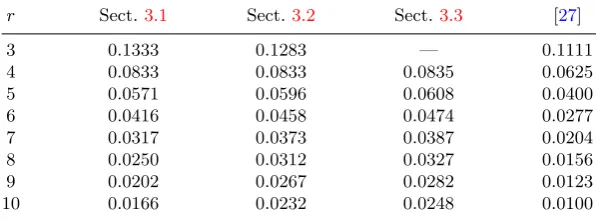
Table2shows the comparison of the upper bounds onγ due to above factoring attacks forr ≤10. The fourth column provides the results using better lattice construction that is discussed above. It is visible that our methods are superior.
Table 2.The comparison of the upper bounds onγ due to distinct factoring attacks
r Sect.3.1 Sect.3.2 Sect.3.3 [27]
3 0.1333 0.1283 — 0.1111
4 0.0833 0.0833 0.0835 0.0625
5 0.0571 0.0596 0.0608 0.0400
6 0.0416 0.0458 0.0474 0.0277
7 0.0317 0.0373 0.0387 0.0204
8 0.0250 0.0312 0.0327 0.0156
9 0.0202 0.0267 0.0282 0.0123
10 0.0166 0.0232 0.0248 0.0100
4 Experimental Results
We now state some experimental results to show the practical performance of our methods. These experiments are carried out under Sage 7.3 running on a laptop with Intel Core i7 CPU 2.70 GHz and 8 GB RAM. The numbers we used are chosen uniformly at random and Assumption1 is found to hold for the experiments.
satisfying our requirements. In other words, we obtain enough sufficiently short vectors after running the LLL algorithm. Hence, we extract the common roots by Gr¨obner basis computation and finally attain the factorization of multi-prime RSA modulus.
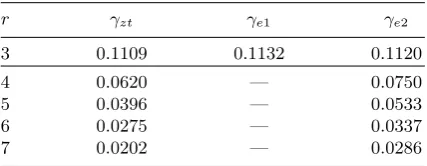
We provide the experimental results on two attacks according to Sect.3.1and Sect.3.2
(actually refined by Sect.3.3), namely the γe1-column andγe2-column, respectively. The
γzt-column provides the experimental bound of Zhang-Takagi method. The results about the comparison are showed in Table3.
Table 3.The experimental results of the upper bounds onγ
r γzt γe1 γe2
3 0.1109 0.1132 0.1120
4 0.0620 — 0.0750
5 0.0396 — 0.0533
6 0.0275 — 0.0337
7 0.0202 — 0.0286
We firstly comment the experiments for r = 3. We reduce a 220-dimensional lattice for the direct method while we use a lattice whose dimension is 300 for the optimized method. A 1536-bit multi-prime RSA modulus can be successfully factored by a 174-bit prime difference by the direct method. While using the optimized method, a 172-174-bit difference leads to the factorization of a 1536-bit modulus. Thus, we conclude that the direct method performs better forr= 3 with roughly similar lattice setting. On the other hand, we observe that the optimized method runs much faster, which is predicted above. For 4≤r ≤7, we use the optimized method with lattices whose dimension is around 300 since it is more efficient. We carry out experiments for much smaller moduli with almost the same lattice setting and they work much better. We also do experiments for moduli of the same size with various lattice dimensions forr= 3,4. The results become better as the lattice dimension increases. So the lattice dimension may be a critical limitation that influences the practical performance of lattice-based methods. The optimized bounds for 4 ≤ r ≤ 7 showed in the γe2-column are those observed in the experiments with much smaller moduli.
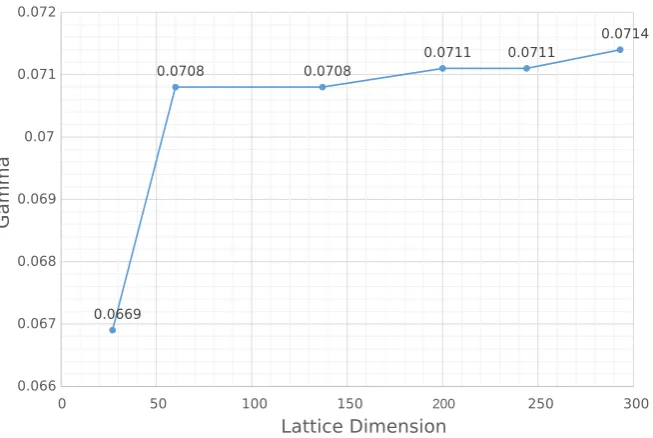
More details about the experimental results are showed below. Firstly, as showed in Fig. 1 and Fig. 2, upper bound on γ gets better when the lattice dimension increases. For the direct method, upper bound on γ remains stable when the lattice dimension is between 50 and 170. For the optimized method, the value is between 60 and 300.
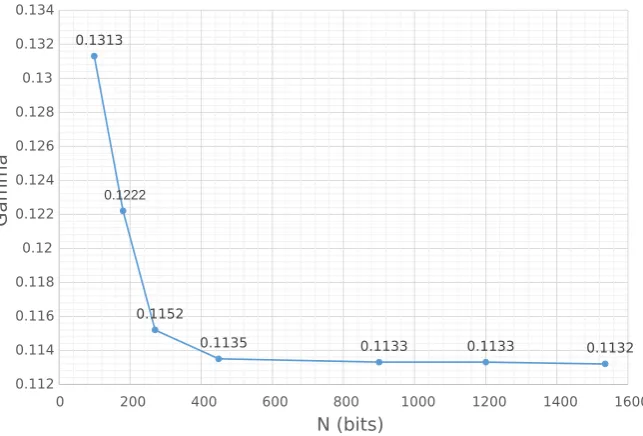
We then show the experimental results forr= 3 using the direct method in Fig. 3. As the size of the modulus increases,γ finally arrives around 0.113. This value is beyond the asymptotic bound 19 of previous Zhang-Takagi method.
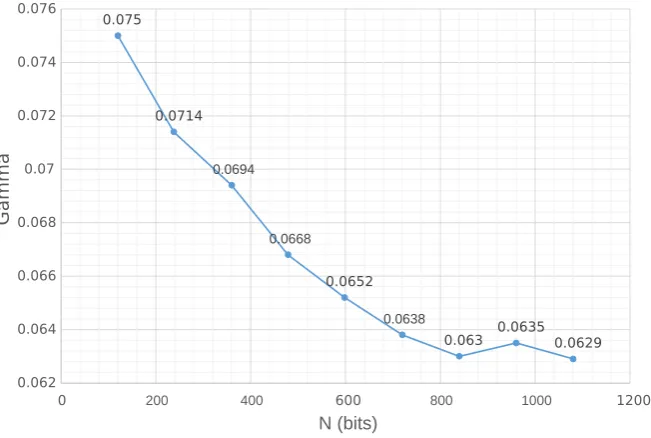
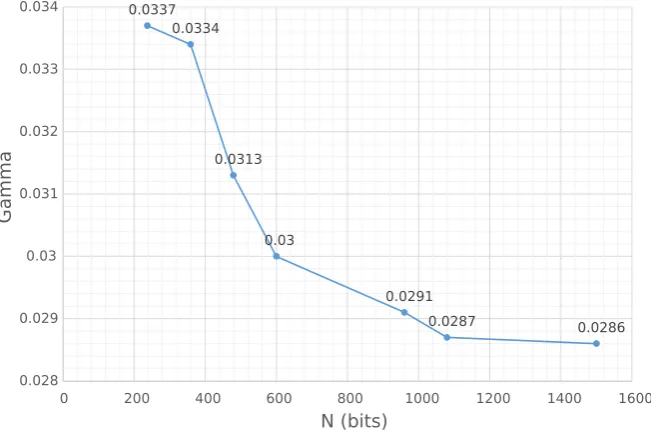
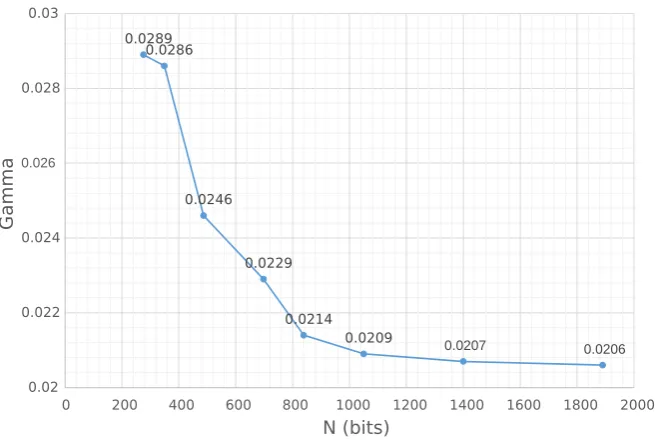
The remaining graphs are related to the experiments for 3≤r≤7 with various moduli using the optimized method. The lattice dimension of each experiment is set around 300. From Fig. 4, Fig. 5, Fig. 6, Fig. 7 and Fig. 8, we find that upper bound on γ is higher for smaller modulus and then goes to a lower value. Also it will finally arrive at a certain value that may be determined by the lattice dimension.
prime factor of less than 160-bit. To obtain desired upper bounds, we need to apply some lattices with huge dimension.
0.11660.1166
0.1173 0.1173 0.1173
0.1222
0.116 0.117 0.118 0.119 0.12 0.121 0.122 0.123
0 50 100 150 200 250
Gamma
Lattice Dimension
Fig. 1.The experimental results of upper bound onγwith various lattice dimensions and the same bit-size moduli forr= 3 using the direct method
5 Conclusions
Factoring attack works better than small private exponent attack on multi-prime RSA with much smaller prime difference, and the former removes the restriction on the private exponents. We further upgrade the insecure bound on the prime difference and propose improved factoring attacks based on lattice approach and the optimal linearization tech-nique.
To summarize, our factoring attacks make significant improvements by taking full knowledge of the small prime difference. We combine more equations rather than only one equation to solve the factoring problem. Furthermore, applying the optimal linearization technique on unknown variables helps us to reduce the time cost and obtain better results. For our factoring attacks on multi-prime RSA modulus with r primes, solving an r -variate linear equation constructed byr simultaneous modular equations is preferred for
r= 3. And solving an l-variate (that depends on r) linear equation constructed byr−1 equations is preferred forr >3. Both factoring attacks can be done in polynomial time. Acknowledgments. The first author was financially supported by China Scholarship Council Grant No. 201606340061. This research was partially supported by JST CREST Grant Number JPMJCR14D6, Japan and JSPS KAKENHI Grant Number 16H02780, and National Natural Science Foundation of China (Grant Nos. 61522210, 61632013).
References
0.0669
0.0708 0.0708
0.0711 0.0711
0.0714
0.066 0.067 0.068 0.069 0.07 0.071 0.072
0 50 100 150 200 250 300
Gamma
Lattice Dimension
Fig. 2.The experimental results of upper bound onγwith various lattice dimensions and the same bit-size moduli forr= 4 using the optimized method
2. Boneh, D., Durfee, G.: Cryptanalysis of RSA with private keydless thanN0.292. IEEE Transactions on Information Theory 46(4), 1339–1349 (2000)
3. Boneh, D., Shacham, H.: Fast variants of RSA. CryptoBytes 5(1), 1–9 (2002)
4. Ciet, M., Koeune, F., Laguillaumie, F., Quisquater, J.J.: Short private exponent attacks on fast variants of RSA. Tech. rep., UCL Crypto Group Technical Report Series CG-2002/4, Universit´e Catholique de Louvain (2002)
5. Collins, T., Hopkins, D., Langford, S., Sabin, M.: Public key cryptographic apparatus and method (1997), US Patent#5,848,159
6. Coppersmith, D.: Finding a small root of a bivariate integer equation; factoring with high bits known. In: Maurer, U. (ed.) EUROCRYPT 1996. LNCS, vol. 1070, pp. 178–189. Springer, Heidelberg (1996) 7. Coppersmith, D.: Finding a small root of a univariate modular equation. In: Maurer, U. (ed.)
EURO-CRYPT 1996. LNCS, vol. 1070, pp. 155–165. Springer, Heidelberg (1996)
8. Coppersmith, D.: Small solutions to polynomial equations, and low exponent RSA vulnerabilities. Journal of Cryptology 10(4), 233–260 (1997)
9. Coron, J.S.: Finding small roots of bivariate integer polynomial equations revisited. In: Cachin, C., Camenisch, J.L. (eds.) EUROCRYPT 2004. LNCS, vol. 3027, pp. 492–505. Springer, Heidelberg (2004) 10. Coron, J.S.: Finding small roots of bivariate integer polynomial equations: A direct approach. In:
Menezes, A. (ed.) CRYPTO 2007. LNCS, vol. 4622, pp. 379–394. Springer, Heidelberg (2007) 11. De Weger, B.: Cryptanalysis of RSA with small prime difference. Applicable Algebra in Engineering,
Communication and Computing 13(1), 17–28 (2002)
12. Herrmann, M., May, A.: Solving linear equations modulo divisors: On factoring given any bits. In: Pieprzyk, J. (ed.) ASIACRYPT 2008, LNCS, vol. 5350, pp. 406–424. Springer, Heidelberg (2008) 13. Hinek, M.J.: On the security of multi-prime RSA. Journal of Mathematical Cryptology 2(2), 117–147
(2008)
14. Hinek, M.J., Low, M.K., Teske, E.: On some attacks on multi-prime RSA. In: Nyberg, K., Heys, H. (eds.) SAC 2002. LNCS, vol. 2595, pp. 385–404. Springer, Heidelberg (2003)
15. Howgrave-Graham, N.: Finding small roots of univariate modular equations revisited. In: Darnell, M. (ed.) Crytography and Coding. LNCS, vol. 1355, pp. 131–142. Springer, Heidelberg (1997)
16. Jochemsz, E.: Cryptanalysis of RSA variants using small roots of polynomials. Ph.D. thesis, Technische Universiteit Eindhoven (2007)
17. Jochemsz, E., May, A.: A strategy for finding roots of multivariate polynomials with new applications in attacking RSA variants. In: Lai, X., Chen, K. (eds.) ASIACRYPT 2006. LNCS, vol. 4284, pp. 267–282. Springer, Heidelberg (2006)
0.1313
0.1222
0.1152
0.1135 0.1133 0.1133 0.1132
0.112 0.114 0.116 0.118 0.12 0.122 0.124 0.126 0.128 0.13 0.132 0.134
0 200 400 600 800 1000 1200 1400 1600
Gamma
N (bits)
Fig. 3. The experimental results of upper bound onγ with various moduli for r = 3 using the direct method
19. Lenstra, A.K., Lenstra, H.W., Lov´asz, L.: Factoring polynomials with rational coefficients. Mathema-tische Annalen 261(4), 515–534 (1982)
20. Lenstra Jr, H.W.: Factoring integers with elliptic curves. Annals of Mathematics 126(3), 649–673 (1987)
21. Lu, Y., Zhang, R., Peng, L., Lin, D.: Solving linear equations modulo unknown divisors: Revisited. In: Iwata, T., Cheon, J.H. (eds.) ASIACRYPT 2015, LNCS, vol. 9452, pp. 189–213. Springer, Heidelberg (2015)
22. Rivest, R.L., Shamir, A., Adleman, L.: A method for obtaining digital signatures and public-key cryptosystems. Communications of the ACM 21(2), 120–126 (1978)
23. Takayasu, A., Kunihiro, N.: Better lattice constructions for solving multivariate linear equations mod-ulo unknown divisors. In: Boyd, C., Simpson, L. (eds.) ACISP 2013. LNCS, vol. 7959, pp. 118–135. Springer, Heidelberg (2013)
24. Takayasu, A., Kunihiro, N.: General bounds for small inverse problems and its applications to multi-prime RSA. In: Lee, J., Kim, J. (eds.) ICISC 2014. LNCS, vol. 8949, pp. 3–17. Springer, Heidelberg (2014)
25. Tosu, K., Kunihiro, N.: Optimal bounds for multi-primeΦ-hiding assumption. In: Susilo, W., Mu, Y., Seberry, J. (eds.) ACISP 2012, LNCS, vol. 7372, pp. 1–14. Springer, Heidelberg (2012)
26. Xu, J., Hu, L., Sarkar, S., Zhang, X., Huang, Z., Peng, L.: Cryptanalysis of multi-prime Φ-hiding assumption. In: Bishop, M., Nascimento, A.C.A. (eds.) ISC 2016, LNCS, vol. 9866, pp. 440–453. Springer, Heidelberg (2016)
27. Zhang, H., Takagi, T.: Attacks on multi-prime RSA with small prime difference. In: Boyd, C., Simpson, L. (eds.) ACISP 2013. LNCS, vol. 7959, pp. 41–56. Springer, Heidelberg (2013)
28. Zhang, H., Takagi, T.: Improved attacks on multi-prime RSA with small prime difference. IEICE Transactions on Fundamentals of Electronics, Communications and Computer Sciences 97(7), 1533– 1541 (2014)
0.1355
0.1176 0.1166
0.1145
0.1138 0.1133
0.1125 0.112
0.11 0.115 0.12 0.125 0.13 0.135 0.14
0 200 400 600 800 1000 1200 1400 1600
Gamma
N (bits)
Fig. 4.The experimental results of upper bound onγ with various moduli forr= 3 using the optimized method
0.075
0.0714
0.0694
0.0668
0.0652
0.0638 0.063
0.0635 0.0629
0.062 0.064 0.066 0.068 0.07 0.072 0.074 0.076
0 200 400 600 800 1000 1200
Gamma
N (bits)
0.0533
0.0469
0.0423
0.0413 0.04110.0409 0.0408
0.0406
0.04 0.042
0.044
0.046
0.048
0.05 0.052 0.054
0 200 400 600 800 1000 1200 1400 1600
Gamma
N (bits)
Fig. 6.The experimental results of upper bound onγ with various moduli forr= 5 using the optimized method
0.0337 0.0334
0.0313
0.03
0.0291
0.0287 0.0286
0.028 0.029 0.03 0.031 0.032 0.033 0.034
0 200 400 600 800 1000 1200 1400 1600
Gamma
N (bits)
0.0289 0.0286
0.0246
0.0229
0.0214
0.0209 0.0207
0.0206
0.02 0.022 0.024
0.026
0.028 0.03
0 200 400 600 800 1000 1200 1400 1600 1800 2000
Gamma
N (bits)