A Monthly Journal of Computer Science and Information Technology
ISSN 2320–088X
IJCSMC, Vol. 2, Issue. 9, September 2013, pg.296 – 301
RESEARCH ARTICLE
© 2013, IJCSMC All Rights Reserved
296
TRACKING AND ACTIVITY
RECOGNITION THROUGH
CAMERA NETWORKS
P. Ravali
PG student , VGSE
[email protected]
Karimnagar, India
D. Sampath Kumar
HOD,ECE Dept, VGSE
[email protected]
Karimnagar, India
Abstract— We consider the agreement problem over random information networks. In a random network, the existence of an information channel between a pair of unit sat each time instance is probability and independent of other channels; hence, the topology of the network varies over time. In such a frame work, we address the asymptotic agreement for the networked units via notions from stochastic stability. Furthermore, we delineate on the rate of convergence as it relates to the algebraic connectivity of random graphs. In many applications, this is prohibitively expensive, both technically and economically. In this paper, we investigate distributed scene analysis algorithms by leveraging upon concepts of consensus that have been studied in the context of multi-agent systems, but have had little applications in video analysis. Each camera estimates certain parameters based on its own sensed data which is then shared locally with the neighboring cameras in an iterative fashion, and a final estimate is arrived at in the network using consensus algorithms. We specifically focus on two basic problems - tracking and activity recognition. For multi-target tracking in a distributed camera network, we show how the Kalman-Consensus algorithm can be adapted to take into account the directional nature of video sensors and the network topology.
I. INTRODUCTION
Networks of video cameras are being installed in many applications, e.g., surveillance and security, disaster response, environmental monitoring, etc. Currently, most of the data collected by such networks is analyzed manually, a task that is extremely tedious and reduces the potential of the installed networks. Therefore, it is essential to develop tools for analyzing the data collected from these cameras and summarizing the results in a manner that is meaningful to the end user. Tracking and activity recognition are two fundamental tasks in this regard.
In this paper, we develop methods for tracking and activity recognition in a distributed network of cameras. For many applications, for a number of reasons it is desirable that the video analysis tasks be decentralized. For example, there may be constraints of bandwidth, secure trans- mission, and difficulty in analyzing a huge amount of data centrally. In such situations, the cameras would have to act as autonomous agents making decisions in a decentralized manner.
© 2013, IJCSMC All Rights Reserved
297
II. CONSENSUSALGORITHMSFORDISTRIBUTEDESTIMATION
In the multi-agent systems literature, consensus means that the agents reach an agreement regarding a certain quantity of interest that depends on the measurements of all sensors in a network. The network may not be fully connected, so there is no central unit that has access to all the data from the sensors. Consequently, a consensus algorithm is an interaction rule that specifies information exchange between a sensor and its neighbors that guarantees that all the nodes reach a consensus.
A. Brief Review
In a network of agents, consensus can be defined as reaching an agreement through cooperation regarding a certain quantity of interest that depends on the information available to measurements from all agents. An interaction rule that specifies the information exchange between an agent and all of its neighbors in the network and the method by which the information is used, is called a consensus algorithm (or protocol). Cooperation means giving consent to providing one’s state and following a common protocol that serves group objective.
The goals of most consensus algorithms usually include:
1. Validity: The final answer that achieves consensus is a valid answer.
2. Agreement: All processes agree as to what the agreed upon answer was by the end of the process. 3. Termination: The consensus process eventually ends with each process contributing.
4. Integrity: Processes vote only once.
Many consensus algorithms contain a series of events (and related messages) during a decision-making round. Typical events include Proposal and Decision. Here, proposal typically means the communication of the state of each agent and decision is the process of an agent deciding on proposals received from its neighbors after which it is not going to receive any proposal from the neighbors to come a different conclusion.
In our application domain of camera networks, the agents are the cameras and the state vector we are trying to estimate are the position and velocity of a set of targets and the ID of an activity based on a learned dictionary of activities.
The cameras then share local estimates with their neighboring cameras in an iterative fashion, and a final estimate is arrived at in the network using consensus algorithms.
1) Distributed Tracking: There have been recent attempts to achieve dynamic state estimation in a consensus-like manner. In contrast to a central Kalman filter where state information coming from several sensors is fused in a central station, Distributed Kalman Filters (DKF) compute a consensus- based estimate on the state of interest with only point-to-point communication between the sensors. A distributed Kalman filtering (DKF) strategy that obtains consensus on state estimates was presented .The overall performance of this so-called Kalman-Consensus filter has been shown to be superior to other distributed approaches. It is on this DKF strategy that we base our distributed tracking algorithm.
© 2013, IJCSMC All Rights Reserved
298
© 2013, IJCSMC All Rights Reserved
299
Fig. 2. Each sub-figure shows 10 cameras at one of four time instants denoted by k. The track of one target, marked with a box, is shown. All targets are tracked using the Kalman-Consensus filtering approach, but are not marked for clarity.
We tested our approach for tracking in a real camera network composed of 10 PTZ cameras looking over an outdoor area of approximately 10000 sq. feet. In the area under surveil- lance, there were 8 targets in total that were to be tracked using our distributed Kalman-Consensus filtering approach. In our experiment, the measurements (i.e., the observed positions of targets) are obtained using histogram of gradient (HOG) hu- man detector. The association of measurements to targets is achieved based on appearance (color) and motion information. Figure 2 shows the tracking results as viewed by each camera at 4 time instants.
© 2013, IJCSMC All Rights Reserved
300
RESULT
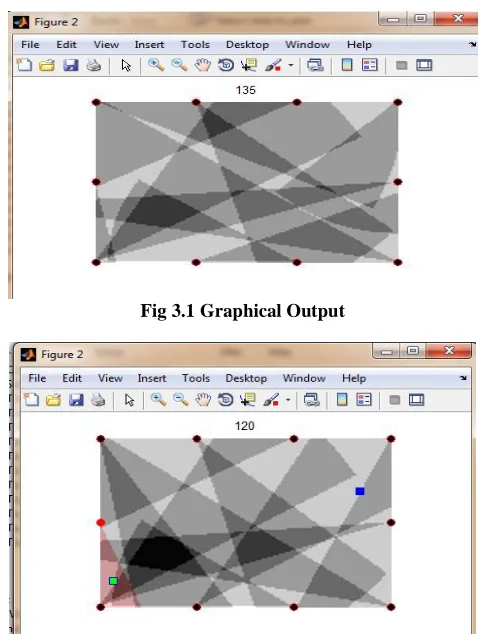
Fig 3.1 Graphical Output
Fig 3.2 Multi object tracking in multiple videos
Fig 3.3 Iteration increases
IV.CONCLUSION
Control of systems consisting of several autonomous agents that are intended to perform a coordinated task is currently an important and challenging of research. This is due to the broad range of applications of multi- agent systems in space missions, operations in hazardous environments, and military operations.
© 2013, IJCSMC All Rights Reserved
301
REFERENCES
[1] H. Ando, I. Suzuki, and M. Yamashita, Formation and agreement problems for synchronous mobile robots with limited visibility, in Proc. IEEE Int. Symp. on Intelligent Control, 1995, pp. 453-460.
[2] A.M. Bruckstein, N. Cohen, and A. Efrat, Ants, crickets, and frogs in cyclic pursuit, Center for Intel- ligent Systems Report 9105, Technion, Haifa, Israel, 1991.
[3] Q. Chen and J. Y. S. Luh, Coordination and control of a group of small mobile robots, in IEEE Int. Conf. on Robotics and Automation, 1994, pp. 2315-2320.
[4] J. Feddema, C. Lewis, and D. Schoenwald, Decen- tralized control of cooperative robotic vehicles: theory and application, IEEE Trans. Robot. Automat., vol. 18, 2002, pp. 852-864.