ON NON-BLACK-BOX SIMULATION AND THE IMPOSSIBILITY OF APPROXIMATE OBFUSCATION∗
NIR BITANSKY†ANDOMER PANETH‡
Abstract.The introduction of a non-black-box simulation technique by Barak (FOCS 2001) has been a major landmark in cryptography, breaking the previous barriers of black-box impossibility. Barak’s technique has given rise to various powerful applications and it is a key component in all known protocols with non-black-box simulation. We present the first black-box simulation technique that does not rely on Barak’s technique (or on non-standard assumptions). Invoking this technique, we obtain new and improved protocols resilient to various resetting attacks. These improvements include weaker computational assumptions and better round complexity.
A prominent feature of our technique is its compatibility with rewinding techniques from classic black-box zero-knowledge protocols. The combination of rewinding with non-black-box simulation has proven instrumental in coping with challenging goals as: simultaneously-resettable zero-knowledge, proofs of knowledge, and resettable-security from one-way functions. While previous works required tailored modifications to Barak’s technique, we give a general recipe for combining our technique with rewinding. This yields simplified resettable protocols in the above settings, as well as improvements in round complexity and required computational assumptions.
The main ingredient in our technique is a new impossibility result for general program obfuscation. The results extend the impossibility result of Barak et al. (CRYPTO 2001) to the case of obfuscation with approximate function-ality; thus, settling a question left open by Barak et al.. In the converse direction, we show a generic transformation from any resettably-sound zero-knowledge protocol to a family of functions that cannot be obfuscated.
∗This paper is the full version of extended abstracts that appeared in FOCS 2012 [9] and STOC 2013 [10] †MIT. Email:[email protected]. This research was done while the first Author was at Tel Aviv
University and supported by the Check Point Institute for Information Security, an ISF grant 20006317, the Fulbright program, and an IBM Ph.D. fellowship. Part of this research was done while visiting Boston University and IBM T. J. Watson Research Center.
‡Boston University. Email:[email protected]. Supported by the Simons award for graduate students in theoretical
1. Introduction. Zero-knowledge (ZK) protocols [31] are a cornerstone of modern cryptography; they can express all NP computations [30], and are essential to almost any form of secure computation. The ZK guarantee of a protocol is established by exhibiting an efficientsimulatorthat can simulate the view of any malicious verifier from the verifier’s code and the statement alone. Following the common practice of black-box reductions, the first ZK protocols all relied on simulators that only use the verifier as a black-box, without making any explicit use of its code. However, while sufficient for a variety of powerful applications, ZK protocols with black-box simulation were soon shown to have inherent limitations. A known example is the impossibility of constant-round public-coin ZK [28]. Surpassing such black-box impossibilities was considered to be an inconceivable task.
This barrier was crossed with the groundbreaking result of Barak [1] that introduced a non-black-box simulation technique. Barak’s technique allowed, in particular, to achieve constant-round public-coin ZK. Subsequently, the technique was utilized to achieve various cryptographic goals, most of which were previously limited by black-box impossibilities, e.g., [4, 2, 6, 41, 42, 7, 43, 44, 20, 35, 33, 34, 45, 14, 32].
Today, an impressive variety of protocols rely on non-black-box simulation; however, the common base of all of these protocols is the very same technique of Barak. The main ques-tion addressed in this work iswhether Barak’s technique is inherent in non-black-box simu-lation, or whether black-box impossibilities may be circumvented using different techniques and tools. Beyond improving our understanding of non-black-box simulation, answering the above question may also lead to protocols with improved features.
Resettable soundness - the bottleneck in black-box impossibilities. To answer the above question, we focus on a specific setting that seems fundamental in ZK black-box impossi-bilities - the setting ofresettably-sound zero-knowledge[4, 38]. Indeed, many of the known black-box ZK impossibilities can be derived by a reduction to the impossibility of resettably-sound ZK with a black-box simulator [28, 4, 46].
A ZK argument is resettably-sound if it remains sound, even if an adversarial prover may reset the honest verifier to its initial state and random tape, and repeat the interaction in any way it chooses (equivalently, the verifier may be rewound to any previous state). As observed by Barak et al. [4], in resettably-sound protocols, the ZK requirement cannot be fulfilled by a black-box simulator (except for trivial languages). Intuitively, the difficulty is that a cheating prover may execute a resetting attack that emulates the strategy of the black-box simulator, and thus violate soundness. In contrast, a resettably-sound ZK protocol was constructed by Barak et al. [4] using Barak’s non-black-box simulation technique.
The difficulty in extending Baraks technique. Attempting to extend [4] to resist more elaborate types of resetting attacks (e.g.,simultaneous resetting), one encounters significant technical difficulties. To overcome these difficulties, subsequent works have extended Baraks technique in various ways [20, 35, 34, 16, 14, 32, 19]. A common theme in these works is to extend Baraks technique so it can be combined with rewinding techniques. While allow-ing to leverage powerful black-box simulation techniques (e.g., [48]), they require tailored modifications to Barak’s technique, and result in rather complicated protocols.
1.1. Our Contribution. In this work, we present a new non-black-box simulation tech-nique that is fundamentally different from Barak’s techtech-nique. Using our techtech-nique we give new protocols for resettably-sound zero-knowledge and related tasks.
Whereas a main technical tool in Barak’s technique is PCP-based universal arguments, our technique does not invoke universal arguments in any way. In the heart of our technique, is a new method for extracting a short trapdoor from adversarial code. The extraction technique can be interpreted as a new impossibility result for general program obfuscation. The result extends the impossibility result of Barak et al. [5] to the case of obfuscation with approximate functionality; thus, settling a question left open by Barak at al..
Finally, we show that any resettably-sound ZK argument can be transformed into a family of functions that cannot be obfuscated, thereby establishing a two-way connection between the impossibility of obfuscation and non-black-box simulation.
1.2. Obfuscation and Non-Black-Box Simulation. The problem ofprogram obfusca-tionconcerns the task of rewriting programs in a way that makes their code “unintelligible”, without destroying its functionality. The rigorous study of the problem was initiated in the work of Hada [36] and Barak et al. [5], which formalized secure obfuscation according to the virtual black-boxnotion. At high-level, this notion requires that whatever an efficient learner can deduce, given an obfuscationP˜ of a programP, should also be learnable, given only black-box access toP. The same work shows, however, that for some programs, this notion is not achievable. Concretely, [5] show that there exists anunobfuscatablefamily of functions{fk}for whichanyprogramP˜that computes a functionfkleaks the keyk; that is,
kcan be efficientlyextractedfromP˜’s code. However, a randomly chosen keykcannot be learned given only black-box access tofk.
At an intuitive level, unobfuscatable functions suggest a meaningful way to use the code of the adversarial verifier in non-black-box simulation. Following this intuition we design a protocol where the verifier evaluates an unobfuscatable functionfk. A non-black-box simu-lator would be able to learnkfrom the code of any malicious verifier and use it to simulate. In contrast, a resetting prover, like a black-box simulator, would only get black-box access to the verifier and would not learnk.
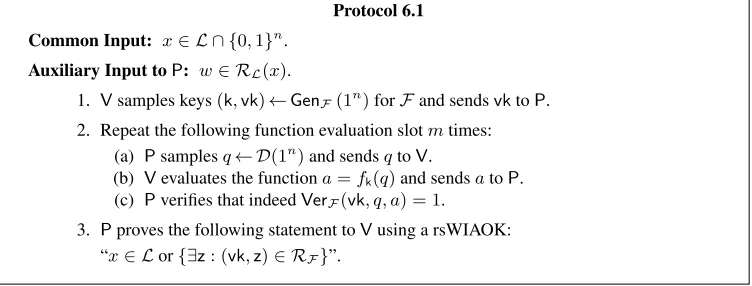
A naive protocol and the problem of non-robust extraction. We now describe a naive resettably-sound ZK protocol based on the intuition presented above. Following the Feige-Lapidot-Shamir paradigm [22], the protocol proceeds in two phases: the first phase defines a trapdoor which is known by verifier but is “hard to compute” for the prover, and in the second phase, the prover gives a witness indistinguishable (WI) proof that either the statement is correct or that it “knows” the trapdoor. In our case, to obtain resettable-soundness we will have to ensure that the trapdoor is hard to compute, even given the ability to reset the verifier. We will also use a resettably-sound WI proof in the second phase of the protocol (such proofs follow directly from classic protocols [24]). For ZK, we will exhibit a simulator that, given the code of the verifier, can extract the trapdoor and successfully complete the simulation.
As suggested above, the trapdoor in our protocol will be a keykfor an unobfuscatable functionfkchosen at random by the verifier. In the trapdoor generation phase of the protocol, the prover asks the verifier to evaluate the functionfkon an inputxof his choice (for simplic-ity of exposition, we assume that this interaction indeed determines the keykand the trapdoor statement for the second phase). To show that the protocol is resettably-sound, we note that any prover that can reset the verifier in the first phase can at most evaluate the functionfkon many inputsxof his choice; however, given such “black-box” access tofk, it is impossible to learnkand cheat in the second phase. To show that the protocol is ZK, we need to show a simulator that can extract the trapdoorkfrom the code of any cheating verifier. Assuming that the cheating verifier correctly evaluates the functionfkon any input sent by the prover, the simulator would be able to learnkfrom the code of the verifier’s next message function. However, if on certain inputsxthe verifier deviates from the protocol and does not respond withfk(x), the extraction guarantee no longer holds and simulation cannot be finished.
1.3. Robust Unobfuscatable Functions and Approximate Obfuscation. A first solu-tion to the above problem [9] is to evaluate the funcsolu-tionfk in the first phase of the protocol using asecure function evaluationprotocol that secure against a resetting provers. Intuitively, in this solution, the secure function evaluation protocol guarantees that the verifier must cor-rectly compute the function on all inputs, or always abort the computation. The solution in [9] relies on semi-honestoblivious transfer. Securing the secure function evaluation protocol against a resetting prover results in a rather complicated protocol with a large (but constant) number of rounds.
In this paper, we focus on a different approach relying on stronger unobfuscatable func-tions that provide a robust extraction guarantee [10] Specifically, it is possible to extract the keykfrom any programP˜thatapproximatelycomputes the functionfk, rather than exactly. More concretely, we define (publicly) verifiablerobustunobfuscatable functions that have, in addition to the secret keyk, an associated public verification keyvk. The verification key can be used to verify that a pair(x, y)indeed satisfiesy=fk(x). On one hand, we require that a randomly chosen keykcannot be learned given the verification keyvkand black-box access tofk. On the other hand, it is possible to extractkfromvkand any programP˜that computes a functionfk,even on some small (but noticeable) fraction of its inputs. We present a construc-tion of verifiable robust unobfuscatable funcconstruc-tions based on ZAPs [21] and non-interactive commitments.
Using verifiable robust unobfuscatable functions fixes the naive protocol above. As be-fore, the trapdoor will be a keykfor a robust unobfuscatable functionfk chosen at random by the verifier. In the first phase of the protocol, the prover will receive the public verification keyvk, and ask the verifier to evaluate the associated function on auniformly randominput
x. The prover will usevkto verify thatfkwas evaluated correctly and abort otherwise. We argue that the revised protocol is ZK: given the code of any cheating verifier, the verifier either makes the honest prover abort with overwhelming probability, in which case simula-tion is trivial, or the verifier evaluatesfk correctly on some noticeable fraction of inputs. In this case, we can extractkfrom the verifier’s next message function and simulate the second phase.
Impossibility of approximate obfuscation. In addition to their application to resettably-sound ZK, verifiable robust unobfuscatable functions also settle an open question raised by Barak et al. [5] regarding the possibility ofapproximate obfuscation. In approximate obfus-cation [5], the obfuscated programP˜ is only required to agree withP on some significant fraction of inputs. Through verifiable robust unobfuscatable functions, we give a negative answer to this question.
Constructing robust unobfuscatable functions. In this work, we focus on constructing robust unobfuscatable functions from minimal computational assumptions. Our construc-tion consists of two steps: First, we construct a weaker object that we call (plain)robust unobfuscatable functions. Such functions have no verification key, however, they still allow extraction from any programP˜ that only computefk on a small fraction of inputs, but only assuming that on all other inputsP˜outputs a special⊥symbol. We construct such robust un-obfuscatable functions from any one-way function. In the second step, we “compile” robust unobfuscatable functions into full fledged verifiable robust unobfuscatable functions based on ZAPs [21] and non-interactive commitments.
We note that a different construction, from stronger assumptions, can be obtained using ideas from [9]. The construction transforms any (non-robust) unobfuscatable function (such as the one of [5]) to a verifiable robust unobfuscatable functions, using a two-messagesecure function evaluationprotocol against malicious parties1.
1Since such protocols require super-polynomial simulation, the unobfuscatable function should also be
Simulation from robust unobfuscatable functions vs. Barak’s simulation. Both our proto-col and Barak’s protoproto-col follow the Feige-Lapidot-Shamir paradigm [22], in which the prover ultimately proves a statement that has a trapdoor witness. A key technical difference between our technique and that of Barak is that our simulator extracts from the verifier’s code a “short” trapdoor of some fixed polynomial length, whereas the simulation of Barak can be seen as using the entire verifier’s code as a “long” trapdoor whose length is not a priori bounded by any fixed polynomial. To facilitate the use of such a long trapdoor, Barak’s protocol involves a WI universal argument[3] while our protocols use a standard WI argument. The ability to extract a short trapdoor explains the compatibility between our technique and rewinding techniques, and enables our simplified constructions. Another difference between our tech-nique an Barak’s is that our in our techtech-nique, the verifier makes inherent use of private coins to sample its trapdoor, a key of an unobfuscatable function.
1.4. Resettable Protocols from Robust Unobfuscatable Functions. We next give an overview of the different resettably-secure protocols constructed based on our new technique. As we shall see, compered to known constructions, our protocols require less rounds, weaker assumptions, and are arguably simpler.
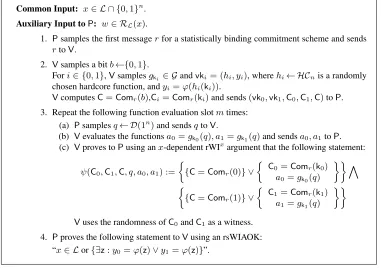
All of our protocols follow a similar design paradigm ofresettable slotsthat abstracts the use of robust unobfuscatable functions. Commonly used in classic ZK protocols (with black-box simulation), aslotis a sub-protocol where the verifier proves knowledge of a trapdoor. While a cheating prover cannot learn the trapdoor from the slot’s execution, the simulator extract the trapdoor by rewinding the verifier during the slot’s execution. The difficulty in using slots within a resettably-sound ZK protocol is that a cheating prover can use resetting to extract the trapdoor and break soundness. The concept of a resettable slot, suggested by [20], requires that the trapdoor cannot be learned by rewinding the slot, but can still be extracted by the non-black-box simulator from the code of a verifier that executes the slot.
Concretely, in our resettable slot, the verifier’s trapdoor is a keykfor a verifiable robust unobfuscatable function, which is determined prior to the slot’s execution by sending the verification keyvkto the prover. The slot consists of the verifier evaluatingfk on a random input selected by the prover.
Following the resettable slot paradigm, we are able to take ZK protocols with black-box simulation and “add resettable-soundness” in a modular way, replacing (standard) slots with resettable slots. This results in protocols that are conceptually and practically simpler than those based on Barak’s technique [20, 16, 14, 19].
Resettably-sound ZK in 4 messages. Plugging a resettable slot into the the 4-message ZK protocol of Feige and Shamir [23] results in a 4-message resettably-sound ZK protocol. Previous constructions relying on Barak’s technique [4] required at least 6 messages.
Simulating such a protocol with a single slot requires verifiable robust unobfuscatable functions that have a fast enough extraction algorithm. We show how to construct such func-tions based onrerandomizable fully homomorphic encryption. Subsequently to our work, Chung et al. [17] constructed a 4-message resettably-sound ZK protocol based on one-way functions, relying on a different approach.
Resettably-sound ZK from one-way functions. By relying directly on robust unobfuscat-able functions (that are not verifiunobfuscat-able), we achieve resettably-sound ZK from the minimal assumption of one-way functions. Our protocol mimics the steps of compiling robust to verifiable robust unobfuscatable functions, but instead of using ZAPs, and non-interactive commitments, we use interactive (resettable) WI arguments and commitments from one-way functions. Our construction is an alternative to the first construction of resettably-sound
able against super-polynomial adversaries
ZK from one-way functions by Chung, Pass, and Seth [19] that showed how to replace the collision-resistent hash functions in to protocol of [4] with an interactive use of signatures.
Simultaneously-resettable ZK from one-way functions. The notion of resettable ZK [13] requires that even cheating verifiers that may reset the prover cannot gain knowledge from the protocol. Barak et al. [4] contemplated the existence of protocols that are simultaneously resettable ZK and resettably-sound. Such protocols were first constructed in the influential work of Deng, Goyal, and Sahai [20]. The main step in the construction of [20] is to construct a resettably-sound concurrent ZK protocol. To do so, they present a sophisticated extension of Barak’s technique that carefully combines existing rewinding strategies from concurrent ZK.
We get a simpler construction of resettably-sound concurrent ZK by plugging our re-settable slot into the concurrent ZK protocol of Richardson and Kilian [48]. Following the transformation of [20], we get a simultaneously-resettable ZK protocol. By directly using robust unobfuscatable functions (that are not verifiable), we get a resettably-sound concur-rent ZK protocol from any one-way function where previous constructions also relied on one-to-one one-way function [20, 19]. Using a construction of simultaneously-resettable WI arguments from one way functions [18], within the transformation of [20] (as augmented by [18]), we get a construction of simultaneously-resettable ZK from one-way functions.
Our protocol inherits its polynomial number of rounds from the protocol of Richardson and Kilian. An open question is whether our technique can be combined with state of the art concurrent ZK protocols [37, 47] to reduce the number of rounds to poly-logarithmic. This turns out to depend on the relation between the unobfuscatable function’s extraction time, and the depth of recursive rewinding in these protocols. Concretely, combining these protocols with our techniques requires linear time extraction. We do not know if such unobfuscatable functions exist.
Simultaneously-resettable WI argument-of-knowledge in 3 messages. The simultaneously-resettable ZK protocol of Deng,Goyal and Sahai [20] does not satisfy the desirable proof-of-knowledge property. Cho et al. [16] show a simultaneously-resettable WI argument-of-knowledge with a large constant number of rounds. This is in contrast to standard construc-tions of WI arguments-of-knowledge in 3 messages [24]. Using a resettable slot, we construct a 3-message simultaneously-resettable WI argument-of-knowledge. In our construction, the extraction property of the resettable slot is used to by the knowledge extractor to obtain a witness from the prover.
1.5. How to Construct Robust Unobfuscatable Functions, an Overview. The main technical challenge in this work is constructing (plain) robust unobfuscatable functions from one-way functions. We now give an overview of the main ideas on which our construction is based.
The starting point for our construction is the construction of Barak et al. [5] of (non-robust) unobfuscatable functions, and can be seen as a “random-self-reducible” version of it. We start by describing the construction of Barak et al., and then move on to describe the main modifications that we introduce.
The construction of Barak et al.. Barak et al. construct a familyF ={fk}of unobfus-catable functions as follows. The keykconsists of two random strings(a, b)and a keysk
for a symmetric encryption scheme. For a simpler exposition, let us assume for now that the encryption scheme isfully homomorphic. Later, we explain how to modify the construction to rely on CCA-1 symmetric encryption (that can be based on one-way functions). For sim-plicity, we describefk=fa,b,skas a randomized function; eventually, it is made deterministic using a pseudo-random function. The function is defined as follows:
1. On inputa, outputb.
2. On input “Encrypt”, output an encryption ofa. 3. On any input that is an encryption ofb, outputb.
Given black-box access to a random function from the family, the only way to learn
bis to first learna, which will break the security of the encryption scheme, or to produce an encryption ofb, which is information theoretically impossible, without first querying the function ona. On the other hand, given a circuitCthat computesfa,b,sk, we can obtain an encryption ofa, evaluate the circuitC homomorphically on this encryption, and obtain an encryption ofb. Then, we can learnbusing another black-box application ofC. Note that in the above construction we only learnbinstead of the entire key of the function. Similarly, in the rest of our constructions we will only be able to extract some unlearnable propertyπ(k), rather than the entire keykof the unobfuscatable function; this will be sufficient for all of our applications.
Making the construction “random-self-reducible”. The latter construction is not robust; for example, given a circuitC that computesfa,b,skbut errs on the single inputa, we can no longer extract b. At high-level, we overcome this problem by defining a new function familyGsuch thatF is randomly reducible toG. That is, for any inputx, we can compute
fa,b,sk(x)by evaluating a correspondingg∈ Gon inputs that are individually random, but are correlated together according tox. It is important that the new functionGremains black-box unlearnable as wasF.
Specifically,Gwill be defined similarly toF, except that its key will also include a seed
sof a pseudo-random function PRF. Instead of mapping the input ato the outputb,gk,s will include two new functionsPRFs(x)andG(x) =b⊕PRFs(x⊕a). Note, that without knowinga, an efficient algorithm that gets black-box access toPRFsandGcannot find any correlation between the functions, and therefore, cannot learnb. However, knowinga, we can queryPRFswith a random stringr, queryGwithr⊕a, and obtainb=PRFs(r)⊕G(r⊕a). Since each individual query toGis distributed uniformly, we can learnbfroma, even if the function errs on, say, a 14-fraction of inputs. To extract from circuits that make more errors, we use standard direct product amplification [49]; namely, we letGevaluatePRFsandGon many random inputs in parallel, amplifying the probability of getting the correct answer on a single random input.
In order to successfully extractb, it is not sufficient to deal with circuits that err ona, but we should also handle circuits that do not outputbgiven an encryption ofb. We would like to use a similar idea to the one described before; namely, include a functionG0(c)that, on inputc, decryptscto some plaintextx, and outputsb⊕PRFs(x⊕b). However, given black-box access to such a function, semantic security is not maintained. Indeed, when two encryptionsc1andc2correspond to the same plaintext thenG0(c1) =G0(c2)and when the encryptions correspond to different plaintextsG0(c1)6=G0(c2)with high probability. Using such an attack it is possible to learnaand thus alsob, in a black-box way.
The first step in our solution involves a slight modification to the homomorphic encryp-tion scheme. An encrypencryp-tion of a bitbwill includeb⊕rfor a random bitrand an encryption ofr. We shall also assume for simplicity that encryptions of uniformly random strings are uniformly random themselves. We also modify the decryption and homomorphic evaluation algorithms accordingly. We refer to such an encryption scheme asdecomposable, since any ciphercis composed of two parts. We think of the encryption ofras a public part and denote it bypub(c), and of the padded plaintext as a private part.pub(c)is independent of the plain-text and can be sampled by anyone, but together with the plainplain-text, it completely determines the cipher.
The next step is to redefineG0(c) =b⊕PRFs(x⊕b||pub(c)), wherexis the decryption ofc. Note that ifc1 6= c2, andx1 = x2, thenpub(c1) 6= pub(c2); therefore, also G0(c1)
andG0(c2)are distributed (pseudo) independently at random, and we can show that semantic security is maintained. Additionally, given an encryption ofb, it is still possible to learnb
by first sampling a random stringrand then homomorphically computing an encryption c
ofb⊕r, and finally, evaluatingG0(c)⊕PRFs(r||pub(c)) =b. Note that both inputscand
r||pub(c)toG0andPRFsare distributed uniformly at random.
Getting rid of homomorphic encryption. The construction of Barak et al. only uses a standard symmetric encryption, where homomorphic operations are performed gate by gate byfk: given two encrypted input bits,fkdecrypts them, evaluates the desired operation, and returns the result encrypted. Trying to employ this strategy in our setting we may hope that, since these queries consist of random encryptions, a circuit C that does not err too much will correctly compute the homomorphic operations required for extraction with high enough probability. However, this is not the case since extraction involves a long (a-priori unbounded) homomorphic computation, and even one error along the way could compromise the integrity of the result.
Here we use the fact that, in the case of robust unobfuscatable functions, we can assume thatC only makes “detectable errors”; we show that this is enough to recover from errors during the homomorphic computation. Specifically, when a single homomorphic operation fails (the circuit outputs ⊥), we would like to rerandomize the input encryptions and try again. This could be achieved by relying on rerandomizable encryption. However, we wish to avoid this assumption and provide a solution based on one-way functions. For this purpose, we modifyGto return many random encryptions of the resulting bit, and show a procedure that assures that the extractor is always left with enough “good” encryptions to continue the homomorphic evaluation. (In the actual construction, when dealing with a deterministicG, we will need to use “invoker randomizable”PRFs [5] to make sure that the encryptions are indeed random.)
From several (key-dependent) input distributions to the uniform distribution. As de-scribed above, a functiong ∈ G implements several different functions: PRFs,G,G0, and the homomorphic evaluation functionality. For the extraction procedure described above to succeed, it is not sufficient that C approximates g well on a random input, but rather C
should approximategon each one of these functions individually. Moreover, to guarantee the success of the homomorphic evaluation, we require thatCapproximates the homomorphic evaluation functionality foreverypossible configuration of gate and input plaintexts. Note that for a specific configuration of gate and input plaintexts, the input to homomorphic evalu-ation functionality is not distributed uniformly, furthermore, such inputs may not be directly samplable without the secret encryption key. Indeed, in symmetric-key encryption (based on one-way functions), we do not know how to sample encryptions of individual bits without the secret key.
To overcome this issue, we use an encryption scheme that supports sampling ciphers of random plaintexts independently of the secret key. Intuitively, if the circuit does not abort given an encryption of a random bit, with sufficiently high-probability, then it also does not abort for encryptions of specific bits, with some related probability. To make sure that the probability is indeed high-enough we use again parallel repetition. Note that during extrac-tion we must querygwith encryptions of individual bits; however, we do not sample those encryptions ourself, but rather these encryptions are obtained as the result of a previous ho-momorphic operation. Eventually, we show that extraction is successful assuming only that
Capproximates the resulting function on a uniform input.
Necessity of one-way functions. We show that one-way functions are not only sufficient, but also necessary for robust unobfuscatable functions. (The function that maps(k, x1, . . . , xm) to(fk(x1), . . . , fk(xm), x1, . . . , xm)is one-way form |k|.) This should be contrasted
with non-robust unobfuscatable functions, where a similar implication is not known; in fact, Barak et al. [5] construct (non-robust) unobfuscatable Turing machine (rather than circuit) families without any computational assumptions, whereas robust unobfuscatable functions also imply one-way functions in the Turing machine case. Additionally we do not know what are the minimal assumptions required for verifiable robust unobfuscatable functions.
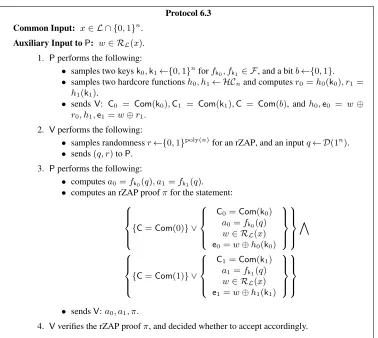
Constructing verifiable robust unobfuscatable functions. Finally, we show how to “com-pile” robust unobfuscatable functions into full fledged verifiable robust unobfuscatable func-tions based on ZAPs [21] and non-interactive commitments. The high level idea is to put a commitment to the keykin the verification keyvkand add to the output of the function a ZAP proving that the function was computed correctly using a key that is consistent withvk. To guarantee that the ZAP does not reveal the secret keykwe evaluate two functions in parallel with independent keys and prove that one of them was computed correctly. The construction uses ideas from [24, 16]. Now, given a program that computes the function correctly on some noticeable fraction of the inputs, we can detect when the output is computed incorrectly and replace it with⊥.
1.6. Related Work. The resettably-sound protocol constructed in [9] was based on the unobfuscatable functions of [5] and oblivious transfer. Subsequently, [19] showed how to re-move the collision-resistent hashing from the protocols of [4, 20] leading to resettably-sound ZK from one-way functions. The constructions based on robust unobfuscatable function appeared in a subsequent work [10]. The construction of simultaneously-resettable WI ar-guments from one-way functions [18] was concurrent to [10]. In another concurrent work Goyal [32] presented a new construction of public-coin concurrent ZK, leading also to a new simultaneously-resettable ZK protocol. The subsequent work of [17] constructed a 4-message resettably-sound ZK protocol based on one-way functions.
1.7. Roadmap. In Section 3, we define the notions of robust and error-robust unobfus-catable functions, as well as other weaker notions used in our constructions. In Section 4, we present our main construction of robust unobfuscatable functions. In Section 5, we define verifiable robust unobfuscatable functions and construct them based on robust unobfuscatable functions. The construction of verifiable unobfuscatable functions will be used to get error-robust unobfuscatable functions and applications to ZK. In Section 6, we describe our new constructions of resettably-secure protocols. In Section 7, we give a transformation from any resettably-sound ZK argument to a family of unobfuscatable functions.
2. Preliminaries.
2.1. Standard Computational Concepts. We rely on the standard notions of Turing machines and Boolean circuits. We say that a (uniform) Turing machine is PPT if is proba-bilistic and runs in polynomial time. A polynomial-size (or just polysize) circuit familyCis a sequence of circuitC = {Cn}n∈N, such that each circuitCn is of polynomial sizenO(1) and hasnO(1)inputs and outputs bits. We follow the standard habit of modeling any efficient adversary strategy as a family of polynomial-sized circuits. For an adversaryA correspond-ing to a family of polysize circuits{An}n∈N, we often omit the subscriptn, when it is clear from the context.
A function ν : N → [0,1]is said to be negligible ifν(n) = n−ω(1), i.e. ν decays faster than any polynomial. We say that an event occurs with overwhelming probability if it occurs with probability1−ν(n)for some negligible functionν. We often denote bynegl
an unspecified negligible function (e.g., when we say that for alln∈Nand eventAnoccurs with probability at mostnegl(n), we mean that this is the case for some negligible function). We say that a functionε:N→[0,1]is noticeable ifε(n) =n−O(1). We denote bypoly(n) an unspecified polynomial.
2.2. A Useful Probability Bound. We prove a basic probability bound that will be used more than once throughout the paper.
The bound. LetS1, . . . , Smbe random variables (intuitively, describing anm-step pro-cess), and let G1, . . . , Gm be events whereGi is determined bySi alone. Denote by Hi the event that the firsti−1stagesS1, . . . , Si−1are such that that the eventGi occurs with bounded probabilityδ(whenSiis sampled conditioned onS1, . . . , Si−1); namely,Hiis the event thatS1, . . . , Si−1satisfy:
Pr
Si|S1,...,Si−1
[Gi |S1, . . . , Si−1]≤δ .2
The following intuitive claim shows an exponential decay in the probability thatkeventsGi occur when the residual probability of their occurrence is bounded through every stage of the process.
CLAIM2.1.For every{i1, i2, . . . , ik} ⊆[m]:
Pr
S1,...,Sm
k ^ j=1
Gij
∧ m ^ j=1 Hj ≤δ k .
Proof.First, we show by induction that for any0≤`≤k:
Pr k ^
j=1+k−`
Gij
∧ k ^
j=1+k−`
Hij
k−` ^ j=1
Gij
∧ k−` ^ j=1
Hij
≤δ`
For`= 0the claim clearly holds. Assuming the claim holds for`−1we have:
Pr k ^
j=1+k−`
Gij
∧ k ^
j=1+k−`
Hij
k−` ^ j=1
Gij
∧ k−` ^ j=1
Hij
≤Pr k ^
j=1+k−`
Gij
∧ k ^
j=2+k−`
Hij
k−` ^ j=1
Gij
∧ 1+k−` ^ j=1
Hij
≤Pr
Gi1+k−`
k−` ^ j=1
Gij
∧ 1+k−` ^ j=1
Hij
· Pr k ^
j=2+k−`
Gij
∧ k ^
j=2+k−`
Hij
1+k−` ^ j=1
Gij
∧ 1+k−` ^ j=1
Hij
≤Pr
Gi1+k−`
k−` ^ j=1
Gij
∧ 1+k−` ^ j=1
Hij
·δ `−1 ≤δ` ,
2More explicitly, we mean that H
i is that even that (S1, . . . , Si−1) = (s1, . . . , si−1), such that
where the first to last inequality is by the induction hypothesis and the last inequality is due
to the fact that the event k−`
V j=1
Gij
!
∧
1+k−` V j=1
Hij
!
is contained in the eventHi1+k−`. By
setting`=kwe get that
Pr k ^ j=1
Gij
∧ m ^ j=1 Hj
≤Pr k ^ j=1
Gij
∧ k ^ j=1
Hij
≤δk .
3. Robust Unobfuscatable Functions. In this section, we define the notion of robust unobfuscatable functions. Before that we define the main notion of function approximation that we work with.
DEFINITION3.1 ((ε, ν,D)-approximation).LetDbe a distribution on{0,1}n. A circuit
Cis said to(ε, ν,D)-approximate a functionf :{0,1}n→ {0,1}n0 if: 1. It often agrees withfon inputs drawn fromD:
Pr
q← D[C(q) =f(q)]≥ε , 2. It almost only makes detectable errors on inputs fromD:
Pr
q← D[C(q)∈ {⊥/ , f(q)}]≤ν .
Cis said to(ε,D)-approximatef with errorsif property 2 is not guaranteed.
DEFINITION3.2 (Robust unobfuscatable functions).A function familyF ={fk}k∈{0,1}n,n∈N
is a robust unobfuscatable family, with respect to an NP relationRFand input samplerD, if it is:
1. Black-box unlearnable:For any poly-size learnerL, and anyn∈N,L:
Pr
k←{0,1}n[(k,z)∈ RF :z←L
fk(1n)]≤negl(n) ;
namely,Lcannot satisfy the relationRF, given only black-box access tofk. RF is thus called “the unlearnable relation”.
2. Non-Black-box learnable: There exists an efficient extractorEsuch that, for any functionsε = ε(n) ≥ 2−√n andν = ν(n) ≤ ε
4n2, any efficient sampler D =
D(1n), any large enoughn∈
N,k∈ {0,1}n, and circuitCthat(ε, ν,D)-approximates
fk,Eextractsz∈ RF(k)fromC:
Pr
E h
(k,z)∈ RF:z←E(C,1n,11/ε) i
≥1−νΩ(1)+ 2−Ω(n)·(|C| ·n/ε)O(1) .3
We say that the family isε-robust for a specific noticeable functionε =ε(n) = n−O(1), if there exists an extractorEsuch that, for all large enoughn∈N,k∈ {0,1}n, and circuitC that(ε, ν,D)-approximatesfk:
Pr
E [(k,z)∈ RF :z←E(C,1
n)]≥1−νΩ(1)+ 2−Ω(n)·(|C| ·n)O(1)
.
3In most cases, the extraction error expression above can be simplified tonegl(n), e.g., when|C|= poly(n),
ε= 1/poly(n), andν= negl(n). There are however cases in which we may use the more general bound above, e.g., in Section 6.3.2.
We next define error-robust unobfuscatable functions, which are defined analogously, only that extraction should work for any circuitCthat sufficiently agrees withfk, even ifC makes undetectable errors.
DEFINITION 3.3 (Error-robust unobfuscatable functions). A family of functions F = {fk}k∈{0,1}n,n∈N is an error-robust unobfuscatable family, with respect to an NP relation RFand input samplerD, if it is:
1. Black-box unlearnable:As in Definition 3.2.
2. Non-Black-box learnable: There exists an efficient extractorEsuch that, for any functionε=ε(n)≥2−
√
n, any efficient samplerD=D(1n), all large enoughn∈ N, and anyk∈ {0,1}n,Eextractsz∈ RF(k)from any circuitCthat(12+ε,D) -approximatesfkwith errors:
Pr
E h
(k,z)∈ RF:z←E(C,1n,11/ε) i
≥1−2−Ω(n)· |C|O(1) .
REMARK3.1 (The samplerD). In the above definitions, we allow the input samplerD
to represent an arbitrary samplable distribution, where sampling is independent of the keyk
for the unobfuscatable function. We can consider a more strict (but natural) definition, where
D(1n)represents the uniform distribution over strings in{0,1}n. Indeed, our constructions also achieve this variant (see Remark 4.1).
REMARK3.2 (Uniquely determined functions). For the case of erroneous circuits, i.e. with non-detectable errors (Definition 3.3), we require for simplicity that the circuitC deter-mines one specific function, and hence we require more than 12-agreement (this is necessary to guarantee thatCcannot simultaneously approximate two functions in the family, and suf-ficient assuming that any two functions in the family have no agreement.) In principle, one may also consider alternative definitions of error-robustness where the circuit may some-what agree with several functions and the extractor is required to extract the keys of all the functions whose agreement withC crosses a given threshold. We restrict attention to the unique-function case, although our techniques naturally extends to such alternative notions.
REMARK3.3 (unique-witness unlearnable relations). A natural requirement regarding the unlearnable relationRF of a familyFis that there exists a unique witnessz ∈ RF(k); namely, z is a deterministic function of k. Furthermore, by the extraction guarantee, we can further assume that, givenkin the clear, the corresponding witnesszcan be computed in expected polynomial time. Our constructions satisfy the unique-witness requirement, and also allow to compute the unique witness in strict polynomial time.
We also note that this property allows to rule out the same notion of virtual black-box ob-fuscation ruled out in [5] that prevents the adversary from learning any deterministic function of the keyk.
REMARK3.4 (Extraction from computationally-bounded circuits). As stated above ex-traction in Definitions 3.2 and 3.3 is information theoretic, and does not explicitly require that the approximating circuitCis of poly-size (although this is the typical case in applications). Here there is a difference between Definition 3.2 and Definition 3.3. In Definition 3.2, the fractionν of undetectable errors is explicit in the definition and affects the probability that extraction will indeed succeed; in particular, we do not require thatν is a concrete neg-ligible function. Jumping ahead, when extracting from poly-size circuits, we may prevent undetectable errors using, for example, a computationally-sound proof system, in which case the functionν may be some negligible functionnegl(n)that depends on the concrete poly-size family of circuits we are extracting from. In Definition 3.3, we require that extraction
works even with undetectable errors, and as said we do not a-priori restrict the circuits to poly-size. To achieve such extraction, we will indeed rely on statistically-sound proofs sys-tems (concretely ZAPs). It is possible to augment the definition to only consider poly-size circuit families, in which case there will be some negligible errornegl(n)in the extraction probability, which depends on the concrete family of circuits.
REMARK 3.5 (Comparison with strongly unobfuscatable functions of [5]). Barak et al. define and construct a family of functions that is strongly unobfuscatable. Such func-tions satisfy a weaker extraction requirement than error-robust unobfuscatable funcfunc-tions, and therefore only rule out a stronger definition of approximate obfuscation.
The definition of [5] considers extraction from a circuit that is sampled from a distribu-tionCover circuits (this corresponds to the output distribution of an obfuscator on a specific input program with random coins). The extraction requirement states that if, for every input
qa circuitC← C satisfiesC(q) = fk(q)with overwhelming probability over the choice of
C, then the extractor on input circuitC← C outputskwith overwhelming probability. In particular, extraction requires that, foreveryinput, the circuit is correct with overwhelming probability. In contrast, the extraction requirement of error-robust unobfuscatable functions is guaranteed even if for some inputs the circuit never answers correctly (in fact this could be the case for almost all inputs).
3.1. Robustness from Weaker Robustness. In this section, we discuss two natural re-laxations of robust obfuscation that will be convenient to work with, and show how to trans-form functions that are unobfuscatable according to these notions to functions that are robust according to Definition 3.2. We restrict attention to approximationwithout errors. (Eventu-ally, in Section 5, we show how to go from robust functions to error-robust ones.)
First, we show that, using standard direct product amplification [49], we can always boost the robustness of an unobfuscatable family (at the cost of blowing up the input and output size).
LEMMA 3.4. Any 1− 1 4 √
n
-robust G can be transformed to a robustF, where the input and output size grows by a factor ofn. Furthermore, if the extractor ofGruns in time
poly(n)· |C|d, whereCis the approximation circuit forg
k, then the extractor ofF runs in timepoly(n)·(|C|/ε)d, whereCis a(ε, ν,D)-approximation circuit forfk.
We describe the construction behind the lemma, followed by the analysis.
CONSTRUCTION 3.1 (Amplifying robustness). LetG be a1− 1 4 √
n
-robust
unobfus-catable family, with respect to an unlearnable relationRF, and an input distribution en-semble D; We construct a new robust unobfuscatable familyF, with respect to the same relation RF, and the n-fold distribution ensemble Db = D ×. . . × D. Each function
fk : {0,1}n 2
→ {0,1}n2 is just then-fold version b
gk(q1, . . . , qn) = (gk(q1), . . . , gk(qn)) of the functiongk :{0,1}n → {0,1}n.
Proof of Lemma 3.4.Unlearnability ofFfollows directly from that ofG, since any oracle call tofk∈ Fcan be simulated bynoracle calls to the correspondinggk.
To show that the function is robust, we describe its extractorbE. For functionsε(n) ≥
2−
√
n,ν(n)≤ ε
4n2 the extractorEbis given as input a circuitCthat
ε, ν,Db
-approximates
fk, as well as the parameter 11/ε. bEfirst constructs fromC a probabilistic circuitC0 that, with very high probability, will give a very good approximation ofgk.
The circuitC0, given a random sampleq← D(1n), samples(q
1, . . . , qn)←Db(1n), re-places a random coordinateqi withq, and feeds the augmented n-fold sample toC. The circuit C0 repeats this procedure nε2 times (for the same q), and if it obtains an answer
(a1, . . . , an)that is not⊥, it returns ai. Then, after producing the circuitC0, bEchooses
nrandom stringsr1, . . . , rn forC0, and runs the extractorEofgk, on eachC0(·;ri). If all executions output⊥, the extractor fails, and otherwise it producesk.
To show thatEbworks as required, we show that the circuitC0is likely to approximategk sufficiently well. For any sampleq∈supp(D), letD|bqdenote the distribution that the circuit
C0samples from (i.e., where a random sample is drawn fromDb, and then one of its random coordinates is replaced byq). We say thatqisgoodifPr~q←
b
D|q[C(~q)6=⊥]≥ε/2n.
We claim that a sampleqdrawn fromDisgoodwith probability at least1−log(2n/ε) ≥ 1−O√1
n
. Indeed, if that was not the case, then in a sample~q←Db(1n), there is some coordinate that isnotgood, except with probabilityε/2; more precisely,
Pr
~ q←Db
[q1, . . . , qn ∈good]≤ Y
i∈[n]
Pr
qi←D
[qi∈good]≤
1−log (2/ε) n
n
≤ε/2 .
However, the probability thatC(~q)6=⊥and someqiis notgoodis at mostε/2; indeed,
1 n·~q←PrDb
[C(~q)6=⊥,∃i:qi∈/good]≤
Pr
~
q←D,i←b [n]
[C(~q)6=⊥, qi∈/good]≤
Pr
q←D,~q←D|bq
[C(~q)6=⊥, q /∈good]≤
Pr
q←D|good,~q←D|bq
[C(~q)6=⊥]≤
ε/2n ,
whereD|gooddenotesDconditioned on not hitting the setgood. OverallC(~q)6= ⊥with probability less thanε/2 +ε/2≤ε, leading to a contradiction.
Next, note that, conditioned on q being good, C0(q) 6= ⊥, except with probability
1− ε 2n
n2/ε
≤2−n/2, and thus
Pr
q←D,r[C
0(q;r)6=⊥]≥1−O√1
n
·1−2−Ω(n)≥
1−O
1
√ n
.
In addition, sinceC(~q)∈ {⊥/ ,gbk(~q)}with probability at mostν(n), by a union bound
Pr
q←D,r[C
0(q;r)∈ {⊥/ , g
k(q)}]≤ν(n)·
n2
ε ≤ 1 4 .
Combining these two facts, it follows that for a1− 1 4 √ n − 1 2
-fraction of the random coins
rused byC0, it holds that both
Pr
q← D[C
0(q;r)6=⊥] ≥1−O
1 4 √ n Pr
q← D[C
0(q;r)∈ {⊥/ , b
gk(~q)}]≥1− r
ν(n)·n
2
namely,C0(·;r)is a
1−O√41n
,
q
ν(n)· n2 ε ,D
-approximation ofgk. For such
ran-domnessr, we know that the extractorEGforgkoutputskwith probability at least
1−
r
ν(n) ·n ε
Ω(1)
·(|C0| ·n)O(1)= 1−νΩ(1)(|C| ·n/ε)O(1) .
and since there arentrials, the overall extraction probability is
1−νΩ(1)(|C| ·n/ε)O(1)−
1−1 2 −
1
4
√ n
n
≥1−νΩ(1)+ 2−Ω(n)·(|C| ·n/ε)O(1) ,
as required.
Noting that the size ofC0 ispoly(n)· |C|/ε, and that we makentrials to extract from
C0; we deduce that, ifEG runs in timepoly(n)· |C|d, then the extractor EF runs in time
poly(n)·(|C|/ε)d.
When constructing robust unobfuscatable functions, it will be convenient to also consider a further relaxed notion where, in order to extract, the circuit is required to approximate the function on multiple distributionsD1, . . . ,Dd, instead of one. Throughout, it will always be the case thatdis a constant. This definition will only serve us as an intermediate step towards constructing families according to Definition 3.2, whered= 1. As another relaxation, we will not require that each of these distributions can be sampled independently ofk, but rather we will only require that, wheni∗is chosen at random from[d], it is possible to sample fromD
i∗,
independently ofk. As we shall see later on, the latter weak sampling guarantee (combined with parallel repetition) will be sufficiently powerful to construct an unobfuscatable function with a single distribution that is samplable independently ofk.
We next present the definition. Since robustness can always be amplified, it will be suf-ficient and more convenient to describe the notion for some concrete constant approximation factor1−δ(we will eventually setδ <2−5, see Section 4).
DEFINITION3.5 (d-distribution robust unobfuscatable function). A family of functions
F is a d-distribution robust unobfuscatable family with respect to an NP relationRF and input samplersD1, . . . ,Dd, if it is:
1. Black-box unlearnable:as in Definition 3.2.
2. Non-Black-box learnable: There exists an efficient extractorEsuch that, for any functionν =ν(n), for any large enoughn∈N, anyk∈ {0,1}n, and every circuit
Cthat(1−δ, ν,Di)-approximatesfk, for alli∈[d],Eextractsz∈ RF(k)fromC:
Pr
E [(k,z)∈ RF:z←E(C,1
n)]≥1−νΩ(1)·(|C| ·n)O(1)
,
whereDi=Di(1n,k).
DEFINITION3.6 (jointly key-independent distributions). For anyk∈ {0,1}n, consider the distribution
Dk∗={q← Di∗(1n,k)|i∗←[d]}
We say thatD1, . . . ,Dd are jointly key-independent, if there exists an efficient sampler
D∗such that for allk,D∗(1n)generates samples from the distributionD∗ k.
We show that any d-distribution robust unobfuscatable family, where D1, . . . ,Dd are jointly key-independent, can be transformed into a robust unobfuscatable family according
to Definition 3.2. Specifically, we show a 1−δ d
-robust family, and then robustness can be amplified using Lemma 3.4.
LEMMA3.7.IfGis ad-distribution robust unobfuscatable family, with samplersD1, . . . ,Dd that are jointly key-independent, then G is also 1−δ
d
-robust with respect to the (key-independent) distributionD∗=D∗(1n).
Proof.Indeed, by a simple union bound, any circuit that 1−δ d, ν,D
∗
-approximatesfk must(1−δ, ν,Di)-approximatefk for each one of the distributionsD1, . . . ,Dd. Thus, we can use the existing extractor associated withG.
3.2. Robust Unobfuscatable Functions with a Hardcore Secret. The notion of robust (and error-robust) unobfuscatable functions is defined with respect to an unlearnable relation
RF, where it is guaranteed that, given black-box access tofk, it is hard to fully learn some unlearnable secretz∈ RF(k). We now present a natural variant of this definition, where each function has an associated hardcore secret that is indistinguishable from a random string, even given black-box access to the function; in contrast, the hardcore secret can be extracted from any circuit that approximatesfk. This variant will be useful for constructing unobfuscatable functions with a verifiable unlearnable secret (see Section 5), and for some applications to resettable protocols (see Section 6.5).
In the following definition,HCn=
h:{0,1}poly(n)→ {0,1}n will represent a fam-ily of functions (called hardcore functions).
DEFINITION3.8 (Robust unobfuscatable functions with a hardcore secret). A family of functionsF ={fk}k∈{0,1}n,n∈Nis a robust unobfuscatable family with respect to an efficient
input samplerD, and a family ofhardcore functionsHC, if it has the following properties: 1. Black-box indistinguishability:For any poly-size distinguisherL, and anyn∈N:
Pr
(k,h)
Lfk(h, h(k)) = 1− Pr (k,h,u)
Lfk(h, u) = 1
≤negl(n) ,
wherek←{0,1}n,h← HCn, andu←{0,1}nare all sampled independently. 2. Non-Black-box learnability:There exists an efficient extractorEsuch that, for any
functionsε=ε(n)≥2−
√
n,ν =ν(n)≤ ε
4n2, any efficient samplerD=D(1 n), any large enoughn, any hardcore functionh∈ HCn, anyk ∈ {0,1}n, and every circuitCthat(ε, ν,D)-approximatesfk,Eextractsh(k)fromC:
Pr
E h
h(k)←E(C, h,1n,11/ε)i≥1−νΩ(1)+ 2−Ω(n)·(|C| ·n/ε)O(1) .
We show that any robust unobfuscatable familyGthat has a unique-witness unlearnable relationRG (as defined in Remark 3.3) can be transformed into a robustF with a hardcore secret.
LEMMA3.9.There exists a hardcore familyHC={HCn}n∈Nsuch that a robust unob-fuscatable familyGwith respect to a unique-witness unlearnable relationRG, can be trans-formed to a robust unobfuscatable familyF with respect to some relationRFand the hard-core familyHC.
Proof. Given a robust familyG, with respect to a unique-witness unlearnable relation
RG and an efficient input samplerD, we define a new function family F, where eachfk consists ofnindependently chosen functions fromG, with keys(k0
1, . . . ,k0n); the new keyk is set to be(k01, . . . ,k0n). The input sampler of the function is then-fold product distribution
b
D=D ×. . .× D, andfk(q1, . . . , qn)is defined to begk0
1(q1), . . . , gk0n(qn).
Let us denote by ` = `(n) the length ` = |zi|of the unique-witness zi ∈ RG(k0i). The hardcore family HCn will be the family GLn that extracts a single Goldreich-Levin [29] hardcore-bit from each k0i. That is, a randomly chosen functionhr1,...,rn ∈ GLn is
parameterized bynrandom strings
ri∈ {0,1}` , and is defined as:
hr1,...,rn(k
0
1, . . . ,k0n) =hz1, r1i, . . . ,hzn, rni ,
where eachzi∈ RG(k0i)is the unique unlearnable secret corresponding tok0i, andh·,·iis the inner-product operation modulo2.
To see thatFhas the black-box indistinguishability property (Definition 3.8), note that the secretsz1, . . . ,zn are each unlearnable given oracle access tofk; indeed, any inverting algorithm directly implies a learner for the underlyinggk. We can thus apply the Goldreich-Levin theorem [29] to deduce thathz1, r1i, . . . ,hzn, rniare pseudo-random, givenr1, . . . , rn and oracle access tofk.
Next, we show thatFis non-black-box learnable according to Definition 3.8; namely, the hardcore secret can be extracted from any circuit approximation. Indeed, note that any circuit
Cthat(ε, ν,Db)-approximatesfk can be transformed, with overwhelming probability, into a circuit that(ε/2,√ν,D)-approximatesgk0
i (and this holds for anyi ∈ [n]). To transform
C into such a circuit, we construct a circuit C0 that, given a sample q← D(1n)for g k0
i,
completesqinto a sample fromDbby sampling the rest of the coordinates himself, and then feeds this tuple toC. A standard averaging argument shows that with probability at leastε/2− √
ν ≥ε/4over the choice of randomnessrforC0the resulting circuitC0(·;r) (ε/2,√ν,D) -approximatesgk0
i. Thus we can taken/εrandom copies ofC
0, and with probability1−2−n ensure that one of the circuits(ε/2,√ν,D)-approximatesgk0
i.
Thus the extractorEFforF, would run the extractorEGwith each of theninstances of circuitC0, and obtain the corresponding secretzi∈ RG(k0i), with probability1−νΩ(1)(|C| ·n/ε)
O(1) . In particular, givenhr1,...,rn∈ GLn,EGcan compute as required
hr1,...,rn(k) =hr1,...,rn(k
0
1, . . . ,k0n) =hz1, r1i, . . . ,hzn, rni . This concludes the proof of Lemma 3.9.
4. A Construction of Robust Unobfuscatable Functions. In this section, we construct robust unobfuscatable functions from one-way functions.
THEOREM4.1.Assuming one-way functions, there exists a family of robust unobfuscat-able functions.
4.1. Required PRFs and Encryption. Before describing the construction, we define several required primitives.
Invoker randomizable pseudo-random functions. Invoker randomizable pseudo-random functions allow their invoker to ensure that the output is truly uniform, independently of the seed for the function. Looking ahead, such functions will allow the extractor for the unobfuscatable function family to obtain samples from the proper distribution. See further details in the next section. The definition is taken almost verbatim from [5].
DEFINITION 4.2 (Invoker randomizable pseudo-random functions [5]). Let PRF = {PRFs}s∈{0,1}∗, be pseudo random function family, where fors∈ {0,1}n,PRFs:{0,1}`(n)+n→
{0,1}n. ThenPRFis calledinvoker randomizableif, for anys ∈ {0,1}n and anyx ∈
{0,1}`(n), the mappingr7→PRF
s(x, r)is a permutation. [5] show that invoker randomiz-able PRFs are implied by any PRF.
Decomposable CCA-1 symmetric-key encryption. In our construction, we will make use ofsymmetric-key encryptionschemes with specific properties. We next define these properties and note existing constructions satisfying them, based only on one-way functions.
In a nutshell, we require a CCA-1 symmetric-key encryption scheme with public ran-domness, and oblivious generation of ciphers for random plaintexts. Such an encryption scheme can be obtained using a one-bit output PRF by encrypting Encsk(b;r) = (r, b⊕
PRFsk(r)). In what follows, we give slightly more general definitions that are sufficient for our needs, and will be useful for optimization of extraction running time.
First, we require that the encryption scheme isdecomposable, meaning that every cipher-text can be “decomposed” into apublic partand aprivate part. We require that the public part is independent of the plaintext, however, together with the plaintext, the public part uniquely defines the ciphertext (with respect to a given secret key). For example, any encryption that uses public randomness (i.e., the randomness of the encryption algorithm is included in the ciphertext) is decomposable; the public part of the cipher is just the public randomness.
DEFINITION 4.3 (Decomposable encryption). An encryption scheme(Gen,Enc,Dec)
is decomposable if there exist an efficient algorithm pubthat operates on ciphertexts and satisfies the following conditions:
• For ciphertextc,pub(c)is independent of the plaintext and samplable; that is, there exist an efficient samplerPubSampsuch that, for any secret keysk∈ {0,1}n:
PubSamp(1n) =pub(Encsk(0)) =pub(Encsk(1)) .
• A ciphertextcis deterministically defined bypub(c)and the plaintext; that is, for every secret key sk and two distinct ciphers c 6= c0, if pub(c) = pub(c0), then
Decsk(c)6=Decsk(c0).
In addition, we shall require random generation of ciphertexts encrypting random values.
DEFINITION4.4 (Encryption with random ciphertext generation).An encryption scheme
(Gen,Enc,Dec)is said to have random ciphertext generation if there exist a ciphertext sam-pling algorithmRanSampsuch that for any secret keysk∈ {0,1}n:
RanSamp(1n) =Encsk(U1) , whereU1is the uniform distribution over{0,1}.
We remark that in both Definitions 4.3 and 4.4, the equality of distributions can be, natu-rally, replaced with statistical (or computational) indistinguishability; however, the construc-tion presented below does satisfy the stronger noconstruc-tion with equality. We also remark that if we assume that the scheme has random ciphertext generation, then the algorithmPubSamp, can be simply implemented asPubSamp(1n) =pub(RanSamp(1n)), and need not be explicitly defined.
The encryption scheme used in our constructions. We will use a CCA-1 symmetric key decomposable bit encryption scheme with random ciphertext generation. Such an encryption scheme can be constructed from one-way functions. Concretely, given a PRF{fs}s∈{0,1}∗
with one bit output, for security parametern, the secret key is a random s ∈ {0,1}n, and encryption of a bitbis computed by sampling a randomr∈ {0,1}nand outputtingr, f
s(r)⊕
b. This function can be shown to be CCA-1 (see [26]), it is clearly decomposable and has random cipher generation.
4.2. The Construction. To prove Theorem 4.1, we construct an unobfuscatable func-tion family that isd-distribution robust with respect to distribution ensembles(D1, . . . ,Dd) that are jointly key-independent in the sense of Definition 3.6. Then, by Lemmas 3.7 and 3.4 we can obtain robust unobfuscatable functions according to Definition 3.2.
Our construction follows the high-level overview provided in Section 1.5, we now pro-ceed to describe it in detail.
CONSTRUCTION4.1.Let(a, b)be strings,ska key for a CCA-1 symmetric key for a de-composable encryption scheme with random ciphertext generation (Definitions 4.3,4.4), and letsa be seed for a pseudo-random functionPRF. The construction will use two probabilistic and three deterministic auxiliary functions:
1. The functionAsk,a, given any input, returns a bit encryptionc = Encsk(a)ofa’s bits.
2. The function Hsk is given two encryptions (c1,c2), and an operationin a uni-versal set of gates; it then decrypts to obtain the plaintextsx1andx2, wherexi =
Decsk(ci), it computes the operation: x3 = x1x2, and returns an encryption
c3=Encsk(x3).
3. The functionRsis givenr∈ {0,1}∗, and returnsPRFs(r).
4. The functionRa,b,sis givenr∈ {0,1}n, and returnsb⊕PRFs(r⊕a).
5. The functionRsk,b,sis givennbit encryptions(c1, . . . ,cn), it decrypts them to obtain a plain textr∈ {0,1}n, and returnsb⊕PRF
s(r⊕b||pub(c1)||. . .||pub(cn)), where
pub(c)is the public part ofc.
Making the functions deterministic and invoker randomizable. Lets0 be a seed for an invoker randomizable PRF. We define derandomized variantsAsk,a,s0,Hsk,s0of the two
prob-abilistic functions:Ask,a,Hsk. For a functionGkey ∈ {Hsk,Ask,a}, the functionGkey,s0 gets,
in addition to its original inputq, a random stringr ∈ {0,1}poly(n).
Gkey,s0(q;r)runs the
originalGkey(q), using randomnessPRFs0(q;r).
Then-fold functionsAbsk,a,s0,Hbsk,s0. We define variants ofAsk,a,s0,Hsk,s0, that instead of
returning a single cipher, return ann-fold cipher, consisting ofnindependent ciphers en-crypting the same result. Specifically, forG∈ {Ask,a,s0,Hsk,s0},Gb gets input(q, r1, . . . , rn) and returnsG(q, r1), . . . ,G(q, rn).
The actual function. A functionfk∈ Fwill be parameterized by a randomk= (a, b,sk,s,s0)∈
{0,1}5n, where(a, b,sk,s,s0)are as specified above. The functionf
k will be given input
(q, iG)whereiG ∈[5], indicates which functionG∈ n
b
Ask,a,s0,Hbsk,s0,Rs,Ra,b,s,Rsk,b,s
o to
invoke with inputq.
The unlearnable relation is
RF = n
((a, b,sk,s,s0),˜b) :b= ˜bo .
(Note that this is a unique-witness relation in the sense of Remark 3.3.)
4.3. Black-Box Unlearnability. We now prove black-box unlearnability. The high-level overview of the proof is presented in Section 1.5.
LEMMA4.5.Fgiven by Construction 4.1 satisfies black-box unlearnability with respect toRF.
Proof. We shall perform the analysis in several steps: we will first show unlearnability assuming probabilistic oracles, whereAsk,a,Hskare given in their1-fold version; then, we
will show security for the case that randomness is derived using PRFs; finally, we will move to security forn-foldAbsk,a,Hbsk, and for the actual functionfk.
LetAbe a polysize adversary with oracle access to the functionsHsk,Rs,Rsk,b,s. LetE1 be the event thatAproduces distinct queriesq = (c1, . . . ,cn), q0 = (c01, . . . ,c0n)toRsk,b,s such that
r⊕b||pub(c1)||. . .||pub(cn) =r0⊕b||pub(c01)||. . .||pub(c0n) , where(r, r0)∈ {0,1}nare the decryptions underskof(q, q0).
CLAIM4.1.Prb,sk,s[E1] = 0.
Proof. Indeed, forE1 to occur, it must be that, for alli ∈ [n],ri =r0i andpub(ci) =
pub(c0i), implying thatci = c0i, and thus alsoq = q0; indeed, recall that, in decomposable encryption (Definition 4.3), the public part and the plaintext determine the cipher.
We now defineE2to be the event thatAproduces queriesq = (c1, . . . ,cn)toRsk,b,s andq0toRssuch thatr⊕b||pub(c1)||. . .||pub(cn) =q0, where as abover∈ {0,1}nis the underlying plaintext ofq.
CLAIM4.2.Prb,sk,s[E2]≤negl(n).
Proof.First, we note that the event is testable given(b,sk)and thus, it is enough to show that the claim holds whenPRFsis replaced by a truly random functionR.
Let¬Ei be the event thatE
2doesnotoccur in the firstiqueries, it is enough to show that
min
i≤|A|Pr
¬Ei+1|¬Ei
≥1−negl(n) .
Indeed, conditioned on¬Ei, the view ofAafter the firstiqueries is information theo-retically independent ofb. So to show that¬Ei+1occurs with overwhelming probability, it is enough to show that, if it does not occur,Acan reconstructbfrom its view in the firsti
queries. Indeed, if the firsti+ 1queries containq, q0satisfyingE2, thenb=r⊕r0, wherer is the decryption ofqandr0are the firstnbits ofq0.
We now claim that, even given the oraclesHsk,Rs,Rsk,b,s, the encryption scheme using
skis still semantically secure.
CLAIM4.3 (semantic security).LetAbe a polysize distinguisher, then:
AHsk,Rs,Rsk,b,s(Enc
sk(0)) sk,s,b≈s
AHsk,Rs,Rsk,b,s(Enc
sk(1)) sk,s,b ,
where the distributions are also over the randomness of all involved probabilistic functions.
Proof.We first note that by Claims 4.1,4.2, we can replaceRsk,b,s(in both distributions) with a random function that is completely independent ofsk. Now, the claim follows directly from the CCA-1 security of the encryption scheme, just as in [5, Claim 3.7].
Next, letAbe a polysize adversary with oracle access to the (probabilistic) functions
Ask,a,Hsk,Rs,Ra,b,s,Rsk,b,s .
We defineE to be the event thatAproduces distinct queries(q, q0)toRa,b,s andRs, respectively, such thatq=q0⊕a.