Effect of Graphite on Tribological Behaviour
of PTFE Composites
Prakash S T 1, Avinash H S 2, Amit Kumar H 3, Ramswamy M P 4
Assistant Professor, Department of Automobile Engineering, Srinivas Institute of Tech, Mangaluru, Karnataka, India1
Assistant Professor, Department of Automobile Engineering, Srinivas Institute of Tech, Mangaluru, Karnataka, India 2
Assistant Professor, Department of Automobile Engineering, Srinivas Institute of Tech, Mangaluru, Karnataka, India 3
Assistant Professor, Department of Automobile Engineering, Srinivas Institute of Tech, Mangaluru, Karnataka, India 4
ABSTRACT: This paper provides a PTFE/Graphite self lubricating composite that shows very low wear rate and friction coefficient. In this work, the tribological behaviour of PTFE filled graphite composites is investigated. Four compounds of PTFE with Graphite (0~30 wt. %) were prepared using injection molding machine and test is carried out on Pin on disc friction and wear tester. The wear tests were conducted at a nominal load of 50 N and a sliding speed of 0.8m/s. The result showed that increase in the addition of graphite into PTFE, reduced the coefficient and wear rate. The highest wear resistance was found for composites containing 30% Graphite. Scanning electron microscopy (SEM) was utilized to study the mating surface and worn surface of PTFE/Graphite composites. The images of SEM show that the presence of transfer film on the surface of mating which act as lubricant is responsible for the low friction and wear rate.
KEYWORDS: Friction and wear, PTFE/Graphite composite, transfer film, scanning electron microscope.
I. INTRODUCTION
Polytetrafluoroethylene (PTFE) polymer is one of the most commonly used solid lubricants in bearing applications, which exhibits low friction coefficient, excellent chemical and thermal Stability [1, 2]. PTFE bearings are frequently used on various machines due to their low friction coefficient in boundary lubrication conditions. These are also used in the suspension of a modern front wheel–drive automobile because it provides low friction and wear under both static and dynamic conditions. The major problems involved in designing polymer bearings are to decide the optimal dimensions and material type for long life and for obtaining lower friction and wear losses. However, PTFE exhibits very poor thermal conductivity, poor wear and abrasion resistance, leading to early failure and leakage problems in the seals [3]. Due to bad conductivity of PTFE during working condition, heat gets accumulated at meeting surface which leads to increase in temperature at meeting surface and it looses mechanical strength at elevated temperature. Some research studies show that, addition of suitable filler materials to PTFE can significantly improve the wear resistance of PTFE [4]. Besides the type, the shape and size of the materials added also influence the tribological properties [5].
II. LITERATURESURVEY
Zang et al.[11] studied the friction and wear properties of metal powder filled PTFE composite under oil lubrication and reported that copper (Cu), lead (Pb) and nickel (Ni) increased the load bearing capacity and reduced the wear of PTFE composite. A traditional way to improve the properties of polymers is to addition of fibers (glass or carbon) or filler material (organic, inorganic and metallic particulates). The addition of filler materials to polymers can enhance the mechanical, thermal, impact, electrical and tribological properties [12]. However, graphite which has high thermal conductivity and low cost can be used with polymer for bearing to increase conductivity and to reduce lubrication. Even though some filler materials are added to the polymers, their effects on tribological properties are not clearly known.
III.OBJECTIVE AND METHODOLOGY
From the literature study, it has been observed that the main purpose of developing composite is to reduce wear rate and lubrication by using graphite as solid lubricant. For this purpose, a composite specimen is developed using pre-determined percentage of graphite powder filled into PTFE using twin screw extruder and injection molding machine. Due to the four levels which affect the performance of wear is applied and wear test is carried out using pin-on-disc wear testing technique and wear rate and microstructure of specimen is found out.
IV.EXPERIMENTAL RESULTS
Materials
Pure PTFE and three PTFE based composite materials were studied in the present work. The compositional details of
each material are presented in Table1. A commercially available PTFE in granular form and having density 2200 kg/m3 used as matrix material as shown in Fig.1. The melting temperature of PTFE is 327°C. It has low thermal conductivity and high linear thermal expansion coefficient. Graphite powder with an average particle size of 45µm and having density of 2.2 g/cm3, was used as reinforcement material as shown in Fig.2. The graphite has good thermal conductivity of 125 W/m-K and has melting temperature above 3500˚C.
TABLE 1COMPOSITION OF PTFE/GR COMPOSITES
Specimen No PTFE in % Graphite in %
1 100 0
2 90 10
3 80 20
4 70 30
Preparation of PTFE/Graphite composite
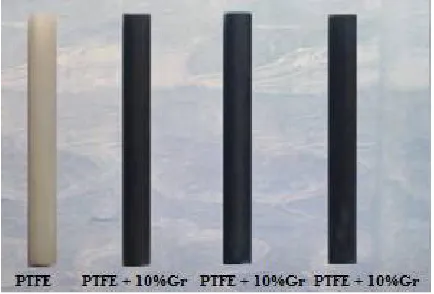
Initially, PTFE with varying amounts of Graphite powder viz 0, 10, 20 and 30% by weight were mixed manually then blended using a Twin screw extruder. The table 1 shows compositions of PTFE/Graphite composites. The specimens of PTFE and its composites were molded by using an injection molding machine. The specimens are prepared according ASTM G 99 standards. Table 1 presents the composition of each composite. Figure 3 shows the prepared specimens with different content of graphite in PTFE.
Friction and wear testing
Wear test was carried out with pin-on-disc wear tester usually under non-abrasive conditions. The test machine causes either the disc or the pin specimen to revolve about the disc centre.
During experiment composite specimens were firmly hold against rotating disc and a normal load was applied using standard weights to apply contact pressures. Each specimen was weighed to get the mass lost due to wear using highly reliable and a sensitive balance to an accuracy of 0.001 gm. The wear rate was calculated by using following equation:
Wear rate = ∆m
ρLd×10³ mm3
Nm
Figure 4 represents line diagram of Pin on disc wear test rig.
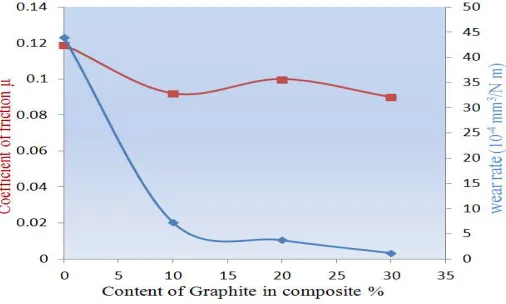
The observed response such as coefficient of friction and wear rate is shown in table 2. It is observed that addition of filler material such as graphite can improve the wear resistance of PTFE composites. This is due to presence of graphite which acts as solid lubricant.
Table 2 Observed Response
Content of Graphite in composite %
wear rate
(10-4 mm3/N m) Coefficient of friction μ
0 44 0.119
10 7.29 0.092
20 3.75 0.1
30 1.21 0.09
It also observed that small fluctuations in coefficient of friction with increase in addition of graphite to PTFE composites. The highest wear resistance was found for composites having 30% of graphite. Figure 5 shows variations in the coefficient of friction (COF) and wear rate with respect to different graphite contents.
Fig. 4 Pin on Disc wear test rig
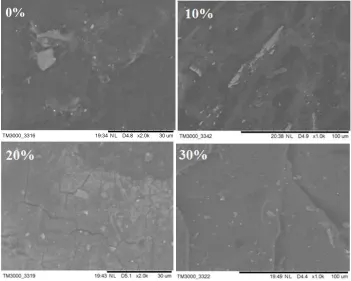
Worn out surfaces of PTFE/Graphite composites were examined in Scanning Electron Microscopy (SEM). Figure 6 shows wear mechanism of PTFE composites having graphite content in % i.e. 0, 10, 20, 30 respectively. SEM observations presents that, wear rate of PTFE composites is influenced by content of graphite present in composites. It is clearly shown that reduction in wear rate of composites is due to presence of transfer film on surface of disc.
V. CONCLUSION
Based on the analysis of experiments and worn out surface images, it is concluded that, addition of graphite into PTFE matrix reduces the coefficient of friction and wear rate. Considering various factors in account, PTFE/Graphite composite shows best wear resistance properties. It can also be concluded that the tribological properties of composites such as coefficient of friction and wear rate depends on thermal conductivity, thermal stability and properties of filler materials.
REFERENCES
[1] M.W.J. Lewis, Lubric. “Friction and Wear of PTFE-Based Reciprocating Seals, Lubrication Engineering”, Volume 42, Issue 3, Pages 152-158, March 1986.
[2] T.A. Blanchet, F.E. Kennedy, “Effects of oscillatory speed and mutual overlap on the tribological behavior of PTFE and selected PTFE-based self-lubricating composites”, Tribology Transactions, Volume 34, Issue 3, Pages 327-334, July 1991.
[3] H. Unal, A. Mimaroglu, “Friction and wear performance of polyamide 6 and graphite and wax polyamide 6 composites under dry sliding conditions”, Wear, vol.289, pp 132–137, 2012.
[4] L. Huang Lee, in: M.J. Comstock (Ed.), Polymer Wear and its Control, American Chemical Society, Washington, DC, pp. 27–39, 1985. [5] K. Tanaka, Y. Uchiyama, S. Toyoka, “The mechanism of wear of polytetrafluoroethylene”, Wear, Volume 23, Issue 2, Pages 153-172,
February 1973.
[6] J.K. Lancaster, J. “The effect of carbon fibre reinforcement on the friction and wear of polymers”, Journal of Physics D: Applied Physics, Volume 1, Issue 5, Pages 549-559, 1968.
[7] B.J. Briscoe, M.D. Steward, “The effect of carbon aspect ratio on the friction and wear of PTFE”, Wear, Volume 42, Issue 1, Pages 99-107, March 1977.
[8] J. Bijwe, C.M. Logani, U.S. Tewari, “Influence of fillers and fibre reinforcement on abrasive wear resistance of some polymeric composites”, Wear, Volume 138, Issues 1–2, Pages 77-92, June 1990.
[9] S. Bahadur, D. Tabor, “The wear of filled polytetrafluoroethylene”, Wear, Volume 98, Pages 1-13, 8 November 1984.
[10] K. Tanaka, S. Kawakami, “Effect of various fillers on the friction and wear of polytetrafluoroethylene-based composites”, Wear, Volume 79, Issue 2, Pages 221-234, 1 July 1982.
[11] Z.Z. Zhang, Q.J. Xue, W.M. Liu, W.C. Shen, “Friction and wear properties of metal powder filled PTFE composites under oil lubricated conditions”, Wear, vol. 210, pp 151–156, 1997.