Experimental Investigation of C.I Engine
Using Jathropa B20 Blend with Variable
Pressures
B. Siva Shanker1, Dr. A. Ramesh Kumar2
M.Tech, Thermal Engineering Student, QISCET- Ongole, India1 Professor, QISCET, Ongole, India2
ABSTRACT: The world’s fossil fuel reserves are depleting rapidly, according to the survey, 75% of fossil fuel production will be decreased in coming 11 years. Developing countries like India, invests heavily on imports of fossil fuels. Diesel fueled vehicles discharge significant amount of pollutants like CO, HC, CO2, and Smoke&NOx, which are
harmful for the environment. In this present work, four different loads with varying pressures like 180 bar , 200 bar & 220 bar were considered with Jathropa Bio diesel with diesel are used for Performance, EmissioJathropa B20l blend as alternative fuel ,on a single cylinder, four-stroke, water cooled, and constant speed engine capable of developing a power output of 5.2kW at 1500 rpm,connecting rod length is 234mm,compression ratio is 17.50 and swept volume is 661.45cc etc,Performance parameters such as brake power, specific fuel consumption, exhaust gas temperature and brake thermal efficiency etc.based on experiments will be calculated.Emission parameters such as carbon monoxide, oxygen, NOx, carbon dioxide, smoke and hydrocarbon etc. will be measured.Further, combustion parameters such as p-thetaa diagram, heat release rate, peak pressure and ignition delay etc. will be measured.
I. INTRODUCTION
Compression ignition engines are employed particularly in the field of heavy transportation and agriculture on account of their higher thermal efficiency and durability. However, diesel engines are the major contributors of oxides of nitrogen and particulate emissions. Hence more stringent norms are imposed on exhaust emissions. Following the global energy crisis in the 1970s and the increasingly stringent emission norms, the search for alternative renewable fuels has intensified.
1.1 ALTERNATIVE FUELS IMPORTANCE
Fossil fuels are one of the major sources of energy in the world today. Their popularity can be accounted to easy usability, availability and cost effectiveness. But the limited reserves of fossil fuels are a great concern owing to fast depletion of the reserves due to increase in worldwide demand. Fossil fuels are the major source of atmospheric pollution in today’s world. So efforts are on to find alternative sources for this depleting energy source. Even though new technologies have come up which have made solar, wind or tidal energy sources easily usable but still they are not so popular due to problems in integration with existing technology and processes. So, efforts are being directed towards finding energy sources which are similar to the present day fuels so that they can be used as direct substitutes. Various types of Alternative fuels available are a) Alcoholic fuels, 2) Bio fuels/ Diesel 3).Bio gas etc.
1.2 ADVANTAGES OF BIO DIESEL
c) Degrades more rapidly than diesel fuel, minimizing the environmental consequences of biofuelspills.
d)Lower emissions of contaminants: carbon monoxide, particulate matter, poly- cyclic aromatic hydrocarbons, aldehydes. e) Lower health risk, due to reduced emissions of carcinogenic substances.
f) No sulfur dioxide (SO2) emissions. g)Higher flash point (100°C)minimum
h)Biodiesel can be used directly in compression ignition engines with no substantial modifications of the engine. i) Blending of biodiesel with diesel fuel increases engine efficiency.
j) The higher flash point of biodiesel makes its storage safer. k)Biodiesel degrades four times faster than diesel.
l) CO, CO2 and UBHC, PAH, soot and aromatics emissions are reduced in biodiesel and its blends than in fossil diesel because biodiesel is oxygen in structure and it burns clearly all the fuels.
m) It is biodegradable.
1.3 LIMITATIONS OF BIO- DIESEL
There are certain disadvantages of using biodiesel as a replacement for diesel fuel that must be taken into consideration: It must be noted that these disadvantages are significantly reduced when biodiesel is used in blends with diesel fuel.
a)Slightly higher fuel consumption due to the lower calorific value of biodiesel. b)Slightly higher nitrous oxide (NOx) emissions than diesel fuel.
c)Higher freezing point than diesel fuel. This may be inconvenient in cold climates.
d)It is less stable than diesel fuel, and therefore long-term storage (more than six months) of biodiesel is not recommended. e) More expensive due to less production of vegetable oil.
1.4 MATERIALS AND METHODS
Rapid depletion of conventional energy sources, along with increasing demand for energy is a matter of serious concern. To solve both the energy concern and environmental concern, the renewable energies with lower environmental pollution impact should be necessary. Biodiesel is renewable and environmental friendly alternative diesel fuel for diesel engine. It can be produced by trans-esterification process. Trans-trans-esterification is a chemical reaction in which vegetable oils and animal fats are reacted with alcohol in the presence of a catalyst. The products of reaction are fatty acid alkyl ester and glycerin, and were the fatty acid alkyl esters known as biodiesel.
MATERIAL:Materials and apparatus used in the production of the biodiesel are as follows: thermometer, retort stand, pipette,
measuring cylinder, separating funnel, magnetic stirrer, oven, water bath, hydrometer, conical flask, digital weighing balance, stop watch, hot plate, distilled water and rubber seed oil.
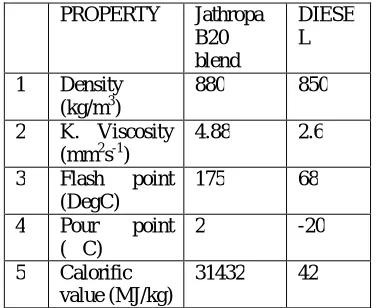
PROPERTY Jathropa B20 blend
DIESE L
1 Density (kg/m3)
880 850
2 K. Viscosity (mm2s-1)
4.88 2.6
3 Flash point (DegC)
175 68
4 Pour point ( C)
2 -20
5 Calorific value (MJ/kg)
31432 42
II. LITEARATURE REVIEW
Minnesota corn [1];In this project, a Rubber seed oil and diesel is injected directly int the cylinder. The amount and timing of the diesel injection controls ignition enabling rich or high temperature zones thus mitigating pollutant formation. Premixed combustion also allows for thermodynamically optimal operation which has shown to improve efficiency of diesel engines. Previous work has shown potential to reduce regulated diesel exhaust emissions such as oxides of nitrogen (NOx) and particulate matter (PM). Depending upon the type and extent of reduction, advanced emission control technology, such as diesel particulate filters and selective catalytic reduction using urea, may not beoadregulations.Shiyasharanpatel ,Dr.Nitin Srivastava [2]; In this experimental analysis diesel fuel, rubber seed oil were used. Experiment has been performed on the basis of constant revolution per minute, and the engine is taken as diesel engine tested on different loading conditions. The experimental analysis is based on the performance parameters like brake specific fuel consumption, brake thermal efficiency along with the exhaust emission parameters like CO, HC, NOx and smoke. JitendraPatil,SanketMulye[3];In this research we used rubber seed oil blends 20%. Experiments performed onKirloskar Make 3.5 kW rated power.The setup enables study of engine performance for brake power, indicated power, frictional power, BMEP, IMEP, brake thermal efficiency, indicated thermal efficiency, Mechanical efficiency, volumetric efficiency, specific fuel consumption, A/F ratio and heat balance. Lab view based Engine Performance analysis software package “Engine soft LV” is provided for on line performance evaluation.
III. PARTS OF EXPERIMENTAL SETUP
1. Kirloskar make Diesel Engine 2 Eddy current Dynamometer 3. Injector
4. Air filter 5. Fuel pump 6. Exhaust pipe 7. Fuel filter
8. Exhaustt gas analyser 9. Alternative fuel tank 10. Burette
11. Three way valve 12. Control panel.
IV. TESTS CARRIED
Tests are carried on the Kirloskar TV1 Engine ,for the following fuel and blends 1. 100% Diesel
2. 20% Jathropa oil + 80% Diesel (B20 blend)
4.1 TEST NO -1 & 2 (USING DIESEL & B20 BLEND) Complete the following checklist before starting the engine.
1) Fill the diesel in the diesel tank for test -1 & B20 blend for test-2. 2) Ensure fuel supply valve or knob is in open condition.
3) Ensure Cooling water inlet and outlet valves are in open position. 4) Ensure lube oil availability in the engine.
5) Ensure exhaust valve should be in open condition 6) Ensure Control panel supply is available. 7) Ensure battery healthiness.
8) Ensure smoke detector availability.
9) Ensure Dynamometer loading unit main supply is in on condition. 10) Made the Engine ready for test.
2. Start the engine using the handle.
3. Allow the engine to run at no load and 1500 rpm for some minutes.
4. Open the exhaust valve and arrange the smoke detector inside the exhaust pipe. Record the smoke parameters.
5.Record the remaining parameter at same condition of the engine. 6.Raise the load to 25 %, using the Dynamometer loading unit knob. 7.Run the system for some time at same load.
8. Record the parameters at 25% of the load and 1500 rpm. 9. Raise the load to 50%.
10. Record the parameters at 50% of the load and 1500 rpm. 11. Raise the load on the engine to 75%.
12. Record the parameters at 75% of the load and 1500 rpm. 13. Raise the load on the engine to 100 %
14. Record the parameters at 100 % of the load at constant speed.
V. RESULTS
Graph5.1:MechanicalEfficiency(vs)
0 20 40 60 80
0 4.5 9 13.5 18
EF
FI
C
IE
N
C
Y
(
%)
LOAD (kG)
MECHANICAL EFFICIENCY vs
LOAD
Graph 5.2 : Volumetric Efficiency vs Load
Graph 5.3 : Specific Fuel consumption (vs) Load
Graph 5.4 : Indicated Thermal Efficiency vs Load
79 80 81 82 83 84 85
0 4.5 9 13.5 18
E
FF
IC
IE
N
C
Y
(
%)
LOAD (kG)
VOLUMETRIC EFFICIENCY
vs LOAD
DIESEL B20 Column1 Column2
0 20 40 60 80
0 4.5 9 13.5 18
SF
T
(K
G
/
K
W
H
)
LOAD (kG)
SFC vs LOAD
DIESEL B20 B20 + E 20 B 20 + E30
0 50 100
0 4.5 9 13.5 18
EF
FI
C
IE
N
C
Y
(
%)
LOAD (kG)
INDICATED THERMAL
EFFICIENCY (vs) LOAD
Graph 5.5: Brake Thermal Efficiency vs Load
Graph 5.6: Carbon Monoxide emission vs Load
0 5 10 15 20 25 30 35 40 45
0 4.5 9 13.5 18
E
FF
IC
IE
N
C
Y
(
%)
LOAD (kG)
BRAKE THERMAL
EFFICIENCY (vs) LOAD
DIESEL B20 B20 + E 20 B 20 + E30
0 0.05 0.1 0.15
0 4.5 9 13.5 18
C
O
(
%)
LOAD (kG)
CARBON MONOXIDE vs
lOAD
Diesel B20
Graph 5.7: Hydrocarbon emission vs Load
Graph 5.8: Carbon dioxide emission vs Load
0 10 20 30 40
0 4.5 9 13.5 18
H
C
(
P
P
M
)
LOAD (kG)
HYDROCARBON vs lOAD
Diesel B20
Column1 Column2
0 2 4 6 8 10
0 4.5 9 13.5 18
C
O2
(%)
LOAD (kG)
CARBONDIOXIDE vs lOAD
Diesel B20
Graph 5.9: Oxygen vs Load
Graph 5.10: NOxemission vs Load
0 5 10 15 20
0 4.5 9 13.5 18
O2
(%)
LOAD (kG)
OXYGEN vs lOAD
Diesel B20
Column1 Column2
0 500 1000 1500
0 4.5 9 13.5 18
N
OX
(P
P
M
)
LOAD (kG)
NO
Xvs lOAD
Diesel B20
Graph 5.11: Opacity vs Load
VI. CONCLUSION
In this present work the experimental investigation of 4-stroke ,single cylinder Diesel engine is carried by using Diesel , Jathropa bio diesel (B20) at various loads with constant speed. Engine performance and emissions are calculated.Engine characteristics are compared ,when only operating with diesel and when operating with Jathropa oil B20 blend at various pressures like 180 bar , 200 bar & 220 bar. Mechanical efficiency of the engine is raised and specific fuel consumption is decreased comparing with diesel, when load on the engine is raised. In engine emission , it is noticed thaat CO , Opacity , NOx& HC values are raised with raising the loads on the engine. Whereas carbon dioxide is coming down.It is noticed that using blends , environmental pollution is lowered , comparing with dieselfuel.
REFERENCES
[1]Balusamy T. and Senthilkumar T. Reduction of NOx emissions in Jatropha seed oil-fueled CI engine, vol.6, NO.5. May 2011
[2]Sharma RP. Bio-diesel and E-diesel in transportation—an OEM perspective. In: Proceedings of XVIII National Conference on IC Engines, Trivandrum, December, 2003, p. 539–50.
[3]Chairman, Committee on development of bio-fuel. Report of committee on development of bio-fuels. Planning Commission, Government of India, April 2003.
[4]Agarwal AK, Das LM. Bio-diesel development and characterization for use as a fuel in CI engines. ASME Trans 2001;123:440–7.
[5]Senthil Kumar M, Ramesh A, Nagalingam B. Explorations on the use of Jatropha oil and its methyl ester as fuel in a CI engine. J Inst Energy 2001;74:24–8. [6]Senatore A, et al. A comparative analysis of combustion process in DI diesel engine fueled with biodiesel and diesel fuel, 2000, SAE Transaction 2000-01-0691. p. 1–11.
[7]Ladommatos N, Abdelhalim SM, Zhao, Hu Z. The effects of CO2 in EGR on diesel engine emissions. ProcInstMechEng 2000;212(Part D):25–42. [8]S.K. Mahla , L.M. Das , M.K.G. Babu . Effect of EGR on Performance and Emission Characteristics of Natural Gas Fueled Diesel Engine ISSN 1995-6665 Pages 523 – 530
[9]Avinash Kumar Agarwal and et al.:. Effect of EGR on the exhaust gas temperature and exhaust opacity in compression ignition engines Vol. 29, Part 3, June 2004, pp. 275–284
[10] International Journal of Agricultural utilization Research Institute (Oct 2014) - Will Northrop (University of Minnesota), Minnesota corn.
[11] International Journal of Renewable Energy Research (2016) - Shiyasharan Patel, Dr. Nitin Srivastava. Experimental Investigation of Performance & Emission of Diesel Engine Fuelled with Preheated Jatropha Biodiesel and its Blends with Ethanol.
[12] International Advanced Research Journal in Science, Engineering and Technology (Dec 2016) - Experimental Investigation of Single Cylinder Diesel Engine Using Biodiesel Ethanol
Blended Fuels - JitendraPatil, SanketMulye, Milan Kumar Nandgaonkar.
0 10 20 30 40 50 60
0 4.5 9 13.5 18
O
P
A
C
IT
Y
(%)
LOAD (kG)