GOTWALT, CHRISTOPHER MICHAEL. Model-Robust Interval Estimation. (Under the
di-rection of Dennis Boos.)
Confidence intervals are one of the most useful statistical tools. This dissertation is
a study of several methods for forming confidence intervals that are insensitive to model
as-sumptions, provided that the mean model for the data is not misspecified. The most commonly
used robust confidence interval, the generalized Wald interval, is known to be liberal in small
sample situations. We investigate several alternatives to the generalized Wald interval that are
shown to often have superior performance: the generalized score interval; the robust profile
likelihood interval; a new, modified generalized score interval that we call the GS2 interval;
and we investigate a bootstrap calibration of the generalized Wald interval. We also introduce
a new general procedure, length-optimal interval estimation, that takes an existing equal-tail
confidence procedure and creates a new one whose length is shorter than the original.
Surpris-ingly, in simulations we see that these shorter intervals are shown to sometimes enjoy higher
by
Christopher Michael Gotwalt
A dissertation submitted in partial fulfillment of the requirements for the degree of
Doctor of Philosophy
in
STATISTICS
in the
GRADUATE SCHOOL at
NC STATE UNIVERSITY 2003
Professor Dennis D. Boos Chair of Advisory Committee
Professor John Monahan Professor Leonard Stefanski
Biography
Christopher Michael Gotwalt was born in York, Pennsylvania on January 2, 1974. He
finished his secondary education at Ridgewood High School in New Port Richey, Florida in
1992.
Upon graduation, he was awarded the Florida Undergraduate Scholars Fund
Scholar-ship. Christopher attended the University of South Florida in the USF Honors Program from
August 1992 until May 1994. In October 1994, he received the Superior Academic Achievement
Award at the USF Presidential Inauguration and Honors Convocation. He studied at the
Uni-versity of Florida from August 1994 until August 1997, whereupon he graduated with Honors,
earning a Bachelor of Arts in Mathematics with a Minor in Physics.
In 1997, he began graduate studies in statistics at North Carolina State University.
He was awarded the Mendenhall Teaching Fellowship in May 1999, and the following summer
developed the MLAB educational statistics software toolkit for Matlab. From August 1999 to
August 2000, Christopher was a Graduate Industrial Trainee at Analytical Sciences, Inc., where
he developed SAS System programs for use by toxicology researchers at the NIH and NIEHS.
Christopher received a Master of Science degree in Statistics from NCSU in May 2000, and was
selected as a recipient of the Gertrude M. Cox Award as Outstanding Ph.D. Candidate. In
August 2000, Christopher was awarded a GAANN Fellowship in Computational Science. He
became the inaugural SAS Computational Statistics Fellow in January 2001. From May 2001
to May 2003, he was a student developer at the SAS Institute, where he developed statistical
software for reliability and survival analysis, neural networks, and psychometric ability testing.
Acknowledgements
First and foremost, I would like to thank my patient wife, Jessica, without whose love and
support this dissertation could not have been completed. I would also like to thank my parents,
Rick and Judy Gotwalt, for their support through these years, and for giving me the inspiration
and drive necessary to come this far.
I would like to extend my gratitute to my advisor, Professor Dennis Boos, for giving me
this challenging topic, and for his time and guidance during the completion of my dissertation.
I would like to thank my committee members, Professors John Monahan, Leonard Stefanski,
and Charlie Smith for their helpful comments during the research process. I would also like to
thank Dr. Sastry Pantula for his support throughout my graduate career, and for pushing me
to be the best I can be.
I would also like to acknowledge John Sall, Executive Vice President and Co-Founder of
the SAS Institute, for sponsoring the SAS Computational Statisics Fellowship, which provided
the funding for this research, and enabled me to take the course work in applied mathematics
and computer science which gave me the broad foundation necessary for a successful career as
a statistical software developer.
Last, but not least, I would like to offer my sincerest gratitude to Dr. Juan E. Sanchez
for all the help and support that he has given me over the years.
One cannot succeed alone, and I have been very fortunate in that I have had so many
kind people help me along the way. I hope that I am given the opportunity to pass along the
Contents
List of Tables vii
List of Figures x
1 Generalized Wald, Score, and Robust Profile Likelihood Confidence Intervals 1
1.1 Introduction . . . 1
1.2 Notation . . . 3
1.3 Generalized Wald Confidence Intervals . . . 5
1.4 Generalized Score Confidence Intervals . . . 6
1.5 Robust Profile Likelihood Confidence Intervals . . . 10
1.6 Numerical Computation of Generalized Score and Robust Profile Likelihood Con-fidence Intervals . . . 12
1.7 Simulations . . . 14
1.7.1 Logistic Regression GEE . . . 15
1.7.2 Poisson Regression GEE . . . 21
1.7.3 Huber Robust Linear Regression . . . 26
1.7.4 Simple Linear Regression With Covariate Measurement Error . . . 33
2 Length-Optimal Interval Estimation 36 2.1 Motivation and Description . . . 36
2.2 Example: Binomial Proportion . . . 41
2.3 Theory . . . 47
2.4 Simulations . . . 59
2.4.1 Logistic GEE Simulations . . . 59
2.4.2 Poisson GEE simulations . . . 64
2.4.3 Huber Robust Linear Regression . . . 67
2.4.4 Simple Linear Measurement Error Models . . . 69
3 The GS2 Confidence Interval 72 3.1 Introduction . . . 72
3.2 Motivation . . . 73
3.3 Theory . . . 76
3.4.1 Simple Linear Logistic GEE With Exchangeable Working Correlation
Ma-trix . . . 83
3.4.2 GUIDE Data Example and Simulations . . . 86
3.4.3 Simple Linear Poisson GEE With AR(1) Working Correlation Matrix . . 89
3.4.4 Epilepsy Data Example and Simulations . . . 92
4 Bootstrap Calibrated Generalized Wald Confidence Intervals 94 4.1 Introduction . . . 94
4.2 Bootstrap Confidence Intervals . . . 94
4.2.1 Bias-Corrected and Accelerated Bootstrap Confidence Intervals . . . 95
4.2.2 Bootstrap Calibrated Generalized Wald Confidence Intervals . . . 97
4.3 Simulations . . . 99
4.3.1 Logistic GEE Simulations . . . 99
4.3.2 Poisson GEE Simulations . . . 102
5 Conclusions and Future Work 104
A A Serially Correlated Poisson-Type Random Number Generation Scheme 107
List of Tables
1.1 Coverage and length for generalized Wald, score, and robust likelihood intervals for Bernoulli data under a simple linear logistic regression model. . . 17 1.2 Proportion of infinite length generalized score and robust likelihood intervals for
Bernoulli data under simple a linear logistic regression model. . . 18 1.3 Logistic regression MLE’s and approximate 95% GEE confidence intervals for
the GUIDE dataset. . . 19 1.4 Coverage and length for generalized Wald, score, and robust likelihood intervals
for clustered Bernoulli data simulated from the GUIDE dataset. . . 20 1.5 Proportion of infinite length generalized score and robust likelihood intervals for
clustered Bernoulli data simulated from the GUIDE dataset. . . 21 1.6 Coverage and length for generalized Wald, score, and robust likelihood intervals
for serially correlated Poisson data under a log linear regression model. . . 23 1.7 Proportion of infinite length generalized score and robust likelihood intervals for
serially correlated Poisson data under a log linear regression model. . . 24 1.8 Poisson regression MLE’s and approximate 95% GEE confidence intervals for the
Epilepsy dataset. . . 25 1.9 Coverage and length for generalized Wald, score, and robust likelihood intervals
for serially correlated Poisson data using the Epilepsy data covariates and MLE. 26 1.10 Coverage and length for generalized Wald, score, and robust likelihood intervals
for iid data under a simple linear Huber regression model. . . 32 1.11 Proportion of infinite length generalized score and robust likelihood intervals for
iid data under a simple linear Huber regression model. . . 32 1.12 Coverage and length for generalized Wald, score, and robust likelihood intervals
from simple linear measurement error model. . . 34 1.13 Coverage and length for generalized Wald, score, and robust likelihood intervals
from simple linear measurement error model. . . 35 1.14 Proportion of infinite length generalized score and robust likelihood intervals
from simple linear measurement error model. . . 35 2.1 Length-optimal and equal-tail treatment effect 95% confidence intervals for 33
2.2 Coverage and length for length-optimal generalized score, and robust likelihood intervals for Bernoulli data under a simple linear logistic regression model. . . 61 2.3 Proportion of infinite length length-optimal generalized score and robust
likeli-hood intervals for Bernoulli data under simple a linear logistic regression model. 61 2.4 Equal-tail and length-optimal approximate 95% GEE confidence intervals for the
GUIDE dataset. . . 62 2.5 Coverage and length for length-optimal generalized score and robust likelihood
intervals for clustered Bernoulli data simulated from the GUIDE dataset. . . 62 2.6 Proportion of infinite length length-optimal generalized score and robust
likeli-hood intervals for clustered Bernoulli data simulated from the GUIDE dataset. . 63 2.7 Coverage and length for length-optimal generalized score and robust likelihood
intervals for serially correlated Poisson data under a log linear regression model. 65 2.8 Proportion of infinite length length-optimal generalized score and robust
likeli-hood intervals for serially correlated Poisson data under a log linear regression model. . . 65 2.9 Equal-tail and length-optimal approximate 95% GEE confidence intervals for the
Epilepsy dataset. . . 66 2.10 Coverage and length for length-optimal generalized score and robust likelihood
intervals for serially correlated Poisson data using the Epilepsy data covariates and MLE. . . 66 2.11 Coverage and length for length-optimal generalized score and robust likelihood
intervals for iid data under a simple linear Huber regression model. . . 67 2.12 Coverage and length for length-optimal generalized score and robust likelihood
intervals for iid data under a simple linear Huber regression model. . . 68 2.13 Proportion of infinite length length-optimal generalized score and robust
likeli-hood intervals for iid data under a simple linear Huber regression model. . . 68 2.14 Coverage and length for length-optimal generalized score and robust likelihood
intervals from simple linear measurement error model. . . 69 2.15 Coverage and length for length-optimal generalized score and robust likelihood
intervals from simple linear measurement error model. . . 70 2.16 Proportion of infinite length length-optimal generalized score and robust
likeli-hood intervals from simple linear measurement error model. . . 71 3.1 Coverage and length for generalized Wald, score, and GS2 intervals for Bernoulli
data under a simple linear logistic regression model. . . 84 3.2 Proportion of infinite length generalized score and GS2 intervals for Bernoulli
data under simple a linear logistic regression model. . . 85 3.3 Logistic GEE with exchangeable working correlation matrix estimates and
ap-proximate 95% confidence intervals parameters from the GUIDE dataset. . . 86 3.4 Coverage and length for generalized Wald, score, and GS2 intervals for clustered
Bernoulli data simulated from the GUIDE dataset. . . 87 3.5 Proportion of infinite length generalized score and GS2 intervals for clustered
Bernoulli data simulated from the GUIDE dataset. . . 88 3.6 Coverage and length for generalized Wald, score, and GS2 intervals for serially
3.7 Proportion of infinite length generalized score and GS2 intervals for serially cor-related Poisson data under a log linear regression model. . . 91 3.8 Poisson GEE AR(1) working correlation matrix estimates and approximate 95%
GEE confidence intervals for the Epilepsy dataset. . . 92 3.9 Coverage and length for generalized Wald, score, and GS2 intervals for serially
correlated Poisson data using the Epilepsy data covariates and MLE. . . 93 4.1 Coverage and length for calibrated generalized Wald and BCaintervals for Bernoulli
data under a simple linear logistic regression model. . . 100 4.2 Coverage and length for calibrated generalized Wald and BCa intervals for
clus-tered Bernoulli data simulated from the GUIDE dataset. . . 101 4.3 Coverage and length for calibrated generalized Wald and BCaintervals for serially
correlated Poisson data under a log linear regression model. . . 102 4.4 Coverage and length for calibrated generalized Wald and BCaintervals for serially
List of Figures
2.1 Confidence curve for a 33 cluster subset of the Epilepsy data. . . 40
2.2 Coverage plots for binomial proportionn=5 . . . 45
2.3 Coverage plots for binomial proportionn=10 . . . 45
2.4 Coverage plots for binomial proportionn=20 . . . 46
Chapter 1
Generalized Wald, Score, and
Robust Profile Likelihood
Confidence Intervals
1.1
Introduction
In likelihood inference there are three standard methods of generating confidence
in-tervals for a parameter of interest. These three methods are derived by simply inverting the
three corresponding likelihood-based hypothesis tests: the Wald test, the score test, and the
likelihood ratio test. These confidence intervals require that the assumed probability model for
the data is the one that actually generated the data; in other words, the probability model is
not misspecified. If the assumed likelihood is misspecified, then the error rates for these
These standard intervals rely on the theory which states that Wald, score, and likelihood ratio
tests are all asymptotically distributed as χ2 random variables. If the model is incorrect this
asymptotic result may not hold, often leading to higher than nominal error rates. In the case
of the Wald and score tests, there are relatively simple modifications of the test statistics that
can be made so that the adjusted statistics follow an asymptotic χ2 distribution even when
the assumed model is incorrect. However, in the case of the likelihood ratio test, this is not in
general possible. Under model misspecification, the likelihood ratio test statistic is distributed
asymptotically as a linear combination ofp−p0χ21random variables (chi-squared with 1 degree
of freedom), where p and p0 are the dimensionalities of the full parameter space and the
pa-rameter space under the null hypothesis, respectively (Kent 1982). The task of finding critical
values for such a distribution is somewhat computationally challenging, and application-level
software to compute such critical values does not appear to be generally available, which is
pos-sibly why it is uncommon to find the likelihood ratio test used in situations where the model
is expected to be incorrect. However, in the case of confidence intervals, we are only interested
in the situation where p−p0 = 1. The likelihood test then follows the distribution of a χ21
multiplied by a scalar constant that is not difficult to estimate. This fact appears to be quite
unappreciated at this time. It suggests a procedure for generating confidence intervals that is
in many ways superior to robust versions of the Wald and score confidence intervals. In this
chapter we discuss and compare the generalized, robust versions of the Wald, score, and profile
1.2
Notation
Let the data be denoted byY={yi}ni=1, and suppose that the assumed model for the
data is that the individual data points,yi, are independent random variables that have density
yi ∼ f(yi|θ,xi), where θ is an unknown parameter of dimension p, and each xi is a known
vector of covariates whose dimension is less than or equal top. The true density that generated
the complete data Y is g(Y|θ,X), and is unknown. In particular, g is not necessarily equal to Q
f(yi|θ,xi) for any value of θ. We assume that regularity conditions like those in White
(1982) hold for f(y|θ,x) and g(Y|θ,X), so that the maximum likelihood estimator (MLE) of θ under model f, ˆθn, is strongly consistent for θt, the true value of θ, and is asymptotically
normally distributed. The model log likelihood is,
ln(θ|Y) = n
X
i=1
logf(yi|θ,xi). (1.1)
We denote the gradient of the log likelihood, or score function, by,
S(θ) = ∂
∂θln(θ|Y). (1.2)
There are two information-type matrices that will be of use. These are, assuming that the
necessary limits exist,
I(θ) = − lim
n→∞Eg
" 1 n
n
X
i=1
∂2
∂θ∂θT logf(yi|θ,xi)
#
and,
D(θ) = lim
n→∞Eg
" 1 n n X i=1 ∂
∂θlogf(yi|θ,xi) ∂
∂θT logf(yi|θ,xi)
#
. (1.4)
Asg is unknown in practical situations, one commonly uses empirical estimators for
the two preceding quantities,
ˆ
I(θ) = −1
n
n
X
i=1
∂2
∂θ∂θT logf(yi|θ,xi), (1.5)
and
ˆ
D(θ) = 1
n
n
X
i=1
∂
∂θlogf(yi|θ,xi) ∂
∂θT logf(yi|θ,xi). (1.6)
Note that, strictly speaking, these are not truly estimates, but are estimates of a matrix function
that takes θ as its argument.
Because our interest lies in confidence intervals, we partitionθinto
θ = ψ η , (1.7)
whereψ is the scalar parameter of interest and η is the vector containing the remaining p−1 parameters. When vector or matrix quantities are seen with subscripts such as S1 or I12,
we assume that the full vector or matrix has been partitioned conformally with the (ψ, η)
The restricted MLE ofη under the constraint thatψis held fixed,˜η(ψ), figures
promi-nently in the calculation of generalized score and robust likelihood intervals, and is computed
by solving
S2(ψ,η(ψ)) = 0.˜ (1.8)
1.3
Generalized Wald Confidence Intervals
Because of its simplicity, the generalized Wald confidence interval has been the most
commonly used confidence interval that is robust to misspecification. Once parameter
estima-tion is completed, the generalized Wald interval is not difficult to compute, and has a simple,
easily interpretable, form.
However, there are some serious drawbacks to these intervals. Although under very
broad conditions the generalized Wald interval has an asymptotic coverage rate equal to the
nominal 1−αrate, in practical small sample situations the actual coverage may be significantly smaller than stated. The generalized Wald interval also lacks the parameterization invariance
that the other two likelihood-based intervals, the generalized score and robust profile likelihood
intervals, often share.
The generalized Wald interval is motivated by the asymptotic normality of the MLE
under possible model misspecification. Under broad conditions, the MLE, ˆθn, has an asymptotic
normal distribution (Stefanski and Boos 2002)
√
This convergence suggests an obvious form for the generalized Wald statistic for testing
H0:ψ=ψ0,
TGW(ψ0) =
n( ˆψ−ψ0)2
{Iˆ−1(ˆθ) ˆD(ˆθ) ˆI−1(ˆθ)}11. (1.10)
This generalized Wald test statistic, which has a null asymptotic χ2
1 distribution, is easily
inverted to obtain the corresponding confidence interval,
ˆ ψn±
q
{Iˆ−1(ˆθ) ˆD(ˆθ) ˆI−1(ˆθ)} 11
z1−α/2
√
n , (1.11)
wherez1−α/2 is the 1−α/2 quantile of the standard normal distribution. In order to improve the generalized Wald interval’s coverage we will often use critical values from thet-distribution
with n−p degrees of freedom, which can dramatically improve its small sample performance. We will call such intervals generalized Wald-t confidence intervals.
The quantity ˆI−1(ˆθ) ˆD(ˆθ) ˆI−1(ˆθ) is commonly referred to as thesandwich matrix, and
plays a central role in robust likelihood inference.
1.4
Generalized Score Confidence Intervals
The generalized score interval arises from inverting the generalized score statistic (Boos
1992) for the hypothesisH0: ψ=ψ0,
TGS(ψ0) =n−1ST(˜θ) ˆI−1(˜θ)e1(eT1Iˆ−1(˜θ) ˆD(˜θ) ˆI−1(˜θ)e1)−1eT1Iˆ−1(˜θ)S(˜θ)
=n−1ST(˜θ) ˆI−1(˜θ)S(˜θ)· {Iˆ−1(˜θ)}11
{Iˆ−1(˜θ) ˆD(˜θ) ˆI−1(˜θ)} 11
,
where ˜θ= (ψ0,η(ψ˜0))T, ande1 is the unit vector whose first element is one, and the remaining
elements are zero.
The first representation is the form of the fully general, hypothesis via constraint,
version of the generalized score test statistic (Boos 1992), for the special case of H0 :ψ =ψ0.
The second form is reduced from the first and highlights its relationship to Rao’s original
score test statistic, n−1STI−1S. The generalized score test statistic is equal to Rao’s score
test multiplied by a scalar robust correction constant. This form, a non-robust test statistic
multiplied by a robust correction, is similar of the robust likelihood ratio test, that we introduce
in the next section.
In many common situations, the generalized score test is invariant to differentiable
parameter transformations. We are easily able to verify this using an argument similar to one
given in Stafford (1996). A sufficient condition for the generalized score test to be invariant is
that the observed and expected information matrices coincide. This is the case, for example, in
generalized linear models with canonical link function, since the second derivative matrix of the
loglikelihood is functionally independent of Y. Suppose that (ψ, ηT) is an invertible and twice
differentiable reparameterization of (τ, λT) = (τ(ψ), λT(ψ, η)). Notice that the two parameters
ψandτ are measuring the same quantity on different scales of measurement whose relationship
may be nonlinear. This means that H0 : ψ = ψ0 and H0 : τ =τ(ψ0) are testing the same
hypothesis. If we differentiate the reparameterized likelihood,ln(τ(ψ), λ(ψ, η)|Y), and take the
necessary expectations for the computation of information matrices, we obtain theψ-scale score
vector and information matrices,
Iψ = J(ψ, η)I(τ(ψ), λ(ψ, η))J(ψ, η)T, (1.14)
and
Dψ = J(ψ, η)D(τ(ψ), λ(ψ, η))J(ψ, η)T, (1.15)
whereJ is the Jacobian of the reparameterization,
J(ψ, η) =
∂τ
∂ψ 0T
∂λ
∂ψ ∂η∂λT
. (1.16)
Now, Rao’s score test statistic is invariant because,
(JS)T(JIJT)−1(JS) =STJTJ−TI−1J−1JS
=STI−1S,
(1.17)
establishes that theψ-scale andτ-scale score test statistics coincide. Partitioned-matrix algebra
shows the invariance of the correction constant, although individually ˆI(θ) and ˆD(θ) are not
invariant.
{J−TI−1J−1}11
{(J−TI−1J−1)(JDJT)(J−TI−1J−1)} 11
= {J−
TI−1J−1}
11
{J−TI−1DI−1J−T}
11
= J
2
11{I−1}11
J2
11{I−1DI−1}11
= {I−
1} 11
{I−1DI−1} 11
.
This demonstrates that the generalized score test statistics in the ψ-scale and theτ-scale have
the same value, proving the invariance of the generalized score test statistic.
If ψ0 is the true value of ψ, then the TGS has an asymptotic χ21 distribution, like
the generalized Wald statistic. This test statistic is derived using the asymptotic distribution
of n−1S(θ), which is a mean of independent random variables, and therefore, under broad
regularity conditions, is asymptotically normally distributed by the Central Limit Theorem.
The Wald statistic also implicitly assumes thatn−1S(θ) is normally distributed, but in addition
requires the use of the delta theorem to obtain the asymptotic normality of ˆθ, as it is the
solution of the equation S( ˆθ) = 0. Thus, one would expect that the χ21 approximation to
the distribution of the generalized score statistic would be more accurate than that of the
generalized Wald statistic. The generalized score statistic contains only restricted estimates of
θ under the null hypothesis. This usually gives it a slight computational advantage over the
Wald and likelihood ratio tests, because there is one less parameter that needs to be estimated.
Unfortunately, this computational advantage does not carry over to generalized score confidence
intervals. This is because obtaining the generalized score confidence interval amounts to solving
TGS(ψ)−z12−α= 0 twice: once each for the upper and lower endpoints of the interval. AsTGS
is generally a nonlinear function ofψ, an iterative procedure is required, and ˜η(ψ) will have to
be recomputed during each iteration.
As the simulations later in this chapter show, in small samples the generalized score
confidence intervals maintain their nominal coverage rate better than the generalized Wald
intervals, but in small samples they can be highly inefficient. These confidence intervals can
be many times wider than generalized Wald intervals, and in some situations can be infinite in
profile likelihood confidence interval.
1.5
Robust Profile Likelihood Confidence Intervals
The robust profile likelihood confidence interval is the least well known of the
likelihood-based intervals, possibly because the critical values of the asymptotic distribution of the robust
likelihood ratio test initially appear to be difficult and unwieldy to compute. A somewhat
closer look reveals that robust likelihood confidence intervals are no more difficult to compute
than generalized score confidence intervals, however. The idea behind these intervals goes back
to Foutz and Srivastava (1977), and Kent (1982), who independently derived the asymptotic
distribution of the likelihood ratio test under model misspecification. Unlike the generalized
Wald and score statistics, except for the scalar parameter of interest case, there is no direct
modification of the likelihood ratio statistic that generally gives it an asymptotic χ2
distribu-tion. In place of such a modification, Foutz et al, and Kent found the asymptotic distribution
of the likelihood ratio test under misspecification. The asymptotic form of the likelihood ratio
statistic for H0:ψ=ψ0, is
2(ln(ˆθ)−ln(ψ0,η(ψ˜ 0)). (1.19)
Assuming for the moment thatψhas dimensionp0 between 1 andp, Kent (1982) gives
the asymptotic distribution of the test statistic to be that of
p0
X
i=1
where theXi are independentχ21 random variables, and theci are the eigenvalues of the matrix
{{I(θ)−1}
11}−1{I(θ)−1D(θ)I(θ)−1}11. (1.20)
Finding critical values for a linear combination of χ2 random variables can be done using
Imhof’s algorithm (Imhof 1961), but in the case of confidence intervals, this is unecessary, as
the asymptotic distribution of the likelihood ratio test is just a scalar constant multiplied by a
χ21 random variable. This correction constant cis simply the robust estimate of the variance of
ψ divided by the model based variance estimate,
c = {I(θ)−
1D(θ)I(θ)−1} 11
{I(θ)−1} 11
, (1.21)
and can be consistently estimated by simply inserting the MLE of ˆθ,
ˆ
c = {I(ˆθ)−
1D(ˆθ)I(ˆθ)−1} 11
{I(ˆθ)−1}11 . (1.22)
So, for scalar ψ, the robust likelihood ratio test statistic is defined to be
TRLR(ψ0) =
2(ln(ˆθn)−ln(ψ0,η(ψ˜ 0)))
ˆ
c , (1.23)
and has an asymptotic χ2
1 distribution underH0 :ψ=ψ0.
Like the generalized score interval, the robust profile likelihood interval is invariant
under all differentiable reparameterizations that preserve ψ (Stafford 1996). This is easily
demonstration of the generalized score test’s invariance, and also by the well-known invariance
of the likelihood ratio test statistic.
The simulations later in this chapter indicate that the robust profile likelihood interval
frequently outperforms both the Wald and generalized score confidence intervals. Its coverage
of the true parameter value is closer to nominal than the Wald interval, while lacking the loss
of efficiency and conservatism of the generalized score interval.
1.6
Numerical Computation of Generalized Score and Robust
Profile Likelihood Confidence Intervals
The computation of the endpoints of profile likelihood and generalized score confidence
intervals, while simple in principle, requires some care to ensure that convergence occurs
when-ever possible. The basic problem is this: given a test statisticT(ψ,η(ψ)) whose null distribution˜
isχ21, find two solutions (ψL, ψU) to the scalar equation
T(ψ,η(ψ))˜ −z12
−α/2 = 0. (1.24)
There are several difficulties that an algorithm for finding (ψL, ψU) must overcome. First and
foremost, the algorithm should employ a root bracketing scheme to ensure that the same root
is not found twice. Root bracketing algorithms maintain a bracket, or interval, that is known
to contain the root of an equation. At every iteration, the bracket’s length is decreased until it
is smaller than some prespecified tolerance. The bisection method is the simplest and most well
finding an initial bracket for each of the confidence interval’s endpoints is made easier because
we know a priori that ψL <ψ < ψˆ U, as all likelihood-based tests accept the null hypothesis,
H0 : ψ = ˆψ. An initial line search is necessary, however, to completely bracket the root, and
to ensure that both of the two roots exist. Unlike Wald type confidence intervals, generalized
score and robust profile confidence intervals are not necessarily finite in length. In fact, if one
were to speak carefully, one would speak instead of generalized score and likelihood confidence
regions, as opposed to intervals, because the set of values of ψ for which test T accepts the
null hypothesis, {ψ|T(ψ,η(ψ))˜ < z12
−α/2}, is not guaranteed to be an interval at all, even an
infinite one. However, in the experience of the author, generalized score or profile likelihood
confidence regions that are not intervals (finite or infinite in length) are very rare for most
models. Furthermore, the asymptotic equivalence of the generalized Wald test, the generalized
score, and robust likelihood ratio tests (in the case of a single parameter of interest) ensures
that the probability that these confidence regions are not intervals goes to zero as the sample
size becomes large. A final consideration is a slight preference for derivative-free methods for
obtaining (ψL, ψU). Although the derivative of the profile likelihood is not difficult to derive,
the derivative of the generalized score test involves quantities like vector derivatives of the
inverse of a matrix, a tensor of degree three, which would be convenient to avoid computing
whenever possible.
Brent’s scalar root finding method (Brent 1973) provides a solution that meets all
the demands stated in the preceding paragraph, and is fast. In fact, if the derivative is at
least as difficult to compute as the function whose root is being sought, Brent’s method is even
faster than Newton’s method (Press, Teukolsky, Vetterling, and Flannery 1988). The details of
constructed combination of bisection, regula falsi, and inverse quadratic interpolation that is
put together in such a way that it converges quickly for well behaved problems, and in most
cases does no worse than bisection on hard problems.
Thus, an effective strategy for computing the endpoints of generalized score and robust
profile likelihood confidence intervals is to first perform a line search to find whereT(ψ,η(ψ))˜ − z21
−α/2 changes sign from negative to positive. Without loss of generality, we will discuss the
computation of upper endpoints, as the method for computing lower endpoints is completely
analagous. We know from the outset that T( ˆψ,η( ˆ˜ ψ)) = 0, so that for both endpoints the
side of the root bracket that corresponds to where T(ψ,η(ψ))˜ −z21
−α/2 < 0 can be initially
set to ˆψ. Then, we initialize ψ to be equal to the upper generalized Wald endpoint and
computeT(ψ,η(ψ))˜ −z2
1−α/2. Because of the asymptotic equivalence of these likelihood-based
tests, the generalized Wald upper endpoint makes a perfectly reasonable, easily computed,
starting value. We continue incrementing ψby the standard error of the MLE, and computing
T(ψ,η(ψ))˜ −z21
−α/2 until this quantity becomes positive. Once this happens, a bracket that
contains the upper endpoint of the confidence interval has been found, and one can now employ
Brent’s method (or bisection, or any other root finding algorithm) to obtain a solution to the
equation. However, if after a predetermined number of steps, a value ofψthat yields a positive
value of T(ψ,η(ψ))˜ −z12
−α/2 has not been found, declare the endpoint to be infinite in value.
1.7
Simulations
In this section are the results of simulations that compare the generalized Wald,
logistic and log-linear GEE models, Huber robust linear regression models, and linear
measure-ment error models.
Generalized estimating equations (GEE) models are an important class of models
that extend the applicability of generalized linear models to data that are correlated within
clusters (Liang and Zeger 1986). The standard method for hypothesis testing and generating
confidence intervals for parameters of a GEE model is the generalized Wald test. However, it
is well known (Gunsolley, Getchell, and Chinchilli 1995) that Wald methods do not perform
well in datasets where the number of clusters is small. In this section we give the results from
a number of simulations that provide evidence that the generalized score and robust profile
likelihood confidence intervals offer a significant improvement over the standard generalized
Wald interval. It also becomes clear that the generalized score interval is often less efficient
than the robust profile likelihood interval, as measured by its length.
1.7.1 Logistic Regression GEE
We investigate, via simulation, the small sample properties of confidence intervals for
parameters that describe the mean of binary data that is correlated in clusters. Two situations
are examined. The first is a series of simulations in the case of simple linear logistic regression,
and the second set of simulations are motivated by the data from a study (Preisser and Qaqish
1999) of urinary incontinence.
Simple Linear Logistic GEE Simulations
In each of the following simulations we generateNS = 2000 data sets in the following
represent the data by {yij} where i = 1,2, . . . K and j = 1,2,3,4. The data for each cluster
is then created using Al-Osh and Lee’s algorithm for generating correlated binary data, given
a specific mean and correlation structure (Al-Osh and Lee 2001). The observations within the
cluster are individuallyBernoullirandom variables whoselog odds of equalling 1 areη+ψxij,
where the xij are independently drawn U nif orm(−1,1) random variables, and the values η
and ψ are known constants. The observations within the cluster have common correlation, γ,
where the value ofγ is either 0, .2, or .5, depending on the simulation.
We estimateθ= (ψ, η)T with a GEE model using the independence working
correla-tion matrix, that amounts to ordinary simple linear logistic regression using thexijas covariates.
We then use the estimate ofθto form 95% (equal tail) generalized Wald, generalized score, and
robust profile likelihood confidence intervals for ψ. Because of the overall poor performance of
the generalized Wald interval, we also report simulation results for the generalized Wald interval
using t-distribution critical values in place of the more commonly used normal-theory critical
values. By analogy with linear models, the degrees of freedom for the t-distribution critical
values is set to the number of clusters minus the number of estimated parameters. Using these
critical values dramatically improves the coverage of the generalized Wald interval.
The size of these simulations, NS = 2000, was chosen so that for values near .95 the
estimated coverage probabilities should be known to within about .01 of the true value with
95% certainty. The proportion of the confidence intervals that covered the true value of ψ
are reported, along with median length of the intervals. The median length was chosen to be
reported, rather than the mean length, because the possibility of infinite intervals renders the
mean a useless measure of typical length. We also report the proportion of intervals that are
and is a manifestation of a significant loss of inferential power.
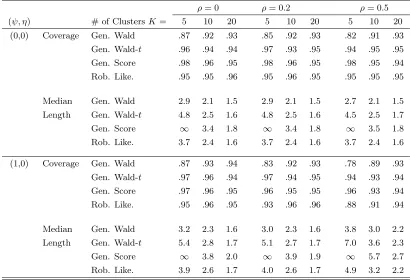
Table 1.1: Coverage and length for generalized Wald, score, and robust likelihood intervals for Bernoulli data under a simple linear logistic regression model.
ρ= 0 ρ= 0.2 ρ= 0.5
(ψ, η) # of ClustersK= 5 10 20 5 10 20 5 10 20
(0,0) Coverage Gen. Wald .87 .92 .93 .85 .92 .93 .82 .91 .93
Gen. Wald-t .96 .94 .94 .97 .93 .95 .94 .95 .95
Gen. Score .98 .96 .95 .98 .96 .95 .98 .95 .94
Rob. Like. .95 .95 .96 .95 .96 .95 .95 .95 .95
Median Gen. Wald 2.9 2.1 1.5 2.9 2.1 1.5 2.7 2.1 1.5
Length Gen. Wald-t 4.8 2.5 1.6 4.8 2.5 1.6 4.5 2.5 1.7
Gen. Score ∞ 3.4 1.8 ∞ 3.4 1.8 ∞ 3.5 1.8
Rob. Like. 3.7 2.4 1.6 3.7 2.4 1.6 3.7 2.4 1.6
(1,0) Coverage Gen. Wald .87 .93 .94 .83 .92 .93 .78 .89 .93
Gen. Wald-t .97 .96 .94 .97 .94 .95 .94 .93 .94
Gen. Score .97 .96 .95 .96 .95 .95 .96 .93 .94
Rob. Like. .95 .96 .95 .93 .96 .96 .88 .91 .94
Median Gen. Wald 3.2 2.3 1.6 3.0 2.3 1.6 3.8 3.0 2.2
Length Gen. Wald-t 5.4 2.8 1.7 5.1 2.7 1.7 7.0 3.6 2.3
Gen. Score ∞ 3.8 2.0 ∞ 3.9 1.9 ∞ 5.7 2.7
Rob. Like. 3.9 2.6 1.7 4.0 2.6 1.7 4.9 3.2 2.2
Note: Estimated coverages have approximate standard error (.95)(.05)/2000 =.005. Cluster size=4.
There are two things that are immediately seen by glancing at the simulation results
in Tables 1.1 and 1.2. The first is that the generalized Wald interval’s coverage rate is much too
low. In none of these simulations does the generalized Wald interval’s coverage rate exceed.94,
and in the smallest sample sizes it is below .87. This result is not really surprising, however,
since it is known that Wald tests can perform very poorly in small samples. The second striking
result is the extreme conservatism of the generalized score interval, especially in small samples.
When K = 5 it is generally infinite in length about 90% of the time. However, when the
Table 1.2: Proportion of infinite length generalized score and robust likelihood intervals for Bernoulli data under simple a linear logistic regression model.
ρ= 0 ρ= 0.2 ρ= 0.5
(ψ, η) # of ClustersK= 5 10 20 5 10 20 5 10 20
(0,0) Proportion Gen. Score .87 .01 0 .90 .01 0 .92 .05 0
Infinite Rob. Like. 0 0 0 0 0 0 .01 0 0
(1,0) Proportion Gen. Score .91 .04 0 .92 .06 0 .96 .16 .01
Infinite Rob. Like. 0 0 0 0 0 0 0 0 0
interval’s, while its coverage is generally lower than that of the robust profile interval’s.
The robust profile likelihood interval and the generalized Wald interval usingtcritical
values perform well, and are quite competitive. Except for the (ψ= 1, ρ=.5) case, the robust
profile likelihood interval maintains its coverage well. The generalized Wald-t interval also
maintains its coverage well, but appears to be less efficient than the robust likelihood interval,
as its median length in these simulations is uniformly longer than the robust profile likelihood’s
in all the K= 5 and K = 10 situations.
GUIDE Data Example and Simulations
The next group of simulations is motivated by the relatively recent Guidelines for
Urinary Incontinence Discussion and Evaluation (GUIDE) study (Preisser and Qaqish 1999).
In this study, researchers contacted 137 patients from 38 medical practices that suffered from
various degrees of incontinence, and were asked whether their incontinence interfered with
their day to day activities, or otherwise bothered them. Their response to this question was
considered to be the independent variable of interest (1=bothered), and there were five other
covariates: a sex indicator (SEX), the scaled and centered ages (AGE), the average number of
of times per day the patient uses the restroom to urinate (TOILET). The data are assumed
to be correlated within each medical practice. The data from one of the clusters was removed
because of missing values in one of the covariates for all patients in the cluster, leaving a
total of 37 clusters. The cluster sizes ranged from 1 to 8, and an analysis of the data using
a GEE model with the exchangeable working correlation matrix yielded an estimate of the
within-cluster correlation equal to .17.
The data in the simulations were generated in a manner similar to the previous
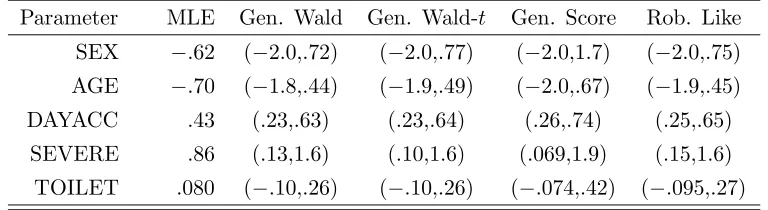
sim-ulations. We generate simulation data using parameter values equal to the logistic regression
MLE for the complete data set, which are displayed in Table 1.3 with their corresponding 95%
confidence intervals.
Table 1.3: Logistic regression MLE’s and approximate 95% GEE confidence intervals for the GUIDE dataset.
Parameter MLE Gen. Wald Gen. Wald-t Gen. Score Rob. Like SEX −.62 (−2.0,.72) (−2.0,.77) (−2.0,1.7) (−2.0,.75) AGE −.70 (−1.8,.44) (−1.9,.49) (−2.0,.67) (−1.9,.45)
DAYACC .43 (.23,.63) (.23,.64) (.26,.74) (.25,.65)
SEVERE .86 (.13,1.6) (.10,1.6) (.069,1.9) (.15,1.6)
TOILET .080 (−.10,.26) (−.10,.26) (−.074,.42) (−.095,.27)
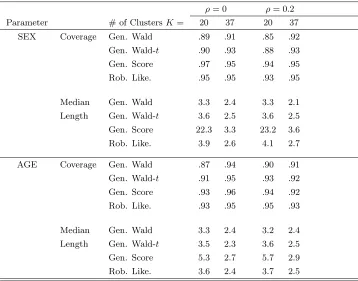
We provide simulation results for confidence intervals about the SEX and AGE
pa-rameters in Tables 1.4 and 1.5. Two sample sizes are investigated, the full dataset (ignoring the
clusters with missing covariate information) of K = 37 clusters, and also a subset of the data
consisting of K = 20 clusters. Two values of the within cluster correlation are investigated,
ρ = 0 and ρ=.2. For these values of the regression parameters, it is not possible to generate
imposed on the correlation by having different observations within a cluster having different
success probabilities.
Table 1.4: Coverage and length for generalized Wald, score, and robust likelihood intervals for clustered Bernoulli data simulated from the GUIDE dataset.
ρ= 0 ρ= 0.2
Parameter # of ClustersK= 20 37 20 37
SEX Coverage Gen. Wald .89 .91 .85 .92
Gen. Wald-t .90 .93 .88 .93
Gen. Score .97 .95 .94 .95
Rob. Like. .95 .95 .93 .95
Median Gen. Wald 3.3 2.4 3.3 2.1
Length Gen. Wald-t 3.6 2.5 3.6 2.5
Gen. Score 22.3 3.3 23.2 3.6
Rob. Like. 3.9 2.6 4.1 2.7
AGE Coverage Gen. Wald .87 .94 .90 .91
Gen. Wald-t .91 .95 .93 .92
Gen. Score .93 .96 .94 .92
Rob. Like. .93 .95 .95 .93
Median Gen. Wald 3.3 2.4 3.2 2.4
Length Gen. Wald-t 3.5 2.3 3.6 2.5
Gen. Score 5.3 2.7 5.7 2.9
Rob. Like. 3.6 2.4 3.7 2.5
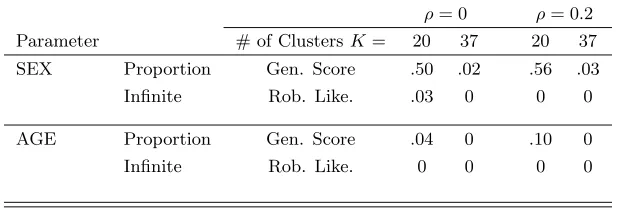
Table 1.5: Proportion of infinite length generalized score and robust likelihood intervals for clustered Bernoulli data simulated from the GUIDE dataset.
ρ= 0 ρ= 0.2
Parameter # of ClustersK= 20 37 20 37
SEX Proportion Gen. Score .50 .02 .56 .03
Infinite Rob. Like. .03 0 0 0
AGE Proportion Gen. Score .04 0 .10 0
Infinite Rob. Like. 0 0 0 0
In these simulations the difference in the performances of the generalized Wald-t and
robust profile intervals is more pronounced. Here the robust profile interval clearly outperforms
the other confidence intervals. Again we see the inefficiency of the generalized score interval.
When K= 20 the generalized score interval for the SEX effect was infinite 50% of the time.
1.7.2 Poisson Regression GEE
As in the previous section, we provide simulation results from two groups of
simula-tions. The first group of simulation results is from simple linear Poisson regression where the
data are correlated in clusters, and the second group is motivated by the data from a study of
epileptic seizures (Thall and Vail 1990).
Simple Linear Poisson GEE Simulations
Like the logistic regression simulations we generate NS = 2000 datasets for each
simulation. For each dataset there are a total of K clusters of size 4, where K is 10, 20 or
50. We represent the data by {yij} wherei = 1,2, . . . K and j = 1,2,3,4. To investigate the
random samples using the algorithm described in Appendix A, which generates autocorrelated
Poisson-type random variates.
We estimateθ= (ψ, η)T with a GEE model using the independence working
correla-tion matrix, essentially fitting a simple linear Poisson regression using thexijas covariates. We
then use the estimate ofθto form the 95% generalized Wald, the generalized Wald-t, generalized
score, and robust profile likelihood confidence intervals forψ. The results of these simulations
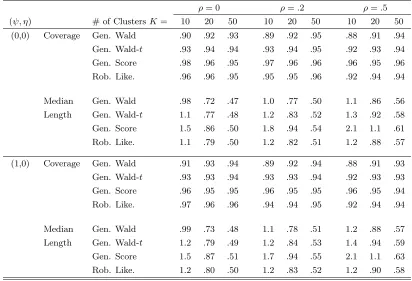
Table 1.6: Coverage and length for generalized Wald, score, and robust likelihood intervals for serially correlated Poisson data under a log linear regression model.
ρ= 0 ρ=.2 ρ=.5
(ψ, η) # of ClustersK= 10 20 50 10 20 50 10 20 50
(0,0) Coverage Gen. Wald .90 .92 .93 .89 .92 .95 .88 .91 .94
Gen. Wald-t .93 .94 .94 .93 .94 .95 .92 .93 .94
Gen. Score .98 .96 .95 .97 .96 .96 .96 .95 .96
Rob. Like. .96 .96 .95 .95 .95 .96 .92 .94 .94
Median Gen. Wald .98 .72 .47 1.0 .77 .50 1.1 .86 .56
Length Gen. Wald-t 1.1 .77 .48 1.2 .83 .52 1.3 .92 .58
Gen. Score 1.5 .86 .50 1.8 .94 .54 2.1 1.1 .61
Rob. Like. 1.1 .79 .50 1.2 .82 .51 1.2 .88 .57
(1,0) Coverage Gen. Wald .91 .93 .94 .89 .92 .94 .88 .91 .93
Gen. Wald-t .93 .93 .94 .93 .93 .94 .92 .93 .93
Gen. Score .96 .95 .95 .96 .95 .95 .96 .95 .94
Rob. Like. .97 .96 .96 .94 .94 .95 .92 .94 .94
Median Gen. Wald .99 .73 .48 1.1 .78 .51 1.2 .88 .57
Length Gen. Wald-t 1.2 .79 .49 1.2 .84 .53 1.4 .94 .59
Gen. Score 1.5 .87 .51 1.7 .94 .55 2.1 1.1 .63
Rob. Like. 1.2 .80 .50 1.2 .83 .52 1.2 .90 .58
Table 1.7: Proportion of infinite length generalized score and robust likelihood intervals for serially correlated Poisson data under a log linear regression model.
ρ= 0 ρ=.2 ρ=.5
(ψ, η) # of ClustersK= 10 20 50 10 20 50 10 20 50
(0,0) Proportion Gen. Score .01 0 0 .01 0 0 .06 0 0
Infinite Rob. Like. 0 0 0 0 0 0 0 0 0
(1,0) Proportion Gen. Score 0 0 0 .03 0 0 .05 0 0
Infinite Rob. Like. 0 0 0 0 0 0 0 0 0
The results of these simulations are quite clear. The generalized Wald interval, using
normal critical values performs quite poorly when the sample size is small, and is improved
significantly by the use oft-critical values. In this set of simulations, the robust profile interval
performs reasonably well, except when the sample size is small and the autocorrelation high.
The generalized score interval consistently has good coverage as well, but is somewhat inefficient
relative to the robust profile likelihood, and is occasionally infinite when the sample size is
K = 10, while no infinite length robust profile intervals were observed.
Epilepsy Data Example and Simulations
The data in the following example comes from a study of the effect of the anti-seizure
drug, progabide, on epileptics (Thall and Vail 1990). In this experiment 59 patients were
randomized into treatment and placebo (standard chemotherapy) groups. A baseline two-week
count of seizures was recorded for the period before treatment was begun, and four other seizure
counts were recorded for each patient at intervals of two weeks over the course of the eight-week
study. Parameter estimates were obtained by fitting a Poisson regression model using treatment
(TREATMENT), age (AGE), and an indicator of baseline vs. study period seizure count as
intervals are given in Table 1.8.
Table 1.8: Poisson regression MLE’s and approximate 95% GEE confidence intervals for the Epilepsy dataset.
Parameter MLE Gen. Wald Gen. Wald-t Gen. Score Rob. Like
TREATMENT −0.8 (−.76,.59) (−.78,.60) (−1.0,.58) (−.77,.60) AGE −.44 (−1.4,.49) (−1.4,.51) (−1.5,.86) (−1.4,.46) BASELINE −1.3 (−1.6,−.97) (−1.6,−.97) (−1.7,−.99) (−1.6,−.98)
In the following simulations, we used a method analogous to the simple linear Poisson
GEE simulations, using the same method to generate counts that are serially correlated within
a patient. The simulated data were generated using the correlated parameter values equal to
the study data’s MLE. In each simulation, 2000 simulation replications of the data were created.
Two sample sizes were used, the full set of 59 observations, and a subset of 30 patients with 15
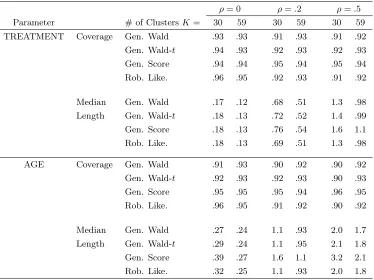
Table 1.9: Coverage and length for generalized Wald, score, and robust likelihood intervals for serially correlated Poisson data using the Epilepsy data covariates and MLE.
ρ= 0 ρ=.2 ρ=.5
Parameter # of ClustersK= 30 59 30 59 30 59
TREATMENT Coverage Gen. Wald .93 .93 .91 .93 .91 .92
Gen. Wald-t .94 .93 .92 .93 .92 .93
Gen. Score .94 .94 .95 .94 .95 .94
Rob. Like. .96 .95 .92 .93 .91 .92
Median Gen. Wald .17 .12 .68 .51 1.3 .98
Length Gen. Wald-t .18 .13 .72 .52 1.4 .99
Gen. Score .18 .13 .76 .54 1.6 1.1
Rob. Like. .18 .13 .69 .51 1.3 .98
AGE Coverage Gen. Wald .91 .93 .90 .92 .90 .92
Gen. Wald-t .92 .93 .92 .93 .90 .93
Gen. Score .95 .95 .95 .94 .96 .95
Rob. Like. .96 .95 .91 .92 .90 .92
Median Gen. Wald .27 .24 1.1 .93 2.0 1.7
Length Gen. Wald-t .29 .24 1.1 .95 2.1 1.8
Gen. Score .39 .27 1.6 1.1 3.2 2.1
Rob. Like. .32 .25 1.1 .93 2.0 1.8
Note: Estimated coverages have approximate standard error (.95)(.05)/2000 =.005. Cluster size=5. Less than .005 of each of the intervals were reported as infinite.
The simulation results are consistent with the simple linear Poisson GEE simulations.
The generalized score interval maintains its coverage better than the other intervals, especially
as the within cluster correlation becomes larger. No infinite length generalized score intervals
were observed. These observations lead us to recommend that the generalized score confidence
interval be used in the analysis of correlated Poisson-type data.
1.7.3 Huber Robust Linear Regression
We investigate the performance of these confidence intervals for robust linear regression
xTi β+i, where the’s are iid with median 0, but are not assumed to be normally distributed.
β = (β1, β2) has dimension p, andβ1 is the scalar parameter of interest. Parameter estimation
of the mean parameters,β, proceeds by solving,
n
X
i=1
ψ yi−x
T
i βˆ
σ !
xi = 0, (1.25)
where Huber’sψ-function is given by,
ψ(z) =
z if|z|< k k·sign(z) otherwise.
(1.26)
For all of the simulations in this study, we usek = 1. Solving the above estimating equation is
equivalent to maximum likelihood estimation, where the density of the errors has the functional
form exp(−ρ(z)/σ), where ρ(z) is defined to be,
ρ(z) = z2
2 if|z| < k
k|z| − k22 otherwise.
(1.27)
We estimate the scale parameter,σ, by solving
n
X
i=1
χ(yi−x
T
i β
ˆ
σ )−(n−p)EΦ(χ) = 0 (1.28)
whereχ(z) =zψ(z)−ρ(z), andEΦ represents expectation with respect to the standard normal
distribution.
Unlike the previous simulations, we do not compute a restricted estimate of σ while
simulations indicated that these confidence intervals suffered a loss of efficiency when this was
done. However, restricted estimates of β2 are computed.
Robust likelihood ratio tests of ANOVA models using Huber’sψ-function were
inves-tigated by (Schrader and Hettmansperger 1980). In their paper, Schrader and Hettmansperger
develop a modeling strategy completely analogous to standard least squares ANOVA using
ro-bust likelihood ratio tests. Although they describe a complete system for likelihood testing of
robust linear models, I have not seen their approach generalized to interval estimation.
Their approach differs, somewhat, from the one we used for GEE models, however.
Rather than use the purely empirical estimators for I and D,
ˆ σ n n X i=1
ψ0 yi−xTi βˆ
ˆ σ
!
xixTi ,
and ˆ σ n n X i=1
ψ2 yi−x
T
i βˆ
ˆ σ
!
xixTi ,
respectively, they use estimates ofIandDthat assume that the data are identically distributed,
ˆ σ n n X i=1
ψ0 yi−x
T
i βˆ
ˆ σ
! n X
i=1
xixTi ,
and ˆ σ n n X i=1
ψ2 yi−x
T
i βˆ
ˆ σ
! n X
i=1
xixTi ,
consistent estimator for the likelihood ratio test’s robust correction constant is
ˆ
cψ = ξ
n n−p
Pn
i=1ψ2
y(i)−xTiβˆ
ˆ
σ
Pn
i=1ψ0
y(i)−xTiβˆ
ˆ
σ
,
whereξ is a bias correction that is given by,
ξ= 1 + p n
n−Pn
i=1ψ0
y i−xTiβˆ
ˆ
σ
Pn
i=1ψ0
yi−xTiβˆ
ˆ
σ
.
Taking the analogy with ANOVA further, they use theF distribution as the reference
distribution for the robust likelihood ratio test instead of the χ2 distribution.
Schrader and Hettmansperger also investigate a bias corrected version of the
gener-alized Wald test statistic that, like their version of the robust likelihood ratio test, assumes
that the data are iid. Inverting this generalized Wald test yields a bias corrected version of the
generalized Wald interval,
ˆ
β1±tn−p(1−α/2)
ˆ σ √ n v u u u t n n−pξ
Pn
i=1ψ2(
yi−xTiβˆ
ˆ
σ )
(Pn
i=1ψ0(
yi−xTiβˆ
ˆ
σ ))2
(XTX)−1 1,1.
Like their robust likelihood ratio test, Schrader and Hettmansperger use a t distribution to
obtain critical values for the Wald test.
In each of the simulations below, we report coverages and median lengths for 5 types
of confidence intervals: the ordinary least squares t confidence interval (OLSt), the
Schrader-Hettmansperger generalized Wald interval (SH-Gen. Wald) and the Schrader Hettmanperger
score and robust profile likelihood intervals.
In each simulation we generateN = 2000 datasets from the modelyi =µ+βxi+ei,
i= 1,2, . . . n, where n is equal to 10, 20, or 50, and the xi are equally spaced in the interval
(−1,1). In the first group of simulations β = µ = 0, and the ei’s are iid, but are generated
from one of three distributions: N ormal(0,1), Cauchy, or a mixture distribution where each
ei has a 75% probability of coming from aN ormal(0,1) distribution, and a 25% probability of
being aCauchy random variate. In this way, we can see the loss of efficiency when the data are
normally distributed, and compare the performance of the various confidence intervals when
the data are heavy tailed, or prone to outliers.
For the second group of simulations β = µ = 1, and the ei’s are independent, but
no longer identically distributed. This allows us to determine whether or not the performance
of the Schrader-Hettmansperger intervals is sensitive to the assumption that the errors are
iid. Here the ei are distributed as either a N ormal(0,1), a Cauchy, or a 75%-25% mixture
of the two, multiplied by a scale parameter, σi, that varies with the xi’s according to the rule
σi =.1 +|µ+xiβ|. Tables 1.10 and 1.11 show the results of these simulations.
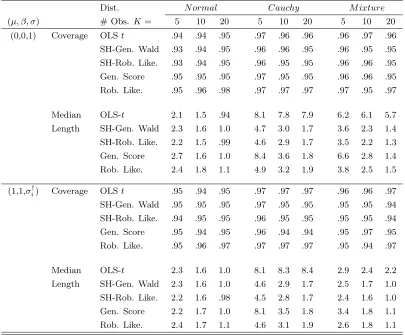
As measured by coverage, all the confidence intervals perform quite well, with
cov-erages often at or exceeding 95% in most of the simulations. We are therefore compelled to
make our recommendation based on the lengths of the intervals. As one would expect, the
OLS tinterval performs the best when the error are iid from a N ormal(0,1) distribution, but
is inefficient when the distribution of the errors has heavy tails. Like the previous simulations,
the generalized score interval is often inefficient when the sample size is small, and is
occasion-ally infinite in length. The robust profile likelihood interval (the general version that does not
The Schrader and Hettmansperger (SH) version of the robust likelihood interval is the most
efficient, and maintains its coverage well, even when the errors are not iid. The SH-robust
profile interval is generally shorter than the SH-generalized Wald interval, and is the one we
Table 1.10: Coverage and length for generalized Wald, score, and robust likelihood intervals for iid data under a simple linear Huber regression model.
Dist. N ormal Cauchy M ixture
(µ, β, σ) # Obs. K= 5 10 20 5 10 20 5 10 20
(0,0,1) Coverage OLSt .94 .94 .95 .97 .96 .96 .96 .97 .96
SH-Gen. Wald .93 .94 .95 .96 .96 .95 .96 .95 .95
SH-Rob. Like. .93 .94 .95 .96 .95 .95 .96 .96 .95
Gen. Score .95 .95 .95 .97 .95 .95 .96 .96 .95
Rob. Like. .95 .96 .98 .97 .97 .97 .97 .95 .97
Median OLS-t 2.1 1.5 .94 8.1 7.8 7.9 6.2 6.1 5.7
Length SH-Gen. Wald 2.3 1.6 1.0 4.7 3.0 1.7 3.6 2.3 1.4
SH-Rob. Like. 2.2 1.5 .99 4.6 2.9 1.7 3.5 2.2 1.3
Gen. Score 2.7 1.6 1.0 8.4 3.6 1.8 6.6 2.8 1.4
Rob. Like. 2.4 1.8 1.1 4.9 3.2 1.9 3.8 2.5 1.5
(1,1,σ†i) Coverage OLSt .95 .94 .95 .97 .97 .97 .96 .96 .97
SH-Gen. Wald .95 .95 .95 .97 .95 .95 .95 .95 .94
SH-Rob. Like. .94 .95 .95 .96 .95 .95 .95 .95 .94
Gen. Score .95 .94 .95 .96 .94 .94 .95 .97 .95
Rob. Like. .95 .96 .97 .97 .97 .97 .95 .94 .97
Median OLS-t 2.3 1.6 1.0 8.1 8.3 8.4 2.9 2.4 2.2
Length SH-Gen. Wald 2.3 1.6 1.0 4.6 2.9 1.7 2.5 1.7 1.0
SH-Rob. Like. 2.2 1.6 .98 4.5 2.8 1.7 2.4 1.6 1.0
Gen. Score 2.2 1.7 1.0 8.1 3.5 1.8 3.4 1.8 1.1
Rob. Like. 2.4 1.7 1.1 4.6 3.1 1.9 2.6 1.8 1.1
Note: Estimated coverages have approximate standard error.005. †σ
i=.1 +|µ+xi|.
Table 1.11: Proportion of infinite length generalized score and robust likelihood intervals for iid data under a simple linear Huber regression model.
Dist. N ormal Cauchy M ixture
(µ, β, σ) # of ObsK= 10 20 50 10 20 50 10 20 50
(0,0,1) Proportion Gen. Score .01 0 0 .12 .01 0 .12 0 0
1.7.4 Simple Linear Regression With Covariate Measurement Error
We investigate the performance of the generalized Wald, generalized score, and
ro-bust profile likelihood confidence intervals in the context of simple linear measurement error
models. In these models we assume that the data consist of pairs (y, u) where y is the
in-dependent random variable of interest, and u plays the role of the covariate. In addition, it
is assumed, however, that there is an unobserved random variable, x, such that x =µx+x
where x ∼ N ormal(0, σ2x). The observed variables, y and u, are assumed to have model,
y = µ+βx+ and u = x+u, where and u are independent of one another, as well as
with x, and normally distributed, each with mean 0, and variances σ2 and σu2, respectively.
Unfortunately this model is not completely identified, which means that one cannot estimate
all six parameters, (µ, β, µx, σ2, σ2x, σu2). To circumvent this difficulty we assume that the
mea-surement error variance, σ2
u, is known a priori. We form the likelihood-based on the model
described above and use it to find global and restricted estimates of the parameters.
To examine the effects of model misspecification we examine four situations. In each
of these the identified scale parameters satisfyσ2 =σ2
x= 1, and the distributions ofandxare
either N ormal(0,1), or scaled t5 so that the error variance is 1. The mean model parameters
have true values, µ = µx = 0, and β = 1. The measurement error variance, σu2 is varied,
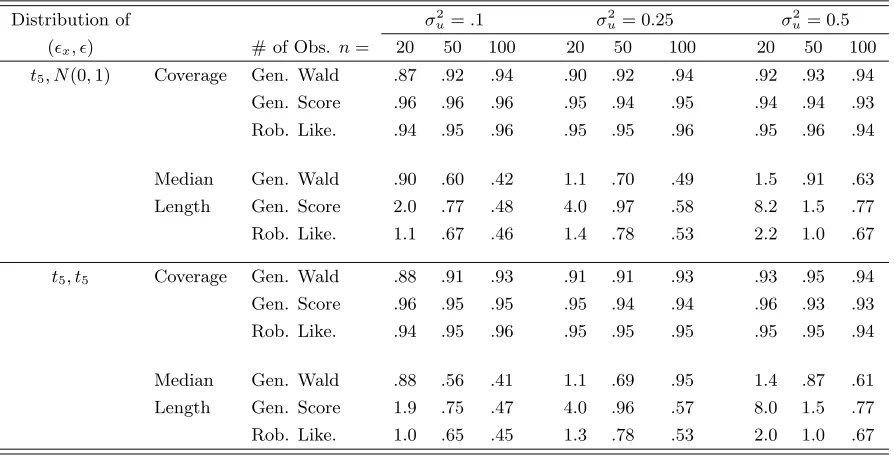
taking on values .1, .25, and .5. We provide simulation results for all four possible combinations
of N(0,1) and t5 distributions for and x. Three sample sizes are investigated, n = 20,50,
and 100. In each simulation, NS=2000 independent samples are drawn, and for each the 95%
generalized Wald, generalized score and robust profile likelihood confidence intervals for the
interval is created using t critical values with n−2 degrees of freedom, but the generalized score and robust profile likelihood confidence intervals simply use χ2
1 critical values. Tables
1.12, 1.13, and 1.14 below contain the results of these simulations.
Table 1.12: Coverage and length for generalized Wald, score, and robust likelihood intervals from simple linear measurement error model.
Distribution of σ2
u=.1 σu2 = 0.25 σ2u= 0.5
(x, ) # of Obs. n= 20 50 100 20 50 100 20 50 100
N(0,1), N(0,1) Coverage Gen. Wald .88 .92 .94 .90 .94 .95 .93 .94 .94
Gen. Score .95 .94 .95 .94 .95 .95 .93 .93 .94
Rob. Like. .93 .95 .96 .95 .96 .96 .95 .95 .95
Median Gen. Wald .88 .59 .42 1.0 .68 .49 1.4 .86 .62
Length Gen. Score 1.5 .68 .46 2.2 .83 .54 6.7 1.2 .71
Rob. Like. 1.1 .64 .45 1.3 .76 .52 2.0 1.0 .67
N(0,1), t5 Coverage Gen. Wald .88 .91 .93 .91 .91 .93 .93 .95 .94
Gen. Score .96 .96 .95 .95 .95 .95 .93 .94 .93
Rob. Like. .95 .96 .96 .94 .95 .96 .95 .97 .96
Median Gen. Wald .88 .56 .41 1.1 .69 .95 1.4 .87 .61
Length Gen. Score 1.4 .66 .45 2.1 .91 .53 6.6 1.2 .70
Rob. Like. 1.0 .64 .45 1.3 .74 .52 2.0 .98 .66
Note: Estimated coverages have approximate standard error (.95)(.05)/2000 =.005.
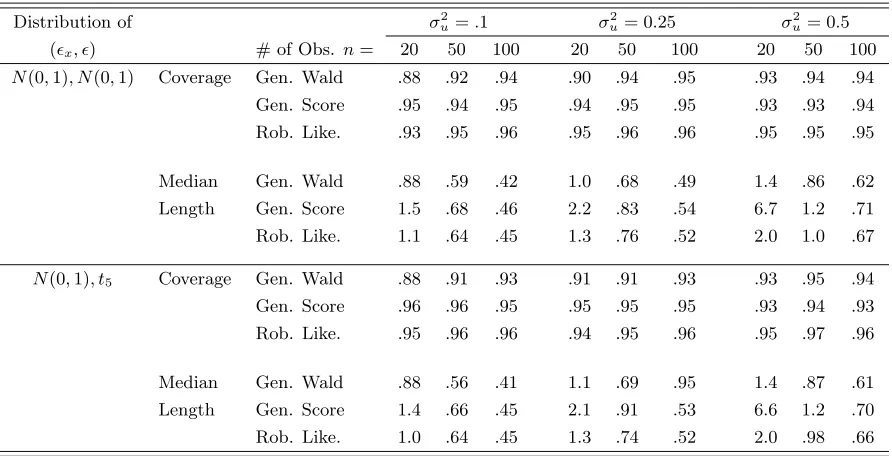
Here we see that the generalized Wald confidence interval is liberal, while the
gener-alized score interval is quite inefficient, and in some circumstances it is frequently infinite in
length. The robust profile likelihood confidence interval performs well, as measured its coverage
Table 1.13: Coverage and length for generalized Wald, score, and robust likelihood intervals from simple linear measurement error model.
Distribution of σ2
u=.1 σ2u= 0.25 σ2u= 0.5
(x, ) # of Obs. n= 20 50 100 20 50 100 20 50 100
t5, N(0,1) Coverage Gen. Wald .87 .92 .94 .90 .92 .94 .92 .93 .94
Gen. Score .96 .96 .96 .95 .94 .95 .94 .94 .93
Rob. Like. .94 .95 .96 .95 .95 .96 .95 .96 .94
Median Gen. Wald .90 .60 .42 1.1 .70 .49 1.5 .91 .63
Length Gen. Score 2.0 .77 .48 4.0 .97 .58 8.2 1.5 .77
Rob. Like. 1.1 .67 .46 1.4 .78 .53 2.2 1.0 .67
t5, t5 Coverage Gen. Wald .88 .91 .93 .91 .91 .93 .93 .95 .94
Gen. Score .96 .95 .95 .95 .94 .94 .96 .93 .93
Rob. Like. .94 .95 .96 .95 .95 .95 .95 .95 .94
Median Gen. Wald .88 .56 .41 1.1 .69 .95 1.4 .87 .61
Length Gen. Score 1.9 .75 .47 4.0 .96 .57 8.0 1.5 .77
Rob. Like. 1.0 .65 .45 1.3 .78 .53 2.0 1.0 .67
Note: Estimated coverages have approximate standard error (.95)(.05)/2000 =.005.
Table 1.14: Proportion of infinite length generalized score and robust likelihood intervals from simple linear measurement error model.
Distribution of σ2
u=.1 σ2u= 0.25 σ2u= 0.5
(x, ) # of Obs. n= 20 50 100 20 50 100 20 50 100
N(0,1), N(0,1) Proportion Gen. Score .05 0 0 .06 0 0 .12 0 0
Infinite Rob. Like. 0 0 0 0 0 0 .05 0 0
N(0,1), t5 Proportion Gen. Score .04 0 0 .07 0 0 .15 0 0
Infinite Rob. Like. 0 0 0 .01 0 0 .05 0 0
t5, N(0,1) Proportion Gen. Score .18 .03 .01 .21 .02 .01 .22 .05 0
Infinite Rob. Like. 0 0 0 .01 0 0 .09 0 0
t5, t5 Proportion Gen. Score .17 .02 .01 .20 .03 .01 .23 .05 .01
Infinite Rob. Like. 0 0 0 .01 0 0 .09 0 0
Chapter 2
Length-Optimal Interval Estimation
In this chapter we introduce a general procedure for taking an existing confidence
in-terval procedure and creating a new one. We call this new confidence inin-terval procedure
length-optimal interval estimation, as it finds the shortest asymptotically level-α confidence interval
in an infinite class of asymptotically level-α confidence intervals. Some theory is developed for
the case of the single parameter likelihood intervals that demonstrates that the length-optimal
profile likelihood intervals are asymptotically equivalent to the more common equal-tail
likeli-hood interval, indicating that the length-optimal intervals retain their asymptotic error rate of
1−α. Simulation results are provided that show that in some circumstances the small sample coverage rate of these confidence intervals is higher than their standard counterparts.
2.1
Motivation and Description
In the previous chapter, we saw that the generalized score interval often has superior
How-ever, the generalized score interval was observed to be inefficient, and in some circumstances
suffered from the defect of being infinite in length a significant proportion of the time.
Length-optimal confidence interval procedures were motivated by an attempt to correct these problems
of the generalized score interval. As we shall see, the length-optimal approach is only modestly
successful in reducing the conservatism of the generalized score interval, but when we apply
the procedure to the robust profile likelihood and generalized score intervals in simulations we
see the surprising result that the length-optimal versions of the intervals often enjoy higher
coverage than their equal-tail counterparts.
Confidence intervals are generally formed by inverting a two-sided level-α hypothesis
test. That is, the endpoints of the confidence interval are found by inverting two level-α/2
one-sided hypothesis tests, H0 : ψ ≤ ψ0, and H0 : ψ ≥ ψ0. Since the error rate is allocated
equally to each side, such intervals are sometimes called equal-tail confidence intervals. For a
given test statistic, T(ψ0), with an asymptotic χ21 distribution, the endpoints of the equal-tail
confidence interval, (ψL, ψU), are obtained by solving T(ψL) =zα/2 2 and T(ψU) =zα/2 2 subject
to the constraint thatψL<ψ < ψˆ U. When one or more of these two equations has no solution,
the confidence interval will have infinite length. This occurs when, for instance, for all ψ0<ψˆ
the value of the test statistic never exceedszα/2 2, or, equivalently, the p-value of the hypothesis
test never drops belowα/2.
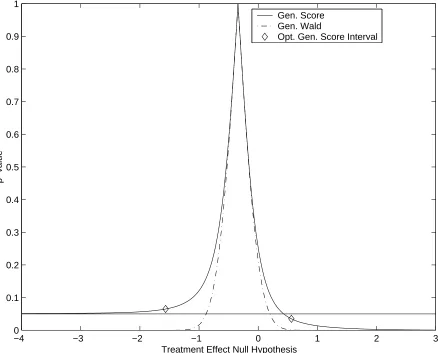
To remedy this situation, we can reallocate the error rate of the confidence intervals
by introducing a new parameter, , that takes on values in (0,1). Rather than place an error
rate of α/2 to each side of the interval, we can distributeα to the lower side of the interval,