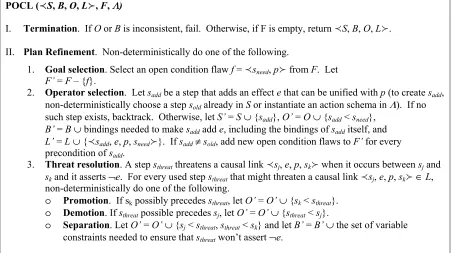
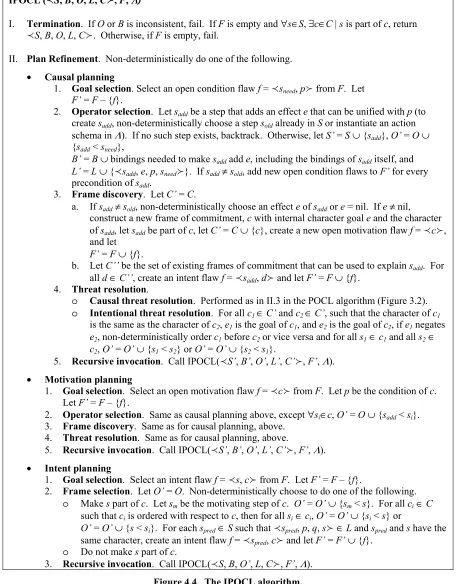
ABSTRACT
RIEDL, MARK OWEN. Narrative Planning: Balancing Plot and Character. (Under the direction of R. Michael Young.)
The ability to generate narrative is of importance to computer systems that wish to
use story effectively for a wide range of contexts ranging from entertainment to training and
education. The typical approach for incorporating narrative into a computer system is for
system builders to script the narrative features at design time. A central limitation of this pre-scripting approach is its lack of flexibility -- such systems cannot adapt the story to the user’s
interests, preferences, or abilities. The alternative approach is for the computer systems
themselves to generate narrative that is fully adapted to the user at run time.
A central challenge for systems that generate their own narrative elements is to create
narratives that are readily understood as such by their users. I define two properties of
narrative – plot coherence and character believability – which play a role in the success of a narrative in terms of the ability of the narrative’s audience to comprehend its structure. Plot
coherence is the perception by the audience that the main events of a story have meaning and
relevance to the outcome of the story. Character believability is the perception by the
audience that the actions performed by characters are motivated by their beliefs, desires, and
traits.
In this dissertation, I explore the use of search-based planning as a technique for
generating stories that demonstrate both strong plot coherence and strong character
believability. To that end, the dissertation makes three central contributions. First, I describe
possible character goals that explain their actions in a plan and creates plan structure that
explains why those characters commit to their goals. Second, I describe how a character
personality model can be incorporated into planning in a way that guides the planner to
choose consistent character behavior without strictly preventing characters from acting “out
of character” when necessary. Finally, I present an open-world planning algorithm that
extends the capabilities of conventional planning algorithms in order to support a process of
story creation modeled after the process of dramatic authoring used by human authors. This
open-world planning approach enables a story planner not only to search for a sequence of
character actions to achieve a set of goals, but also to search for a possible world in which the
story can effectively be set.
The planning algorithms presented in this dissertation are used within a narrative
generation system called Fabulist. Fabulist generates a story as a sequence of character actions and then recounts the story by first generating a discourse plan that specifies how the
story content should be told and then realizing the discourse plan in a storytelling medium. I
present the results of an empirical evaluation that demonstrates that narratives generated by
Fabulist have strong plot coherence and strong character believability. The results clearly
indicate how a planning approach to narrative generation that reasons about plot coherence
NARRATIVE GENERATION:
BALANCING PLOT AND CHARACTER
by
MARK OWEN RIEDL
A dissertation submitted to the Graduate Faculty of North Carolina State University
in partial fulfillment of the requirements for the Degree of
Doctor of Philosophy
COMPUTER SCIENCE
Raleigh
2004
APPROVED BY:
Biography
The story of Mark Riedl’s academic career has always been about making computers
interact with human users more intelligently. As an undergraduate, Mark supplemented the
Computer Science curriculum at NC State University with courses in cognitive psychology
and earned his Bachelor’s Degree in Computer Science with a minor is Psychology in 1999.
Mark began his graduate study in 1999 under the guidance of Dr. Robert St. Amant doing
research that applied artificial intelligence to human-computer interaction. Mark earned his
Master’s Degree in Computer Science in 2001 with his thesis, A Computational Model of
Navigation in Social Environments, which presented a computational account for human social navigation behavior. In order to push the limits on intelligent human-computer
interaction, Mark joined the Liquid Narrative group run by Dr. R. Michael Young. As a
member of the Liquid Narrative group, Mark researched ways in which computer systems
can use storytelling as a way of guiding their interaction with interactive, human users.
Acknowledgements
Foremost, I would like to thank my committee members, Michael Capps, Jon Doyle,
James Lester, and Brad Mehlenbacher for their guidance, concern, and enthusiasm.
Throughout my time as a graduate student, I have had several advisors who I am
indebted to. Robert St. Amant taught me to be a scientist. Although our interests diverged, I
don’t think I would be where I am today without him. Michael Young for his willingness to
continuously bend over backwards to ensure that I had every opportunity to be successful.
Many people have been generous and helpful over the years. In the larger world, I
wish to thank those professional colleagues who have invited me to be their peers: William
Bares, Marc Cavazza, Fred Charles, and Lewis Johnson. At NC State University, I have had
the support and confidence of a number of faculty: James Lester, Carol Miller, Matthias
Stallmann, Robert St. Amant, and Michael Young. A large number of fellow graduate
students have been there for me: Charles Callaway, Yuna Cheong, Pankaj Chopra, David
Christian, Brent Dennis, Justin Harris, Arnav Jhala, Sarat Kocherlakota, Seung Lee, Brad
Mott, Brian Shiver, Laura Tateotian, Tommy Vernieri, Joe Winegarden, Alex Woods, and
the rest of the Mimite hoard (too numerous to name, but you know who you are).
I would also like to thank my parents, Dr. Richard Riedl and Theresa Riedl, for
encouraging me to pursue my interests and overcome my weaknesses and for all their
friends for their understanding and patience. Finally, I would like to thank my best friend of
all, Jennifer King, for her patience, encouragement, emotional support, and willingness to not
Table of Contents
List of Figures ix
List of Tables xi
1. Introduction 1
1.1. Motivation . . . 3
1.1.1. Linear Narrative . . . 4
1.1.2. Branching Narrative . . . 5
1.2. Narrative . . . 7
1.2.1. Narratology . . . 8
1.2.2. Narrative Terminology . . . 10
1.3. Problem Statement . . . 12
1.4. Reader’s Guide . . . 14
2. Related Work 16
2.1. Evaluating Story Generation Systems . . . 16
2.1.1. Overview of Existing Frameworks . . . 17
2.1.2. A Revised Framework for Categorizing Story Generation Systems . . . 18
2.1.3. Comparing the Framework to Properties of Story . . . 20
2.1.3.1. General Observations about Character-Centric Systems . . . 21
2.1.3.2. General Observations about Author-Centric Systems . . . 22
2.2. Review of Story Generation Systems . . . 24
2.2.1. Character-Centric Systems . . . 24
2.2.1.1. Tale-Spin . . . 25
2.2.1.2. The Oz Project . . . 27
2.2.1.3. The Virtual Storyteller . . . 29
2.2.1.4. The Virtual Theatre Project . . . 30
2.2.1.5. I-Storytelling . . . 30
2.2.1.6. America’s Army: Soldiers . . . 32
2.2.2. Author-Centric Systems . . . 33
2.2.2.1. Universe . . . 34
2.2.2.2. Tailor . . . 35
2.2.2.3. Mexica . . . 36
2.2.2.4. Façade . . . 37
2.2.3. Relationship between Fabulist and Previous Work . . . 39
2.3. Summary . . . 40
3. Planning and Story Generation 42
3.1. A Computational Model of Dramatic Authoring . . . 43
3.1.1. A Model of Dramatic Authoring . . . 44
3.1.2. Computational Formalization of the Model of Dramatic Authoring . . . 46
3.1.2.2. Limitations of Planning as a Computational Formalization of the Model of
Dramatic Authoring . . . 51
3.2. A Planning Approach to Story Generation . . . 52
3.2.1. Model of Plot Coherence . . . 53
3.2.2. Model of Character Believability . . . . . 56
3.2.3. Open World Planning for Story Generation . . . 58
3.3. Summary . . . 59
4. Intent-Driven Planning 61 4.1. Planning for Rational Agents . . . 62
4.2. Mismatch between Conventional Planning and Story Planning . . . 63
4.3. Intention Recognition in Fabula Planning . . . 67
4.4. Integrating Intention Recognition into Least-Commitment Planning . . . 74
4.4.1. Causal Planning in IPOCL . . . 76
4.4.1.1. Frame Discovery . . . 78
4.4.1.2. Threat Resolution . . . 83
4.4.2. Motivation Planning in IPOCL . . . 84
4.4.3. Intent Planning in IPOCL . . . . . 85
4.4.3.1. Supporting Actions for Multiple Commitments . . . . . 86
4.4.3.2. Orphans . . . 88
4.5. An Example . . . 88
4.6. Heuristics for Fabula Planning . . . . . 92
4.7. Computational Complexity of the IPOCL Algorithm . . . 94
4.8. Summary . . . 96
5. Domain-Independent Support for a Personality Model 98 5.1. Psychology of Personality . . . 99
5.2. Computational Personalities for Synthetic Actors . . . 101
5.3. A Framework for a Domain-Independent Personality Model . . . 103
5.3.1. Representation of Character Personality . . . 105
5.3.2. Informing the Planner about Operator Appropriateness . . . 109
5.3.3. Enforcing Character Consistency . . . 111
5.3.4. Personality Change . . . 113
5.3.5. Heuristics . . . 114
5.3.5.1. A Domain Independent Heuristic for Preserving Character Consistency . . . 115
5.3.5.2. Domain Dependent Heuristics that Permit Character Inconsistency . . . 115
5.4. The Domain-Independent Personality Model as a Theory of Motivation . . . 117
5.5. Summary . . . 118
6. Initial State Revision 120 6.1. Open World Planning . . . 121
6.2. Initial State Revision Planning . . . 123
6.2.1. Satisfying Open Conditions with Sentences in the Undetermined Set . . . 126
6.2.2. Simplifying the Representation of the Undetermined Set . . . 128
6.2.3. Mutual Exclusion . . . 129
6.3. An Example . . . 133
6.4. Soundness of ISR Plans . . . 136
6.5. ISR and the Framework for a Domain-Independent Personality Model . . . 138
6.5.1. Avoiding Contradictory Possible Worlds . . . 141
6.5.2. Revising the Possible World Based on the Personality Model . . . 142
7. Fabulist Architecture 146
7.1. The Story Planner . . . 147
7.1.1. Author Goals . . . 148
7.1.2. Fabula Plan Ordering . . . 152
7.2. The Discourse Planner . . . 153
7.3. The Media Realizer . . . 154
7.4. The Domain Knowledge-Base . . . 157
7.5. Implementation Notes . . . 159
7.6. Summary . . . 160
8. Limitations 162 8.1. Story Planner Limitations . . . 162
8.1.1. Conflict . . . 163
8.1.2. A Model of Story Structure . . . 164
8.1.3. Decomposition of Actions . . . 166
8.1.4. Relationship between Personality Traits and Actions . . . 169
8.1.5. Support of Audience Recognition of Personality Traits . . . 170
8.1.6. Designation of the Undetermined Initial State . . . 172
8.2. Architectural Limitations . . . 174
8.3. Computational Complexity . . . 175
8.4. Summary 176 9. Evaluation 179 9.1. Plot Coherence Evaluation . . . 181
9.1.1. Method . . . 183
9.1.2. Results . . . 187
9.1.3. Discussion . . . 187
9.2. Character Believability Evaluation . . . 188
9.2.1. Method . . . 195
9.2.1.1.Mapping IPOCL Plans to QUEST Knowledge Structures . . . 199
9.2.1.2.Testing Procedure . . . 203
9.2.2. Results . . . 205
9.2.3. Discussion . . . 216
9.3. Summary . . . 209
10. Conclusions 210 10.1.Planning as a Model of Dramatic Authoring . . . 211
10.2.Planning for Character Believability . . . 213
References 215 A. Evaluation Materials 226 A.1. Plot Coherence Evaluation Study . . . 226
A.2. Character Believability Evaluation Study . . . 230
B. Example Story World Specifications 236 B.1. Bribery . . . 237
B.2. Deer Hunter . . . 238
B.3. Secret Agent . . . 241
List of Figures
1.1. Aristotle’s dramatic arc . . . 7
1.2. Freytag’s pyramid . . . 7
2.1. Aristotelian theory of drama . . . 19
2.2. A story generated by Tale-Spin . . . 26
2.3. A “mis-spun tale” generated by Tale-Spin . . . 27
2.4. The Oz Architecture . . . 28
2.5. A plot diagram in Oz . . . 29
2.6. A hierarchical task network for a character in the I-Storytelling project . . . 31
2.7. The Façade dramatic arc . . . 38
3.1. Egri’s model of the dramatic authoring process . . . 45
3.2. The POCL algorithm . . . 49
3.3. A causal network representation for a story . . . 53
3.4. The relationship between plot coherent stories and story coherent stories . . . 55
3.5. Character believability broken down into it constituent components . . . 56
4.1. Example of a tripartite model for dialogue . . . 68
4.2. An IPOCL plan with a single frame of commitment and motivating step . . . 71
4.3. An IPOCL plan with two frames of commitment where one frame is in service of another . . . . 73
4.4. The IPOCL algorithm . . . 77
4.5. An IPOCL plan where one character is contracted out by another character . . . 82
4.6. An IPOCL plan with two frames of commitment sharing steps . . . 86
4.7. A partial IPOCL plan with a single frame of commitment . . . 90
4.8. A partial IPOCL plan with several characters with interrelated frames of commitment . . . 92
5.1. The continuum relationship of polar opposite personality traits . . . 107
5.2. The set relationship of polar opposite personality traits . . . 107
5.3. The personality framework algorithm . . . 112
5.4. A partial plan with an action with an unsatisfied recommendation . . . 116
6.1. Set relationship of possible worlds given propositions with indeterminate truth values . . . 127
6.2. Relating possible worlds to plans in the plan search space . . . 128
6.3. The ISR algorithm . . . 132
6.4. Diagram of the secret agent world . . . 134
6.5. A solution plan for the secret agent world . . . 136
6.6. Possible worlds in which character definitions are undetermined . . . 139
7.1. The narrative generation process used in Fabulist . . . 147
7.2. The Fabulist architecture . . . 148
7.3. A story plan with author goals . . . 150
7.4. Tracking camera shot of a character running through the forest . . . 155
8.1. Schematic DPOCL plan illustrating parent/sub-plan relationship . . . 168
8.2. The Universe character “life cycle” . . . 172
9.1. Narrative text used in the plot coherence evaluation study . . . 185
9.2. Fabula plan representation of the story in the plot coherence evaluation study . . . 186
9.3. An example story used to test the QUEST model of question answering . . . 190
9.4. An example of a QUEST model of a story . . . 191
9.5. Algorithm for converting a POCL plan into a QUEST knowledge structure . . . 193
9.6. Narrative text used in the test condition of the character believability evaluation study . . . 195
9.7. Narrative text used in the control condition of the character believability evaluation study . . . . 196
9.8. Fabula plan representation of the story used in the test condition of the character believability evaluation study . . . 198
9.9. Fabula plan representation of the story used in the control condition of the character believability evaluation study . . . 199
9.10. The QUEST knowledge structure for the IPOCL plan used in the test condition of the character believability study . . . 202
9.11. The QUEST knowledge structure for the IPOCL plan used in the control condition of the character believability study . . . 203
A.1. Instruction sheet for questionnaire in the plot coherence evaluation study . . . 227
A.2. Story sheet for questionnaire in the plot coherence study . . . 228
A.3. First page of questions in the plot coherence study . . . 229
A.4. Instruction sheet for questionnaire in the character believability evaluation study . . . 231
A.5. Story sheet for questionnaire in the test condition of the character believability study . . . 232
A.6. First page of questions in the test condition of the character believability study . . . 233
A.7. Story sheet for questionnaire in the control condition of the character believability study . . . 234
List of Tables
1.1. The layers of interpretation of narrative . . . 8
2.1. A typical Universe plot fragment . . . 35
4.1. Two action schemata demonstrating joint versus singular character intentionality . . . 78
4.2. Possible frames of commitment generated for action schemata with joint and singular character intentionality . . . 79
4.3. Examples of action schemata for happenings . . . 83
5.1. An example of a personality model definition . . . 108
9.1. Results of the plot coherence evaluation study . . . 187
9.2. Results of the character believability evaluation study . . . 205
9.3. Results of the character believability study when only the shared question-answer pairs are considered . . . 207
B.1. Initialization parameters for the Bribery story problem . . . 237
B.2. Action library for the Bribery story problem . . . 238
B.3. Initialization parameters for the Deer Hunter story problem . . . 239
B.4. Action library for the Deer Hunter story problem . . . 240
B.5. Initialization parameters for the Secret Agent story problem that are guaranteed to fail . . . 242
B.6. Initialization parameters for the Secret Agent story problem that uses initial state revision . . . 242
B.7. Action library for the Secret Agent story problem . . . 243
B.8. Initialization parameters for the Aladdin story problem used in the plot coherence evaluation study . . . 244
B.9. Initialization parameters for the Aladdin story problem used in the character believability evaluation study . . . 245
B.10. Part of the action library for the Aladdin story problem . . . 246
Chapter 1
Introduction
Narrative as entertainment, in the form of oral, written, or visual stories, plays a central role in our social and leisure lives. Narrative is also used in education and training contexts to motivate and to illustrate. One reason for this is that cognitive structures we use to understand the world around us are similar to the cognitive structures we use to understand narratives (Bruner, 1990). In order to act effectively in the world, one must understand the world one is situated in. Our understanding of the world is achieved by “constructing reality” as a sequence of related events from our senses (Bruner, 1991). The cognitive process of structuring related events enables one to extract meaning from changes in the world and to make inferences about the future. Essentially, we understand the world by telling ourselves stories about how we have changed the world and witnessed the world change. This autobiographical representation of memory and thought has evolved from the social nature of our species because stories are a highly efficient and natural way to communicate (Dautenhahn, 2003). Whereas we tend to understand inanimate objects through cause and effect, we attempt to understand the intentional behavior of others through a sophisticated process of interpretation with narrative at its core (Bruner, 1990; Sengers, 2000a).
that cognitive science and artificial intelligence tackle the problem of narrative understanding and generation. The research agenda of Roger Schank and his students in the 1970’s and early 1980’s was to explore the knowledge structures and processes that humans used to understand the meaning of natural language. Since the meaning of sentences cannot always be determined without a larger context (Schank, 1977), Schank and his team turned to computational models of understanding – and then later of generating – stories. Later, artificial intelligence research took a more applied approach to narrative generation, focusing on the entertainment and educational goal of building interactive narrative systems. An interactive narrative system implements a virtual world in which a computer user can enter the world as a character in an unfolding narrative. Recently, Blair and Meyer (1997) coined the term “narrative intelligence” to refer to the ability – human or computer – to organize experience into narrative. A computer system that uses a narrative approach to entertainment or education will benefit from the ability to reason about narrative intelligence because the system can structure its narrative in ways that afford understanding by the user.
(the events that will be presented to an audience), ordering of narrative content and presentation through discourse of narrative content. A system that can generate stories is capable of adapting narrative to the user’s preferences and abilities, has expanded “replay value” and is capable of interacting with the user in ways that were not initially envisioned by system designers.
1.1. Motivation
The applications that can benefit from storytelling are many and varied. Storytelling has long been associated with computer games; story provides scaffolding as motivation for why the user should suspend her disbelief and play the game (Juul, 2001). Many computer games tell a story to the user as the user manipulates a character through levels but the plot of the story is typically scripted. The only variation in story is in the moment-to-moment sequencing of actions that the user performs. Major developments in the story that do not involve the life or death of the protagonist are shown through pre-scripted cinematic sequences – cut-scenes – in which the user is temporarily relieved of control while the storyline unfolds.
Education and training systems have also successfully applied storytelling. The Victec project (Sobral, Machado, & Paiva, 2003a; Sobral, Machado, & Paiva, 2003b) uses stories to illustrate effective strategies for children to handle bullying situations. Carmen’s Bright Ideas (Marsella, Johnson, & LaBore, 2000) uses a story to teach parents of pediatric cancer patients coping strategies. The ICT Leaders project (Gordon et al., 2004) uses story to involve a student in situations where leadership decisions must be made to complete a task.
objective (usually killing all the enemies in an area) or failure, in which case the user must start the level over. All users experience the same story and each user will experience the same story during successive sessions.
Some computer games use branching narrative in which there are many points in the story at where some action or decision made by the user alters the way in which a narrative unfolds or ends. Educational and training systems typically use branching narrative so that students can apply their skills or test their understanding. Branching narratives (e.g. Kelso, Weyhrauch, & Bates, 1993; Galyean, 1995; Silva, Raimundo, & Paiva, 2003; Gordon et al., 2004) are typically represented as directed graphs in which each node represents a linear, scripted scene followed by a decision point. Arcs between nodes represent decisions that can be made by the user. Even though a branching narrative may introduce variability into the experience a user has with a storytelling system, the variability is scripted into the system at design time and is thus limited by the system designer’s anticipation of the user’s needs or preferences. All users will be presented with the same set of decision points and each user will experience the same story if she makes the same set of choices.
1.1.1. Linear Narrative
Any system that requires a script of action for one or more agents to follow can benefit from the ability to generate linear narrative. The range of applications is broad. The applications that most obviously can benefit from the ability to generate linear narrative are those that produce scripts, stories, or movies for the purpose of entertaining an audience. While it is not likely that computer applications will replace human authors of stories and movie and TV scripts any time soon, story generation systems can be tools for authors. For example, a defense-related application can be asked to rapidly generate a number of plausible narratives describing how a particular world state might be achieved (e.g. the outcome of an emergency rescue operation). For entertainment, a system that can produce stories on request has similar potential.
be met at the end of each interactive episode so that there is a coherent transition from interactivity to cut-scene animation. Typically, an interactive episode ends with the user moving her embodied character through a doorway so that the cut scene can begin with an animation of that character, no longer under the control of the user, walking through the doorway. A computer game that dynamically generates cut-scenes could generate coherent cut-scenes in levels with multiple ending conditions, including end conditions that the system designers did not initially foresee.
In the contexts of education and training, systems that can dynamically generate narratives can illustrate learning principles through stories that are tailored to individual students’ interests and abilities. Students respond better to systems that account for individual difference between users such as age, sex, and interest in particular themes. For example, in a system that teaches students about history, the context surrounding an historical event can be taught through fictional accounts of the people that lived in a particular time (Riedl & Young, 2004). Educational systems can also teach by generating Aesop-like fables to illustrate principles and morals that are directly relevant to a particular context. Training systems can generate stories to demonstrate how to achieve some particular goal or even to project possible outcomes of student decisions.
1.1.2. Branching Narrative
the system designer. Users that make the same choices at each decision point will have identical experiences with the system. If a user were to make the same decisions during two consecutive sessions with the system, her experience would be the same.
Interactive narrative systems not only have to consider the quality of the storytelling experience, but must balance the coherence of a story against the amount of control afforded the user (Riedl, Saretto, & Young, 2003). Providing more control to the user means increasing the possibility that the story will lose coherence and become less understandable. For that reason, branching narratives in interactive narrative systems are typically constructed at design time. One way to generate a branching narrative that balances coherence and control is to generate a linear narrative and then consider all the ways in which a user – playing a character situated in the story world – can interact with the objects and other characters in the world (Young & Riedl, 2003; Riedl, Saretto, & Young, 2003; Young et al, 2004). For every action that the user makes that threatens to deviate too severely from the linear story proposed by the system, the system dynamically generates an alternative storyline starting from the point of deviation. An alternative linear story structure exists for every potentially threatening user action. The combination of alternative linear stories is at least as expressive as an acyclic story graph. See (Riedl, 2004) for further discussion, including a proof of the expressivity claim.
1.2. Narrative
Narrative is associated with storytelling but the two terms are not equivalent. Narrative is the recounting of a sequence of events (Prince, 1987). To distinguish narrative from a recounting of a laundry list of random events, those who study narrative often consider narrative to have a “continuant subject and constitute a whole” (Prince, 1987, p. 58). For a narrative to have a continuant subject and constitute a whole, the events described in the narrative have a single point or relate to a single communicative goal (Chatman, 1993). One
Tension
Time
Exposition
Rising action
Complication
Climax
Falling action
Catastrophe
Figure 1.2. Freytag’s pyramid.
Reversal
Tension
Time
Exposition
Rising action
Crisis
Climax
Falling action
Denouement
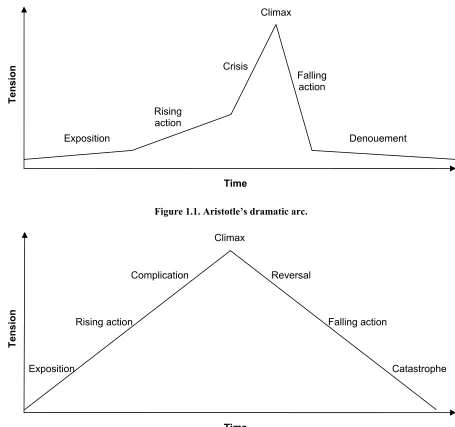
can, however distinguish between narratives that “tell a story” and narratives that do not (Herman, 2002). A narrative that tells a story has certain properties that one comes to expect. In particular, stories have plot. A plot is the list of main incidents in a narrative that make up an outline of the most important events in the story that is told. Plot adheres to a particular pattern that describes the order of events in time (Chatman, 1993). Aristotle suggests that narrative is patterned in such a way that the tension the audience feels in response to the story changes in a predictable way over time as the story is told. Aristotle’s dramatic arc, as shown in Figure 1.1, is one common model of story structure. In a story with more than one act, the dramatic arc of each successive act starts at a higher level of tension and reaches a higher climax than the previous act. Another pattern of events in a narrative used explicitly for the genre of the tragedy is Freytag’s Pyramid shown in Figure 1.2. The fact that narrative is a recounting of a sequence of events implies that all narratives have a narrator – an agent who tells a story to an audience (Bal, 1997). The narrator is not necessarily equivalent to the author of the narrative and can be an agent that is external to the story world or part of the story world as a character.
1.2.1. Narratology
Narratology is the theory of narratives that “tell a story” (Bal, 1997). Recently, narratology has been extended to apply to additional forms of audiovisual media such as movies (Brannigan, 1992). Narratology is the study of the structural elements of narrative media in order to devise a narrative system that generalizes the form of all narratives. Narratologists divide a narrative into three levels of interpretation: text or media, sjužet, and fabula. The levels of interpretation are shown in Table 1.1. At the lowest level of interpretation is the fabula. The fabula of a narrative consists of an enumeration of the events that occur in the
Table 1.1. The layers of interpretation of narrative.
Level Meaning
Media/text The surface-level communicative form that the narration takes.
Sjužet The discourse that relates some of the events in the fabula from narrator to audience.
story world between the time that the story begins and the time that the story ends. The events in the fabula are ordered chronologically, in the order that they occur in the story world. The fabula is relatively complete; it contains events that are not necessarily part of the discourse of telling the story to an audience.
The sjužet is the discourse layer of the narrative. The sjužet consists of a subset of the events in the fabula that are actually told to the audience. Some events from the fabula are omitted from the discourse because they are irrelevant to the intentions of the narrator. Some events are omitted because they can be inferred. For example, a narrative about a businessman who travels from Los Angeles to Chicago by airplane might have a description of the businessman’s arrival at the Los Angeles airport followed by a description of the businessman’s departure from the Chicago airport. The description of the sequence of events involving the businessman’s assumedly stereotypical experiences in both airports and on the airplane is unnecessary since the author assumes that his target audience has a schema which describes a typical air travel experience. Had any deviation from the schema been significant to the outcome of the story or the narrator’s communicative intentions, those exceptional events might have been included in the discourse.
At the highest layer of interpretation in the narrative structure is the text or media. At this layer, the events of the sjužet are described to the audience in some communicative medium. If the narrative is in written or spoken format, this layer includes the natural language used to describe the events of the sjužet. If the narrative is cinematic, this layer includes the actions that actors perform and the camera operations that capture those actions.
The separation of a narrative into structural layers is an artificial distinction. The author of a narrative does not necessarily consider the fabula, sjužet, and media separately during the process of creating a narrative. However, the distinction between layers of interpretation is useful for analysis of narratives. Issues of story as represented by the fabula are clearly
separated from issues of storytelling as represented by sjužet and media. From an
in whatever form, one can now reason about discourse and media for telling of the story independent from the generative issues relevant to the fabula.
1.2.2. Narrative Terminology
The following are narratological terms that are applicable to research in narrative generation. The definitions are taken from Prince (1987).
Definition 1.1 (Narrative). A narrative is a recounting of one or more real or fictitious events communicated by one or more narrators to one or more narratees.
It is assumed that narrative, as a form of discourse, has a purpose. The purpose of a narrative is often referred to as the narrative’s point. The plot of a narrative is the main incidents of a narrative that outline the way in which the point of a narrative. Plot is typically structured with regard to the way in which the events of a story impact the audience. It is possible for a narrative not to have a plot, although the narratives that are most often considered “stories” are those that have a plot.
Definition 1.2 (Plot). The plot of a narrative is an outline of the main incidents that constitute a structure characterizable in terms of Freytag’s pyramid or Aristotle’s dramatic arc.
Narratologists are interested in the structure of narratives. The structure of a narrative can be analyzed on many different levels, as discussed in the previous section. The ordering of events is particularly important to an audience’s understanding of a narrative. The temporal ordering of events, however, can differ depending on whether one is analyzing the narrative on the level of fabula or sjužet.
Definition 1.3 (Fabula). The fabula of a narrative is the set of narrated situations and events in their chronological sequence.
Definition 1.5 (Story). The story of a narrative is the content of a narrative as opposed to the expression of the narrative.
For the purpose of the discussion in this dissertation, story is equivalent to fabula. The content (story) of a narrative is made up of events. These events can be further categorized depending on the agent that causes them to occur.
Definition 1.6 (Actor). An actor is an entity consisting entirely of functions and attributes. A function is an operation that the actor can perform to change the state of the world. An attribute is a trait possessed by the actor.
Definition 1.7 (Act). An act is a type of event that can occur in a narrative that is characterized by a change in the state of the world that is brought about by some actor.
Defintion 1.8 (Happening). A happening is a type of event that can occur in a narrative that is characterized by a change in the state of the world that is
not brought about by some actor.
Acts and happenings in the story world together make up the events of a narrative. The artificial intelligence community uses the terms action and operation to mean intentional behavior that is performed in order to change the state of the world. These terms are interchangeable with the narratological term, act. Consequently, actions and operations are events. I use the terms event, action, and operation interchangeably throughout this dissertation. I use the terms acts and happenings when I need to make a clear distinction between intended and unintended events.
The term actor is a generic term that refers to anything that has the ability to change the state of the story world. However, it is common to refer to characters instead of actors.
Definition 1.9 (Character). A character is an actor endowed with
anthropomorphic traits and engaged in anthropomorphic actions.
entity that is endowed with the ability to change the state of the world. An agent is therefore an actor.
1.3. Problem Statement
A narrative is the recounting of a sequence of events. As mentioned above, a narrative is about something and is detailed enough for one to understand the relevance of events towards that something1. All narratives describe how a certain state of affairs in the story world is transformed into some resulting state. One event leads to another event and so on until the inevitable conclusion is reached. The causality of events is an inherent property of narratives that ensures a whole and continuant subject (Chatman, 1993). However, even if a narrative is complete and continuous, some narratives are considered “stories” while others are not. Narratives that can be considered to “tell a story” have a quality of tellability – meaning that they have some quality that makes them something worth being told – while other narratives do not. Narratives that are considered tellable are those in which the events in the narrative are the intentional consequence of the beliefs, desires, plans, and goals of characters in the story world (Herman, 2002).
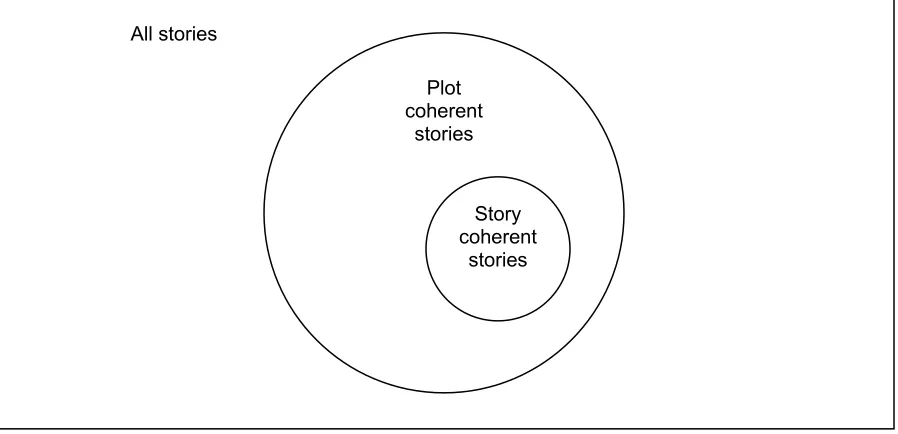
The causality of events and intentionality of characters that make certain stories more appealing than others is not arbitrary. Cognitive psychologists have determined that the ability of an audience to comprehend a narrative is strongly correlated with the causal structure of the story (Trabasso & Sperry, 1985; van den Broek, 1988; Graesser, Lang, & Roberts, 1991) and the attribution of intentions to the characters that are participants in the events (Graesser, Lang, & Roberts, 1991; Gerrig, 1993). Story comprehension requires the audience (e.g. reader, hearer, viewer) to perceive the causal connectedness of story events and to infer intentionality of characters. I define two properties of story that must be perceived by an audience for the story to be considered successful.
Definition 1.10 (Plot coherence). Plot coherence is the perception that the main events of a story are causally relevant to the outcome of the story.
1 This corresponds to Grice’s maxims of quantity and relation (Grice, 1975). The maxim of quantity states that
Definition 1.11 (Character believability). Character believability is the perception that the events of a story are reasonably motivated by the beliefs, desires, and goals of the characters that participate in the events.
Plot coherence is the way in which the main events that make up the plot of a story appear to form a chain that necessarily terminates in the outcome of the story. Plot coherence only applies to the main events; the less significant events that lead to the main plot points do not need to be relevant to the outcome of the story, although in many cases they will, since they lead up to the main plot points. It is not enough that a narrative be merely coherent. A coherent narrative is one in which one event follows from another (Meehan, 1976; Lebowitz, 1985). Any narrative whose fabula is not a random list of unrelated events is coherent. Plot coherence refines the notion of coherence by suggesting not only that events are causally relevant to each other, but that the chain of causality eventually leads to the satisfaction of a point. Plot coherence is coherence that is goal-driven, reflecting the fact that an audience expects a story to have some point (Wilensky, 1982). When a story has significant events that do not appear to be relevant to the way the story ends, the direction of the story’s plot is
not completely focused on the outcome2. As a result, the audience may make incorrect
inferences about the direction of the plot and in general have a lower level of story comprehension (Gerrig, 1993).
Character believability refers to the numerous elements that allow a character to achieve the “illusion of life” (Bates, 1994). It does not refer to a character that is honest or reliable, but to a character that convinces us to suspend our disbelief in the possibility that that character exists in some story world. Character believability is partially dependent on the idiosyncrasies of a character’s appearance and physical movements. Physical appearance is very important in visual media such as animated film (Thomas & Johnson, 1981). The description of appearance is also found in written and spoken presentations. Equally important is the way in which the internal attributes of a character such as personality, emotion, desires, and intentions manifest themselves through the decisions the character makes and the behaviors the character performs (Thomas & Johnson, 1981; Bates, 1994;
2 If a story is not plot coherent, then it has main events that are not causally relevant to the outcome of the story.
Loyall, 1997). The definition of character believability places emphasis on the goal-oriented nature of characters. Goal-oriented behavior is a primary requirement for believability (Charles, 2003).
The purpose of the research presented in this dissertation is to investigate a technique for automatically generating narratives whose stories are plot coherent and character believable. My technique for generating narratives is implemented in the Fabulist system which treats the process of narrative generation as a process of generating a fabula and then transforming the fabula into sjužet and media. A fabula is constructed by a planner that emphasizes plot coherence and character believability. By reasoning about plot coherence and character believability, the fabula planner is able to construct stories whose structures facilitate audience understanding of causality and character intentionality. The core contribution of this research is a planning algorithm that is capable of generating stories that are structured so as to enhance the audience’s perception of plot coherence and character believability.
1.4. Reader’s Guide
There are many parts to this dissertation. Depending on the interests of the reader, it is not necessary to read the entire dissertation, nor read the entire dissertation sequentially. The following describes what the reader will find in each chapter.
Chapter 2 is a discussion of related work. The chapter summarizes other, relevant research in story generation in order to motivate a planning approach to the problem of story generation. The chapter starts out by presenting a framework for evaluating story generation systems and then describes how the strengths and weaknesses of various classes of story generation systems are applicable to the problem of generating stories with both strong plot coherence and strong character believability. Exemplar story generation systems from each class are described to illustrate those strengths and weaknesses.
model. The ways in which planning does not naturally correspond to dramatic authoring are enumerated and I present ways in which models of plot coherence and character believability can be incorporated into the planning algorithm.
Planning algorithms are not perfectly suited to story generation. As general problem-solvers, planners do not necessarily generate plans that have plot coherence or character believability. Chapters 4, 5, and 6 describe extensions to existing planning algorithms (e.g. partial-order planning) that specialize planning to story generation. Chapter 4 describes a planning algorithm that considers the intentions of the story world characters separate from the intentions of the author in order to ensure that characters in the story plan appear to be acting on their own beliefs, desires, and motivations. Intentionality is one component of character believability. Chapter 5 describes a planning algorithm that uses a model of personality to determine whether characters in the story world are acting consistently. Consistency is another component of character believability. Chapter 6 describes a planning algorithm that enables a story generation system to assume responsibility for determining certain characteristics of the story world and the characters in the story world in order to better fit the model of dramatic authoring presented in Chapter 3.
Bringing the three planning algorithms together yields a single narrative generation system,
Chapter 2
Related Work
The research problem I am addressing is how to automatically generate stories that are both strong in character believability and strong in plot coherence. Therefore, it is of interest to analyze the degree to which related story generation systems are capable of generating stories with character believability and plot coherence. This chapter presents a framework for evaluating story generation systems that highlights the limitations of related research systems with regard to their reliably generating stories with strong character believability and strong plot coherence. While the limitations of some of the systems that I describe below arise, in whole or in part because of the distinct nature of the research problems that they address, it is an informative exercise to identify the attributes of other systems that are valuable to the problem I am solving and to motivate my solution by highlighting differences. This chapter reviews the story generation systems that are most relevant to my work.
2.1. Evaluating Story Generation Systems
category. Specifically, I am interested in how each category relates to the concepts of character believability and plot coherence.
2.1.1. Overview of Existing Frameworks
Bailey (1999) was the first to categorize story generation systems, dividing systems informally into three categories:
• Author models, in which story generation is approached from the perspective of how a human author would invent a story.
• Story models, in which story generation proceeds from an abstract representation of the story as a structural or linguistic artifact such as a grammar.
• World models, in which story generation is approached by constructing a virtual world and then simulating characters within the world.
Mateas and Sengers (1999) present a scheme (adopted from (Bailey, 1999)) that categorizes story generation systems as author-centric, story-centric, or character-centric. These categories are identical to Bailey’s categories except that Bailey calls character-centric systems world models. Sobral, Machado, and Paiva (2003a) distinguish between two categories of systems that use or generate story: those that are plot-based and those that are
character-based. Plot-based systems represent story as discrete, high-level pieces of plot that are interrelated through explicit linkages. Character-based systems involve autonomous characters that can act freely in the story world. This scheme is primarily meant to distinguish design approaches to building interactive narrative systems in which the user is a participant in a virtual world in which a story is being told. However, the scheme can also be applied to story generation systems.
in order to achieve dramatic effects. Strong autonomy is similar to the character-centric categorization and strong story is similar to the author-centric categorization, although the continuum allows for a system to fall somewhere in between the extremes. The continuum however, only addresses the degree to which the decision-making of individual characters is distributed – or apparently distributed – versus centralized.
2.1.2. A Revised Framework for Categorizing Story Generation
Systems
Simplifying Mateas and Sengers (1999), I categorize story generation systems as character-centric and author-centric.
Definition 2.1 (Character-centric): A character-centric system models the mental factors such as beliefs, desires, goals, and traits that affect how characters act in a virtual world and simulates the cognitive processes of those characters as they react to the environment they are situated in. As time progresses forward in the simulated virtual world, characters respond to the world and story emerges from the decisions that the characters make.
Definition 2.2 (Author-centric): An author-centric system computationally models the creative process of a human author. A single authoring agent implicitly or explicitly has intentions towards the outcome of the story or the structure of the plot.
plausible3 (in the same way that the domain information used to infer understanding from an agent’s goal-driven behavior can be used to generate goal-driven behavior (Wilensky, 1981)). Even Hitch (Bailey, 1999), for which the story-centric category was defined, uses a model of reader comprehension of narratives to guide the story generation process. Generalizing this argument, I claim that story-centric systems implement computation models of story authoring, making them a type of author-centric systems.
Laurel’s (1991) analysis of Aristotle’s Poetics describes stories (plays) in terms of the five hierarchical categories represented in Figure 2.1 (Laurel, 1991, fig. 2.2). The categories are related by formal cause and material cause. Formal cause is a top-down perspective that suggests that a story has some purpose and thus dictates the types of characters that can be in the story and the actions that they perform. Material cause is a bottom-up perspective that a layer is made up of the materials at the lower levels. The author views story from the perspective of formal cause. The audience views story from the perspective of material cause because they observe the physical enactment and infer from what they observe character and plot.
From the Aristotelian perspective, character-centric systems generate stories from the perspective of character or lower. Character-centric systems model the cognitive processes
3 See (Black & Wilensky, 1979) for a critique of story grammars which claims that grammars accept some
ill-formed stories and exclude other well-ill-formed stories. The practical consequence is that story grammars may not be suited to story generation.
Action (plot)
Character
Enactment (spectacle) Pattern Language (diction)
Material cau
se
Inferre
d Form
al Cau
se
of the story world characters and simulate their actions in a virtual world. The simulation usually involves forward progression of time so that the implications of character actions can be fully captured and reacted to by other characters. Story emerges from the actions that characters perform in the story world (Aylett, 1999). In these systems, character is the material with which plot is made. Author-centric systems, on the other hand, generate stories from the perspective of the plot. Author-centric systems treat characters as the effectors through which the hypothetical author changes the world (Egri, 1960). Author-centric systems possess some degree of intention towards what the structure of the plot should be or what the outcome of the story should be and use characters to achieve those authorial intentions.
2.1.3. Comparing the Framework to Properties of Story
The framework for categorizing story generation systems is useful for making broad distinctions between various approaches to the problem of generating stories. But what does it mean to use a character-centric approach over an author-centric approach, or vice-versa? The assumption made in Section 1.3 is that successful stories will have both strong character believability and strong plot coherence. However, it is my belief that the general design approach – either character-centric or author-centric – biases a story generation system towards achieving either strong character believability or strong plot coherence. Specifically I make the following general observations.
• Character-centric systems tend to more reliably generate stories with strong
character believability but tend to less reliably generate stories with strong plot coherence.
• Author-centric systems tend to more reliably generate stories with strong plot
coherence but tend to less reliably generate stories with strong character believability.
accidentally achieved. The converse applies to author-centric systems and character-believability in the stories that they generate. It is possible that character-centric systems exist or can exist that reliably produce stories with both strong character believability and strong plot coherence. Likewise, it is possible that author-centric systems exist or can exist that reliably produce stories with both strong plot coherence and strong character believability.
Whether or not a story generation system is character-centric or author-centric suggests broad implications about its ability to generate stories with character believability and plot coherence. While character-centrism and author-centrism are defined in opposition to each other, character believability and plot coherence, as properties of story, are not opposite ends of a spectrum. That is, a story is not either character believable or plot coherent or somewhere in between. Instead, character believability and plot coherence are two dimensions in the Cartesian space of stories; a story can be both character believable and plot coherent. The assumption given in Section 1.3 is that successful stories are strong in character believability and plot coherence. However, the general observations about character-centric systems and author-centric systems would suggest a generated story can have either strong character believability or strong plot coherence.
2.1.3.1. General Observations about Character-Centric Systems
In general, character-centric systems more reliably generate stories with strong character believability and less reliably generate stories with strong plot coherence. That character-centric systems are proficient at producing stories with strong character believability is evident from the definition of character-centricity. Character-centric systems simulate a virtual world in which characters independently pursue their individual goals in a manner consistent with their traits and desires. Since the actions that characters perform can be observed by the audience to be motivated by the goals, desires, and traits of the character themselves, character believability is a natural side-effect of character-centric systems.
(Aylett, 2000) meaning that allowing autonomous characters (or even an interactive user) authority to make decisions independently of other agents makes plot coherence unlikely. Decision-making at the level of the character is necessarily localized in scope; characters react to the world around them and, if modeled after real world counterparts – humans – are not concerned with the long term consequences of their actions on the perceived development of a plot. Plot coherence is something that is only evident to the audience after long term exposure to material cause.
To compensate for difficulties achieving plot coherence due to the narrative paradox, some character-centric systems utilize additional modules, often called drama managers (e.g. Bates, 1992; Kelso, Weyhrauch, & Bates, 1993; Weyhrauch, 1997; Lamstein & Mateas, 2004), to monitor the emergence of story and coerce or constrain characters to behave in ways that are more likely to yield coherence of plot. Unfortunately, any external manipulation of character autonomy necessarily decreases the believability of characters since characters may suddenly adopt new goals, make decisions, or behave in ways that are unexpected, inconsistent, or seemingly lacking in motivation for the sake of plot development.
2.1.3.2. General Observations about Author-Centric Systems
are made are in attempt to achieve author goals or a particular plot which guarantees strong plot coherence.
Character believability often takes a second seat to plot coherence in author-centric systems, however. Author goals and character goals are often not compatible and achieving author goals by choosing the actions that characters take in the story world can cause characters to appear to act inconsistently or without motivation. The author agent can decide what each story world character needs to do and when to do it in order to bring about a particular conclusion. The character actions might not make sense to the audience since the audience will attribute the actions that are performed to characters. The audience assumes that the characters know nothing about the goals of the author and are acting in response to the world they are situated in. Systems that treat the achievement of characters’ initial goals or needs as the plot outcome generate stories that are more likely to have character believability since character actions truly are motivated; however, the range of stories that can be told by these systems is limited. Character believability is, consequently, not typically considered by author-centric systems to the degree that plot coherence is.
2.2. Review of Story Generation Systems
Research into story generation and the development of story generation systems began as a natural progression from cognitive science research in story understanding in the 1970’s. Since then, numerous systems have been developed which generate stories or can be considered to generate stories. Story generation systems include interactive drama systems in which the user can participate in a storytelling experience by entering a virtual world through an animated avatar. Although in many cases, interactive drama systems rely on pre-scripted story fragments, because the user can intervene with other character’s goals and with the way in which a story unfolds, an interactive drama system must be able to adapt or restructure the story in order to present a unified experience to the user. The historical record of the events that occur in the virtual world is a story that was generated dynamically.
Given the vast number of systems that can be described as story generation systems, it is beyond the scope of this dissertation to enumerate and describe all of them. The story generation systems described in this section are those that are most relevant to the research on story generation presented in later chapters.
2.2.1. Character-Centric Systems
computational methods so that they act in order to fulfill those goals and desires. Due to the emphasis on character, character-centric systems often, although not necessarily, use autonomous agent technologies such that each story world character is represented by an intelligent agent. Due to the agent-oriented nature, character-based approaches are favored by systems in which the user is allowed to act on story world because characters are represented by autonomous agents that are able to react to unanticipated user interventions (Sobral, Machado, & Paiva, 2003b).
2.2.1.1. Tale-Spin
Tale-Spin (Meehan, 1976) is a system that generates Aesop Fable-like stories by modeling characters in a story world. The user describes one or more characters to Tale-Spin and gives at least one of the characters a goal to achieve. In addition to goals, characters have knowledge about some parts of the story world and have attitudes towards each other. Tale-Spin reasons about how each character, given what it knows about the world, can pursue its goals. The model of reasoning used to simulate the story world characters is based on Schank’s model of human knowledge structures (Schank & Abelson, 1977). On behalf of each character in the world, Tale-Spin employs a combination of planning and inference to determine the next action that character should take (Meehan, 1976). The character may have a pre-existing script which can be executed or may have one or more partial plans that can be completed. A character tries each option in turn until it achieves its goal or fails. After each step of a script or a plan is executed, an inference engine determines how the story world has changed and how the characters in the story world react to the change. The inference process can result in characters adopting new goals.
outcome of the story. In that case, any story in which the protagonist achieves his goal can be plot coherent. There are two reasons that Tale-Spin is not guaranteed to generate stories with plot coherence. First, the system can infer new goals depending on how the world evolves; characters can start pursuing new goals that are not related to the “outcome” of the story. Figure 2.2 shows a story generated by Tale-Spin (Meehan, 1977, p. 91). The two characters were each given the initial problem that they were thirsty but the resulting story appears to be about how George the ant becomes indebted to Wilma the bird. If the rescue is the point of the story, then the part of the story in which Wilma the bird satisfies her thirst is not meaningful to the outcome.
The second way in which Tale-Spin can fail to generate plot coherence is due to the fact that scripts and plans can fail when the story world is not set up in a manner that is conducive for the characters to solve for their goals. If a character is hungry and has a goal to satisfy his hunger but does not know where any food is and does not have any plan to find food (e.g. ask someone who is friendly to him where some food is), then the resulting story will be brief and without plot coherence. Figure 2.3 (Meehan, 1976, p. 95), translate to natural language by Meehan, is a story generated by Tale-Spin that fails because the initial description of the world was not adequate. The story in Figure 2.3 lacks plot coherence because the events in the story do not appear to lead to any meaningful outcome. The inference engine determined that the crow would become hungry when noticing it had some cheese. Had the world been
ONCE UPON A TIME GEORGE ANT LIVED NEAR A PATCH OF GROUND. THERE WAS A NEST IN AN ASH TREE. WILMA BIRD LIVED IN THE NEST. THERE WAS SOME WATER IN THE RIVER. WILMA KNEW THAT THE WATER WAS IN THE RIVER. GEORGE KNEW THAT THE WATER WAS IN THE RIVER. ONE DAY WILMA WAS VERY THIRSTY. WILMA WANTED TO GET NEAR SOME WATER. WILMA FLEW FROM HER NEST ACROSS A MEADOW THROUGH A VALLEY TO THE RIVER. WILMA DRANK THE WATER. WILMA WASN’T THIRSTY.
GEORGE WAS VERY THIRSTY. GEORGE WANTED TO GET NEAR SOME WATER. GEORGE WALKED FROM HIS PATCH OF GROUND ACROSS THE MEADOW THROUGH THE VALLEY TO A RIVER BANK. GEORGE FELL INTO THE WATER. GEORGE WANTED TO GET NEAR THE VALLEY. GEORGE COULDN’T GET NEAR THE VALLEY. GEORGE WANTED TO GET NEAR THE MEADOW. GEORGE COULDN’T GET NEAR THE MEADOW. WILMA WANTED GEORGE TO GET NEAR THE MEADOW. WILMA WANTED TO GET NEAR GEORGE. WILMA GRABBED
GEORGE WITH HER CLAW. WILMA TOOK GEORGE FROM THE RIVER THROUGH THE VALLEY TO THE MEADOW. GEORGE WAS DEVOTED TO WILMA. GEORGE OWED EVERYTHING TO WILMA. WILMA LET GO OF GEORGE. GEORGE FELL TO THE MEADOW. THE END.
instantiated so that the crow had recently eaten, then the crow would not have eaten the cheese and the fox would proceed to trick the crow into dropping the cheese (Meehan, 1976). The protagonist is the fox and his goal to satisfy his hunger. However, if one makes the case that if the meaningful outcome of the story is the satisfaction of the crow’s hunger, then the story in Figure 2.3 would be plot coherent if the fox’s actions were completely omitted.
2.2.1.2. The Oz Project
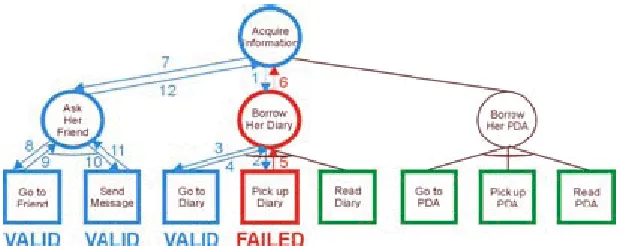
The Oz Project (Bates, 1992; Bates, 1994; Mateas, 1997; Loyall, 1997) uses reactive, animated, autonomous agents that interact with human users to create interactive dramas. Agents are implemented in a reactive planning language called HAP (Loyall, 1997) such that each agent has its own set of unique expressible behaviors. As the user, embodied in an animated avatar, interacts with the autonomous agents in a virtual world, the characters form goals and perform behaviors that achieve those goals. Goals are decomposed into a hierarchy of sub-goals that eventually decompose in primitive behaviors that are executed as animated behaviors. Behaviors have applicability conditions that must be true in the world for a behavior to be performed; if there are no applicable behaviors then a goal fails. Expressiveness of an agent is captured in the unique way in which goals are decomposed into primitive behaviors.
Character believability is apparent in the Oz project because each character forms goals and reactively pursues those goals with distinctive personality as implemented by individualized HAP behaviors. However, left to their own means, the virtual world will be unstructured and the autonomous agents will react and interact without direction. Since the agents are situated in the virtual world they are unable to reason about the long-term consequences of their goals and behaviors in terms of whether events are leading towards a meaningful conclusion or not. In order to provide direction to the characters in the world, a module called the drama
ONCE UPON A TIME THERE WAS A DISHONEST FOX AND A VAIN CROW. ONE DAY THE CROW WAS SITTING IN HIS TREE, HOLDING A PIECE OF CHEESE IN HIS MOUTH. HE NOTICES THAT HE WAS HOLDING THE PIECE OF CHEESE. HE BECAME HUNGRY, AND SWALLOWED THE CHEESE. THE FOX WALKED OVER TO THE CROW. THE END.
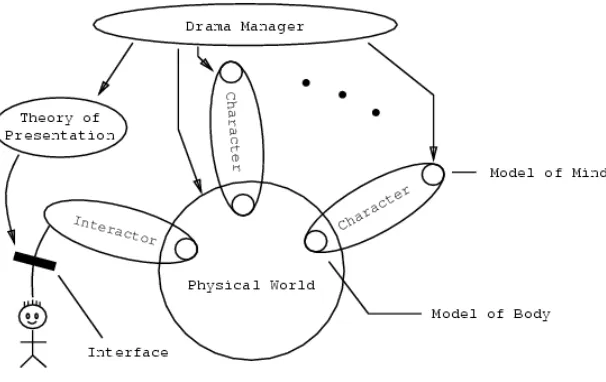
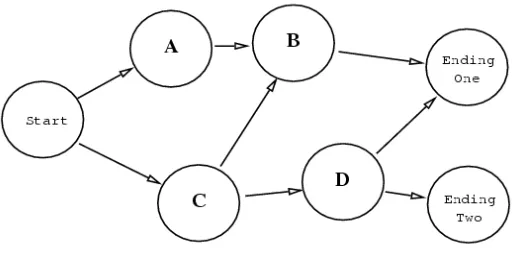
manager is introduced to the architecture. Figure 2.4 (Kelso, Weyhrauch, & Bates, 1993, fig. 1) shows the Oz architecture. The drama manager models plot as a directed, acyclical graph (DAG) of scenes as in Figure 2.5 (Kelso, Weyhrauch, & Bates, 1993, fig. 2). Each scene is an abstract representation of the events that should occur together during a localized block of time in the story world. The drama manager observes the action in the virtual world and advances the story by advancing a frontier. When the drama manager sees an opportunity to advance the story to the next scene it subtly influences the goals and behaviors of the agents in the virtual world so that the scene occurs. Influencing the goals and behaviors of agents is detrimental to character believability because character actions can appear unmotivated when intervention by the drama manager occurs. However, preliminary experiments demonstrate that an interactive user situated in the virtual world is less likely to notice inconsistencies in character behavior (Kelso, Weyhrauch, & Bates, 1993).
The plot graph is provided by the system developer as a way of constraining the possible stories that can emerge from the system. However, since the plot graph provides an abstract specification of the plot, there is room for improvisation in the story world so that each performance of the same plot structure can result in distinct stories as the level of primitive behaviors. The drama manager cannot guarantee plot coherence, however, because agents responding to the world and the user can develop and pursue new goals that are not meaningful to any of the outcomes described in the plot graph. Such sequences of actions
can be distinct enough from the scenes in the plot graph that the drama manager is unable to recognize opportunities to coerce the agents back into the prescribed plot. One reason that this occurs in that the user is an interactive part of the story world and can choose to pursue activities that are not strictly part of the plot outline, causing the other agents in the world to respond accordingly.
2.2.1.3. The Virtual Storyteller
The Virtual Storyteller (Theune et al., 2003) is based on the Oz project but does not involve an interactive user. Characters are represented by autonomous agents who pursue their own goals. A drama manager is used to subtly influence the way in which a plot unfolds. The drama manager in the Virtual Storyteller, however, uses a proscriptive method of influencing the agents instead of a prescriptive method. Agents ask permission from the drama manager to perform behaviors in the virtual world and the drama manager can grant or deny a request based on whether that behavior violates certain rules about how plots is expected to unfold. The Virtual Storyteller distinguishes between fabula and sjužet in that the system uses a two phase process, first generating a sequence of events that occur in the story world and then reasoning about how best to relate the fabula to the audience. The fabula is formed by the actions of the agents in the virtual world. The agents are not visually animated as in Oz. Instead, the fabula is narrated by another agent who relates the occurrences of the virtual world in a descriptive, verbal form.