Abstract
LAI-YUEN, SUSANA KARINA. Nano-scale Molecular Docking and Assembly Simulator (NanoDAS) with Haptic Force-Torque Rendering and Energy Minimization for Computer-Aided Molecular Design (CAMD). (Under the direction of Dr. Yuan-Shin Lee).
The objective of this research is to investigate and develop computational and haptic interface techniques to improve the search and design of molecular docking, and to facilitate the assembly of molecular components during molecular design. Nano-scale molecular docking and molecular assembly are vital for the discovery and development of medicines,
nano-scale devices, and new materials. Molecular docking and molecular assembly processes consist of finding the feasible pathway, and the correct location and orientation between two molecules so that they can remain attached to each other. As one small molecule (ligand) approaches a larger molecule (receptor), the ligand may need to change its conformation until finding one with the lowest interaction energy. Moreover, for a given receptor molecule, a huge number of ligand molecules need to be searched and tested before a potentially active drug can be identified. Therefore, a fast and efficient method to determine the feasibility of the ligand to dock into the receptor is required.
In this paper, a new method called NanoDAS (Nano-scale Docking and Assembly Simulator) is presented to determine the feasibility of a ligand reaching the binding site of a
docking into a receptor in molecular docking, and to determine the feasibility of nano-scale assembly in molecular design applications.
To improve the design of molecular docking and assembly processes, effective users (i.e., scientists or designers) intervention is necessary. In this paper, a 5-DOF (degrees of freedom) force-torque feedback Haptic device is introduced to provide force-torque feedback to users. Through the force-torque feedback haptic interface, a user is able to feel the forces exerted on the ligand by the receptor, and to determine whether the ligand can actually dock into the receptor by considering its conformational changes and finding a feasible path using the proposed NanoDAS. An energy minimization algorithm has also been proposed to find low-energy molecular conformations in real-time.
A Two-phase algorithm is proposed to analyze the probability of a ligand to be docked or assembled into another molecule. The first phase determines the feasibility of a ligand to dock into a targeted binding site of a receptor using an iterative searching procedure. The second phase generates a probability graph to examine all the ligand’s feasible paths to find the most likely docking path. The developed Two-phase algorithm can identify the ligands that, although feasible for the targeted binding site of the receptor, posses higher probability towards other binding site than the targeted one.
Biography
Acknowledgements
I would like to express my deep appreciation and gratitude to my advisor, Dr. Yuan-Shin Lee, for his continuous support, guidance and encouragement during my academic study and research work at North Carolina State University. I am deeply indebted for getting me involved into research when I was an undergraduate student. I would like to thank Dr. Yahya Fathi, Dr. Ezat T. Sanii, Dr. Christopher G. Healey, and Dr. Donald W. Brenner for serving in my doctoral dissertation committee, and for their time and suggestions. I would also like to thank Dr. James R. Wilson and Dr. Jason Shih for their support and suggestions during my doctoral examination.
I sincerely thank my research group mates: John Chiou, Jirawan Kloypayan, Bahattin Koc, Yongfu Ren, Chirag Chafekar, Weihang Zhu, Abhinand Pamali, Ron Aman, Jennifer Hartman, Forest Lin, Betty Li, and Num Boonma for their valuable suggestions, advice, and help during my years at NC State. I deeply enjoy sharing academic and personal experiences with them. I will definitely miss our lunch time and badminton games.
I would like to thank our visiting professors to our research group, Dr. Sang-Yoon Ju, Dr. Hong-Tzong Yau, Dr. Cha-Soo Jun, and Dr. Ajay Joneja for their valuable suggestions and discussions during our group meetings.
Table of Contents
Page
List of Figures viii
List of Tables xii 1. Introduction 1
1.1Motivation 1 1.2Molecular Docking 2
1.3Molecular Assembly 5
1.4Research Objectives 7
1.5Dissertation Organization 8
2. Literature Review 9
2.1 Molecular Docking 9
2.2 Molecular Assembly 10
2.3 Haptic Devices in Molecular Modeling 12
2.4 Summary 13
3. Nano-scale Docking and Assembly Simulator (NanoDAS) for Computer-Aided Molecular Design (CAMD) 14
3.1 Introduction 14
3.2 Overview of the Proposed NanoDAS 18 3.3 Energy Field Calculation for Molecular Docking 21 3.4 NanoDAS (Nano-scale Docking and Assembly Simulator) Methodology 25
3.4.1 NanoDAS algorithms for molecular docking and assembly 26
3.4.2 Constructing the NanoDAS search tree 29
3.5 Examples 39
3.6 Summary 43
4. Haptic Force-Torque Rendering and Energy Minimization for Computer-Aided Molecular Design (CAMD) and Assembly Simulation 44
4.1 Introduction 44
4.2 Haptics Rendering for Computer-Aided Molecular Design (CAMD) 49 4.2.1 Potential energy and interactive molecular force calculation 51 4.2.2 Calculating molecular collision forces by 3D collision grids 56 4.2.3 Calculating haptic force and torque feedback for molecular docking 58 4.3 Haptics Force-torque Rendering for Computer-Aided Molecular Design 61 4.4 Flexible Molecular Configuration in Molecular Collisions and Docking 64 4.5 Adaptive Local Search and Flexible Molecular Docking 66
4.6 Examples 72
4.7 Summary 75
5. A Two-Phase Algorithm of Multiple Docking Paths Analysis for Computer-Aided
Molecular Design (CAMD) 76
5.1 Introduction 76
5.2 NanoDAS and Interactive Energy Calculation for Molecular Docking 80 5.3 Two-Phase Algorithm for Evaluating Docking Feasibility and Identifying
the Most Likely Docking Ligand 81
5.4 Phase I: Docking Feasibility Evaluation Using the NanoDAS Search Tree 84 5.5 Phase II: Multiple Docking Paths Analysis using a Probability Graph 90
5.6 Examples 95
6. Computer Implementations and Results 101 6.1 Proposed NanoDAS System with Haptic Force-Torque Feedback and Multiple
Path Analysis 101
6.2 Results of Nano-scale Docking and Assembly Simulator (NanoDAS) 103 6.3 Results of Haptic Force-Torque Rendering with Energy Minimization 114 6.4 Results of the Two-Phase Algorithm for Multiple Docking Paths Analysis 128
6.5 Summary 139
7. Conclusions and Future Research 141
7.1 Conclusions 141
7.2 Future Research Plan 142
List of Figures
Page Figure 1.1 Example of receptor and ligand molecules in molecular docking 3 Figure 1.2 Possible docking paths for the ligand during the molecular docking
Process 4
Figure 1.3 Carbon nanotube-based gears with benzyne teeth 6
Figure 2.1 Haptic device in molecular docking 13
Figure 3.1 Example of molecular receptor and ligand in molecular docking 15 Figure 3.2 Ligand’s search for the binding site in the molecular docking process 16
Figure 3.3 Growing a search tree in the search space 19
Figure 3.4 Traditional binary collision detection test in path planners vs.
continuous energy field test in NanoDAS 20
Figure 3.5 Receptor enclosed in 3D grid for interacting energy calculation 23
Figure 3.6 General searching scheme of NanoDAS 26
Figure 3.7 Flowchart of NanoDAS search tree 28
Figure 3.8 Potential Field method in NanoDAS 34
Figure 3.9 Local Search method in NanoDAS 37
Figure 3.10 Molecular energy field for receptor molecule Streptavidin (PDB ID: 1stp) 40 Figure 3.11 Results for the example Streptavidin-Biotin complex showing the
influence of potential field on the search performance 42 Figure 4.1 Receptor and ligand molecules involved in the molecular docking process 45 Figure 4.2 Ligand’s search and molecular configuration change process in
molecular docking 47
Figure 4.3 Lab set-up of haptic controller and 5-DOF haptic device with a
dual-CPU workstation 50
Figure 4.4 Calculation of interactive force Fpotential between ligand and receptor
Figure 4.5 Calculation of collision force between a ligand and a receptor using
pre-computed 3D collision grids 57
Figure 4.6 Haptic responding force and torque distribution to haptic device 59 Figure 4.7 The haptic-based NanoDAS system with force-torque feedback for
molecular docking 62
Figure 4.8 Arrangement of atoms into groups based on the number of rotatable
bonds within the molecule 64
Figure 4.9 General searching scheme of NanoDAS 67
Figure 4.10 Molecular configuration change through energy minimization using
the adaptive local search method 69
Figure 4.11 Haptic interface and the example receptor-ligand complex 73 Figure 4.12 Potential energy and force-torque feedback for the example
Tyrosyl-tRNA synthetase receptor with Tyrosine ligand 74 Figure 5.1 Example of receptor and ligand molecules in molecular docking and
assembly 77
Figure 5.2 Possible docking paths for the ligand during the molecular docking
process 78 Figure 5.3 Overview of the proposed two-phase algorithm for molecular docking 82 Figure 5.4 Growth of the NanoDAS search tree with energy-constrained guidance
for Phase I 85
Figure 5.5 Phase I of the docking feasibility evaluation using the NanoDAS search
tree with energy-constrained guidance 87
Figure 5.6 Generation of the probability graph for multiple docking paths analysis
of Phase II 91
Figure 5.7 Phase II of the analysis of multiple docking paths using the probability
graph 93
Figure 5.8 Example Tyrosyl-tRNA synthetase (receptor) with tyrosine (ligand),
Figure 5.9 Molecular energy field for receptor molecule Tyrosyl-tRNA
(PDB ID: 4ts1) 97
Figure 5.10 Resultant docking paths of the proposed two-phase algorithm for the
example Tyrosyl-tRNA with Tyrosine complex 99
Figure 6.1 Proposed NanoDAS system with force-torque feedback and multiple
docking paths analysis for computer-aided molecular design (CAMD) 102 Figure 6.2 NanoDAS results for different initial searching locations for the
Streptavidin-Biotin complex (PDB ID: 1stp) 104
Figure 6.3 NanoDAS results showing the configuration change of the Biotin ligand as it enters the narrow passage towards the binding site of the
Streptavidin receptor 105
Figure 6.4 Example Tyrosyl-tRNA synthetase (PDB ID: 4ts1) receptor with different
ligands to be screened for testing 107
Figure 6.5 NanoDAS results for screening Ligand_1 and Ligand_2 into the
Tyrosyl-tRNA synthetase receptor (PDB ID: 4ts1) 108
Figure 6.6 NanoDAS results for screening Ligand_3 and Ligand_4 into the
Tyrosyl-tRNA synthetase receptor (PDB ID: 4ts1) 110
Figure 6.7 Change in molecule configuration of Ligand_4 as it enters into the
targeted binding site A 111
Figure 6.8 Haptic display and device developed at our research lab 114 Figure 6.9 Docking rigid and flexible ligands to a receptor 115 Figure 6.10 Results of NanoDAS docking a flexible ligand for the 4ts1 complex 117 Figure 6.11 NanoDAS results for different initial searching locations for the
Tyrosyl-tRNA synthetase with Tyrosine complex (PDB ID: 4ts1) 118 Figure 6.12 Example of finding the feasible ligand from different candidate ligands
to be docked into a targeted binding site of the Streptavidin
(PDB ID: 1stp) receptor 120
Figure 6.13 Force feedback and potential energy results for docking Ligand_1
Figure 6.14 Force feedback and potential energy results for docking Ligand_2
into the targeted binding site 123
Figure 6.15 Force feedback and potential energy results for a successful docking
of Ligand_3 into the targeted binding site 125
Figure 6.16 Developed NanoDAS system with haptic force-torque rendering 128 Figure 6.17 Ligand is not feasible for docking into the binding site and it does not
dock anywhere else in the receptor 129
Figure 6.18 Ligand is feasible for docking and it successfully docks into the binding
site of the receptor 131
Figure 6.19 Ligand is feasible for docking into the binding site but it is attracted
to location B 132
Figure 6.20 Example of finding the feasible ligand from different candidate ligands to be docked into a targeted binding site of the Streptavidin
(PDB ID: 1stp) receptor 134
Figure 6.21 Docking paths for Ligand_1 and Ligand_2 using the proposed two-phase
algorithm 135
Figure 6.22 Docking paths for Ligand_3 and Ligand_4 using the proposed two-phase
List of Tables
Page
Table 6.1 Comparison of performance results for the example Streptavidin-
Biotin complex 112
Table 6.2 Comparison of performance results for the example Streptavidin-
Biotin complex by increasing the maximum number of search nodes 113
Table 6.3 Comparison of performance results using the traditional random
sampling search method and the proposed NanoDAS searching method 126
Table 6.4 Comparison of performance results using NanoDAS with and without
the presented haptic interface system 127
Table 6.5 Docking feasibility evaluation for the different ligands by Phase I 138
Table 6.6 Multiple paths analysis by Phase II for the ligands found feasible for
Chapter 1
Introduction
1.1
Motivation
Nanotechnology is perhaps “the most anticipated technological revolution in modern times” [Knight 1991]. In molecular nanotechnology, two of the major research objectives are the design, modeling, and fabrication of pharmaceutical drugs and molecular devices through molecular docking and molecular assembly, respectively [Merkle 1991]. Although these two problems have distinct applications, they are similar in that both address the “assembly” of molecules. Molecular device designs are developed based on a molecule-by-molecule construction while molecular docking tries to find the best fit between two molecules. Molecular docking has received a lot of attention due to its importance in the drug design industry while molecular device design is still in its infancy. The reason behind the increasing interest on molecular docking lies on its vital role on “discovering and developing safe and effective medicines that will affect the lives of perhaps millions of patients” [Boyd 1998]. In addition, the lead-time cost from the laboratory to the market for a new drug is very high and has risen in the last years [Boyd 1998]:
In 1987 each new medicine cost on average $281 million and took 8-12 years to bring it from discovery to market…in 1990 [it] had grown to $359 million for each new pharmaceutical. In 1994, average costs had jumped further to $597 million on the development of a new drug starting then.
discovery, reduce costs, and relief some of the problems encountered by chemists giving place to what is usually referred as Computer-Aided Molecular Design (CAMD) or more specifically Computer-Aided Drug Design (CADD). The molecular docking problem is highly complex and far from being completely solved [Halperin 2002]. Therefore, this paper presents new techniques for solving some of the issues of molecular docking. Due to the similarities between molecular device design and molecular docking, it is expected that the methods used for solving the molecular docking problem can also be applied to molecular assembly design extending the range of applications of these techniques and opening new areas to explore.
1.2
Molecular Docking
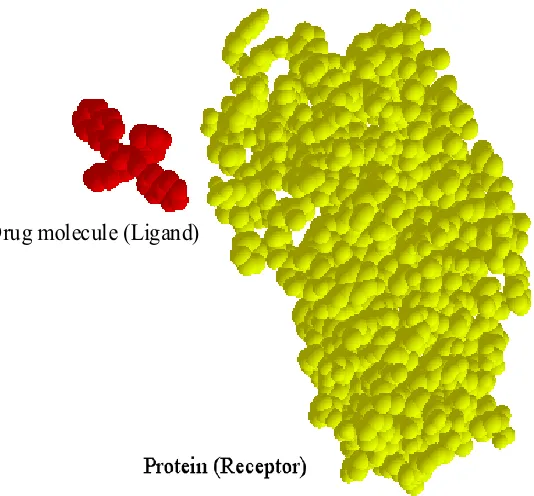
Molecular docking (or binding) is an essential process in biochemical processes and is the main challenge in drug design since the development of a pharmaceutical drug is a “long, incremental process, typically requiring years of research and experimentation” [LaValle 2000]. In general, molecular docking is the process where a drug molecule (usually referred as the ligand) attempts to find a particular position and orientation inside a protein (or receptor), as shown in Figure 1.1. This particular position and orientation of the ligand is called the binding site. The ligand molecule usually has 10 to 50 atoms with around 5 to 15 torsional degrees of freedom (DOFs); on the other hand, receptor molecules can contain thousands to hundreds of thousands of atoms with a huge number of DOFs [Apaydin 2001].
molecules shown in Figure 1.1 were obtained from the Protein Data Bank (PDB) with PDB ID: 1hvr [Berman 2000].
Drug molecule (Ligand)
Figure 1.1 Example of receptor and ligand molecules in molecular docking.
Narrow passage or high-energy barrier
Other possible docking paths
Feasible docking path to binding site Initial location
Ligand
Best binding site
Receptor
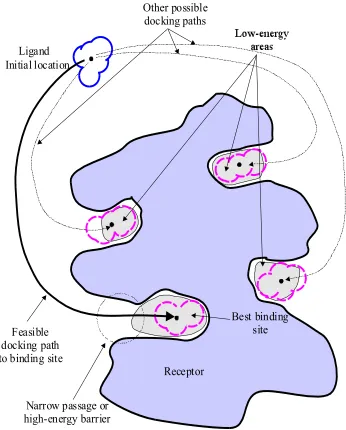
Figure 1.2 Possible docking paths for the ligand during the molecular docking process.
binding site, which is usually considered to be the lowest-energy region in the search space, is surrounded by other low-energy regions that can attract the ligand and divert it from arriving at the correct binding site. Moreover, the best binding site might be surrounded by high energy barriers or narrow passages, making accessibility to the binding site difficult to find, as shown in Figure 1.2. The problem of trapping in a local optimum has hindered many searching methods in finding the correct docking sites or docking paths.
1.3
Molecular Assembly
Figure 1.3 Carbon nanotube-based gears with benzyne teeth [Han 1997]
1.4
Research Objectives
The objective of this research is to investigate and develop computational and haptic interface techniques to improve the search and design of molecular docking, and to facilitate the assembly of molecular components during molecular design. This paper intends to provide a tool for the search of new ligand molecule design and novel molecular devices using optimization, computational geometry, and haptic interface. Several research issues are addressed in this paper to improve the molecular docking design and the molecular assembly processes:
• Nano-scale Docking and Assembly Simulator (NanoDAS) for Computer-Aided Molecular Design (CAMD). A new NanoDAS method for determining the accessibility of a ligand molecule into a receptor molecule is proposed for molecular docking and assembly. The objective of the NanoDAS method is to identify molecules that cannot be docked or assembled into another molecule during molecular docking or molecular design.
• Haptic Force-Torque Rendering with Energy Minimization for Computer-Aided Molecular Design (CAMD) and Assembly Simulation. A haptic force-torque rendering with energy minimization method is presented to provide scientists or designers with real-time intuitive guide for manipulating the molecules and facilitating the molecular docking and assembly processes.
• A Two-Phase Algorithm for Multiple Docking Path Analysis for Computer-Aided Molecular Design (CAMD). The two-phase algorithm aims to provide a tool for examining the different pathways of a molecule and determining the probability of the molecule to dock or assemble into another molecule.
Computer-Aided Drug Design (CADD).
1.5
Dissertation Organization
The remaining sections of this dissertation are organized as follows:
Chapter 2 presents a literature review on the research issues studied in this work including molecular docking, molecular assembly, and haptic interface device applications in molecular modeling.
Chapter 3 describes the proposed nano-scale docking and assembly simulator (NanoDAS) for determining the feasibility of a ligand molecule to dock into a receptor molecule for molecular docking and assembly.
Chapter 4 introduces the development of the haptic interface device for molecular docking and assembly. An energy minimization method is discussed for finding low-energy and collision-free molecular configurations in real-time.
Chapter 5 presents the Two-phase algorithm for multiple paths analysis. The algorithm creates a probability graph for determining the likelihood of the ligand’s different docking paths.
Chapter 6 provides the computer implementations and illustrative examples of the proposed computational techniques and algorithms.
Chapter 2
Literature Review
In this chapter, we review the issues and previous work related to molecular docking, molecular assembly, and haptic interface device applications in molecular modeling. These issues will be further discussed and addressed in the following chapters.
2.1 Molecular Docking
In order to solve the molecular docking problem, several approaches have been proposed. Early approaches to find the final ligand conformation inside the protein considered only the translational and orientational degrees of freedom of the ligand treating it as a rigid body. Then, with the increase in power of computer hardware, the internal conformational flexibility of the ligand was considered using techniques such as molecular dynamics, Monte Carlo methods, fragment-based methods [Ewing 2001, Kuntz 1982], point complementarity, distance geometry methods, simulated annealing [Goodsell 1990, Morris 1996], genetic algorithms [Jones 1997, Judson 1994, Oshiro 1995] and Tabu search methodologies [Baxter 1998, Morales 2000]. In the work by Jones et al. (1997), the receptor also had some limited flexibility in addition to the full flexibility of the ligand.
algorithms are not apt for extensive flexible drug docking due to their slow processing [Halperin 2002].
Tabu searches try to model the human memory process. They are based on neighborhood search with local optima avoidance. The search starts with an initial random solution and moves are randomly generated to arrive at other solutions. A tabu list is used to keep track of previous visited solutions in order to avoid cycling and promote diversified search. A comparison of heuristic search algorithms for molecular docking was presented by Westhead et al. (1997), where genetic algorithms, simulated annealing and tabu search methods were tested. It was found that genetic algorithm can find the lowest median energies but Tabu search was more robust for locating the global minimum.
The models mentioned above can determine whether a ligand fits into the protein’s binding site or not, but do not consider the conformational changes that a ligand goes through to arrive at the binding site. In fact, docking may not be feasible because the ligand would have to traverse high-energy conformations to achieve the final conformation state [Apaydin 2001]. Singh et al. (1999) addressed the problem of finding energetically favorable paths for the binding site using probabilistic motion planning. They predicted low energy binding sites on the surface of the protein and determine the average path difficulty for different paths entering and leaving the site. Bayazit et al. (2001) developed an obstacle-based probabilistic roadmap motion planning algorithm (OBPRM) based on the probabilistic roadmap (PRM) proposed in [Singh 1999]. Their algorithm differs in that they generate additional random configurations near the protein’s surface, build a local roadmap instead of a global roadmap, and introduce the use of a haptic device for user intervention in finding configurations closer to the binding site.
2.2 Molecular Assembly
Computer-Aided Molecular Design (CAMD) software packages have been developed since 1980s. However, they have limitations when designing and manipulating molecular-scale components with large number of molecules as known as nano-scale components [Freitas 1999]. For this reason, a CAD system for scale devices is necessary to explore nano-scale structure possibilities.
A project to develop a CAD system for nanoelectronic devices (NANOTCAD) is being developed in cooperation with several European universities [Iannaccone 2001, Macucci 2001]. This project mainly addresses the modeling and simulation of nanoelectronic devices (i.e. single electron transistors and memories) based on semiconductors and on transport via single molecules. With respect of nanomechanical devices, Kaehler (1990) addressed the arrangement of atoms to form a bridge out of diamond crystal by designing hundreds of short, strong molecular brackets and classifying them by offset and angle. The brackets are stored in a dictionary, which helps the designer on selecting the proper bracket to use and on finding the place in the diamond lattice where it will connect. Other few primitive design packages have been attempted such as Crystal Sketchpad [Leach 1996]. Crystal Sketchpad is a molecular CAD program for the design of diamondoid molecular structures. It extends the capabilities of a previous software called Crystal Clear [Leach 1994], which was developed at Xerox PARC.
2.3 Haptic Devices in Molecular Modeling
Haptic comes from the Greek word haptesthai, which means to touch, relating to or based on the sense of touch [Salisbury 1999]. The haptic device is an electromechanical device that exerts forces on users while tracking their motions. These forces provide users with the illusion of touching something. Haptic interface devices have been widely used in many applications such as virtual prototyping, shape sculpting, and surgical simulation and training [Srinivasan 1997]. In our earlier work, a 5-DOF haptic-based force-torque feedback system has been developed for product development and manufacturing [Ren 2005, Zhu 2003, 2004a].
In molecular docking, haptic devices have been used for representing the ligand, and for letting the user feel the protein potential field and identify possible binding sites in the protein [Lee 2004, Nagata 2002, Ouh-young 1988]. Figure 2.1 shows a haptic interface for molecular modeling, where the user holds the haptic device probe to feel the potential field around the molecule. One of the first ones to introduce haptic device in this area was Ouh-young et al. (1988). They developed a real-time molecular docking system using a manipulator to generate the forces and torques exerted on the ligand by the receptor. The manipulator serves as an input device for 6D manipulation as well as an output device for force feedback. Levine et al. (1997) developed an interactive system called Stalk, which interacts with a genetic algorithm running on a parallel computer to find low energy geometric configurations. Nagata et al. (2002) used the haptic probe to represent a single charge and have the user feel the electrostatic potential field of a protein to identify candidate sites for binding. Finally, Lee et al. (2004) developed a new method for smoothing haptic interaction with molecular force calculations.
Figure 2.1 Haptic Device in Molecular docking [Salisbury 1999].
2.4 Summary
Chapter 3
Nano-scale Docking and Assembly Simulator (NanoDAS) for
Computer-Aided Molecular Design (CAMD)
This chapter presents a new approach called NanoDAS (Nano-scale Docking and Assembly Simulator) for exploring the molecular docking that is vital for the discovery and
development of medicines and biotechnology. Using a potential field gradient method and a local search with randomization technique, the proposed NanoDAS generates a search tree to explore and predict molecular behavior and determine the feasibility of the ligand reaching
the binding site of the receptor. The proposed NanoDAS can also be applied to determine
the feasibility of nano-scale assembly of a molecular component into another molecular
assembly. The presented techniques can be used in computer-aided molecular design
(CAMD) for nano-scale molecular docking and molecular assembly design.
3.1
Introduction
Molecular binding (or docking) is an essential process in biochemical processes and is the main challenge in drug design since the development of a pharmaceutical drug is a
“long, incremental process, typically requiring years of research and experimentation”
[LaValle 2000]. In general, molecular binding consists of finding the geometric and
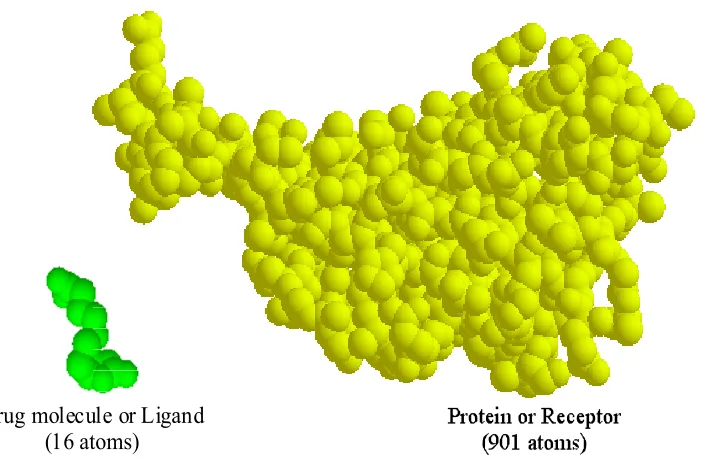
energetic match between two molecules, a large molecule named protein or receptor and a small molecule called the drug or ligand, as shown in Figure 3.1. The ligand molecule usually consists of 10 to 50 atoms with around 5 to 15 torsional degrees of freedom (DOFs);
on the other hand, receptor molecules can contain thousands to hundreds of thousands of
between the receptor and ligand, also called the binding site, is difficult due to the extremely high DOFs. In the example shown in Figure 3.1, the ligand is a Biotin containing 16 atoms
while the receptor is a Streptavidin having 901 atoms. Data for these molecules shown in
Figure 3.1 were obtained from the Protein Data Bank (PDB) with PDB ID: 1stp [Berman
2000].
Drug molecule or Ligand (16 atoms)
Figure 3.1 Example of molecular receptor and ligand in molecular docking.
For a given receptor, very large numbers of ligands need to be tried and docked in a
reasonably acceptable amount of time to identify potentially active drugs [Venkatachalam
2003]. Many computational techniques have been applied to simulate and predict the
behavior of the ligand in the presence of the receptor [Floudas 1999]. Most of the methods
bound configuration and do not consider any feasible flexible configuration of the ligand as it
enters the binding site [Singh 1999]. Finding whether a binding site can be accessed by the
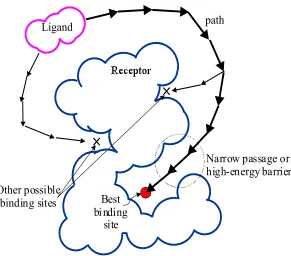
ligand is of vital importance for the binding process to take place. Figure 3.2 shows an
example search process for the best binding site during a molecular docking. It can be
observed that the binding site, which is usually considered to be the lowest-energy region in
the search space, is surrounded by other low-energy regions that can trap the ligand and
divert it from arriving at the correct binding site. Moreover, a binding site might be
surrounded by high energy barriers or narrow passages, making accessibility to the binding
site difficult to find, as shown in Figure 3.2. The problem of trapping in a local optimum
has hindered many searching methods in finding the correct docking sites or docking paths.
Ligand
Best binding
site
path
+
+
Other possible binding sites
Narrow passage or high-energy barrier
Methods based on motion planning from robotics called Probabilistic Roadmaps
(PRM) were developed to study the energy landscape surrounding the receptor molecule and
to analyze the molecular motion [Apaydin 2001, Bayazit 2001, Singh 1999]. Probabilistic
roadmaps were introduced by Kavraki et al. (1996) for multiple query path planning using a
simple local planner. There have been many variants of PRMs for addressing problems in
robotics, computer animation, and computational biology [Amato 1998, Bohlin 2000, Yakey
2001]. Although PRMs have been successfully applied to the molecular docking process,
the methods suffered from the narrow passage problem, in which sampling points rarely fall
within narrow spaces in the search space [Singh 1999, Bayazit 2001]. This issue can cause
PRM to fail to provide a path to the binding site due to the lack of milestones in narrow
spaces. Bayazit et al. (2001) introduced user input into the process by entering milestones
through haptic interface. In this way, milestones can be placed in narrow passages and the
path to the binding site can be found. However, Bayazit et al. (2001) found that it was
tedious and a significant burden for the user to search the receptor’s surface and place the
milestones [Bayazit 2001]. In addition, the use of user input adds users’ bias to the search
process.
In this chapter, a NanoDAS (Nano-scale Docking and Assembly Simulator) method is presented. The method consists of building a search tree that combines exploration and
exploitation techniques to search high-dimensional spaces and to approximate the ligand’s behavior in the presence of the receptor. NanoDAS grows the search tree based on the
potential energy field created between the receptor and the ligand. It explores the search
space by combining randomization and the potential field method. It then exploits
low-energy regions using the local search method, which minimizes the ligand’s energy by
changing the ligand’s configuration.
The remainder of this chapter is organized as follows: Section 3.2 introduces the basis
calculation for molecular docking and assembly. Section 3.4 discusses the proposed
NanoDAS method using randomization, potential field analysis, and local search methods.
Section 3.5 presents some examples of the proposed NanoDAS. Finally, Section 3.6
provides the summary.
3.2
Overview of the Proposed NanoDAS
In this chapter, a NanoDAS (Nano-scale Docking and Assembly Simulator) method is proposed to explore and find the molecular binding site and the molecular docking feasibility
analysis. NanoDAS builds a search tree to explore the space until an initial position and the
goal position (or binding site) are connected. The main idea of this method is to bias the
exploration toward unexplored portions of the space by sampling points in the state space,
and incrementally “pulling” the search tree toward them. Search tree methods have been
successfully used in the area of robotics as incremental search algorithms that share many of
the great properties of probabilistic roadmaps but have the advantage of generating better
feasible solutions [LaValle 1998, 2001, Urmson 2003].
Figure 3.3 shows the basic concept of constructing a search tree to reach the target
destination in a search space. As shown in Figure 3.3, a tree planner attempts to grow a tree
Obstacle
Initial searching location Goal location qg oal
near
q
new
q
ran do m
q
initi al
q
Figure 3.3 Growing a search tree in the search space.
Once qnear has been identified, the tree tries to expand in the direction of qnearqrandom by a search step ε to find a new feasible location qnew. The new configuration is tested for any possible collision using an incremental distance computation method. At this point, three
situations can occur:
(1) Reached, when qrandom is added to the tree because it already contains a
configuration within of qrandom;
(2) Extended, when a new configuration (qnew≠qrandom) is inserted into the tree;
(3) Trapped, when the new configuration qnew is rejected because it is in collision with the obstacles in the search space.
The searching process is repeated until the initial configuration and goal configuration are
connected. NanoDAS grows a tree based on a potential energy field created between the receptor and the ligand, thus replacing the mentioned collision detection procedure used in
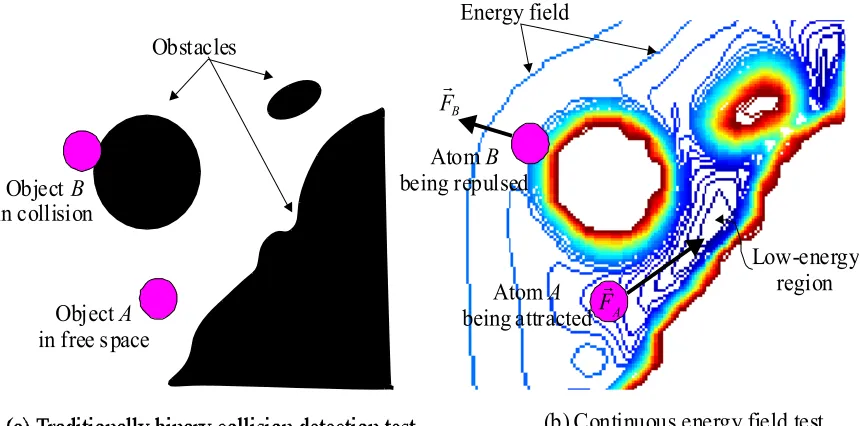
robotic applications. As shown in Figure 3.4, the main differences between the search tree
test is replaced by a complex and continuous energy field test to represent the molecular
search space as shown in Figures 3.4(a) and 3.4(b); and (ii) the search tree expands through a
combination of exploration and exploitation of the search space. In contrast to the robots, molecules cannot be controlled since they follow the potential energy conditions of the
environment, as shown in Figure 3.4(b).
(b) Continuous energy field test Obstacles
Object in free spaceA
Energy field
Atom being attractedA Atom
being repulsedB
Low-energy region
A
Fr
B
Fr
Object in collisionB
Figure 3.4 Traditional binary collision detection test in path planners vs. continuous energy field test in NanoDAS.
As the ligand enters the energy field generated between the receptor and the ligand, the
ligand is subject to two types of forces: an attractive force FrA pulling the ligand towards
shown in Figure 3.4(b). Thus the overall interacting energy is the combination of all the
attractive force FrA and the repulsive force FrB and whichever component is greater determines whether the resultant force is attractive as in ligand A or repulsive as in ligand B
in Figure 3.4(b). By using the potential energy field, the NanoDAS searching pulls the tree
towards the low-energy regions.
When the ligand is far away from the receptor, the potential energy is small and
negligible; thus the ligand’s behavior can be approximated as free or random motion through
randomization. Once the ligand enters a preset threshold of attractive energy level, the
method is applied to examine the possible ligand movement until the ligand reaches the
binding site. During the searching process, a local search method is applied to find a better
configuration by minimizing the ligand’s potential energy. This exploitation scheme can
overcome the narrow passage (or high-energy barriers) encountered as a molecule gets closer
to the binding site. The search tree continues growing until the target binding site is reached.
The next section provides more detailed discussion of the NanoDAS and the calculation of
the interacting energy and force between the receptor and the ligand through a pre-computed
three-dimensional (3D) energy field.
3.3
Energy Field Calculation for Molecular Docking
One of the main requirements for simulating the ligand binding process is to
effectively represent the interaction between the ligand and its receptor. Although both the
ligand and the receptor are flexible, it is commonly assumed that the receptor is rigid while
the ligand is flexible. Approximating the receptor as a rigid body has been justified by
experimental data for most cases [Bayazit 2001, Finn 1999]. The receptor typically consists
of thousands of atoms while the ligand consists of tens of atoms. The receptor molecule is
potential, hydrogen bond potential, etc. generating the potential energy between the protein
and the ligand [Goodford 1985].
Computing the total potential energy is accurate but is also very computationally
expensive since it needs to take into account the contribution for each atom pair. In this
chapter, we approximate the potential energy by the most important van der Waals terms only.
Although this simplification might seem extreme, results by Bayazit et al. (2001) had
justified that most of the time, they were able to find the real binding site using only the van
der Waals terms in their approximation. To calculate the potential energy in real-time
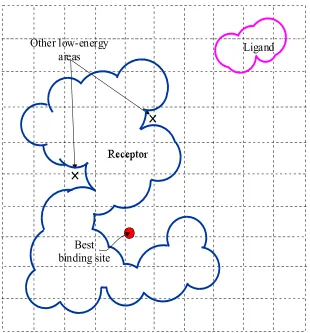
during searching, a grid-based energy calculation method is used in the NanoDAS. As
shown in Figure 3.5, the protein is enclosed by a 3D grid where each grid point stores the
potential energy generated by surrounding protein atoms at that point. The potential energy
function used in this work is approximated by the sum of van der Waals and is expressed as
follows [Goodford 1985, Pattabiraman 1985]:
∑∑
∑∑
= = = = − = = lig i rec j ij ij ij ij lig i rec j ij r B r A e E1 1 12 6
1 1
(3.1)
where eij is the potential energy defined as
− 6 12 ij ij ij ij r B r A
between one ligand
atom i and one receptor atom j,
lig and rec are the number of atoms in the ligand and the receptor, respectively,
Aij and Bij are the van der Waals repulsion and attraction parameters, and
Best binding site
Ligand Other low-energy
areas
+
+
Figure 3.5 Receptor enclosed in 3D grid for interacting energy calculation.
For each 3D grid, all the receptor atoms located within a predefined range from the current
grid center are used in the potential energy calculation, and all the others located too far away
will not be included in the calculation. In this way, when a ligand is introduced in the
vicinity of the receptor, all the grids occupied by the ligand atoms are used in calculating the
total interaction energy between the ligand and the receptor. Atoms that fall outside the
reasonable range 3D grid are assigned a large value to avoid incorrect selection of molecules
To determine the resultant force Fr that a molecule imposes on another molecule, the potential energy E of Equation (3.1) is used for calculating the correspondent force elements (
ij ij ij y z
x f f
f , , ) acting on a ligand atom i located at (xi, yi, zi) by a receptor atom j. The interactive force between a ligand atom i and a receptor atom j can be found by differentiating the potential energy E with the distance rij [Leach 2001]. To construct the 3D potential energy grid, the force vector (
ij ij ij y z
x f f
f , , ) in the x, y, and z direction acting on
ligand atom i located at (xi, yi, zi) by the receptor atom j is calculated as follows:
, i ij ij ij i ij x x r r e x e f ij ∂ ∂ ∂ ∂ − = ∂ ∂ −
= (3.2)
, i ij ij ij i ij y y r r e y e f ij ∂ ∂ ∂ ∂ − = ∂ ∂ −
= (3.3)
i ij ij ij i ij z z r r e z e f ij ∂ ∂ ∂ ∂ − = ∂ ∂ −
= (3.4)
where eij is the potential energy between a ligand atom and a receptor atom and
6 12 ij ij ij ij ij r B r A
e = − as described earlier in Equation (3.1), and
rij is the distance between a ligand atom i and a receptor atom j.
The total resultant force Fracting on the ligand atom i by the receptor molecule j is determined as follows:
[
]
∑∑
= = = lig i rec j z y xij f ij f ijf F 1 1 , , r (3.5) where ij x f , ij y
f and ij
z
f are found by Equations (3.2), (3.3) and (3.4). The resultant
towards low-energy regions. In our earlier work presented in [Lai-Yuen 2005a], the
calculated resultant force Fr can also been used to provide the force feedback when using a developed haptic device for molecular manipulation. As the ligand approaches the receptor,
its shape can be changed to find a lower-energy configuration based on the total interacting
energy found by Equation (3.1). Details for considering the flexible molecules and
searching for the feasible binding path by the NanoDAS are discussed in the next section.
3.4
NanoDAS (Nano-scale Docking and Assembly Simulator) Methodology
The NanoDAS focuses on finding the accessibility of a ligand docking to the binding
site through the growth of a search tree under the constraints of potential energy and the
molecular collisions. The energy field represents the interaction energy that takes place
between the receptor and the ligand molecules. The ligand is either rejected or accepted
based on the interacting energy value, which is determined by the proximity of the ligand to
the receptor.
This section presents the details of the proposed NanoDAS methodology that
combines the exploitation capability of potential field approach and the exploration
capability of search with randomization. NanoDAS also introduces an energy-minimization
scheme into the search tree to further exploit the low energy regions to overcome narrow
Initial location
Potential Energy Field Low-energy
areas
Target location
Random sample configuration Potential field based configuration Local search resulting configuration NanoDAS
search tree
A
B
C C’
Narrow passage or high-energy barrier Change of configuration
from to C new C’
Figure 3.6 General searching scheme of NanoDAS.
3.4.1 NanoDAS algorithms for molecular docking and assembly
Figure 3.6 shows the general concept of the proposed NanoDAS for finding the
initiating from the vicinity of the receptor, as shown in Figure 3.6. The NanoDAS
algorithm checks whether the ligand is within an attractive potential energy field. If a
ligand is not within an attractive potential energy field as molecule A shown in Figure 3.6, a random sampled configuration is selected and the search tree is tested for expansion. If a
ligand does fall within an attractive potential field as molecule B shown in Figure 3.6, then the NanoDAS method is applied to pull the search tree towards the lower energy regions
based on the interacting force between the ligand and receptor, as described in Section 3.3.
As the ligand approaches the targeted docking site, if the ligand collides with the receptor
(indicated by a higher energy value) as molecule C shown in Figure 3.6, a local search method is applied to minimize the ligand’s energy by changing its configuration, resulting in
molecule C’. The process continues until the search tree reaches the targeted destination thus providing a path for the ligand to access the binding site.
Figure 3.7 shows the flowchart of the proposed NanoDAS to search for the optimal
molecular docking. NanoDAS consists of three searching algorithms. As shown in Figure
3.7, Algorithm_I is the main algorithm for building the NanoDAS search tree and it consists
of Algorithms II and III.
Algorithm_I uses both the potential field analysis and the randomization mechanisms to
expand the search tree by exploiting low-energy regions and exploring the search space, as
shown in Figure 3.7. In addition, the randomization mechanism supplies the necessary
“jump” to prevent the trapping by the local minima during the search. Algorithm_II of the
exploitation scheme finds the new molecule configuration to be added into the search tree by
using the Algorithm_III of a local search methodology to minimize the total configuration
energy if possible, as shown in Figure 3.7. The details of the three algorithms are shown in
no
yes no
Calculate interacting energy and force vector direction. Set
e(q )
qcurr= initial e
q
curr =
initial
Assign force directional configuration to Set = 0
q
random dir
Is ( < ) AND (
n Nmax
Dist(qnew, ) qgoal > dmax)?
yes
no
Is (random = 1) OR [(random = 0) AND
(qcurr= qnear)]? Is (ecurr fielde )?
Assign a random configuration to Set = 1
q
random dir
Find nearest node in tree qnear toqdir
Set ecurr >efield
Stop
Algorithm I
≤
yes Get new configuration
Calculate the new energy = ( ) and the new force vector
q enew e qnew new
yes no Is (e < e )?
new max
Add qnewto tree T. Set ecurr= and enew currq = qnew
Is (Dist( , ) < )?
q q
dmaxnew goal
Can be minimized? enew yes yes no no
Algorithm II
Algorithm III
new
Fr
Is (number of iterations = N LS)?
no yes
3.4.2 Constructing the NanoDAS search tree
In the proposed NanoDAS, the potential field method biases or “pulls” the growth of
the search tree into low-energy regions when the ligand is within the protein potential field,
while the local search method further exploits the search space as the ligand approaches the
target configuration. In Figure 3.7, Algorithm_I focuses on the construction of the
NanoDAS search tree. Details of Algorithm_I are shown as follows:
Algorithm_I. Constructing the NanoDAS search tree
Inputs:
qinitial: Initial molecular configuration, qgoal: Goal configuration,
G: pre-computed 3D grid for energy and force calculation. Output:
T: Resultant NanoDAS search tree.
Step 1. Initialize the search tree by assigning qinitial as the root of the search tree T.
Step 2. Set the initial configuration qinitial to be the current configuration qcurr. Step 3. Calculate the energy ecurr and the force Frcurr for qcurr using Equations (3.1)
and (5), respectively.
Step 4. IF ((qgoal ⊄ T) AND (number of iterations < Nmax)), then Go to Step 5;
ELSE Go to Step 10.
Step 5. IF (ecurr ≤ efield), then
directional configuration qdir,
Set random to 0. ELSE
Sample a random configuration qrandom and set it as the directional configuration qdir,
Set random to 1.
Step 6. Find the nearest node qnear in the tree T to the directional configuration qdir.
Step 7. IF ((random = 1) OR (random = 0 AND qcurr = qnear)), then
Go to Step 8;
ELSE Go to Step 9.
Step 8. IF a new configuration qnew can be found by the Algorithm_II, then Add the new configuration qnew to the search tree T, Set the new energy enew as the current energy ecurr, and
Set the new configuration qnew as the current configuration qcurr, Go to Step 4.
Step 9. Set a value higher than the field energy efield to the current energy ecurr to
escape the potential field analysis method and switch to the randomization
method.
Go to Step 4.
Step 10. Output the search tree path T.
END.
In Algorithm_I, Steps 1-3 initialize the search tree data by setting the initial configuration
qinitial as the root of the tree and calculating its energy and force using the pre-computed 3D
grid and Equations (3.1) and (3.5). The search cycle begins at Step 4 where, unless the goal
analysis or by randomization, as shown in Step 5. Step 6 finds the nearest possible node
qnear in the search tree to the directional configuration qdir obtained either through the
potential field method or randomization. If the search tree is being extended through the
potential field analysis, a check is performed to verify that the nearest node qnear in the search tree corresponds to the current configuration qcurr, as shown in Step 7. In Algorithm_I, the potential field method pulls the branch containing the current configuration qcurr towards the low-energy area. If the condition (qcurr = qnear) is not satisfied, other branches of the search
tree might be pulled instead of the desired branch. If the condition (qcurr = qnear) is not
satisfied, Step 9 sets the current energy value ecurr higher to the field energy efield to jump out
of the potential field method and to use the randomization method on the next new searching
iteration, as shown in Figure 3.7.
3.4.3 Finding a new molecule configuration for expanding the search tree T
If the search tree is extended by satisfying the condition (qcurr = qnear), the search of a new configuration is performed using Algorithm_II of an exploitation scheme, as shown in
Figure 3.7. If the tree can be expanded along the direction of qdir, the new configuration
qnew found by Algorithm_II is added to the search tree T in Step 8. The process continues
until the goal qgoal is reached or a preset number Nmax of iterations has elapsed, and the
resultant tree T is returned.
Algorithm_II is focused on the searching for a new feasible configuration qnew to be
added to the search tree. In Algorithm_II, a local search method is invoked to further
minimize the energy of the configuration if possible. Details of Algorithm_II are shown as
Algorithm_II. Finding a new molecule configuration for expanding the search tree T
Inputs:
qdir: directional configuration,
qnear: node in the search tree T closest to the random configuration qrandom.
Outputs:
qnew: new configuration to be tested for extending tree T, unew: actions on qnew to reach qrandom,
enew: energy of new configuration qnew.
Step 1. Find the new configuration qnew by the nearest node qnear in the tree and the directional configuration qdir.
Step 2. Calculate the energy enew of the new configuration qnew using Equation (3.1). Step 3. Calculate the interactive force Fnew
r
of the new configuration qnew using Equation (3.5).
Step 4. IF (enew< emax) then
Return (SUCCESS and qnew, unew, enew); ELSE IF (Distance(qnew, qgoal) < dmax) then
FIND_NEW_CONFIGURATION ← LOCAL_SEARCH(qnew, enew) by the Algorithm_III,
IF (FIND_NEW_CONFIGURATION) then
Return SUCCESS and qnew, unew, enew;
In Algorithm_II, Step 1 calculates the new molecule configuration, which extends the
search tree from the nearest node qnear towards the directional configuration qdir. Step 2 in
Algorithm_II calculates the energy enew and force Fnew
r
of the new molecule configuration.
If the energy value is less than a maximum allowable energy value emax, the new molecule configuration is accepted and added to the search tree. Otherwise, if the molecule is near
the binding site, the Algorithm_III of a local search is executed to minimize the current total
energy value if possible as shown in Figure 3.7. Algorithm_III will be discussed in more
detail in the next section. If a new configuration with acceptable energy can be found, the
new molecule configuration is accepted and added to the search tree.
The following sections present the details of the potential field searching methods used in the
algorithms of the NanoDAS. These searching techniques are used to bias the growth of the
search tree towards the low-energy regions and to minimize the total energy of molecular
docking during the searching.
3.4.4 Potential field analysis and randomization for search tree growth
To find the minimal energy of molecular docking, there are two ways to expand the
search tree in NanoDAS: (1) potential field analysis, and (2) randomization, as shown in
Potential Energy Field
Random sampled configuration
Local search resulting configuration Random
Random Ligand
Potential field based configuration Targeted location/
binding site
A B
C
Fr
qdir (Randomization)
qdir
(Potential Field)
Narrow passage or high-energy barrier
Molecule in collision
Figure 3.8 Potential Field method in NanoDAS.
Case 1. Potential Field Analysis:
If the ligand is in the vicinity of the receptor and its interacting energy ecurr is smaller than a predefined energy value efield, there exists a net attractive force pulling the ligand towards the receptor, as the force FrB acting over molecule B shown in Figure
“pulled”. The force Frcurr is calculated by using Equation (3.5) and it is also equivalent to the negative gradient of the potential energy function shown as follows:
curr curr E
Fr =−∇r (3.6)
where ∇r is a gradient operator of the energy field and Ecurr is the potential energy
value for the current configuration qcurr defined earlier by Equation (3.1). Frcurr
provides the expanding direction the search tree is growing by establishing a
directional configuration qdir defined as follows:
curr curr
dir q u
q = +ε⋅r (3.7)
where qcurr is the current configuration on which the force is being applied,
ε is the predefined distance between the nodes of the tree,
curr
ur is the unit vector of Frcurr and
curr curr curr
F F
u r
r
r = .
It should be noted that the potential field method used in this chapter pulls the molecule
based on the translation and does not change the rotational and torsional angles, as shown in
Figure 3.8. The rotational and torsional angles are not considered at this stage until
Algorithm_III of the local search method is invoked to further minimize the total molecule
configuration energy. More details of the rotational and torsional changes and the
Algorithm_III of the local search will be discussed later in the next section.
3.4.5 Local search for exploitation of low-energy regions
When the search tree is being tested for possible expansion, a directional
configuration qdir is determined by Algorithm_I. A new configuration qnew is accepted based
which is the maximum energy allowed for a configuration. Any value larger than emax is
interpreted as the ligand being in contact with the receptor and thus not being a feasible (or
free) configuration.
In this section, Algorithm_III is presented to explore the possibility of minimizing the
configuration’s total energy through a local search of all the possible molecule configurations
with different rotational or torsional angles. If the configuration’s energy enew is higher than the threshold energy level emax, which means the ligand is within the proximity of the protein molecule, the local search method is applied to the configuration until its energy falls below
emax or the number of iteration limit nLS has elapsed.
Figure 3.9 shows an example of the local search to reach the targeted configuration in
molecular docking. The local search method for energy minimization allows the
exploitation of the search space by pushing the molecule to change its rotational and torsional
angles to lower-energy configurations, thus exploiting the neighborhood of qnew. In the
local search, random values are assigned to all variables except the translational variables.
Thus, a molecular configuration search of other feasible rotational or torsional angle is
performed without changing the current location of the molecule in question, as shown in
Figure 3.9. This is particularly helpful as the ligand approaches the target configuration
since it increases the chances for the ligand to pass through a narrow space leading to the
Local search resulting configuration Change of configuration
from configuration to new configuration CC’
Potential field based configuration Receptor
Ligand
Potential Energy Field
C
C’ B
B
Fr
C
Fr
Narrow passage or high-energy barrier
Targeted location/ binding site
Figure 3.9 Local Search method in NanoDAS.
In Figure 3.9, the example molecule C cannot access the binding site due to the blocking by the narrow passage of the molecular, which causes the potential energy level to be high.
The local search method is then invoked to look for a low-energy configuration with different
feasible rotational and torsional angles (see the example molecule C’ in Figure 3.9). By finding the feasible molecule configuration with different rotational and torsional angles, the
ligand is no longer in collision with the receptor and can access the target configuration, as
closer to the optimal docking site. The search procedure continues until the target
configuration qgoal is reached or the maximum number of search nodes has been reached.
Detailed Algorithm_III of the local search for the change of molecular angles is shown as
follows:
Algorithm_III. Local Search for Feasible Molecular Rotational and Torsional Angles
Inputs:
qnew: new configuration to be tested for extending the search tree T, enew: energy of new configuration qnew
Outputs:
q’new: configuration with lower energy than qnew if exists,
e’new: energy of configuration q’new
Step 1. Set the maximum number of iterations nLS to 0.
Step 2. Set the new configuration qnew to the configuration q’new and to the hold
configuration qhold.
Set enew to e’new.
Step 3. Assign a random configuration to the hold configuration qhold. Step 4. Calculate the energy ehold and force Fhold
r
for the hold configuration using
Equations (3.1) and (3.5).
Step 5. IF (ehold < emax) then
Assign the hold configuration qhold to the new configuration q’new, Assign the hold energy ehold to the new energy e’new,
Return (SUCCESS and the new energy e’new).
Return (FAILURE). ELSE Go to Step 2.
END.
In this chapter, the developed NanoDAS consists of the above-mentioned Algorithm_I,
Algorithm_II and Algorithm_III in searching for the optimal molecular docking. In
summary, Algorithm_I builds the search tree for NanoDAS through either the potential field
analysis or the randomization, depending on the proximity of the configuration to the
receptor. Algorithm_II searches for the new configuration along the current searching
direction provided by Algorithm_I. In addition, Algorithm_II tests the feasibility of a new
configuration and determines its possible addition to the search tree. The new
configuration’s energy can be further minimized by using Algorithm_III, which applies the
local search method to further exploit the search space and thus overcome the narrow
passages or the high-energy barriers encountered along the search path. In the next section,
examples of the developed NanoDAS are presented.
3.5
Examples
Figure 3.10 shows the surrounding energy field for an example receptor Streptavidin
(PDB ID: 1stp) when a Biotin ligand is introduced in the nearby region, as shown in Figure
3.10(a). The receptor molecule contains 901 atoms and the ligand molecule has 16 atoms.
The 3D potential grid is generated using a grid size of 0.5 Å based on the size of the receptor.
Figure 3.10(b) shows the 3D energy field surrounding the example Streptavidin receptor
found by using Equation (3.1). Notice that, in Figure 3.10(b), the energy value increases as
the ligand approaches the molecule’s boundary while the low energy ponds are formed
minima occurs. For illustration purpose, Figure 3.10(c) presents a 2D contour plot on a
cross section plane of the Streptavidin receptor to show the surrounding potential energy
distribution.
(c) 2-D contour plot of the energy field (a) Receptor molecule Streptavidin (PDB ID: 1stp) with the ligand Biotin
Receptor Energy field
Biotin (ligand) (16 atoms)
Streptavidin (Receptor) (901 atoms)
Cross-sectional plane for display
Receptor
Figure 3.11 shows an example of the searching for molecular docking between an
example ligand Biotin and the example receptor Streptavidin. Figure 3.11(a) shows the 3D
image of the example receptor Streptavidin with 901 atoms and the ligand with 16 atoms.
To assess the feasibility of the ligand’s docking into the receptor, the presented NanoDAS
searches to find any feasible docking paths and to access the docking site with the optimal
molecular configuration. For comparison and to highlight the functions of the presented
NanoDAS, Figures 3.11(b)-(d) show the growth of the search trees by using different
constraints in molecular docking search. In Figure 3.11(b), the search tree is grown by
using only the randomization (without potential energy field analysis) with a goal bias of 5%.
A goal bias percentage indicates the percentage the goal configuration is considered in
selecting the next searching direction while growing the search tree. As shown in Figure
3.11(b) it takes 101 search nodes for the search tree to find the optimal docking site by
randomly exploring the search space with a bias of 5% towards the goal. Notice that using
only randomization may result in taking more searching steps to find the best docking site
due to the failure of making every move in the right direction towards the goal, as some
example of the random search within the region a shown in Figure 3.11(b).
Figure 3.11(c) shows the NanoDAS search by using the potential energy field
analysis method. A threshold of field energy level efield is set to be –0.05 to consider the
possible search move to find the optimal docking site. As shown in Figure 3.11(c), the
NanoDAS method using the potential energy field analysis (with efield = -0.05) takes only 33 search nodes, less than the 101 search nodes in Figure 3.11(b), to find the best docking site.
The value of efield is negative representing the net attractive force experienced by the ligand as it approaches the receptor. The threshold value of efield (with efield = -0.05) indicates the value at which a ligand in a net attractive field will trigger the potential field method. For
![Figure 2.1 Haptic Device in Molecular docking [Salisbury 1999].](https://thumb-us.123doks.com/thumbv2/123dok_us/1597225.1197194/27.595.220.392.125.287/figure-haptic-device-molecular-docking-salisbury.webp)