T H E PATTERN
OF
SUPERNUMERARY MACROCHAETAE I N CERTAIN DROSOPHILA MUTANTSJAMES V. NEEL
The University of Rochester, Rochester, New York
Received November 11,1939
INTRODUCTION
HE genetical approach to the problem of pattern determination
T
consists in a precise evaluation of the effects of gene substitutions upon a given organismic pattern, and an attempt to explain the re- sults of such substitutions in terms of fundamental processes. If such an approach is to be profitable the pattern studied should be arelatively simple one, and should, further, be one which can be considered in a variety of genetical and environmental backgrounds. Such requirementsFIGURE I.-Location and names of the bristles of wild-type Drosofihila melanogaster and D. fune- bris (after PLUNKETT 1926). Distances on this plane surface are proportional to actual distances on the curved surface of the fly. The abbreviations given in the figure for the various bristles will be employed throughout the text, as follows: a or, m or, p or, anterior, middle, and posterior or- bitals; oc, ocellar; i v, o v, inner and outer verticals; pv, postvertical; U h, 1 h, upper and lower
humerals; ps, presutural; a np, p np, anterior and posterior notopleurals; sp, sternopleurals; a sa, p sa, anterior and posterior supra-alars; a dc, p dc, anterior and posterior dorsocentrals; a pa, p pa, anterior and posterior postalars; a sc, p sc, anterior and posterior scutellars; T S, transverse suture, S G
,
scutellar groove.are met by the thoracic bristles of Drosophila (figure I). Each of these is the outgrowth of a single epidermal cell. They all have a characteristic position and size, both of which may be widely altered by various genetic factors.
Studies intended to elucidate the nature of normal and mutant bristle patterns have in the main utilized genes which have as one of their chief
252 JAMES V. NEEL
effects the removal of bristles. From the relative frequency of occurrence, in a mutant, of the various bristles which are a constant feature of the normal pattern, and from the associations between the variable bristles of this mutant, conclusions as to the processes underlying certain patterns have been reached. As investigations in point may be cited the work on Dichaete (PLUNKETT 1926) and the studies on the scute series of alleles (DUBININ 1929, STURTEVANT and SCHULTZ 1931, GOLDSCHMIDT 1931, Only a few pattern studies have involved flies with supernumerary bristles. Chief among these is that of MACDOWELL ( I ~ I S ) , who in an investigation of the occurrence of extra bristles in the dorsocentral region was unable to detect any regularity in their distribution. The studies reported in this paper also concerned flies with supernumerary macro- chaetae. The use of such flies makes it possible to analyze certain bristle pattern problems which cannot be attacked when bristle-removing genes are employed. I n this investigation the emphasis has been not only on the determination of the numbers of bristles present a t the various loci and their associations, but more particularly on answering two other questions which have an important bearing on the pattern problem. These are: I )
what is the exact position of extra bristles, and 2 ) what is their size? CHILD 1935, IVES 1939).
An abstract of this work has already been published (NEEL 1939).
MATERIAL AND METHODS
Five different genotypes have been studied: wild type and PchlPch of
Drosophila funebris; wild type, p y d l p y d , and y H w dl-49 Thetaly sn3 bb
of D . melanogaster. The three mutant conditions agree in that super- numerary macrochaetae are present on the thorax. Of the various bristle groups affected by the mutants, the dorsocentrals and scutellars can most conveniently be precisely analyzed and so these two groups have been studied chiefly.
All flies were raised a t 24.of o.5OC in half-pint milk bottles, Drosophila funebris on banana-agar and D . melanogaster on standard cornmeal-
molasses-agar. Two or three pairs of flies were introduced into a bottle and allowed to remain there seven to eight days. Only the offspring which appeared during the first three days of emergence was used. All stocks were highly inbred.
BRISTLE PATTERNS IN DROSOPHILA 253 the position of each of the bristles with reference to a definite morpho- logical landmark. There are present on the dorsum of the thorax, ex- clusive of the scutellum, small microchaetae or hairs; certain of these were included in the drawing. By rolling a small calibrated wheel along the somewhat curved outline of a bristle or hair as drawn, its length in micra could be determined. I n order to determine the exact position of the dorsocentrals in wild-type flies, a line was drawn from the base of the a dc to the base of the p dc and extended posteriorly until it intersected the scutellar groove (figure I ) . This line will henceforth be referred to as
the dorsocentral line. The distance of either the a or p dc from the scutellar groove was determined by measuring along this line from groove to bristle. The same or slightly modified procedures were used in determining bristle positions in mutant patterns.
The need of an abbreviated nomenclature for the dorsocentral bristles when several extra ones are present in the dorsocentral line was met in the following manner. I n the normal thorax, where there are two dorso- centrals on a side, the p dc is designated as B I and the a dc as B2. The distance of B I from the scutellar groove is L I ; the corresponding distance of B2, L2. In a mutant thorax where, for example, there may be four dorso- centrals, the one nearest the scutellar groove is B I and that most distant,
B4. The intervening bristles are Bz and B3. The distances of B I through
B4 from the groove, as measured along the dorsocentral line, are L I
through L4. A similar nomenclature was used for designating the hairs found in the dorsocentral line.
I n the determinations of the positions and lengths of these bristles, there are several possible sources of error, notably I) failure of the thorax, or a bristle on it, to be well flattened on the slide, 2) lack of exact cor-
respondence between the camera lucida drawing and the structure studied, and 3 ) slight inaccuracies in the measurement of the camera lucida draw- ing. The total error from these three sources probably does not exceed seven percent for any single measurement; such maximal errors must be rare. Since the figures given in the following tables and diagrams are the mean of a number of flies, and since such errors as do exist are quite com- parable and consistent from pattern to pattern analyzed, it seems im- probable that inaccuracies of measurement contribute in any way to the differences between patterns to be reported here.
EXPERIMENTAL DATA
The normal bristle pattern in Drosophila funebris
In order to have a standard of comparison with mutant types, as well
254 JAMES V. NEEL
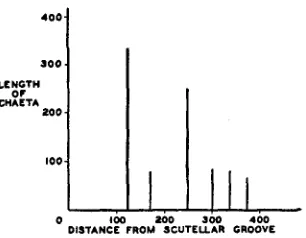
wild-type Drosophila funebris females. The results are summarized in table I and graphically shown in figure 2. In figure 2, a t the distance
from the scutellar groove found to be the mean LI and L2, heavy lines
have been erected the heights of which correspond to the lengths of BI and B2. The four small, light lines represent the most posterior of the
hairs normally present in the dorsocentral line. Morphologically these
TABLE I
The mean positions and lengths in micra o j the dorsocentral bristles and hairs of w’ld-type Drosophila funebris females.
MEASUREhtENT M Ulll U htEASUREMENT M ‘Jm 0
a. Bristles
LI 178.8 1.4 9.8 BI 513.4 2.9 20.7
L2 403.4 2.8 19.8 B2 378.2 2.4 1 7 . 0
b. Hairs
11 242.9 2.1 15.3 h I 102.9 1.6 1 1 . 7
12 454.0 3.3 23.5 h2 87.1 2.8 20.4
13 511.0 3.8 27.0 h3 126.7 2.5 18.0
14 558.7 4.0 28.3 hq 97.5 2.7 19.1
microchaetae differ from the macrochaetae only in size. The figure is in effect a schematic representation of a parasagittal section through the dorsocentral line of a typical, flattened thorax. Each of the mean measure- ments given in table I is not necessarily based upon exactly 5 2 half- thoraces, since sometimes a slight imperfection in a mounted thorax made i t impossible to secure a given measurement. This is also true for the other patterns.
The hairs anterior and lateral to the three figured in front of the a dc have not been studied in detail, but it has been observed that these three are only the first in a row of large hairs extending well forward on the dorsum of the thorax. This is characteristic of the species (STURTEVANT
1921).
From table I it can be seen that there is considerable variability in the
BRISTLE PATTERNS I N DROSOPHILA 2 5 5
should establish a significant correlation between the measurements
LI
and (Lo
-LI).
Since the correlation between these measurements is actu- ally 0.072fo.137, it is obvious that under the present conditions the posi- tion of one bristle is independent of that of the other. Consequently, individual size differences probably do not contribute heavily to the ob- served standard deviation. The relative importance of experimental errors and positional variability cannot be determined a t present.LENGTH
W CHAETA
I
5wl
I
so0
400
L€NGTH OF CHAETA
PM)
0 200 400 M O
DISTANCE FROM SCUTELLAR GROOVE
eo0
GROOVE
a.
“i
I
LENGTH
CHAETA
LOO
]
I,, IJ;
+oo 400 600ISTANCE FROM SCUTELLAR GROOVE
b. C
FIGURE z (upper left).-A schematic parasagittal section through the dorsocentral line of a typical Drosophilafunebris wild-type female, showing the distribution and size of the hairs and bristles. For further explanation see text.
FIGURE 3 (upper right, lower left and right).-The distribution and size of the bristles and hairs of the dorsocentral line of D . funebris PchlPch females, when two, three, or four dorsocen- trals are present per side. Where a hair is an inconstant feature of a pattern, it is indicated by a dotted line. Details in text.
2 5 6 JAMES V. NEEL
Polychaeta in Drosophila .funebris
I n homozygous condition the autosomal semi-dominant mutant Poly- chaeta (Pch) of Drosophilafunebris is characterized in the stock employed
TABLE 2
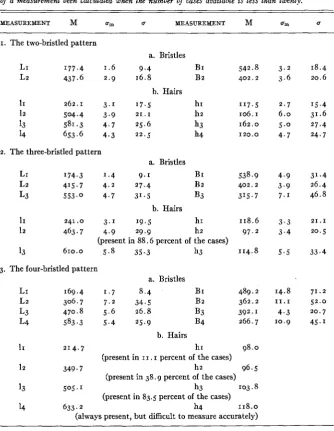
The mean positions and lengths of the dorsocentral bristles and hairs o j Pch Drosophilafunebris females, when two, three, or four of these bristles are present per side. I n no case have the U and U,,,
of a measurement been calculated when the number of cases available is less than twenty.
MEASUREMENT M "Ill U MEASUREMENT M Um U
I. The two-bristled pattern
a. Bristles
LI 177.4 1 . 6 9 . 4 BI 542.8 3.2 18.4 L2 437.6 2.9 16.8 B2 402.2 3 . 6 20.6
b. Hairs
11 262.1 3 . 1 17.5 hI 117.5 2 . 7 15.4
12 504.4 3 . 9 21.1 h2 106.1 6.0 31.6 13 581.3 4.7 25.6 h3 162.0 5 . 0 27.4 14 653.6 4 . 3 22.5 h4 1 2 0 . 0 4.7 24.7
2. The three-bristled pattern
a. Bristles
LI 174.3 1.4 9.1 BI 538.9 4.9 31.4
L2 415.7 4.2 27.4 B2 402.2 3 . 9 26.4 L3 553.0 4.7 31.5 B3 315.7 7 . 1 46.8
b. Hairs
11 241.0 3.1 19.5 hr 118.6 3 . 3 2 1 . 1
12 463.7 4.9 29.9 h2 97.2 3 . 4 2 0 . 5
13 610.0 5.8 35.3 h3 114.8 5.5 33.4
(present in 88.6 percent of the cases)
3. The four-bristled pattern
a. Bristles
LI 169.4 1 . 7 8 . 4 BI 489.2 14.8 71.2
L2 306.7 7.2 34.5 Bz 362.2 11.1 52.0
L4 583.3 5.4 25.9 B4 266.7 10.9 45.1
b. Hairs
L3 470.8 5.6 26.8 B3 392.1 4 . 3 2 0 . 7
214.7 hI 98.0
(present in I I
.
I percent of the cases)349.7 h2 96.5
(present in 38.9 percent of the cases)
505.1 h3 103.8
(present in 83.5 percent of the cases)
(always present, but dficult to measure accurately)
633.2 h4 118.0
BRISTLE PATTERNS I N DROSOPHILA 2 5 7 in the dorsocentral line or an extension of it. Dorsocentrals were not com- monly found anterior to the level of the transverse suture; those rare ones which did appear in this region were not included in the study. There was observed a continuous gradation from large hairs through small bristles to large bristles. Arbitrarily, setae are considered microchaetal if less than 200p in length, and macrochaetal if longer.
Of the 1 0 2 Pch female half-thoraces drawn, 34 showed only two dorso-
centrals. The mean locations and sizes of the bristles and hairs in these cases are given in table 2 and figure ga. Comparison of this figure with figure 2, the wild-type pattern, reveals a great similarity between the two. However, every distance and length in the Pch flies is greater than the corresponding measurement in the wild-type. In order to determine whether differences in mean fly size play a role in this difference between the patterns, wild-type and Pch flies were raised under identical conditions. The average weight of 90 Pch females with only two dorsocentrals on one or both sides (usually the latter) was 2.18 mg. The average weight of 85 wild-type females was 1.94 mg. It will be noted that the heavier of the two kinds of flies is the one in which the chaetae are further apart and longer. I n addition to the general size factor, there seems to be a t least one specific distinction between the two patterns. The hairs anterior to
Bz are not only absolutely but also relatively further apart than in the wild-type pattern, and one, the middle of the three, is longer. Otherwise, the patterns appear to be identical and will be treated as such inthe following.
I n a previous paper (NEEL 1940) it has been shown that in the case of a
Drosophila melanogaster mu tan t
,
polychae toid, which is morphologically very similar to Pch, there is a correlation between fly size and the number of dorsocentrals present per side. It seems probable that Pch behaves in a similar manner. This has a direct bearing upon the present studies. IfPch half-thoraces with two dorsocentrals are associated on the average with smaller flies than half-thoraces bearing three or four dorsocentrals, then too much emphasis cannot be placed upon a direct comparison of the measurements of these various patterns. While such comparison un- doubtedly reveals in a general manner similarities and differences between various measurements, it cannot take into account the greater size of flies with higher bristle numbers.
The results of a study of 44 half-thoraces bearing three dorsocentrals are found in table 2 and figure 3b. I n such cases BI corresponds in size and
position to the normal BI, and Bz is similar to the normal Bz. B3 is
found some 12op anterior to the wild-type
Bz,
near the normal locus of a large hair, and is in general shorter thanBz;
there is great variability in258 JAMES V. NEEL
in the wild-type pattern, while between Bz and B3 there is usually (88.6
percent of the cases) found a second small hair, about the size of that normally directly in front of the a dc. There is, of course, a row of hairs anterior to B3, of which only the first is shown. Where a hair is an in- constant feature of a pattern, it is represented in this and subsequent figures by a broken line.
Occasionally (ca. IO percent) a three-bristled condition has been ob-
served in which bristles are present in the a and p dc positions, with the third located between these two. So far the number of cases is insufficient for analysis. However, a similar condition has been observed in D . melano- gaster pyd and will be discussed below.
When four dorsocentrals are present per side (table 2 and figure 3c), B I
and B3 are in approximate correspondence with the normal positions and sizes of the p and a dc respectively. B4 is similar to B3 of the three-bristled cases, while B2 is about intermediate between the normal a and p dc positions. Both B4 and B2 are quite variable in size. The occurrence of hairs in the dorsocentral line differs among individuals; the frequency of appearance of one between
B I
and B2, B2 and B3, and B3 and B4 is given in table 2.Each of the bristles present in four-bristled flies has a characteristic size, resulting in a posterior-anterior size sequence of long-short-long-short. These mean differences between successive bristles along the dorsocentral line are fully significant, with the exception of that between B2 and B3,
which is only 2 . 5 times the standard error of the difference (29.9+ 1 1 . 9 ~ ) .
It is apparent from both this and the three-bristled data that a super- numerary macrochaeta anterior to the locus of the a dc is on the average much smaller than that latter structure, while one between the positions of the a and p dc tends to be smaller than either.
Table 2 shows that as the number of bristles present on the thorax
increases, the variability in the size of all those present rises. Thus, in all the patterns investigated B I has been similar in mean size and position to the p dc, but for this particular bristle the standard deviation has risen from 18.41.1 through 31.41.~ to 7 1 . 2 ~ .
The wild-type pattern in Drosophila melanogaster
I n table 3 and figure 4 the results of a study of 45 half-thoraces from wild-type (Flu) Drosophila melanogaster males are given. As would be expected from the size differences between the species, all dimensions of the delanogaster pattern are much less than the corresponding funebris
measurements. Otherwise, the chief distinctions between the species are found in the relative sizes of the hairs which precede the a dc.
BRISTLE PATTERNS IN DROSOPHILA 259
0.38410.127. I n agreement with the conclusions reached earlier, it seems probable that size variations from fly to fly are a major contributing factor
TABLE 3
The mean positions and lengths of the dursocentral bristles and hairs of wild-type Drosophila melanogarter males.
-
MEASUREMENT M UtlI U MEASUREMENT M U
a. Bristles
LI 1 2 3 . 4 1.4 9 . 2 B I 336.2 3 . 7 24.7
L2 250.1 2 . 5 17.0 B2 250.1 2 . 5 1 6 . 7 b. Hairs
11 1 7 2 . 5 2 . 2 14.9 hr 80.1 1 . 1 7 . 7
13 3 3 5 . 0 3 . 9 22.4 h3
14 3 7 3 . 1 4 . 0 2 3 . 2 h4 6 7 . 5
12 3 0 1 . 1 3.4 2 1 . 6 hz 82.1 2 . 0 12.7 80.5 2 . 1 1 2 . 5
2 . 2 13.2
in this correlation. Size variations in this stock must therefore be relatively greater than in the funebris wild-type stock. The correlation between the lengths of
BI
and B 2 is 0.739k0.067.FIGURE 4.-Distribution and size of the dorsocentral bristles and hairs in wild-type D. melanogarter males.
Polychaetoid in Drosophila melanogaster
The weakly dominant mutant polychaetoid ( p y d , 3-39+ 2) in homo- zygous condition is characterized by the presence of supernumary bristles at many different loci. The dorsocentral region is particularly apt to be affected. The number of bristles present here may vary from two to, rarely, six per half thorax. Usually the extra bristles fall along the dorso- central line, and cases where they deviate from the line have not been in- cluded in the study. In this mutant, as in Pch of funebris, hairs grade imperceptibly into bristles; the arbitrary lower limit for bristle size was set at 120p.
2 60 JAMES V. NEEL
have been looked over. Only the two-, the three-, and the four-bristled conditions have been studied. As pointed out earlier, there is a correlation between fly size and bristle number, and for this reason the two- and three- bristled conditions are on the average associated with a smaller half- thorax than the four-bristled. Comparison of the absolute measurements pertaining to the various patterns is only valid when the slight mean size differences between the groups of flies studied are kept in mind.
TABLE 4
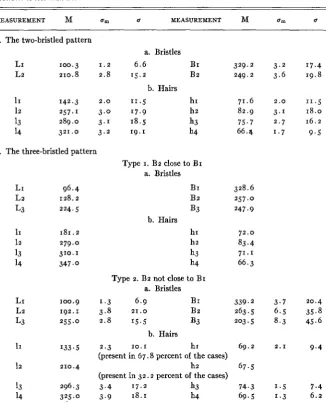
The mean positions and lengths of the dorsocentral bristles and hairs of pyd Drosophila melano- gaster males. In no case have the U and um of a measurement been calculated when the number of cases available is less than 20.
MEASUREMENT M Um U MEASUREMENT M 'Jm U
I. The two-bristled pattern
LI 100.3 1 . 2
L2 210.8 2.8
11 142.3 2 . 0
13 289.0 3 . 1 14 321.0 3.2 12 257.1 3 . 0
2. The three-bristled pattern
LI 96.4
Lz 128.2 L3 224.5
11 181.2
13 310.1 12 279.0
14 347.0
a. Bristles
6.6 BI
15.2 B2
b. Hairs
11.5 hr
17.9 h2
18.5 h3
19.1 h4
Type I. B2 close to BI
a. Bristles
BI B2 B3
hr h2 b. Hairs
h3 hq
Type 2. B2 not close to BI
a. Bristles
L I 100.9 1.3 6.9 BI
L2 192.1 3 . 8 2 1 . 0 B2
L3 255.0 2.8 15.5 J33
b. Hairs
11 133.5 2.3 10.1 hr
329.2 249.2 71.6 82.9 75.7 66.4 328.6 257.0 247.9
7 2 . 0
83.4 71.1 66.3 339.2 263.5 203.5 69.2 (present in 67.8 percent of the cases)
(present in 32.2 percent of the cases)
12 210.4 h2 67.5
13 296.3 3.4 1 7 . 2 h3 74.3
14 325.0 3.9 18.1 h4 69.5
3.2 17.4 3.6 19.8
2 . 0 11.5 3.1 18.0
2 . 7 16.2 1 . 7 9 . 5
2 . 1 9 . 4
BRISTLE PATTERNS I N DROSOPHILA
TABLE 4-Continwd
261
MEASUREmNT M O m U MEASUREMENT M Cm U
~ ~~~
3. The four-bristled pattern. Measurements for the predominant (81.5%) type a. Bristles
LI 105.0 1.5 8 . 3 BI 375.6 5 . 0 28.0
L2 151.9 3 . 2 17.8 B2 261.3 12.4 68.1
L3 228.8 3 . 4 19.0 B3 289.7 7 . 4 40.3 L4 286.6 3 . 1 1 7 . 1 B4 208.7 7 . 7 42.2
b. Hairs
(present in 43.7 percent of the cases)
(present in 21.9 percent of the cases)
11 189.7 hI 66.5
12 242.4 hz 64.5
13 338.6 3 . 4 18.2 h3 81.5 1 . 7 9 . 3
14 369.6 4 . 2 2 2 . 0 h4 73.4 1.5 7 . 7
Thirty-one of the half-thoraces drawn bore only the normal number of
dorsocentrals (table 4 and figure sa). The only difference between pyd half thoraces with two dorsocentrals and the wild-type dorsocentral pattern is that all dimensions are less in the former. I n agreement with this, micro- scopic inspection shows that p y d flies with two dorsocentrals on one or both sides are often appreciably smaller than the average wild-type fly studied.
A total of 184 half-thoraces with three dorsocentrals have been observed, and of these the 40 which showed no defects were drawn. All but three cases could be classified into one or the other of two alternative conditions. One group of flies (nine of the 40 drawn, 31.6 percent of the total 184
observed) is represented in table 4 and figure sb. Comparison with the wild type or two-bristled pyd data reveals that in these type I cases, B I
shows a good correspondence to the
p
dc location, while B3 approximates the a dc position. B2 is found between the usual p and a dc locations, and is very similar in position to a hair in the wild-type pattern. This hair is now missing, but a “new” hair is found between B2 and B3.The measurements of the remaining three-bristled cases (31 out of 40
drawn, 66.8 percent of the total 184 observed) are given in table 4 and figure sc. I n these type 2 cases B I is found in the normal p dc position, B2 is at or somewhat posterior to the usual a dc location, and B3 appears some distance anterior to where a bristle normally occurs. In 67.8 percent of these cases there is a hair in the normal h I position, between B I and
B2, but none between Bz and B3. I n the other 32.2 percent the hair be- tween B I and B2 is missing, but one is now found between B2 and B3,
262 JAMES V. NEEL
Although in both of these three-bristled patterns the size of BI remains rather constant, that of the other two bristles fluctuates widely. On the average, when a macrochaeta comes between the usual positions of the p and a dc, it is not very different in size from the latter, while if it appears anterior to the position of the a dc it is considerably smaller.
A total of 119 half-thoraces with four dorsocentrals have been studied, of which 37 were suitable for drawing. Four different arrangements of the bristles were found: I) I n 81.5 percent (97 cases, 32 drawn) the pattern
400 300 LENGTH OF CHAETA 200 100 LENGTH
CHAETA M O
I O 0
MSTANt
L
201
FROM S
a.
llL
300lELLAR GROOVE
b. 400 300 LENGTH OF CHAETA 200
1 0 0
0 1
OISTANCI
CHAETA LENGTH OF
:[
100 0 1 OISTANC I * F I U
-
?OM
LL
ZUTELLAR 300 GROOVE
C.
900 300
IOU SCUTELLAR GROOYL
d.
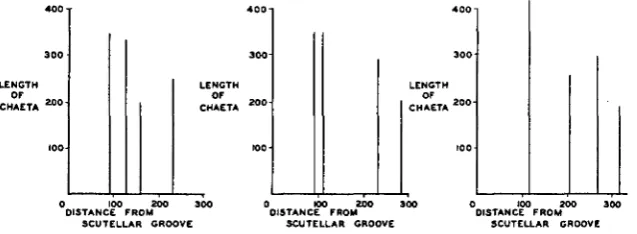
FIGURE S.-The pattem of bristles and hairs along the dorsocentral line in D. melanogaster pyd /pyd males, when two, three, or four dorsocentrals are present per side. A hair which is an incon- stant feature of a pattem is indicated by a dotted line.
BRISTLE PATTERNS I N DROSOPHILA 263
tion, B3 was toward the posterior limit of its distribution. 2) I n 10.9
percent (13 cases) the following was observed: bristles were present in approximately the normal a and p dc positions; a third bristle was present near where in the wild type h I is found; the fourth was situated between the normal positions of h I and the a dc (figure 6a). 3 ) A third pattern, seen in five cases, was characterized by bristles a t the a and p dc locations, the appearance of a bristle anterior to the a dc position, and the appearance of a bristle very close to the p dc locus. I n these cases the basal rings of
B I and B2 were often in contact (figure 6b). 4) I n a fourth pattern (four cases) B I was in the p dc position; B2 appeared somewhat posterior to the a dc location; B3, anterior to this locus; and B4 about 20011 from the p dc
position (figure 6c). The three patterns shown in figure 6 are semi- diagrammatic.
400
300
LENGTH OF CHAETA
100
0
OISTAN
400
300
LENGTH OF CHAETA
100
-
7
0 I00
OlsTANCE
SCUTELLAR GROOVE SCUTELL
200 300
4 0 0 1 300
LENGTH
CHAETA
r
0
FROM DISTAN,
.AR GROOVE scu
FIGURE 6.-Three additional patterns of the dorsocentrals when four are present per side in
pydlpyd D. melanogarter males. These together constitute 18.5 percent of all the four-bristled cases. Details in text.
I n all of these four-bristled patterns it was found that bristles in the p or a dc locations tend to be larger than those located between these points, or anterior to the a dc location. Thus, the length differences be- tween the bristles shown in figure gd are all significant except that between
B2 and B3, which is equal to two times the standard error of the difference
(28.4+ 1 4 . 4 ~ ) . I n this respect the pattern is very like the four-bristled
Pchfunebris arrangement, and serves to indicate that the size of a bristle is related to its location in the dorsocentral line.
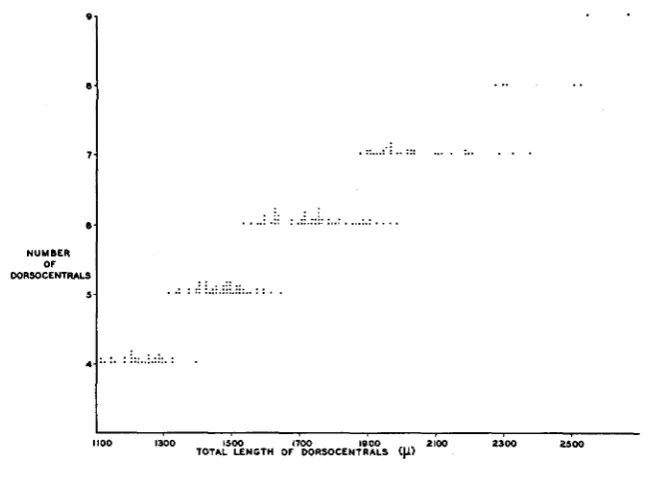
I n order to determine the relation between the number of dorsocentrals present on both sides of the fly and their total length, p y d male flies showing a wide range in bristle numbers were obtained by collecting from the same set of stock bottles over a 21 day period. Figure 7 shows that
264 JAMES V. NEEL
be due in part to errors in the evaluation of total bristle length. If the com- bined length of the dorsocentrals is an index of the amount of some hypothetical “bristle-forming” substance present, then it seems that in
..
.
.
...
..
. . .
...
. . .
. . . ...
. . .
. . .
. . . ...
NUMBER
OF
DORSOCENTRALS . . . . ...
... ...
5-
FIGURE 7.-The relation between the total number of dorsocentrals present in pyd/pyd males and their combined length. Each point on the figure represents a single fly.
this mutant new bristles are called forth a t regular intervals as the amount of bristle-forming substance increases.
Hairy wing in Drosophila melanogaster
Flies which are either homozygous or heterozygous for the dominant mutant Hairy wing ( H w , 1-0.0) possess extra hairs and bristles on the body and wing surfaces. DEMEREC and HOOVER (1939) have shown the
Hw
factor to be a short duplication for the salivary chromosome bandI B 1.2. The expression of the factor was studied in y H w dl-49 Theta/
BRISTLE PATTERNS I N DROSOPHILA 265
bristle within the dorsocentral area could be expressed by two measured distances, namely, the distance from the scutellar groove and the distance from the midline. A sample case is shown in figure 8a.
I n a wild-type Drosophila, and in Pch and p y d , there is a quadrilateral area between the dorsocentrals, on one hand, and the a sa, the p sa, and the a pa, on the other, in which macrochaetae are not present (see figure
I). I n these
Hw
flies, bristles occur at almost any point in this region. Since the investigation concerns dorsocentrals and bristles which clearly arise in closer proximity to these than to any others, it becomes necessary to delimit a “dorsocentral area.” This has been defined as shown in figure 8b. It is bounded medially by the midline; posteriorly, by a line parallel to the scutellar groove and 55p anterior to this landmark; anteriorly, byFIGURE 8a (left).-The dorsocentral bristles in a typical y Hw dl-49 Thetaly sa3 bb female. The lines drawn on the camera lucida drawing of the thorax in order to determine the position of each brisqe are shown; the most lateral bristle on either side is slightly outside the “dorsocentral area.” FIGURE 8b (right).-The “dorsocentral area” in D. mlunogusler. The heavy line indicates the limits of this area, while the dotted lines show the levels into which the area was divided. Dimen- sions involved given in the text.
a second line parallel to the groove, 380p in front of it; while the lateral boundary parallels the midline at a distance of 195p from it except in the posterior 35p of the area, where the lateral boundary is 15op fromthe midline. The notch thus formed in the posterior-lateral corner of the area excludes from consideration bristles close to the p pa.
Figure 9 shows an anterior-medial view of a model of the area.The position and height of each bristle observed in this region on the 46
Hw
half-thoraces studied is indicated in the figure by an insect pin. The standard of macrochaetae length used here was I O O ~ rather than the I 20p
of p y d because of the smaller size of these
Hw
flies. From the model, anumber of facts are evident. I) There are two locations where there is a
high frequency of occurrence of bristles. These are marked in the figure by arrows. These spots correspond to the positions of the normal p and a
266 JAMES V. NEEL
tween the a and p dc locations, and medial to the p dc position, bristles also occur frequently and tend to be small. A few scattered macrochaetae, also small, were seen anterior to the a dc locus. 3) Bristles are more fre- quently found close to the midline in the posterior portion of the area than in the anterior.
The dorsocentral area was divided into four levels by lines drawn parallel to the scutellar groove at points 125, 195, and 2 6 9 anterior to it (see figure 8b). I n a wild-type fly, the p dc would be found in the first subdivision and the a dc in the third. For each level, the length of every bristle present was correlated with its distance from the midline. I n each of the three posterior levels, a significant coefficient of correlation (r) was found. I n level I , r equals 0.836f0.037; in level 2, 0.451+0.123, and in
POSTERIOR
, .
,“d.
M I D L I N E .‘ ANTERIOR
FIGURE 9.-The distribution and size of the bristles observed in the “dorsocentral area” of y Hw dl-49 Theta/ y sn* bb females.
level 3, 0.711f0.076. The number of bristles present in the fourth level is too small for a calculation of r. Nevertheless, i t seems clear that through- out the dorsocentral area bristle length tends to be an inverse function of nearness to the midline.
If one subdivides each level into a more median ( 0 - I W ~ ) and a more
lateral (IOC-I~~~) zone one finds that each of the four latter is character- ized by a significantly different mean bristle length as follows (proceeding anteriorly): 276.7+3.9p, 1 7 9 . 5 k 6 . 3 ~ ~ 2 2 0 . 7 f 5 . 3 ~ ~ and 2 0 2 . 8 ~ . I n the last
BRISTLE PATTERNS I N DROSOPHILA 267
Those found here have a mean size similar to that of the bristles in the lateral zone of level 2.
T h e scutellar bristle pattern in pyd Drosophila melanogaster
The question of whether extra bristles in another area of the thorax are subject to the well-defined position and size tendencies shown by those in the dorsocentral region was next investigated. The scutellum in
pyd males was studied, since it is available for an accurate analysis and is often marked by extra bristles,
I n pyd flies there may be none, one, or two extra scutellars per side. When there are no supernumerary bristles the pattern is in no respect different from the wild type (figure Ioa, based on 21 cases). If only one extra macrochaeta is present, it is characteristically found close to either the a sc or p sc position, and only occasionally intermediate to the two loci.
-405ot3s
\
a. b. C.
FIGURE Io.-The pattern of the scutellar bristles in pyd/pyd males which have either two or three of these per side per fly.
Accordingly, on the basis of the position of the extra bristle-whether it is close to the a sc or p sc location-two types of pyd flies with one extra scutellar can be distinguished. When the supernumerary macrochaeta is close to the a sc locus, the average relationship of the three bristles now present is indicated in figure Iob ( 2 8 cases). As regards position, neither
of the two anterior bristles corresponds to the a sc, since one occurs some
20p anterior to the normal location and the other an equal distance pos-
terior. With respect to size, the posterior of the two is very like the normal a sc, while the more anterior is characteristically smaller. This is a regular difference, comparable to the size-place relationships seen in the dorso- central region. The third bristle resembles the p sc. Figure IOC shows the
268 JAMES V. NEEL
to the p sc; while the middle, although similar in size to the p sc, is some
40p anterior to the wild-type position of this macrochaeta. These two extra- bristled positions are not the average of wide deviations about a mean, but are rather constantly adhered to in any given case. Only a few flies with four scutellar bristles on one side have been found; in these instances one extra bristle was in the a sc region and the other anterior to the p sc location.
T h e innervation of supernumerary bristles
STERN
(1938), using the methylene blue technique of intravitam stain- ing, found that each hair and bristle of Drosophila is innervated by a sepa- rate bipolar cell situated below the hypodermis. From each nerve cell one short fiber is sent to the base of the seta, while the second long fiber joins with similar long fibers from other cells into nerves which lead to the central nervous system. A cell innervating a bristle is larger than one in- nervating a hair. It was noted that the nerve cell supplying the a dc sends its axon directly anteriorly to join a rather small nerve trunk, while the axon of that innervating the p dc runs posteriorly and laterally to join a large trunk.I n order to determine what the relation is between bristle and nerve patterns, the source of innervation of the supernumerary dorsocentrals of
pyd flies was studied by means of the methylene blue technique. It was found that with very few exceptions, nerve cells supplying bristles a t the p dc position or between the normal a and p dc positions send their axons to join the large posterior trunk to which the nerve cell of the p dc normally contributes. The axons of nerve cells connect- ing with bristles a t or anterior to the a dc position joined the same trunk with which the nerve cell of the a dc normally establishes connec- tions. This is true regardless of the exact pattern of the bristles, that is, in type 2 three-bristled pyd (figure gc), when B2 was found as far forward
as the normal a dc, it was innervated from the front, but otherwise, from the rear. A specific bristle pattern is not correlated with a particular type of bristle innervation.
T h e development of the bristles
BRISTLE PATTERNS I N DROSOPHILA 269 grow a t rates which differ from region to region of the thorax, or 2) those
bristles which are to be the largest may begin to differentiate first and retain their initial advantage throughout development. According to this latter hypothesis, the size differences between hairs and bristles might be due to a later onset of development in the former.
ROBERTSON (1936), working on Drosophila melanogaster, reported that “the mechanism of formation of hairs and bristles appears to be identical, both being formed a t the same time” (p. 365). According to this author, a t 25’C the trichogenic cells which enter into the formation of bristles may first be seen about the twenty-seventh hour of pupal life; the bristles ap- pear shortly after the thirtieth hour as colorless extensions of the trichogen. The abdominal bristles appear a little later than those on the anterior part of the body.
MR. HARRISON STALKER of this laboratory has kindly placed a t my disposal a series of slides of early wild-type Drosophila pupae. ROBERT-
SON’S observations with respect to the time of appearance of the macro-
chaetae were confirmed. The bristle-forming trichogens could be located a t an earlier hour than the hair-forming, but the smaller size of the latter militates against their being seen. Likewise, although the initial outgrowth of both hair and bristle-forming cells is colorless, the smaller size of the former makes it much more difficult to identify. For this reason it has not been possible to determine with certainty whether hairs and bristles appear simultaneously; there may be a slight difference, with bristles appearing first. No difference in the order of appearance of the various thoracic bristles has been established, although inequalities in adult bristle length are foreshadowed a t an early stage in pupal development. If the hairs and bristles do not appear simultaneously, then the time interval between the formation of each must be small.
T h e eflect of these mutants upon the bristle pattern as a whole
PLUNKETT (1926) in an extended analysis of the Dichaete mutant showed that the bristle-removing effect of this factor was strongest in the vicinity of the ps bristle. As distance over the thorax from this locus in- creased, the effect of the gene tended to decrease, although in a somewhat irregular manner. It was further found that three other bristle-removing genes showed a region or regions of maximum effect. ROKIZKY (1930) reports similar findings.
270 JAMES V. NEEL
mutant is extremely localized in its action in the stock employed. Extra bristles, common in the dorsocentral region, have been observed at only one other locus, the humeral, and there but seldom. However, N. W. and
H.
A. TIMOFEEFF-RESSOVSKY (1934) and N. W. TIMOFEEFF-RESSOVSKY(1935) have shown that the mutant under suitable conditions may remove bristles, and have found that in one of their stocks the greatest bristle- adding effect of the gene is on the anterior dorsum of the thorax whereas in another it is on the posterior portion of this region.
The pyd factor is quite general in its effects. In figure 11 the average
number of bristles present a t or near each of 2 0 loci, on IOO half-thoraces,
has been indicated. At only four of these loci have extra bristles never been found. The maximum effect of the gene is on the dorsocentrals, with
FIGURE Ir.-The frequency of occurrence of bristles in
pydlpyd males at or near each of twenty loci.
scutellar, presutural, and humeral bristles also frequently affected. (Inas- much as it was often found impractical to distinguish a supernumerary macrochaeta as U h or 1 h, these two loci have been treated as one.)
I n an attempt to explain this characteristic ‘field effect’ in the case of Dichaete, PLUNKETT (1926) has postulated that during early embryonic development a percursor of a catalyst of a bristle-destroying reaction dif- fuses out from two bilaterally symmetrical centers in the egg. These cen- ters correspond to the region of greatest effect of Dichaete in the adult. I n explanation of the pattern of missing bristles seen in scute flies, STURTE-
VANT and SCHULTZ (193 I) and GOLDSCHMIDT (I 93 I ) have likewise ad-
BRISTLE PATTERNS I N DROSOPHILA 271 major features autonomous a t the site of each bristle” (p. 250). CHILD
(1935) found in scute flies a complete absence of association between the bristles of the same side, as measured by the association coefficient. He therefore concluded that the concept of a pattern in scute was based upon nothing more than a difference in mean numbers, in a group of flies, of dif- ferent bristles, and did not correspond to any coordinating developmental process in the individual fly (such as a diffusion phenomenon). IVES (1939) has reported similar findings. However, in Dichaete flies high association coefficients between adjacent bristles were reported (PLUNKETT 1926).
The 15 possible association coefficients between the six bristle loci (humeral, ps, a dc, p dc, p pa, and a sc) most frequently affected in p y d male flies have been calculated. The U h and 1 h have been treated as one
in the calculation of the coefficients. For none of the 1 5 possible combina- tions of these loci was there found a significant association coefficient. As in CHILD’S studies, so here it may be concluded that each bristle locus behaves independently of the others.
TABLE 5
Right-left correlation coejicients for all combinations of the humerals, ps, a dc, p dc, p pa, and a sc in pyd male Jies. The IOO Jies used in the derivation of these correlations were raised under slightly adverse culturol conditions.
LEFT SIDE
humerals ps a dc P dc P Pa a sc
humerals O . 0.061 0.001 -0.042 0.126 -0.173
kO.088 k0.099 kO.100 kO.100 k0.098 kO.097
-0.100 0.156 0.065 -0.040 -0.038 0.155 &0.099 k0.098 k0.099 kO.100 kO.100 k ,0098
PS
RIGHT 0.039 0.093 0 . 1 7 3 0.124 0.142 0.096
a dc
SIDE kO.100 k0.099 k0.097 kO.098 kO.098 kO.099
0.020 -0.104 0.064 0.376 - 0 . 1 1 1 0.013
p d c kO.100 k0.099 k0.099 k0.086 kO.099 kO.100
-0.038 0.187 0.110 0.168 0.058 0.024 fo.100 k0.096 ko.099 k0.098 ko.099 ko.100
-0.202 0.034 0.013 0.002 0.035 0.289 a sc
fo.096 ko.100 ko.100 fo.100 ko.100 k0.092
Nevertheless, there are indications that in p y d flies the appearance of
2 7 2 JAMES V. NEEL
ment to overcrowding. Six bristle loci were studied: humeral, ps, a dc, p dc, p pa, and a sc. For every locus, the coefficient of correlation for the presence of extra bristles a t it and a t each of the six loci on the opposite side was calculated. Thus, a total of 36 coefficients was derived (table 5). I n three instances significant left-right correlations were found. I n each of the three cases, the correlation was between homologous bristles on the two sides, rather than between non-homologues. The implications of this are clear. The two half-thoraces which together constitute the right and left halves of a single fly have developed under as nearly identical conditions as can be obtained. The environmental conditions which tend to produce an extra bristle a t one locus tend also to produce an extra bristle a t the corresponding locus on the other side.
DISCUSSION
The data presented in the last section show that in pyd flies the macro- chaetae found a t or near a given bristle locus vary independently of those found a t nearby loci. A similar independence of the bristle loci has been noted in Pch and Hw. This finding justifies a study of a few bristles or groups of bristles as a means of getting a t the manner of action of these mutants.
T h e position of the bristles
I n a consideration of the positions of the bristles composing the various patterns seen for each mutant; two possibilities a t once present themselves. I) The various patterns of, for example, pyd flies may be related to one another in the sense that a given bristle or hair of one pattern corresponds to (is homologous with) a bristle or hair of another pattern. 2 ) It is also
possible that the different patterns are in no wise related to one another, but that each represents a totally different expression of the activity of the gene.
I n every mutant pattern studied, there is a bristle which shows an ex- cellent correspondence to the p dc. For instance, B I of the three- and four-
bristled pyd patterns closely resembles B I of two-bristled pyd (figure
s),
and this latter, we have seen, corresponds to the normal p dc (figure 4).The same similarity of B I to the p dc is true of all Pch patterns (figure 3).
BRISTLE PATTERNS IN DROSOPHILA 2 7 3
470.8f 5 . 6 ~ . These significantly different positions cannot be explained in
terms of mean size differences; if this were the case B2 of the three- bristled pattern should be intermediate to the other two in its distance from the scutellar groove. Therefore, if these three bristles are homologous, some factor in development other than size has brought about significant shifts from pattern to pattern in the mean positions of the chaetae-forming cells involved.
Another example of an approximate correspondence of a bristle of a
mutant pattern to the normal a dc is provided by B2 of the type 2 three-
bristled p y d condition (figure gc). This bristle differs from the normal a dc chiefly in that its mean location is 1 8 . 4 f 4 . 7 ~ posterior to the normal posi- tion. In individual cases the location of the bristle is rather variable. On the assumption, in some instances, of a posterior shift in the chaeta- forming cell involved, it could be identified with B2 of the normal pattern. Such an assumption, although appealing, has a t present no supporting evidence.
Comparisons of several of the mutant patterns with wild type reveals a striking coincidence between the position of a hair in the wild type and the position of a bristle in a mutant pattern. Thus, B3 of the three-bristled Pch pattern (figure 3b) shows a correspondence to the large hair normally found anterior to B2 of wild type and two-bristled Pch flies (figures 2 and 3"). As another example, B2 of the type I three-bristled pyd dorsocentral
pattern (figure 5b) resembles in position h I of the wild-type pattern, and when this bristle is present, hr is missing. B2 of the predominant four- bristled pattern (figure 5d) also is located where hI normally is found. The agreement in position is so striking that it seems to call for some kind of causal interrelationship; it seems quite probable that the anlage which would normally form a hair may on occasion hypertrophy and form a
bristle.
There are, on the other hand, instances of bristle occurrence where there is no correspondence to a hair or bristle of the normal pattern. Thus B2 of four-bristled Pch (figure 3c) does not closely resemble any feature of the normal pattern.
H. A. and N. W. TIMOFEEPF-RESSOVSKY (1934) in their study of Pch found that the first extra dorsocentrals to appear usually came between the
a and p dc positions. When many extra bristles were present on the an- terior dorsum of the thorax, no bristle was found in the p dc locus. They suggest, without making a detailed study, that Pch may cause hyper-. trophy of hair anlagen.
Since in levels I and 3 of the dorsocentral area of
Hw
flies there are found274 JAMES V. NEEL
substitute an entirely new pattern. It is noteworthy that in this mutant the relations of an extra bristle in the dorsocentral region to the surround- ing hairs are similar to the relations of a hair occurring in the same region to the other hairs. The data do not permit a decision as to whether hair anlagen hypertrophy into bristles, or whether bristles may occur at any point on the thorax in complete independence of the hair pattern. The latter alternative would require that with the determination of the occur- rence of a bristle a t any one point there follows a rearrangement of the hair anlagen about that place, so that the distances between hair and bristle are still of the order characteristic of those between two hairs.
I n the final analysis, any decision between the two possible explanations of the positions of the bristles suggested above is not feasible with the present data. That the various patterns observed are derived from normal is suggested by the fact that there is always present a bristle closely cor- responding to the p dc, and also one approximating the a dc. Moreover, the repeated coincidence in the position of a hair in the wild-type pattern and a bristle in a mutant pattern suggests that a hypertrophy of a micro- chaetal anlagen into a macrochaeta is one and perhaps the usual mode of action of these mutants, although hair anlagen hypertrophy clearly cannot explain all occurrences of extra bristles.
The size of the bristles
We have seen that in these mutant patterns the largest bristles occur- ring in the dorsocentral area are usually found in or close to the a and p dc locations. The only pattern where this localization is not apparent is type
I three-bristled $yd. If the size of the bristles present in the various re-
gions of the dorsocentral area be regarded as an adequate expression of “bristle-forming potencies,” then a regular gradient in these potencies is indicated. However, from the standard deviation values given in the tables, it is clear that the individual bristles of a region vary considerably about the mean; the manifestation of the gradient is variable from fly The fact that there is a gradient on the thorax in bristle-forming ability, which is only revealed when supernumerary bristles appear, presents an interesting analogy to a case described by D’ARCY THOMPSON (1917) and
BRISTLE PATTERNS I N DROSOPHILA 2 7 5 the growth-gradient is continuous along the head, but can only reveal itself in species where a second specific horn-area is present” (HUXLEY
1932, P- 152).
T h e nature of the bristle pattern
From the present data some very tentative inferences may be drawn as to the nature of the normal and mutant bristle patterns studied. The unit of the pattern is the individual bristle. This is shown by the manner in which the loci vary independently of one another. I n the dorsocentral region each of the bristles present in wild-type flies arises in the center of a field of bristle-forming potencies. Whether this is true of all other loci is not clear; certainly there is evidence for localization of bristle-forming abilities in the scutellum. Since there are wide variations in the size of the bristles appearing a t any one spot on the thorax, the gradient cannot be regarded as extremely rigid in its specifications. This field would seem from the embryological evidence to be primarily due to some spatial difference in the distribution of bristle-forming materials, rather than to a temporal difference in the time of appearance of various chaetae. It is not bound up with the manner of innervation of the bristles.
The mechanism which normally brings about the appearance of a bristle in the center of the field and only there is unknown. It is obvious, however, that in certain mutant conditions this mechanism is disrupted, and bristles may appear a t almost any point in the field. These extra bristles may be the result of hypertrophy of microchaetae-forming cells, or may be struc- tures not foreshadowed in the normal pattern. I n some instances where it seems that a bristle of a mutant pattern corresponds to a macrochaeta of the normal pattern, a t the same time it is probable that the position of the bristle has been somewhat shifted from the normal.
ACKNOWLEDGMENTS
I am greatly indebted to DR. CURT STERN for aid throughout the course of this work, and to DR. D. R. CHARLES for many suggestions during the preparation of the manuscript.
SUMMARY
I . Five genotypes have been studied with respect to the size and posi-
tion of the bristles: wild type and P c h of Drosophila funebris; and wild type, p y d , and y
Hw
dl-49 Thetaly sn3 bb ofD.
melanogaster. Each of the mutant conditions is characterized by the presence of extra bristles.2 . For each mutant genotype a number of clearly defined and alterna-
2 7 6 JAMES V. NEEL
3 . When supernumerary macrochaetae are found in the dorsocentral region, two of the three or more bristles now present tend to correspond in size and position to the wild-type p and a dc. Frequently the position of an extra bristle coincides with that of a hair in the wild-type pattern. It is suggested that the factors for supernumerary bristles may act through the medium of hair anlagen hypertrophy. However, this is clearly not the only way these mutants work, for extra bristles regularly occur in nor- mally hairless areas.
4. I n the presence of more than the normal number of dorsocentrals, the largest characteristically are found in or close to the normal a and p dc positions. As distance from these points increases in any direction, there is a tendency for bristle size to decrease.
5 . Supernumerary bristles on the scutellum of pyd flies are found close
to the normal a and p sc positions; there is a relation between the size and the position of a bristle.
6. There is no association of a particular bristle pattern withaparticular manner of innervation of the bristles.
7. Either all the macro- and microchaetae begin to differentiate simul- taneously during early pupal life, or such differences in the order of ap- pearance as do exist are small.
8. The absence of significant association coefficients between the chief bristles affected by the pyd factor shows that these vary independently. The existence of significant left-right correlations between homologous bristle loci on the two sides, while non-homologues show no such relation, suggests that the bristle pattern on one side of the fly is the result of a
definite developmental condition frequently duplicated on the opposite side.
LITERATURE CITED
CHILD, G. P., 1935 Phenogenetic studies on scute-1 of Drosophila melanogaster. I. The associations between the bristles and the effects of genetic modi6ers and temperature. Genetics 20: 109- 126.
DEMEREC, M., and HOOVER, M. E., 1939 Hairy wing-a duplication in Drosophila melanogaster.
Genetics 24 : z 7 1-2 7 7.
DUBININ, N. P., 1929 Allelomorphentreppen bei Drosophila melanogaster. Biol. Zbl. 49: 328-339.
GOLDSCHMIDT, R., 1931 Die entwicklungsphysiologische Erklarung des Falls der sogenannten
HUXLEY, J. S., 1932 Problems of relative growth. xix+z76 pp. New York: The Dial Press. IVES, P. T., 1939 The effects of high temperature on bristle frequencies in scute and wild-type
MACDOWELL, E. C., 1915 Bristle inheritance in Drosophila. Extra bristles. J. Exp. Zool. 19: 61-
MULLER, H. J., 1932 Further studies on the nature and causes of gene mutations. Proc. Sixth Int.
NEEL, JAMES, 1939 Studies on the pattern of supernumerary macrochaetae in Drosophila. Genet- Treppenallelomorphe des Gens scute von Drosophila. Biol. Zbl. 51 : 507-526.
males of Drosophila melanogaster. Genetics 24 : 315-331.
98.
Cong. Genetics I: 213-255.
BRISTLE PATTERNS I N DROSOPHILA 277
1940 The interrelations of temperature, body size, and character expression in Drosophila melanogaster. Genetics 25: 225-250.
PLUNKETT, C. R., 1926 The interaction of genetic and environmental factors in development. J. Exp. Zool. 46: 181-244.
ROBERTSON, C. W., 1936 The metamorphosis of Drosophila melanogaster, including an accurately timed account of the principal morphological changes. J. Morph. 59: 351-399.
ROKIZKY, P. TH., 1930 Uber die differentielle Wirkung des Gens auf verschiedene Korperge- genden. Z. i. A. V. 57: 37-91.
STERN, CURT, 1938 The innervation of setae in Drosophila. Genetics 23 : I 72-1 73.
STURTEVANT, A. H., 1921 The North American species of Drosophila. Publ. Carneg. Instn. 301. STURTEVANT, A. H., and SCHULTZ, JACK, 1931 The inadequacy of the sub-gene hypothesis of the
nature of the scute allelomorphs of Drosophila. Proc. Nat. Acad. Sci., Wash. 17: 265-270. THOMPSON, D’ARCY W., 1917 On growth and form. xv+793 pp. Cambridge: University Press. TIMOFEEFF-RESSOVSKY, N. W., 1935 Uber “miitterliche Vererbung” bei Drosophila. Naturwiss.
23: 494-496.
TIMOFEEFF-RESSOVSKY, N. W., and TIMOFEEFF-RESSOVSKY, H. A., 1934 Polare Schwankungen in der phanotypischen Manifestierung einiger Genmutationen bei Drosophila. Z. i. A. V. 67: