ISSN(Online): 2319-8753 ISSN (Print): 2347-6710
International Journal of Innovative Research in Science,
Engineering and Technology
(A High Impact Factor & UGC Approved Journal) Website: www.ijirset.com
Vol. 6, Issue 8, August 2017
A Novel Design Approach for Smart Door
Locking and Home Security using IoT
Anshika Agarwal1, Nancy Hada1, Deepali Virmani2, Tarun Gupta3
U.G. Student, Department of Computer Science, Bhagwan Parshuram Institute of Technology, Delhi, India1 H.O.D (CSE), Department of Computer Science, Bhagwan Parshuram Institute of Technology, Delhi, India 2 U.G. Student, Department of Information Technology, Bhagwan Parshuram Institute of Technology, Delhi, India3
ABSTRACT: In today's world, home security is a key concern. Keeping in mind the high level of security a home security device must provide a security system is proposed in this paper. The proposed system lets the user control his door lock either via Bluetooth or a message over the internet. The proposed security functions allow the user to keep a track of who visited his home and when along with controlling the cases of possible intrusion. Since Internet of Things has been the dominant technology in the field of security products, considering its usefulness, we have designed the system based on this technology. It lowers the human effort and provides security to people from unwanted intrusions or break-ins through the door locks. The camera in the proposed system helps to upload the clicked photos on the cloud for either mailing them or messaging as per the situation. This system has been designed overcoming the disadvantages of existing systems and providing the security over the internet. It is a low-cost system which works on motion detectors and the ringing of the bell to categorize the person as an intruder or visitor. Thus, once implemented, the system will prove to be much useful and more efficient compared to existing cost ineffective systems.
KEYWORDS: Home Security, Internet of Things (IoT), Passive Infrared Sensor (PIR), Raspberry Pi 3, Smart Door Locking.
I. INTRODUCTION
Security concerns are increasing every day, in every field of living, be it vehicles, homes or the family members. Focusing on the home security, this paper proposes a system, called as HSDL System i.e. Smart Door Locking and Home Security System which can provide freedom from the concern of being robbed. This system is based on the technology of Internet of Things i.e. IoT, due to its wide use in the development of new products. The proposed system provides two major functionalities: Home Security and Smart Locking.
Home Security
The main focus of this system is providing home security by smartly analysing the person outside the door. The proposed system smartly detects that whether the person outside the door is the owner, visitor or a case of possible intrusion. If it detects the person as the member of the house, it unlocks the door without much intervention of the user. If a visitor is detected, the system immediately clicks the visitor's photo and e-mails it to the user for maintaining records of whoever visited the owner’s home. This provides a way to access a record of visitors in case of any future issue. In addition to this, if it detects a case of possible intrusion, it clicks the photo of the intruder, emails it and sends and offline message over the internet to the owner. Besides this, it raises an alarm to alert the neighbours. This helps to take an immediate action in case of any crime like an attempt to break-in.
Smart Locking
ISSN(Online): 2319-8753 ISSN (Print): 2347-6710
International Journal of Innovative Research in Science,
Engineering and Technology
(A High Impact Factor & UGC Approved Journal) Website: www.ijirset.com
Vol. 6, Issue 8, August 2017
control the lock from a remote location. They can command the system to lock or unlock the door using their mobile phones. In case the Wi-Fi fails, the user can also unlock and lock via Bluetooth.
Raspberry Pi 3 [3] is responsible for controlling all the hardware like camera, motion sensor [2], and electromagnetic lock. It senses the input signals from the bell, the motion sensor, commands from owner and acts accordingly.
Paper is organized as follows. Section II describes the need for smart door locking and home security system by stating the limitations in the existing proposed works and stating the features of the proposed work in this paper. The various features of real time systems are compared with the proposed system in Section III. The flow diagram in Section IV represents the step of the algorithm and its algorithm is given in Section V. Section VI presents with the various results obtained while Section VII discusses and concludes the paper.
II. RELATED WORK
1. Automated Door Control System using Android Phone and GSM Modem [4]- In this system, android smart phones along with GSM Modem are used for the automation of opening and closing of door.
Its main limitation is that it can only be used on Android based smart phones and not on the phones having other operating system like Windows, Mac etc. And, if the phone gets stolen, the system completely fails to provide security.
2. Automatic Door Locking System [5]- In this system, door can be unlocked by entering registered password. The user needs to enter two passwords, one for Bluetooth handshake and second for unlocking the door. It also has the feature to change or reset the password in case, the owner forgets it. It is cost effective but the functionality of changing and resetting password is a big threat to security. It can be misused by the intruder to break through the security.
3. Finger Print based Door Locking System [6]- In this system, finger prints of authorized users are stored. Sensor, senses them and validates for authentication. Mismatch of finger prints activates the buzzer which is connected to an audio amplifier. This alerts the neighbours about the threat.
But the sensor is not capable of differentiating between the real and artificial finger. Thus, intruder can easily fool the system by using gelatine print mould of real finger. And for every guest, the owner needs to ensure that his finger prints are already stored to avoid any inconvenience.
4. Optimized Door Locking and Unlocking using IoT for Physically Challenged People [7]- The motivation behind this work was to send signals to the door via electronic device like mobile phone or Tablet within a Wi-Fi range available, in order to save time and energy. Android app is used for its implementation. It is really a boon for Physically Challenged people but it doesn’t take security into consideration. Its use is restricted to Android OS only.
5. An Intelligent Door System using Raspberry Pi and Amazon Web Services IoT [8]- The user is notified about the intrusion by email. Raspberry pi reads intrusion data and communicate with Amazon Web Services IoT console, as soon as any change in motion of the door is being detected by ADXL345 accelerometer. Then, email notification is sent by AWS Simple Notification Service as per the console message. All logs of intrusion are stored in google spreadsheet.
Its main limitation is, that it can only keep records of date and arrival time of the visitors. It cannot capture their image to let owner know the identity of intruder.
ISSN(Online): 2319-8753 ISSN (Print): 2347-6710
International Journal of Innovative Research in Science,
Engineering and Technology
(A High Impact Factor & UGC Approved Journal) Website: www.ijirset.com
Vol. 6, Issue 8, August 2017
III.NEED FOR SMART DOOR LOCKING AND HOME SECURITY SYSTEM
A lot a work has already been done in [4, 5, 6, 7, 8, 9, 10]. These systems have certain limitations such as: 1. In [4,7,10], the system is restricted to the Android platform.
2. The system in [4] does the communication between users and appliances using a GSM modem and SIM card. Due to lack of authentication with SIM cards, the security of the system is compromised.
3. In [6], the use of a fingerprint is a major drawback. Although it has its advantages, but it fails when the fingerprints are dirty or rough or have some injury on them.
Thus, this paper presents a new system to meet today’s requirements. It will have the following features: 1. It makes the locking and unlocking of doors easier.
2. It helps control the possibility of theft by alerting the user.
3. Only registered users can command the system to lock or unlock over the internet. 4. It helps keep a record of the visitors whoever stopped by, be it mail man or some relative. 5. It is cost effective compared to other existing systems.
6. It is a smart system which senses the situation and takes an action accordingly.
7. Its usage is not restricted to Android OS i.e. it can work for users having any type of smartphone. 8. Along with an alert message, it sends photographs of visitors and intruders.
9. Electromagnetic lock reduces the probability of any breakage of the lock by any physical force.
Besides providing smart door locking system, it provides with home security features too unlike as proposed in [17,18], where only a smart door locking system is proposed.
IV.EXISTING SYSTEMS
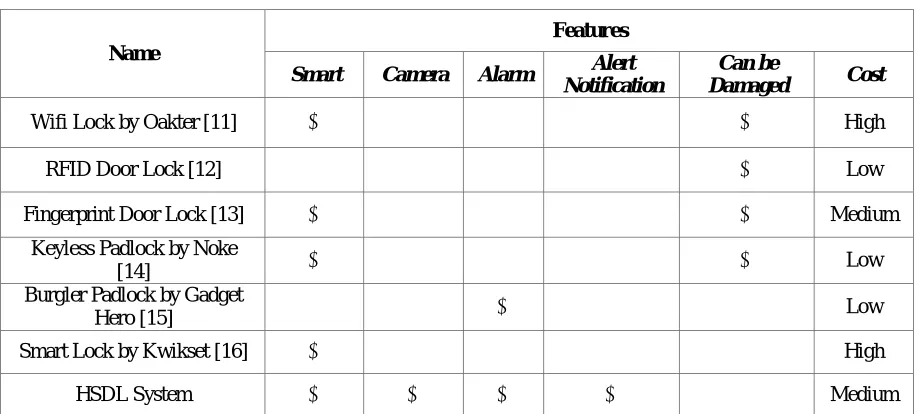
Besides these proposed systems, there are existing systems which have certain limitations over the proposed system presented in this paper. Table 1 compares the features of existing systems with those of the proposed HSDL System.
TABLE I. FEATURES OF EXISTING SYSTEMS COMPARED TO HSDLSYSTEM
Name
Features
Smart Camera Alarm Alert
Notification
Can be
Damaged Cost
Wifi Lock by Oakter [11] High RFID Door Lock [12] Low Fingerprint Door Lock [13] Medium
Keyless Padlock by Noke
[14] Low
Burgler Padlock by Gadget
Hero [15] Low Smart Lock by Kwikset [16] High HSDL System Medium
ISSN(Online): 2319-8753 ISSN (Print): 2347-6710
International Journal of Innovative Research in Science,
Engineering and Technology
(A High Impact Factor & UGC Approved Journal) Website: www.ijirset.com
Vol. 6, Issue 8, August 2017
V. PROPOSED SYSTEM DESIGN 1. System Prototype
System prototype defines the basic structural layout of the proposed system. It shows the various connections among the hardware, and the input output dependencies. Fig. 1 provides with such layout of the proposed system.
Fig. 1. System prototype of proposed system
Fig.1 gives the basic hardware diagram of the proposed system consists of raspberry pi 3 as the brain of the system. Other hardware like the camera, PIR Sensor, electromagnetic lock and the bell are connected to raspberry pi 3. In system prototype, the bell is formed using the buzzer and a push button.
2. System Flow Analysis
ISSN(Online): 2319-8753 ISSN (Print): 2347-6710
International Journal of Innovative Research in Science,
Engineering and Technology
(A High Impact Factor & UGC Approved Journal) Website: www.ijirset.com
Vol. 6, Issue 8, August 2017
Click()
1. camera= PiCamera() 2. camera.start_preview() 3. time.sleep(1)
4. camera.capture('/home/pi/Desktop/Visitor.jpg'); 5. camera.stop_preview()
Unlock(), Lock()
1. pin = gpio.output(22) 2. if (pin = false) 3. current.close() 4. else
5. current.open() 6. end
R_Message(msg)
1. if (msg.text=='Unlock Door') 2. send_msg(‘'Door Unlocked') 3. Unlock()
4. return true
5. if (msg.text=='Lock Door') 6. send_msg('Door locked', false) 7. Lock()
8. Return false
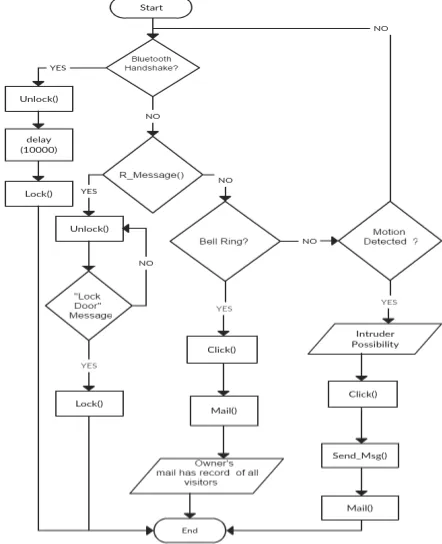
As shown in Fig. 2, the proposed system begins by checking for a Bluetooth handshake. If handshake takes place, the door unlocks and locks again using Unlock() and Lock() method. If there is no handshake, it checks for a command from the user via message through the method R_Message(). If an unlock message has been received, the door gets unlocked and locked again when “Lock Door” Message is received. In case there is no message, the system checks for the possibility of a visitor. If there are signals from the bell, it clicks the photo using Click() method and emails it to the owner's email id using Mail() method. This way the owner gets the record of the visitors. In case there was no ringing of the bell but some motion was detected, it smartly considers it a case of intrusion and clicks the photograph using Click() method. It emails this photograph as an alert and sends an offline message over the internet as an alert for the intrusion.
VI. SYSTEM ALGORITHM
1. Unlocking and Locking of the door
2. Send an alert Message
3. Check message from the owner
4. Click the photograph
Send_Msg()
1. msg = "Alert!! Possible Intrusion!!"
ISSN(Online): 2319-8753 ISSN (Print): 2347-6710
International Journal of Innovative Research in Science,
Engineering and Technology
(A High Impact Factor & UGC Approved Journal) Website: www.ijirset.com
Vol. 6, Issue 8, August 2017
Main() 1. do
2. if (BT.handshake()) 3. Unlock()
4. Lock() 5. goto step 1 6. else goto step 6 7. if R_Message()
8. if (message = ‘Lock Door’) 9. Lock()
10. else Unlock() 11. goto step1
12. if (bell_ring = true) 13. Click()
14. Mail() 15. else break
16. if (motion == true) 17. Click()
18. SendMessage() 19. Mail() 20. else break 21. while (1=1)
5. Send an email
6. Smart Locking and Home Security
VII. RESULT
When the system is executed, it gives out the following results depending upon the scenario:
1. Visitor Notification
Whenever the system detects the bell ringing, it smartly categorizes the person on the door as a visitor. That person may be a relative, mailman, milkman, neighbor etc. It immediately clicks the photo of the person and emails it to the members. This helps the members keep a track of who visited them, in case they were not present at home. Fig. 3 & 4 represent the outputs obtained under this situation.
Mail()
1. recipients = [‘[email protected]’] 2. msg0 = MIMEMultipart()
3. msg0['Subject'] = str("Visitor at Home") 4. msg0['From'] = ‘[email protected]’
5. msg0.attach(MIME("Hi, please find the attached image")) 6. part1=open("/Desktop/Visitor.jpg”).read()
7. part1.addheader('attach',fname=str('Visitor.jpg')) 8. msg0.attach(part1)
9. server= smtplib.SMTP("smtp.gmail.com:587") 10. server.login("[email protected]", "abc")
ISSN(Online): 2319-8753 ISSN (Print): 2347-6710
International Journal of Innovative Research in Science,
Engineering and Technology
(A High Impact Factor & UGC Approved Journal) Website: www.ijirset.com
Vol. 6, Issue 8, August 2017
Fig.3. Visitor Notification Module output
Fig. 3 displays “Mail sent” as the message when the proposed system notifies the owner via email with an attachment of the visitor’s photograph. It shows that the bell ring is detected, then the image is “captured” and finally the mail is sent.
Fig. 4. Mail with the subject of “Visitor at Home” is received from the system with the attached photograph of the visitor in the case of visitor
Fig. 4 gives a screenshot to the email received from the proposed system with the attachment of the visitor photograph. It displays the message as “Hi, please find the attached image of the visitor” with a subject as “Visitor at Home”.
2. Intruder Alert
In case the proposed system doesn't sense any ringing of the bell but does sense some motion, the system smartly categorizes the person on the door as a possible intruder. There is a possibility that the person might be a burglar. It immediately clicks the photograph of the person and emails it to the members with an alert message. This helps the members take necessary action in case of crime and safeguard their homes from chances of burglary or theft. Fig 5-6 show the output results for this situation.
Fig.5. Intruder Alert module output
ISSN(Online): 2319-8753 ISSN (Print): 2347-6710
International Journal of Innovative Research in Science,
Engineering and Technology
(A High Impact Factor & UGC Approved Journal) Website: www.ijirset.com
Vol. 6, Issue 8, August 2017
Fig.6. Mail from the system is made with a photograph of the intruder and alert message indicating possibility of intrusion
Fig. 6 gives a screenshot to the email received from the proposed system with the attachment of the intruder’s photograph. It displays the message as “Hi, find the photograph of the intruder” with a subject as “Possible Intrusion”. An alert text message is also sent to the owner’s mobile phone.
3. Smart Door Locking
In this, the user controls the system via a personal chat assistant. It interacts with the system and commands it to either lock the door or unlock it. Fig. 7 & 8 show the results for this case.
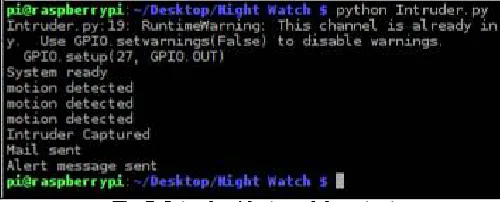
Fig.7. Output Window for the door locking module Fig. 7 displays commands received for locking or unlocking the door, by the owner.
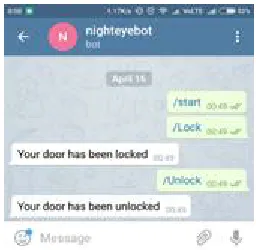
Fig.8. NightEyeBot having a chat with HSDL system
Fig. 8 shows the messages sent by the owner through his mobile to the device, for locking or unlocking the door, along with subsequent response from the system.
Fig. 9 shows the actual system hardware which includes: 1. Raspberry Pi 3
ISSN(Online): 2319-8753 ISSN (Print): 2347-6710
International Journal of Innovative Research in Science,
Engineering and Technology
(A High Impact Factor & UGC Approved Journal) Website: www.ijirset.com
Vol. 6, Issue 8, August 2017
6. Bell
Fig.9. The hardware components in system prototype
Fig. 9 depicts the various components of the prototyped system. It is the sample hardware setup for the functional proposed system.
VIII.DISCUSSION AND CONCLUSION
The purpose of developing this system was to ensure the security of home and along with it to provide a smart way to lock and unlock the door.
Figs. 3-8 show the effectiveness and usefulness of the proposed system. The functional cost effectiveness of the system compared to existing systems is promising.
Results show that the proposed system is a complete security solution.
REFERENCES
[1] The electromagnetic lock. Available: https://goo.gl/llpEDZ [2] Passive Infrared Sensor. Available: https://goo.gl/SaEwOd [3] Raspberry Pi 3 Model B. Available: https://goo.gl/czsiG2
[4] S. Sahare, A. Bagade, K. Gomase, A. Darbeshwar and A. Awate, “Automated Door Control System Using Android Phone and GSM Modem”, International Journal Of Advanced Research in Computer Science and Software Engineering, vol. 6, no. 2, Feb. 2016. [5] N. Majgaonkar, R. Hodekar and P. Bandagale, “Automatic Door Locking System”, IJEDR, vol. 4, no. 1, 2016.
[6] A.A. Shankar, P.R.K. Sastry, A.L.V. Ram and A. Vamsidhar, “Finger Print based Door Locking System”, International Journal Of Engineering And Computer Science”, vol. 4, no. 3, Mar. 2015.
[7] R.S. Anuradha, R. Bharathi, K. Karthika, S. Kirithika and S. Venkatasubramanian, “Optimized Door Locking and Unlocking Using IoT for Physically Challenged People”, International Journal of Innovative Research in Computer and Communication Engineering, vol. 4, no. 3, Mar. 2016.
[8] S.N. Basha, S.A.K. Jilani, and S. Arun, “An Intelligent Door System using Raspberry Pi and Amazon Web Services IoT”, International Journal of Engineering Trends and Technology, vol. 33, no. 2, Mar. 2016.
[9] Ilkyu, "Security and Usability Improvement on a Digital Door Lock System based on Internet of Things", International Journal of Security and Its Applications, vol. 9, no. 8, 2015.
[10] M. Kumar, M. Hanumanthappa, T.V.S. Kumar and A.K. Ojha, “Android Based Smart Door Locking System with Multi User and Multi Level Functionalities”, International Journal of Advanced Research in Computer and Communication Engineering, vol. 5, no. 2, Oct. 2016.
[11] Wifi Lock by Oakter. Available: https://goo.gl/fmkyRG [12] RFID Door Lock. Available: https://goo.gl/T7CsAv [13] Fingerprint Door Lock. Available: https://goo.gl/47SBvD [14] Keyless Padlock by Noke. Available: https://goo.gl/DaXSal
[15] Burgler Padlock by Gadget Hero. Available: https://goo.gl/AjilVm [16] Smart Lock by Kwikset. Available: https://goo.gl/pbZxqw
[17] Y.T.Park, P.Sthapit and J.Y.Pyun, “Smart digital door lock for the home automation”, IEEE Explore TENCON 2009, Jan. 2010.