Volatile Anesthetics Affect Nutrient Availability in Yeast
Laura K. Palmer,
1Darren Wolfe,
1,2Jessica L. Keeley and Ralph L. Keil
3Department of Biochemistry and Molecular Biology, The Milton S. Hershey Medical Center, The Pennsylvania State University, Hershey, Pennsylvania 17033
Manuscript received January 28, 2002 Accepted for publication March 8, 2002
ABSTRACT
Volatile anesthetics affect all cells and tissues tested, but their mechanisms and sites of action remain unknown. To gain insight into the cellular activities of anesthetics, we have isolated genes that, when
overexpressed, renderSaccharomyces cerevisiaeresistant to the volatile anesthetic isoflurane. One of these
genes,WAK3/TAT1, encodes a permease that transports amino acids including leucine and tryptophan,
for which our wild-type strain is auxotrophic. This suggests that availability of amino acids may play a key role in anesthetic response. Multiple lines of evidence support this proposal: (i) Deletion or overexpression of permeases that transport leucine and/or tryptophan alters anesthetic response; (ii) prototrophic strains are anesthetic resistant; (iii) altered concentrations of leucine and tryptophan in the medium affect anesthetic response; and (iv) uptake of leucine and tryptophan is inhibited during anesthetic exposure. Not all amino acids are critical for this response since we find that overexpression of the lysine permease does not affect anesthetic sensitivity. These findings are consistent with models in which anesthetics have a physiologically important effect on availability of specific amino acids by altering function of their permeases. In addition, we show that there is a relationship between nutrient availability and ubiquitin metabolism in this response.
T
HE initial public demonstration of general anesthe- ent anesthetics; and volatile, lipophilic compounds that sia in 1846 marked a pivotal event in the history of do not induce anesthesia in mammals do not inhibit medicine. Until that time, surgery was performed only growth of yeast. These similarities indicate that the man-as a lman-ast, desperate resort because of the unbearable ner in which anesthetics inhibit yeast growth and induce pain and suffering inflicted on the patient. Although mammalian anesthesia may be closely related, if not volatile anesthetics are essential for modern clinical identical.practice due to their ability to render patients uncon- To investigate anesthetic action inS. cerevisiae, sponta-scious and insensitive to pain, the mechanisms and sites neous mutants that confer resistance to the growth-of action growth-of these drugs remain unknown. inhibitory effects of the volatile anesthetic isoflurane Volatile anesthetics affect all cells and tissues that have have been isolated and characterized (Keilet al. 1996; been tested, including a wide array of mammalian neu- Wolfeet al. 1998, 1999). Two of the genes identified ronal and nonneuronal cells, plant cells, yeast, and bac- in this analysis have been implicated in ubiquitin metab-teria (Overton1901;Keilet al. 1996;Bataiet al. 1999). olism:ZZZ1is identical toBUL1, which encodes a pro-We are taking a molecular genetic approach to investi- tein that interacts with yeast ubiquitin ligase ( Yashir-gate anesthetic action using the yeastSaccharomyces cere- odaet al. 1996), andZZZ4is identical toDOA1, which visiae. We find that volatile anesthetics arrest yeast cell affects degradation of ubiquitinated proteins (Ghislain division in a manner that strikingly parallels the activities et al. 1996). Finding that mutations in these genes affect of these drugs in mammals (Koblin 1994; Keil et al. anesthetic sensitivity suggests that ubiquitin metabolism 1996;Wolfeet al. 1998). These parallels include correla- plays a critical role in the normal response of yeast to tion of lipophilicity and potency (the Meyer-Overton these drugs.
rule;Koblin1994); rapid and reversible effects; a sharp To identify additional proteins involved in yeast anes-dose-response curve; additivity of partial doses of differ- thetic response, we isolated genes that, when present in multiple copies, confer resistance to the volatile anes-thetic isoflurane. Here we report that one of these genes, WAK3, is identical to TAT1, which encodes a 1These authors contributed equally to this work.
yeast amino acid permease (Schmidtet al. 1994). Find-2Present address:Department of Molecular Genetics and
Biochemis-try, University of Pittsburgh School of Medicine, Pittsburgh, PA 15261. ing that overexpression of an amino acid permease con-3Corresponding author:Department of Biochemistry and Molecular
fers anesthetic resistance suggests that nutrient availabil-Biology H171, The Milton S. Hershey Medical Center, The
Pennsylva-ity may be a critical factor in yeast anesthetic response. nia State University, 500 University Dr., Hershey, PA 17033.
E-mail: [email protected] Multiple, mutually supportive experimental findings are
al. 1994), were kindly provided by M. Hall. The 3.7-kbEcoRI consistent with this proposal. In addition, we find a
fragment from YCpTAT2containing theTAT2open reading
relationship between ubiquitin metabolism and
nutri-frame and flanking genomic sequences was ligated into the ent availability in the response of yeast to these drugs. EcoRI site of theURA3-marked YEplac195 vector (Gietzand Sugino1988). This plasmid was termed YEpTAT2. The
high-affinity lysine permease,LYP1, on the 2-based pYX212 vector
MATERIALS AND METHODS (original designation pRB165; Rengenberget al. 1999), and
BAP2 on the pYX212 vector (original designation pRB145;
Strains, media, and anesthetic exposure:Yeast strains used
Regenberget al. 1999) were obtained from M. C.
Kielland-in this study are derivatives of RLK88-3C (LKielland-inandKeil1991)
Brandt. These plasmids were termed YEpLYP1 and
YEp-and are listed in Table 1. Strains P1353, P1337, YEp-and P1361
BAP2-2, respectively. were constructed from RLK88-3C by PCR-directed correction
The entire protein-encoding sequences ofTAT1orBAP2were
of the chromosomal leu2-3,112 and/or trp1-HIII mutations.
deleted from RLK88-3C and replaced with loxP-kanMX-loxP
Oligonucleotides used to generate theLEU2andTRP1PCR
from pUG6 (Guldeneret al. 1996) by using appropriate
PCR-products from plasmid-borne copies of the wild-type genes
generated gene disruption cassettes. Oligonucleotides used
were as follows: LEU2, 0-230 (5⬘-GAATACTCAGGTATC-3⬘)
to generate these cassettes were as follows:TAT1, 0-153 (5⬘
-and 0-231 (5⬘-TCGTAAGGCCGTTTC-3⬘); and TRP1, 0-228
GTAGCTACCTAATATAGTTTCTCGATAAAAAGGCGTAAA
(5⬘-GTGACTATTGAGCAC-3⬘) and 0-229 (5⬘-GTGCACAAAC
ACAGGTCGACAACCCTTATA-3⬘) and 0-154 (5⬘-AAGCCCG
AATAC-3⬘). PCR products were transformed into RLK88-3C,
ATGAAGCCAAGCGGAAAATGAATCGAATTGCTGGTGGA
and stable Leu⫹ or Trp⫹transformants were isolated. In a
TCTGATATCACCTA-3⬘); and BAP2, 0-216 (5⬘-CAATTTAT
similar manner, strain P1814 was constructed from P1361 by
TTAGCTTCAATAAAACTCAAGTGATTTTAGAACAGGTCG
PCR-directed correction of the chromosomal his4-260 and
ACAACCCTTAAT-3⬘) and 0-217 (5⬘-TCTAATGGGTAGTGT
ade2-1mutations. Oligonucleotides used to generate theHIS4
CCAGACCTGAGTGGTGTAGTTAAGTGTGGATCTGATAT
and ADE2 PCR products from plasmid-borne copies of the
CACCTA-3⬘). Correct gene deletions were verified by PCR.
wild-type genes were as follows:HIS4, 0-253 (5⬘-TCATCGGAA
To delete the entire protein-encoding sequence ofTAT2
GAGGTGGCATC-3⬘) and 0-254 (5⬘-AAACCGTCAGGACGGT
in RLK88-3C, a vector derived from YCpTAT2in which the
CTGT-3⬘); andADE2, 0-259 (5⬘-GAAACTTCATGCTCGAAA
TAT2gene was precisely replaced with aloxP-kanMX-loxP
frag-AAG-3⬘) and 0-260 (5⬘-CAAGGGAACATTATAGGGTG-3⬘).
ment was constructed as follows: Inverse PCR was used to
Unless otherwise noted, yeast (LinandKeil1991) and
bacte-create a derivative of YCpTAT2in which theTAT2gene was
rial (Sambrooket al. 1989) media were prepared as previously
precisely deleted and replaced with a NotI restriction site.
described. Isoflurane (Baxter Healthcare Corporation)
expo-Oligonucleotides 0-384 (5⬘ATACGATAGCGGCCGCATGAG
sure of yeast grown on solid media was performed as described
AGTGTGTTGCGTAATTTGC-3⬘) and 0-385 (5⬘-ATAAGATA
previously (Keilet al. 1996;Wolfeet al. 1999).
GCGGCCGCTACCGAAGAAACAAGTTC-3⬘) were used for
Isolation of anesthetic resistance-conferring genes:To
iden-this PCR reaction. The resulting PCR product was digested tify genes that confer resistance to anesthetics when present
withNotI and the 1.6-kbNotI fragment of pUG6 containing
in multiple copies, RLK88-3C was transformed (Schiestland
loxP-kanMX-loxPwas inserted, producing pL4071. A PCR prod-Gietz1989) with a 2-based (YEp; multicopy) yeast genomic
uct was generated from pL4071 using oligonucleotides 0-373
plasmid library (CarlsonandBotstein1982) and screened
(5⬘-CATGATATTGCATC TACCTC-3⬘) and 0-374 (5⬘-AAATT
for transformants resistant to isoflurane. Plasmids recovered
TGATTCCTACGGCAG-3⬘) and transformed into RLK88-3C.
from these transformants were propagated inEscherichia coli
Thetat2⌬::loxP-kanMX-loxPtransformants created by this
pro-strain MC1066 [leuB trpC pyrF::Tn5 (Kanr)araT lacX74 del strA
cess were identified on the basis of resistance to G418, and hsdR hsdM(obtained from M. Casadaban)].
the occurrence of the appropriate deletion was verified by PCR.
DNA manipulations, plasmids, and gene deletions:PCR
re-Amino acid import studies:To measure leucine or trypto-agents as well as restriction and modification enzymes were
phan uptake in the presence or absence of isoflurane, cells purchased from various sources and used according to the
were grown to an approximate OD600of 0.4 in synthetic
com-instructions of the manufacturers. Standard procedures for
plete (SC) media (Linand Keil1991) containing 70 g/
the purification of plasmid (Sambrooket al. 1989) and yeast
ml leucine and 10 g/ml tryptophan. Twenty-five-milliliter
genomic (Roseet al. 1990) DNA were used.
aliquots of this culture were injected into 250-ml evacuated Plasmid pL3271 contains an 11.1-kb fragment of yeast
geno-bottles (Baxter Healthcare Corporation) containing the
de-mic DNA from chromosome II that includesWAK3. This
frag-sired concentration of volatilized anesthetic. Air was admitted
ment is inserted in theBamHI site of YEp24 (Botsteinet al.
into the bottles to achieve 1 atmosphere of pressure. After 1979). Oligonucleotides used to sequence into the insert from
15 min of incubation at 30⬚, 20 Ci of l-[U-14C]leucine
both ends were 0-73 (5⬘-GCCAGCAACCGCACC-3⬘) and 0-74
(50Ci/ml; Amersham, Arlington Heights, IL) or 80Ci of
(5⬘-GCCACTATCGACTAC-3⬘), which hybridize to plasmid
se-l-[5-3H]tryptophan (1 mCi/ml; Amersham) was added.
Tripli-quences flanking the insert. DNA sequencing was performed
cate samples of cells were removed at 0- and 10-min time in the Molecular Genetics Core Facility of the M. S. Hershey
intervals after the addition of the labeled amino acid, collected College of Medicine using an ABI 377 DNA sequencer.
on glass-fiber filters, and washed extensively with cold liquid
To initially localize the sequences encodingWAK3, deletion
medium containing excess unlabeled leucine (20 mg/ml) and derivatives of pL3271 were constructed by digestion with
con-tryptophan (4 mg/ml). Washed filters were placed in scintilla-venient restriction enzymes. The restricted DNA was religated
tion vials and treated with 1mNaOH. This solution was
neu-to produce plasmids with the various deletions. Among the
tralized with 1 m acetic acid and liquid scintillation fluid
deletion derivatives constructed were pL3273, which contains
(Fisher Scientific, Pittsburgh) was added. Uptake of labeled
the C-terminal portion ofTAT1and the entire
protein-encod-amino acid into the cells was determined by liquid scintillation
ing sequence forBAP2, and pL3277, which contains the entire
counting and levels in the presence or absence of isoflurane
TAT1gene and the amino-terminal portion ofBAP2. These
were compared.
plasmids are termed YEpBAP2and YEpTAT1, respectively.
To measure leucine uptake intat1⌬, YEpTAT1, zzz1⌬, or
TAT1and TAT2on the low-copy YCplac33 vector (Gietz
zzz4⌬strains or lysine uptake in RLK88-3C transformed with
andSugino1988), named YCpTAT1and YCpTAT2,
to an approximate OD600of 0.4 in SC or SC-ura medium were
harvested and resuspended in 1.25 ml of fresh media. The cell suspension was added to SC or SC-ura medium containing
1.25 Ci of l-[U-14C]leucine or 5 Ci of l-[4,5-3H]lysine
(1 mCi/ml; Amersham) to a total volume of 3.2 ml. Triplicate samples of cells were removed at 0- and 10-min time points after addition of the cells to the medium containing the la-beled amino acid and collected on glass-fiber filters. The filters were washed and treated as described above, and radioactivity was quantified by liquid scintillation counting.
RESULTS
Altered levels of TAT1 affect yeast anesthetic re-sponse:To identify novel genes involved in volatile anes-thetic action inS. cerevisiae, an overexpression library containing random fragments of yeast genomic DNA inserted into the 2-based YEp24 vector (Botstein et al. 1979) was screened for plasmids that confer resis-tance to the volatile anesthetic isoflurane. Seven trans-formants resistant to a normally growth-inhibitory con-centration of isoflurane [12%; theminimuminhibitory concentration (MIC; Keil et al. 1996)] were isolated fromⵑ20,000 transformants. Loss of the plasmids from these transformants resulted in reversion to the anesthe-tic-sensitive phenotype of the wild-type strain, RLK88-3C (Table 1), indicating that the anesthetic resistance was due to plasmid-borne genes. Plasmids from each of these transformants were recovered intoE. coliand rein-troduced into RLK88-3C. All of the transformants tested were anesthetic resistant, further demonstrating that the plasmids were responsible for altering anesthetic response. Genes on these plasmids critical for anesthetic resistance (identified in subsequent analyses) were termed WAK (pronounced “wake”) genes to indicate their roles in preventing yeast growth inhibition, or “sleep,” produced by anesthetic agents.
Restriction mapping of the plasmids indicated that five of the seven plasmids contained a common DNA segment. These plasmids represent five isolates con-taining theWAK3gene. Sequencing into the insert in one of these plasmids, pL3271, revealed that the insert was an 11.1-kb DNA fragment from chromosome II con-taining the carboxy terminus of YBR070C, full-length TAT1, BAP2, TIP1, and NRG2 genes, and the amino-terminal portion ofECM2(Figure 1). Deletion analysis of pL3271 showed thatTAT1was essential for producing the anesthetic resistance (Figures 1 and 2).TAT1 en-codes an amino acid permease that transports leucine, tryptophan, isoleucine, valine, and tyrosine (Schmidt et al. 1994;Regenberget al. 1999). Even when present on a low-copy, centromeric plasmid (YCplac33;Gietz andSugino1988),TAT1increased the anesthetic resis-tance of RLK88-3C (Figure 2, compare strains 5 and 6), indicating that a relatively small increase inTAT1 expression is sufficient to alter anesthetic response. These results suggest that nutrient availability may be a
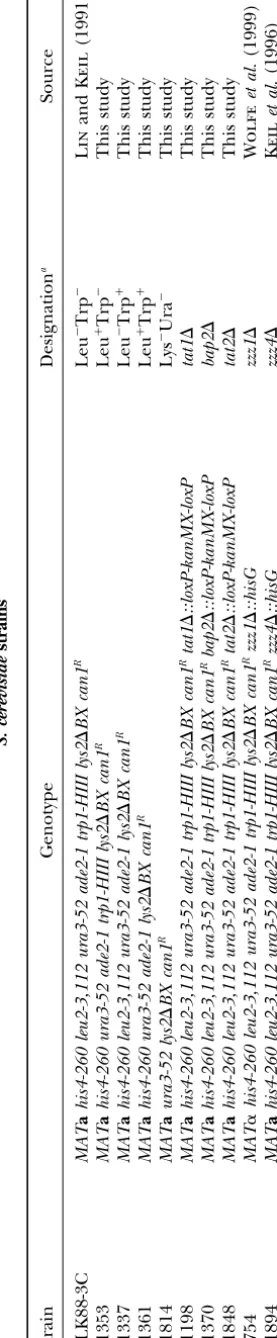
TABLE 1 S. cerevisiae strains Strain Genotype D esignation a Source RLK88-3C MAT a his4-260 leu2-3,112 ura3-52 ade2-1 trp1-HIII lys2 ⌬ BX can1 R Leu ⫺Trp ⫺ Lin and Keil (1991) P1353 MAT a his4-260 ura3-52 ade2-1 trp1-HIII lys2 ⌬ BX can1 R Leu ⫹Trp ⫺ This study P1337 MAT a his4-260 leu2-3,112 ura3-52 ade2-1 lys2 ⌬ BX can1 R Leu ⫺Trp ⫹ This study P1361 MAT a his4-260 ura3-52 ade2-1 lys2 ⌬ BX can1 R Leu ⫹Trp ⫹ This study P1814 MAT a ura3-52 lys2 ⌬ BX can1 R Lys ⫺Ura ⫺ This study P1198 MAT a his4-260 leu2-3,112 ura3-52 ade2-1 trp1-HIII lys2 ⌬ BX can1 Rtat1 ⌬ ::loxP-kanMX-loxP tat1 ⌬ This study P1370 MAT a his4-260 leu2-3,112 ura3-52 ade2-1 trp1-HIII lys2 ⌬ BX can1 Rbap2 ⌬ ::loxP-kanMX-loxP bap2 ⌬ This study P1848 MAT a his4-260 leu2-3,112 ura3-52 ade2-1 trp1-HIII lys2 ⌬ BX can1 Rtat2 ⌬ ::loxP-kanMX-loxP tat2 ⌬ This study P754 MAT ␣ his4-260 leu2-3,112 ura3-52 ade2-1 trp1-HIII lys2 ⌬ BX can1 Rzzz1 ⌬ ::hisG zzz1 ⌬ Wolfe et al. (1999) P1894 MAT a his4-260 leu2-3,112 ura3-52 ade2-1 trp1-HIII lys2 ⌬ BX can1 Rzzz4 ⌬ ::hisG zzz4 ⌬ Keil et al. (1996) aTAT1 , TAT2 , ZZZ1 ,a n d ZZZ4 are identical to VAP1 , SCM2 , BUL1 ,a n d DOA1/UFD3 , respectively.
Figure 1.—WAK3 and
flanking genomic DNA.
WAK3was identified on the
basis of deletion analysis of an 11.1-kb fragment of yeast genomic DNA contained in plasmid pL3271. Thick lines represent multicopy vector (YEp24) sequences and thin lines represent the frag-ment of yeast genomic DNA
containingWAK3. The
hori-zontal arrows indicate the open reading frames con-tained within this fragment and their direction of
trans-cription, with the arrowhead at the 3⬘ terminus. The short dashed vertical lines indicate the positions at which theYBR070C
andECM2genes are truncated in pL3271. The sequences present in several deletion derivatives of this plasmid are shown below
the restriction map of the fragment, with the lines indicating the DNA present in the deletion derivative. Strain numbers refer to strains shown in Figure 2 that contain the indicated plasmid derivatives; NS, not shown in Figure 2. The level of isoflurane
resistance (IsoR) of each derivative as compared to the wild-type strain (RLK88-3C; Table 1) is indicated:⫺, same level of resistance
as the wild-type strain;⫹⫹, intermediate level of isoflurane resistance;⫹⫹⫹, higher level of isoflurane resistance.
In addition to Tat1p, pL3271 also contains the pro- (Figure 2, compare strains 1 and 3), suggesting that while increasing the availability of only branched-chain tein-encoding sequence for Bap2p, a branched-chain
amino acid permease that transports leucine, isoleucine, amino acids is not sufficient to impart anesthetic resis-tance to RLK88-3C, it can augment the level of resisresis-tance and valine (Grauslundet al. 1995). Although deletion
analysis clearly showed thatTAT1was indispensable for provided by overexpression ofTAT1.
If overexpression of TAT1 confers anesthetic resis-the anesresis-thetic resistance, a plasmid containing both
TAT1andBAP2rendered RLK88-3C more resistant to tance by increasing amino acid availability, decreased levels of this permease might render cells hypersensitive isoflurane than did a plasmid overexpressing onlyTAT1
to anesthetics due to reduced ability of the cells to trans-(Figure 2, compare strains 2 and 4). Overexpression of
port one or more critical amino acids. To test this possi-BAP2 alone did not render cells anesthetic resistant
bility, the anesthetic response of cells containing a pre-cise deletion of the protein-encoding sequence ofTAT1 was examined. We find that deletion ofTAT1increases the sensitivity of our wild-type strain (Figure 3, compare strain 1 TAT1to strain 1tat1⌬). This provides further evidence that TAT1 plays a critical role in anesthetic response.
Other permeases can affect anesthetic response:Of the amino acids transported by Tat1p, our wild-type strain is auxotrophic for only leucine and tryptophan (Table 1), suggesting that the availability of one or both of these amino acids affects anesthetic response. The finding thatBAP2does not confer anesthetic resistance to RLK88-3C when overexpressed alone raises the possi-bility thatTAT1is unique in its ability to alter anesthetic response. Alternatively, the ability ofTAT1to transport both leucine and tryptophan may be the critical prop-erty, and permeases that transport only one of these amino acids may have the ability to alter anesthetic response if overexpressed in appropriately prototrophic strains. To distinguish between these possibilities, anes-Figure2.—Increased levels ofTAT1affect isoflurane MIC. thetic response was assessed when BAP2 was
overex-Approximately 104cells from freshly saturated cultures of the
pressed in yeast strains with varying leucine or
trypto-indicated strains were spotted on SC-ura medium and incu- phan prototrophies. Overexpression of BAP2 in a
bated for 3 days at 30⬚in the presence or absence of various
Leu⫺Trp⫺ strain had no effect on the isoflurane MIC concentrations of isoflurane (Iso). YEp, multicopy plasmid
(Figure 2, compare strains 1 and 3) and only very slightly containing the indicated permease gene(s); YCp,
Figure5.—Deletion ofBAP2(bap2⌬) orTAT2(tat2⌬) from
the Leu⫺Trp⫺wild-type strain (RLK88-3C; Table 1) decreases
MIC. Approximately 104cells from freshly saturated cultures
of the indicated strains were spotted on SC medium and tested for response to isoflurane (Iso).
BAP2(YEpBAP2-2). We observed a similar level of resis-tance with this plasmid as with YEpBAP2 in the Leu⫺ Figure3.—Deletion ofTAT1(tat1⌬) decreases isoflurane
resistance of Leu⫺or Trp⫺ strains but not of a Leu⫹Trp⫹ Trp⫹strain (data not shown). These results indicate that
strain. Approximately 104cells from freshly saturated cultures
overexpression ofBAP2, which encodes a high affinity
of the indicated strains were spotted on SC medium and tested leucine transporter, can increase anesthetic resistance
for response to isoflurane (Iso).
when overexpressed in a strain that is prototrophic for tryptophan but auxotrophic for leucine. In a similar manner, overexpression of TAT2, which encodes the compare strains 1 and 2). However,BAP2
overexpres-high affinity yeast tryptophan transporter, in Leu⫺Trp⫺ sion in a Leu⫺Trp⫹ derivative, which is slightly more
or Leu⫺Trp⫹ strains did not increase anesthetic resis-resistant to isoflurane than the Leu⫺Trp⫺strain (Figure
tance (Figure 4, compare strains 6 and 7 or strains 8 and 3, compare strains 1 and 3), increased the resistance of
9), while overexpression of this permease in a Leu⫹Trp⫺ this strain to the same level as that of overexpression
strain resulted in increased resistance to isoflurane (Fig-of Tat1p (Figure 4, compare strains 4 and 5 to strain
ure 4, compare strains 10 and 11). 3). YEpBAP2contains open reading frames in addition
Analogous to TAT1, deletion of BAP2 or TAT2 in-to BAP2 (Figure 1, strain 3 plasmid). To ensure that
creases the anesthetic sensitivity of RLK88-3C (Figure the altered anesthetic response required only
overex-pression ofBAP2, we tested a plasmid containing only 5). Taken together, these results indicate that the
avail-Figure 4.—Overexpression of (A) BAP2
or (B) TAT2 can alter anesthetic response
when expressed in strains with appropriate
prototrophies. Approximately 104cells from
Figure 6.—Lysine availability does not affect anesthetic sensitiv-ity. (A) Overexpression of the
ly-sine-specific permease,LYP1, does
not affect the anesthetic response
of RLK88-3C. Approximately 104
cells from freshly saturated cul-tures of RLK88-3C (his4 leu2 ura3 ade2 trp1 lys2) transformed with
YEp or YEpLYP1 plasmids were
spotted on selective media and tested for the ability to grow in various concentrations of isoflur-ane (Iso). (B) Overexpression of
LYP1 inhibits growth of P1814
(HIS4 LEU2 ura3 ADE2 TRP1 lys2). P1814 strains transformed with
YEp or YEpLYP1 plasmids were
streaked on selective medium and
incubated at 30⬚ in the absence
of anesthetic for 48 hr. (C)LYP1
overexpression does not increase the anesthetic resistance of P1814.
Approximately 104cells from freshly saturated cultures of P1814 transformed with YEp or YEpLYP1 plasmids were spotted on
selective media and tested for response to isoflurane (Iso).
ability of leucine and tryptophan together plays a role in thetic response even when the strain is auxotrophic for only this amino acid. This indicates that Lyp1p levels anesthetic response. They also demonstrate that Tat1p is
not unique in its ability to alter anesthetic response in are not a critical factor in yeast anesthetic response. Leucine and tryptophan phenotypes affect anesthetic yeast.
Overexpression of LYP1 does not affect anesthetic response:To verify that the ability of some amino acid permeases to alter anesthetic response is due to their response:To test whether all amino acid permeases are
capable of affecting anesthetic response, we examined ability to transport nutrients into the cell and not some other function of the permease, anesthetic response was the behavior of a derivative of our wild-type strain that
contained a multicopy plasmid encoding the high affin- assessed in a series of Leu⫹and/or Trp⫹derivatives (Table 1) of the Leu⫺Trp⫺ strain. We find slight increases in ity lysine-specific permease, LYP1(Sychrova and
Che-vallier1993). Although our wild-type strain is auxotro- the level of isoflurane resistance of the Leu⫹Trp⫺and Leu⫺Trp⫹ derivatives as compared to the Leu⫺Trp⫺ phic for lysine,LYP1 overexpression had no effect on
the anesthetic response of this strain (Figure 6A). To strain (Figure 7A, compare strains 2 and 3 to strain 1). In contrast, the isoflurane MIC of a Leu⫹Trp⫹derivative verify that overexpression ofLYP1increased lysine
im-port in this strain, uptake of radiolabeled lysine was increased from 12% to ⬎14% (Figure 7A, compare strains 1 and 4), indicating that cells that can synthesize measured. An ⵑ2.5-fold increase in lysine uptake was
observed in cells overexpressingLYP1(YEpLYP1) com- both leucine and tryptophan are more anesthetic resis-tant than cells that are auxotrophic for one or both pared with cells containing the vector alone (YEpLYP1,
249⫾ 23%; YEp, 100%). amino acids. Deletion of TAT1 did not affect the
isoflurane MIC of the Leu⫹Trp⫹strain (Figure 3, com-It is possible thatLYP1overexpression may alter
anes-thetic response in a strain with appropriate prototro- pare strain 4 TAT1 to strain 4 tat1⌬). This provides additional evidence that the role of Tat1p in anesthetic phies, similar to the finding that overexpression ofBAP2
or TAT2 only increases anesthetic response in strains response is likely due to its ability to import leucine and tryptophan from the external environment.
that are Trp⫹or Leu⫹, respectively. To test this
possibil-ity, a derivative of the wild-type strain that is auxotrophic If the ability of a cell to import amino acids is affected by volatile anesthetics, increasing the concentrations of only for lysine and uracil (Lys⫺Ura⫺) was constructed
(Table 1). This strain was transformed with theURA3- these nutrients in the medium may alleviate the growth-inhibitory effects of these drugs. A similar approach was marked multicopyLYP1plasmid or the vector control
and anesthetic response was assessed. Although overex- employed to demonstrate that excess tryptophan in the growth medium can mitigate the toxicity of the immu-pression of LYP1 decreased growth of this strain for
an unknown reason even in the absence of isoflurane nosuppressive drug FK506, which inhibits amino acid import in yeast (Heitmanet al. 1993). To test whether (Figure 6B), we find that overexpression ofLYP1does
anes-TABLE 2
Amino acid uptake in the absence of isoflurane
Straina Uptake (%)
YEpTAT1 135⫾14 (3)b
tat1⌬ 81⫾6 (4)
zzz1⌬ 203⫾19 (3)
zzz4⌬ 111⫾3 (2)
Uptake of radiolabeled leucine was measured in the
indi-cated strains as described inmaterials and methods. Uptake
values were calculated relative to the uptake in the appropriate wild-type control, which was given a value of 100%. All values
are expressed as the average percentage of uptake⫾SEM.
aYEpTAT1is RLK88-3C (Table 1) with a multicopy plasmid
containingTAT1.All other strain designations are as given
in Table 1.
bThe numbers in parentheses indicate the number of trials
that were averaged to obtain the experimental value shown.
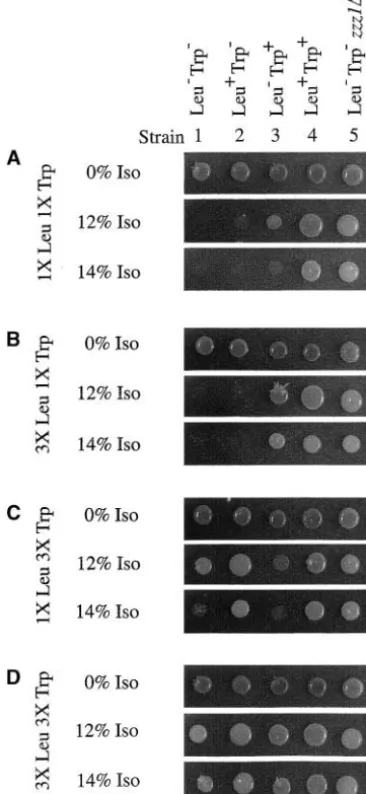
strains 3 and 4). Increasing the tryptophan concentra-tion threefold in the medium moderately increased the isoflurane resistance of the Leu⫺Trp⫺ and Leu⫺Trp⫹ strains, although these strains are still more sensitive than the Leu⫹Trp⫹strain (Figure 7C, compare strains 1 and 3 to strain 4). The increased tryptophan concen-tration rendered the Leu⫹Trp⫺ strain extremely isoflur-ane resistant, to a level similar to that of the Leu⫹Trp⫹ strain (Figure 7C, compare strains 2 and 4). Increasing the concentrations of both leucine and tryptophan ren-dered all strains extremely resistant to isoflurane regard-less of their leucine or tryptophan phenotypes (Figure 7D). These results further emphasize that availability of both leucine and tryptophan plays a critical role in anesthetic response and that high levels of amino acids Figure 7.—Excess leucine and tryptophan in the growth in the medium are able to alleviate anesthetic-induced medium render auxotrophic strains resistant to isoflurane.
growth inhibition of strains with appropriate
auxotro-Approximately 104cells from freshly saturated cultures of the
phies. indicated strains were spotted on media containing (A) our
normal concentrations of leucine and tryptophan (1⫻ Leu Anesthetics inhibit amino acid import: The results
1⫻Trp), (B) a threefold excess of leucine (3⫻Leu 1⫻Trp), described above suggest that anesthetics may inhibit
(C) a threefold excess of tryptophan (1⫻Leu 3⫻Trp), or
yeast cell division by decreasing amino acid import.
(D) a threefold excess of both amino acids (3⫻Leu 3⫻Trp)
Thus, a reasonable explanation for the increased
iso-and incubated for 3 days at 30⬚in the presence or absence
flurane resistance conferred byTAT1overexpression is of various concentrations of isoflurane (Iso). A strain
con-taining a genomic deletion ofZZZ1/BUL1(Leu⫺Trp⫺zzz1⌬) that it increases uptake of amino acids from the external
was included as an anesthetic-resistant control. environment, allowing the cell to grow in the presence
of a normally inhibitory concentration of anesthetic. Indeed, we find that overexpression ofTAT1increases and Leu⫹Trp⫹strains grown on SC medium containing
leucine uptake in our wild-type strainⵑ35% (Table 2). a threefold excess of leucine (3⫻Leu 1⫻Trp),
trypto-In addition, we find anⵑ20% decrease in leucine up-phan (1⫻Leu 3⫻Trp), or both amino acids (3⫻Leu
take in an anesthetic-supersensitivetat1⌬strain as com-3⫻ Trp) were compared to those of strains grown on
pared to its wild-type counterpart (Table 2). Taken to-media containing our normal concentrations of these
gether, these results suggest a correlation between the amino acids (1⫻ Leu 1⫻ Trp). While increasing the
level of amino acid import and the level of isoflurane leucine concentration threefold in the medium had
resistance in yeast. no effect on the isoflurane MIC of the Leu⫺Trp⫺ or
To directly test the effect of isoflurane exposure on Leu⫹Trp⫺strain (Figure 7B, strains 1 and 2), the MIC
amino acid import, transport of radiolabeled leucine of the Leu⫺Trp⫹ strain increased to levels similar to
ab-TABLE 3
Amino acid uptake in the presence of isoflurane
Uptake (%)
Amino acid 15 min 30 min
A. Wild typea
Leucine 45⫾4 (5)b NDc
Tryptophan 53⫾6 (5) 39⫾6 (4)
Amino Acid Uptake (%)
B.zzz1⌬
Leucine 47⫾2d(109⫾21)e(2)
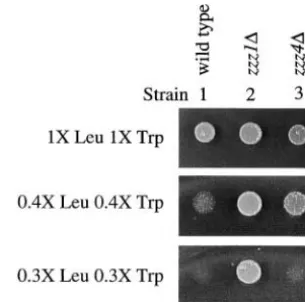
Figure8.—Anesthetic-resistant mutants grow better than
aUptake of radiolabeled leucine or tryptophan was
mea-the isogenic wild-type strain on media containing low levels of
sured in the wild-type strain (RLK88-3C; Table 1) after expo- leucine and tryptophan. Approximately 104cells from freshly
sure to isoflurane for the indicated amount of time. Uptake saturated cultures of wild-type,zzz1⌬, andzzz4⌬strains were
values were calculated relative to uptake measured in the spotted on media containing the indicated concentrations
unexposed wild-type control, which was given a value of 100%. of leucine and tryptophan. Growth was evaluated following
bThe numbers in parentheses indicate the number of trials
incubation at 30⬚forⵑ40 hr.
that were averaged to obtain the experimental value shown.
cND, not determined.
dUptake of radiolabeled leucine was measured in strain
tered degradation of ubiquitinated proteins, render P754 (Table 1) after 15 min of isoflurane exposure. Uptake
cells resistant to isoflurane (Keilet al. 1996;Wolfeet al. values were calculated relative to uptake in the unexposed
zzz1⌬control, which was given a value of 100%. 1999). Ubiquitination has been implicated in regulating
eUptake value of thezzz1⌬strain after 15 min of isoflurane
the turnover and cellular distribution of amino acid exposure calculated relative to uptake in the unexposed
wild-permeases in yeast (Heinet al. 1995;Hicke1997;Beck type control, which was given a value of 100%. All uptake
et al. 1999;Helliwellet al. 2001;Omuraet al. 2001).
values are expressed as the average percentage of uptake⫾
These findings raise the possibility that the role of ubi-SEM.
quitin metabolism in anesthetic response is related to nutrient availability through regulation of amino acid permeases. To test this possibility, we measured leucine sence of isoflurane. As shown in Table 3A, leucine
im-port decreased ⵑ55% in anesthetic-exposed wild-type import in zzz1⌬ and zzz4⌬ strains. In the absence of anesthetic, we find an approximately twofold increase cells after 15 min of exposure to isoflurane. This rapid
inhibition also corresponds to the time frame in which in the amount of leucine import in azzz1⌬strain com-pared to its isogenic wild-type counterpart (Table 2). anesthetic-induced growth inhibition occurs (Wolfeet
al. 1998). The observed decrease in leucine import as a The ability of this anesthetic-resistant mutant to import higher levels of amino acids is further supported by the result of anesthetic exposure (Table 3A) is substantially
larger than the decrease observed in the tat1⌬ strain finding that it is able to grow much better than the wild-type strain on media containing decreased levels (Table 2), which is hypersensitive to isoflurane. This is
consistent with our finding that leucine permeases, such of leucine and tryptophan (Figure 8, compare strains 1 and 2). Although only a small increase in leucine import as Bap2p, in addition to Tat1p play a role in anesthetic
response. Similar results were observed for tryptophan was detected in thezzz4⌬strain as compared to the wild-type strain (Table 2),zzz4⌬mutants had a slight growth import. After 15 min of isoflurane exposure, import of
this amino acid decreased ⵑ50% (Table 3A), and an advantage compared to wild-type cells when grown on media with low levels of leucine and tryptophan (Figure even greater decrease (ⵑ60%) was observed after 30
min of exposure (Table 3A), indicating that incubation 8, compare strains 1 and 3 at 0.4⫻Leu 0.4⫻Trp). This suggests that only a slight increase in amino acid import for extended periods of time in isoflurane further
de-creases amino acid import. is sufficient to affect anesthetic response and is reminis-cent of the finding that even a single extra copy ofTAT1 Nutrient availability and ubiquitin metabolism are
re-lated in the anesthetic response of yeast: The results (YCpTAT1) can increase anesthetic resistance (Figure 2, strain 6).
from this study indicate that nutrient availability plays
a critical role in the cellular response of yeast to volatile We also tested the effect of isoflurane exposure on amino acid import in zzz1⌬ cells. Leucine import de-anesthetics. Our previous investigations have shown that
ubiquitin metabolism also affects anesthetic response. creasedⵑ50% when these cells were exposed for 15 min to a concentration of isoflurane that inhibits growth of Mutations in ZZZ1, which is identical to BUL1 (binds
al-the strongly anesal-thetic-resistantzzz1⌬ mutant was not affected on the 0.5⫻ Leu 0.5⫻ Trp media (Figure 9, compare strains 2 and 5) and may require an even greater reduction in the leucine and tryptophan con-centrations to observe an effect.
DISCUSSION
Our results indicate that volatile anesthetics inhibit yeast cell division by affecting the availability of amino acids, in particular leucine and tryptophan for our strain, from the external environment. Numerous mutually Figure 9.—Anesthetic MIC decreases on medium con- supportive experimental findings are consistent with this
taining low levels of leucine and tryptophan. Approximately statement. First, deletion or overexpression of amino acid
104cells from freshly saturated cultures of the indicated strains
permeases that transport leucine and/or tryptophan were spotted on medium containing our normal
concentra-affects the anesthetic response of appropriately
auxotro-tions of leucine and tryptophan (1⫻Leu 1⫻Trp) or medium
phic strains. Second, strains that are prototrophic for containing one-half the normal concentrations of these amino
acids (0.5⫻Leu 0.5⫻Trp) and tested for response to isoflur- leucine and tryptophan are much more resistant to
ane (Iso). isoflurane than auxotrophic strains. Third, increased
concentrations of leucine and tryptophan in the me-dium make auxotrophic strains resistant to these drugs, strain is similar in magnitude to that observed in the while decreased concentrations of these amino acids in wild-type strain (Table 3A). However, sincezzz1⌬ cells the medium make them more sensitive. Fourth, uptake import approximately twofold more leucine in the ab- of radiolabeled leucine or tryptophan is inhibited dur-sence of isoflurane (Table 2), the 50% reduction in- ing anesthetic exposure. These findings are consistent duced by isoflurane leads to import levels similar to with models in which anesthetics affect amino acid avail-that for unexposed wild-type cells (Table 3B). Thus, the ability by either directly or indirectly affecting amino ability ofzzz1⌬ strains to grow in the presence of nor- acid permeases.
mally inhibitory concentrations of isoflurane may be due Role of amino acid permeases in anesthetic response: to their continued import of sufficient levels of amino One potential role for amino acid permeases is that
acids. they may behave as drug pumps similar to the
Figure10.—Models for (A) direct and (B) indi-rect involvement of amino acid permeases in
anes-thetic response. Seediscussionfor details of the
models. Barrel, amino acid permease; open
cir-cles, amino acids; triangles, anesthetic;X,
inhibi-tion of amino acid transport; cross-hatched circle, post-translational modification of amino acid per-mease. The curved arrow indicates removal of the permease from the plasma membrane. Alterna-tive models for the indirect involvement of amino acid permeases are possible.
prototrophies provide further evidence that the perme- 1995;Hicke1997;Becket al. 1999). Of particular inter-est is the finding that ubiquitination and degradation ases are not functioning as drug export pumps. This is
reminiscent of the findings ofWolfeet al.(1998) that of Tat2p are induced by nutrient limitation (Becket al. 1999). Studies are currently in progress to determine the pleiotropic drug response genes YAP1/PDR4 and
PDR5do not affect anesthetic response. which, if any, of these models accurately reflect the involvement of amino acid permeases in anesthetic re-The involvement of amino acid permeases in
anesthe-tic response may be direct or indirect (Figure 10). Direct sponse.
Specificity of amino acid permeases: We find that involvement would indicate that permeases are the
pri-mary targets of volatile anesthetics. In the absence of overexpression or deletion of TAT1,BAP2, and TAT2 increases or decreases anesthetic resistance, respectively, anesthetics, permeases would function normally,
per-mitting the cell to grow (Figure 10A, i). During anesthe- in strains with appropriate amino acid auxotrophies. However, overexpression ofLYP1has no effect on anes-tic exposure, the anestheanes-tic could bind directly to the
permease and inhibit amino acid transport (Figure 10A, thetic response. These results indicate specificity in the activity of anesthetics in yeast. In addition, it suggests ii), or the anesthetic could interact with the plasma
membrane near the permease, inducing a perturbation that these drugs are not affecting the proton gradient necessary to drive amino acid import, as this gradient that leads to altered permease function (Figure 10A,
iii). In both cases, anesthetic interaction would lead to is required for transport of all amino acids. While it is not clear why the levels of some amino acid permeases decreased permease activity and thus inhibition of
amino acid transport. affect anesthetic response while others do not, it is inter-esting to note that Tat1p, Bap2p, and Tat2p are more An alternative explanation for decreased uptake of
amino acids is that volatile anesthetics induce a post- closely related evolutionarily to each other than to Lyp1p (Nelissenet al. 1997). In addition, transcription translational modification of the permease that either
directly decreases transport activity (Figure 10B, ii) or ofTAT1,BAP2, andTAT2has been shown to be affected by Ssy1p (Didionet al. 1996;Iraquiet al. 1999), a com-leads to altered cellular localization or degradation of
the permease (Figure 10B, iii), thus affecting its activity. ponent of a yeast plasma membrane sensor of extracellu-lar amino acids (Klasson et al. 1999; Forsberg et al. Our finding that mutation of a number of different
ubiquitin metabolism genes affects anesthetic response 2001). Experiments are currently in progress to delin-eate which other amino acid permeases alter anesthetic (Wolfe et al. 1999) suggests that ubiquitination may
be a potential modification. Further support for this response when their levels are genetically manipulated and to determine whether Ssy1p plays a role in anesthe-possibility comes from the finding that a variety of plasma
membrane proteins, including amino acid permeases, tic response. Results from these studies should provide insights into the nature of anesthetic specificity in yeast. undergo ubiquitin-dependent endocytosis and
In mammals, volatile anesthetics have been shown to tified as altering cellular responses to these drugs must dramatically affect metabolism in a variety of cells and reflect molecular effects of anesthetics that are biologi-tissues, including the brain. Of particular interest in cally relevant, although it does not demonstrate if this regard to this study is the finding that anesthetics affect involvement is direct or indirect. In several model organ-amino acid transport in mammalian systems. Since a isms, including yeast, concentrations higher than those number of neurotransmitters are amino acids (exam- used clinically have been employed to identify mutants ples include glutamate, aspartate, and glycine) or amino with altered anesthetic response (Overton1901; Mor-acid derivatives (tryptophan is the precursor for seroto- ganet al. 1988;Keilet al. 1996). One reason suggested nin, tyrosine is the precursor of catecholamines includ- for the necessity of high doses is the need of these ing dopamine, glutamate is the precursor for GABA, organisms to protect themselves from potentially harm-and histidine is the precursor of histamine), availability ful compounds in an environment on which they exert of amino acids and their derivatives is of critical impor- little control (Sedenskyet al. 1994). While this may be tance for neuronal function. Shimada et al. (1995) true, the findings reported here show that for yeast the showed that volatile anesthetics inhibitl-alanine trans- relatively high biologically relevant anesthetic dose is port in rat megakaryocytes (precursors of platelets). Vol- due, at least in part, to: (1) the ability of yeast to effi-atile anesthetics also inhibit transport of dopamine ciently import critical nutrients, (2) the culture condi-(el-Maghrabi and Eckenhoff 1993) and serotonin tions used to grow yeast in our lab, and (3) the particular (5-hydroxytryptamine;Martinet al. 1990) in rat brain auxotrophic markers present in our wild-type strain. synaptosomes. In addition, while branched-chain amino Specifically, anesthetic MIC in yeast can be dramatically acids are neither neurotransmitters nor precursors, they influenced by (1) the cellular concentration of a puta-(especially leucine) play a major role in regulating cellu- tive protein target [e.g., compare MIC forTAT1(12%), lar pools of the neurotransmitter glutamate (Yudkoff YEpTAT1 (⬎14%), andtat1⌬ (9%) strains (Figures 2 et al. 1994;Yudkoff1997). It is intriguing that a num- and 3)], (2) the concentration of essential metabolites ber of these amino acids are transported by permeases in the environment [e.g., compare MIC for the wild-that are affected by volatile anesthetics in yeast: Trypto- type strain grown on 3⫻ Leu 3⫻ Trp (⬎14%)vs.1⫻ phan and tyrosine are transported by Tat1p and Tat2p Leu 1⫻Trp (12%)vs.0.5⫻Leu 0.5⫻Trp (9%; Figures (Schmidtet al. 1994); branched-chain amino acids are 7 and 9)], and (3) the auxotrophic requirements of the transported by Tat1p and Bap2p (Grauslund et al. cell [e.g., compare MIC for the Leu⫺Trp⫺strain (12%) 1995;Nelissenet al. 1997); and Tat1p has been shown to that of the Leu⫹Trp⫹ strain (⬎14%; Figure 7A)]. to act as a low-affinity histidine transporter (Bajmoczi Experiments are in progress to determine if strains et al. 1998). Thus, effects of volatile anesthetics on per- auxotrophic for other nutrients have an even lower anes-meases that transport any of these critical nutrients in thetic MIC than the yeast strain currently used. The neuronal cells as well as in other cells and tissues may ability to manipulate MIC in yeast genetically or environ-play an essential role in the cellular activities of these mentally suggests that determination of effective con-drugs in mammals. centrations in otherin vivoor in vitro systems may be Biologically relevant targets: The search for cellular subject to similar constraints. Thus, finding that the targets of anesthetics that are critical for inducing anes- effective concentration in a particular experimental sys-thesia has been a predominant theme in research on tem approximates a clinical concentration may be a these drugs for years. One standard applied in this fortuitous mix of experimental conditions and seems search has been whether effects on potential targets are likely to provide limited insight regarding the biological observed when a clinically relevant concentration of importance of a given target.
anesthetic is used. This standard has sparked a lively
We thank Drs. Anita K. Hopper and Roderic G. Eckenhoff for their exchange (Eckenhoff and Johansson 1999, 2001;
critical comments regarding this manuscript, members of the Keil Egeret al. 2001). Finding that activities of a wide range laboratory for their helpful discussions, and M. Hall and M. C. Kiel-of cellular proteins are affected by clinical concentra- land-Brandt for providing plasmids used in this work. This work was tions of anestheticsin vitro(for a review seeEckenhoff supported in part by grant GM57822 from the National Institutes of
Health to R.L.K. andJohansson 1997) makes it difficult to argue that
this is an informative guidepost to distinguish between targets that are biologically significant for anesthetic
action and targets that are inconsequential. In addition, LITERATURE CITED EckenhoffandJohansson(1999) caution against
ex-Bajmoczi, M., M. Sneve, D. J. EideandL. R. Drewes, 1998 TAT1
trapolating effects determined with clinically relevant encodes a low-affinity histidine transporter inSaccharomyces cerevis-anesthetic concentrationsin vitrotoin vivosystems, cit- iae.Biochem. Biophys. Res. Commun.243:205–209.
Balzi, E., andA. Goffeau, 1995 Yeast multidrug resistance: the ing a lack of understanding of how variousin vitro
sys-PDR network. J. Bioenerg. Biomembr.27:71–76. tems contribute to integrated responses in an intact
Batai, I., M. KerenyiandM. Tekeres, 1999 The impact of drugs organism. A clear advantage of using a genetic approach used in anaesthesia on bacteria. Eur. J. Anesthesiol.16:425–440.
iden-vacuolar targeting and degradation of the tryptophan permease Klasson, H., G. R. FinkandP. O. Ljungdahl, 1999 Ssy1p and Ptr3p are plasma membrane components of a yeast system that in yeast. J. Cell Biol.146:1227–1238.
senses extracellular amino acids. Mol. Cell. Biol.19:5405–5416.
Botstein, D., S. C. Falco, S. E. Stewart, M. Brennan, S. Scherer
Koblin, D. D., 1994 Inhaled anesthetics: mechanisms of action, pp. et al., 1979 Sterile host yeasts (SHY): a eukaryotic system of
67–99 inAnesthesia, edited by R.Miller. Churchill-Livingstone, biological containment for recombinant DNA experiments. Gene
New York.
8:17–24.
Lin, Y. H., andR. L. Keil, 1991 Mutations affecting RNA polymerase
Carlson, M., andD. Botstein, 1982 Two differentially regulated
I-stimulated exchange and rDNA recombination in yeast. Genet-mRNAs with different 5⬘ends encode secreted with intracellular
ics127:31–38. forms of yeast invertase. Cell28:145–154.
Martin, D. C., R. J. AdamsandR. S. Aronstam, 1990 The influence
Didion, T., M. Grausland, C. Kielland-BrandtandH. A.
Ander-of isAnder-oflurane on the synaptic activity Ander-of 5-hydroxytryptamine.
Neu-sen, 1996 Amino acids induce expression ofBAP2, a
branched-rochem. Res.15:969–973. chain amino acid permease gene in Saccharomyces cerevisiae.J.
Morgan, P. G., M. M. Sedensky, P. M. MeneelyandH. F. Cascorbi, Bacteriol.178:2025–2029.
1988 The effect of two genes on anesthetic response in the
Eckenhoff, R. G., andJ. S. Johansson, 1997 Molecular interactions
nematodeCaenorhabditis elegans.Anesthesiology69:246–251. between inhaled anesthetics and proteins. Pharmacol. Rev.49:
Nelissen, B., R. De WachterandA. Goffeau, 1997 Classification 343–367.
of all putative permeases and other membrane plurispanners of
Eckenhoff, R. G., andJ. S. Johansson, 1999 On the relevance of
the major facilitator superfamily encoded by the complete ge-“clinically relevant concentrations” of inhaled anesthetics inin
nome ofSaccharomyces cerevisiae.FEMS Microbiol. Rev.21:113– vitroexperiments. Anesthesiology91:856–860.
134.
Eckenhoff, R. G., andJ. S. Johansson, 2001 What are “relevant”
Omura, F., Y. KodamaandT. Ashikari, 2001 The N-terminal do-concentrations? Anesthesiology95:1537–1539.
main of the yeast permease Bap2p plays a role in its degradation.
Eger, II,E. I., D. M. Fisher, J. P. Dilger, J. M. Sonner, A. Everset Biochem. Biophys. Res. Commun.287:1045–1050. al., 2001 Relevant concentrations of inhaled anesthetics for in
Overton, C. E., 1901 Studies of Narcosis. Gustav Fischer, Jena, Ger-vitro studies of anesthetic mechanisms. Anesthesiology94:915– many.
921. Regenberg, B., L. During-Olsen, M. C. Kielland-BrandtandS.
el-Maghrabi, E. A., andR. G. Eckenhoff, 1993 Inhibition of dopa- Holmberg, 1999 Substrate specificity and gene expression of mine transport in rat brain synaptosomes by volatile anesthetics. the amino-acid permeases inSaccharomyces cerevisiae.Curr. Genet.
Anesthesiology78:750–756. 36:317–328.
Forsberg, H., M. Hammar, C. Andreasson, A. MolinerandP. O. Rose, M. D., F. WinstonandP. Hieter, 1990 Methods in Yeast Genet-Ljungdahl, 2001 Suppressors ofssy1andptr3null mutations ics: A Laboratory Course Manual. Cold Spring Harbor Laboratory define novel amino acid sensor-independent genes inSaccharo- Press, Cold Spring Harbor, NY.
myces cerevisiae. Genetics158:973–988. Sambrook, J., E. F. FritschandT. Maniatis, 1989 Molecular
Clon-Ghislain, M., R. J. Dohmen, F. Levy and A. Varshavsky, ing: A Laboratory Manual. Cold Spring Harbor Laboratory Press, 1996 Cdc48p interacts with Ufd3p, a WD repeat protein re- Cold Spring Harbor, NY.
quired for ubiquitin-mediated proteolysis inSaccharomyces cerevis- Schiestl, R. H., andR. D. Gietz, 1989 High efficiency transforma-iae.EMBO J.15:4884–4899. tion of intact yeast cells using single stranded nucleic acids as a
Gietz, R. D., andA. Sugino, 1988 New yeast-Escherichia colishuttle carrier. Curr. Genet.16:339–346.
vectors constructed within vitromutagenized yeast genes lacking Schmidt, A., M. N. HallandA. Koller, 1994 Two FK506 resistance-six-base pair restriction sites. Gene74:527–534. conferring genes inSaccharomyces cerevisiae,TAT1andTAT2,
en-Grauslund, M., T. Didion, M. C. Kielland-BrandtandH. A. Ander- code amino acid permeases mediating tyrosine and tryptophan
sen, 1995 BAP2, a gene encoding a permease for branched- uptake. Mol. Cell. Biol.14:6597–6606.
chain amino acids inSaccharomyces cerevisiae.Biochim. Biophys. Sedensky, M. M., H. F. Cascorbi, J. Meinwald, P. Radfordand Acta1269:275–280. P. G. Morgan, 1994 Genetic differences affecting the potency
Guldener, U., S. Heck, T. Fielder, J. BeinhauerandJ. H. Hege- of stereoisomers of halothane. Proc. Natl. Acad. Sci. USA91:
10054–10058.
mann, 1996 A new efficient gene disruption cassette for
re-Shimada, H., Y. Tomita, G. Inooka and Y. Maruyama,
peated use in budding yeast. Nucleic Acids Res.24:2519–2524.
1995 Sodium-coupled neutral amino acid cotransporter
inhib-Hein, C., J. Y. Springael, C. Volland, R. Haguenauer-TsapisandB.
ited by the volatile anesthetic, halothane, in megakaryocytes. Jpn.
Andre, 1995 NPl1, an essential yeast gene involved in induced
J. Physiol.45:165–176. degradation of Gap1 and Fur4 permeases, encodes the Rsp5
Sychrova, H., andM. R. Chevallier, 1993 Cloning and sequenc-ubiquitin-protein ligase. Mol. Microbiol.18:77–87.
ing of theSaccharomyces cerevisiaegeneLYP1coding for a
lysine-Heitman, J., A. Koller, J. Kunz, R. Henriquez, A. Schmidtet al.,
specific permease. Yeast9:771–782. 1993 The immunosuppressant FK506 inhibits amino acid
im-Wolfe, D., P. HesterandR. L. Keil, 1998 Volatile anesthetic addi-port inSaccharomyces cerevisiae.Mol. Cell. Biol.13:5010–5019.
tivity and specificity inSaccharomyces cerevisiae: implications for
Helliwell, S. B., S. LoskoandC. A. Kaiser, 2001 Components of
yeast as a model system to study mechanisms of anesthetic action. a ubiquitin ligase complex specify polyubiquitination and
intra-Anesthesiology89:174–181. cellular trafficking of the general amino acid permease. J. Cell
Wolfe, D., T. Reiner, J. L. Keeley, M. PizziniandR. L. Keil, 1999 Biol.153:649–662.
Ubiquitin metabolism affects cellular response to volatile
anesthe-Hicke, L., 1997 Ubiquitin-dependent internalization and
down-reg-tics in yeast. Mol. Cell. Biol.19:8254–8262. ulation of plasma membrane proteins. FASEB J.11:1215–1226.
Yashiroda, H., T. Oguchi, Y. Yasuda, E. A. TohandY. Kikuchi,
Iraqui, I., S. Vissers, F. Bernard, J. O. de Craene, E. Boleset al., 1996 Bul1, a new protein that binds to the Rsp5 ubiquitin ligase 1999 Amino acid signaling inSaccharomyces cerevisiae: a perme- inSaccharomyces cerevisiae.Mol. Cell. Biol.16:3255–3263. ase-like sensor of external amino acids and F-Box protein Grr1p Yudkoff, M., 1997 Brain metabolism of branched-chain amino are required for transcriptional induction of the AGP1gene, acids. Glia21:92–98.
which encodes a broad-specificity amino acid permease. Mol. Yudkoff, M., Y.Daikhin, Z. P.Lin, I.Nissim, J.Sternet al., 1994 Cell. Biol.19:989–1001. Interrelationships of leucine and glutamate metabolism in
cul-Keil, R. L., D. Wolfe, T. Reiner, C. J. PetersonandJ. L. Riley, tured astrocytes. J. Neurochem.62:1192–1202. 1996 Molecular genetic analysis of volatile-anesthetic action.