Effect of Light and Air on the Quality and
Stability of Selected Vegetable Oils
Leonia Ndesiamoo Henry
Senior Lecturer, Department of Science and Laboratory Technology, Dar es Salaam Institute of Technology, Dar es
Salaam, Tanzania.
ABSTRACT: The quality and stability of industrially processed palm, sunflower and cotton oils as affected by light
and air were investigated. The oils exposed to light, air and both light and air were analyzed for physicochemical properties of acid value, free fatty acids and peroxide value over a period of four consecutive days. Determination of the acid values (AV), free fatty acids (FFA) and peroxide value (PV) was done by titration method while the data analysis employed SPSS statistical software. Results show that the effect of light and air on the deterioration of oils is statistically significant (p<0.05). The effect varied from one type of oil to another where as light and air contributed about 50:50 to the oil instability. The estimated marginal means of deterioration of the oils exposed to light and air were in the trend; sunflower > cotton > palm oil. Palm oil (saturated) showed higher stability compared to cotton and sunflower oil (unsaturated) that supports the argument that saturated oils are more stable to oxidation that unsaturated oils. This study recommends that the small scale oil sellers to purchase small packs of oils to avoid prolonged exposure of the oils to both light and air.
KEY WORDS: Acid value, free fatty acids, peroxide value, edible oils, oil stability and rancidity
I. INTRODUCTION
Vegetable oils are produced from plant seeds, commonly used for frying, baking and other types of cooking. Acidity is a measure of the extent to which vegetable cooking oil has been decomposed by action of light and other action of oxygen, heat, water and other impurities like heavy metals, lead and copper. The decomposition of vegetable cooking oil brings about rancidity that means the vegetable cooking oil having unpleasant smell, taste or flavor. Rancidity is the process by which a substance to become having a rank, unpleasant smell or taste. Specifically, it is the hydrolysis and/or autoxidation of fats into short-chain aldehydes and ketones which are objectionable in taste and odor. Acid value (AV), free fatty acids (FFA) and peroxide values (PV) determination is used to verify if oil has been produced, processed, refined and stored properly away from light which make cooking oil to decompose and deteriorate easily and become rancid. In general acidity test is the indication of vegetable cooking oils which are safe and useful for eating
slow at first during an induction period which may vary from few weeks to several months according to particular oil or fats. Peroxide value can be determined by the reaction of potassium iodide in acid solution with the bound oxygen followed by titration of liberated iodine with 0.1M sodium thiosulphate [1]. Rancidity occurs during storage due to the presence of free fatty acid in the oil and by action of atmospheric oxidation as accelerated by action of heat and light, by moisture and by presence of transition metals (example copper, nickel and iron), residual, natural dyes and pigment [2].
The importance of determination of PV in oils is based on the fact that high levels of peroxide accelerate the rate of oxidation and the cooking oil begins to smell or taste rancid [3]. Oxidative rancidity of oil occurs through taking up of oxygen in the presence of light resulting to oxidative decomposition products such as aldehydes, ketones, fatty acids and gases [4]. The free fatty acids (FFA) released during the rancidity process can smell unpleasant and allow free radical to form in the human diet, harming body cells and increase the risk of degenerating diseases such as Cancer, Diabetes, Alzheimer's diseases and Atherosclerosis, a condition in which artery walls thicken due to build up of fatty materials [5]. Palm oil is among the saturated vegetable cooking oils which are solid or semi solid at room temperature while cotton oil and sunflower oil are in the group of unsaturated oils. Saturated oils are highly resistant to rancidity and have long term stability compared to unsaturated oils. Unsaturated vegetable oil are liquid at room temperature and also are healthier than saturated oil but are more easily to oxidized, to become rancid than saturated fats [6].
In most small scale retailer shops the oil containers are frequently exposed to both light and air for prolonged times. At a level of household oils are used in prolonged times frequently exposed to light and air. Apparently, the extent to which these repeated exposures to light and air may have on the stability of the oil is not certain. With time different reactions or decompositions may have taken place to the extent that the oil becomes rancid. The aim of the study was to determine the value of indicators of rancidity; acid value, free fatty acids and peroxide value for oils exposed to light and air at different times and hence evaluate the effect of the two parameters on the deterioration of oils.
II. MATERIALS AND METHODS
1. Oil Samples: Three types of traditionally processed palm (Elaeis guineensis), Cotton (Gossypium Spp.) and sunflower (Helianthus annuus) oils were purchased from the local market at Kariakoo, Dar es Salaam. The sampling and storage were conducted as described by TZS 1979b and 2001[7, 8]. The samples were transported to the Tanzania Bureau of Standards (TBS) for storage and analysis. Analytical grade reagents were used. All glassware were cleaned with liquid soap, rinsed with distilled water and then dried before use.
2. Experimental Set up: Three sets of experiments were set for each oil sample; Oil samples stored in sealed colored
containers that do not allow light and air (condition A), Oil samples stored in the transparent closed containers that allow light but not air (condition B) and Oil samples stored in the open and transparent containers to allow both light and air (condition C). Samples were drawn once from each container for four consecutive days at the specific time of the day.. In each case the samples were analyzed for Acid Value (AV), Free Fatty Acids (FFA) and Peroxide Value (PV).
3. Sample Analyses: Determination of acid value (AV) and Free Fatty Acids (FFA) were determined by titration as
follows: A 5g of the vegetable oil sample was neutralized with 100ml of ethanol and then boiled for about five minutes. This was followed by addition of phenolphthalein indicator and the solution titrated while hot against standard aqueous sodium hydroxide to neutral point (faint pink). The Acid Value (AV) was calculated as
AV =56.1VM/m
Calculation of peroxide value (PV) = 1000VM/m Where
V = volume in ml of sodium thiosulphate solution used. M= morality of sodium thiosulphate solution.
m = mass in g of vegetable oil sample.
4. Statistical Analysis: Duplicate samples of the oils were analyzed and the mean marginal values calculated for each
physicochemical parameter. The mean marginal values of acid value (AV), free fatty acid (FFA) and peroxide value (PV) were calculated using SPSS-statistical software. The statistical correlation between the length of exposure of the oils to either light and/or air and the magnitude of deterioration of the oil was established. The magnitude of oil deterioration was considered to be indicated by the amount of AV, FFA and PV values. The mean values were also compared to the acceptable values of the tested physical parameters as given by the Tanzania Bureau of Standard (TBS). Differences were considered significant at p<0.05. The paper is organized as follows; section II describes the materials and methods applied in data collection and analysis. Section III summarizes the results and discussion while section IV presents the conclusion.
III. RESULTS AND DISCUSSIONS
Acid values (AV) and Free Fatty Acids (%FFA): The Free Fatty Acids (FFA) and Acid values (AV) are indicators
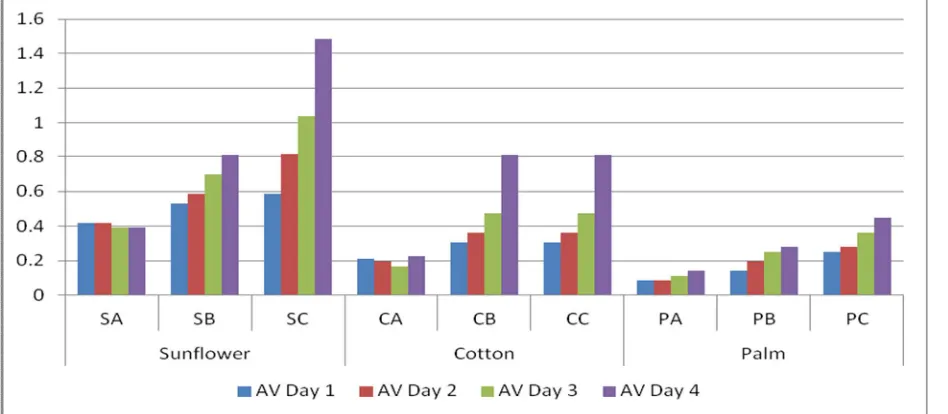
of both hydrolytic and oxidative rancidity of oils. The two are proportional to each other whereas the FFA is generally twice the acid value (AV). The acid values (AV) present the degradation of the oil quality resulting from the hydrolysis of triacylglycerol as well as further decomposition of hydroperoxides. The %FFA content is the most commonly used criterion for determining the quality of crude oil; the FFA content must not exceed 5% as oleic acid in palm according to CODEX Alimentarius 210, [9]. FFA is formed due to the hydrolysis of triacylglycerol by lipase in the mesocarp of the palm fruit. This enzyme is activated at maturity upon bruising and/or wounding of the fruit or, to some extent, by microbial contamination [10]. After processing the fruits for oils, the lipase becomes no longer active for the production of FFA. The formation of FFA in oils is a result of autocatalytic hydrolysis [11, 12]. The general trend showed increasing mean values with time in which the samples exposed to both light and air (Condition C) were the most affected. On the other hand the samples protected from both light and air were mostly stable over the whole experimental time of four days.(Fig. 1). Similar results were reported showing increasing values of FFA in oils that were exposed to open air, packaged in plastic bottles exposed to high light, heat and humidity [13, 14, 15].
Deterioration of oils is more pronounced in sunflower and cotton than in palm oils based on their structural differences. The presence of unsaturation in sunflower and cotton molecules make the oils to become more prone to oxidation compared to the later, palm oil which is saturated (Fig. 1).
Peroxide values (PV): Peroxide value is the most widely used test for oxidative rancidity, peroxide value is a measure
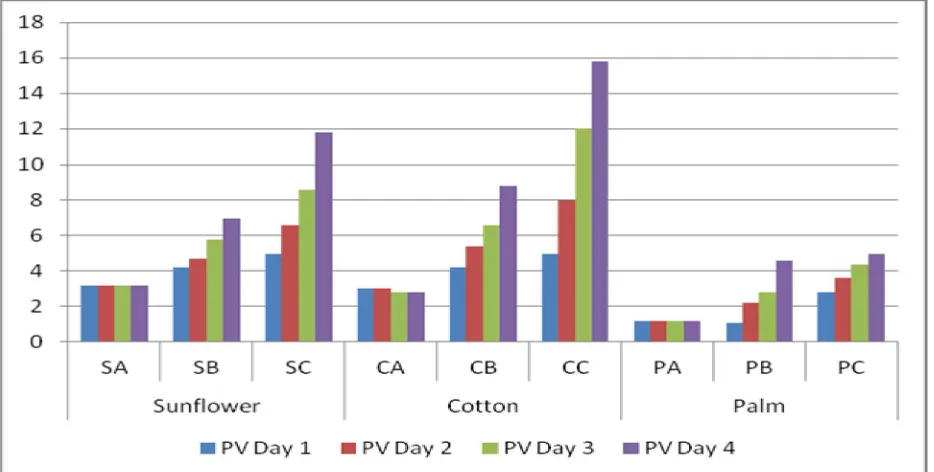
of the concentration of peroxides and hydroperoxides formed in the initial stages of lipid oxidation. The PV is an indicator of the level of lipid peroxidation or oxidative degradation. The PV for the three samples; sunflower, cotton and palm oil showed a similar trend of increasing mean values with time in which the samples exposed to both light and air were the most affected while the samples protected from both light and air were stable throughout (Fig 2).
Figure 2: Mean peroxide values (PV) for oils exposed to different conditions
The current study shows the range of 4.1 to 7.0 and 5.0 to 12 meq O2Kg-1 for sunflower in condition B and C, respectively for the four consecutive days. The cotton oil showed a range of 4.1 to 8.7 and 5.0 to 16 meq O2Kg-1 in conditions B and C, respectively. A rancid taste is often noticeable when the PV is between 20 and 40 meq O2kg–1 of oil [16], however, a low PV does not indicate that the oil is good; it only gives an indication of the current state of oxidation of an oil sample and does not indicate the potential for oxidation [11]. High peroxide values are a definite indication of a rancid fat, but moderate values may be the result of depletion of peroxides after reaching high concentrations. The argument shows a necessity of testing for more indicators to explain the state of the oil based on the rancidification.
Recommended values by WHO/FAO and TBS: The marginal values obtained for Acid Values (AV) and Peroxide
Table 1: Recommended Physicochemical Characteristics of Edible Oils as Given by FAO/WHO and by TBS.
Oil Brand FFA1 AV1 PV1 FFA2 AV2 PV2 FFA3 AV3 PV3
%oleic acid
Mg KOH/g
Meq/kg %oleic Mg KOH/g
Meq/kg %oleic Mg KOH/g
Meq/kg
SunFlower 0.085 < 0.6 < 10 0.085 < 0.5 - 0.72 < 1.45 < 11.5
Palm Oil 1.376 < 0.6 < 10 1.376 < 0.5 < 3 0.21 < 0.42 < 4.5
Cottonseed Oil
0.225 < 0.6 < 10 0.225 < 0.3 - 0.4 < 0.8 < 16.0
1=WHO/FAO standard, 2=TBS standard and 3= Values observed in the current study
Lowest levels of FFA, PV and AV were observed in Palm oil, followed by Cotton oil and Sunflower oil respectively. The levels set by the FAO/WHO and TBS are generally the same. The levels of FFA, PV and AV observed in this study showed values in Cotton oil and Sunflower oils that exceeded the national and international recommended levels. Statistical Analysis: The statistical analysis by r-test showed a positive correlation (p< 0.05) between light and/or air exposure of the oils and the degree of spoilage (rancidity) of the oils. This shows that light and air contribute significantly in deterioration of cooking oils. (Fig 3 and 4). In the determination of effect of light and air on the deterioration of oil, all effects were reported as significant at p<0.05. There was a significant effect of exposure of light/air on oil on the peroxide value (PV), F(1.848, 548.983)=105795.603. The contrasts revealed that effect on day 2, F(1,297)=34769.897, r=0.996; day 3, F(1,297)= 173680.089, r=0.999 , and day 5, F(1,297)= 160345.810, r=0.999, were significantly higher than on day 1. Similar results were obtained for Acid values (AV).
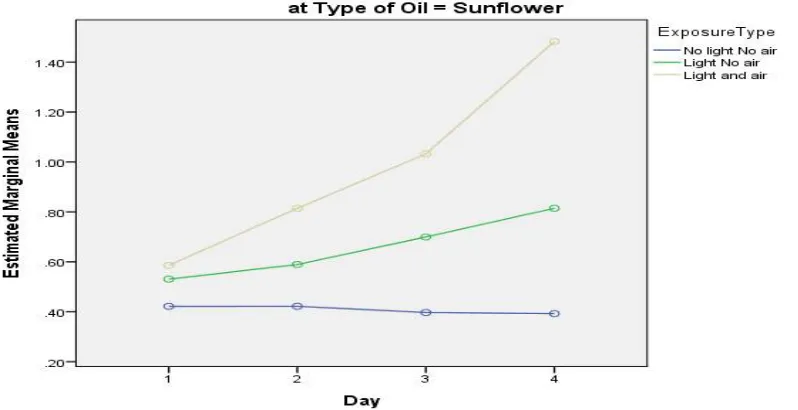
Contribution of light and air in the deterioration of oils are in the same magnitude 50:50 (Fig. 2) as shown by the sunflower oil (Fig. 3).
The trend of deterioration in the sunflower oil under these conditions were that the oil exposed to both light and air >oil exposed to light alone > oil exposed to none. Similar trend was observed for cotton and palm oil, respectively. The variation of acid values in the three oils showed the trend of deterioration as follows: sunflower> Cotton> Palm oil(Fig 3). The trend shows that the palm oil is more stable under these extreme conditions as compared to other oils. This was also observed when the oils were subjected to condition B where the samples were exposed to light only(Fig 4).
Figure 4: Acid Values variation among the three oils exposed to different conditions of light and air.
In fig.4 above, the estimated marginal means from day 1 to day 4 is estimated in the range of 16 – 25 (10), 30 - 80(50) and 50 – 90(40) for Palm oil, Cotton oil and Sunflower oil, respectively. The results show also increased rate of oxidation with exposure time.
IV. CONCLUSION
The oxidative stability of oils is affected by the storage conditions including exposure to light and air. The study showed the values of PV, AV and FFA varying proportionally with the exposure to light and air. There was also a significant difference between the oils stability to spoilage where palm oil showed the highest stability (p<0.05). The stability of the palm oil was related to the saturated structure of the palm oil limiting a number of reactions that may occur across the double bond. The two parameters; light and air equally affected the stability of oils. The values of AV, PV and FFA observed for the four days did not reach alarming levels but shows increasing deterioration of oil with prolonged exposure times. The most important for the users is to observe less exposure time to light and air for the oils since the picture is clear that these exposures affect the stability of light. For this matter among the three oils tested the palm oil is preferred for use that the rest. However, the most alarming experience in developing countries and in Tanzania in particular is the poor way of processing and handling of cooking oils. Most of vegetable oils are packaged in transparent plastic containers before and after refinery process. During marketing transfers from one container to another is common regardless of length of exposure to factors like light and air. The small scale retailer shops are advised to buy small packages of the commodity that will not take long time in their hands and also to get rid of unnecessary exposures to light and air.
ACKNOWLEDGEMENT
The Tanzania Bureau of Standards (TBS) is highly appreciated for providing technical assistance and laboratory space for sample analysis. Sincere acknowledgements are extended to Pendo Dennis who assisted in laboratory tests and Edwin Rutalebwa for statistical analysis of the data.
REFERENCES
[1] Pearson, D. ‘Chemical analysis of food’, Cornell University, 2008. [2]Halmiton, R.J., John, C.A. ‘Rancidity in food’. Springer, 1994, pg304.
[3]Board, N. ‘Morden Technology of oils, fats and its derivatives’, National Institute of Industries, 2002. [4]Singhal, S.R. ‘Hand book of food quality and Authenticity’, Woodland Publishing Limited, pp 306-309, 1997. [5] Science daily, ‘Toxic Substances in Oxidation of Fats and Oil’. United Kingdom, 2005.
[6] Leyton, J., Drury, P.J., Crawford, M.A. ‘Differential Oxidation of Saturated and Unsaturated Fatty Acids in Vivo in the Rat’. British Journal of Nutrition, Vol 51, pp 383-393, l987.
[7]TZS 561 1979b ‘Tanzania Standard Oils and Fats-Sampling and Test Methods’ Part 1: Sampling and Chemical Tests, Tanzania Bureau of Standards, 1979.
[8]TZS 561 2001 ‘Tanzania Standards, Sampling and Test Methods for Palm Oil and Palm Oil Products’, Tanzania Bureau of Standards, 2001. [9]WHO/FAO, CODEX ALIMENTARIUS, International Food Standards, 2011.
[10]Ebonguea, G.F.N, Dhouibc, R., Carrièrec, F., Amvam Zollob, P.H., Arondelc, V. ‘Assaying Lipase Activity from Oil Palm Fruit Mesocarp’, Plant Physiol. Bioch., Vol.44, pp 611–617, 2006.
[11] Frank, N.E.G., Albert, M.M.E., Ekwe D. ‘Assessment of the Quality of Crude Palm Oil from Small Holders in Cameroon’, J. Stored Prod. Postharvest Res., Vol 2, pp 52-58, 2011.
[12] Idris, N.A., Abdullah, A., Halim, A.H. ‘Evaluation of Palm Oil Quality, Correlating Sensory with Chemical Analyses’. J. Am. Oil Chem. Soc., Vol.69, pp 272-275, 1992.
[13]Henry, O.H. ‘Monitoring the Free Fatty Acid Levels of Crude Palm Oil Stored under Light of Different Wavelengths, Am. J. Food Technol. Vol. 6, pp 701-704, 2011.
[14]Nkpa, N.N., Osanu, F.C., Arowolo, T.A. ‘Effect of Packaging Materials on Storage Stability of Crude Palm Oil’, J. Am. Oil Chem. Soc., Vol. 67, pp 259-263, 1990.
[15]Akinyeyea, R.O., Adeyeye, E.I., Fasakina, O., Agboolaa, A. ‘Physico-Chemical Properties and Anti-Nutritional Factors of Palm Fruit Products (Elaeis Guineensisjacq.) from Ekiti State Nigeria’, Electron. J. Environ. Agric. Food Chem., Vol.10, pp 2190-2198, 2011.