ABSTRACT
FENG, YUAN. Nonparametric Methods for High-dimensional and Longitudinal Data. (Under the direction of Luo Xiao and Eric Chi).
Multivariate response data are frequently produced in modern scientific applications. In this
dissertation we focus on developing statistical and computational methods for the following types
of multivariate data:
1. growth data(Ti j,Yi j), j=1,· · ·,mi, i=1,· · ·,n
Ti j is the (time, measurement) pair for subjecti at thejth visit,mi is the number of visits for
subjecti, andnis the number of subjects.
2. multivariate response data with covariates{(yi,xi), i=1,· · ·,n}
yi∈Rq is the response vector of interest andxi∈Rpis the covariate vector.
In Chapter 1 we use data from the Fetal Growth Longitudinal Study of the INTERGROWTH-21st
Project to model the longitudinal dependence of fetal growth metrics with a two-stage approach.
The first stage involved finding a suitable transformation of the raw measurements and applied to
the longitudinal data to provide standardized deviations (Z-scores). In the second stage, the focus is
to model the temporal correlation which we model by a Gaussian process with zero mean and unit
variance. We consequently provide formulae and visualization tools for obtaining the correlation
for each fetal measure at any two time points between 14 and 40 weeks.
In Chapter 2 we propose a sparse multivariate single index model, where responses and
predic-tors are linked by unspecified smooth functions and multiple matrix level penalties are employed to
select predictors and induce low-rank structures across responses. An alternating direction method
of multipliers (ADMM) based algorithm is proposed for optimization. We demonstrate the
effec-tiveness of proposed methods in simulation studies and an application to conducting a genetic
In Chapter 3 we propose computation strategies for the penalized matrix bi-factorization
ap-proach to address some of the computational issues for the multivariate response linear regression
model when the dimension of the coefficient matrix is high. We also generalize this approach to
deal with matrix regression. The proposed computation strategy has good estimation accuracy and
© Copyright 2019 by Yuan Feng
Nonparametric Methods for High-dimensional and Longitudinal Data
by Yuan Feng
A dissertation submitted to the Graduate Faculty of North Carolina State University
in partial fulfillment of the requirements for the Degree of
Doctor of Philosophy
Statistics
Raleigh, North Carolina
2019
APPROVED BY:
Rui Song Jessie Jeng
Luo Xiao
Co-chair of Advisory Committee
Eric Chi
DEDICATION
BIOGRAPHY
The author was born in Wuhan, China. He earned a Bachelor of Science degree from Department
of Mathematics and Statistics, Wuhan University in 2013 and a Master of Business degree from
Department of Statistics, National Cheng Kung University in 2015. Later in 2015, he entered the Ph.D.
program of Statistics at North Carolina State University. He will graduate with a Ph.D. in Statistics in
ACKNOWLEDGEMENTS
First and foremost, I would like to express my sincerest gratitude to my co-advisors Dr. Luo Xiao
and Dr. Eric Chi. Both of you are knowledgeable young professionals, and your enthusiasm on
research and teaching infected me deeply. I learned a lot from our discussions, and always got
patient instructions and encouragements from you when I faced difficulty in my projects. Your great
support enabled me to move forward towards this dissertation. Hope that we can all be the best
version of ourselves in future.
I would like to thank Dr. Rui Song, Dr. Jessie Jeng and Dr. Derek Kamper for being able to serve
on my committee and provide insightful comments. I would like to thank Dr. Wenbin Lu for the help
as the director of graduate program. I really appreciate the richness of the graduate level courses
provided by the department and would like to extend my thank all the instructors and TAs.
I would like to thank my mentors Jerry Yang and Shuling Liu at WalmartLabs and Sabrina Wan at
Merck. The two unforgettable internship experience made me more confident on my learning and
myself. I would also like to thank all my friends here at NCSU. You are an important part of these
four years’ memory, and our friendship will long last.
Finally, I would like to thank my family: little Claire, Liuyi and our parents. You are my strength.
TABLE OF CONTENTS
LIST OF TABLES . . . vii
LIST OF FIGURES. . . .viii
Chapter 1 Correlation Models for Monitoring Fetal Growth. . . 1
1.1 Introduction . . . 1
1.2 Data . . . 2
1.3 Statistical Methodology . . . 4
1.3.1 Working Models for Marginal Reference Distribution . . . 4
1.3.2 Correlation Models . . . 5
1.3.3 Estimation of the Correlation Models . . . 8
1.4 Results . . . 12
1.4.1 Marginal Reference Charts . . . 12
1.4.2 Correlation Models . . . 12
1.5 Case Study: Dynamic Growth Velocity . . . 16
1.6 Discussion . . . 17
1.7 Acknowledgments . . . 20
Chapter 2 Sparse Single Index Models for Multivariate Responses . . . 21
2.1 Introduction . . . 21
2.2 Regularized MSIM . . . 25
2.3 Estimation . . . 27
2.3.1 Step 1: EstimatingF . . . 27
2.3.2 Step 2: EstimatingB . . . 28
2.3.3 Marginal Screening and Identifiability . . . 32
2.3.4 Algorithm, Computation Complexity and Convergence . . . 32
2.4 Tuning Parameter Selection . . . 34
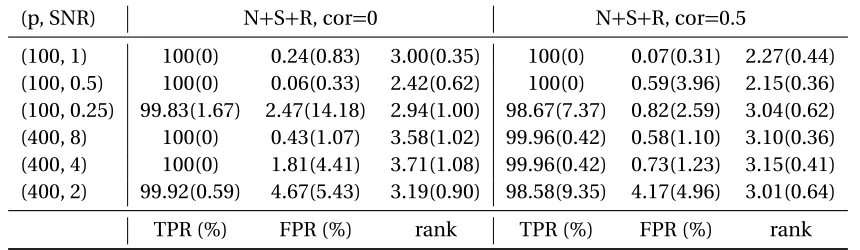
2.5 Simulation Studies . . . 35
2.6 Application to a Genetic Association Study . . . 37
2.7 Conclusion and Future Work . . . 39
Chapter 3 Penalized Matrix Factorization . . . 42
3.1 Introduction . . . 42
3.2 Penalized Matrix Factorization . . . 45
3.2.1 Nuclear Norm Surrogate Penalization . . . 47
3.2.2 Max Norm Penalization . . . 48
3.3 Application to Multivariate Response Regression . . . 48
3.4 Application to Matrix Regression . . . 51
3.5 Conclusion and Future Work . . . 53
APPENDIX . . . 62
Appendix A Supplemental Material . . . 63
A.1 Correlation Models for Monitoring Fetal Growth . . . 63
A.2 Sparse Single Index Models for Multivariate Responses . . . 67
A.2.1 Derivation of Gradients . . . 67
A.2.2 Mean functions Using MSIM Model for the Gene Pathway Data . . . 68
LIST OF TABLES
Table 1.1 Correlation models. . . 7
Table 1.2 Comparison of correlation models. . . 13
Table 1.3 MSE(·, P1+) comparison. . . 14
Table 1.4 Estimated parameters for P1+correlation models. . . 15
Table 2.1 Common matrix penalties and proximal maps. . . 31
Table 2.2 True positive rate, false positive rate and rank selection result. . . 37
Table 2.3 MSE for signal part. . . 37
Table 2.4 Gene pathway data 10-fold cross-validation result,(n,p,q) = (118, 39, 62). . . 38
Table 2.5 Contaminated gene pathway data (simulated) result,(n,p,q) = (118, 200, 62). . 38
Table 3.1 Scenario I,ρ=0.5, true rank=10. . . 50
Table 3.2 Scenario II,ρ=0.5, true rank=5. . . 50
Table 3.3 Scenario I,ρ=0.5, true rank=10. The three numbers are (Est, Pred, Time). . . 51
Table 3.4 Scenario II,ρ=0.5, true rank=5. The three numbers are (Est, Pred, Time). . . 51
Table 3.5 Simulation results of MSE for penalized matrix regression. . . 52
Table A.1 Correlation matrix for AC . . . 66
Table A.2 Correlation matrix for FL . . . 66
Table A.3 Correlation matrix for HC . . . 67
Table A.4 Scenario I,ρ=0.1, true rank=10. . . 71
Table A.5 Scenario I,ρ=0.9, true rank=10. . . 71
Table A.6 Scenario II,ρ=0.1, true rank=5. . . 72
LIST OF FIGURES
Figure 1.1 Estimated location, scale and skewness parameters as functions of gestational
age for the three fetal growth measurements. . . 8
Figure 1.2 Estimated kurtosis parameters as functions of gestational age for the three
fetal growth measurements using BCPE and BCT. . . 9
Figure 1.3 Smooth estimates of the first to fourth moments of the constructed Z-scores
for AC (left panel), FL (middle panel) and HC (right panel). . . 10
Figure 1.4 Further comparison of BCCG (solid), BCPE (dashed) and BCT (dotted) on the
fourth moments ofZ-scores. . . 11
Figure 1.5 Smooth estimates of the first and second moments of Z-scores constructed
via BCCG (solid) and SDS (dashed). . . 13
Figure 1.6 Temporal correlations of standardized AC with different correlation models. . 15
Figure 1.7 Observed growth trajectory (linked triangles) and predicted measurements
(dots) given most recent observations of a randomly selected fetus. Dashed line is the population mean. . . 16
Figure 1.8 Longitudinal fetal growth calculator. . . 18
Figure 2.1 Linear and nonlinear regression models based on the same set of pre-selected
covariates for various responses - red: single index model; blue: linear model. In order to compare index model with linear model in the same plot, the coefficient vector for each response is fixed for both models and only the unknown function of the index is considered. . . 23
Figure 2.2 Mean functions for some responses using MSIM model for the gene pathway
data. . . 40
Figure 3.1 Illustration plots for penalized matrix regression. Top left is the true signal
region; top middle is the recovered matrix using a randomly generated initial matrix; top right is the warm-up initial matrix using Frank-Wolfe; Bottom panel contains recovered matrices using warm-up initial matrix with different tuning parameters for penalization. . . 54
Figure A.1 Temporal correlations of standardized FL with different correlation models. . 64
Figure A.2 Temporal correlations of standardized HC with different correlation models. . 65
Figure A.3 Mean functions using MSIM model for the gene pathway data - I. . . 68
Figure A.4 Mean functions using MSIM model for the gene pathway data - II. . . 69
CHAPTER
1
CORRELATION MODELS FOR
MONITORING FETAL GROWTH
1.1
Introduction
During pregnancy, fetal anthropometric measures consisting of head circumference (HC),
abdomi-nal circumference (AC) and femur length (FL) are measured using ultrasound to monitor attained
fetal size at a given gestational age (GA). By comparing measurements to a defined reference or
standard[TW76; Cam80], fetuses with measurements at the extreme ends of the distribution (for
example below the 3rd, 5th, or 10thcentiles or above the 90th, 95th, or 97thcentiles) are identified as
being at increased risk of a growth disorder, such as intra-uterine growth restriction (IUGR) that
may require further investigation. Growth charts, which conventionally record only cross-sectional
assessment of velocity enables the evaluation of an individual’s growth between any two time points
(rate of growth). These changes observed between two time points may be used to identify those
requiring closer monitoring in the case of great differences between the observed fetal size and what
is expected at a specific time. Notably, fetal growth is rapid in the first and second trimester and
slows towards term. An evaluation of growth velocity ought to consider the correlation of
measure-ments from the same individual. The correlation coefficient is not constant as it is dependent on
the interval between measurements. An estimate of the correlation coefficient is straightforward for
fixed time intervals, but it is clinically useless as, in normal practice, fetuses are seen and measured
at arbitrary time points. For pragmatic reasons, it is impossible to see and measure everyone at fixed
time intervals. Therefore, a flexible model that represents the correlation as a function of time is
required. To the best of our knowledge, correlation models have previously been derived for child
data[Arg08a; And18; Wri94; Col98; Col94]but not for fetal biometry data.
The main aim of this article is therefore, to model the correlation of fetal biometry i.e., HC, AC,
and FL and make available formulae or a tool that can be used to obtain the correlation for each
fetal measure between measurements made at any two time points between 14 and 40 weeks of GA.
We model the correlations using fetal ultrasound data from the INTERGROWTH-21stProject Fetal
Growth Longitudinal Study (FGLS) that were used to construct the international standards for fetal
growth[Pap14; Ohu18]. Further analysis of the cohort demonstrated that the FGLS cohort remained
healthy with adequate growth and motor development up to 2 years of age[Vil18].
1.2
Data
The INTERGROWTH-21stProject was a population-based longitudinal study that measured serial
fetal growth scans every 5±1weeks from recruitment at 9+0- 13+6weeks of gestation until, but not
beyond, 42+0weeks of gestation. The FGLS component of the INTERGROWTH-21stProject is a
unique dataset as it is the largest prospective study to collect data on fetal ultrasound measurements
from optimally healthy pregnant women to date, collecting data in eight geographically diverse
growth scans every 5±1weeks after the initial dating scan, so that the possible ranges after the dating
scan were 14−18, 19−23, 24−28, 29−33, 34−38, and 39−42 weeks of gestation. To ensure all
centres collected high-quality data that were comparable within and between the study sites, all
sonographers and anthropometrists were trained, and all ultrasound measurements were performed
in a standardized manner following strict protocols[Sar13]. All centres adopted uniform methods,
used identical ultrasound equipment in all of the study sites, adopted standardized methodology
to take fetal measurements, and employed locally accredited ultra-sonographers who underwent
standardization training and monitoring.
The analysis was based on the target sample of 4,321 women (20,313 ultrasound scans) who
had pregnancies without major complications and delivered live singletons without congenital
malformations that contributed data for the construction of the INTERGROWTH-21stinternational
fetal growth standards[Pap14], international gestation-specific newborn standards[Vila], gestational
weight gain standards[Lei], and preterm postnatal growth standards[Vil15]. This cohort experienced
very low maternal and perinatal mortality and morbidity rates[Pap14; Vila], confirming that the
participants were at low risk of adverse outcome and therefore contributed to the construction of
the international fetal growth standards. The baseline characteristics of the study cohort across the
eight sites were very similar, which was expected because women were selected from the underlying
low-risk populations using the same clinical and demographic criteria[Pap14; Vilb]. The median
number of ultrasound scans (excluding the dating scan) was 5.0 (mean=4.9, SD=0.8, range from
4 to 7) and 97% of women had 4 scans (mean=5.0, SD=0.6, range from 4 to 7), indicating that
participants adhered well to the protocol. Eighty-five percent of the 20,313 ultrasound scans were
performed within the expected gestational age window of the protocol[Pap14].
The INTERGROWTH-21stProject was approved by the Oxfordshire Research Ethics Committee
“C” (reference: 08/H0606/139), the research ethics committees of the individual participating
in-stitutions, and the corresponding regional health authorities where the project was implemented.
1.3
Statistical Methodology
Consider the longitudinal data{(Ti j,Yi j), 1≤ j ≤mi, 1≤i ≤n}, whereTi j is the gestational age
in weeks for subjecti at the jth visit,Yi j is one of the three ultrasound growth measurements
continuously valued in millimeters atTi j,mi is the number of visits for subjecti, andn is the
number of subjects. Note that the total number of visits can be different for each subject. The goal
is to construct a correlation matrix of the ultrasound measurement at different gestational ages.
Fetuses will not be dichotomized by gender for growth measurement evaluation, and it is also
not the norm as not all populations desire to know fetal sex. Because the marginal distributions of
ultrasound growth measurements may be non-normal, e.g., skewed, a suitable transformation of the
raw growth measurements is first identified and applied to the data to construct a working marginal
reference chart. The raw measurements are then transformed accordingly to provide standardized
deviations (Z-scores). Next the Z-scores are modeled by a Gaussian process with zero mean and
unit variance so that the temporal correlation of the process can be estimated.
1.3.1 Working Models for Marginal Reference Distribution
We consider the LMS transformation[CG92]which could transform non-normal data into normal
data. LetY be a positive random variable and its LMS transformation is given by
Z=
1 σν
¦Y µ
ν
−1© if ν6=0,
1 σlog
Y µ
if ν=0.
(1.1)
Hereµ,σ∈R+andν∈Rare location, scale and skewness parameters, respectively. IfZ has a
standard normal distribution, thenY is said to follow the three-parameter Box-Cox Cole-Green
distribution[CG92]denoted by BCCG(µ,σ,ν). A fourth parameter can be added to further model
kurtosis: ifZhas at distribution with degrees of freedomτ∈R+, thenY is said to follow the Box-Cox
t distribution[RS06]denoted by BCT(µ,σ,ν,τ); ifZ has a standard power exponential distribution
denoted by BCPE(µ,σ,ν,τ). Note that BCT(µ,σ,ν,τ= +∞)and BCPE(µ,σ,ν,τ=2)reduce to BCCG(µ,σ,ν).
In practice, ultrasound measurements are often taken at irregular visits, i.e., observed at
gesta-tional ages that differ between subjects. Thus, it may not be feasible to find the proper transformation
at each gestational age separately. Instead, a more practical and statistically efficient approach is
to model the parameters in (1.1) as a smooth function of gestational age. We shall adopt such an
approach and the parameters for BCCG becomeµ(t),ν(t)andσ(t), wheret denotes the gestational
age. The additional parameters in BCT and BCPE are similarly defined. The GAMLSS method[SR07]
can be used to estimate such functions. Under the LMS framework, suppose thatµˆ(t), ˆσ(t), ˆν(t)
are the obtained estimates, then the transformed measurementsZi j can be computed as
Zi j=
1 ˆ
σ(Ti j)νˆ(Ti j)
§ Yi j
ˆ µ(Ti j)
ˆν(Ti j)
−1
ª
if ˆν(Ti j)6=0,
1 ˆ σ(Ti j)log
Yi j ˆ µ(Ti j)
if ˆν(Ti j) =0.
(1.2)
Under the BCCG model, marginallyZi j has approximately a standard normal distribution. Under
the BCT or the BCPE models, additional transforms ofZi j are needed to makeZi j normal. For
simplicity, we assume all proper transformations have been taken. Then we modelZi j as a
zero-mean Gaussian process with a constant variance of 1. The Gaussian process is fully identified by
estimating its correlation matrix.
1.3.2 Correlation Models
In this section, we focus on constructing a growth correlation matrix for the Z-scores. We shall
compare several parametric and nonparametric models. The parametric models considered here
are those that have been used for modeling child growth correlation. The exponential model[Dig88]
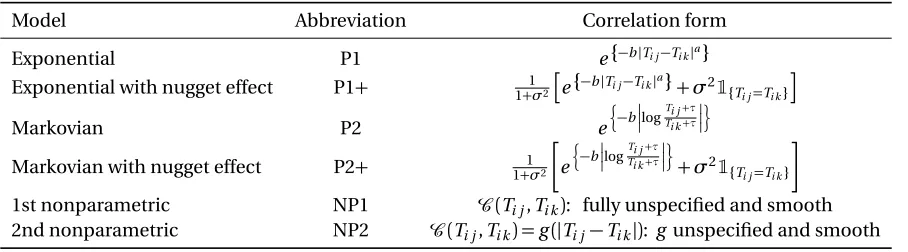
(denoted by P1) is
cor(Zi j,Zi k) =e{−b|Ti j−Ti k|
a}
wherea,b∈R+are two unknown parameters that can be interpreted as the order and the rate of
the change in the correlation. This model is commonly used due to its simple form and stationarity,
i.e., the correlation depends only on the distance between two gestational ages. The second model
(denoted by P2), proposed by[Arg08a]for child growth, takes the form
cor(Zi j,Zi k) =e
n
−b
log
Ti j+τ
Ti k+τ
o
,
where τ,b ∈ R+are two unknown parameters. The model is non-stationary, but possesses the
Markovian property. Indeed, via the transformationSi j=log(Ti j+τ)andSi k=log(Ti k+τ), the corre-lation becomes cor(Zi j,Zi k) =ρ|Si j−Si k|, whereρ=e(−b). Because growth measurements might have non-ignorable measurement errors, a nugget effect term is usually added to the above correlation
models. The exponential correlation with a nugget effect model (denoted by P1+) takes the form
cor(Zi j,Zi k) = 1 1+σ2
e{−b|Ti j−Ti k|a}+σ21 {Ti j=Ti k}
,
whereσ2is the variance of the measurement error in the Z-scores and1
{}is the indicator function
which is 1 if the statement inside the bracket is true and 0 otherwise. Similarly, the P2+correlation
model has the form
cor(Zi j,Zi k) = 1 1+σ2
e n −b log
Ti j+τ
Ti k+τ
o
+σ21
{Ti j=Ti k}
.
Note that with the nugget term, neither the stationary property nor the Markovian property holds.
Parametric models are simple and easy to interpret, but they can be subject to model
misspecifi-cation. Thus, in addition to the above parametric correlation models, we shall also consider two
nonparametric correlation models. The first one is based on functional data analysis[Yao05], which
Table 1.1Correlation models.
Model Abbreviation Correlation form Exponential P1 e{−b|Ti j−Ti k|a}
Exponential with nugget effect P1+ 1+1σ2
e{−b|Ti j−Ti k|a}+σ21
{Ti j=Ti k}
Markovian P2 e n
−b
log
Ti j+τ
Ti k+τ
o
Markovian with nugget effect P2+ 1+1σ2
e n
−b
log
Ti j+τ
Ti k+τ
o
+σ21
{Ti j=Ti k}
1st nonparametric NP1 C(Ti j,Ti k): fully unspecified and smooth
2nd nonparametric NP2 C(Ti j,Ti k) =g(|Ti j−Ti k|): gunspecified and smooth
a random measurement error term. Specifically, the functional data model is
Zi j=bi(Ti j) +εi j, (1.3)
where bi(·)is a random and smooth function modeled by a zero-mean Gaussian process with
a smooth covariance functionC(Ti j,Ti k) =Cov{bi(Ti j),bi(Ti k)},{εi1, . . . ,εi mi}are independent
measurement errors with varianceσ2
ε, andbi(·)is independent from the measurement errors.
Such a covariance function does not impose any parametric assumption for modeling correlations
between the repeated observations and is hence very flexible. Since Var(Zi j) =1, the correlation of
the Z-scores at two distinctive time pointsTi j andTi kwithj6=k is automatically given byC(Ti j,Ti k).
Thus, we callC the correlation function and its estimation is described in Section 1.3.3.
The correlation function from the functional data method is in general nonstationary. We shall
also consider a stationary but yet nonparametric correlation by assuming that the correlation
functionC satisfiesC(Ti j,Ti k) =g(|Ti j−Ti k|), whereg is a smooth but unspecified univariate
function. Note that due to the presence of measurement error in the functional data model, the
overall correlation between the Z-scores is still nonstationary. The estimation ofg is also given in
Section 1.3.3.
15 20 25 30 35 40 100 200 300 GA (week) A
C: location par
.
15 20 25 30 35 40
0.055
0.065
0.075
GA (week)
A
C: scale par
.
15 20 25 30 35 40
0.4 0.6 0.8 1.0 GA (week) A C: skne wness par .
15 20 25 30 35 40
10 20 30 40 50 60 70 GA (week)
FL: location par
.
15 20 25 30 35 40
0.06
0.08
0.10
0.12
GA (week)
FL: scale par
.
15 20 25 30 35 40
0.4 0.6 0.8 1.0 GA (week) FL: skne wness par .
15 20 25 30 35 40
100 150 200 250 300 GA (week)
HC: location par
.
15 20 25 30 35 40
0.035
0.045
0.055
0.065
GA (week)
HC: scale par
.
15 20 25 30 35 40
0.0 0.5 1.0 1.5 GA (week) HC: skne wness par .
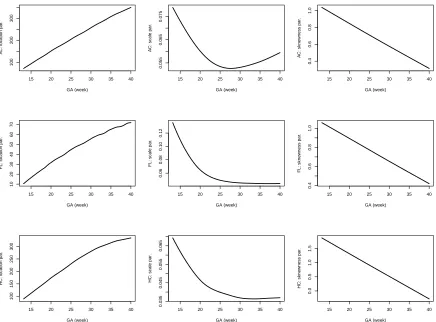
Figure 1.1Estimated location, scale and skewness parameters as functions of gestational age for the three fetal growth measurements.
1.3.3 Estimation of the Correlation Models
The parametric correlation models can be easily estimated by maximizing likelihood of theZ-scores
under normality. We now focus on the estimation of the two nonparametric models. Estimation
methods for the functional data model have been well developed in the statistics literature and here
we use the fast covariance estimation method for longitudinal data, developed in[Xia18]. We briefly
describe the method here, which will also be useful for explaining our estimation method for the
second nonparametric model. First, empirical estimates of the correlation function are constructed.
15 20 25 30 35 40
1.8
1.9
2.0
2.1
2.2
GA (week)
A
C
, FL, HC: kur
tosis par
. b
y BCPE
AC
FL
HC
15 20 25 30 35 40
0
100
200
300
400
500
GA (week)
A
C
, FL, HC: kur
tosis par
. b
y BCT
AC
FL
HC
−0.10 −0.05 0.00 0.05 0.10
20 30 40 GA (week) A C: Z_{ij} −0.10 −0.05 0.00 0.05 0.10
20 30 40 GA (week) FL: Z_{ij} −0.10 −0.05 0.00 0.05 0.10
20 30 40 GA (week) HC: Z_{ij} 0.8 0.9 1.0 1.1 1.2
20 30 40
GA (week) A C: Z_{ij}^2 0.8 0.9 1.0 1.1 1.2
20 30 40
GA (week) FL: Z_{ij}^2 0.8 0.9 1.0 1.1 1.2
20 30 40
GA (week) HC: Z_{ij}^2 −0.2 −0.1 0.0 0.1 0.2
20 30 40
GA (week) A C: Z_{ij}^3 −0.2 −0.1 0.0 0.1 0.2
20 30 40
GA (week) FL: Z_{ij}^3 −0.2 −0.1 0.0 0.1 0.2
20 30 40
GA (week) HC: Z_{ij}^3 2.0 2.5 3.0 3.5 4.0
20 30 40
GA (week) A C: Z_{ij}^4 2.0 2.5 3.0 3.5 4.0
20 30 40
GA (week) FL: Z_{ij}^4 2.0 2.5 3.0 3.5 4.0
20 30 40
GA (week)
HC: Z_{ij}^4
2.0 2.5 3.0 3.5 4.0
20 30 40
GA (week)
A
C: Z_{ij}^4
2.0 2.5 3.0 3.5 4.0
20 30 40
GA (week)
FL: Z_{ij}^4
2.0 2.5 3.0 3.5 4.0
20 30 40
GA (week)
HC: Z_{ij}^4
Figure 1.4Further comparison of BCCG (solid), BCPE (dashed) and BCT (dotted) on the fourth moments ofZ-scores.
ri j kis an unbiased estimate ofC(Ti j,Ti k)wheneverj6=k. We will conduct a bivariate smoothing
of the data{(Ti j,Ti k,ri j k), 1≤ j 6=k ≤mi, 1≤i ≤n}to estimate the correlation functionC. We
use bivariateP-splines[EM03], which approximates the bivariate correlation function with
tensor-product B-splines and employs a smoothness penalty to avoid overfit. Moreover, constraints on
spline coefficients are imposed to ensure thatC is symmetric; see[Xia18]for further details. Denote
the corresponding estimate by ˆC(s,t), then we estimate the error varianceσ2
εusing the equality
E(ri j j) = C(Ti j,Ti j) +σε2 for 1≤ j ≤ mi, 1≤ i ≤n. For the second nonparametric model, by
assumption,E(ri j k) =g(|Ti j−Ti k|) +1{j=k}σ2ε. Thus, we smooth the data{(|Ti j−Ti k|,ri j k), 1≤j6=
k≤mi, 1≤i≤n}to estimate the functiong. Specifically, we use univariateP-splines[EM96], which
approximatesgusing B-spline bases and also controls overfit using a smoothness penalty. Then the
1.4
Results
1.4.1 Marginal Reference Charts
The estimated location, scale and skewness parameters show that a transformation model simpler
than BCCG will be insufficient to fit the data marginally; see Figure 1.1. Our empirical results also
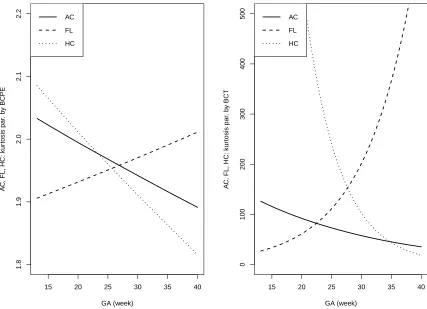
indicate the sufficiency of using BCCG rather than more complicated BCPE or BCT, as Figure 1.2
suggests that the estimated parameter of kurtosis is close to 2 for BCPE model and very large for BCT
model. Figure 1.3 plots the smoothed first to fourth moments of the Z-scores against the gestational
age. Specifically, fork =1, 2, 3, 4, a corresponding nonparametric smooth function is estimated
using the data{Zi jk, 1≤j≤mi, 1≤i≤n}. If the Z-scores are indeed marginally normal, then the
estimated curves should be close to the constant linesy =0, 1, 0, and 3, respectively. Figure 1.3
suggests that the BCCG-transformed Z-scores are marginally normally distributed. A closer look at
the smoothed fourth moments under different models in Figure 1.4 again suggest that BCPE and
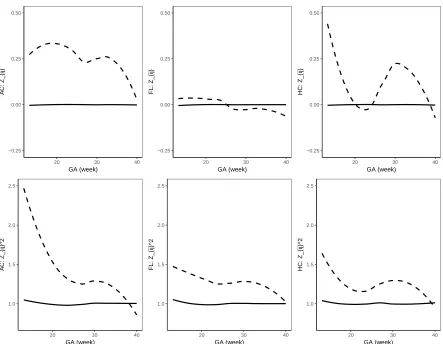
BCT are not necessary. We also note that for standardizing the raw measurements, BCCG seems to
be a much better approach than the standard SDS, which presents a systematic biased estimation;
see Figure Figure 1.5.
Consequently, the BCCG model will be applied to construct marginal reference charts.
1.4.2 Correlation Models
We use the BCCG model to fit the marginal distributions of the raw ultrasound measurements
and then convert the transformed measurements into Z-scores. Then different parametric and
nonparametric correlation models are considered and compared via model selection criteria: AIC
and BIC. Both criteria require the degrees of freedom of the model. For parametric correlation
models, it is the number of free parameters. For nonparametric correlation models, the effective
degree of freedom, which evaluates the model complexity of nonparametric smoothers[Rup03],
will be calculated.
−0.25 0.00 0.25 0.50
20 30 40 GA (week)
A
C: Z_{ij}
−0.25 0.00 0.25 0.50
20 30 40 GA (week)
FL: Z_{ij}
−0.25 0.00 0.25 0.50
20 30 40 GA (week)
HC: Z_{ij}
1.0 1.5 2.0 2.5
20 30 40
GA (week)
A
C: Z_{ij}^2
1.0 1.5 2.0 2.5
20 30 40
GA (week)
FL: Z_{ij}^2
1.0 1.5 2.0 2.5
20 30 40
GA (week)
HC: Z_{ij}^2
Figure 1.5Smooth estimates of the first and second moments of Z-scores constructed via BCCG (solid) and SDS (dashed).
Table 1.2Comparison of correlation models.
Models -2log-lik AIC BIC -2log-lik AIC BIC -2log-lik AIC BIC
P1 44656.31 44660.31 44673.01 42790.43 42794.43 42807.13 41999.78 42003.78 42016.48 P1+ 44505.17* 44511.17* 44530.21* 42672.04* 42678.04* 42697.08* 41846.77* 41852.77* 41871.82* P2 45201.95 45205.95 45218.64 43471.66 43475.66 43488.36 42117.83 42121.83 42134.53 P2+ 44540.30 44546.30 44565.34 42708.85 42714.85 42733.89 41943.10 41949.10 41968.15
NP1 44489.71 44509.85 44573.75 42681.81 42697.74 42748.32 41743.67 41783.82 41911.26
NP2 44524.09 44530.36 44550.24 42670.06 42678.54 42705.47 41863.42 41869.44 41888.52
AC FL HC
Note that∗denotes the best parametric model in each column. The bold type denotes the best
Table 1.3MSE(·, P1+) comparison.
Model AC FL HC
NP1 3.93×10⁻⁴ 4.46×10⁻⁴ 6.33×10⁻⁴
NP2 2.25×10⁻⁴ 6.46×10⁻⁵ 3.75×10⁻⁴
P1 2.87×10⁻³ 1.94×10⁻³ 1.98×10⁻³
P2+ 9.19×10⁻⁴ 3.73×10⁻⁴ 1.08×10⁻³
P2 1.40×10⁻² 1.36×10⁻² 2.82×10⁻³
the P1+model is overall the best model across the three fetal growth measurements. On the one
hand, P1+fits the data best among all parametric models; on the other hand, it has a very simple
form compared to nonparametric methods, and yields the smallest BIC. To quantify the differences
among different correlation models, we use P1+as the reference correlation and evaluate how
the other models differ from P1+. DenoteρP1j k+the correlation coefficient at times(j,k)in P1+
correlation matrix, the mean squared error (MSE) of NP1, for example, to P1+is defined as
MSE(NP1, P1+)= 1
(L−1)(L−2)
X
1≤j<k≤L
ρNP1
j k −ρ
P1+
j k
2
, (1.4)
whereL=183 is the range of gestational age in days in this study.
Table 1.3 demonstrates an ignorable difference between P1+and NP2, which is as expected
because of the stationarity nature of both models. Furthermore, difference between P1+and NP1 is
also small, suggesting that an exponential correlation model with nugget effect is sufficiently good
for fetal growth measurements. Indeed, the average difference in correlation is only 0.020 for AC,
0.021 for FL and 0.025 for HC. On the other hand, the correlations from the other parametric models
are relatively more divergent from those of P1+compared to the nonparametric models NP1 and
NP2, indicating the superiority of P1+over the other parametric models.
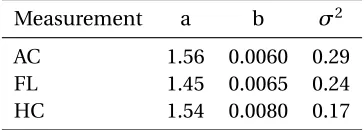
As a result, the estimated parameters for a P1+model are summarized in Table 1.4. For
illustra-tion, we plot the fitted correlation surface on a grid of gestational age by weeks for AC in Figure 1.6.
Table 1.4Estimated parameters for P1+correlation models.
Measurement a b σ2
AC 1.56 0.0060 0.29
FL 1.45 0.0065 0.24
HC 1.54 0.0080 0.17
100 200 300
20 30 40
GA (week)
A
C
20 40 60
20 30 40
GA (week)
FL
100 150 200 250 300 350
20 30 40
GA (week)
HC
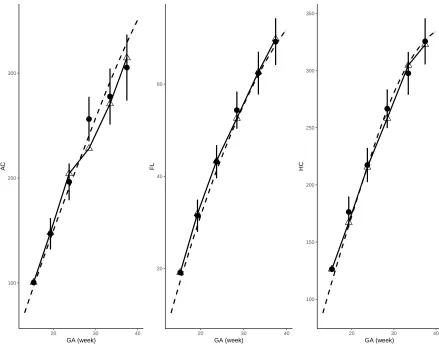
Figure 1.7Observed growth trajectory (linked triangles) and predicted measurements (dots) given most recent observations of a randomly selected fetus. Dashed line is the population mean.
1.5
Case Study: Dynamic Growth Velocity
As an example, we use the result from parametric correlation models to study the growth velocity
of a sample fetus chosen for the purpose of illustration, whose AC, FL and HC are consecutively
measured for 6 times between week 15 and week 38. The observed growth trajectories are shown
as linked triangles in Figure 1.7. Based on each observed measurement atTj, we also dynamically
predict the measurementTj+1shown as dots, each with a 95% prediction interval. Specifically, each
observed measurement atTj is transformed to Z-score using (1.2). Then, a conditional Z-score
Z〈Tj+
conditional Z-score is then transformed back to the original measurement given marginal references.
Clinicians might use this approach to compare the observed fetal growth measurements versus its
expected measurements at a certain age to determine if a fetus is growing normally. They can also
calculate and compare velocity increments. We will use the correlations studied in this paper for the
subsequent clinical paper on conditional fetal velocity for use by clinicians.
It is observed that for this randomly sampled fetus, the growth of FL and HC are regular and can
be accurately predicted. For GA, its measurements are higher (still normal) than predicted during
the third visit, but much lower than expected during the fourth visits. This suggests that a closer
monitoring might be needed. The following visits indicate that the GA of the sampled fetus becomes
consistently below the population mean.
To facilitate the usage of the obtained results in practice, a Shiny application is built along with
this paper, where functionalities such as visualization, calculating correlation, prediction and cSDS
are integrated for all the three fetal growth measurements (https://lxiao5.shinyapps.io/shinycalculator/);
see Figure 1.8.
In the meanwhile, correlation tables for fetal growth measurements are provided in appendix.
1.6
Discussion
We have modelled the correlation coefficients of fetal growth for HC, AC, and FL and provided
formulae that can be used to obtain the correlation coefficient for each fetal measure between
measurements made at any two time points between 14 and 40 weeks based on the FGLS data. The
FGLS cohort is the largest prospective study to date to collect data on fetal ultrasound measurements
among optimally healthy pregnant women, used many quality control measures, encompasses
eight geographically diverse populations, was population-based, involved a cohort of women at
low risk of intra-uterine growth restriction and preterm, remained healthy with adequate growth
and motor development up to 2 years of age, hence making it an ideal dataset for characterising the
expected correlation of fetal size measurements[Pap14; Vil18; Sar13; Vil15; Vil13].
lations offered a good fit to the empirical correlation structure. We modelled the correlations in
weekly intervals on the assumption that the correlations were reasonably stable within each week
of gestation. The fitted correlations decreased with increasing time interval as expected. Although
velocity charts could be an important complement to attained size charts[Pap14], they are not often
used clinically. For example, a clinician may be interested to know whether fetal HC at 20 weeks is a
good predictor of that same fetuses HC at 30 weeks. If we know the correlation between these two
time points, then we are able to make inference about what fetal HC might be at 30 weeks given
that we know their fetal HC at 20 weeks. Such predictions can be useful for identifying fetuses that
are faltering in growth i.e., if their observed fetal HC at 30 weeks is significantly less than what was
predicted. This would be indicative of poor growth within that time period that may be require
further investigation or intervention. A limitation of the study was paucity of data and small sample
sizes for some pairs of gestational ages especially in early gestation (first trimester) and at term (40
weeks).
In summary, we have for the first time provided formulae for obtaining correlation coefficients
for fetal biometry using data that was prospectively collected, involved eight countries from diverse
settings, collected using unified protocols, measurement procedures and standardisation, using
high quality data based on the rigorous data quality process that was put in place during the
study period. INTERGROWTH-21stProject is the largest prospective study of fetal growth involving
multiple measurements per fetus that were purposely obtained for the study. These equations for
obtaining corresponding correlation coefficients for any pair of data between 14 and 40 weeks and
consequently the calculation of a velocity Z-score provide a potentially useful tool for clinicians
who wish to monitor the fetal growth and development over time. To facilitate ease of use, a web
application (Shiny application for now) that calculates the expected correlation between any two
time points in the interval 14 to 40 weeks for HC, AC, and FL will be made freely available on the
INTERGROWTH-21stwebsite where other applications for fetal, preterm, and newborn size are
1.7
Acknowledgments
This study was funded by the INTERGROWTH-21stgrant 49038 from the Bill & Melinda Gates
Foundation to the University of Oxford; we gratefully acknowledge their support. We would also like
CHAPTER
2
SPARSE SINGLE INDEX MODELS FOR
MULTIVARIATE RESPONSES
2.1
Introduction
Multivariate response linear regression models are commonly used to predict several quantities
simultaneously given a common set of covariates. Consider data{yi,xi}in=1∈Rq×Rp, a coefficient
matrixB∈Rp×q and uncorrelated random errors{εi}ni=1∈Rq assumingE(εi) =0and Cov(εi) =
σ2I
q, the model is given by
The model (2.1) may be rewritten more compactly asY=XB+E, whereY= (y1,· · ·,yn)T∈Rn×q, X= (x1,· · ·,xn)T∈Rn×pandE= (ε1,· · ·,εn)T∈Rn×q. We assume thatYandXhave been centered so
that intercept is not present in the model.
While univariate regression models can be separately fitted to each response, joint regression
models exploit correlations among responses and hence can be superior in prediction accuracy
[BF97]. Indeed, various methods have been proposed in the literature, such as partial least-squares
regression (PLR), canonical correlation regression (CCR), principal component regression (PCR)
and reduced rank regression (RRR)[Hai98; VR13]. Regularization techniques have been adopted for
multivariate response regression models when predictors or responses reside in high dimensional
spaces. On the one hand, to deal with the challenge of having more predictors than samples, i.e.
p>n, Obozinski et al.[Obo08; Obo10]utilized a block-structured penalty on the coefficient matrix
Bto select covariates that are predictive for all the responses. Peng et al.[Pen10]considered a
combination of penalties that induces both overall sparsity and row sparsity of a matrix. Li et al.
[Li15]proposed models to include arbitrary group structure for the regression coefficient matrix.
On the other hand, whenqis large, low-rank approaches[Yua07; Bun11; Che13; Ma14]are often
adopted by thresholding the singular values ofB. These low-rank models assume the underlying
regression structures have a shared representation for all the responses, and hence have substantially
fewer unknown parameters to estimate, potentially leading to more efficient model estimation.
More parsimonious models can be obtained by enforcing both a variable selection penalty and a
low-rank penalty[Bun12; CH12]to handle high-dimensional models with both largep and largeq.
The problem of multi-task learning[Car98]in the machine learning community presents a similar
problem, and we refer interested readers to Evgeniou & Pontil[EP04], Argyriou et al.[Arg07]and
Argyriou et al.[Arg08b]for some representative work on the multi-task learning.
A key assumption of model (2.1) is the linear relationship between each response and covariates,
which can be seriously violated in practice. Figure 2.1 illustrates the relationship among different
re-sponses and a common set of covariates in a genetic association study, where a joint linear regression
−3 −2 −1 0 1 2
−3
−2
−1
0
1
2
3
Index
At1G06570
−1.5 −0.5 0.5 1.0 1.5
−3
−2
−1
0
1
2
3
Index
A
T5G52570
−2 −1 0 1
−3
−2
−1
0
1
2
3
Index
A
T5G24150
Figure 2.1Linear and nonlinear regression models based on the same set of pre-selected covariates for various responses - red: single index model; blue: linear model. In order to compare index model with linear model in the same plot, the coefficient vector for each response is fixed for both models and only the unknown function of the index is considered.
potential nonlinear relations. Because of the curse of dimensionality, a fully nonparametric
regres-sion approach is often undesired. To address the dimenregres-sion problem, Yuan et al.[Yua07]proposed
additive models for each response, where each additive component is a nonparametric univariate
function of a covariate. An alternative approach is the single index model (SIM), in which each
response is modeled as a nonparametric function of an index that is a linear combination of the
covariates. For univariate response (q=1), SIM, as well as its various forms, such as partially linear
SIM and generalized SIM, were extensively studied by Härdle & Stoker[HS89], Ichimura[Ich93],
Carroll et al.[Car97], Hristache et al.[Hri01], Liang et al.[Lia10]and Wang et al.[Wan10]using kernel
methods, and by Yu & Ruppert[YR02]and Wang & Yang[WY09]using splines. For spline-based
methods, recent studies of Kong & Xia[KX07]and Foster et al.[Fos13]considered the problem of
variable selection for SIM.
To tackle both potential nonlinearity in multivariate response regression and challenges in
the response vectoryiis linked to covariatesxiand coefficient matrixBthroughqunknown and unspecified link functionsF ={f1, . . . ,fq}such that
yi = f1(xTiB·1),· · ·,fq(xTi B·q) T
+εi. (2.2)
In (2.2),B·j ∈Rp is the jth column ofBand is the coefficient vector corresponding to the jth
response yi j inyi = (yi1,· · ·,yi q)T for all i = 1,· · ·,n. For model identifiability we assume that
kB·jk22=1, and without loss of generality letb1j, the first element ofB·j, be nonnegative. Such an
assumption is commonly used in single index models[Ich93]. Moreover, we shall assume thatBhas
sparse structures that induces information sharing among multivariate responses. For example,
we assume that the non-zero rows ofBare sparse, or the vector of singular values ofBare sparse,
or both are sparse. We will impose these sparsity structures via corresponding penalty functions,
as shall be shown later in this paper. The recovery of the sparsity structures inBand the form of
the link functions could thus provide insights on how the covariates are related to multivariate
responses. However, to the best of our knowledge, the problem of MSIM with multiple penalties has
not been addressed in the literature. Thus, the main contribution of this paper is a computational
framework for jointly estimating the unknown smooth link functionsF and coefficient matrixB
under a general collection of structure-inducing assumptions. At a high level we employ a classic
alternating strategy for estimatingF conditioned onBand vice versa. The former problem can be
solved using existing nonparametric methods. The latter, however, requires a new approach based
on the alternating direction method of multipliers (ADMM).
The rest of this paper introduces our framework in the following stages. In Section 2.2, we
describe the main model framework and discuss various sparsity-inducing penalties for MSIM.
In Section 2.3, we detail a new alternating two-step iterative algorithm for regularized MSIM. In
Section 2.4, we discuss how to choose tuning parameters for the model. In Section 2.5 and Section 2.6,
we demonstrate the effectiveness of our model through simulation studies and an application in a
2.2
Regularized MSIM
We first introduce notation. Bold upper-case letters (e.g.B) denote matrices, bold lower-case letters
or upper-case letters with dot notation (e.g.b,B·j orBk·) denote vectors and lower-case letters
denote scalars (e.g.b). In particular, for any matrixB, we useB·j andBk·to denote the jth column
andkth row ofB, respectively. We usek·k2to denote the Euclidean norm of a vector andk·kFto
denote the Frobenius norm of a matrix.
To fit our proposed regularized MSIM (2.2), we consider the following optimization problem:
minimize F,B
¨
LF(B) + h
X
l=1
Rl,λl(B)
«
(2.3)
subject to identifiability constraintskB·jk22=1 andb1j ≥0 for j =1, . . . ,q. In (2.3),LF is a loss
function depending on theqlink functions andRl,λl is a regularizer each depending on a tuning
parameterλl. Treatingfj as an elementwise function if its argument is a vector and noticing that
Y·j−fj(XB·j) 2 2=
Pn
i=1
yi j−fj(xTiB·j)
2
, we shall use least-squares loss
LF(B) = 1 2n
q
X
j=1
Y·j−fj(XB·j) 2 2.
Thejth column ofY, i.e.Y·j = (y1j,· · ·,yn j)T, corresponds to thejth response.
The regularizerRl,λl enforces sparsity onB. We use multiple sparsity-inducing penalties to
recover a parsimonious and sparse coefficient matrixB. Below we review some popular matrix
penalties.
• Column penalty
By treating each column ofBas a block, penalizing column vectors inByieldsq sparse
SIMs under the least-squares loss. For a fixed indexj, problem (2.3) reduces to minimizing
Lfj(B·j)+Rλ(B·j), whereLfj(B·j) =
1
2nkY·j−fj(XB·j)k22. This is a generic model to study variable
lasso[Zou06], SCAD[FL01], MC+ [Zha10]and so on have been studied under the assumption
thatfj is a linear function and consequently some have been applied to the SIM by Carroll
et al.[Car97], Liang et al.[Lia10], Peng & Huang[PH11]and Foster et al.[Fos13]. Our model
includes sparse SIM as a special case and the algorithm proposed to solve (2.3) is directly
applicable for this simpler model.
• Row penalty
The row penalty is a group lasso type penalty that penalizes each row ofBas a group. The
implication of the row penalty is that it identifies covariates that are active for predicting all
qresponses simultaneously in a joint model. Take theL2,1norm regularization for example;
it is equivalent to a group lasso penaltyRλ(B) =λPpk=1kBk·k2[YL06]. The tuning parameter
λcontrols the amount of shrinkage to each row. Whenq =1, this penalty reduces to the
standard lasso penalty for SIM.
• Rank penalty
It is often useful to assume that the coefficient matrixBhas low-rank. To induce the recovery
of a low-rankB, we may useRλ(B) =λrank(B)or its tightest convex relaxationRλ(B) =λkBk∗
that penalizes the nuclear norm ofB. Extensions of this line of research include, for example,
Chen et al.[Che13]and Josse & Sardy[JS16]. An alternative way to achieve the recovery of a
low-rankBis to directly fix the rank of the coefficient matrix; see, e.g. Bunea et al.[Bun12]and
Chen & Huang[CH12].
In addition to these penalties, we can also penalize individual elements inB, or any group
of elements properly defined. In principle, the form of the penalty is based on the structure of
the coefficient matrix that one wishes to recover. Our proposed model estimation is general and
accommodates different types and combinations of penalties, but the computational challenge also
increases as we increase the number of structure-inducing penalties. The next section introduces a
flexible and general framework based on alternating minimization and the ADMM algorithm for
marriage of the row penalty and the rank penalty will be the extensively studied under MSIM in
later sections.
2.3
Estimation
Simultaneously estimating a collection ofq unknown smooth functionsF ={f1, . . . ,fq}and the
index coefficient matrixBis computationally challenging. Estimating the collection of functionsF
givenB, and vice versa estimatingBgivenF, in contrast is computationally more straightforward
and consequently a commonly used strategy in fitting single index models[WY09; Fos13]. Thus, we
adopt the following two-step iterative approach.
Step 1: Given the index coefficient matrixB, we estimate each response fj ∈ F via univariate
smoothing; see Section 2.3.1.
Step 2: GivenF, we estimateBvia the proposed optimization algorithm in Section 2.3.2.
To obtain an initial estimate ofB, we fitqunivariate ridge regressions separately.
2.3.1 Step 1: EstimatingF
Given the index coefficient matrixB, we fit each unknown and unspecified functionfj using
penal-ized splines[EM96]. Letui j =xTi B·j be the index for the jth response, thenyi j=fj(ui j) +εi j. The
penalized splines approximatefj(t)by a linear combination of B-splines, i.e.
fj(t) = m
X
k=1
θk jφk j(t), (2.4)
where{φ1j(t), . . . ,φm j(t)}is a set ofmcubic B-spline basis functions constructed from
equally-spaced knots defined in the range ofui j andθk j are the associated coefficients to be estimated. To
simplify notation, we use the same number of B-spline basis functions for all responses. Note that
the knots depend on the range of the indices and hence are response specific. Moreover, they could
are iteratively updated. In practice we use 10 basis functions to reduce the approximation bias and
enforce a smoothness penalty on the estimate to control over-fitting. Specifically, we estimate the
coefficientsΘ·j= (θ1j, . . . ,θm j)Tby minimizing
Qγj(Θ·j) = 1 2n
n
X
i=1
¨
yi j− m
X
k=1
θk jφk(ui j)
«2
+γjΘT·jDΘ·j, (2.5)
whereDis a second-order difference penalty matrix[EM96]andγj is a smoothing parameter that
balances model fit and model complexity. The optimization problem is a least-squares problem
and to quickly and automatically selectγj, we use generalized cross-validation (GCV)[Rup02]for
each response.
2.3.2 Step 2: Estimating B
Even withF fixed, estimatingBis not straightforward when multiple non-smooth sparsity inducing
penalties are involved. To address this challenge, we introduce a collection of dummy variablesC =
{C0,C1,· · ·,Ch}, one for each of theh+1 penalty terms. GivenF, the following equality constrained problem is equivalent to problem (2.3) after variable splitting:
minimizeLF(B) +
h
X
l=1
Rl,λl(Cl) +
q
X
j=1
ιS C0,·j
subject toB=C0=C1=· · ·=Ch,
(2.6)
whereιS is the indicator function of the identifiability constraint setSand is given by
ιS(c) =
0 ifkck2=1 andc1≥0,
+∞ otherwise.
With the help of dummy variablesC, the optimization problem in (2.6) can be iteratively solved
using the classic alternating direction method of multipliers (ADMM) algorithm[GM76; GLT89]. In
problems[Boy11]. The algorithm for (2.6) admits a simple iterative block updates for the matricesB
andCl’s that involve minimizing the augmented Lagrangian function of (2.6). Let〈A,B〉=tr(ATB)
denote the inner product between the matricesAandB, then the augmented Lagrangian function
of (2.6) is
Lρ(B,C,M) = LF(B) + h
X
l=1
Rl,λl(Cl) +
q
X
j=1
ιS C0,·j
+Q(B,C,M)
where
Q(B,C,M) =
h
X
l=0
Ql(B,Cl,Ml) = h
X
l=0
〈Ml,Cl−B〉+
ρ
2kCl−Bk
2 F
,
M={M0,· · ·,Mh}are Lagrange multiplier matrices, andρis a positive tuning parameter. We will
discuss the choice ofρin next section.
At thekth iteration of the algorithm, minimization of the augmented Lagrangian is illustrated
by the following steps:
• Update 1:B(k+1)=arg min
B LF(
B) +Q B,C(k),M(k)
• Update 2:C(lk+1)= arg min C0 Q0
B(k+1),C0,M(0k)
+Pq
j=1ιS C0,·j
ifl=0
arg min
Cl
Ql
B(k+1),Cl,M(
k)
l
+Rl,λl(Cl) ifl>0
• Update 3:M(lk+1)=M(lk)+ρC(lk+1)−B(k+1)
Update 1: B
Due to the sum-of-squares structure of the Frobenius norm, definegj(k)(B·j) =21nkY·j−fj(XB·j)k22+ Ph
l=0
§ ¬
Ml(k,·)j,Cl(k,·)j−B·j
¶ +ρ2
C
(k)
l,·j−B·j
2 2 ª
, thenBcan be updated column by column through
B(·kj+1) = arg min
B·j
However, there is no explicit solution to optimize a generalgj, thus we propose to inexactly minimize
(2.7) using a first-order or second-order method. With the spline representation (2.4), fj0and fj00
can be estimated together to formulate the gradient∇gj and the Hessian matrix∇2gj (see the
supplemental materials). Thus, for an iterative optimization algorithm nested in the(k+1)th iteration
of the ADMM algorithm, we setB·(kj+1,1)=B(·kj)as the initial value and iterate by the formula
B(·jk+1,m+1) = B(·kj+1,m)−tm∇gj(k)
B(·kj+1,m), (2.8)
wheretm is a step size that can potentially depend on the current inner iteration indexm.
Symboli-cally, the desired final result isB(·kj+1)=limm→∞B(·kj+1,m), but in practice we stop when the relative change of two consecutive iterations falls within a pre-specified threshold. To achieve a balance
between the convenience and speed of the inner-loop and the convergence rate, we recommend
using a quasi-Newton type algorithm (e.g. BFGS), where an approximate Hessian matrix∇Ö2gj is
updated through a recursion requiring only the information of first-order derivative∇gj andfj0.
Then we replacetm by∇Ö2gj
−1
in (2.8).
Update 2: C0
Similar to the column-wise update toB, after some simple manipulations, we can see the subproblem
in this step is to minimizeιS C0,·j
+ρ2
C0,·j−B
(k+1)
·j +ρ−1M
(k)
0,·j
2
2. The solution is
C(0,k·+j1) = PS
B(·kj+1)−ρ−1M(0,k·)j, (2.9)
wherePS(·)is the Euclidean projection of a vector onto the surface of unit-ball with the first element
being nonnegative.
Update 2: Cl
Without loss of generality, we ignore the subscriptl and consider one penalty at a time. Then the
Table 2.1Common matrix penalties and proximal maps.
Type Rλ Solution Comment
L2,1 λPp
r=1kCr·k2 Cr·=
1−λ/ρkZr·k2
+Zr· row-wise update
rank λrank(C) C=UHard(D,λ/ρ)VT hard-thresholding
nuclear norm λkCk∗ C=USoft(D,λ/ρ)VT soft-thresholding
then have
C(k+1) = arg min
C Rλ
(C) +ρ
2kC−B
(k+1)+ρ−1M(k)
k2F. (2.10)
The subproblem of (2.10) is known as the proximal map and for many useful regularization penalties,
there exists explicit solutions[CW05; PB14; Pol15]. We illustrate this result by first defining a new
response matrixZ(k)=B(k+1)−ρ−1M(k). UnderL2,1penalty, for instance, the explicit solution is to
updateCrow by row through
C(rk·+1) = 1−λ/ρkZ(rk·)k2
+Z(
k)
r· ,
wherer =1,· · ·,pand[u]+=max{0,u}denotes the positive part of the scalaru. Moreover, Table 2.1
summarizes some common matrix penalties mentioned in Section 2.2 and their corresponding
proximal maps. Note that after singular value decomposition of the new response matrix SVD(Z) =
UDVT, Hard(D,λ/ρ)is the element-wise hard thresholding of the diagonal matrixDwith tuning
parameterλ/ρand similarly Soft(D,λ/ρ). Also note that with penalties in Table 2.1, the updates are
all non-iterative.
Another useful type of rank penalization is to restrict the minimizer to have exactly rankr using
the indicator function
ιr(C) =
0 if rank(C) =r,
as the penalty function. This is a fixed rank approach, which is similar to but computationally
cheaper than using a tuning paramterλto penalize the rank because differentλ’s may result in a
same matrix having a particular rank. For the simplicity of narration, we treatr andλequally in
tuning parameter searching.
It is obvious that by using this block updating approach, we can conveniently recover a coefficient
matrix that has various structures at the same time by switching among different penalties.
2.3.3 Marginal Screening and Identifiability
When applying theL2,1norm penalty on the coefficient matrixBto conduct variable selection, it is
possible that a large tuning parameterλshrinks all rows inBto zero. This problem also exists for
SIM, and will apparently violate the identifiability constraints. A possible solution would be to leave
a certain row ofB, denoted byBK·, unpenalized and keep the sign to be positive for each element in
this row. In this case, there is always one active covariate for all responses. The choice of theKth
row, however, is not trivial. Motivated by the nonparametric variable screening technique[Fan11],
we propose finding the particular covariate having a combined largest effect for all responses.
Consider univariate simple nonlinear regression for the thejth response andkth covariateyi j=
µk j(xi k) +εi k j, whereεi k j are i.i.d. errors. Thus, we can chooseK by
K = arg min
k q
X
j=1
n
X
i=1
{yi j−µˆk j(xi k)}2.
ˆ
µk j can be obtained by any standard univariate smoothing technique. In our application, we apply
the penalized spline smoother with tuning parameter selected by GCV.
2.3.4 Algorithm, Computation Complexity and Convergence
The above discussion leads to Algorithm 1 for regularized MSIM. Note that in practice we will
termi-nate the algorithm after finitely many iterations. At termination each dummy variable will posses