Efficient Consumer Load Management by
IOT Technique
Anand S Melinamane
Assistant Professor, Dept. of EEE, CCIS, BLDEA’s Engineering College, Vijayapura, Karnataka, India
ABSTRACT: The electrical energy becomes very critical factor for development of nation. The developed countries
are not facing electricity problems. Developing countries are facing electricity problems like gap between demand and generation and interrupted power supply. The increase in demand can be met by installation of new generating stations. This technique needs huge investment for installing generation plants and transmission lines. The researchers are focus towards implementation of load conservation technique to reduce losses in the system. The consumers are encouraged to use their loads effectively. Improper residential loading provides the increase in maximum demand for a shorter period. Consumers have to pay more electricity bill with penalty. The proposed maximum demand controller encourages to control their loads as per consumer option. It also provides an automatic load control as per set point in the soft ware. The main object is to remove the penalty zone of maximum demand. It is achieved through designing I.O.T based maximum demand controller by using hard ware and software combination. When the system load is increases more than set point. The buzzer will be ON for information to consumer. Consumer may turn OFF some of loads to avoid maximum demand penalty charge zone. After some point, some of loads are switched OFF automatically. In this manner consumers are avoided from paying more electricity bill with penalty charge. The consumers are adopting a maximum demand controller in residency. It provides more beneficial to consumers in terms of saving in electricity bill and utility in terms of installing of new generation plants and transmission lines. The load factor of power plant also increases, which reduces the generation cost.
KEYWORDS: MD controller, electrical energy, IOT, load factor.
I. INTRODUCTION
The electrical energy is a determinative factor for development of every nation. The standard living of human depends on the quality and quantity of electrical energy consumption. The growth of population with their standardization is rapidly increasing in developing countries The growth of population is controlled in developed countries. The increase in population has led to increase in demand of electrical energy. The increased demand of energy can be met by i) installation of more generating stations. ii) using renewable energy sources iii) implementing efficient energy conservation principles. The advanced countries gives more interest towards energy conservation techniques These techniques encourage to adopt a new load control techniques, efficient software based controls and new DSM based tariffs .The power sector is currently facing many challenges due to improper operation of consumer loads. so this problem can be overcome by implementation of IOT based maximum demand controller. The maximum demand controller encourages the consumer to change their load use pattern. The consumer can operate the loads at off peak loads instead of peak load condition.
management interface or the local management interface, features like manual override is also provided. The Demand Controller communicates with the load controller using the ESP-12 access point module to turn on or off the devices. The IOT based maximum demand controller can be used as energy management tool for consumers. The controller will operate when the load increases beyond the set point. It will provide a buzzer to give an indication. Then consumer may change some inconvenient load operation to avoid peak demand schedule. This paper also explores an automatic shedding of in convenient loads. It increases more of electricity, less attention of consumers. In this manner the new maximum demand controller reduces the consumers bill and utility tension for installation of new generation plants and erection of new transmission lines
II. RELATED WORK
[1] paper explores that South Africa’s unpredicted electrical power consumption. The increased demand of electricity will affects the grid performance. This results in to a interrupted power supply to consumers. The increased demand of electricity can be met by adding new power generation units. This technique makes more critical factor for developing countries due to huge investment. Another solution is to shift the consumer loads from peak load to off peak load condition. This technique enhance the grid performance and load factor of the plant. The proposed controller is used to operate the loads below the set point of demand. The consumer will decide their set point as per load requirements. The demonstration of maximum demand controller shows that increase in load factor and reduction in peak load demand. The penalty on maximum demand is eliminated. The consumers are relaxed from the additional penalty charge in electricity billing system.
[2] paper explains about the electrical energy conservation for residential load. It also focus on a technique to develop the effective load control. The improvement in load factor can be achieved by changing the consumers load use pattern. In this type of controller the computer serves as controller, data base unit, works with digital power meter inform of multidrop network by serial communication via RS-485. The control system uses PLC to control the load via serial communication RS-485. The data of measurement such as voltage, current, power, power factor and energy can be saved as ‘data base’ and ‘analysis’.
[3] paper explains about the role of electrical energy in developing nation. The demand of electricity is fast growing due to due rapidly increasing population. The gap between generation and demand of electricity increases for every year. The another fact is depleting of fossil fuel resources. The research focus towards to reduce the gap between generation and demand. The one method suggests that optimal utilization of available energy sources and limiting the demand during peak hours. This paper also presents the application of load controller and DSM techniques to control the domestic loads. The power consumption can be reduced during peak hours. It encourages uninterrupted supply of electricity to consumers with high quality.
[4] paper explains about a novel algorithm for smart direct load control and load shedding. This technique uses IOT, consumers data, analysis of demand. This algorithm can be implemented for load forecasting, load shedding and smart grid control. The research mainly focus on development of real time load control and optimization of system. A simulation model was developed for 100 consumers .All consumers are having different load use pattern. This simulation model responds very quickly to loads at emergency conditions. It also postpones the power outages due to loading pattern of consumers.
[5] explores about the Internet Of Things (IOT) with their technology and its issues . It can be used in RFID, smart sensors and communication technologies. At present, IOT technologies are involved in internet, mobile and machine to machine (M2M) technologies. In coming days IOT plays an important role for connecting the physical objects together in intelligent systems. It provides the information about technology, applications and protocols. Research is focus on some challenges of IOT with present emerging technologies. conditioning The IOT technology can be effectively used in smart house design. In smart house the AC electrical power distribution can be controlled and monitored for heating, ventilation and air conditioning loads.
III.PROPOSED ALGORITHM
A raspberry pi modem is wireless modem that works with a IOT wireless network. A wireless modem behaves like a dial up modem. It’s main function is continuously monitor the load conditions of the home or industries. It also monitors of the devices present in the specific load. If the load increases beyond the rated capacity (set value), the raspberry pi will automatically shut down the given load, and intimates the same to the operator by sending a message through a ESP-12 WI-FI modem. A modem provides the communication. It transports data to
another ESP-12 WI-FI module and it receives data analyzed then trips the overload or specified load.
Fig 1: IOT based Maximum Demand Controller
The proposed system is shown in the block diagram 1. The demand controller features IOT devices for its functioning and is built around three different blocks namely
1. Power Input & Metering 2. Demand Controller 3. Load Controller
1. Power Input & Metering:
2. Demand Controller
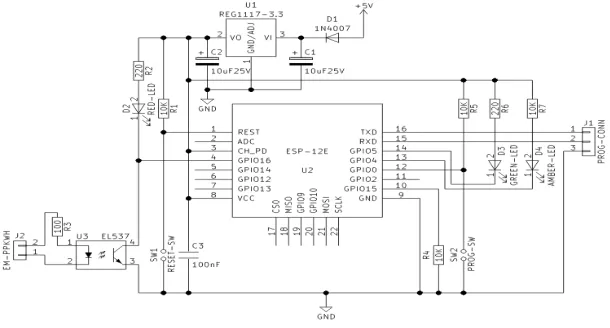
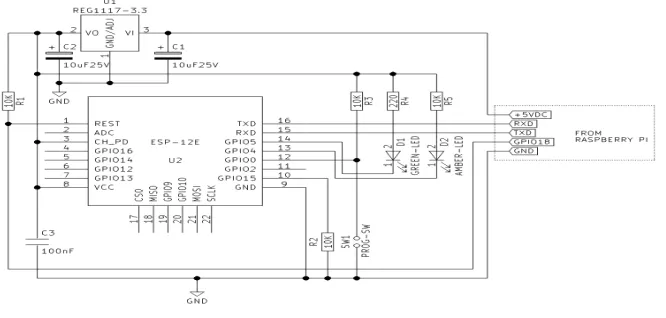
The demand controller is based on an ARM development kit – Raspberry Pi with a resistive TFT touch screen for the user interface. The demand controller receives Kilo Watt Hour Consumption information from its ESP-12 programmed to act as an access point and receives the information from the ESP-12 pulse transmitter module. The system is also equipped with a USB type Wi-Fi dongle connected to a WLAN network for remote monitoring, alert and control. An audio visual enunciator unit consisting of a LED tower and buzzer alerts the local users. The load profile can be programmed into the system via the remote management interface or the local management interface, features like manual override is also provided. The Demand Controller communicates with the load controller using the ESP-12 access point module to turn on or off the devices.
Fig 3: Demand Controller Schematic 3. Load Controller:
The load controller is built using another ESP-12 module which is connected to a shift register and optically isolated relay drivers and relays to control the connected loads
IV.SIMULATION RESULTS
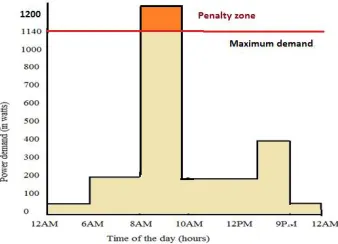
We have considered a typical residential loading for demo purpose as shown below. The consumer residency consists of four loads lamp-1 of 40W, lamp-2 of 100W, lamp-3 of 200W and heating load of 800W.In actual conditions the load may be heater, fan, air-conditioner , cooler and water pumps. Total load of the consumer is 1140Watts.
Total Load = 1140 watts
The consumer may operate residential loads in different conditions. The consumer can select four maximum demand controls as shown the table
.
Different load control options for consumer:
Table 1: load control options for consumer
Sl No. Maximum
Demand Watts
Load 1 Lamp-40W
Load 2 Lamp-100W
Load 3 Lamp-200W
Load 4 Heating-800W
1. 100 OFF ON OFF OFF
2. 200 ON ON ON OFF
3. 400 ON ON ON OFF
4. 800 OFF OFF OFF ON
All consumer loads are ON without use of Maximum Demand Controller
Fig 5: Typical load curve without maximum demand controller
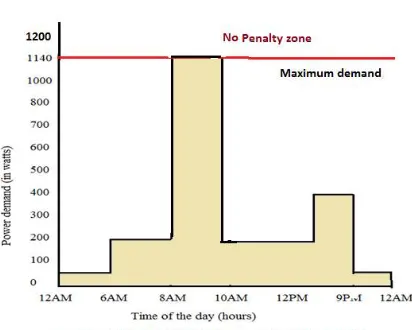
The operation of loads with maximum demand controller
Fig 6: Typical load curve without maximum demand controller
V. CONCLUSION AND FUTURE WORK
The IOT based maximum demand controller can be used as a energy management tool to control the consumers load. The consumer have to pay more electricity bill with penalty charge for operation of load above the maximum demand. This proposed maximum demand controller is having options for consumers to select their loads. The buzzer will be ON ,when the system load crosses beyond the set point. Consumer may operate their loads less than set point in the controller .Secondly, controller may operate to switch OFF some of less important loads as per load priority techniques. This technique mainly focus on shifting the loads from peak load schedule to off peak load schedule. In this manner consumer can control critical and non critical load operation during peak load condition. It can save the consumer bill. This proposed maximum demand controller can be used for industrial environment. The consumers are to be encouraged to use the maximum demand controller. Themselves are participating in national energy saving plans. It postpones the capital investment on installation of new generation plants and transmission lines. The cost of generation reduces by increasing plant load factor.
REFERENCES
[1] P. Govender, A.RambaUee, S.A Moodley “A Load Shedding Controller For Management Of Residential Loads During Peak Demand Periods” IEEE AFRICON, pp 729-734, 2004.
[2] V. Tipsuwanporn, K. Srisuwan, S. Kulpanich, T. Suesut and A. Numsomran, “Development of Load Control and Management System”, IEEE, pp 2139-2142., 2002.
[3] Ravi Babu , V.P Sree Divya, “Maximum Demand Limiter for Reliable Supply by Reducing the Power Cuts to Domestic Loads”, International Conference on Power, Energy and Control (ICPEC), pp 542-545 , 2013.
[4] Hamed Mortaji, Ow Siew Hock, Mahmoud Moghavvemi and Haider A.F. Almurib ,“Smart Grid Demand Response Management U sing Internet of Things for Load Shedding and Smart-Direct Load Control”, IEEE, pp 1-7, 2016.
[5] Ala Al-Fuqaha, Mohsen Guizani, Mehdi Mohammadi, Mohammed Aledhari, Moussa Ayyash, “Internet of Things: A Survey on Enabling Technologies, Protocols and Applications”, IEEE Journal, 2015.
[6] Hippert, H.S., C.E. Pedreira, and R.C. Souza, Neural networks for short-term load forecasting: A review and evaluation. Power Systems, IEEE Transactions, pp. 44-55, 2001.
[7] Huang, K.-Y. and Y.-c. Huang, integrating direct load control with interruptible load management to provide instantaneous reserves Jor ancillary services. Power Systems, IEEE Transactions, pp. 1626-1634, 2004.
[8] Beute. N “ Initiation to Shift Domestic Load to Improve Load Factor “ , Domestic Use of Energy Conference, University of Cape Town, pp1- 6,1999. [9] Wienand R and Reuben R, “ Domestic TOU The Durban Experience”, Domestic Use of Energy Conference, University of Cape Town, PP 46-52, 1999.
[10] Wie Yu Chiu, Hongjain Su, H Vincent Poor, “ Demand Side Energy Storage System Management in Smart Grid”, IEEE Smart Grid Communication, 2012.
[11] V.Tipsuwanporn, K.Srisuwan, S. Kulpanich, T. Suesut, A. Numsomian “ Development of Load Control and Management System”Thailand,, pp- 2139-2142,2012.