Curvelet Image Fusion Using Decision Tree
Algorithm
Muzafar Ahmad Dar,
Ashish SharmaResearch Student, Dept. of CSE., Bells Institute of Management and Technology, Shimla, India Assistant Professor,
Dept. of CSE.,
Bells Institute of Management and Technology, Shimla, IndiaABSTRACT: This paper presents a novel image fusion method, suitable for pan-sharpening of multispectral (MS) bands, based on multi-resolution analysis. The low-resolution MS bands are sharpened by injecting high-pass directional details extracted from the high-resolution panchromatic (Pan) image by means of the Curvelet transform, which is a non-separable MRA, whose basis function are directional edges with progressively increasing resolution. The fusion of high-spectral but low spatial resolution multispectral and low-spectral but high spatial resolution panchromatic satellite images is a very useful technique in various applications of remote sensing. Recently, some studies showed that wavelet-based image fusion method provides high quality of the spectral content of the fused image. However, most of wavelet-based methods have a spatial resolution of the fused result less than the Brovey, IHS, and PCA fusion methods. In this thesis, we introduce a new method based on the Curvelet transform using Decision Tree which represents edges better than wavelets. Since edges play a fundamental role in image understanding, one good way to enhance spatial resolution is to enhance the edges. Curvelet-based image fusion method provides richer information in the spatial and spectral domains simultaneously. We will perform image fusion using Curvelet Transform with Decision Tree Algorithm. This new method has reached an optimum fusion result. For the implementation of this proposed work we use the Image Processing Toolbox under Matlab Software.
KEYWORDS: Edge detection, Fusion, Multi resolution analysis, IKONOS, Wavelet transform, Curvelet transform. I. INTRODUCTION
Digital images are two-dimensional matrices in image processing. One important task is to adjust the values of these matrices in order to get clear features in images. The adjusting of values obeys a certain mathematical model. The main challenge is how to build suitable mathematical models for practical requirements. Taking image denoising as an example, many mathematical models are based on a frequency partition of the image, where components with high frequency are interpreted as noise that have to be removed while those with low frequency are seen as features to be remained. Curvelets, which are going to be reviewed in this paper, can be seen as an effective model that not only considers a multiscale time-frequency local partition but also makes use of the direction of features.
II. LITERATURE SURVEY
Vishal P.Tank, Divyang D. Shah,Tanmay V. Vyas, Sandip B. ChotaliyaManthan S. Manavadaria in 2013. They purposed Image Fusion Based on Wavelet and Curvelet Transform. In this paper we have put forward an image fusion algorithm based on wavelet transform andsecond generation Curvelet transform. The wavelet transform does not represent the edges and singularitieswell. So the second generation Curvelet transform is performed along with the wavelet transform and the imagefusion is done. Their proposed algorithm holds useful information from source multiple imagesquite well. This paper puts forward an image fusion algorithm based on Wavelet Transform and the SecondGeneration Curvelet Transform. It includes multi resolution analysis ability in Wavelet Transform, also has betterdirection identification ability for the edge feature of awaiting describing images in the Second GenerationCurvelet Transform. This method could better describe the edge direction of images, and analyzes feature ofimages better. According to it, this paper uses Wavelet and the Second Generation Curvelet Transform intofusion images, then makes deep research on fusion standards and puts forward corresponding fusion projects. Atlast, these fusion methods are used in simulation experiments of multi-focus and complementary fusion images.In vision, the fusion algorithm proposed in this paper acquires better fusion result than previous.
Myungjin Choi, Rae Young Kim, Moon-Gyu Kim in 2009. They proposed THE CURVELET TRANSFORM FOR IMAGE FUSION. The fusion of high-spectral but low spatial resolution multispectral and low-spectral but high spatial resolution panchromatic satellite images is a very useful technique in various applications of remote sensing. Recently, some studies showed that wavelet-based image fusion method provides high quality of the spectral content of the fused image. However, most of wavelet-based methods have a spatial resolution of the fused result less than the Brovey, IHS, and PCA fusion methods. In this paper, we introduce a new method based on the Curvelet transform which represents edges better than wavelets. Since edges play a fundamental role in image understanding, one good way to enhance spatial resolution is to enhance the edges. Curvelet-based image fusion method provides richer information in the spatial and spectral domains simultaneously. We performed IKONOS image fusion. This new method has reached an optimum fusion result. We have presented a newly developed method based on the Curvelet transform for fusing IKONOS images. In this paper, an experimental study was conducted by applying the proposed method, and also other image fusion methods, for fusing IKONOS images. A comparison of the fused image from the wavelet and IHS method was made.
several medical images. The medical images are fused with four fused methods: Wavelet method, Multi wavelet method, Curvelet Transform and Proposed Method. A Curvelet transform using Gabor filter based approach is used in the Proposed Method. The Gabor filter approach is used in the proposed algorithm because it gives more visually pleasant images. The effectiveness of this approach has been justified using different medical images. The results are compared qualitatively (visually) as well as quantitatively using quality measures. In this paper three techniques have been used for comparison and they are: Wavelet. Method, Multi wavelet method and Curvelet Transformation. Four quality metrics have been used for calculating results to compare quantitatively these four techniques. Experimental results show that proposed method performs well than the Wavelet method, Multi wavelet method, Curvelet method in terms of quality of images. The proposed method increases the quality significantly, while preserving the important details or features. This also gives the better results in terms of visual quality. This algorithm can be used in other type of images like Remote sensing images, Ultrasound images, SAR images etc. Other quality metrics can be used to judge the performance of this algorithm. And further improvements can also be done in the algorithm to improve the quality. Instead of log Gabor approach, algorithm can be modified to improve the quality of the images.
Smt.G. Mamatha (Phd), L.Gayatri in 2012. They proposed AN IMAGE FUSION USING WAVELET AND CURVELET TRANSFORMS. This paper presents wavelet and Curvelet transform based approach for the fusion of digital image, magnetic resonance (MR) and computed tomography (CT) images. We looked at the selection principles about low and high frequency coefficients according to different frequency domain after Wavelet and the Curvelet Transform. In choosing the low-frequency and high frequency coefficients, the concept of local area variance and window property of pixels respectively. Some attempts have been proposed for the fusion of MR and CT images using the wavelet transform. The objective of the fusion of an MR image and CT images of the same organ is to obtain a single image containing as much information as possible about that organ for diagnosis. Since medical images have several objects and curved shapes, it is expected that the Curvelet transform would be better in their fusion. The simulation results show the superiority of the Curvelet transform to the wavelet transform in the fusion of digital image and MR and CT images from entropy, correlation coefficients and the RMS error points of view. The paper has presented a new trend in the fusion ofdigital image, MRI and CT images which are based onthe Curvelet transform. A comparison study has beenmade between the traditional wavelet fusion algorithmand the proposed Curvelet fusion algorithm. Theexperimental study shows that the application of theCurvelet transform in the fusion of MR and CT imagesis superior to the application of the traditional wavelettransform. The obtained Curvelet fusion results havehigher correlation coefficient and entropy values thanin wavelet fusion results and minimum values of RMSerror than in the wavelet transform. At last, thesefusion methods are used in simulation experiments ofmulti-focus and complementary fusion images. Invision, the fusion algorithm proposed in this paperacquires better fusion result. In objective evaluationcriteria, Curvelet fusion characteristic are superior totraditional DWT.
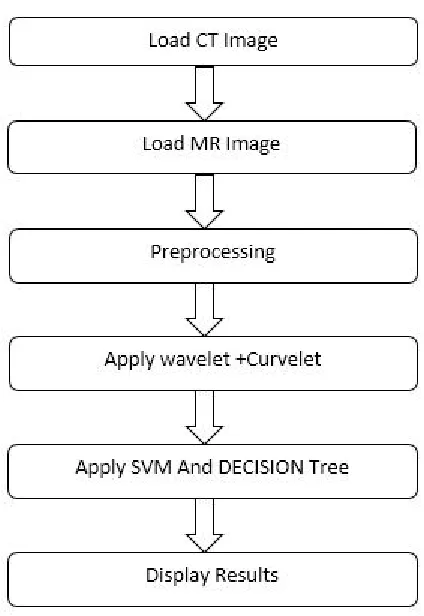
III. METHODOLOGY
Figure 1.1.1 Methodology
IV. RESULTS & DISCUSSION
The techniques are implemented by using algorithm which defines the enhancement of Image Fusion. The proposed scheme successfully performs image fusion enhancement. Various image processing techniques applied on the sample images give the satisfactory numerical results as compared to the previously proposed algorithms. The parameters whose values were calculated include, PSNR, RMSE, ENTOPY, BER AND CC.
Snapshots
Figure 1: Main Interface
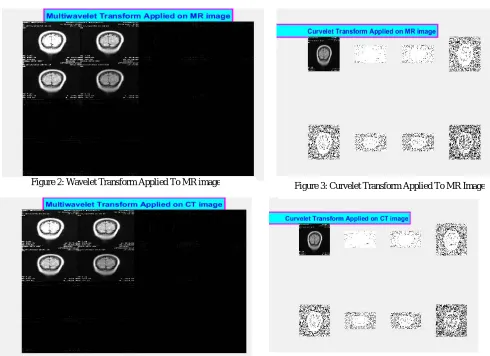
Figure 2: Wavelet Transform Applied To MR image Figure 3: Curvelet Transform Applied To MR Image
Now we apply wavelet as well as curvelet on both CT image as well as MR image. This is illustrated in following images
After that the results are retrieved and following values are obtained
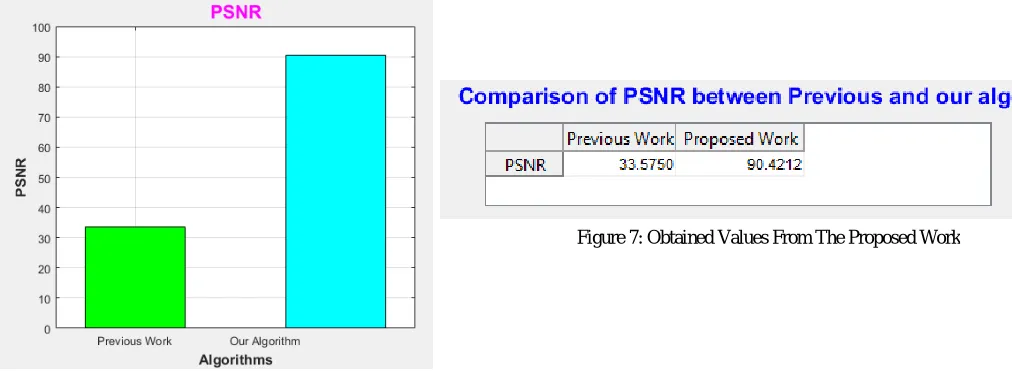
1. PSNR:-PSNR is most commonly used to measure the quality of reconstruction of lossy compression codecs (e.g., for image compression). The signal in this case is the original data, and the noise is the error introduced by compression. When comparing compression codecs, PSNR is an approximation to human perception of reconstruction quality. Although a higher PSNR generally indicates that the reconstruction is of higher quality, in some cases it may not. One has to be extremely careful with the range of validity of this metric; it is only conclusively valid when it is used to compare results from the same codec (or codec type) and same content. Typical values for the PSNR in lossyimage and video compression are between 30 and 50 dB, provided the bit depth is 8 bits, where higher is better. For 16-bit data typical values for the PSNR are between 60 and 80 dB.Acceptable values for wireless transmission quality loss are considered to be about 20 dB to 25 dB.. Values obtained from our algorithm are graphically shown as
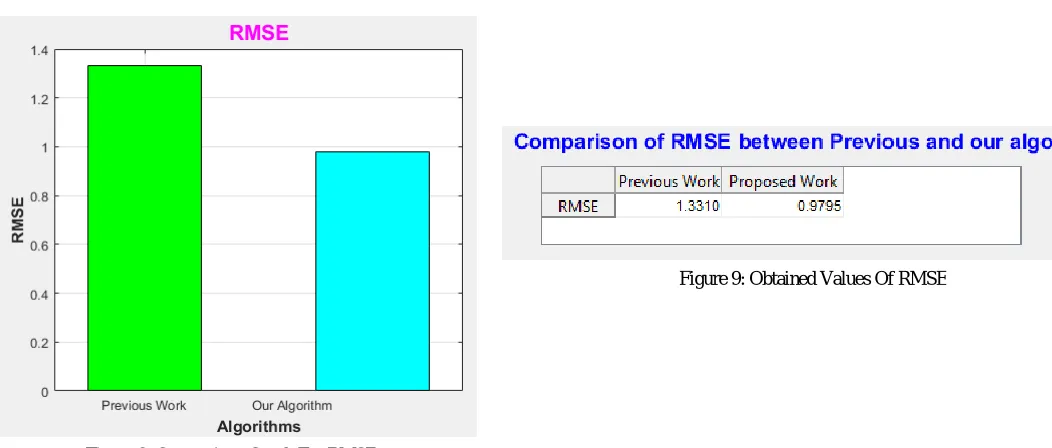
2. RMSE:-Root Mean Square Error (RMSE) A commonly used reference based assessment metric is the Root Mean Square Error (RMSE). The RMSE between a reference image, R, and a fused image, F, is given by the following equation:
RMSE= ∑ ∑ ( ( , )− ( , ))2
Where R(m,n) and F(m,n) are the reference (CT or MR) and fused images, respectively, and M and N are image dimensions. Smaller the value of the RMSE, better the performance of the fusion algorithm. The plotted values of RMSE obtained from our algorithm are given in following figures
Figure 6: Comparison Graph For PSNR
3.
Correlation Coefficient
:-The correlation coefficient is the measure the closeness or similarity in small size structures between the original and the fused images. It can vary between -1 and +l .Values closer to + 1 indicate that the reference and fused images are highly similar while the values closer to -1 indicate that the images are highly dissimilarCORR=(2Crf) / (Cr+Cf)
Where
Cr= ∑
∑
r(i,j)2Cf= ∑
∑
f(i,j)2C
rf= ∑
∑
r(i,j)
2I
f(i,j)
2 Figure 8: Comparison Graph For RMSECr is the reference image and Cf is the fused image respectively. The results are shown below
4.
Entropy:-
The Entropy (H) is the measure of information content in an image. The maximum value ofentropy can be produced when each gray level of the whole range has the same frequency. If entropy of fused image is higher than parent image then it indicates that the fused image contains more information.
H= -∑ ( ) log ( )
The results for entropy are plotted as
Figure 10: Comparison Graph For CC
Figure 11: Obtained Values For CC
Figure 12:Comparison Graph For Entropy
V. CONCLUSION
Thus the two different modality images are fused using the various fusion rules based on the Curvelet transforms with the application of decision trees . Moreover the difference in performance of the two methods is clearly exhibited using four performance measures. It is observed that, fusion methodology based on the Curvelet transform with decision trees has given curved visual details better than those given by the Multi-Wavelet fusion algorithm. The fused image obtained using MWT and Curve let transform contains more useful information than the source images, thus enabling the radiologists to locate the imperfections accurately, making the treatment easier and perfect
ACKNOWLEDGMENT
Thanks to my Guide and my family member who always support, help and guide me during my work. Special thanks to my father who always support my innovative ideas and also to my spouse.
REFERENCES
[1]. Vishal P.Tank, Divyang D. Shah,Tanmay V. Vyas, Sandip B. ChotaliyaManthan S. Manavadaria in 2013. They are purpose Image Fusion Based on Wavelet and Curvelet Transform.
[2]. Jianwei Ma and GerlindPlonka in 2012. He purpose A Review of Curvelets and Recent Applications. Multiresolution methods are deeply related to image processing, biological and computer vision, scientific computing, etc.
[3]. Smt.G. Mamatha (Phd), L.Gayatri in 2012. They are purposed AN IMAGE FUSION USING WAVELET AND CURVELET TRANSFORMS. [4]. T. Ranchin and L. Wald, “Fusion of High Spatial and Spectral Resolution images: The ARSIS Concept and Its Implementation,”
PhotogrammetricEngineering and Remote Sensing, vol. 66, 2000, pp. 49-61.
[5]. L. Wald, T. Ranchin and M. Mangolini, “Fusion of Satellite images of different spatial resolution: Assessing the quality of resulting images,” Photogrammetric Engineering and Remote Sensing, vol. 63, no. 6, 1997, pp. 691-699.
[6]. J. Nunez, X. Otazu, O. Fors, A. Prades, V. Pala and R. Arbiol, “Multiresolution-based image fusion with addtive wavelet decomposion,” IEEE Transactions on Geoscience and Remote sensing, vol. 37, no. 3, 1999, pp. 1204-1211.
[7]. E. J. Cand`es, “Harmonic analysis of neural networks,” A ppl. Comput. [8]. Harmon. Anal., vol. 6, 1999, pp. 197-218.
[9]. E. J. Cand`es and D. L. Donoho, “Curvelets- A surprisingly effective non adaptive representation for objects with edges,” in Curve and Surface Fitting: Saint-Malo, A. Cohen, C.Rabut, and L.L.Schumaker, Eds. Nashville, TN: Vanderbilt Univ. ersity Press, 1999.
[10].J. L. Starck, E. J. Cand`es and D. L. Donoho, “The curvelet transform for image denosing,” IEEE Trans. Image Processing, vol. 11, 2002, pp. 670-684.
[11].J. L. Starck, E, J. Cand`es, and D. L. Donoho, “Gray and Color Image Contrast Enhancement by the Curvelet Transform,” IEEE Trans. ImageProcessing, vol. 12, no. 6, 2003, pp. 706-717.
[12].E. J. Cand`es, “Ridgelets: Theory and Applications,” Ph.D. Thesis, Department od Statistics, Stanford University, Standford, CA, 1998. [13].D. L. Donoho, “Digital ridgelet transform via rectopolar coordinate transform,” Stanford Univ., Stanford, CA, Tech. Rep, 1998. [14].D. L. Donoho, “Orthonormal ridgelets and linear singularities,” SIAM J. Math Anal., vol. 31, no. 5, 2003, pp. 1062-1099.
[15].M. I. Smith, J. P. Heather, "Fusion Technology Review of Image in 2005," Proceedings of the SPIE, Volume 5782, pp. 29-45, 2005.
[16].Yong Yang, "Multi modal Medical Image Fusion through a New DWT Based Technique", 4th International Conference on Bioinformatics and Biomedical Engineering, pp 1-4, 2010.
[17].Chandrakanth.R, SaibabaJ,Varadan.G, Raj.PA,"Fusion of High Resolution Satellite SAR and Optical Images "International Workshop on Multi-Platform/Multi-Sensor Remote Sensing and Mapping , pp 1-6, Jan 2011.
BIOGRAPHY
Muzafar Ahmad Dar is currently a research scholar at Bells Institute of Management and Technology. He is currently doing masters in computer science and engineering and is involved in many research projects. His choicest areas of research are networking, image processing, data mining etc. He has completed his Bachelor’s degree in computer science and engineering at Islamic University of Science And Technology.