University of Windsor University of Windsor
Scholarship at UWindsor
Scholarship at UWindsor
Electronic Theses and Dissertations Theses, Dissertations, and Major Papers
2014
Recommendation Framework Based on Subjective Logic in
Recommendation Framework Based on Subjective Logic in
Decision Support Systems
Decision Support Systems
Arshdeep Singh Sidhu
University of Windsor
Follow this and additional works at: https://scholar.uwindsor.ca/etd
Recommended Citation Recommended Citation
Sidhu, Arshdeep Singh, "Recommendation Framework Based on Subjective Logic in Decision Support Systems" (2014). Electronic Theses and Dissertations. 5115.
https://scholar.uwindsor.ca/etd/5115
This online database contains the full-text of PhD dissertations and Masters’ theses of University of Windsor students from 1954 forward. These documents are made available for personal study and research purposes only, in accordance with the Canadian Copyright Act and the Creative Commons license—CC BY-NC-ND (Attribution, Non-Commercial, No Derivative Works). Under this license, works must always be attributed to the copyright holder (original author), cannot be used for any commercial purposes, and may not be altered. Any other use would require the permission of the copyright holder. Students may inquire about withdrawing their dissertation and/or thesis from this database. For additional inquiries, please contact the repository administrator via email
Recommendation Framework based on Subjective Logic in Decision Support Systems
by
Arshdeep Singh Sidhu
A Thesis
Submitted to the Faculty of Graduate Studies
through the School of Computer Science
in Partial Fulfillment of the Requirements for
the Degree of Master of Science at the
University of Windsor
Windsor, ON, Canada
2014
Recommendation Framework based on Subjective Logic in Decision Support Systems
by
Arshdeep Singh Sidhu
APPROVED BY:
______________________________________________
A. Hussein
Department of Mathematics and Statistics
______________________________________________
Z. Kobti
School of Computer Science
______________________________________________
R. D. Kent, Advisor
School of Computer Science
iii
DECLARATION OF ORIGINALITY
I hereby certify that I am the sole author of this thesis and that no part of this thesis has
been published or submitted for publication.
I certify that, to the best of my knowledge, my thesis does not infringe upon anyone’s
copyright nor violate any proprietary rights and that any ideas, techniques, quotations, or
any other material from the work of other people included in my thesis, published or
otherwise, are fully acknowledged in accordance with the standard referencing practices.
Furthermore, to the extent that I have included copyrighted material that surpasses the
bounds of fair dealing within the meaning of the Canada Copyright Act, I certify that I
have obtained a written permission from the copyright owner(s) to include such
material(s) in my thesis and have included copies of such copyright clearances to my
appendix.
I declare that this is a true copy of my thesis, including any final revisions, as approved
by my thesis committee and the Graduate Studies office, and that this thesis has not been
iv
ABSTRACT
In this thesis our goals are to investigate the suitability of subjective logic within
the decision support context that requires connectivity to complex data, user specification
of frames of discernment, representation of complex reasoning expressions, an
architecture that supports distributed usage of a decision support tool based on a
client-server approach that separates user interactions on the browser side from computational
engines for calculations on the server side, and analysis of the suitability and limitations
of the proposed architecture.
The nature of our framework represents a proof-of-concept approach in that we
have limited ourselves to the scope of binomial and multinomial opinions only, foregoing
recent work on emerging hyper-nomial opinions, and also on a limited subset of
operators, due in part to ongoing work that is moving towards establishing generally
v
DEDICATION
To my loving parents and grandparents whose immense
vi
ACKNOWLEDGEMENTS
My ultimate gratitude goes to my supervisor Dr. Robert D. Kent, for providing me
the opportunity to work in an exciting and challenging field of research. His constant
motivations, support, innovative ideas, own research and infectious enthusiasm have
guided me toward successful completion of my thesis. My interactions with him have
been of immense help in defining my research goals and in identifying ways to achieve
them.
I would like to acknowledge Dr. Ziad Kobti and Dr. Abdulkadir Hussein whose
suggestions and recommendations greatly improved the quality of this work. I would also
like to thank Bryan St. Amour for his advice and help in learning new things. I am
thankful to my good friends Sukhmanjot Singh and Manpreet Singh for their valuable
and helpful ideas in this work. And I want to thank my best friends Harmeetpal,
Bhupinder and Sandeep for always motivating me in tough times.
My special thanks to my grandparents and parents for their patience and love they
vii
TABLE OF CONTENTS
DECLARATION OF ORIGINALITY ... iii
ABSTRACT ... iv
DEDICATION ...v
ACKNOWLEDGEMENTS ... vi
LIST OF TABLES ...x
LIST OF FIGURES ... xi
CHAPTER I. INTRODUCTION 1.1 Problem Statement ...2
1.2 Thesis Objective ...4
1.3 Thesis Contribution ...4
1.4 Thesis Outline...5
II. PRELIMINARIES AND DEFINITIONS 2.1 Decision Support Systems ...7
2.1.1 DSS Architecture and Categories ...8
2.1.2 Web-Based Decision Support ...9
2.1.3 Benefits of Decision Support Systems ...10
2.2 Uncertainty ...11
2.2.1 Uncertainty Categories ...12
2.3 Probability Theory...13
2.3.1 Probabilistic Reasoning in DSS ...13
2.3.2 Interpretations of Probability ...13
2.3.3 Subjectivist Bayesian Approach ...14
2.3.4 Decision Theory and Decision Analysis ...15
2.4 Dempster-Shafer theory ...16
2.5 Subjective Logic ...19
2.5.1 Belief Representations in Subjective logic ...21
2.5.2 Elements of Subjective Opinions ...22
2.5.3 Opinion Classes ...26
viii
2.5.5 Applications ...41
2.6 Related Work ...42
2.6.1 Probabilistic Reasoning in DSS ...42
2.6.2 Dynamic DSS Based on Bayesian Networks ...42
2.6.3 The application of Dempster-Shafer theory ...44
2.6.4 Visualizing opinions on opinion triangles ...44
2.6.5 Legal reasoning with subjective logic ...46
2.7 Summary ...47
III. THESIS OBEJCTIVE AND RESEARCH METHODOLOGY 3.1 Introduction...49
3.2 Synopsis of Problems and Limitations ...50
3.3 Statement of Objectives ...51
3.4 Research Methodology ...51
3.5 Architecture of the workbench ...53
3.6 User Role ...56
3.7 Opinions ...57
3.8 Simple and Complex Expressions ...59
3.9 Explanation of Implemented Algorithm ...60
3.10 Workflow of the Workbench ...63
3.11 Summary ...69
IV. IMPLEMENTATION AND VERIFICATION 4.1 Background ...71
4.2 Implementation ...71
4.3 Computational Module ...74
4.3.1 Binomial Module ...76
4.3.2 Multinomial Module ...77
4.4 Verification ...77
4.4.1 Verification of System Design ...78
4.5 Test Results ...81
4.5.1 Verification of System Design ...81
4.6 Summary ...81
V. CONCLUSION AND FUTURE WORK 5.1 Conclusion ...83
5.2 Future Work ...85
5.2.1 Subjective Logic Operators ...85
ix
5.2.3 Enrich user experience ...85
APPENDICES
Subjective Logic Workbench ...87
REFERENCES ...92
x
LIST OF TABLES
2.1 Opinion classes with equivalent probabilistic representations………27
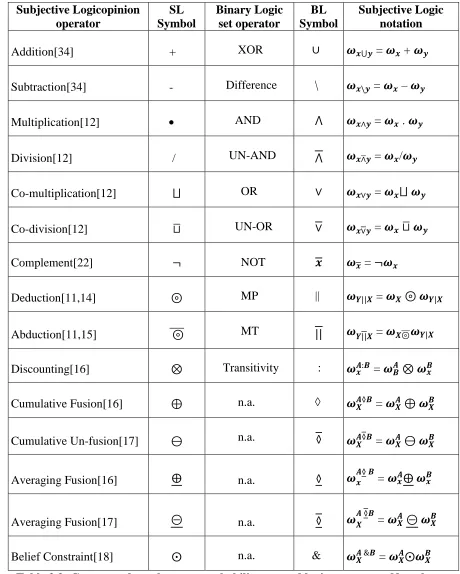
2.2 Correspondence between probability, set and logic operators……….36
2.3 Example preferences and corresponding subjective opinions……….42
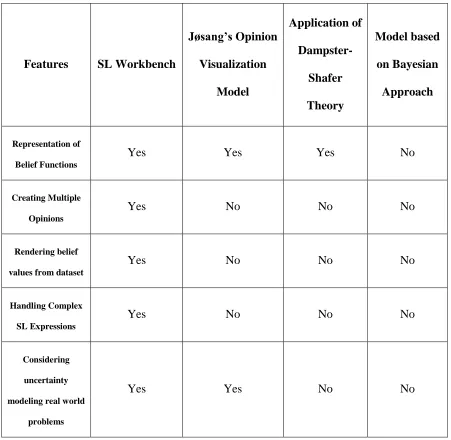
2.4 Briefly shows the comparison of existing and our implemented approach………….48
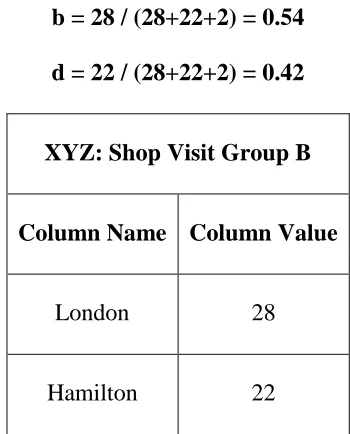
3.1 Example of Table in dataset……….65
xi
LIST OF FIGURES
2.1 Basic architecture for decision support systems………..9
2.2 DSS benefits via improvements to decision-making processes or outcomes………..11
2.3 Movement of belief where evidence creates conflict (K>0)………18
2.4 Principle of the discounting operator ………...39
2.5 Opinion triangle with example opinion………...46
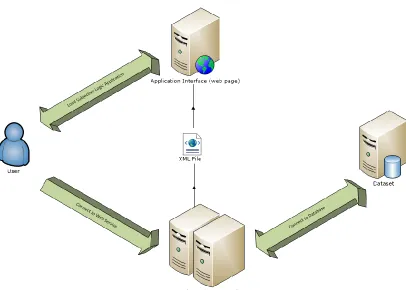
3.1 Architecture of the system………...………55
3.2 High-level Flow Diagram of system…..……….….68
3.3 Work flow diagram……….….69
4.1 Flow Diagram of a Silverlight Application……….72
4.2 Structure of the system……….72
1
CHAPTER I
INTRODUCTION
A fundamental aspect of the human condition is that nobody can ever determine
with absolute certainty whether a proposition about the world is true or false, or
determine the probability of something with 100% certainty. [1] When subjective logic is
used for decision support, it allows decision makers to be better informed about
uncertainties affecting the assessment of specific situations and future outcomes. [1]
The idea of subjective logic is to extend probabilistic logic by also expressing
uncertainty about the probability values themselves, meaning that it is possible to reason
with argument models in presence of uncertain or incomplete evidence. Subjective logic
is directly compatible with binary logic, probability calculus and classical probabilistic
logic. The advantage of using subjective logic is that real world situations can be more
realistically modeled, and that conclusions more correctly reflect the ignorance and
uncertainties that necessarily result from partially uncertain input arguments. [1] It can
for example be used for modeling trust networks, for modeling Bayesian networks, for
Intelligence Analysis and logical argumentation. In general, subjective logic is suitable
for modeling and analyzing situations involving uncertainty, incomplete knowledge and
different world views. [1]
Following Jøsang, subjective logic provides a suitable framework for connecting
survey data collection directly to a model of evidence based opinions with uncertainty
2
Subjective logic [3] is a type of probabilistic logic [4], [5] where connectives are
defined by mathematical expressions instead of look-up truth tables. Subjective logic
explicitly takes uncertainty and belief ownership into account, and is suitable for
modeling and analyzing situations involving uncertainty and incomplete knowledge.
Arguments in subjective logic are opinions about propositions.
With this in mind, we have implemented a very general methodology for decision
support systems that provide recommendations. Our starting point still involves the
Human Expert as a significant oracular element within the system, but as research
continues, one senses how the vision of computationally driven, intelligent support for
complex human and machine system activities may evolve. A recommendation system is
implemented which is able to populate a set of belief values from datasets, in order to
build a model of a complex subjective logic assertion.
1.1 Problem Statement
Since the pioneering work on evidentiary reasoning with uncertainty by Dempster
and Shafer (Shafer 1976; 1990) there have been attempts to develop consistent reasoning
frameworks of logic and interpretation of belief and uncertainty in the context of
evidence. The inclusion of uncertainty was intended to provide a method for dealing
with evidence subjectively. Substantial progress towards such a subjective logic
framework has been made by Jøsang and co-workers (Jøsang 1997, 2001, 2002, 2007,
2008; Jøsang and McAnally 2004; Jøsang, et al 2005; Jøsang, et al 2006; Jøsang, et al
3
Although this evolving framework provides accurate numeric results based on
subjective logic (SL) calculations and interpretations, they do have some limitations. The
major limitation is a lack of implementation in software, or reasoning systems. Existing
web browser applets provided by Jøsang et al., provide a limited approach of solving
operator expressions involving two opinion arguments using single SL operators at a
time. The applets allow belief values to be entered manually; but, they do not offer
mechanisms to build complex subjective logic expressions and solve them, particularly in
cases where real data sets are of interest. Similarly, there has been no software framework
developed for multinomial opinions where a user can build multiple opinions.
The application of subjective logic to actual data is of considerable interest.
There has been no previous work which populates belief values directly from datasets.
Most of the previous work limits the user to work with two opinions at a time, and only
to perform calculations. Existing proposed applets provide a limited approach of solving
two opinion arguments using single SL operators. In existing applets belief values are
entered manually and they do not offer mechanism to build complex expressions and
solve them. There has been no framework for multinomial opinions where user can build
multiple opinions.
For decision support systems, the need to join data to subjective logic to support
reasoning, especially dynamic exploration of data, is vital. Simply stated, the problem
identified for this thesis is one of designing an architecture for a decision support system
that embeds subjective logic to support reasoning over data. This simple statement
contains several implications for software and system design and verification that will be
4
1.2 Thesis Objective
The aim of this thesis is to outline the objective decision support system elements
in a workbench based on subjective logic. Our main objective is to develop a web-based
representative and reasoning framework based on Subjective Logic in decision support
systems, which consists of a belief model called opinion and set of operations for
combining opinions.
In this thesis research, our practical goal is to construct a standard data acquisition
interface based on subjective logic which proves to be productivity enhancing tool in
decision support system where uncertainty is essential part of decision, while also serving
as foundation platform for future research. Our goal is to build a subjective logic
workbench which has capabilities of rendering opinion values from datasets, solve simple
and complex subjective logic expressions for binomial and multinomial opinions, and
provide results based on the dataset used. In accordance to this our goal is to develop an
algorithm to solve subjective logic expressions built using subjective logic operators. We
need a suitable workbench which connects survey data collection directly to a model of
evidence based opinions with uncertainty.
1.3 Thesis Contribution
In this thesis we aim to design and implement a workbench based on subjective
logic, which enables the user to build opinions, render belief values, construct simple and
complex subjective logic expressions, using subjective logic operators to calculate the
degree of uncertainty associated with a hypothesis. Subjective logic can be used to model
real world situations and the conclusions reflect the ignorance and uncertainties. In this
5
to be better informed about uncertainties affecting the assessment of specific situations
and future outcomes.
The workbench is able to populate a set of belief values by direct query to
datasets, in order to build a model of a complex subjective logic assertion. Main goals of
this thesis are:-
• Develop an interface which allows user to build “n” number of opinions.
• Display data sets to user and allow user to render belief values as per hypothesis.
• Develop a mechanism to build SL expressions for binomial and multinomial
opinions.
• Develop an algorithm to solve subjective logic expressions.
• Decision support: Enable user to construct and interactively investigate
hypothesis arguments utilizing SL operators.
• To allow users to define their own frame of discernment.
1.4 Thesis Outline
The aim of this study is to outline the decision support elements in
recommendation framework, specifically in context of complex subjective logic
expressions, design, and implementation of user interface (UI) based on subjective logic,
automated functioning of subjective logic operators, critically examine the influence of
the factors that contribute to certain decisions in decision support systems (DSS). In order
to discuss this we divide the thesis into following chapters.
In Chapter 2, a literature review and survey is presented on decision support
6
theory, Bayesian networks, Dempster-Shafer theory and related work. Then we discuss,
in detail about subjective logic.
More specifically, we first describe the representations and interpretations of subjective
opinions which are the input arguments to subjective logic. We then describe the most
important subjective logic operators. Finally, we describe how subjective logic can be
applied in decision support systems.
Chapter 3 describes brief overview of workbench by discussing the architecture of
the workbench and several components involved in the architecture design and describe
the implemented algorithm for handling simple and complex subjective logic
expressions.
Chapter 4 presents implementation and verification of workbench and also about
usability of system.
Chapter 5 concludes the thesis and proposes some avenues of future work in
7
CHAPTER II
PRELIMINARIES AND DEFINITIONS
2.1 Decision Support Systems
Decision support systems (DSS) are interactive computer-based systems that help
decision makers solve decision problems. They attempt to do this by formalizing
knowledge so that it is amenable to mechanical reasoning. DSS can be categorized under
knowledge-based systems. One class of DSSs, expert systems, originates from the field
of artificial intelligence, and aims at imitating the reasoning of a human domain expert in
solving decision problems. DSSs can also be built on formal techniques, such as the
methods of operations research, or decision theory.
Decision support systems are gaining an increased popularity in various domains,
including engineering, business, and medicine. Although their reasoning power is still
rather limited, they can sometimes approach the abilities of human experts and
outperform practitioners in some domains [2, 3, 4]. DSSs are valuable in situations where
the amount of relevant information that needs to be considered is prohibitive for the
intuition of an unaided human decision maker. Such environments are often given the
common name of DSSs. A Decision Support System is a class of information systems
that supports business and organizational decision making activities. DSS couple the
intellectual resources of individuals with the capabilities of the computer to improve the
quality of decisions [7]. It is a computer-based support for management decision makers,
those who deal with semi-structured problems. A properly designed DSS is an interactive
8
from a combination of raw data, documents, personal knowledge, or business models to
identify and solve problems and make decisions. Decision Support System is a general
term for any computer application that enhances a person’s or a group’s ability to make
decisions. It can also be used as a tool in which user inputs the data and the software
component process the data and recommendations are made on the basis of the
information given. In order to make the decision making tool, all the major components
of the system should be considered in the system to get the optimal results.
2.1.1 DSS Architecture and Categories
The architecture is comprised of four main subsystems: language system,
presentation system, knowledge system, and problem-processing system. These
determine its capabilities and behaviors (Bonczek et al. 1980, 1981a, Dos Santos and
Holsapple 1989, Holsapple and Whinston 1996). By varying the makeup of these four
elements, different types of decision support systems are produced.
A language system consists of all messages the DSS can accept. A presentation
system consists of all messages the DSS can emit. A knowledge system consists of all
knowledge the DSS has stored and retained. By themselves, these three kinds of systems
can do nothing, neither individually or in tandem. They are inanimate. They simply
represent knowledge, either in the sense of messages that can be passed or representations
that have been accumulated for possible future processing. Although they are merely
systems of representation, the KS, LS, and PS are essential elements of a DSS. Each is
9
Figure 2.1: Basic architecture for decision support systems [32]
This system is the active component of a DSS. A problem processingsystem is the DSS’s
software engine. As its name suggests, a PPS is what tries to recognize and solve
problems (i.e., process problems) during the making of a decision. Figure 2.1 illustrates
how the four subsystems of a DSS are related to each other and to a DSS user. The user is
typically a decision maker or a participant in decision making.
2.1.2 Web-Based Decision Support
Web-based decision support systems (WB-DSS) are decision support systems that are
accessible on the Web. They have the same broad boundaries as those of desktop DSSs.
Nevertheless, WB-DSS can be identified by certain characteristics:
10
2. Supporting individuals/customers/employees/managers/groups in their
decision-making process regardless of their physical locations or time of access
3. Having outcomes that are specific to a predetermined context that is either unique to
the Web environment or as the interface for desktop DSS
4. Dealing with decision processes that are semi-structured or unstructured at different
stages of the decision process, some of which could take place on the Web
5. Utilizing data, knowledge base, document, model and heuristics, which appeal to a
culturally varied and large user group
6. Being an optional tool for Web users in their decision processes.
2.1.3 Benefits of Decision Support Systems
It is important to identify the benefits of a decision support system (DSS).
Systems that are implemented without understanding the prospective benefits for a
particular context will not achieve their full potential in contributing to organizational
performance. After implementation, it is important that the benefits be apparent, or the
system will fall into disuse because DSS use is typically optional. Furthermore, a record
of producing DSSs with benefits that can be identified, elaborated, and quantified creates
more opportunities for those who created and implemented the systems. It also
contributes to an organization’s learning about how to plan for and realize future DSS
success.
Decision support systems provide benefits when the combination of the system
plus a decision maker (or makers) is superior to the performance of software or humans
alone. Often, combining the best attributes of fast computation, large disk storage,
11
achieve excellent decision quality or an excellent decision making process. Generally, the
benefit of a DSS is better decisions, a better decision- making process, or both. Figure 2.2
illustrates this idea.
Figure 2.2: Decision support system benefits via improvements to decision-making processes or outcomes [32]
2.2 Uncertainty
There are many systems that are designed and developed based on precision and
certainty. They provide unrealizable solutions based on the assumption of closed
environments. For the most real applications uncertainty is inevitable and cannot be
12
2.2.1 Uncertainty Categories
Information imperfection is the most difficult, but unavoidable problem faced by
agents in an open environment. According to Smets approach [24] it can be generally
grouped into imprecision, inconsistency or uncertainty.
1) Imprecision presents the ambiguity, vagueness or approximation of
information.
2) Inconsistency expresses that contradictory conclusions can be drawn based on
given information or statements.
3) Uncertainty is caused by a lack of knowledge about the environment when
agents need to decide the truth of statements. Uncertainty can be distinguished
objectively and subjectively. Objective uncertainty relates to randomness which likely
qualifies the occurrence possibility of an event, whereas subjective uncertainty depends
on the subjective opinions of agents about the truth value of information. Imprecision and
inconsistency are essential properties related to information content whereas uncertainty
is a property of the relation between the information and our knowledge about the world.
Besides the classification based on Smets approach, another viewpoint describing
perspectives on computational perception and cognition under uncertainty, is proposed by
Zadeh [25]. Two broad categories of uncertainty, U-Type One and U-Type Two, are
suggested:
• The first type of uncertainty deals with information arising from the random
behaviour of physical systems.
• The second type of uncertainty deals with information arising from human
13
The first type has been investigated for centuries with efforts of statistical theory. The
statistical methodologies are very useful to model this type, but lack the sophistication to
process the second type. In order to deal with the second type, several effective methods
have been proposed, including fuzzy logic, neural networks and so on.
2.3 Probability Theory
2.3.1 Probabilistic Reasoning in Decision Support Systems
Uncertainty is an inherent and prevalent property of most types of knowledge. It
arises from sources like incomplete knowledge, disagreement between various
information sources, linguistic imprecision, statistical variation in the measured
population, measurement error, or approximations. Arguably all practical decisions
involve uncertainty. We might cope with uncertainty simply by worrying about it or
pretending it is not there, but there are situations in which we would like to estimate,
reduce, and, if this is not feasible, take it into account when making the decision of the
calculi developed for dealing with uncertainty, the oldest and most widely used is
probability theory. Uncertainty in probability theory is measured by a real number
between 0:0 (impossible event) and 1:0 (sure event), called probability.
2.3.2 Interpretations of Probability
There are several interpretations as to what probability means. These can be roughly
divided into three classes: the frequency interpretation, the propensity interpretation, and
the subjectivist interpretation. In the frequency interpretation, the probability of an
outcome is given the meaning of the relative proportion with which that outcome would
be obtained if the process were repeated a large number of times under similarconditions.
14
large number of times and counting the proportion of times that the coin fell “heads” with
respect to the total number of tosses. In the propensity interpretation, the probability is
thought of as a property of the physical system that generates the events. A coin has two
sides and because of symmetry considerations, these can be assumed to be equally likely,
and therefore the probability of “heads” is equal to the probability of “tails” and, hence,
has to be equal to 0.5 (a biased coin will have the propensity to fall “heads” with a
different probability, but this probability will be again a property of the coin).
The frequency and the propensity views are often called objectivist, because they
interpret probability as an objective property of the world. In the subjectivist view, often
called personalist, personal, or Bayesian view, probability of an outcome is a measure of
personal degree of belief in that outcome, given the person’s current state of knowledge.
A person with no special information about the coin or the way in which it is tossed
might regard both “heads” and “tails” equally likely, but he or she might equally well
give it a different assignment given the previous experiences with other coins, other
relevant information. The person canalso change this assignment in the course of
observations.
2.3.3 Subjectivist Bayesian Approach
The probability of a proposition in the subjectivist Bayesian view is a measure of
Personal belief in that proposition. As two different people may have different
information relevant to the event, they can have legitimately different measures of belief
in that event. Effectively, there is no measure that can be termed as probability. Bayesian
view of probability theory includes methods for eliciting and evaluating accuracy of
15
probabilities, proponents of the Bayesian view advocate indirect measurement in which a
person is observed making choice between bets [30]. A person is offered choice between
gambles involving the proposition in question and the choices made between these
gambles are used to estimate the measure of belief that the person has in the proposition.
A fundamental principle of Bayesian reasoning is belief updating, which means starting
with an initial belief in a proposition and changing this belief as new evidence
accumulates. The initial belief is called the prior probability and the belief that results
from taking evidence into consideration is called the posterior probability. As evidence
can be processed stepwise, the posterior probability obtained in one step can be used as
the prior probability in the next step. The fundamental rule used inbelief updating is
Bayes theorem. The simplest form of the Bayes theorem is:
Pr (H|E) = 𝑃𝑟(𝐻∩𝐸)
𝑃𝑟(𝐸)
=
𝑃𝑟(𝐸|𝐻)𝑃𝑟(𝐻)
∑ 𝐻𝑖∈Ω𝑃𝑟(𝐸|𝐻𝑖)𝑃𝑟(𝐻𝑖)
(2.1)
Bayes theorem provides a rule for updating belief in a hypothesis H given evidence E.
Pr(H) on the right hand side of the equation is the prior probability of the hypothesis H,
while Pr(H|E) on the left hand side is its posterior probability. Pr(E|H) and Pr(E) are
measures that jointly express the value of the evidence E for the hypothesis H. One of the
ways to obtain Pr(E) is summing its probability over all possible hypotheses.[1]
2.3.4 Decision Theory and Decision Analysis
Bayesian probability theory forms the foundation of a theory of decision making,
usually known as decision theory. While probability theory provides formalism for
16
consistency among preferences and decisions. Preferences describe relative valuations of
outcomes, while decisions are actions that are under decision maker’s control. Applied
branch of decision theory, known as decision analysis [28] has been developed as a
normative aid to human cognitive deficiencies in decision making. Decision analysis is
based on the paradigm that people are able to reliably store and retrieve their personal
beliefs about uncertainty and preferences for different outcomes, but are much less
reliable in aggregating these fragments into a global inference. Decision analysis includes
quantities of methods for model construction, such as methods for elicitation of
probability distribution that allow to minimize human bias, methods for checking the
sensitivity of a model to imprecision in the data, etc. [28,29]. It should be pointed out that
decision theory does not address the first and arguably the most important step of any
decision-making process, notably framing of the decision problem and generation of the
decision alternatives. Although modern textbooks for decision analysis provide numerous
advices and heuristics that aid this stage, framing a decision problem is essentially an art,
requiring much creativity on the part of decision analysts.
2.4 Dempster-Shafer theory
Following is a brief description of elements of Dempster-Shafer theory. The
theory is a system for qualifying one’s beliefs using numerical expressions of degrees of
support. Shafer (1976) provides a fuller theoretical treatment for the interested reader.
Shafer described several, inter-related measures, conveying slightly different messages
about evidential weight, and the transformation functions connecting them. One of these,
‘Bel’ is termed a belief function and is a commonly employed measure from the system.
17
call the reserve function. Both measures capture a degree of belief. The two measures
have a 1–1 correspondence and are mathematically inter-transformable, so the selection
for assessment is a matter of experimenter preference. The reserve function measure is
chosen here as being most conceptually like probabilities. Both probabilities and reserve
functions can be characterized as dividing the whole of one’s belief (1.0) into smaller
elements. Consequently, the measure is believed to be an intuitive one for individuals to
assess. Which of the two measures might be better for assessment is an open empirical
question that is not addressed here. We do argue that the assessments obtained in this
study are meaningful and informative. For brevity of exposition, hereafter belief is used
interchangeably with “degree of belief.” Other terminology from the theory that is used in
this work includes:
1. Frame of Discernment: A finite set of possible values for a variable X,
such that one, and only one, element of the set are true. These elements are the
possible states of nature or hypotheses. In general, the items within the frame of
discernment develop as evidence accumulates i.e., one can assign belief to Ѳ
without specifying what elements might be contained within it. However, in this
study for experimental control, the elements in the frame are given to subjects, Ѳ
= {a, b, c, d, e, f, and g}.
2. Dempster’s Rule: A method for combining two independent functions,
m1 and m2, into a new function,
18
(b) Dempster’s Rule
Figure 2.3 Movement of belief where evidence creates conflict (K>0) in (a), (b)
m (A) = (1 – K)−1 P∑ m1(Ai)m2(Aj),
for all Ai⊆ Ѳ, Aj⊆ Ѳ
Where Ai⋂Aj= A; and
K =∑m1 (Ai) m2 (Aj),
19
The parameter K is a measure of conflict in the evidence. The idea behind the
combination rule is that initially your belief is undifferentiated and allocated to Ѳ. As
evidence becomes available, you partition your belief into smaller subsets. Although
shown successively, Dempster’s Rule is commutative; the order of evidence is irrelevant.
Initially, there is no evidence and all support (1.0) is in the undifferentiated set Ѳ. As
shown, the first piece of evidence implicates a and d, not differentiating between them.
The function m1 moves a portion of the weight of evidence into the set {a, d} to convey
this, leaving the remainder of the weight in the set Ѳ. How much weight is moved
depends on the reliability, credibility and strength of the evidence. The second piece of
evidence implicates a, b and c. The function m2 moves a portion of the weight from Ѳ
into {a, b, c} and moves the same proportion of the weight from {a, d} to the
inter-section of the two sets: {a}, in this way, as evidence accumulates, support becomes
differentiated into finer subsets capturing the justification for the possible evidential
conclusions.
2.5 Subjective Logic
Since the pioneering work on evidentiary reasoning with uncertainty by Dempster
and Shafer (Shafer 1976; 1990) there have been attempts to develop consistent
frameworks of logic and interpretation of belief and uncertainty in the context of
evidence. Substantial progress towards such a subjective logic framework has been made
by Jøsang and co-workers (Jøsang 1997, 2001, 2002, 2007, 2008; Jøsang and McAnally
2004; Jøsang, et al 2005; Jøsang, et al 2006; Jøsang, et al 2010; McAnally and Jøsang
2004; Pope and Jøsang 2005) [6]. The idea of subjective logic is to extend probabilistic
20
that it is possible to reason with argument models in presence of uncertain or incomplete
evidence. Subjective logic is directly compatible with binary logic, probability calculus
and classical probabilistic logic [7].
It is nearly impossible to determine with absolute certainty about the truthfulness
or falseness about a proposition in the world, or to determine the probability of something
with 100% certainty. Important aspects are missing in the way standard logic and
probabilistic logic capture our perception of reality and that these reasoning models are
more designed for an idealized world than for the subjective world in which we are all
living. A limitation of probabilistic logic, and binary logic alike, is that it is impossible to
express ignorance in the input arguments as e.g. reflected by the expression “I don’t
know”. An analyst who does not have a reliable value for a given input argument can be
tempted or even forced to set a value without any evidence to support it. This practice
will generally lead to unreliable conclusions, often described as the “garbage in – garbage
out” problem [7]. Arguments in subjective logic are called “subjective opinions” or
“opinions” for short. An opinion can contain degrees of uncertainty in the sense of
“uncertainty about “probability estimates”. The uncertainty of an opinion can be
interpreted as ignorance about the truth of the relevant states, or as second order
probability about the first order probabilities [7]. The advantage of subjective logic over
traditional probability calculus and probabilistic logic is that real world situations can be
modeled and analyzed more realistically. The analyst’s partial ignorance and lack of
information can be taken explicitly into account during the analysis, and explicitly
21
decision makers to be better informed about uncertainties affecting the assessment of
specific situations and future outcomes.
2.5.1 Belief Representations in Subjective logic [7]
Explicit expression of uncertainty is one of the main characteristics of subjective
logic. Uncertainty comes in many flavors, and a good taxonomy is described in [8]. It
describes four different syntactic representations of beliefs that can be applied in
subjective logic. Although quite different in notation, these representations are
mathematically and semantically equivalent. The subjective opinion notation is the
classical and original representation used in subjective logic. Subjective opinions can be
visualized in the form of opinion triangles and opinion simplexes which can aid human
interpretation. The subjective opinion representation forms the basis for the subjective
logic operators, and the other representations are useful to better understand the
correspondence between subjective logic and other mathematical formalisms, for
solicitation of beliefs. The evidence representation, which is the second type, provides a
classical mathematical representation often used in statistics which can also give useful
and intuitive visualisations in the form of probability density functions. The evidence
representation also provides the most intuitive way of including new evidence an
observation into opinions. The probabilistic representation, which is the third type, might
seem simple because it explicitly contains the probability expectation value.
This representation provides the most direct correspondence with probability
calculus, but it does not seem to facilitate any particularly intuitive visualisations of
22
a way of expressing opinions in terms of common verbal expressions such as “unlikely”
or “very likely”.
2.5.2 Elements of Subjective Opinions
An opinion is a composite function consisting of belief masses, uncertainty mass
and base rates which are described separately below. An opinion applies to a frame, also
called a state space, and can have an attribute that identifies the belief owner. The belief
masses are distributed over the frame or over the reduced power set of the frame in a
sub-additive fashion, meaning that the sum of belief masses normally is less than one. An
important property of opinions is that they are equivalent Beta or Dirichlet probability
density functions (pdf) under a specific mapping.
The Reduced Power set of Frames [7]
Let X is a frame of cardinality k. The power set of X, denoted as P(X) equivalently as 2X,
has cardinality 2k and contains all the subsets of X, including X and ∅. In subjective
logic, the belief mass is distributed over the reduced power set denoted as R(X). More
precisely, the reduced power set R(X) is defined as:
R(X) = 2X \ {X, ∅} = {xi | i = 1 . . . k, xi ⊂ X} (2.2)
It means that all proper subsets of X are an element of R(X), but X itself is not in R(X).
The empty set ∅ is also not considered to be a proper element of R(X).Let κ denote the
cardinality of R(X), i.e. κ = |R(X)|. Given the frame cardinality k = |X|, then we have κ=
(2k – 2), i.e. there are only (2k – 2) elements in the reduced power set R(X) because it is
23
elements of R(X) as having the same index as the corresponding singletons of X. The
remaining elements of R(X) should be indexed in a simple and logical way. The elements
of R(X) can be grouped in classes according to the number of singletons from X that they
contain.
Belief Distribution over the Reduced Power set [7]
Subjective logic allows various types of belief mass distributions over a frame X.
The distribution vector can be additive or sub-additive, and it can be restricted to
elements of X or it can include proper subsets of X. A belief mass on a proper subset of X
is equivalent to a belief mass on an element of R(X). When the belief mass distribution is
sub-additive, the sum of belief masses is less than one, and the complement is defined as
uncertainty mass. When the belief mass distribution is additive, there is no uncertainty
mass. The sub-additivity of the belief vector and the complement property of the
uncertainty mass are expressed by
Belief sub-additively: ∑𝑥𝑖𝜖𝑅(𝑋)𝑏⃗ 𝑋(𝑥𝑖) ≤ 1, 𝑏⃗ 𝑋(𝑥𝑖) ∈ [0,1] (2.3)
Belief and uncertainty additively:𝑢𝑋+ ∑𝑥𝑖𝜖𝑅(𝑋)𝑏⃗ 𝑋(𝑥𝑖) = 1, 𝑏⃗ 𝑋(𝑥𝑖), 𝑢𝑋 ∈ [0,1] (2.4)
Base Rates over Frames [7]
The concept of base rates is central in the theory of probability. Base rates are for
example useful for default and for conditional reasoning. Traditional belief theory does
not specify base rates. [7] Without base rates however, there are many situations where
24
section specifies base rates for belief functions and shows how it can be used for
probability projections.
Given a frame of cardinality k, the default base rate of for each singleton in the
frame is 1/k, and the default base rate of a subset consisting of n singletons is n/k. In other
words, the default base rate of a subset is equal to the number of singletons in the subset
relative to the cardinality of the whole frame. A subset also has default relative base rates
with respect to every other fully or partly overlapping subset of the frame. However, in
practical situations it would be possible and useful to apply base rates that are different
from the default base rates. For example, when considering the base rate of a particular
infectious disease in a specific population, the frame can be de-fined as {“infected”, “not
infected”}. Assuming that an unknown person enters a medical clinic, the physician
would a priori be ignorant about whether that person is infected or not before having
assessed any evidence. This ignorance should intuitively be expressed as a vacuous belief
function, i.e. with the total belief mass assigned to (“infected” ∪ “not infected”). The
probability projection of a vacuous belief function using default base rate of 0.5 would
dictate that the a priori probability of having the disease is 0.5. Of course, the base rate of
diseases is normally much lower, and can be determined by relevant statistics from a
given population. The actual base rate can often be accurately estimated, as e.g. in the
case of diseases within a population. Typically, data is collected from hospitals, clinics
and other sources where people diagnosed with a specific disease are treated. The amount
of data that is required to calculate a reliable base rate of the disease will be determined
by some departmental guidelines, statistical analysis, and expert opinion about the data
25
assessment. After the guidelines, analysis and opinion are all satisfied, the base rate will
be determined from the data, and can then be used with medical tests to provide a better
indication of the likelihood of specific patients having contracted the disease [9].
Integrating base rates with belief functions provides a basis for a better and more
intuitive interpretation of belief functions facilitates probability projections from belief
functions and provides a basis for conditional reasoning. The base rate function is a
vector denoted as 𝑎 𝑋 so that 𝑎 𝑋(xi) represents the base rate of the elements xi ∈ X.
(Base Rate Function) LetX be a frame of cardinalityk, and let 𝑎 𝑋 be the function from
X to [0, 1] k satisfying:
𝑎 𝑋(∅) = 0, 𝑎 𝑋(𝑥𝑖)𝜖 [0,1] 𝑎𝑛𝑑 ∑𝑘𝑖=1𝑎 𝑋(𝑥𝑖)= 1 (2.5)
Then 𝑎 𝑋 is a base rate distribution over X. Two different observers can share the same
base rate vectors. However, it is obvious that two different observers can also assign
different base rates to the same frame, in addition to assigning different beliefs to the
frame. This naturally reflects different views, analyses and interpretations of the same
situation by different observers. Base rates can thus be partly objective and partly
subjective. Events that can be repeated many times are typically frequent in nature,
meaning that the base rates for these often can be derived from statistical observations.
For events that can only happen once, the analyst must often extract base rates from
subjective intuition or from analyzing the nature of the phenomenon at hand and any
other relevant evidence. However, in many cases this can lead to considerable uncertainty
about the base rate, and when nothing else is known, the default base rate of the
26
uniform distribution. More specifically, when there are k singletons in the frame, the
default base rate of each element is 1/k.
2.5.3 Opinion Classes [7]
Subjective opinions express beliefs about the truth of propositions under degrees
of uncertainty, and can indicate ownership (of the opinion) whenever required. A
subjective opinion is normally denoted as ω𝑥𝐴 where A is the opinion owner, also called
the subject, and X is the target frame to which the opinion applies. An alternative
notation is ω (A: X). There can be different classes of opinions, of which hyper opinions
are the most general. Multinomial opinions and binomial opinions represent specific
sub-classes of general hyper opinions, as will be explained below. In case of binomial
opinions, the notation is ω𝑥𝐴 or alternatively ω (A: x), where x is a single proposition that
is assumed to belong to a frame X, but the frame is normally omitted, and only implicitly
assumed in the notation for binomial opinions.
The propositions of a frame are normally assumed to be exhaustive and mutually
disjoint, and belief owners are assumed to have a common semantic interpretation of
propositions. The belief owner (subject) and the propositions (object) are optional
attributes of an opinion. The opinion itself is a composite function consisting of the belief
vector 𝑏⃗ 𝑋, the uncertainty mass 𝑢𝑋 and the base rate vector𝑎 𝑋. More specific opinion
classes can be defined, such as DH opinion (Dogmatic Hyper), UB Opinion (Uncertain
Binomial) etc. The six main opinion classes defined in this way are listed in Table 2.1
27 Binomial Cardinality |X|=2 X=R(X) Multinomial Cardinality |X|>2
Focal elements x ∈ X
Hyper Cardinality
|X|>2
Focal elements x ∈ R(X)
Uncertain
u > 0
UB opinion beta pdf UM opinion Dirichlet
pdf over X
UH opinion Dirichlet pdf
over R(X)
Dogmatic
u = 0
DB opinion
Scalar probability
DM opinion
Probabilities on X
DH opinion
Probabilities on R (X)
Table 2.1 Opinion classes with equivalent probabilistic representations [7]
The intuition behind using the term “dogmatic” is that a totally certain opinion
(i.e. where u = 0) about a real-world proposition can be seen as an extreme opinion. From
a philosophical viewpoint nobody can ever be totally certain about anything in this world,
so when it is possible to explicitly express degrees of uncertainty as with opinions, it can
be seen as arrogant and extreme when somebody explicitly expresses a dogmatic opinion.
This interpretation is confirmed when considering that a dogmatic opinion has an
equivalent probability density function in the form of a singularity requiring an infinite
amount of evidence. This does not mean that traditional probabilities should be
interpreted as dogmatic, because their representation does not allow uncertainty to be
28
associated with every probability estimate. One advantage of subjective logic is precisely
that it allows explicit expression of this uncertainty.
The notation ω𝑥𝐴 is traditionally used to denote opinions in subjective logic, where
the subscript indicates the frame or proposition to which the opinion applies, and the
superscript indicates the owner entity of the opinion. Subscripts can be omitted when it is
clear and implicitly assumed to which frame an opinion applies, and superscripts can be
omitted when it is irrelevant who the belief owner is.
Each opinion class will have an equivalence mapping to a type of Dirichlet or a
Beta pdf (probability density function) under a specific mapping so that opinions can be
interpreted as a probability density function. This mapping then gives subjective opinions
a firm basis in notions from classical probability and statistics theory.
Binomial Opinions
Opinions over binary frames are called binomial opinions, and a special notation
is used for their mathematical representation. A general n-ary frame X can be considered
binary when seen as a binary partitioning consisting of one of its proper subsets x and the
complement 𝑥̅.
(Binomial Opinion) Let X={x,x̅}be either a binary frame or a binarypartitioning of an
n-ary frame. A binomial opinion about the truth of state x is the ordered quadruple
ωx = (b, d, u, a) where:
b (belief) : the belief mass in support of x being true,
29
u (uncertainty): the amount of uncommitted belief mass,
a (base rate) : the a priori probability in the absence of committed belief mass.
These components satisfy b + d + u = 1 and b, d, u, a ∈ [0, 1]. The characteristics of
various binomial opinion classes are listed below. A binomial opinion:
where b = 1 is equivalent to binary logic TRUE,
where d = 1 is equivalent to binary logic FALSE,
where b + d = 1 is equivalent to a traditional probability,
where b + d < 1 expresses degrees of uncertainty, and
where b + d = 0 expresses total uncertainty.
The probability projection, or expectation probability, of a binomial opinion on
proposition x is defined below.
Ex = b + au (2.6)
Binomial opinions can be represented on an equilateral triangle as shown in Figure 2.5. A
point inside the triangle represents a (b, d, u) triple. The belief, disbelief, and
uncertainty-axes run from one edge to the opposite vertex indicated by the bx axis, dx axis and ux axis
labels. For example, a strong positive opinion is represented by a point towards the
bottom right belief vertex. The base rate is shown as a point on the base line, and the
probability expectation, Ex, is formed by projecting the opinion point onto the base,
parallel to the base rate director line. The opinion
ωx
= (0.2, 0.5, 0.3, 0.6) withexpectation value Ex = 0.38 is shown in Figure 2.4 as an example. The class of binomial
opinions where u ≥ 0 is called UB opinion (Uncertain Binomial), whereas the opinion
class where u = 0 is called DB opinion (Dogmatic Binomial). A DB opinion is equivalent
30
multinomial and a hyper opinion both have 3 degrees of freedom which is the same as for
binomial opinions. [7]
In case the opinion point is located at one of the three vertices in the triangle, i.e.
with b = 1, d = 1 or u = 1, the reasoning with such opinions becomes a form of
three-valued logic that is compatible with Kleene logic [10]. However, the three-three-valued
arguments of Kleene logic do not contain base rates, so that probability expectation
values cannot be derived from Kleene logic arguments. In case the opinion point is
located at the left or right bottom vertex in the triangle, i.e. with b = 1 or d = 1 and u = 0,
the opinion is equivalent to Boolean TRUE or FALSE, and is called an ABO (Absolute
Binomial Opinion). Reasoning with ABOs is the same as reasoning in binary logic. A
general UBO corresponds to a Beta pdf (probability density function) normally denoted
as Beta (p |α, β) where α and β are its two evidence parameters. Beta pdfs are expressed
as:
𝐵𝑒𝑡𝑎(𝑝|𝛼, 𝛽) =𝛤(𝛼)𝛤(𝛽)𝛤(𝛼+𝛽) 𝑝𝛼−1(1 − 𝑝)𝛽−1 (2.7)
where 0 ≤ p ≤ 1, α > 0, β > 0 ,
With the restriction that the probability variable p 0 if α < 1, and p 1 if β < 1. Let r denote
the number of observations of x, and let s denote the number of observations of x. The α
and β parameters can be expressed as a function of the observations (r, s) in addition to
the base rate a.
31
Alternate representation of the Beta pdf is:
𝐵𝑒𝑡𝑎(𝑝|𝑟, 𝑠, 𝑎) =𝛤(𝑟+𝑊𝑎)𝛤(𝑠+𝑊(1−𝑎))𝛤(𝑟+𝑠+𝑊) 𝑝(𝑟+𝑊𝑎−1)(1 − 𝑝)(𝑠+𝑊(1−𝑎)−1), (2.9)
Where 0 ≤ 𝑝 ≤ 1, (𝑟 + 𝑊𝑎) > 0, (𝑠 + 𝑊(1 − 𝑎)) > 0, with the restriction that the
probability variable p 0 if (r + Wa) < 1, and p 1 if (s + W (1 – a)) < 1.The
non-informative prior weight denoted by W is normally set to W = 2 which ensures that the
prior (i.e. when r = s = 0) Beta pdf with default base rate a = 0.5 is a uniform pdf.
The probability expectation value of the Beta pdf is defined by Eq. below:
𝐸(𝐵𝑒𝑡𝑎(𝑝|𝛼, 𝛽) = 𝛼 (𝛼 + 𝛽) =⁄ 𝑟+𝑠+𝑊𝑟+𝑤𝑎
(2.10)
The mapping from the parameters of a binomial opinion x (b,d,u,a) to the
parameters of a Beta pdf Beta (p | r, s, a) is defined by:
(Binomial Opinion-Beta Mapping)
Let x (b,d,u,a) be a binomial opinion, and let Beta (p | r, s, a) be a Beta pdf, both
over the same proposition x, or in other words over the binary state space {x, x}. The
opinions xand Beta (p | r, s, a) are equivalent through the following mapping:
32
The default non-informative prior weight W is normally defined as W = 2 because it
produces a uniform Beta pdf in case of default base rate a = 1/2. The equivalence
between binomial opinions and Beta pdf is very powerful because subjective logic
operators then can be applied to density functions and vice versa, and also because
binomial opinions can be determined through statistical observations. Multinomial
opinions described next are a generalisation of binomial opinions in the same way as
Dirichlet pdfs are a generalisation of Beta pdfs.
Multinomial Opinions
An opinion on a frame X larger than binary where the set of focal elements is
restricted to class-1 elements in addition to X itself is called a multinomial opinion. The
special characteristic if this opinion class is thus that possible focal elements in R(X) are
always singletons of X which by definition are never overlapping.
The frame X can have uncertainty mass assigned to it, but is not considered as a
focal element. In case 𝜇x ≠ 0 it is called a UMO (Uncertain Multinomial Opinion), and in
case 𝜇x = 0 it is called a DMO (Dogmatic Multinomial Opinion). In case of multinomial
opinions the belief vector 𝑏⃗ 𝑋 and the base rate vector 𝑎 𝑋 both have k parameters each.
The uncertainty parameter 𝜇x is a simple scalar. A multinomial opinion thus contains (2k
+ 1) parameters. It is interesting to note that for binary state spaces there is no difference
between hyper opinions and multinomial opinions, because uncertain binomial opinions
are always 3-dimensional.
33
An opinion on a frame X of cardinality k > 2 where any element x ∈ R(X) can be a
focal element is called a hyper opinion. The special characteristic if this opinion class is
that possible focal elements x ∈ R(X) can be overlapping subsets of the frame X. The
frame X itself can have uncertainty mass assigned to it, but is not considered as a focal
element. In case 𝜇x ≠ 0 it is called a UH opinion (uncertain hyper opinion), and in case 𝜇x
= 0 it is called a DH opinion (dogmatic hyper opinion). In [35] Jøsang and Hankin
describe belief fusion with general hyper opinions in subjective logic, and explain how to
select the most appropriate belief fusion operator according to the nature of the situation
to be modelled.
Definition Hyper Opinion
Assume X be to a frame where R(X) denotes its reduced power-set, of cardinality 2|X|-2.
Let 𝑏⃗ 𝑋 be a belief vector over the elements of R(X), let 𝜇x be the complementary
uncertainty mass, and let 𝑎 𝑋 be a base rate vector over the frame X, all seen from the
viewpoint of the opinion owner A. The composite function XA = (𝑏⃗ 𝑋, 𝜇x, 𝑎 𝑋) is then A’s
hyper opinion over X. Hyper opinions, with inherent exponential scalability of opinions,
represent the most general class of opinions. It is challenging to design meaningful
visualisations of hyper opinions because belief masses are distributed over the reduced
power-set with partly overlapping elements.
In this thesis we chosen to avoid dealing with hyper-opinions, in large part due to
its recent entry to subjective logic research, and the large number of challenges to design
for incorporation into our approach, which is more specifically directed at design and
34
2.5.4 Operators of Subjective Logic [7]
Table below provides a brief overview of the main subjective logic operators.
Additional operators exist for modeling special situations, such as when fusing opinions
of multiple observers. Most of the operators correspond to well-known operators from
binary logic and probability calculus, whereas others are specific to subjective logic.
Subjective logic is a generalization of binary logic and probability calculus. This
means that when a corresponding operator exists in binary logic, and the input parameters
are equivalent to binary logic TRUE or FALSE, then the result opinion is equivalent to
the result that the corresponding binary logic expression would have produced. We will
consider the case of binary logic AND which corresponds to multiplication of opinions
[10]. For example, the pair of binomial opinions (in probabilistic notation)
ω
x= (1, 1,
a
x)
andω
y= (0, 1, a
y)
producesω
x∧y= (0, 1, a
xa
y)
which is equivalent to TRUE ∧FALSE = FALSE. Similarly, when a corresponding operator exists in probability
calculus, then the probability expectation value of the result opinion is equal to the result
that the corresponding probability calculus expression would have produced with input
arguments equal to the probability expectation values of the input opinions. For example,
the pair of argument opinions (in probabilistic notation):
ω
x= (E
x, 1, a
x)
andω
y=
(E
y, 1, a
y)
producesω
x∧y= (E
xE
y, 1, a
xa
y)
which is equivalent to p(x∧
y) = p(x)p(y).
In the following sections in this chapter we are discussing some general operators.
35
Addition and Subtraction [7]
The addition of opinions in subjective logic is a binary operator that takes
opinions about two mutually exclusive alternatives (i.e. two disjoint subsets of the same
frame) as arguments, and outputs an opinion about the union of the subsets. The operator
for addition first described in [9] is defined below.
(Addition) Let x and y be 2 disjoint subsets of the same frame X, i.e. x ∩ y = ∅. The
opinion about x ∪ y as a function of the opinions about x and y is defined as:
𝜔𝑥∪𝑦:
{
𝑏𝑥∪𝑦 = 𝑏𝑥+ 𝑏𝑦,
𝑑𝑥∪𝑦= 𝑎𝑥(𝑑𝑥−𝑏𝑦)+ 𝑎𝑦(𝑑𝑦−𝑏𝑥),
𝑎𝑥+𝑎𝑦
𝑢𝑥∪𝑦 =𝑎𝑥𝑢𝑥+ 𝑎𝑥𝑢𝑦
𝑎𝑥+𝑎𝑦
𝑎𝑥∪𝑦 = 𝑎𝑥+ 𝑎𝑦
(2.12)
By using the symbol “+” to denote the addition operator for opinions, addition can be
denoted as
ω
x∪y= ω
x+ ω
y.(Subtraction) Let x and y be subsets of the same frame X so that x and y, i.e. x ∩ y = y.
The opinion about x\y as a function of the opinions about x and y is defined as: The
opinion about x\y is given by
𝜔𝑥∪𝑦:
{
𝑏𝑥\𝑦 = 𝑏𝑥− 𝑏𝑦,
𝑑𝑥\𝑦 = 𝑎𝑥(𝑑𝑥+𝑏𝑦)− 𝑎𝑦(1+𝑏𝑦−𝑏𝑥−𝑢𝑦),
𝑎𝑥−𝑎𝑦
𝑢𝑥\𝑦 =𝑎𝑥𝑢𝑎𝑥− 𝑎𝑥𝑢𝑦
𝑥−𝑎𝑦
𝑎𝑥\𝑦 = 𝑎𝑥− 𝑎𝑦
![Figure 2.1: Basic architecture for decision support systems [32]](https://thumb-us.123doks.com/thumbv2/123dok_us/1414977.1174058/21.612.114.536.77.335/figure-basic-architecture-decision-support-systems.webp)
![Figure 2.2: Decision support system benefits via improvements to decision-making processes or outcomes [32]](https://thumb-us.123doks.com/thumbv2/123dok_us/1414977.1174058/23.612.154.416.166.446/figure-decision-support-benefits-improvements-decision-processes-outcomes.webp)

![Table 2.3: Example preferences and corresponding subjective opinions [7]](https://thumb-us.123doks.com/thumbv2/123dok_us/1414977.1174058/55.612.100.537.67.648/table-example-preferences-corresponding-subjective-opinions.webp)
![Figure 2.5 Opinion Triangle with example opinion [7]](https://thumb-us.123doks.com/thumbv2/123dok_us/1414977.1174058/58.612.213.463.146.330/figure-opinion-triangle-example-opinion.webp)