Implementation and Comparative Study of
Pillar K-Means Ant lion Caesar Cipher
Routing Protocol (PACR) with FSER Protocol
in FSO MANET
V. Shanmukha Rao, V. Srinivasa Rao
Research Scholar, Dept. of Computer Science, Rayalaseema University. Kurnool, A.P, India
Professor & Head, Dept. of CSE, V.R.Siddhartha Engineering College, Vijayawada, A.P, India
ABSTRACT:Quality of service is the measure of overall efficiency of a network service by considering network QoS
factors. The FSO-MANET utilizes spherical surfaces secured with transmitter and collector modules for keeping up optical connections notwithstanding when the network nodes are utilized in transmission of information. The fundamental variable influencing FSO-MANET is the nature of QoS measurements. The proposed PACR protocol reduces the concentration of QoS parameters when the node transmit data from source to destination and it enhance security to the node while in transmission. The proposed protocol consists of pillar K-means clustering technique for cluster the network in to nodes. The clustered nodes are classified and optimized by ant lion optimization algorithm to find cluster heads for the clustered nodes. The transmission of data begins on the nodes in the network, the transmission data is encrypted with elliptical curve based Caesar cipher algorithm. The elliptical curve is proposed in this paper to generate key for the encryption and decryption by Caesar cipher algorithm and it is a public domain cipher used for the encryption process. The main purpose of this proposed technique is to optimize the QoS parameters and security to the network nodes during the route discovery. The proposed work is carried out in the Mat Lab platform and the analyzed results are compared with existing protocol such as FSER and ANT-DSR in terms of QoS constraints such as PDR, route throughput, route latency, route delay and route overhead. Thus the proposed PACR protocol shows it is a least possible method in secure the free space optical mobile adhoc network for quality of service constrains.
KEYWORDS: FSO-MANET, Pillar k-means Clustering, Ant lion Optimization, Routing, Caesar cipher, Encryption,
Decryption, Mat Lab, quality of service (QoS).
I.INTRODUCTION
The mobile Ad hoc network (MANET) is also a mesh network, and it is a self-configuring network of mobile apparatuses. Multi-hop wireless communications are used to create connectivity in the mobile nodes present in the MANET [1]. The free space optical (FSO) communications, is an optical communication technology that utilized light propagating in free space to wirelessly broadcast information used for computer networking. One of the most important weak points over FSO links is the disturbance of atmospheric, which consequences in the variations of received signal, and extremely degrading the link accomplishment [2]. FSO technology is able to contribute enhanced per-node throughput used for MANET. The FSO MANETS can be achievable using “optical antennas”.
The Constrained Bellman-Ford algorithm is used to identify the feasible pathway with the minimal cost among source and destination to the delay constraint [7]. The Genetic Algorithm based multi constraint QoS (MQMGA) is used to optimize the maximum link utilization, the selection of pathway, the maximum end-to-end delay and the average delay [8]. The generalized fuzzy-constrained fuzzy-optimization technique is utilized to resolve the QoS multicast routing problems [9]. Fast multi-objective evolutionary algorithm (QMOEA) is used to solve the multicast routing problem (MRP) in MANET. EA is a kind of heuristic global search algorithm, and is applied to different optimization issues. Crossover, selection, and mutation are the common operators used in the EA [10].
Routing in MANET is difficult due to the dynamic features of MANET [11]. Hybrid multicast routing protocol in MANET is used to reduce response time and reduced control overhead accessible by reactive routing. The protocol form is a combo of three dimensions in protocol design, they are hybridity, and adaptability [12]. To reduce the overhead of route discover by using information of location in place of mobile hosts. Global positioning system (GPS) is utilized to find the location information. The Location-Aided Routing (LAR) protocol utilize location information to diminish the search area for a preferred route [13].
AntHocNet is a hybrid multi pathway algorithm and it contains reactive and proactive components. To enhance the proactive ant behavior the overhead will be reduced [14]. The unstable link, and variations in the topology was decreased by an Open Flow-based Control Architecture for mobile free space optical (MFSO) network [15]. Find the optimum pathway and get good solution in MANET a Multicast routing algorithm based on the particle swarm optimization is used [16]. Ad hoc routing is a difficult issue as it display properties due to the node mobility. The collaborative reinforcement learning (CRL) approach is used to resolve the optimization problems in dynamic and decentralized networks [17].
Routing is improved by a sociological orbit aware location approximation and routing protocol [18]. The localization performance and transmission is enhanced by a hybrid FSO/RF network model for mobile robot team [19]. A hybrid Delay/Disruption-Tolerant Network DTN-MANET routing protocol is used to reduce the overhead in terms of delivery ratio and delay [20].
The ant colony optimization is a meta-heuristic algorithm inspired from the foraging behavior of ants. The optimization is carried out to find the shortest path which is achieved from the food prey behavior of ants. The dynamic source routing protocol induced in this study to route the network utilizing the source routing technique. The ANT-DSR proposed in this study to route the network by finding shortest path and source routing for quality of service in mobile adhoc networks. This article determines the routing is done by the discovering the paths by measuring the Euclidean distance and selects the optimal path for routing. The Dynamic source routing transmits the data through the selected paths generated by the ant colony algorithm. By utilizing the ANT-DSR protocol the routing mechanism is efficient by optimizing the energy and quality of service in the mobile adhoc networks [26] [27].
The rest portion of the paper is organized as follows, the recent survey of paper is organized in the section 2, the proposed methodology of PACR protocol is explained in the section 3, the section 4 derives the experimental analysis and performance metrics, the conclusion part of proposed work is explained in the section 5 respectively.
II. RELATED WORK
V.Shanmukha Rao et al. [21] had developed a based Social spider Elliptic curve cryptography Routing (FSER) protocol based on Fuzzy c-means cluster used for protected the data transmission and energy consumption using Quality of Service (QoS). The clusters were designed by an effective Fuzzy c-means clustering FSO MANET. Routing table was generated by a Social Spider Algorithm over the vibration to other spiders. An Elliptic curve cryptography algorithm was proposed for MANET to support secure packet delivery starting from source to destination.
Vijayakumar.A et al. [22] had developed an effective Audit Misbehaviour Detection and Monitoring Method (AMDMM) was used to protect the packet delivery in MANET and to found the bad nodes and removed this from the MANET. The reliable routes were found by integrated the bad nodes along with reputation management depend on behavioral audits.
Shubhajeet Chatterjee et al. [24] had proposed an improved version of Ant Colony Optimization (ACO) algorithm based Dynamic Source Routing (DSR) system was used for satisfied the necessities of QoS in the MANET. Low routing overhead and low energy consumption the high data packet were produced in high distribution rate in the low end to end delay. Cache for existing routes was checked if a node was needed to send a packet to another node, like DSR. The pheromone level of the route in the ant colony framework was utilized for choose the leading routes. M. Kaliappan et al. [25] had developed a Dynamic Bayesian Signaling Game to evaluated strategy profiles for mischievous and normal nodes. The nodes were motivated by utilizing the Payoff and belief updating and belief calculation scheme of the Bayes rule were used for screens the regular nodes constantly to calculate their neighbours. The simulation outcomes were improve the protection of routing.
R. Asokan et al. [26], Shubhajeet et al. [27] had developed a Dynamic Source Routing (DSR) using Ant Colony Optimization (ACO) was named as Ant DSR (ADSR). This technique was based on the backward ant (BANT) and forward ant (FANT) packets were added in the route reply and request. This technique was produced better outcomes in end-to-end delay, residual energy at the node, and packet delivery ratio.
III.PROPOSED PILLAR ANTLION CAESAR ROUTING PROTOCOL
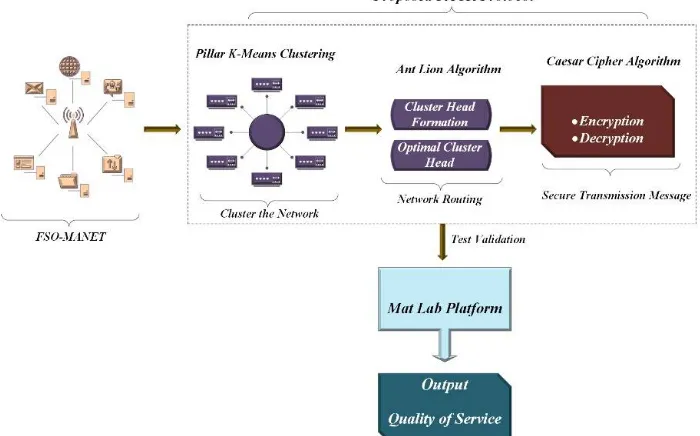
Quality of service is the concerned factor induced in the data transmission of mobile adhoc networks, the efficiency of QoS parameters are taken as the evaluation parameters in free space optical mobile ad hoc networks for effective data transmission and the motive of this work is to propose an effective quality of service routing protocol for message transmission. This paper proposes a PACR (Pillar k-means cluster based Ant lion Caesar cryptographic routing) protocol for optimizing the QoS parameters. The process in this paper starts with clustering the FSO-MANET by hierarchical based pillar k- means clustering algorithm. The clustering process groups the FSO-MANET in to entities called clusters. Each cluster nodes were stated in to four criteria namely cluster heads. The ant lion algorithm proposed in this paper to route the network with quality of service constraints such as packet delivery ratio, latency, throughput, overheads and end delay. During the routing the message is transmitted to the node, for the security of message an elliptic curve based Caesar cipher is implemented. The Caesar cipher is an encryption and decryption algorithm carried out in this paper to secure the message transmitted to the nodes. The proposed PACR protocol is implemented in the Mat Lab platform where the proposed protocol is compared with existing protocol like FESR and ANT-DSR. The analyzed results shows the proposed protocol is a least possible method for improving the QoS parameters and offer security to the free space optical mobile ad hoc networks.
A. PILLAR K-MEANS CLUSTERING
The pillar k-means clustering is a process clustering network based on the clustering technique of K-means clustering. The concept of pillar k-means is the concrete pillar mounted in building to withstand the roof pressure and the pillars are placed between particular distances, so it can withstand the pressure act on roofs equally without loss of failures. Let
Y
y
i where,
i
1
,
,
n
be the input nodes, ‘h
’ be the number of clusters,C
c
i where,
i
1
,
,
h
be the initial centroid taken from number of clusters,
ZY
Y
be the description for input Ywhich are already selectedin the sequence of process,
TG
m
y
i , where,
i
1
,
,
n
be the concentrated distance measured,T
y
i ,where
i
1
,
,
n
be distance measured for each iteration, andG
m be the grand mean of Y . The proposed pillar k-means clustering calculates the initial centroid nodes by the concentrated distance between each cluster nodes and all past centroid nodes, from the evaluation the maximum distance of nodes is selected as the centroid node. The node with high distance metric is selected as initial centroid ‘S
’. The evaluation of centroid in pillar k- means clustering can be evaluated from the following equation below. The pillar K-means cluster randomly generates the initial cluster center and the centroid of cluster can be determined by giving input
y
i
1
n
in to ‘C
’ with distanceT
y
i,
c
i
andnew cluster,
c
i is defined by the equation below.
ZY
(1)
Where,
be the outlier for select distance with input Y and distanceTG
m. Thus the new cluster is described by the given equation below.
C
C
(2)Where
C
is defined as the initial centroid with outlier
with input Yand distanceTG
m.The position of the cluster can updated by iterating with the new cluster to get the optimal centroid and it is explained in below equation.
1 t
S
(3)Where,
S
tis the iteration of cluster with threshold
in updation.B.ANT LION OPTIMIZATION ALGORITHM
The proposed ant lion optimization is a nature inspired algorithm based on the food prey technique of ant lions. The ant lion algorithm imitates the prey searching of ant lion by optimizing the prey to obtain best. The antlion hunt the prey by classify the food prey from its trap. The prey of ant lion is categorized in to random walk, the random walk of ants is explained in the following equation
q
0
,
cumsum
2
f
q
1
1
,
cumsum
2
f
q
2
1
,
,
cumsum
2
f
q
i
1
W
(4)Where, ‘cumsum’ defines the cumulative sum in the optimization, ‘n’ is the maximum number of iteration, ‘q’ is the
random walk step and
f
q
is a stochastic function in algorithm defined as follows.
5
.
0
0
5
.
0
1
rand
if
rand
if
q
f
(5)
The position of nodes is described in the matrix
Where,
M
nodesis the each node position matrix,n
is the number of nodes, andd
is the number of node variables. The fitness for the selecting optimal node for the cluster head selection is explained in the matrix below
d n n n d n OCCn
Cn
Cn
Cn
Cn
Cn
Cn
Cn
Cn
f
X
, 2 , 1 , , 2 2 , 2 1 , 2 , 1 2 , 1 1 , 1
(7)
Where,
f
is the objective function, ‘Cn
’ is the cluster nodes.
d n n n d n d ClusterHeaCn
Cn
Cn
Cn
Cn
Cn
Cn
Cn
Cn
X
, 2 , 1 , , 2 2 , 2 1 , 2 , 1 2 , 1 1 , 1
(8)
Where,
X
ClusterHead is the each cluster node position matrix,n
is the number of nodes, and d is the number of node variables.To select the best node for cluster head selection can be estimated from the equation below
ii t i t i i i t i t i
k
b
c
u
o
b
Q
Q
(9)Where,
b
i is the minimumi
th variable of random walk,o
i is the maximumi
th variable of random walk,u
ti is theminimum
i
thvariable in thet
th iteration andc
it indicates the maximumi
th variable in thet
th iteration.i. updating the cluster nodes
The updation of cluster node is carried out by the iteration process, the node in the matrix by the following equation
t t j t
i
CH
u
u
(10)t t j t
i
CH
c
c
(11)Where,
R
u
u
t
t is the minimum variables in thet
th iteration,R
c
c
t
t is the maximum of all variables in thet
thiteration and
CH
tjis the position of the selectedj
thcluster nodes in thet
thiteration, R is the ratio calculated in the iteration. Ratio,T
t
R
q
10
(12)
nT
t
if
n
T
t
if
T
t
if
I
5
.
0
2
1
.
0
1
(13)Where, ‘t’ is the iteration carried out in the algorithm, ‘T ’ is the maximum iteration carried out in the algorithm, and ‘
I’ is the iteration constant occur at every iteration.
2
t E t A t i
q
q
CH
(14)Where,
q
tAthe random walk around the cluster is selected in thet
thiteration, andq
tEis the random walk around theelite cluster choosen in the
t
thiteration.C. ELLIPTICAL CIPHER CURVE KEY BASED CAESAR ALGORITHM
In the proposed algorithm, the key is generated by the elliptical curve because the length of key is the concerned factor the strength of encryption. The ECK can offer 160bit key security for the encryption and decryption by Caesar cipher algorithm. The Caesar cipher is based on symmetric key algorithms that utilize same key for the encryption and decryption process. It is a shift cipher which divides the message into a set of length during the encryption/decryption process. Base point or generator point selection in ECK is the prime step for its security. The base point of ECC is given below,
b
az
z
y
E
:
2
3
(15)Where,
a
andb
are integers, satisfy the condition is4
a
3
27
b
0
mod
c
;
and here ‘c
’ is the prime number and includes a point called infinity point. By utilizing the following equation to generate the public key,C
K
*
(16)Where,’ ‘is the private key choosen as random in the range of 1to n-1, point curve on ECK is denoted by
C
and public key for the generation is denoted byK.i. Caesar Cipher Encryption and Decryption
The proposed Caesar cipher algorithm is otherwise called shift cipher and attains one of the simplest form of encryption. In this algorithm each message letters being replaced with other alphabetic or numerical which shifts up or down. In this paper the elliptic curve key generation offer better security to the generated key, thus the attempt for breaking or crashing is not possible for any level.
Initially the key is generated by the elliptical curve for the encryption process, the mathematical model for the encryption of Caesar cipher is explained below.
L
(
L
s
)
mod
26
C
Es
(17)The decryption of Caesar cipher reverse to the encryption, where the shifted letters are arranged to the initial state after the decryption process. The decryption of message can be computed from the given equation below.
L
(
L
s
)
mod
26
C
Ds
(18)IV.PSEUDOCODE
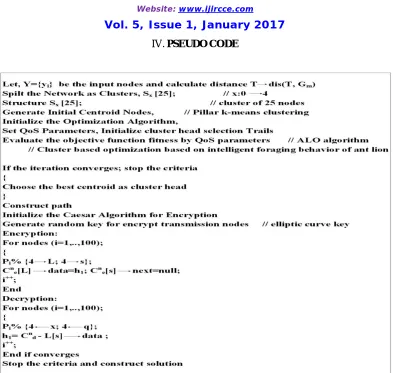
Fig 4: Pseudocode for Proposed PACR protocol
V.SIMULATIONRESULTS
The proposed PACR protocol for the analysis of QoS metrics is implemented in the working platform of MATLAB with the following system configuration.
Processor : Intel Core 2 Quad @ 2.5 GHz RAM : 3GB
Operating system : windows 7
Table 1: Parameters for Analyzing
Parameters Value
Nodes 100
Area 500×500 meters
Protocol PACR
Traffic Source CBR Energy 100 Joules Distance of nodes 1-100 meter
Mac Wireless Phy/802.11 Antenna Type FSO/RF Antenna Propagation Model Free Space Optical
Sending Rate 1 packet/sec Size of Packets 512 Bit
Packet delivery Ratio (PDR)
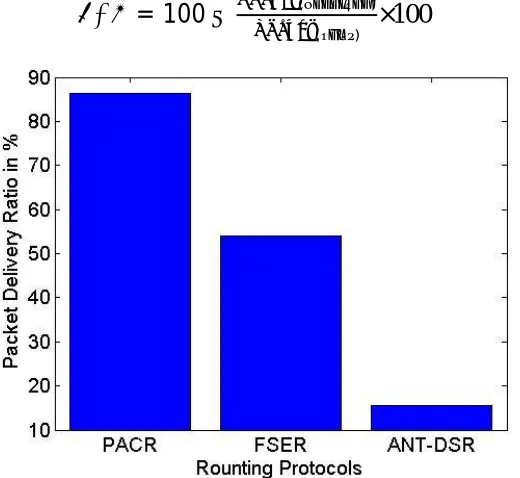
The packet delivery ratio to the sum of message obtained to the number of message forwarded. The packet delivery ratio for the proposed PACR protocol can be evaluated from the following equation below.
= 100
−
( )( )
×100
(19)
Fig 5: Packet Delivery Comparison of Routing Protocols
From the figure 5 the packet delivery ratio of proposed PACR protocol is compared with existing protocol FSER and ANT-DSR. In the comparison the proposed PACR attains higher efficiency rate of 80%, while the other two has the average rate below 50%. From the result it shows the proposed protocol has higher packet delivery ratio and optimal in routing QoS parameter.
Packet Loss Ratio (PLR)
= 100− ( )
( )×100 (20)
Fig 6: Packet Loss Comparison of Routing Protocols
In figure 6, the packet loss ratio during message transmission is compared with routing protocols. In this paper the proposed PACR protocol is compared with existing protocols like FESR and ANT-DSR. From the analysed results the proposed protocol has lower packet loss ratio of 19%, which is lower than the existing protocols. Thus the proposed PACR protocol is edible for message transmission with any loss of information.
Route Latency
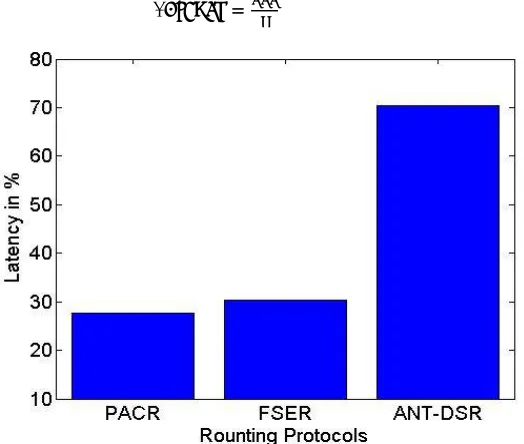
The network latency is defined as the time taken for the analysis to the time responds. Lower the latency rate make the efficiency of routing to higher state. The evaluation of network latency can be estimated from the following equation below.
= (21)
In figure 7, the route latency of proposed PACR protocol is compared with existing protocols like FESR and ANT-DSR. From the analysed result the proposed PACR protocol has lower latency of 28% than the existing protocols. Thus the proposed protocol is least effective in terms of route latency in free space optical mobile ad hoc networks.
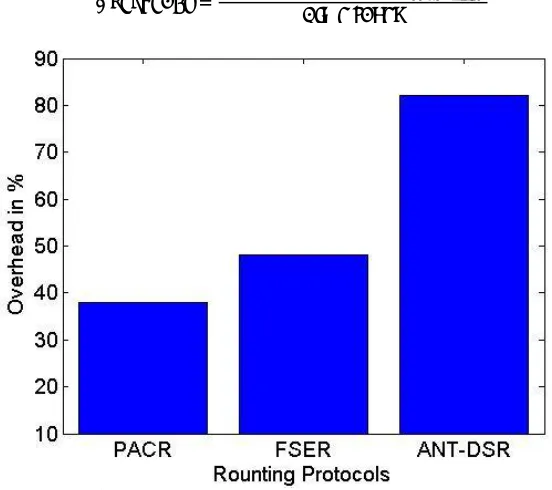
Route Overhead
The route overhead is defined as the time taken by the message to forward over a message transferring entity. Lower the overheads make the route efficiency an optimal level. In this paper the route overheads of network is compared with existing protocol and results are plotted. The equation given below is to derive the overheads in the sensor network.
ℎ = ( )
Fig 8: Overhead Comparision of Routing Protocols
In figure 8 the route overheads of information transmission is compared with the proposed PACR and Existing protocols like FSER and ANT-DSR. The route overheads of proposed PACR protocol has lower route overheads of 38% than the existing protocols in the range of 48% and 82%, which forms optimal in message transmission in free space optical mobile ad hoc networks.
Route End to End Delay
The end to end delay is defined as the time taken for sending and receiving message with in the network to attain the destination point. The end to end delay induced in the network transferring can be evaluated from the following equation below.
Fig 9: End Delay Comparison of Routing Protocols
The main criteria discussed in figure 9 shows the time delay evaluation of routing protocols. The proposed PACR protocol is compared with existing protocol like FSER and ANT-DSR. From the result analysis the time delay of message transmission is lower by 25% in proposed PACR protocol and forms stable in message transmission.
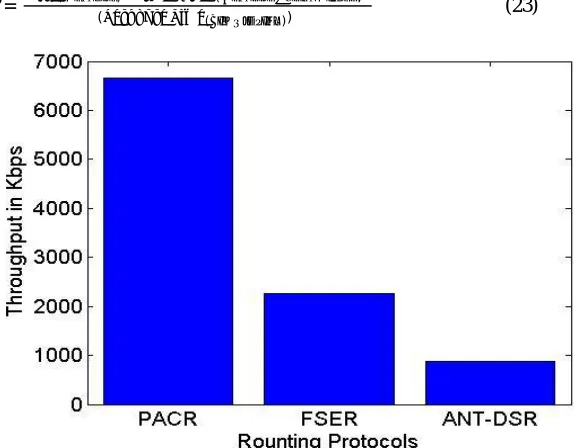
Route Throughput
The route throughput in network is defined as the number of positive message transmitted over FSO-MANET network. The purpose of throughput is to analyze the message transferred at mean time. The route throughput analysis of network can be derived from the following equation below.
ℎ ℎ =( ( )× ( ))
( ( )) (23)
In figure 10, the throughput of message transmission of Proposed PACR protocol is compared with existing protocols like FSER and ANT-DSR. The throughput of message ranges from 1000 to 7000 kilobytes per second. The result shows the proposed PACR protocol has higher throughput range of 6800 kilobytes per second and forms optimal for effective message transmission in free space optical mobile ad hoc networks.
Jitter
The jitter is the deviation of end to end delay between the transmitted messages. The message transmission time is very low in case of jitter evaluation. In case of jitter value, the delay time of transmission must be lower than the required point value. The average value of jitter is derived from the following equation below.
= −[ ( )− ( )] (24)
Fig 11: Jitter Comparison of Routing Protocols
In figure 11 the Jitter is validated for routing protocols such as PACR, FSER and ANT-DSR. The proposed PACR protocol has least jitter ratio of 15% than the FSER and ANT-DSR protocols in the range of 38% and 98% respectively and forms optimal in routing packets.
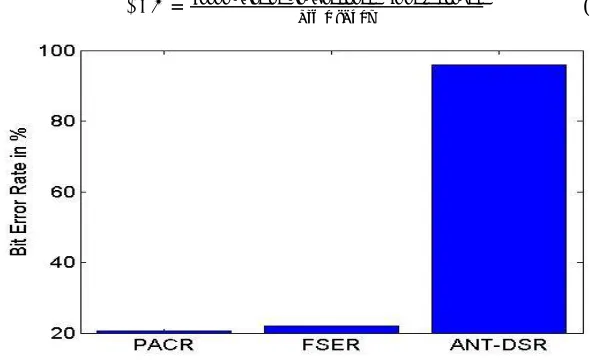
Bit Error Rate:
The bit error is derived as the ratio of bit error to the number of message transferred during time interval. The bit error rate for the routing protocols are expressed in percentage and expressed in the following equation.
= (25)
In figure 12 the bit error rate of proposed PACR protocol is compared with existing protocols such as FSER and ANT-DSR. From the analyzed result, it shows the proposed protocol has least value of 21 % than FSER and ANT-DSR protocol which has the range of 25% and 97% respectively.
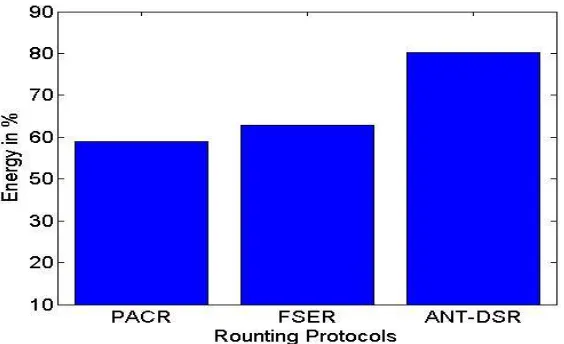
Energy Consumption
The energy consumption in message transmission during routing on a single route path is defined by
ll l
nod
l con
path
G
G
1
(26)
Where
nod
i is the count node of route path I and the energy consumed during transmission is defined byrecev trans
con
g
g
G
l
(27)
g
r
m
g
trans
t
amp
2
(28)Where
g
transthe energy is consumed during the transmission of m bits of message ande
trans is the energy consumed during receiving ‘m
’ bits of data between the source and destination.m
g
g
recev
r
(29)
g
g
r
m
G
con t r ampl
2
(30)Where,
g
rec andg
rare the energy consumed during the transmission and receiving one bit of data, ‘
amp’ is the consumption of energy in the transmission amplifier. When the communication radius ‘r
’ is fixed and the sensor located randomly at any distance with in the area be ‘r
2’.Fig 13: Energy Consumption Comparison of Routing Protocols
In figure 13, the energy consumption during routing is compared with proposed PACR and existing protocols such as FSER and ANT-DSR. The results clearly shows the proposed protocol has lower energy consumption of 58%, while the other protocols has higher of 63% and 80% respectively.
Buffer Occupancy
The buffer occupancy is defined as ratio of packet delivered to the number of packet during routing. The buffer occupancy for the packet transmission is derived from the following equation below.
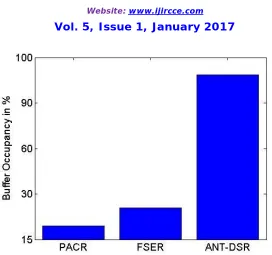
Fig 14: Buffer Occupancy Comparison of Routing Protocols
From figure 14 the buffer occupancy in routing is compared with PACR and existing routing protocols such as FSER and ANT-DSR. The results shows the proposed PACR protocol has the buffer rate of 20%, while the existing FSER and ANT-DSR has buffer occupancy rate of 25% and 96% respectively.
VI.CONCLUSION
Secure aware QoS aware PACR protocol in FSO-MANET network is researched and implemented in this article. The message transmission on network nodes based on the QoS parameters such as packet delivery ratio, latency, throughput, overheads and end to end delay. The proposed PACR attains higher level of quality of service constraints. The pillar k-means clustering offer best cluster technique for cluster the network in to nodes. The ant lion optimization is utilized for the network routing the clustered node and an effective method secure the data transmission on network, the elliptical curve based Caesar cipher encryption and decryption is utilized to secure the data transmitted from source to destination. The proposed PACR is analyzed in the Mat Lab platform and compared with existing protocol like FESR and ANT-DSR in terms of QoS metrics. Thus the analyzed results clearly mentioned that the proposed PACR protocol is an overall least method in optimizing the quality of services and security to the free space optical mobile ad hoc networks.
REFERENCES
[1] Gupta, Sonia, P. K. Bharti, and Vishal Choudhary, “Fuzzy logic based routing algorithm for mobile ad hoc networks”, In High Performance Architecture and Grid Computing, no. 1, pp. 574-579, 2011.
[2] Uysal, Murat, S. Mohammad Navidpour, and Jing Li, “Error rate performance of coded free-space optical links over strong turbulence channels”, IEEE Communications Letters, vol. 8, no. 10, pp. 635-637, 2004.
[3] Awwad, Osama, Ala Al-Fuqaha, Bilal Khan, and Ghassen Ben Brahim, “Topology control schema for better QoS in hybrid RF/FSO mesh networks”, IEEE Transactions on Communications, vol. 60, no. 5, pp. 1398-1406, 2012.
[4] Tseng, Yu-Chee, Sze-Yao Ni, Yuh-Shyan Chen, and Jang-Ping Sheu, “The broadcast storm problem in a mobile ad hoc network”, Wireless networks, vol. 8, no. 2, pp. 153-167, 2002.
[5] Jain, Anil K, “Data clustering: 50 years beyond K-means”, Pattern recognition letters, vol. 31, no. 8, pp. 651-666, 2010.
[6] Liu, Lianggui, and Guangzeng Feng, “Simulated annealing based multi-constrained QoS routing in mobile ad hoc networks”, Wireless Personal Communications, vol. 41, no. 3, pp. 393-405, 2007.
[8] Sun, Baolin, Shangchao Pi, Chao Gui, Yue Zeng, Bing Yan, Wenxiang Wang, and Qianqing Qin, “Multiple constraints QoS multicast routing optimization algorithm in MANET based on GA”, Progress in Natural Science, vol. 18, no. 3, pp. 331-336, 2008.
[9]Chen, Ping, and Tian-lin Dong, “A fuzzy genetic algorithm for QoS multicast routing”, Computer communications, vol. 26, no. 6, pp. 506-512, 2003.
[10] Liu, Yanbing, and Jun Huang, “A novel fast multi-objective evolutionary algorithm for QoS multicast routing in MANET”, International Journal of Computational Intelligence Systems, vol. 2, no. 3, pp. 288-297, 2009.
[11] Wang, Jianping, Eseosa Osagie, Parimala Thulasiraman, and Ruppa K. Thulasiram, “HOPNET: A hybrid ant colony optimization routing algorithm for mobile ad hoc network”, Ad Hoc Networks, vol. 7, no. 4, pp. 690-705, 2009.
[12] Mnaouer, Adel Ben, Lei Chen, Chuan Heng Foh, and Juki Wirawan Tantra, “OPHMR: an optimized polymorphic hybrid multicast routing protocol for MANET”, IEEE Transactions on Mobile Computing, vol. 6, no. 5, pp. 551-562, 2007.
[13] Ko, Young‐Bae, and Nitin H. Vaidya, “Location‐Aided Routing (LAR) in mobile ad hoc networks”, Wireless networks, vol. 6, no. 4, pp. 307-321, 2000.
[14] Di Caro, Gianni, Frederick Ducatelle, and Luca Maria Gambardella, “AntHocNet: an adaptive nature‐inspired algorithm for routing in mobile ad hoc networks”, European Transactions on Telecommunications, vol. 16, no. 5, pp. 443-455, 2005.
[15] Zhao, Yongli, Lingnan Gao, Xingbin Yin, Yue Yu, and Jie Zhang, “OpenFlow-based control architecture for the mobile Free Space optical networks”, China Communications, vol. 11, no. 8, pp. 65-72, 2014.
[16] Nasab, Alireza Sajedi, Vali Derhami, Leyli Mohammad Khanli, and Ali Mohammad Zareha Bidoki, “Energy-aware multicast routing in MANET based on particle swarm optimization”, Procedia Technology, vol. 1, pp. 434-438, 2012.
[17] Dowling, Jim, Eoin Curran, Raymond Cunningham, and Vinny Cahill, “Using feedback in collaborative reinforcement learning to adaptively optimize MANET routing”, IEEE Transactions on Systems, Man, and Cybernetics-Part A: Systems and Humans, vol. 35, no. 3, pp. 360-372, 2005.
[18] Ghosh, Joy, Sumesh J. Philip, and Chunming Qiao, “Sociological orbit aware location approximation and routing (SOLAR) in MANET”, Ad Hoc Networks, vol. 5, no. 2, pp. 189-209, 2007.
[19] Derenick, Jason, Christopher Thorne, and John Spletzer, “Hybrid free-space optics/radio frequency (FSO/RF) networks for mobile robot teams”, In Multi-Robot Systems. From Swarms to Intelligent Automata, Volume III, pp. 263-268, 2005.
[20] Whitbeck, John, and Vania Conan, “HYMAD: Hybrid DTN-MANET routing for dense and highly dynamic wireless networks”, Computer Communications, vol. 33, no. 13, pp. 1483-1492, 2010.
[21] Rao, V. Shanmukha, and V. Srinivasa Rao, “Security Aware Fuzzy C-Means Cluster-based SocialSpider Elliptic Curve Cryptography (FSER) Routing Protocol in FSO MANET”, Indian Journal of Science and Technology, vol. 9, no. 44, 2016.
[22] Vijayakumar, A., and K. Selvamani, “Reputed Packet Delivery Using Efficient Audit Misbehaviour Detection and Monitoring Method in Mobile Ad Hoc Networks”, Procedia Computer Science, vol. 48, no. 1, pp. 489-496, 2015.
[23] Mandhare, V. V., V. R. Thool, and R. R. Manthalkar, “QoS Routing enhancement using metaheuristic approach in mobile ad-hoc network”, Computer Networks, vol. 110, pp. 180-191, 2016.
[24] Chatterjee, Shubhajeet, and Swagatam Das, “Ant colony optimization based enhanced dynamic source routing algorithm for mobile Ad-hoc network”, Information Sciences, vol. 295, pp. 67-90, 2015.
[25] Kaliappan, Madasamy, and Balasubramanian Paramasivan, “Enhancing secure routing in Mobile Ad Hoc Networks using a Dynamic Bayesian Signaling Game model”, Computers & Electrical Engineering, vol. 41, pp. 301-313, 2015.