• No results found

Simulation of assembly of components for industrialized building system

N/A
N/A
Protected

Academic year: 2020

Share "Simulation of assembly of components for industrialized building system"

Copied!
23
0
0

Loading.... (view fulltext now)

Full text

(1)

ALI HOUSSEIN ALI ZOUBI

(2)

ALI HOUSSEIN ALI ZOUBI

A project report submitted in partial fulfillment of the

requirements for the award of the degree of

Master of Science (Construction Management)

Faculty of Civil Engineering

Universiti Teknologi Malaysia

(3)
(4)

ACKNOW LEDGEMENT

The author wishes to express his sincere appreciation to all who have helped

directly or indirectly in his Masters Project research work. The first gratitude is to

Allah for his prosperity and guidance. A big thank is to the project supervisor,

Associate Professor Dr. Abdul Kadir Bin Marsono, for his passionate assistance, and

concern.

With his invaluable advices and superb directions, the author has

successfully completed his Masters Project. It is indeed a true honor and privilege

for being able to work under the supervision of such a dedicated and enthusiastic

lecturer.

(5)

ABSTRACT

(6)

ABSTRAK

Sistem

sebagai proses

pekerja, menyediakan kawalan kualiti yang lebih baik dan meningkatkan

produktiviti. Selain itu, kaedah pembinaan ini juga menyediakan reka bentuk yang

ekonomi dan memberi perlindungan terhadap perubahan dari segi kos pembinaan.

Tujuan kajian ini adalah untuk menentukan aliran proses pemasangan komponen

dalam pembinaan (IBS) untuk sistem utama komponen struktur. Bagi tujuan ini satu

kajian telah dijalankan untuk menganalisis kaedah pemasangan dan menambah baik

pelaksanaan IBS untuk 80 bengkel pembinaan yang dibahagikan kepada 6 zon di

Dubai Maritime City. Ia menerangkan kaedah pemodelan simulasi dengan

menggunakan proses simulasi pemasangan komponen dalam pembinaan melalui

penggunaan perisian Arena10. Analisis hasil kajian ini menunjukkan bahawa

terdapat kaedah untuk memperbaiki proses bagi operasi projek pembinaan. Melalui

simulasi yang dilakukan, didapati Model (BTA) dapat mencapai tempoh siap 2 hari

lebih awal daripada keadaan pembinaan sebenar dengan mengunakan sumber yang

sedia ada. Manakala dengan strategi model (FCFS) jangka siap adalah lebih pendek 4

hari berbanding (BTA). Walau bagaimanapun jika penggunaan sumber dapat

ditingkatkan, BTA akan dapat mencapai tempoh siap lebih awal berbanding dengan

(FCFS).

(7)

TABLE OF CONTENTS

CHAPTER

TITLE

PAGE

DECLARATION

ii

DEDICATION

iii

ACKNOW LEDGEMENT

iv

ABSTRACT

v

ABSTRAK

vi

TABLE OF CONTENTS

vii

LIST OF TABLES

xi

LIST OF FIGURES

xii

LIST OF APPENDICES

xiv

1

INTRODUCTION

1

1.1

Introduction

1

1.2

Problem Statement

2

1.3

Aim and Objectives of Study

3

1.4

Scope of Study

3

1.5

Significance of Study

5

1.6

Brief Research Methodology

6

2

LITERATURE REVIEW

7

2.1

Introduction

7

2.2 Industrialised Building System (IBS)

8

2.3 Principle of IBS

9

(8)

2.5 The Selection of IBS

13

2.6 Benefits of IBS

14

2.7 IBS Construction Logistics

15

2.8 Factors affecting Logistics

15

2.9 The Functions o f Logistics

17

2.10 Manufacturing of Components

18

2.11

Transportation of Components

19

2.12 Civil Engineering Works

19

2.13

Contractors and Consultants

19

2.14 Assembly of Components

20

2.15 Potential Benefits by Improving Logistics

21

2.16 Factors effective functioning of Logistics

21

2.17 Supply Chain Management (SCM)

22

2.17.1

Information Flow Role in SCM

22

2.17.2 Logistics and SCM in Construction

23

2.18 Modular Coordination

24

2.19 Just-In-Time Philosophy

26

2.20 Simulation in Construction

29

2.21

ARENA Simulation

30

2.22 Summary Literature Review

35

3

M ETHODOLOGY

37

3.1

Introduction

37

3.2 Literature Review

39

3.3

Selecting Attributes of Logistics Process

39

3.4 Forming Systematic Workflow Processes

40

3.5 Data Collection

41

3.6 Data Analysis and Discussion

42

4

DATA CO LLECTIO N

43

4.1

Introduction

43

4.2 Data Collection

44

(9)

4.3.1

Site Layout Plan

45

4.3.2 IBS Components

47

4.3.3

Supply of Components

48

4.3.4 Resources Requirement

48

4.3.5 Working Time

50

4.3.6 Crane Constraint

51

4.3.7 Installation Process

52

4.4 Process Flow of IBS Assembly in Construction

52

4.5

Summary

55

5

SIMULATION ANALYSIS AND DISCUSSION

56

5.1

Introduction

56

5.2 Simulation Elements

57

5.3

Simulation Modelling

58

5.3.1

One Block Model

59

5.3.2 Constructing Blocks Individual Models

60

5.3.3 BTA - Built To Assembly Model

61

5.4 Simulation Analysis

64

5.5 Optimization of Time of Completion

65

5.5.1 Model Sensitivity Analysis

66

5.6 Summary

68

6

CONCLUSION AND RECOMMENDATIONS

69

6.1

Introduction

69

6.2 The Review of Findings

70

6.2.1 First Finding to identify the detail workflow

activities and their resources to assemble

the components of IBS project

70

6.2.2 Second Finding to simulate BTA ( built to

assemble ) model for IBS construction

(10)

6.2.3

Third Finding to improve Model process

to achieve less completion time

71

6.3

Conclusion

72

6.4 Recommendations

73

REFERENCES

75

(11)

LIST OF TABLES

TABLE NO

TITLE

4.1

The location and number of IBS for precast walls

component in each block

4.2

Task and resources for assembly of walls

components

4.3

Installation process for each IBS components

5.1

Completion time to each block using simulation

and site condition

5.2

Completion time of BTA simulation and site

condition

PAGE

47

50

(12)

FIGURE NO

1.1

2.1

2.2

2.3

2.4

2.5

3.1

3.2

3.3

4.1

4.2

4.3

LIST OF FIGURES

TITLE

Research flow

Sequence of activities for IBS construction

method

Sequences

process

of

IBS

components

installation

Construction logistics tasks

Principle of Just In Time (Abidin, 2007)

The Arena window

Methodology Flowchart

Conceptual Models for Organization of assemble

components process to (Arena10) Simulation

Diagram.

Arena implementation diagram with sequences

of assembly for IBS construction.

A site layout plan of New Workshops Blocks

using semi-IBS components for walls / Dubai

Maritime

Typical

IBS

walls

components

used

in

workshops

(13)

4.4

5.1

5.2

5.3

5.4

5.5

5.6

5.7

Sequences of IBS construction walls activities

for All Blocks

Designer elements in Arena

A Model of IBS walls block 7

BTA - Built To Assembly Model

The Comparison of Processes Between BTA &

Actual Process In Site

Simulation model for First Come First served

strategy

The Comparing of Completion Times Between

BTA & FCFS Models

Simulation of BTA and FCFS strategy by using

deferent number of cranes

(14)

LIST OF APPENDIX

APPENDIX

TITLE

PAGE

A

Questionnaire Survey Form

78

(15)

INTRODUCTION

1.1

Introduction

Collaboration among construction companies in management of supply

chains has become a topic of increasing importance over the past few years.

Researchers and practitioners alike have been trying to raise awareness on the need

for the construction industry to incorporate to other sectors in the management of

supply chains (Buntrock, 2001).

Supply chain management plays a major role in the growth of companies

involved in delivering of a product or service. However, the gains accruable to at

most times is not achievable due to conflicting interests among various stakeholders

in the supply chain, network complexity, barriers in interactions between various

participants which hinders information flow, money and goods (Simchi-Levi et al.

2003).

(16)

prominence over the years. Thus, a high process planning and accurate logistic of

IBS (Industrialized Building System) construction process is needed in order to

enhance logistic activities of IBS component.

This study examines the logistics in construction process and its effect on

construction supply chains for the assembly of components of IBS. Past studies on

construction supply chains are reviewed and simulation are used to assemble of

components process and examined its implication from research to practice.

1.2

Problem Statement

The supply chain of IBS involves many parts of management. One of the

most important processes of IBS is the logistic process. Logistics involve the

logistics management, supply chain management, standardization of IBS

construction such as sizing, project management, policy and regulation.

(17)

1.3

Aim and Objectives of Study

The application of Supply Chain Management (SCM) philosophy to the IBS

construction has been widely investigated as an effective and efficient logistic

process to improving the performance of construction. One of the logistic process

that is very important in IBS is assembly process of components. Currently it is

fragmented, waste, poor productivity, cost and time overruns, conflicts and disputes

since long time ago.

In order to improve the IBS construction industry mode of assembly, the

research is to focus and simulate the integration of supply chain management tool

through order and demand. Arena simulation tools will be used to create a simulation

model to reach to the optimize completion time and appropriate resources.

The objectives of this study are:

To identify the detail workflow activities and their resources to assemble the

components of IBS project.

To simulate BTA ( built to assemble ) model for IBS construction method.

To improve Model process to achieve less completion time.

1.4

Scope of Study

(18)

components until finish the whole assembly process. The assumptions that have to be

made in this study are the installation will not be interrupted due to any delay,

machine breakdown, lack of labours and insufficient supply of IBS components from

the supplier. The study will also seek criterion for a good logistics vision statement

that is to provide the route map for how these goals are to be achieved:

• Literary study on IBS and supply chain management for logistics of

construction process in assembly components process.

• Modeling and simulation of supply chain management to achieving a good

overall IBS assembly period, time needed and Alternative models for

organization process.

• Data analysis of the results and conclusions.

(19)

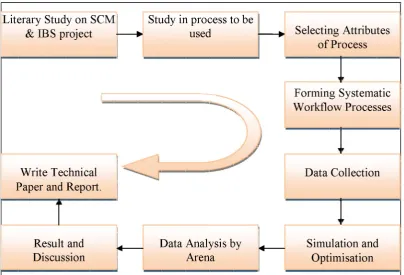
Literary Study on SCM

& IBS project

Write Technical

Paper and Report.

Study in process to be

---►

used

---►

Result and

k

---

Data Analysis by

<4

---Discussion

Arena

Selecting Attributes

of Process

Forming Systematic

Workflow Processes

Data Collection

Simulation and

Optimisation

Figure 1.1

Research process

1.5

Significance of Study

The significance of the study are:

a) A methodology used in this study can be applied in the planning of IBS

projects assembly especially in organization of work flow.

b) It also will prevail the best sequence process in IBS assembly.

(20)

1.6

Brief Research Methodology

(21)

Abidin, A. R. B. Z. (2007).

Simulation o f Industrialized Building System Formation

fo r Housing Construction.

Unpublished master thesis. Universiti Teknologi

Malaysia, Skudai.

Alashwal, A. M. (2006).

Optimizing Production Line o f IBS by Using Simulation

Model.

Unpublished master thesis. Universiti Teknologi Malaysia, Skudai.

Badir, Y.F., Kadir, M.R.A. and Hashim, A.H. (1998). Industrialized Building

Systems Construction in Malaysia. Malaysia: Journal of Architectural

Engineering, March 1998.

Baumgarten, H. (1998)

Successes o f future-oriented logistics o f the building site

(Erfolge mit zukunftsorientierter Baustellenlogistik), Bereich Logistik,

Technische Universitat Berlin, Berlin, (1998) in German.

Cigolini, R. Cozzi, M. Perona, M. (2004) A new framework for supply chain

management. Conceptual model and empirical test.

International Journal o f

Operations & Production Management,

Vol 24, No 1, (2004), pp. 7-41.

CIDB Malaysia, (2001)

Manual fo r Assessment o f Industrialized Building Systems

CIDB, Kuala Lumpur, 2001.

Cooper, M.C., Lambert, D.M., and Pagh, J.D. (1997).

Supply Chain Management:

More than Just a New Name fo r Logistics.

Intl. J. of Logistics Mgmt., 8 (1)

pp.1-13.

Chew, Y.L., and Michael (2001).

Construction Technology fo r Tall Building.

2nd

Edition. Singapore: Singapore University Press and World Scientific

Publishing Co. Pte. Ltd.

Christopher, M. (1992).

Logistics and Supply Chain Management: Strategies for

(22)

Cooper, M.C., and Ellram, L.M. (1993).

Characteristics o f Supply Chain

Management and the Implications fo r Purchasing and Logistics Strategy

.Intl.

J. Log. Mgmt., 4 (2) pp.13-24

Donald Waters (2003).

Logistics an Introduction to Supply Chain Management,

New

York, N.Y. 10010

Dulaimi, M. (1995).

The challenge o f innovation in construction,

Building Research

and Information. 23(2), pp.106-109.

Esa, H. and Nuruddin, M.M. (1998).

Policy on Industrialised Building System

-Report on Colloquim on Industrialised Construction System.

Kuala Lumpur.

Foong Kok Li (2006),

Scheduling On Transportation fo r Industrialized Building

Systems.

Master of Science (Construction Management).

Fred, Michael O ’Brien, Ron Wakefiled, Yvan Beliveau (2000).

Industrializing the

Residential Construction Site Center fo r Housing Research

at Virginia

Polytechnic Institute and State University, Blacksburg, Virginia 24061

Joines J. A., Barton R. R., Kang K., and P. Fishwick A., eds. (2000).

Introduction to

Simulation

Brooks Automation, Auto Simulations Division Atlanta, GA

30067, U.S.A. pp.9-16.

Junid, S.M.S. (1986).

Industrialised Building System - Proceedings o f a

UNESCO/FEISEAP Regional Workshop.

Malaysia: UPM Serdang.

Lambert, D.M., Cooper, M.C., Pagh, J.D., 1998.

Supply chain management:

implementation issues and research opportunities.

International Journal of

Logistics Management

Liker, J.K. (2004) The Toyota Way:

Management Principles from the World’s

Greatest Manufacturer

. McGraw-Hill: New York, NY. 330p.

London, K.A. and Kenley, R. (2001).

An Industrial Organization Economic Supply

Chain Approach fo r the Construction Industry: a Review. Construction

Management and Economics.

19, 777-788.

Palevich, R. F. (1997).

Supply Chain Management

,” APICS Conference,

Washington, D.C. Alexandria, Va.: APICS-The Educational Society for

Resource Management.

(23)

Rollet, M. (1986).

Modular coordination in the building industry.

Toward

industrialization in the building industry, Proc., UNESCO/FEISEAP Regional

Workshop, Univ. Pertanian, Malaysia.

Serra, S. M. B.; Oliveira, O. J. (2003)

Development o f the logistics plan in building

construction. System-based vision fo r strategic and creative design.

Bontempi

(ed.), Lisse, Swets& Zeitlinger. (2003), pp. 75-80.

Shaari, Shahrul Nizar and Ismail, Elias, (2003)

Promoting the Usage o f

Industrialized Building Systems (IBS) and Modular Coordination (MC) in

Malaysian Construction Industry

in Buletin Ingeniur, Board Engineers of

Malaysia (BEM), Kuala Lumpur, March 2003.

Simchi-Levi, D., Kaminsky, P., Simchi-Levi, E. (2003).

Designing and Managing

the Supply Chain: Concepts, Strategies & Case Studies.

Second Edition.

McGraw-Hill Irwin: Boston, MA. 354pp.

Sobotka, A. (2000).

Simulation modeling fo r logistics re-engineering in the

construction company.

Construction Management and Economics, 18 (2000),

pp. 183-195.

Sumadi, Salihuddin Radin, et al, (2001).

Promotion Strategies and Future Research

& Development.

National Seminar on Industrialised Building System, CIDB,

Kuala Lumpur, 17 September 2001.

Trikha, D, N. (1999). Industrialised Building System:Prospects in Malaysia

Proceedings World Engineering Congress.

Vrijhoef, R. Koskela, L. (2000).

The four roles o f supply chain management in

construction.

European Journal of Purchas ing & Supply Management, 6

(2000), pp. 169-178.

Warszawski,

A.

(1999)

Industrialised and automated building systems.

Figure

Figure 1.1 Research process

References

Related documents