Watermarking Scheme based on Redundant
Discrete Wavelet Transform, Singular Value
Decomposition and Uniform Probability
Density Function
Goda Vasantha Rao1, G V Satya Kumar2
M. Tech Student, VVIT, Nambur, Andhra Pradesh, India1 Associate Professor, VVIT, Nambur, Andhra Pradesh, India2
ABSTRACT: Now a day’s watermarking is one of the major one in the copyright protections and proof of ownership applications in digital image processing. As the technology improves day by day, it becomes a challenging task for the researchers to develop new algorithms under different noise attacks. While embedding a watermark in a host image, security, robustness and imperceptibility are the major factors to be concerned. The proposed method using Uniform Probability Density Function (Uniform PDF), Redundant Discrete Wavelet Transform (RDWT) and Singular Value Decomposition (SVD) i.e. RDWT-SVD-Uniform PDF, achieved a large capacity due to redundancy in RDWT domain and high degree of imperceptibility due to SVD properties. The proposed method shows a significant improvement in terms of Peak signal to Noise Ratio (PSNR) when weighted against existing technique RDWT-SVD.
KEYWORDS: RDWT, SVD, Uniform PDF, Watermarking.
I. INTRODUCTION
Recently, the wide increase in the pirated digital media due to the technology enhancement and the ease of distribution, has led to the need to protect the media against attacks [1]. The digital media (such as audio, video, text or image) can be easily modified by the attackers which may lead to claim its ownership.
So it is required to develop robust methods to prevent unauthorized copying and redistributing it on the network become a critical task for the researchers in digital watermarking. Traditional method such as copyright protection and encryption could not solve the problem of unauthorized copying entirely. It is clear from the literature digital watermarking provides a possible solution to the said problem.
Digital watermarking is a technique for inserting information (watermark) into an image, which can be later extracted or detected for variety of purposes, includes the identification and authentication purposes. The watermark embedded may be visible or invisible. The performance of digital watermark can be evaluated based on the parameters like Robustness, perceptual transparency, secrecy, complexicity and capacity.
The digital watermark can be classified into various categories as perceptible and imperceptible, robust and fragile, public and private watermarks. According to the domain these are subdivided as spatial and transform domain techniques. In spatial domain the water mark is directly embedded into the cover image by changing the pixel values of the data, for example watermarking using SVD. In transform domain it is done by altering the transform coefficients for example watermarking using DCT [2] and DFT [3].
ISSN(Online): 2320-9801 ISSN (Print): 2320-9798
International Journal of Innovative Research in Computer
and Communication Engineering
(An ISO 3297: 2007 Certified Organization)
Vol. 4, Issue 11, November 2016
II. RELATED WORK
A. REDUNDANT DISCRETE WAVELET TRANSFORM (RDWT/SWT)
Wavelet is rapidly decaying wave like oscillation that has zero mean. Unlike sinusoids, which extends to ∞, a wavelet exits only for finite duration. Wavelet may be in different sizes and shapes. The availability of a wide range of wavelets is the key feature of the wavelet analysis. To choose the right wavelet you need to consider the application that you use it for.
The discrete wavelet transform (DWT) [4] is the implementation of the wavelet transform using a discrete set of the wavelet scales and translations obeying some defined rules.
B. NEED FOR DISCRETE WAVELET TRANSFORM
The DWT provides sufficient information both for analysis and synthesis of original signal with a significant reduction in the computation time. The DWT [4] is considerably easier to implement when compared to CWT.
The DWT provides sufficient information both for analysis and synthesis of original signal with a significant reduction in the computation time. The DWT [4] is considerably easier to implement when compared to CWT.
1. DWT analysis
Where * indicates the convolution and ↓2 indicates the down sampling i. e.
2. DWT synthesis
Where ↑ here denotes to the up sampling process i.e. if ↑ 2 then
C. ADVANTAGES OF RDWT OVER DWT
Classical DWT is not a shift invariant. This means that DWT of translated version of a signal is not the same as the DWT of the original signal. Shift invariance is important in many applications such as pattern detection and de-noising etc. Translation invariance [11] is achieved by removing the down sampling and up sampling in DWT and it is done by using a special algorithm called as Redundant Discrete Wavelet Transform (RDWT) [5] and it is also called as SWT Stationary Wavelet Transform). The SWT is most commonly known as “algorithme a ﬥtrous” in French (word trous means holes in english) which refers to inserting zeros in the filter.
As shown in fig 2, the RDWT itself removes the up sampling and down sampling coefficients .Therefore the filters themselves are up sampled to suitable length of growing data are as
and
Figure1. Two level 1D DWT analysis and synthesis filter bank
D. SINGULAR VALUE DECOMPOSITION (SVD)
SVD is a most widely used technique in various applications like image hiding, image compression, Noise reduction and in image water marking.SVD [4], [6] is based on a theorem from linear algebra says that a rectangular matrix A can be broken down into 3 matrices as orthogonal matrix ‘U’ ,a diagonal matrix ‘S’ and the transpose of orthogonal matrix ‘V’. The theorem is usually presented like this as
For 3×3 size
Where =I , the columns of U are orthogonal Eigen vectors of and the columns of V are orthogonal Eigen vectors of and S is a diagonal matrix containing the square roots of Eigen values from U and V in descending order, here SVD is used for watermarking embedding process [7],[8],[9].The disadvantage present in the existing RDWT-SVD algorithm is that the scaling factor α is fixed one. So to have better performance in terms of PSNR the proposed RDWT-SVD-Uniform PDF algorithm is used.
ISSN(Online): 2320-9801 ISSN (Print): 2320-9798
International Journal of Innovative Research in Computer
and Communication Engineering
(An ISO 3297: 2007 Certified Organization)
Vol. 4, Issue 11, November 2016
Figure 3 (a) Host image (peppers) (b)Watermark image (VVIT) (c)Watermarked image (peppers) (d) Extracted watermark image
III. PROPOSED WORK
To overcome the drawback present in the RDWT-SVD algorithm, the uniform probability density function along with RDWT and SVD [5] techniques was used. The Uniform Probability Distribution function is applied on cover image to get the value of ‘α’ which is called the scaling factor for watermarking embedding process.
A. WATERMARK EMBEDDING ALGORITHM
The steps are as follows
Perform 1D RDWT on cover image that decomposes into four sub bands as (LL, LH, HL, HH)
Apply SVD on all sub bands (LL, LH, HL, HH) as
= , where i indicates the sub bands LL, LH, HL, HH
Get the value of α scaling factor for watermarking by applying Uniform PDF on cover image
.
Apply SVD to the each sub bands as
Where indicates the sub bands LL, LH, HL, HH
Perform the new modified RDWT coefficients for each sub band as =
where indicates the sub bands LL, LH, HL, HH
Apply inverse RDWT on 4 sub bands to get watermarked image
B. EXTRACTION ALGORITHM
Apply RDWT on watermarked image to decompose it into 4 sub bands
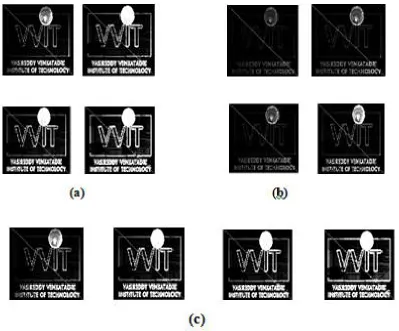
Figure4(a).Watermarked image under salt and pepper noise (0.3) (PSNR 10.2309); (b).Watermarked image under salt and pepper noise (0.01) (PSNR 25.0773); (c). Watermarked image under salt and pepper noise (0.001)(PSNR 35.2101) ; (d). Watermarked image under salt and pepper noise (0.005) (PSNR 28.4087) ; (e). Watermarked image under speckle noise (0.01)(PSNR 28.8270) ; (f). Watermarked image under speckle noise (0.3)(PSNR 14.5851); (g). Watermarked image under Gaussian noise(0,0.01)(PSNR 20.1826) ; (h).Watermarked image under Gaussian noise(0, 0.05)(PSNR 14.0263) ; (i). Watermarked image under Gaussian noise (0, 0.1) (PSNR 11.6882).
IV. EXPERIMENTAL RESULTS AND DISCUSSION
The proposed method is implemented using MATLAB and tested on a cover image of size of 512×512 with a watermark of size 256×256. Here VVIT image is considered as watermark image and it is embedded into the cover image. A Uniform probability distribution function is used on cover image to find the value of α which helps in determining the imperceptibility. The performance of the proposed method is evaluated based on the metrics peak signal-to-noise ratio and Mean Square Error (MSE) to denote the imperceptibility degree.
To test the robustness of the watermarks different noise attacks are simulated. The PSNR can be calculate as follows
ISSN(Online): 2320-9801 ISSN (Print): 2320-9798
International Journal of Innovative Research in Computer
and Communication Engineering
(An ISO 3297: 2007 Certified Organization)
Vol. 4, Issue 11, November 2016
Table 1
Comparison of PSNR (db) for our scheme RDWT-SVD-Uniform PDF with RDWT-SVD
Watermark image
Proposed Scheme
(RDWT-SVD-Uniform PDF) RDWT-SVD
Cameraman 65.4346 db 52.833 db
VVIT 98.972 db 81.4654 db
Table 2
Comparative analysis of RDWT-SVD-Uniform PDF with RDWT-SVD scheme
Description RDWT+SVD Proposed
Type of scheme Blind Blind
Type of transforms RDWT+SVD RDWT+ SVD+ Uniform
Embedding sub bands All All
Size of host image 512×512 512×512
Type of watermark Gray Gray
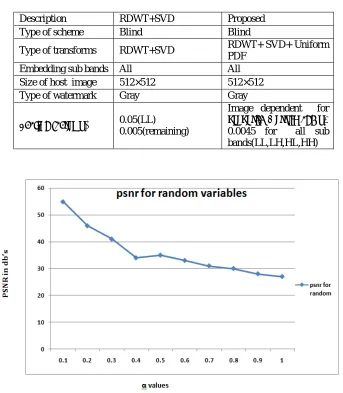
Scaling factor(α) 0.05(LL) 0.005(remaining)
Image dependent for proposed Host image α= 0.0045 for all sub bands(LL,LH,HL,HH) .
Figure7. Graphical representation of PSNR Vs α as a random variable within the range of 0 to 1
V. CONCLUSION
ISSN(Online): 2320-9801 ISSN (Print): 2320-9798
International Journal of Innovative Research in Computer
and Communication Engineering
(An ISO 3297: 2007 Certified Organization)
Vol. 4, Issue 11, November 2016
possible high PSNR. The Uniform PDF is applied on the image and the watermark was directly embedded to all the RDWT Sub bands. Although embedded data may lead to distorted, the proposed method preserved high degree of imperceptibility and improved PSNR. The experimental results produced in this paper achieved high PSNR under various noise attacks. Thus the proposed scheme satisfied high PSNR, imperceptibility and security requirements.
REFERENCES
[1] Hien TD, Nakao Z, Chen YW. Robust multi-logo watermarking by RDWT andICA. Signal Process 2006;86(10):2981–93. [2] Lin S, Chen CF. A robust DCT-based watermarking for copyright protection. IEEETrans Consum Electron 2000;46(3):415–21.
[3] Premaratne P, Ko C. A novel watermark embedding and detection scheme for images in DFT domain. In: 7th international conference on image processing and its applications. 1999. p. 780–3.
[4] Lai CC, Tsai CC. Digital image watermarking using discrete wavelet transform and singular value decomposition. IEEE Trans Instrum Meas 2010;59(11):3060–3.
[5] Lagzian S, Soryani M, Fathy M. A new robust watermarking scheme based on RDWT–SVD. IJIIP Int J Intell Inform Process 2011;2(1):22–9. [6] Rastegar S, Namazi F, Yaghmaie K, Aliabadian A. Hybrid watermarking algorithm based on singular value decomposition and radon transform. Int J Electron Commun (AEU) 2011;65(7):658–63.
[7] Lai CC. An improved SVD-based watermarking scheme using human visual characteristics. Opt Commun 2011;284(4):938–44.
[8] Ling HC, Phan RCW, Heng SH. On the security of a hybrid watermarking algorithm based on singular value decomposition and radon transform. Int J Electron Commun (AEU) 2011;65(11):958–60.