Performance Comparison of Massive MIMO
& Conventional MIMO using Blind Channel
Estimation Technique
Madhusrhi.N.Kumar, Pappa.M
M.Tech Student, Dept. of Telecommunication, CMR Institute of Technology, Bengaluru, India
Associate Professor, HOD, Dept. of Electronics and Communication, CMR Institute of Technology, Bengaluru, India
ABSTRACT: Multiple-Input Multiple-Output (MIMO) technology is becoming nature for wireless communications. This Paper presents to the Blind channel estimation of Massive MIMO, And it has been incorporated into wireless broadband standards like LTE and Wi-Fi. It allows the use of multiple antennas at the transmitter and the receiver to increase the data rate, capacity and the link reliability. Multiple antennas at the transmitter and the receiver are used to exploit the multipath propagation. One of the key techniques that enable MIMO is Orthogonal Frequency Division Multiplexing (OFDM). In OFDM, the multiple symbols are transmitted in parallel on the same frequency band. Each symbol is transmitted sequentially in a narrow frequency band for a greater period of time which enables the receiver to pull each symbol. Even if the symbol is degraded, it is possible to receive one of the best symbol for the fact that it is been transmitted for a longer duration which is important while working in MIMO environment. By using OFDM technique the spectral efficiency can be improved and also by using more number of antennas the overall efficiency of the system can be increased.
Furthermore, Multi-User MIMO is one of the current practices which have advantages over conventional point to point MIMO as it works with cheap single-antenna terminals, it does not require a very rich scattering environment and the resource allocation is simplified because each terminal uses all of the time-frequency bins. MU-MIMO can support multiple users simultaneously which uses the same channel thereby enhancing the spectral efficiency of the spectrum usage. As originally envisioned, MU-MIMO uses roughly equal number of antennas at the transmitter and the receiver and frequency division duplex, which is not a scalable technology and also as the signal is transmitted on the same frequency band; it is likely to have more interference at the receiver which requires a complex hardware to recover the particular signal. These drawbacks can be eliminated by the use of “massive MIMO” which allows asymptotic orthogonality and uses simple processing methods.
KEYWORDS: Antenna, LTE, OFDM, MIMO
I.INTRODUCTION
increased in a MIMO-OFDM system, BER gets reduced and channel capacity gets increased. The MIMO-OFDM technique is widely used in wireless communication in frequency selective fading channels due to its high spectral efficiency and its ability to divide a frequency selective fading channel into multipath flat fading sub-channel (subcarriers). This is the main reason for MIMO-OFDM technology being considered as the best technology for next generation wireless systems.
MIMO system has multiple antennas at the transmitter and receiver side to transmit multiple data streams simultaneously in wireless communication systems. In theory, it is shown that with a large number of antennas, system can improve performance significantly in terms of data rate, capacity, and link reliability and radiated energy efficiency. In MIMO technology, first conventional point to point MIMO is developed, after that multi-user MIMO is developed. Multi-user MIMO provides many advantages over point to point MIMO, but it has some disadvantages like it roughly requires equal number of Base station antennas and terminals and also it is not a scalable technology. So due to these problems after multi-user MIMO, Massive MIMO (also known as Large Scale MIMO) is developed which gives huge advantages over point to point MIMO and multi-user MIMO.
II. RELATEDWORK
David Neumann et.al [01] this method proposed for Channel estimation. And it is a crucial part of massive MIMO systems and without accurate channel state information, the promising array and multiplexing gains cannot be achieved. In typical propagation environments, the linear minimum mean squared error (LMMSE) channel estimate significantly outperforms the simple least squares estimate. This is due to the fact that LMMSE estimation can reduce interference in the training phase and thus reduce the impact of pilot-contamination. Unfortunately, LMMSE estimation comes at a high computational cost and is thus prohibitive for a large scale system. Review existing methods for approximate low-complexity LMMSE estimation and show that it is crucial to consider the estimation of the covariance matrices when designing the estimator.
Nayan A. Patadiya et.al [02] described MIMO is an emerging technology in wireless communication that increases capacity largely compared to MIMO systems. & Massive MIMO, also known as very-large MIMO with Massive MIMO, multi-user MIMO (MU-MIMO) has been considered where a base station is equipped with a large number (say, tens to hundreds) of antennas and that serves many single-antenna users in the same time-frequency resource. However, multiple antennas require multiple RF chains which consists amplifier, mixer, ADC, filter, etc. So due to multiple RF chains, cost and hardware complexity of the system is increased. Hence in order to reduce cost and hardware complexity, antenna selection techniques is used that minimizes the complexity with nearly same capacity.
Xiang Gao et.al [03] this method proposed for Massive MIMO, also known as very-large MIMO or large-scale antenna systems, is a new technique that potentially can offer large network capacities in multi-user scenarios. With a massive MIMO system, we consider the case where a base station equipped with a large number of antenna elements simultaneously serves multiple single-antenna users in the same time-frequency resource. So far, investigations are mostly based on theoretical channels with independent and identically distributed (i.e.) complex Gaussian coefficients, i.e., i.e. Rayleigh channels. Here, this paper investigates how massive MIMO performs in channels measured in real propagation environments. Channel measurements were performed at 2.6 GHz using a virtual uniform linear array (ULA) which has a physically large aperture, and a practical uniform cylindrical array (UCA) which is more compact in size, both having 128 antenna ports. Based on measurement data, we illustrate channel behaviour of massive MIMO in three representative propagation conditions, and evaluate the corresponding performance. The investigation shows that the measured channels, for both array types, allow us to achieve performance close to that in i.e. Rayleigh channels. It is concluded that in real propagation environments we have characteristics that can allow for efficient use of massive MIMO, i.e., the theoretical advantages of this new technology can also be harvested in real channels.
III.PROPOSEDSYSTEM
transmitted through a number of antennas. A suitable technique is adopted for modulation depending upon the channel conditions and other transmission factors like available power and distance of transmission etc. Then, these transmitted data streams are received through a number of antennas at the receiving end. The number of antennas at both the ends may be same or different. Further, after OFDM demodulation, the data is present into its original form for further processing at the receiving end.
Fig.1 Block Diagram of the proposed System
A. Inverse Fast Fourier Transform (IFFT)
It an efficient implementation of FFT/IFFT processor for multiple input multiple outputs orthogonal frequency division multiplexing (MIMOOFDM) systems with variable length is presented. This paper opts memory scheduling and Multipath Delay Commutate (MDC) as the hardware architecture. RadixNs butterflies are used at each stage, where Ns denote the number of data streams, so that there is only one butterfly is used in each stage. For area and time
optimization and to reduce power consumption, the Read Only Memories (ROM‟S) which is used to store twiddle factor
is replaced by complex multiplier. The design reduces the use of logic elements & 100% utilization rate is achieved. The result shows the advantages of the proposed scheme in terms of area and power consumption.
B. MIMO Transmitter
Multiple-Input Multiple-Output (MIMO) technology is a wireless technology that uses multiple transmitters and receivers to transfer more data at the same time. MIMO technology takes advantage of a radio-wave phenomenon called multipath where transmitted information bounces off walls, ceilings, and other objects, reaching the receiving antenna multiple times via different angles and at slightly different times.
MIMO technology leverages multipath behaviour by using multiple, “smart” transmitters and receivers with an added “spatial” dimension to dramatically increase performance and range. MIMO allows multiple antennas to send and receive multiple spatial streams at the same time. MIMO makes antennas work smarter by enabling them to combine data streams arriving from different paths and at different times to effectively increase receiver signal-capturing power. Smart antennas use spatial diversity technology, which puts surplus antennas to good use. If there are more antennas than spatial streams, the additional antennas can add receiver diversity and increase range.
Blind channel estimation:
C. Blind channel estimation
algorithm. Depending on how the zero-memory nonlinear estimator is constructed, it can be classified as Sato algorithm, CMA (Constant Modulus Algorithm), or Godard algorithm. However, Buss gang algorithm is rarely used in OFDM systems since it is not easy to find a nonlinear estimator appropriate for the received signal in the OFDM system.
D. Channel estimation technique
The performance of channel estimation technique for multiple-input multiple-output MIMO) systems mainly from the point of view of estimation theory by computing a lower bound on the estimation error and studying its properties. Then, based on the insight obtained from the analysis, efficient channel estimators are designed that perform close to the derived limit. The proposed channel estimators compute the long-term features of the multipath channel model through a subspace tracking algorithm by identifying the invariant (over multiple OFDM symbols) space/time. modes of the channel (modal analysis). On the other hand, the fast-varying fading amplitudes are tracked by using least-squares techniques that exploit temporal correlation of the fading process (modal filtering). The analytic treatment is complemented by thorough numerical investigation in order to validate the performance of the proposed techniques. MIMO-OFDM with bit-interleaved coded modulation and MIMO-turbo equalization is selected as a benchmark for performance evaluation in terms of bit-error rate.
IV. EXCEPTEDRESULT
Fig 1 SNR vs. Bit error Rate plot for 40*2 MIMO
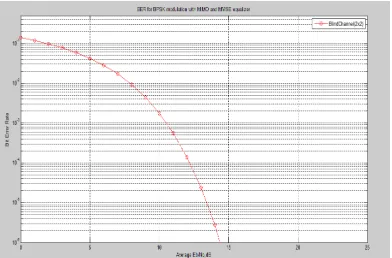
Fig 1 SNR vs. Bit error Rate plot for 2*2 MIMO
V. CONCLUSION
REFERENCES
[1] B Erik G, “Massive MIMO for Next Generation Wireless Systems”.
[2] Gabor Fodor, “Performance Analysis of Block and Comb Type Channel Estimation for Massive MIMO Systems”, 2014. [3] David Neumann,” Low-Complexity Computation of LMMSE Channel Estimates in Massive MIMO”, March 3-5, 2015. [4] Xiang Gao, “Massive MIMO performance evaluation based on measured propagation data”.
[5] Cheng-Xiang WANG, “Recent advances and future challenges for massive MIMO channel measurements and models”, February 2016, Vol. 59 021301:1–021301:16.
[6] Greeshma Sajive, Pappa.M, “Implementation of Precoder Based Blind Channel Estimation for Conventional and Massive MIMO Systems”, Volume 5, Issue 5, May 2015.