A Survey on Resource Constrained Devices
Enabling Proof of Multiple Cloud Using
Auditing Process
Roshan Zameer N1, Usman K2
M.Tech 4th Sem, Dept. of CSE, Ballari Institute of Technology and Management, Bellari, India1
Assistant Professor, Dept. of CSE, Ballari Institute of Technology and Management, Bellari, India2
ABSTRACT: Cloud processing moves the application programming and databases to the incorporated expansive
server farms, where the administration of the information and administrations may not be completely dependable. In this work, we examine the issue of guaranteeing the integrity of data storage in Cloud Computing. To decrease the computational expense at client side amid the uprightness check of their information, the idea of public verifiability has been proposed. Nonetheless, the test is that the computational weight is excessively immense for the clients with asset compelled gadgets to register people in general confirmation labels of recorder pieces. To handle the test, we propose proof of numerous cloud, another distributed storage plan, including a cloud storage server and a cloud audit server, where the last is thought to be semi-fair. Specifically, we consider the cloud audit server, for the cloud clients, to pre-process the information before transferring to the distributed storage server and later checking the data integrity. This proposed plan outsources the overwhelming calculation of the label era to the cloud review server and kills the inclusion of client in the evaluating and in the pre-preparing stages. Besides, we fortify the Proof of various cloud models to support dynamic information operations, and in addition guarantee security against reset attacks dispatched by the distributed storage server in the transfer stage.
KEYWORDS: Proof of Multiple Cloud; Data integrity; Public Verifiability; Reset Attacks.
I. INTRODUCTION
Cloud computing has been imagined as the following era engineering of the IT endeavor because of its not insignificant rundown of remarkable focal points: on-interest self- administration, universal system access, area free asset pooling, fast asset versatility, and use based valuing. Specifically, the ever less expensive and that's only the tip of the iceberg capable processors, together with the "product as a administration" (SaaS) processing design, are changing server farms into pools of registering administration on an enormous scale.
In spite of the fact that having engaging points of interest as a promising administration stage for the Internet, this new information stockpiling worldview in "Cloud" brings numerous testing issues which have significant impact on the ease of use, reliability, versatility, security, and execution of the in general framework. One of the greatest worries with remote information capacity is that of information trustworthiness confirmation at untrusted servers. For example, the capacity administration supplier may choose to cover up such information misfortune occurrences as the Byzantine disappointment from the customers to keep up a state of being famous. What is more genuine is that for sparing cash and storage room the administration supplier may purposely dispose of infrequently gotten to information records which have a place with a customary customer. Considering the expansive size of the outsourced electronic information and the customer's obliged asset ability, the center of the issue can be summed up as by what means can the customer locate an effective approach to perform periodical respectability confirmation without the neighborhood duplicate of information records.
private conviction imposture computational weight on clients. Then again open irrefutability mitigates customers from performing a parcel of calculation for guaranteeing the trustworthiness of information capacity. To be particular, customers can appoint a outsider to perform the check without commitment of their calculation assets. In the cloud, the customers may crash out of the blue or can't manage the cost of the over-burden of incessant trustworthiness checks. Hence, it appears to be more sound also, pragmatic to outfit the confirmation convention with open unquestionable status, which is required to play a more critical part in accomplishing better proficiency for Cloud Registering. In Cloud Computing, the remotely put away electronic information may be gotten to as well as be redesigned by the customers, example through piece adjustment, erasure, insertion and so on. Sadly, the-best in class with regards to re-bit information stockpiling essentially concentrate on static information records and this dynamic information upgrades has gotten constrained consideration in the information ownership applications so far [1]–[3], [11], [13]. In spite of the fact that such issue likewise has been tended to in [6], [7], it is very much trusted that supporting element information operation can be of essential significance to the functional utilization of capacity outsourcing administrations. Besides, larger piece of existing works get weaker security models which don't consider the reset attacks. Specifically, the conveyed stockpiling server can trigger reset attacks in the exchange stage to slight the soundness of the arrangement.
II. RELATED WORK
Ateniese et al. [1] characterized the "provable information ownership" (PDP) model for guaranteeing ownership of documents on untrusted stockpiles. They likewise proposed the primary confirmation of-capacity plan that backings open unquestionable status. The plan uses RSA-based homomorphic labels for auditing outsourced information, such that a straight blend of document squares can be totaled into a solitary piece and confirmed by utilizing homomorphic property of RSA. Be that as it may, the information proprietor needs to figure a huge number of labels for those information to be outsourced, which more often than not includes exponentiation and duplication operations. Besides, The instance of element information stockpiling has not been considered by Ateniese et al. , and the direct extension of their plan from static information stockpiling to dynamic case brings numerous security issues. In their ensuing work [13], Ateniese et al. proposed a dynamic form of the earlier PDP plan. Be that as it may, the framework forces a priori bound on the quantity of inquiries and don't bolster completely rapid information operations. In [7], Wang et al. Considered element information stockpiling in dispersed situation, furthermore, the proposed challenge-reaction convention can both decide the information accuracy and find conceivable mistakes. Like [13], they just thought to be fractional backing for dynamic information operation. In [6], they likewise considered step by step instructions to spare storage room by presenting deduplication in distributed storage. As of late, Zhu et al. [4] Exhibited the provable data possession issue in pleasant cloud organization suppliers and formed another remote trustworthiness checking system. Juels et al. [2] Exhibited a "proof of retrievability" model, where spot-checking and botch changing codes are grasped to ensure both "possession" and "retrievability" of data archives in document organization structures. Be that as it may, open, undeniable nature is not bolstered in their plan and the information proprietor additionally needs to make numerous computational endeavors to create labels for those information to be outsourced. Shacham et al. [3] planned a moved forward proof of retrieve ability plan with open unquestionable status taking into account BLS signature and the evidences are given in a more grounded security model characterized in [2]. Like the development in [1], they utilized openly undeniable homomorphism authenticators that are worked from BLS marks and demonstrated secure in the irregular prophet model.
III. PROPOSED METHODOLOGY
A. Design Considerations
Our configuration objectives can be outlined as the accompanying:
Public undeniable nature: to permit anybody, not only the customers initially puts away the document, to have the ability to check rightness of the remotely put away information.
Low calculation overhead at the customer side: to transfer information to the cloud server while supporting
certainty, the information proprietor does not have overwhelming extra calculation.
Dynamic information operation backing: to permit the customers to perform piece level operations on the
information, documents while keeping up the same level of information accuracy confirmation;
Stateless check: to dispose of the requirement for state data support at the verifier side between reviews and all through the long haul of information stockpiling. This is likewise the fundamental prerequisite for accomplishing open undeniable nature. Specifically, we mean to accomplish improved security against reset attacks in our development.
B. Description of the proposed system
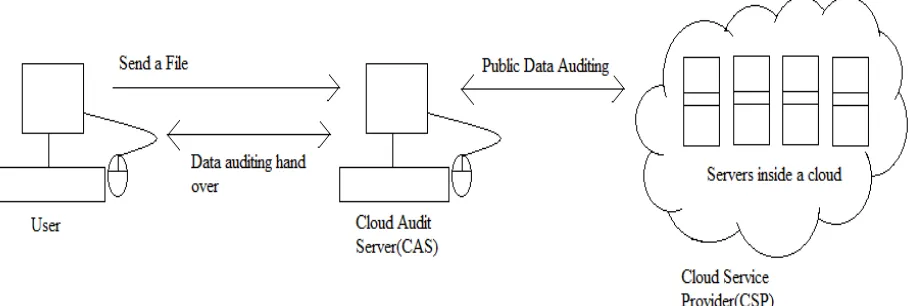
The existing system appears as no scheme can take a stand against reset attacks while supporting efficient pulic verifiability and dynamic data operations simultaneously. We propose proof of Multiple Cloud, another Proof of retrieveability plan with two autonomous cloud servers. Especially, one server is for inspecting and the other for capacity of information. The cloud audit server (CAS) is not required to have a higher storage limit. Unique in relation to the past work with inspecting server and capacity server, the client is assuaged from the calculation of the labels for documents, which is moved and outsourced to the cloud audit server. Moreover, the cloud audit server likewise assumes the part of reviewing for the documents remotely put away in the cloud storage server..
As shown in figure1 it conatins three modules as follow:
User: An entity who uploads data to the cloud.
Cloud Audit Server(CAS): An entity who takes the data from the user then split the data and encrypt the blocks and
move to the cloud.
Cloud Servers: An entity which is managed by cloud service provider, has significant storage space and it has computational resources to maintain client’s data.
The parameters used as follows:
(pk, SK) ← Setup (1k) It takes as information security parameter 1k, return open parameters and the key pair
of the cloud audit server.
(F∗, t) ← Transfer (SK, F). There are two stages in this calculation. On the main stage, the customer transfers its information record F to the cloud review server, where F is a requested accumulation of squares {Mi}. In the second stage, the record F is re-transferred to the distributed storage server by the cloud review server: it takes as information the private key ”SK” what's more, F, and yields the mark set Φ, which is a requested
gathering of marks {σi} on {Mi}. We signify the put away document F∗ = {F, Φ}. It additionally yields
metadata-the root R of a Merkle hash tree from {Mi} what's more, the mark t= sig SK (h (R)) as the tag of F ∗. Notice that the capacity server stores (F∗, t), yet the review server (the customer) just keeps “t” as a receipt. 1 / 0 ← Integrity Verify {P (pk, F∗,t) V (pk, t)}. This is an intuitive convention for respectability check of a
record F∗ with tag t. The cloud storage server plays the part of prover P with information general society key pk , a put away record F what's more, a record tag t . The cloud audit server assumes the part of verifier V with infrmationo pk what's more, t. At the end of the convention, V yields T RU E (1) on the off chance that F ∗ passes the trustworthiness check or F ALSE (0) something else (F∗, t) ←.
Upgrade {P (pk, ˆ F ∗, ˆ t) V (sk, ˆ t, upgrade)}. This is an intuitive convention for element upgrade of a document ˆ F ∗ tagˆ t. The cloud storage server plays the part of prover P with data people in general key pk , a put away document ˆ F ∗ , and a document tag ˆ t . The cloud audit server plays the part of verifier V with data the private key sk, ˆ t, also, an information operation demand “upgrade” from the customer. Toward the end of the convention, V yields a record tag t of the upgraded record F ∗ on the off chance that P gives a substantial confirmation for the redesign, then again F ALSE (0) something else.
Accuracy: Proof of multiple cloud plan is right if the accompanying two conditions hold:
1. On the off chance that ( F ∗ , t) ← Transfer ( sk, F) , then IntegrityVerify {P ( pk, F ∗ , t ) V ( pk, t )} = 1.
2.In the event that ( F ∗ , t ) ← Redesign { P ( pk, ˆ F ∗ , ˆ t ) V ( sk, ˆ t, redesign ) } , at that point IntegrityVerify { P (pk, F ∗ , t ) V ( pk, t ) } = 1.Comments . Since the cloud review server is completely trusted in the two-server design, we permit it to produce the key sets in the interest of the customers in the setup stage. Be that as it may, it may be undesirable to place full trust on the cloud review server in some outsourcing assignments.
IV. CONCLUSION AND FUTUREWORK
This paper proposes proof of multiple cloud, another confirmation of retrievability for cloud storage, in which a reliable cloud audit server is familiar with pre process and transfer the information for the sake of the customers. In proof of multiple cloud storage, the calculation overhead for label era on the customer side is decreased altogether. The cloud audit server additionally performs the data integrity verification or upgrading the outsourced information upon the customers' request.
REFERENCES
[1]G. Ateniese, R. Burns, R. Curtmola, J. Herring, L. Kissner, Z. Peterson, and D. Song, “Provable data possession at untrusted stores,” in CCS ’07: Proceedings of the 14th ACM conference on Computer and communications security. New York, NY, USA: ACM, 2007, pp. 598–609.
[2]A. Juels and B. S. K. Jr., “Pors: proofs of retrievability for large files,” in CCS ’07: Proceedings of the 14th ACM conference on Computer and communications security. New York, NY, USA: ACM, 2007, pp. 584–597.
[3]H. Shacham and B. Waters, “Compact proofs of retrievability,” in ASIACRYPT ’08: Proceedings of the 14th International Conference on the Theory and Application of Cryptology and Information Security. Berlin,Heidelberg: Springer-Verlag, 2008, pp. 90–107.
[4]Y. Zhu, H. Hu, G.-J. Ahn, and M. Yu, “Cooperative provable data possession for integrity verification in multicloud storage,” IEEE Trans. Parallel Distrib. Syst, vol. 23, no. 12, pp. 2231–2244,2012.
[5]H. Xiong, X. Zhang, D. Yao, X. Wu, and Y. Wen, “Towards end-to-end secure content storage and delivery with public cloud,” in CODASPY, 2012, pp. 257–266.
[6]Q. Zheng and S. Xu, “Secure and efficient proof of storage with deduplication,” in CODASPY, 2012, pp. 1–12.
[7]C. Wang, Q. Wang, and K. Ren, “Ensuring data storage security in cloud computing,” in Proceedings of IWQoS 2009, Charleston,South Carolina, USA, 2009.
[8]C. Erway, A. Kupcu, C. Papamanthou, and R. Tamassia, “Dynamic provable data possession,” Cryptology ePrint Archive, Report 2008/432, 2008,
http://eprint.iacr.org/.
[9]H. Li, B. Wang, and B. Li, “Oruta: Privacy-preserving public auditing for shared data in the cloud,” in IEEE Transactions on Cloud Computing, 2014, pp. vol. 2, no. 1, 43–56.
[10]J. Li, X. Tan, X. Chen, and D. S. Wong, “An efficient proof of retrievability with public auditing in cloud computing,” in INCoS, 2013, pp. 93– 98.
[11]T. S. J. Schwarz and E. L. Miller, “Store, forget, and check: Using algebraic signatures to check remotely administered storage,”in ICDCS ’06: Proceedings of the 26th IEEE International Conference on Distributed Computing Systems. Washington,DC, USA: IEEE Computer Society, 2006. [12]Q. Wang, K. Ren, S. Yu, and W. Lou, “Dependableand secure sensor data storage with dynamic integrity assurance,”ACM Transactions on Sensor Networks, vol. 8,no. 1, pp. 9:1–9:24, Aug. 2011. [Online]. Available: http:
//doi.acm.org/10.1145/1993042.1993051.
[13]L.V. M. Giuseppe Ateniese, Roberto Di Pietro and G. Tsudik, “Scalable and efficient provable data possession” in International Conference on Security and Privacy in Communication Networks (SecureComm 2008), 2008.
BIOGRAPHY
Roshan Zameer N, received his Information science and Engineering(ISE) degree from VTU, Belgaum, INDIA in 2013, and currently pursuing M.tech in Computer Networking Engineering from VTU university, Belgaum, INDIA. Research field of interest is computer networking.