ISSN(Online): 2320-9801 ISSN (Print): 2320-9798
I
nternational
J
ournal of
I
nnovative
R
esearch in
C
omputer
and
C
ommunication
E
ngineering
(An ISO 3297: 2007 Certified Organization)
Vol. 4, Issue 4, April 2016
Secured Multimodal Biometric Login using
MapReduce
Meghana .A. Divakar
M.Tech Student, Dept. of ISE, MSRIT, Bangalore, India
ABSTRACT: Establishing the identity of a person is becoming critical in our vastly interconnected society.The need for reliable user authentication techniques has increased in the wake of heightened concerns about security and rapid advancement in networking.Biometrics is the most recognized means for identification of person. Although the Unimodal biometric systems serve well in various areas, it has many disadvantages regarding security and accuracy. Multimodal biometric systems focus on combining more than one biometrics in order to secure the applications to a great extent. This system uses three biometric technologies in the process of person identification: (i) Face recognition; (ii) Fingerprint recognition and (iii) Speech Recognition. Map/Reduce is used for exploring and analysing big data sets which cannot be processed normally due to memory constraints.
KEYWORDS: Multimodal Biometrics; Face recognition; Fingerprint recognition; Speech Recognition; MapReduce
I. INTRODUCTION
Traditionally, personal identification systems were based on the pass codes and tokens or cards. Those systems required the users to remember the pass codes or tokens in order to prove their identity. Tokens maybe lost, stolen, forgotten or compromised.To overcome these difficulties in the identification process, biometric identification systems were introduced. Biometrics is the field of science in which an individual is identified based on his/her physiological or biological traits. [1]
Currently, nine different biometric indicators are either widely used or are under intensive evaluation. All these biometric indicators have their own advantages and disadvantages in terms of accuracy, user acceptance, and applicability. It is the requirements of an application domain which determine the choice of a specific biometric indicator. [2]
However, unimodal biometric system is not able to satisfy acceptability, speed, and reliability constraints of authentication in real applications. This is due to noise in sensed data, spoof attacks, data quality, lack of distinctiveness, non-universality and other factors. Therefore multimodal biometric systems are used to increase security as well as better performance.
In a Multimodalbiometric login system using face, fingerprint and voice biometrics for person authentication, if an imposter wants to access the system it is not possible for an untrained user to spoof all the three biometrics. Hence better security is achieved.The utility of the mapreduce function lies in its ability to perform calculations on large collections of data. MapReduce is used to perform a statistical or analytical calculation on a data set that does not fit in memory.Each call to the map or reduce function by mapreduce is independent of all others.
II. RELATED WORK
ISSN(Online): 2320-9801 ISSN (Print): 2320-9798
I
nternational
J
ournal of
I
nnovative
R
esearch in
C
omputer
and
C
ommunication
E
ngineering
(An ISO 3297: 2007 Certified Organization)
Vol. 4, Issue 4, April 2016
issues to think about when selecting an experience recognition method. The keys ones were: Accuracy, Time limitations, Process speed and Availability. In [5] authors present overview of a basic Fingerprint recognition (FPR) system various FPR techniques and challenges. Fingerprints are the most widely used biometric identifier because of their ease of acquisition, storage and further processing for identification/ verification. Challenge is use of advanced image processing techniques for better results of FPR, which actually provides a platform for research and development in this area for researchers. In [6] authors proposed a model to recognize speaker by face and voice signal. In this model input of voice is given into model and voice and face features is got corresponding to that voice and face by which the user is recognized.
III.PROPOSED SYSTEM
The proposed Multimodal biometric login system focuses on combining face, fingerprint and voice biometric in order to secure the applications to a great extent. Generally multimodal biometrics operates in two phases i.e. Enrolment phase and authentication phase where biometric traits are captured in enrolment phase and matched in authentication phase.
Fig.1.Block Diagram of the Proposed System Architecture
The proposed system architecture in Fig.1, shows the complete flow of the system. The images for face and fingerprint are captured and a voice sample is recorded for a user and pre-processed to extract the features for each biometric trait for a particular user and stores in database. These features are stored in the database and a database is created for each biometric trait, i.e., face database, fingerprint database and voice database for all the users who are enrolled. When a user has to be authenticated, the images of the user face and fingerprint are acquired along with a test voice sample and stored as test file samples. Features of the biometric traits for the test images are then extracted and matched against database, and a decision is processed as to whether the user is authenticated or not. Since the database size is large due to multiple users, mapreduce can be used to process large datasets.
A. Face Recognition System
ISSN(Online): 2320-9801 ISSN (Print): 2320-9798
I
nternational
J
ournal of
I
nnovative
R
esearch in
C
omputer
and
C
ommunication
E
ngineering
(An ISO 3297: 2007 Certified Organization)
Vol. 4, Issue 4, April 2016
i. Feature Extractor(PCA)
The main goal in the PCA algorithm lies in reducing the large dimensions of space data to the dimensions of the smallest spaces. PCA algorithm has the following steps:
Step 1: Create a training set and load it.Convert face images in Training set to face vectors. Step 2: Normalize the face vectors.
I. calculate the average face vector
II. subtract average face from each face vector ф = Ti - Ѱ to calculate eigenvectors first calculate the covariance matrix C,
C = AAT where A = {ф1, ф2, ф3,….,фM } Step 3: Eigenvectors are calculated from the covariance matrix.
Step 4: Select k best eigenfaces, such that K<M and can represent the whole training set. Step 5: Convert tower dimensional k eigenvectors to original face dimensionality.
Step 6: Represent each face image in a linear combination of all K eigenvectors. A summation of the weight of the K Eigenfaces + the Mean face is calculated to refer to each face that is from the Training set.
After that the eigenfaces for the M training images are found and selected a set of K most relevant Eigen faces, K<M. The related weight vectors are calculated and stored in the training set of each image individually. [7]
ii. Feature Classifier(SVM)
The basic idea behind the SVM classification technique is to identify the class of the input test vectors. This is a supervised learning algorithm, where the training vectors are used to train the system to map these training vectors in a space with clear gaps between them using standard kernel functions and the input test vectors are mapped on to the same space to predict the possible class. SVMs perform pattern recognition between two classes by finding a decision surface that has maximum distance to the closest points in the training set which are termed support vectors. Using this, the test image is assigned to a particular class and thereby the image is identified and better accuracy is achieved using a combination of both PCA and SVM.
B. Fingerprint Recognition System
Minutiae points are very important in fingerprints recognition since no two fingers have been shown to be identical. Most common minutiae that are used in fingerprint recognition techniques are based on ridge ending and bifurcation. Minutiae based algorithms usually comprises of two stages: Minutiae Extraction and Minutiae Matching.
i. Minutia Extraction.
The algorithm follows the steps of Image enhancement and Binarization, followed by extracting the Region of Interest. Then Ridge Thinning is done to remove the redundant pixels from ridges and making the ridges just one pixel wide, followed by Minutiae marking. After this, false minutiae are removed by calculating the distance between each minutia and the points are accepted or rejected and then minutiae are extracted and saved.
ii. Minutia Matching:
1. Alignment stage: Given two fingerprint images to be matched, choose any one minutia from each image, calculate the similarity of the two ridges associated with the two referenced minutia points. If the similarity is larger than a threshold, transform each set of minutia to a new coordination system whose origin is at the reference point and whose x-axis is coincident with the direction of the referenced point.
2. Match stage: After we get two set of transformed minutia points, we use the elastic match algorithm to count the matched minutia pairs by assuming two minutia having nearly the same position and direction are identical. [8]
C. Voice Recognition System
ISSN(Online): 2320-9801 ISSN (Print): 2320-9798
I
nternational
J
ournal of
I
nnovative
R
esearch in
C
omputer
and
C
ommunication
E
ngineering
(An ISO 3297: 2007 Certified Organization)
Vol. 4, Issue 4, April 2016
signals is an important task in the design of any speech recognition system; it significantly affects the recognition performance. A compact representation would be provided by a set of mel-frequency cepstrum coefficients (MFCC), which are the results of a cosine transform of the real logarithm of the short-term energy spectrum expressed on a mel-frequency scale. The MFCCs are proved more efficient. The calculation of the MFCC includes the following steps:
I. Mel-frequency wrapping
Human perception of frequency contents of sounds for speech signal does not follow a linear scale. Thus for each tone with an actual frequency, f, measured in Hz, a subjective pitch is measured on a scale called the ‘mel’ scale. The melfrequency scale is a linear frequency spacing below 1000 Hz and a logarithmic spacing above 1000Hz .As a reference point ,the pitch of a 1 KHz tone ,40dB above the perceptual hearing threshold, is defined as 1000 mels. Therefore the following approximate formula can be used to compute themels for a given frequency f in Hz.
Mel(f) = 2595*log10(1 + f/700)
The approach to simulate the subjective spectrum is to use a filter bank, one filter for each desired mel-frequency component. The mel scale filter bank is a series of l triangular band pass filters that have been designed to simulate the band pass filtering believed to occur in the auditory system.
II. Cepstrum
In this step, the log mel spectrum is converted back to time. The result is called the Mel Frequency Cepstrum Coefficients (MFCC).The cepstral representation of the speech spectrum provides a good representation of the local spectral properties of the signal for the given frame analysis.
Because the mel spectrum coefficients (and so their logarithm) are real numbers, it needs to be converted to time domain using the discrete cosine transform (DCT). In this final step log mel spectrum is converted back to time. The result is called the Mel Frequency Cepstrum Coefficients (MFCC).The discrete cosine transform is done for transforming the mel coefficients back to time domain.[9]
In the implemented multimodal biometric login systemthe recognition results of the three biometric traits i.e., face, fingerprint and voice are combined using decision level fusion.It is then used to verify an authorized or unauthorized user. The authentication system consists of three modules (face, fingerprint and voice).The final decision made by our system is based on the decisions made by face recognition, fingerprint recognition and voice recognition modules. If two of the three biometric parameters match for an individual then the person is authenticated. If only one biometric matches then person does not pass as the claimed identity. This has been done in order to increase the security of the Multimodal Biometric login system. Possibility of fraudulent users and spoof attacks is significantly reduced. Only persons with recorded biometrics of face, fingerprint and voice stored in the database can access the system.[10]
D. Map/Reduce
While the collection of this information presents opportunities for insight, it also presents many challenges. Most algorithms are not designed to process big data sets in a reasonable amount of time or with a reasonable amount of memory. MapReduce function uses a data store to process data in small chunks that individually fit into memory. Each chunk goes through a Map phase, which formats the data to be processed. Then the intermediate data chunks go through a Reduce phase, which aggregates the intermediate results to produce a final result. The Map and Reduce phases are encoded by map and reducefunctions, which are primary inputs to MapReduce. There are endless combinations of map and reduce functions to process data, so this technique is both flexible and extremely powerful for tackling large data processing tasks.Thus, MapReduce is not well-suited for performing calculations on normalsized data sets which can be loaded directly into computer memory and analyzed with traditional techniques.
IV.EXPERIMENTAL RESULTS
ISSN(Online): 2320-9801 ISSN (Print): 2320-9798
I
nternational
J
ournal of
I
nnovative
R
esearch in
C
omputer
and
C
ommunication
E
ngineering
(An ISO 3297: 2007 Certified Organization)
Vol. 4, Issue 4, April 2016
camera and stored in .jpg format. The voice samples were collected by using a microphone and these recordings were saved in .wav format.
In biometrics, the performance requirement is usually specified in terms of FAR(false acceptance rate) and FRR(false rejection rate). FAR is the ratio of imposter been recognized as genuine and FRR is the ratio of genuine being accepted as an imposter.[11] In this case the decision fusion should satisfy the FAR specification and minimize the FRR. This is the result obtained Fig.2 graph.
Fig.2.Performance of the Identification system, showing the True Recognition Rate and False Recognition Rate in (%) for Face, Fingerprint and Voice Recognition
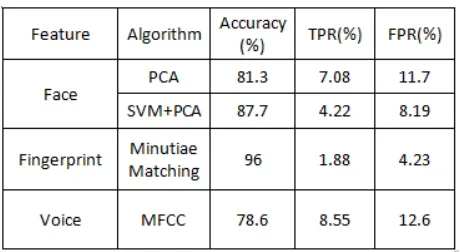
The Face database (200 images) was divided into Training and Testing Samples of 100 face images each. Then Support Vector Machine Classifier was trained on these Samples and a SVM Classifier with accuracy 87% was obtained. All the fingerprint images obtained are processed to create a Fingerprint Database, which consists of processed values of each user fingerprint. The fingerprint images are processed and then the corresponding terminations and bifurcations are stored for each image in a text (.txt) file. Similarly, a Voice Database is created when recording the voice samples from the users. The voice samples are processed to obtain mel-frequency cepstrum coefficients (MFCC). The accuracy obtained for each is shown in Fig 3. Table.
Fig. 3. Figures showing Accuracy and True Positive Rate (TPR) and False Positive Rate (FPR) in (%) for Face using Principal Component Analysis (PCA) and Support Vector Machine(SVM). Voice recognition accuracy using mel-frequency cepstrum coefficients (MFCC)
ISSN(Online): 2320-9801 ISSN (Print): 2320-9798
I
nternational
J
ournal of
I
nnovative
R
esearch in
C
omputer
and
C
ommunication
E
ngineering
(An ISO 3297: 2007 Certified Organization)
Vol. 4, Issue 4, April 2016
and without map/reduce, results showed that time for processing is significantly reduced by using map/reduce function. The obtained result is shown in Fig 4 graph.
Fig. 4. Performance with Map/Reduce and without Map/Reduce indicating time taken in minutes to process number of images
V. CONCLUSION AND FUTURE WORK
The simulation results showed that the proposed multimodal biometric login performs better with the combination of face, fingerprint and voice combined than traditional multimodal biometrics or unimodal biometrics. The proposed system provides secure and accurate login to user and imposters are not recognized.As the performance of the system is analyzed with Map/Reduce performance and time is significantly improved. Also a large amount of data can be processed with Map/Reduce. Further, another biometric trait can be added to multimodal biometric system to improve the security of the system. Different fusion methods can be tested to comprehend their influence on the performance of the system.
REFERENCES
[1] Prabu, U., G. Priyadharshini, M. Saranya, N. ResmaParveen, M. Shanmugam, and J. Amudhavel. "Efficient personal identification using multimodal biometrics."In Circuit, Power and Computing Technologies (ICCPCT), 2015 International Conference on, pp. 1-5.IEEE, 2015.
[2] Kataria, Atul N., Dipak M. Adhyaru, Arvind Kumar Sharma, and Tanish H. Zaveri. "A survey of automated biometric authentication techniques."InEngineering (NUiCONE), 2013 Nirma University International Conference on, pp. 1-6. IEEE, 2013.
[3] Raju, A. S., and V. Udayashankara. "Biometric person authentication: A review." In Contemporary Computing and Informatics (IC3I), 2014 International Conference on, pp. 575-580. IEEE, 2014.
[4]Kaur, Ramandeep, and ErHimanshi. "Face recognition using Principal Component Analysis." In Advance Computing Conference (IACC), 2015 IEEE International, pp. 585-589.IEEE, 2015.
[5] Rashid, Rozeha A., NurHijaMahalin, MohdAdibSarijari, and Ahmad Abdul Aziz. "Security system using biometric technology: Design and implementation of Voice Recognition System (VRS)." In Computer and Communication Engineering, 2008.ICCCE 2008. International Conference on, pp. 898-902. IEEE, 2008.
[6] Roy, Didier, and AnupamShukla. "Speaker recognition using multimodal biometric system." In Oriental COCOSDA held jointly with 2013 Conference on Asian Spoken Language Research and Evaluation (O-COCOSDA/CASLRE), 2013 International Conference, pp. 1-7. IEEE, 2013. [7] Dave, Pushpak, and JatinAgarwal. "Study and analysis of face recognition system using Principal Component Analysis (PCA)." In Electrical, Electronics, Signals, Communication and Optimization (EESCO), 2015 International Conference on, pp. 1-4.IEEE, 2015.
[8] Khan, AsifIqbal, and M. ArifWani. "Strategy to extract reliable minutia points for fingerprint recognition." In Advance Computing Conference (IACC), 2014 IEEE International, pp. 1071-1075.IEEE, 2014.
[9] Kumar, ChSrinivasa, and P. R. Mallikarjuna. "Design of an automatic speaker recognition system using MFCC, Vector Quantization and LBG algorithm." International Journal on Computer Science and Engineering 3(8), pp.2942-2954.
[10] Sasikala, T. S., and J. Celin. "Enhancement of security using multimodal biometrics."In Circuit, Power and Computing Technologies (ICCPCT), 2014 International Conference on, pp. 1652-1656.IEEE, 2014.