University of Windsor University of Windsor
Scholarship at UWindsor
Scholarship at UWindsor
Electronic Theses and Dissertations Theses, Dissertations, and Major Papers
2010
Attentional focus on supra-postural tasks affects postural control:
Attentional focus on supra-postural tasks affects postural control:
Neuromuscular efficiency and sway characteristics
Neuromuscular efficiency and sway characteristics
Stefan Gabriel M-L.A. Lambrecht
University of Windsor
Follow this and additional works at: https://scholar.uwindsor.ca/etd
Recommended Citation Recommended Citation
Lambrecht, Stefan Gabriel M-L.A., "Attentional focus on supra-postural tasks affects postural control: Neuromuscular efficiency and sway characteristics" (2010). Electronic Theses and Dissertations. 263. https://scholar.uwindsor.ca/etd/263
This online database contains the full-text of PhD dissertations and Masters’ theses of University of Windsor students from 1954 forward. These documents are made available for personal study and research purposes only, in accordance with the Canadian Copyright Act and the Creative Commons license—CC BY-NC-ND (Attribution, Non-Commercial, No Derivative Works). Under this license, works must always be attributed to the copyright holder (original author), cannot be used for any commercial purposes, and may not be altered. Any other use would require the permission of the copyright holder. Students may inquire about withdrawing their dissertation and/or thesis from this database. For additional inquiries, please contact the repository administrator via email
ATTENTIONAL FOCUS ON SUPRA-POSTURAL TASKS AFFECTS POSTURAL CONTROL: NEUROMUSCULAR EFFICIENCY AND SWAY
CHARACTERISTICS
by
Stefan Lambrecht
A Thesis
Submitted to the Faculty of Graduate Studies through the Faculty of Human Kinetics in Partial Fulfillment of the Requirements for the Degree of Master of Human Kinetics at the
University of Windsor
Windsor, Ontario, Canada 2009
ii
ATTENTIONAL FOCUS ON SUPRA-POSTURAL TASKS AFFECTS POSTURAL CONTROL: NEUROMUSCULAR EFFICIENCY AND SWAY
CHARACTERISTICS
by
Stefan Lambrecht
APPROVED BY:
______________________________________________ Dr. Xiang Chen
Department of Electrical and Computer Engineering
______________________________________________ Dr. James Frank
Department of Human Kinetics
______________________________________________ Dr. Nancy McNevin, Advisor
Department of Human Kinetics
______________________________________________ Dr. Sean Horton, Chair of Defense
Department of Human Kinetics
iii
Author’s Declaration of Originality
I hereby certify that I am the sole author of this thesis and that no part of this thesis has been published or submitted for publication.
I certify that, to the best of my knowledge, my thesis does not infringe upon anyone‟s copyright nor violate any proprietary rights and that any ideas, techniques, quotations, or any other material from the work of other people included in my thesis, published or otherwise, are fully acknowledged in
accordance with the standard referencing practices. Furthermore, to the extent that I have included copyrighted material that surpasses the bounds of fair dealing within the meaning of the Canada Copyright Act, I certify that I have obtained a written permission from the copyright owner(s) to include such
material(s) in my thesis and have included copies of such copyright clearances to my appendix.
iv
Abstract
This study is the first in which both performance production and outcome
measurements are incorporated for a postural and supra-postural task, to identify the effect of attentional focus (AF) on muscles distal to the primary action.
Postural and shoulder muscles are assessed when 21 participants attempt to minimize aiming error on a distal target while being subject to discrete arm perturbations. During each 60s trial random perturbations were delivered to the right arm and subjects were provided different AF instructions: control (no instruction), internal (focus on finger), and external (focus on laser).
v
Table of Contents
AUTHOR’S DECLARATION OF ORIGINALITY ... III ABSTRACT ... IV TABLE OF CONTENTS ... V LIST OF ABBREVIATIONS ... VI LIST OF TABLES ... VII LIST OF FIGURES ... VIII LIST OF APPENDICES ... IX
PART1:LITERATURESTUDY ... 1
Balance ... 1
Attentional focus ... 5
Introduction ... 5
Attention ... 6
Constrained Action Hypothesis ... 7
Dual-task paradigm ... 11
Probe reaction time ... 11
Frequency of movement adjustments ... 12
Muscular activity ... 13
PART2:METHODS,RESULTS,ANDDISCUSSION ... 17
Introduction ... 17
Method ... 20
Participants ... 20
Procedure ... 20
Data collection ... 24
Data processing ... 24
Statistical analysis ... 25
Results... 27
Kinematics ... 27
Force platform ... 30
EMG ... 33
Discussion ... 34
Limitations ... 45
Conclusion ... 46
REFERENCES ... 47
vi
List of Abbreviations
ADT Anterior deltoid
AF Attentional Focus
AP Anterior-Posterior
BFM Biceps femoris
CAH Constrained Action Hypothesis
CNS Central Nervous System
COG Center Of Gravity
COGv Vertical projection of Center of Gravity
COM Center Of Mass
COP Center Of Pressure
EMG Electromyography
GST Gastrocnemius medialis
iEMG integrated EMG
LGS Erector spinae
MPF Mean Power Frequency
PDT Posterior deltoid
PL Path Length
RAB Rectus abdominis
SD Standard Deviation
SP Supra-Postural
TIB Tibialis anterior
vii
List of Tables
Table 1 Participant characteristics 20
Table 2 Attentional focus instructions 22
Table 3 Statistical analysis of kinematic data 26
Table 4 Statistical analysis of COP PL in AP-direction 29
viii
List of Figures
Figure 1 6 components of postural stability (Horak, 2006) 5
Figure 2 Participant with reflective markers and splint 21
Figure 3 PeakMax of splint across AF conditions 27
Figure 4 PeakMin of splint across AF conditions 27
Figure 5 Peak-to-peak of splint across AF conditions 28
Figure 6 Area under the acceleration curve (onset - +2sec) 28
Figure 7 Path length of COPnet across conditions 30
Figure 8 Standard deviation of COPnet across conditions 31
ix
List of Appendices
Appendix 1 Perturbation force 51
1
PART 1: LITERATURE STUDY
Standing upright is often considered to be a simple activity that is performed seemingly automatically as a precursor to performance of other activities of daily living, such as brushing your teeth, reading while standing, carrying a cup of coffee and ringing a door bell. Besides being an interface with the external world, posture also has a second function; an anti-gravity function. This anti-gravity function consists of two components: providing joint stiffness and maintaining balance (Massion, 1998).
Neurological and anatomical redundancies built into the human body make postural control seem effortless and simple. Three types of sensory information are integrated at the neurological level: vision, somatosensory and vestibular information (Buchanan & Horak, 2001). Wilson and Melvill-Jones (1979) have shown that high frequency information provided by semicircular canals and somatosensory receptors, and low frequency information from the otolith organs and visual system generate this redundancy in the human sensory system. A redundancy can also be found in the myriad definitions of balance and posture. Akram et al. define postural control as “a complex process requiring integration of the sensory information and execution of appropriate postural responses”
(Akram, Frank, Patla & Hallum, 2008, p.393). Postural control is described by Horak et al. as “the condition in which all the forces acting on the body are
balanced such that the COM is controlled relative to the base of support” (Horak, Henry & Shumway-Cook, 1997). Balasubramaniam and Wing (2002, p.531) define posture as “the geometric relation between two or more body segments”. Because joints between body segments are free to move, the central nervous system (CNS) must actively intervene in maintaining postural equilibrium (Balasubramaniam & Wing, 2002). In the same article they define balance as “the equilibrium resulting from the matching of torques, which can be organized in anticipation, or as a reaction to the effects of postural disturbance”
2
“postural maintenance involves the active orientation of one or several segments against disturbing forces exerted by the external world or by other segments”. Massion suggests that there are two approaches to look at balance. The first approach considers stance to be accurately controlled by postural reflexes related to gravity. For example the righting reflexes of a cat, that make it land on its feet, illustrates this view (Arabyan & Tsai, 1998; Igarashi & Guitierrez, 1983). The second approach to balance control is based on anatomical considerations and support. According to this view musculature of both upper and lower limbs and trunk can be used to preserve stability. This is done by maintaining the projection of the center of gravity (COG) onto the ground in between the feet (the support base) by generating movements in the opposite direction of the
perturbation (Massion, 1998). Horak (2006) reported that there is no one balance system. Previously, balance was viewed as resulting from a set of reflex-like equilibrium responses, much in agreement with the first approach as mentioned by Massion (Horak et al., 1997). More recently, balance has been shown to be proactive, adaptive and organized by the CNS. Balance is a fundamental motor skill that the CNS learns (Horak et al., 1997). The definition of balance used in this article is the one used by Akram et al. (2008), Winter et al. (1998) and Jian et al. (Jian, Winter, Ishac & Gilchrist, 1993): “Balance control during stance is the ability to maintain control of the position and velocity of the body‟s COM relative to the position of the base of support” (Akram et al., 2008, p. 396). Thus
equilibrium is not so much one particular position but an area determined by the size of the support base and the biomechanical constraints such as joint range and muscle strength.
Different coordinative movement patterns are employed by the CNS to control postural stability in response to perturbations. These patterns are called postural strategies (Creath, Kiemel, Horak, Peterka & Jeka, 2005). There are three main strategies: ankle strategy, hip strategy, and step strategy. The emphasis in research has mainly been on ankle and hip strategy. The ankle strategy consists of the body moving at the ankle as a flexible inverted pendulum in order to
3
if the balance disturbance cannot be compensated by ankle torques, a hip or step strategy will be called upon. The hip strategy is characterized by torques exerted at the hip to rapidly move the body‟s COM. Individuals with a higher risk of falling, such as the elderly, rely relatively more on the hip and step strategy than those with a low risk of falling. Hip strategies can be evoked in the latter group by challenging their balance on a compliant or narrow surface. This type of support surface does not allow the individual to make adequate use of the
developed ankle torques. The third strategy is the step strategy, where a step is taken in an attempt to regain balance after a substantial disturbance of balance (Horak, 2006).
Based on neuromuscular activation, body kinematics and ground reaction forces, previous studies have identified the ankle and hip strategies as two discrete strategies. Runge et al. (1999) found indications of a continuum of postural
responses. Through joint torque analysis they discovered that there is an addition of hip flexor torque to ankle flexor torque during fast translations (Runge,
Shupert, Horak & Zajac, 1999). In doing so Runge et al. were the first to confirm active control of combined ankle and hip strategies. A pure hip strategy, i.e. hip torque without accompanying ankle torque, however was not observed in this study.
Nashner and McCollum mention a pure hip strategy in their 1985 paper. They hypothesised two discrete postural strategies. Nashner and McCollum suggest that a pure hip strategy will only occur in situations that limit the effectiveness of ankle torque of producing whole body motion. The pure hip strategy, according to Nashner and McCollum, is limited to balance on very narrow or compliant
surfaces. In agreement with Runge, mixed strategies in response to fast translations of the flat support surface were observed.
4
significant knee flexion in the mixed strategy. Investigators should therefore measure knee angles and account for them in their analyses.
Most studies that looked into postural strategies did so in perturbed stance conditions (Akram et al., 2008; Alexandrov, Frolov & Massion, 2001; Runge et al., 1999; Horak & Nashner, 1986; Nashner & McCollum, 1985). Creath et al. (2005) investigated both quiet and perturbed stance and concluded that multiple coexisting strategies are active at the same time with varying amounts of power during upright quiet stance. The weighting of each strategy depends upon biomechanical, environmental and task constraints. Horak et al. (1990) had also shown that task requirements influence the selection of postural control
strategies by the CNS (Horak, Nashner & Diener, 1990). Alexandrov et al. (2001) showed that up to three modes (ankle, hip, and step) can exist simultaneously, in response to platform perturbations. Kuo and Zajac (1993) reported that a
5
Postural control is a complex process that requires the interaction of multiple sensorimotor processes (Akram et al., 2008; Balasubramaniam & Wing, 2002; Horak & Macpherson, 1996). The postural system consists of many
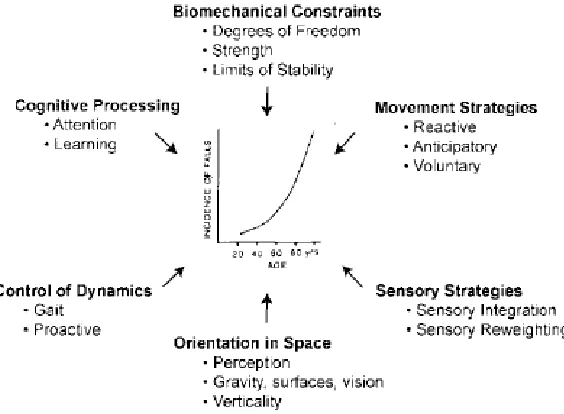
subcomponents that can be divided in six categories: biomechanical constraints, cognitive processing, movement strategies, sensory strategies, orientation in space, and control of dynamics (Figure 1). A disorder in any of these categories can lead to postural instability (Horak, 2006). This study will examine one
component specifically, the influence of attention on balance performance.
Figure 1: Important resources required for postural stability and orientation (Horak, 2006).
Attention demands and attentional focus are part of cognitive processing, one of the six subcomponents of postural stability as defined by Horak (2006). To examine the attentional demands of postural tasks, researchers often use a dual-Attentional focus
6
task methodology. In this method a secondary task is performed simultaneously with the primary postural task (Woollacott & Shumway-Cook, 2002).
Two types of attentional focus will be discussed, internal and external, in relation to their effect on supra-postural and postural tasks. The constrained action hypothesis (McNevin et al., 2003; Wulf, McNevin & Shea, 2001; Wulf & Prinz, 2001) provides the rationale behind this research. What follows, is a framework of fundamental terms in attention research in motor learning and motor control research. Linkages to previous research will be established to demonstrate the body of knowledge present in this field and to establish a rationale for the current study. Fundamental terms such as attention, constrained action hypothesis and dual-task paradigm will be explained first.
There is more than sufficient anecdotal evidence that being too concerned with or even paying attention to one‟s movements can disrupt performance (i.e. looking down when walking on a narrow mountain path next to a steep ravine). A certain amount of attention is however required for stance postural control, even in young adults (Kerr, Condon & McDonald, 1985; Teasdale, Bard, LaRue & Fleury, 1993; Brown, Shumway-Cook & Woolacott, 1999; Woollacott &
Shumway-Cook, 2002). Kerr et al. (1985) were the first to demonstrate this, by making use of a dual-task paradigm. They concluded that postural control in young adults is attention demanding, but that not all cognitive tasks affect postural control in the same way. If no attentional resources were required to perform a postural task, then posture would be purely automatic, as implied by Magill‟s definition of automaticity (Magill, 2001). Several researchers (e.g.
Woollacott & Shumway-Cook, 2002) have revealed the role of cognitive factors in the control of balance during standing in young adults. The difficulty of the
postural task itself influences the attentional demands of posture as well. It has been shown that with increasing postural task difficulty, more cognitive
7
Vuillerme & Nougier, 2004). Also, a voluntary increase in attention (i.e. more than demanded by the posture) seems to result in a degradation of postural stability in young adults (Vuillerme & Nafati, 2007). A possible explanation could be that focusing attention on the movement interferes with automatic processes (Wulf & Prinz, 2001; Wulf, 2007).
Over the past decade several studies have examined the influence of an
individual‟s focus of attention on motor performance (and learning) (for a review Wulf & Prinz, 2001; Wulf, 2007). Findings from these studies indicate that an external focus of attention is more effective (i.e. does not disrupt learning, better performance), than an internal focus of attention (Hardly, Mullen & Jones, 1996; Maxwell, Masters & Eves, 2000; Riley, Stoffregen, Grocki & Turvey, 1999;
Singer, Lidor & Cauraugh, 1993; Wulf, Lauterbach & Toole, 1999; Wulf, McNevin & Shea, 2001; Wulf, Shea & Park 2001; Wulf & Prinz, 2001; Wulf, 2007). Under an external focus condition, a performer‟s attention is directed to the effect or intended outcome of their movement. An internal focus on the contrary is body-movement related. If a skier were to adopt an internal focus, he or she could concentrate on which limb is exerting the most force when turning. If that skier were to focus on the path itself, instead of what creates that path, he or she adopts an external focus. It is shown that when performers focus on the
movement effects, automaticity in movement control is promoted. It is believed that this enhances the effectiveness and efficiency of motor performance (Wulf, 2007).
The constrained action hypothesis proposed by McNevin, Shea and Wulf (2003) offers a theoretical framework that contributes to the understanding of the
8
in terms of „distal events‟ (Wulf & Prinz, 2001; Wulf, 2007). The fundamental assumption of the common-coding theory is that there is a common
representational medium for action and perception and that they both refer to distal events. The common-coding theory however is relatively abstract; no predictions are put forward regarding the effect of an external over an internal focus of attention on performance (Wulf & Prinz, 2001). The constrained action hypothesis does explain the relative benefit of adopting external rather than internal attentional foci. When participants adopt an internal focus they try to consciously control their movements. This interference constrains the motor system and disrupts automatic motor control processes. Focusing on the
movement effect, an external focus, on the other hand allows the motor system to more naturally self-organise. This in turn would result in a more effective, efficient, automatic, postural performance (McNevin, Shea & Wulf, 2003; Wulf, McNevin & Shea, 2001; Wulf, Shea & Park, 2001; Wulf & Prinz, 2001; Wulf, 2007). A similar concept was formulated by Riley et al. (1999) as the „notion of suprapostural activity‟. The notion of suprapostural activity states that goal achievement is assisted by the constraints imposed on postural control by a suprapostural task (Riley et al., 1999; Stoffregen, Pagualayan, Bardy & Hettinger, 2000).
In general there are three types of research that use attentional focus as a
9
postural sway, but the secondary supra-postural task in the touching relevant condition that facilitated postural adjustments. In the touching relevant condition, participants were asked to keep the curtain still. In the touch irrelevant condition participants were told that touching the curtain was irrelevant, this condition did not result in a significant change in postural sway (Riley et al., 1999).
In attentional focus research, the performers‟ attention is directed to a part of the main variable of interest, in this case postural control. The performance on the postural task is examined in relation to the manipulation of the attentional focus directed at the secondary task (Wulf et al., 2003). An example of such an attentional focus research is the 2003 study by Wulf and McNevin in which the researchers compared the relative effectiveness of preventing the performers from directing attention to their movements to the relative effectiveness of supplying them with an external focus. Participants were asked to stand on a stabilometer and to keep the platform horizontal during the trials. Four trial conditions were compared: internal focus, external focus, a shadowing task, and a control condition. The shadowing task required participants to „repeat out loud‟ a story that was replayed to the participants while they were balancing. The assumption was that the shadowing would prevent the learners from directing their attention to the primary task, balancing. In contrast to the supra-postural research, the learners‟ attention in this research was directed to something related to the movement. In the internal focus condition participants were asked to focus on markers attached to their feet, keep their feet horizontal. In the external focus condition, participants directed their attention to markers attached to the balance platform, keeping the platform horizontal. The results indicated that only the adoption of an external focus did not disrupt learning of the primary task (Wulf & McNevin, 2003).
Both types of research have been combined in the past (i.e. Wulf et al., 2003). Performers may adopt different strategies depending on which task they
prioritise. A performance substitution between supra-postural and postural tasks could thus occur. By measuring both postural and supra-postural task
10
effect can be avoided or at least it can be accounted for. Wulf et al. (2003) measured postural and supra-postural task performance as a function of
attentional focus on the supra-postural task. The purpose of this experiment was to examine whether adopting an external focus on a supra-postural task would be advantageous for both the postural and the supra-postural task. The postural task required participants to keep the stabilometer platform horizontal for as long as possible during the ninety second trial. For the duration of the trial, the
deviations of the platform from the horizontal were measured. Postural performance was the average of these deviations over the trial. The supra-postural task consisted of holding a wooden tube with a tennis ball in the middle horizontal while balancing. Participants were instructed to keep the ball in the center of the tube (experiment 1). Instructions varied slightly between groups. Participants in the external focus group were requested to focus on keeping the tube horizontal. Participants in the internal focus group were told to pay attention on keeping their hands horizontal. Performance on the supra-postural task was measured as the number of times the ball made contact with the tube. A hit on either side of the tube by the tennis ball was considered an error. These errors were summed in order to obtain a total performance score on the supra-postural task over the ninety seconds trial. Participants that received external focus instructions showed a more effective balance performance than those with an internal focus. The results confirmed Wulf et al.‟s hypothesis that the attentional focus adopted on a supra-postural task would not only influence the performance on the supra-postural task, but also influence the performance on the postural task (Wulf et al., 2003). The results of these studies demonstrate that postural control is a function of the focus of attention adopted on the supra-postural task. The constrained action hypothesis appears to provide a viable explanation for the learning or performance advantage associated with an external focus of
attention. In support of the constrained action hypothesis four lines of evidence can be distinguished: attentional capacity, reaction time, frequency of movement adjustments and muscular activity. In the following sections, each line of
11
Attention, or the information processing capacity of an individual, is both limited and selective (Guadagnoli, McNevin & Wulf, 2002; Woollacott & Shumway-Cook, 2002). As a consequence, if two tasks are performed simultaneously and both tasks require attention then a poorer performance on the secondary task can be expected (Abernethy, 1988; Guadagnoli et al., 2002; Wulf, McNevin & Shea, 2001). The dual-task paradigm requires participants to perform two or more concurrent activities and has often been used to assess the amount of attention demanded by the postural tasks (Donker, Roerdink, Greven & Beek, 2007; Pellechia, 2003; Wulf, McNevin & Shea, 2001; for a review Woollacott & Shumway-Cook, 2002). Previous research has shown that the amount of
attention required to perform the secondary task influences balance performance (Balasubramaniam, Riley & Turvey, 2000; Huxhold, Li, Schmiedek &
Lindenberger, 2006; Pellechia, 2003; Riley, Baker & Schmit, 2003). A wide variety of secondary, cognitive activities have been used to manipulate task difficulty: arithmetic and numeric tasks (Maylor & Wing, 1996), Brooks spatial and non-spatial memory tasks (Maylor & Wing, 1996), presenting word lists (Li,
Lindenberger, Freund & Baltes, 2001) as well as numerous (primary) balance tasks: stabilometer (McNevin, Shea & Wulf, 2003), pedalo (Totsika & Wulf, 2003) and compliant surface (Wulf, Mercer, McNevin & Guadagnoli, 2004).
The constrained action hypothesis states that an external focus would allow the motor system to more naturally self-organise, resulting in a more effective, automatic postural performance (McNevin, Shea & Wulf, 2003; Wulf, Shea & Park, 2001; Wulf & Prinz, 2001; Wulf, 2007). A greater degree of automaticity is generally associated with reduced attentional demands. The smaller the amount of attention required for the primary task, the faster probe reaction times will be Dual-task paradigm
12
on the secondary task (Abernethy, 1988; Schmidt & Lee, 1999; Wulf, McNevin & Shea, 2001). Wulf, McNevin and Shea (2001) used reaction times to assess the relative automaticity of processes involved in postural control in relation to an external or internal attentional focus. Results of their study confirmed the assumption of reduced attention under the external focus condition and are consistent with the constrained action hypothesis.
There is always some body movement during upright stance. This irregular and low-amplitude movement is called postural sway. This postural sway produces information across the sensory system that facilitates the maintenance of upright stance (Riley & Clark, 2003). A more irregular sway pattern is indicative of higher efficiency and/or higher automaticity in maintaining upright balance (Donker et al., 2007).
Postural control is a function of both spatial and temporal parameters. The spatial parameter can be described as the amount of sway of the balancing body, the temporal characteristic as the response frequency (Thompson & Stewart, 1986). Due to its association with muscle/joint stiffness, response frequency can provide an insight into how postural control is maintained under different task constraints (Winter, Patla, Prince, Ishac & Gielo-Perczak, 1998). Frequency has two
13
reduced by introducing a dual-task. Under the dual-task condition, a decrease in postural sway regularity was observed. Increased COP regularity can thus be explained as an increasingly ineffective postural control strategy (Belair, Glass, an Der Heiden & Milton, 1995; Donker, Roerdink, Greven & Beek, 2007). These findings indicate that an additional or increased internal focus could be
detrimental to balance performance (Donker, Roerdink, Greven & Beek, 2007). Wulf et al. (2003) found that when participants were given external focus
instructions their balance movements showed a higher frequency and lower amplitude of movement, indicative of a higher degree of automaticity. Similar findings were recorded by McNevin and Shea (2001) after a Fast Fourier Transformation (FFT) of platform movements. Frequency characteristics of the stabilometer platform in this study revealed higher frequency adjustments. Higher frequency components have been associated with an incorporation and
coordination of additional degrees of freedom, indicative for a higher degree of automatic control (Thompson & Stewart, 1986; Wulf et al., 2003). Vereijken et al. argue that consciously intervening in control processes results in a „freezing‟ or decrease „the degree‟ of freedom and thus less automatic movement execution (Vereijken, van Emmerik, Whiting & Newell, 1992). These findings are all in support of the constrained action hypothesis.
14
15
measurements in this and other attentional focus studies have all been taken with regard to the supra-postural task (upper limb).
Zachry et al. (2005) suggest that effects of attentional focus can even affect muscle groups that are not in the performer‟s focus of attention. So far, no research has been published that looks at non-targeted muscle groups or at a combination of muscle groups (lower limb & upper extremity). Outcome
measures and performance production measures were combined in the experiment by Vuillerme and Nafati (2007). They examined how different attentional foci affect balance performance (outcome measure) during quiet standing and also looked into the neuromuscular requirements (performance production measure) for ensuring standing control. Vuillerme and Nafati used COP and the relation between COP and the vertical projection of the center of gravity (COGv) as a base for their critical analysis. The assumption made was that upright standing can be modeled as a one-link inverted pendulum, thus the relationship between COP and COGv discloses ankle-joint stiffness (Vuillerme & Nafati, 2007; Winter et al., 1998). It was further assumed that the amount of ankle-joint stiffness is related to the level of neuromuscular activity of the lower limb muscles required for controlling quiet standing (Rougier & Caron, 2000). Vuillerme and Nafati concluded that the monitored increase in COP-COGv motions in attention relative to control conditions might reflect a modulation of neuromuscular activity and most likely an increase of the EMG activity (Vuillerme & Nafati, 2007). These results in turn provide additional support to the
constrained action hypothesis.
In an effort to identify the effect of attentional focus on muscles distal to the primary action, this study will be the first in which both performance production measurements are incorporated together with outcome measurements in a dual-task design. The purpose of this experiment is to examine how manipulating attentional focus affects supra-postural and postural performance while being subject to discrete perturbations. Although the advantages of adopting an
16
these benefits has not yet been identified (Wulf, McNevin & Shea, 2001). The COP and EMG measurements will provide insight into which strategy or
combination of strategies is used. The neuromuscular activity of selected upper limb, trunk and lower limb muscles will be analysed in order to determine whether there is a „spread‟ of the attentional focus effect and to what extent this spread occurs in the different muscles. Furthermore the decrease in stability as
17
PART 2: METHODS, RESULTS, AND DISCUSSION
Researching balance is considered an important step towards fall prevention, gait, and other locomotion research. Horak has identified 6 subcomponents of postural control, one of which is cognitive processing (Horak, 2006). Where and how we direct our attention has been suggested to have a strong effect on balance performance and the postural strategy behind this performance. This study seeks to identify a link between the regulation and control of motor actions and the effect on neuromuscular efficiency and sway characteristics of a non-impaired population.
18
was reported under the external focus condition. A degradation of postural stability under an internal focus condition was shown by Vuillerme and Nafati (2007) in a study where young adults where monitored during quiet standing. Only a handful of studies have looked at performance production measures and attentional focus (Marchant, Greig & Scott, 2006; Vuillerme & Nafati, 2007; Vance, Wulf, McNevin, et al., 2004; Zachry, Mercer & Bezodis, 2005).
Performance production measures can provide an insight into how motor control is organized by the central nervous system when attentional focus (AF) is
manipulated (Landers, Wulf, Wallmann & Guadagnoli, 2005; Marchant et al, 2005; Vance et al., 2004).
Vance et al. looked at the performance difference between external and internal attentional focus conditions and whether or not this could also be observed at the neuromuscular level. In doing so, they were the first to use EMG as a
performance production measure in an AF study. Discrepancies in
neuromuscular activation as an effect of AF manipulation were only investigated for 2 upper limb muscles (biceps brachii, and triceps brachii). The same task, biceps curl, was later used by Marchant et al. (2006). Zachry et al. (2005)
changed the task to a basketball free-throw but limited EMG recording to several muscles of the upper limb as well. All of the aforementioned reported a decrease in measured EMG activity in the external condition. They concluded that an external condition is favourable over „no instruction‟ (control) or an internal focus (Marchant et al., 2006; Vance et al., 2004; Zachry et al., 2005). Automaticity imparts more efficient movement production, thus in line with the constrained action hypothesis, fewer motor units are expected to be recruited when an external focus is adopted. The underlying principle being that an external focus promotes greater coherence between sensory input and motor output (McNevin & Wulf, 2002). Zachry and colleagues suggested that AF effects could spread to reach muscle groups that are not within the performer‟s focus of attention
19
In an effort to identify the effect of AF on muscles distal to the primary action, this study is the first in which both performance production measures are
incorporated together with outcome measurements for both the postural and the supra-postural task. Although the advantages of adopting an external focus seem to be a relatively robust phenomenon, the exact reasons for these benefits have not yet been identified (Wulf, McNevin & Shea, 2001). The purpose of this experiment is to examine how manipulating attentional focus affects supra-postural and supra-postural performance while being subject to discrete perturbations. It is hypothesised that AF manipulations will have an effect on both the supra-postural and supra-postural task (Wulf et al., 2003). The second hypothesis is that an external AF will result in more efficient muscle recruitment (Vance et al., 2004; Zachry et al., 2005). An external AF is also thought to result in more muscle coherence (Wulf et al., 2001). The fourth and final hypothesis is that AF
20
Twenty-one university students, 10 male and 11 female volunteered to
participate in this study (Table 1). Participants were free from any known motor, vestibular, and/or neuromuscular impairments. Inclusion criteria were: 18 to 35 years old, right handed, and not been taking medication in the last month that could affect balance, nor could they have experienced dizziness in the last month (Balasubramaniam & Turvey, 2000; Balasubramaniam, Riley & Turvey, 2000; Balasubramaniam & Wing, 2002; Hauck, Carpenter & Frank, 2008). All inclusion and exclusion criteria were verified by self-report. Procedures were approved by the University of Windsor‟s Research Ethics Board. All participants were
informed about the experimental procedure prior to signing a consent form and given a tour in the lab, including a brief explanation of the equipment.
Table 1: Participant characteristics (mean +/- SD). Elbow width is the distance between medial and lateral epicondyl.
Prior to testing, anthropometric measurements including body mass, body height, leg length and width of the wrists, elbows, knees and ankles were recorded for each participant. These measurements were subsequently entered into the Vicon Nexus software program to create a participant specific skeleton file (.vsk file).
Under each of 4 conditions, participants stood barefoot as immobile as possible for 60seconds on a compliant surface covering 2 force platforms (OR6-7, AMTI, USA) in a side-by-side position (feet 10cm apart and 20° externally rotated; this Method
Participants
Height (mm) Body weight (kg) Elbow width (mm)
Age (y)
Male (9) 1789.4 +/- 92.8 72.6 +/- 10.5 73.8 +/- 10.4 23.4 +/- 3.8 Female (10) 1654 +/- 69.8 60.4 +/- 9.2 66.5 +/- 8.7 22.5 +/- 2.3
21
position was marked with tape on the foam) with their weight equally divided over toes and heels (Carpenter, Frank, Winter & Peysar, 2001). Foam pads were used to reduce the proprioceptive feedback from the feet, and to reduce the effectiveness the ankle strategy. Young healthy adults predominantly use an ankle strategy to maintain postural control. Increasing the difficulty level of the balancing task and reducing the effectiveness of the ankle strategy could result in the use of more/different strategies. Participants aimed a laser, attached to a splint covering the wrist and elbow of the right arm, at a small (2*2cm) target located on the wall at shoulder height 3m away (Figure 2).
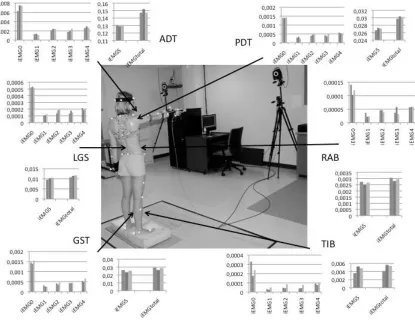
Figure 2: Participant with reflective markers, according to Vicon Full Body Plug-In Gait model, and splint (5 additional markers). Medium density foam pads are covering the force plates. The splint is connected to an air compressor, placed in the adjacent room to minimize noise interference. Distance between the ankles and target is 3m.
22
The splint consisted of a set of light wooden dowels and Velcro and was
designed to prevent aiming corrections by flexing the index finger, wrist or elbow. The intention being that all arm movement had to be generated by the deltoid muscles. The first trial served as a baseline, the correct position was assumed but the laser was not turned on nor were any perturbations delivered. Prior to the perturbation trials participants were given open ended practice time to familiarize with the task and equipment, as well as exposed to one perturbation. Height of the target was set to the participant‟s shoulder height when standing on the foam pads, so that (in the correct position) the right arm was parallel with the ground (Figure 2). Perturbations were delivered by an air compressor and scaled to the participants arm weight as derived from his/her body weight (10psi increments within 150-110psi interval) (Winter, 2005). Two perturbations were used, 100ms and 150ms, to ensure that the duration of the perturbation was long enough to trigger a reaction. Three perturbations of each duration were delivered in
alternating fashion to the participant (100ms -150ms- 100ms -...), for a total of 6 perturbations. Three different focus instructions were provided to each
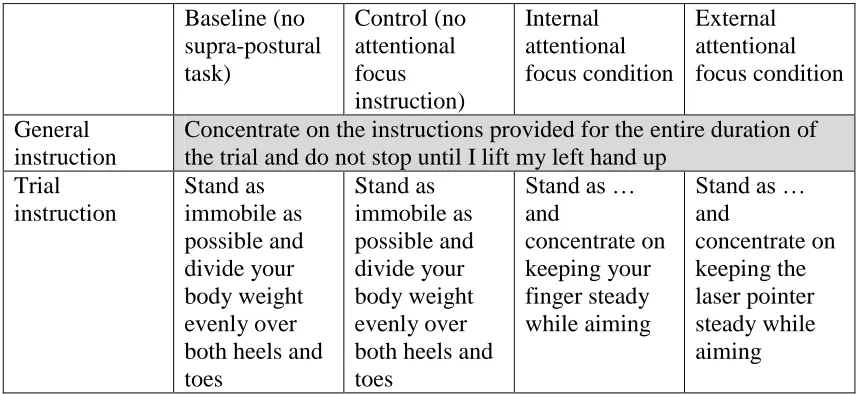
23 Table 2: Attentional focus instructions, as provided to the participants.
Baseline (no supra-postural task) Control (no attentional focus instruction) Internal attentional focus condition External attentional focus condition General instruction
Concentrate on the instructions provided for the entire duration of the trial and do not stop until I lift my left hand up
Trial instruction Stand as immobile as possible and divide your body weight evenly over both heels and toes Stand as immobile as possible and divide your body weight evenly over both heels and toes
Stand as … and
concentrate on keeping your finger steady while aiming
24
Kinematic data was collected at 100 Hz with a 7-camera Vicon MX-system (Vicon Motion Systems, Oxford, UK). Thirty-nine reflective markers were placed on anatomical landmarks, according to the Nexus Full Body Plug-in Gait
template. Five additional markers were attached to the splint to track movement of the laser (Figure 2).
Two AMTI force platforms collected COP data under each foot at 2000 Hz. Neuromuscular activity was recorded through 2 AMT-8 Bortec EMG amps at 2000 Hz. Disposable, bipolar Ag/AgCl Bortec electrodes (Bortec, Calgary) were attached to the following 8 bilateral muscles: tibialis anterior (TIB), gastrocnemius medialis (GST), vastus medialis (VAM), biceps femoris (BFM), rectus abdominis (RAB), erector spinae (LGS), anterior deltoid (ADT), and posterior deltoid (PDT). Ground electrodes were placed on the lateral epicondyl of both ankles. Seniam guidelines were consulted for electrode placement (Seniam, 2009).
All data was processed in Matlab, SPSS was used for statistical analysis. Kinematic data was „pre-processed‟ with Vicon Nexus software (gap filling and Woltring filtering) prior to Matlab processing. Area (trapezoidal integration), peak max, peak min, and peak-to-peak distance of each perturbation was calculated for the acceleration curve (2nd derivative of the arm displacement).
The COP data was low-pass filtered (Butterworth) at a cut-off frequency of 10Hz. COP path length (PL), and standard deviation (SD) were calculated for each force platform over the 60s trial (COPleft and COPright) as well as for COPnet (Winter, 1995). Path length is defined as the displacement of the COP over time (Winter, 1995).
EMG data was low-pass filtered (Butterworth) at 100Hz and normalized by subtracting the baseline condition. IEMG (trapezoidal integration) was calculated over 6 time intervals: -100ms -0ms (iEMG0), 0ms – 20ms (iEMG1), 20ms – Data collection
25
50ms (iEMG2), 50ms – 80ms (iEMG3), 80ms - 120 ms (iEMG4), 120ms – 2000ms (iEMG5), and 0ms – 2000ms (iEMGtotal). Mean power frequency over the 0 – 2000ms interval was also calculated.
Dependent measures
Three categories of dependent measures can be identified: SP performance (kinematic data), postural performance (force platform data), and efficiency data (EMG). Kinematic data was analysed by calculating peakMax, peakMin, peak-to-peak, and area of the acceleration curve.
Acceleration was chosen over displacement to prevent potential drift in displacement from biasing the data. Acceleration is obtained through differentiation of the displacement data (post-filtering) and as such related „directly‟ to displacement.
PeakMax is the first upward peak that is a consequence of the perturbation (> 2SD as calculated over 2 seconds prior to the perturbation). The magnitude of this peak gives an indication of how the perturbation affects the participant. PeakMin is the magnitude of the first peak in the downward direction, and as such describes the participant‟s initial reaction. Peak-to-peak is the distance between peakMax and peakMin and has the potential to reveal a trade-off (lower max, but higher min vs. higher max but lower min) between „action‟ and reaction. Finally, the area under the curve was calculated by trapezoidal integration and contains both temporal and spatial characteristics of the response over a 2sec interval (perturbation onset - onset+2s). Analysis of pilot data revealed that on average 2 seconds are needed to return to a steady and correct aiming position. Force platform data, in particular COP, was investigated to determine postural performance. COP PL was used to express postural sway, whereas COP SD describes the variability in quiet standing. To reveal potential differences in limb control, force platform data was investigated for each platform (COPleft,
26
p.11). Winter‟s formula is used to compute the latter based on data from the force platform under each foot (Winter, 1993 & 1995).
In an attempt to differentiate between normal and „expert‟ (above average) balancers, COP PL in the AP-direction of the baseline trial was used as a
discriminator. Anterior-posterior path length was averaged across all participants and this mean was then used as a cut-off to define normal and expert (< mean PL) balancers.
EMG data was integrated via trapezoidal integration to obtain iEMG over several time intervals. IEMG0 – iEMG5 have the potential to reveal whether the
difference occurs in the reflex, triggered response, or conscious phase. IEMGtotal shows the total response to an individual perturbation. Additional intervals that are investigated are: 0 - 120 ms (unconscious or automatic
27
To verify that gender, perturbation duration, and trial were not confounding variables, a 2(gender: male, female) X 2(perturbation: 100ms, 150ms) X 3(trial: 1-3) X 3(attentional focus: control, internal, external) factorial analysis with repeated measures analysis on the second factor was performed on the kinematic data. For all dependent kinematic variables (peakMax (Figure 3), peakMin (Figure 4), peak-to-peak (Figure 5), and area (Figure 6)), analysis revealed no main or interaction effects of gender, perturbation duration and trial with attentional focus. Therefore, all data were pooled across gender,
perturbation duration, and trial and reanalysed with attentional focus as a within subjects factor analyzed via repeated measures ANOVA.
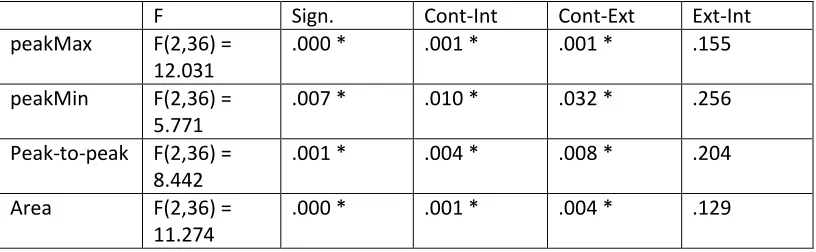
For each dependent variable, analysis revealed a significant main effect of attentional focus (AF). Post-hoc testing, using a Bonferonni adjustment yielded significant differences between the control compared to both internal and external focus conditions, which did not differ themselves (Table 3).
Table 3: Statistical analysis of kinematic data. Data represents a significant main effect of AF. * indicates significant difference (p < 0.05)
Results
Kinematics
F Sign. Cont-Int Cont-Ext Ext-Int
peakMax F(2,36) = 12.031
.000 * .001 * .001 * .155
peakMin F(2,36) = 5.771
.007 * .010 * .032 * .256
Peak-to-peak F(2,36) = 8.442
.001 * .004 * .008 * .204
Area F(2,36) =
11.274
28 Figure 3: Maximal positive acceleration created by the perturbation (same force across
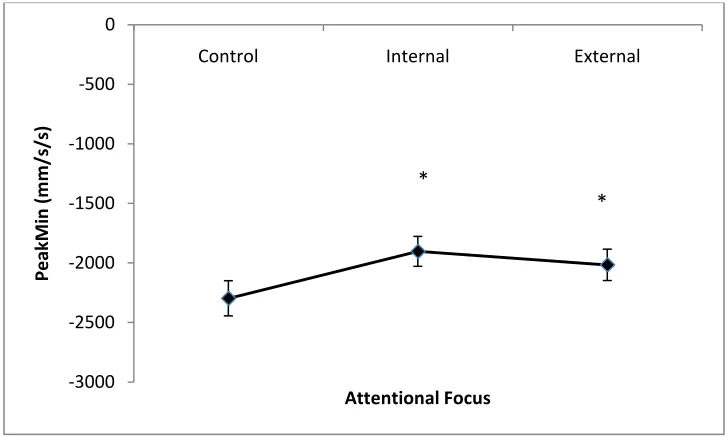
conditions). Performance improves significantly when AF instructions are provided. No significant differences were found between an internal or external focus.
* indicates significant difference from control condition (p < 0.05) error bars represent SEM, n = 19
Figure 4: Maximal downward acceleration. Performance improves significantly when AF instructions are provided. No significant differences were found between an internal or external focus. 0 200 400 600 800 1000 1200 1400 1600 1800 2000
Control Internal External
Peak M ax (m m /s/s) Attentional Focus -3000 -2500 -2000 -1500 -1000 -500 0
Control Internal External
29 * indicates significant difference from control condition (p < 0.05)
error bars represent SEM, n = 19
Figure 5: Distance between peakMin and peakMax of the acceleration curve. Performance improves significantly when AF instructions are provided. No significant differences were found between an internal or external focus.
* indicates significant difference from control condition (p < 0.05) error bars represent SEM, n = 19
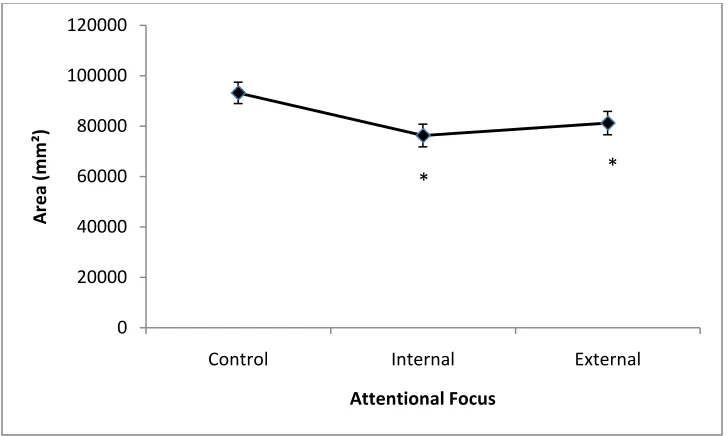
Figure 6: Area under the acceleration curve from perturbation onset until 2 seconds later. Performance improves significantly when AF instructions are provided. No significant differences were found between an internal or external focus.
0 500 1000 1500 2000 2500 3000 3500 4000 4500
Control Internal External
Peak -to -p e ak (m m /s/s) Attentional Focus 0 20000 40000 60000 80000 100000 120000
Control Internal External
30 * indicates significant difference from control condition (p < 0.05)
error bars represent SEM, n = 19
Path length
Large variability in COP was observed between participants. This variability could not be attributed to specific outliers, thus a differential approach was used.
Participants were ranked according to baseline balance performance in either a normal or an „expert‟ group. An initial 2(gender) X 2(perturbation duration) X 3(trial) X 2(balance: normal, expert) X 3(attentional focus) analysis with gender, perturbation duration, trial, and balance as a between subjects factor revealed a significant main effect of attentional focus but no interaction with any of the between factors. Therefore, all data were pooled and reanalysed with attentional focus as within subjects factor (repeated measures ANOVA).
For COPnet,-right, and –left, analysis revealed a significant main effect of AF. Post-hoc testing, using a Bonferonni adjustment yielded significant differences between the control compared to both internal and external focus conditions, which did not differ themselves, for both COPnet and COPright. For COPleft, only the control and internal condition differed significantly.
Table 4: Statistical analysis of COP PL in AP-direction. Post-hoc testing revealed that the main effect of attentional focus is created by differences between the control and internal (COPnet, COPright, COPleft), and control and external (COPnet, COPright) conditions.
* indicates significant difference (p < 0.05) Force platform
F Sign Cont-Int Cont-Ext Int-Ext
COPnet F(2,36) =
5.259
.010 * .003 * .040 * .653
COPright F(2,36) = 7.531
.002 * .005 * .009 * .892
COPleft F(2,36) = 4.909
31 Figure 7: Path length of COPnet. PL decreases significantly when instructions are provided. No significant differences were found between an internal or external focus.
* indicates significant difference from control condition (p < 0.05) error bars represent SEM, n = 19
SD
An initial 2(gender) X 2(perturbation duration) X 3(trial) X 2(balance: normal, expert) X 3(attentional focus) analysis revealed no significant main effects. A significant interaction effect of focus with balance was found. Since no main or interaction effect of gender, perturbation duration, and trial were found, all data were pooled across these factors and reanalysed with attentional focus as within subjects factor and balance as between subjects factor via a repeated measures ANOVA.
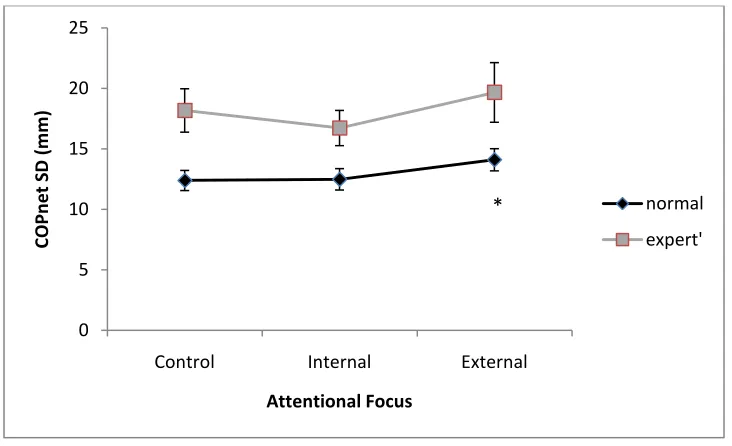
Analysis revealed a significant interaction effect of focus and balance in all COP‟s. Post-hoc testing, using a Bonferonni adjustment yielded a significant difference between the external and control condition for normal balancers on both COPnet (Figure 8). However, Post-hoc testing failed to identify a difference in COPleft or COPright.
900 950 1000 1050 1100 1150
Control Internal External
COPn
e
t
PL
(m
m
)
Attentional Focus
32 Table 5: Statistical analysis of COP SD in AP-direction. An interaction effect between focus and balance was revealed. This effect was only significant for COPnet.
* indicates significant difference (p < 0.05)
Figure 8: Standard deviation of COPnet. Variability increases significantly under an external AF for normal balancers. No significant differences were found for „expert‟ (above average)
balancers.
* indicates significant difference from control condition (p < 0.05) error bars represent SEM, n = 19
0 5 10 15 20 25
Control Internal External
COPn e t SD (m m ) Attentional Focus normal expert' Normal balance
F Sign Cont-Int Cont-Ext Int-Ext
COPnet F(2,12) =
7.543
.008 * .209 .004 * .072
COPright F(2,12) = 2.280
.145
COPleft F(2,12) = .686
.522
Experts F Sign Cont-Int Cont-Ext Int-Ext
COPnet F(2,22) = .302
.743
COPright F(2,22) = .257
.776
COPleft F(2,22) = .033
.967
33
To verify that gender, perturbation duration(100ms, 150ms), and trial(1-3) were not confounding variables, a 2(gender) X 2(perturbation) X 3(trial) X 3(AF) factorial analysis with repeated measures analysis on AF was performed on the EMG data. For all dependent variables (time intervals), analysis revealed no main or interaction effects. Therefore, all data was pooled and reanalysed with AF as a within subjects factor via repeated measures ANOVA. None of the dependent variables (-100ms-0ms; 0ms-20ms; 20ms-50ms; 50ms-80ms; 80ms-120ms; 120ms-2000ms; 0ms-80ms-120ms; -100ms-2000ms; 0s-60s) revealed a main or interaction effect (Figure 2).
34
The purpose of the present study was to investigate the differential effect of internal and external attentional focus instructions on postural control and supra-postural (SP) performance. Specifically, whether external focus instructions create positive effects on both the primary and the secondary task, i.e. increase in performance and increase in efficiency.
19 young healthy, right-handed, participants (9 male, 10 female) were asked to stand upright as immobile as possible (primary task) while aiming a laser at a target (secondary task) with their right arm. During the 60s trials, participants right arm was perturbed by an air compressor (force scaled to their body weight). This study is the first AF study to use discrete perturbations. Three focus
conditions were compared: control (no instruction), internal (focus on keeping finger steady), and external (focus on keeping laser steady). After completion of all trials participants were asked what they focused on during each trial, if they were able to attain that focus for the duration of the trial, and which focus
condition they perceived to be the most difficult. Participants who failed to follow the instructions or remain focus during the trial where removed from the sample (21 participants collected, 19 analysed).
Three important findings emerged from this study. First, attentional focus affected both the postural and the supra-postural (SP) task. Second, no differential effect between internal-external focus conditions was observed and third, no difference in efficiency was found across conditions. Given that the aiming task was
identical across conditions, a higher iEMG value in one condition relative to the other condition would represent a less efficient recruiting of motor units.
35
more closely. Contrary to results reported in previous studies, which found improved performance under external focus conditions relative to no, or internal focus conditions, the present study found a performance advantage for both attentional focus conditions. That is, both internal and external focus instructions resulted in less pronounced peaks (peakMax, peakMin, peak-to-peak) as well as a decrease in the area under the curve. The latter measurement combines spatial and temporal characteristics of the aiming performance. These findings are not in line with the literature. Wulf et al. (2003) reported significantly less hits of the tennis ball against the end of the tube under an external focus. However, SP performance was only reported for the first experiment in that study. In their first experiment, both a pre-test and a control group (a between subjects design was used) were lacking. Scores on the first practice trial further suggest that there may have been sample bias in this experiment, as the external condition group performed better on both the SP and postural task from the first practice trial (Wulf et al., 2003; Wulf, 2007). A second experiment with both a control group and pre-tests was done, but unfortunately SP performance results were not available. In their 2004 study, where participants were asked to keep a stick steady with both hands, no significant attentional focus effect on SP sway was reported. The „stick task‟ differs from the task used in this study in that it lacks a clear outcome or goal for the participants. It can be argued that the aiming task in the current study is not „realistic‟ in the sense that failure has no consequences. It is the investigator‟s belief that all participants were motivated to produce minimal aiming error. Anecdotal evidence to support this is that one participant refused to follow the internal instruction as she felt this was decreasing her performance. Therefore, visual feedback provided by the laser on the target, and motivation to perform contribute to the realism of aiming task. Wulf et al also indicated that the SP task might not have been challenging enough to „trigger‟ an attentional focus effect (Wulf et al., 2004). In earlier studies by McNevin & Wulf (2002) and Riley et al. (1999), the SP consisted in touching a sheet with the fingertips. No SP
36
Postural sway is regularly used as an indicator of postural performance (Winter, 1995). In this study, path length of the COP and standard deviation of the COP are used to express postural sway. COP is the point location of the vertical ground reaction force vector (Winter, 1995, p. 3-4). „Less sway‟ should facilitate the SP aiming task, therefore reduced path length and variability are regarded as enhanced performance in this study. No differential effect between types of instructions was found in the current study. Postural performance improved under both internal and external focus condition. Previous studies such as the ones done by Wulf et al. in 2003 and 2004, also reported an attentional focus effect on postural control. Both studies consisted of a postural and SP task. In the 2003 study, Wulf and colleagues had their participants balance on a
stabilometer while holding a wooden tube in both hands. The SP task involved holding the tube horizontal so that the tennis ball inside the tube would not hit the ends. Wulf et al. (2003) reported an increase in postural and supra-postural performance when an external focus on the SP task was adopted. In their 2004 study, Wulf et al. investigated what effect focusing on the SP or postural task would have on each task. Results indicated a stronger influence of SP focus instructions on the postural task than vice versa. Therefore the SP instruction was chosen as the independent variable in the current study.
Although performance increased when specific instructions were provided, no beneficial effect of an external over an internal focus were found. Possible reasons for this discrepancy may be due to several procedural differences between the studies. For example, Wulf et al. (2003, 2004) used RMSE to express postural sway. RMSE is sensitive to trial duration (Carpenter et al., 2001). The relative short duration of the trials in the 2004 study by Wulf et al. may have influenced these results. Carpenter et al. have shown that RMSE tends to increase with longer trial duration as does RMSE reliability, and
37
retention and transfer trials. A significant main effect of attentional focus was reported for both the retention and transfer trials. The current study however looked at immediate effects rather than learning. A comparison between these results and the results from the practice trials in the Wulf et al. 2004 study seems more viable. The results of the practice trials did not show a main effect of
attentional focus (Wulf et al., 2004). This result is consistent with the standard deviation results found in this study. A significant interaction effect was found between balance skills and attentional focus, where normal balancers showed a greater variability (higher SD) under the external relative to the internal condition, when compared to „expert‟ balancers. However, both internal and external SD results did not differ significantly from those under the control condition.
More recently, Vuillerme and Nafati (2007) investigated how attentional focus on body sway affects postural control. They used a discriminating method for the analysis of COP, where COP was decomposed into COM and COP-COM
(Rougier & Caron, 2000). Under the assumption that upright postural control can be modelled by a one-link inverted pendulum (Winter et al., 1998; Gage, Winter, Frank, & Adkin, 2004), the difference between the COP and COM is an
expression of ankle joint stiffness. Ankle joint stiffness can in turn be linked to neuromuscular activity of the lower limb muscles that control upright standing (Vuillerme & Nafati, 2007). Based on their results Vuillerme & Nafati suggested that an internal attentional focus hampers the efficiency of controlling quiet standing. However, in their study only two conditions were used: control and „internal attention‟. Under the internal condition they instructed participants to “deliberately focus their attention on their body sways and to increase their active intervention into postural control” (Vuillerme & Nafati, 2007, p. 193). It appears to the author that the second part of the instruction “to increase their active
38
difference in focus instruction can lead to a change in postural control, perhaps making it more/less efficient.
The difference in neuromuscular activity suggested by Vuillerme and Nafati (2007) was not identified in this study. No significant differences were found in the EMG data. Integrated EMG was calculated over 6+2 time intervals (100ms prior to perturbation to perturbation onset, onset – 20ms post onset, 20ms – 50ms, 50ms – 80ms, 80ms – 120ms, 120ms- 2000ms, -100ms – 2000ms, 0ms – 120 ms). The first time interval was used as a baseline and to verify that there were no differences prior to perturbations. Since perturbations were randomized, participants could not prepare and thus no differences in this measure were expected. The following 4 intervals (0-20ms, 20-50ms, 50-80ms, 80-120ms) had the potential to identify during which point of the response
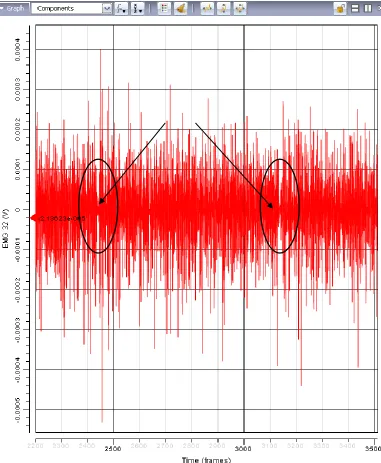
39 Figure 9: Sample profile of right anterior deltoid activity.
The profile depicts the 22s-35s time interval and encompasses two perturbations, indicated by the arrows and circles
A sample profile of right anterior deltoid activity is shown in figure 9 (Figure 9). The upward discrete perturbation resulted in a short „gap‟ in ADT activity. After this initial gap, activity returned to normal. This was analysed with the several post-perturbation intervals. It can be argued that the activity in between
40
has been analysed by looking at the total trial interval. Since the biggest change occurs after the perturbations, and this change does not differ significantly across conditions, there should not be any „wash-out‟ over the total trial. As mentioned earlier, total trial analysis did not reveal any significant effects. Therefore it is suggested that AF does not influence discrete top-down perturbation tasks. A different profile and response could be expected for bottom-up (support
surface) perturbations or perturbations where gravity cannot assist the correcting activity. The latter might be the reason why no significant increase in activity in either ADT or PDT was observed.
Three studies on attentional focus where neuromuscular activity was recorded are known to the investigator. In all of those studies significant differences in neuromuscular activity, were reported, providing support for the CAH. Vance et al. (2004) were the first to incorporate EMG as a performance production measurement. EMG data from biceps and triceps muscles was recorded when participants performed a biceps curl. Vance et al. did 2 experiments, one in which no attempt was made to control speed of movement, and a second where an attempt was made to control execution speed. iEMG was significantly higher under internal focus in the first experiment, but in the second experiment this effect faded to a trend that only reached significance during the flexion phase. Vance et al. however reported a significantly bigger ROM in the internal
condition, which would have influenced the iEMG results. MPF differences were observed in the first experiment, a trend where MPF tended to be higher under the internal condition was reported but not significant in the second experiment. Marchant et al. (2006) also looked at the effect of attentional focus on
41
Marchant et al. used an isokinetic dynamometer that controlled range of motion and velocity. They also changed the task from being bilateral to unilateral
(dominant arm curl), as well as (unwillingly?) the actual primary task. Vance et al. scaled the load to be 50% of each participant‟s bilateral maximal force (as
estimated from a unilateral biceps curl). The higher internal iEMG reported in the first experiment can thus be seen as detrimental. However, caution is advised since ROM and speed of execution were different between internal and external conditions. In the study by Marchant et al. participants were asked to „exert maximal effort throughout the entire range of motion‟. Their results showed a significantly lower peakEMG and iEMG under the external focus condition
compared to internal. Marchant et al. concluded that their results were in line with those reported by Vance et al. (2004). One could argue that the instructions differed to the extent that a lower activation (iEMG) in the Marchant study characterizes a poorer performance. Such an interpretation would favour an internal focus in tasks where participants are required to exert maximal effort. If similar force was produced under both conditions, with fewer motor units
recruited under the external condition, then the interpretation by Marchant et al. would be valid. Regrettably, no results on amount of force generated were made available.
Both the Vance and Marchant study used a task (biceps curl) that lacks a clear goal or measurable outcome. Zachry et al. (2005) therefore investigated a basketball free throw. EMG data was recorded from 4 muscles (flexor carpi radialis, biceps brachii, triceps brachii, and deltoid) and the SP tasked was scored on a 5-point scale for free-throw accuracy. Zachry and colleagues
42
of the basketball free-throw was included. This technique requires substantial contribution from leg and trunk muscles in the execution of the movement. Unfortunately, neither of those muscle groups‟ activity was collected. A trade off between arm and leg muscle activation may have occurred.
The discrepancy between the results found in this study and the literature can thus be explained by both differences in study design as in „gaps‟ in previous studies. Differing views and the challenges they bring are what drive a field forward and enhance our understanding. Rather than making an (exhaustive) „critiquing list‟, the author has chosen to list 2 points of attention: information processing, and generalizability.
Several studies have manipulated attentional focus to a bilateral task. Under the external focus of attention, the participant‟s focus is directed to a solid object with one degree of freedom. An internal focus however often adds a degree of
freedom as the participants are no longer asked to focus on i.e. keeping one object steady, but rather to focus on keeping both hands or both feet steady. This is the case in the 1999 study by Shea & Wulf were participants were asked to focus on the markers attached to a stabilometer platform (internal) or their feet. A similar design has later been used by Wulf, Mercer, McNevin, & Guadagnoli (2004), and Wulf, Weigelt, Poulter, & McNevin (2003). In both those studies a bilateral postural task was combined with a bilateral SP task respectively by holding a stick or a tube. Vance et al. (2004) also used a bilateral SP task (bilateral biceps curl). The study by Marchant et al. (2006) is the only study known to the investigator where a unilateral task was used. The additional
43
The findings from the current study suggest that there is not one optimal attentional focus. Bund et al. have previously suggested that the functional relationship between instruction and task supersedes the mode of control (Bund, Wiemeyer & Angert, 2007) based on the results from a pedalo learning study (Körndle, 1983 in Bund et al., 2007). Fast learners in that study concentrated on items representing an internal focus. The general rule of favouring an external focus, as suggested by Wulf (2007), is further questioned by Künzell and colleagues (Künzell, 2007: Künzell, Schipke, 1996). They interviewed German elite level coaches and reported a preference to give instructions that focussed on „key points‟ during skill training (88% of coaches). During skill execution (competition) 40% of coaches choose not to provide any specific instructions as to not disrupt the automaticity of movement (Künzell, 2007; Künzell, Schipke, 1996 in Künzell, 2007). It is unclear whether or not their definition of „automaticity‟ matches that of Wulf et al., but this does provide support for context specific attentional focus instructions. The coaches‟ view is supported by a study looking at balance performance in acrobats (Wulf, 2008). Wulf reported that no
differences in conditions were found for acrobats, who can be considered to be „elite-balancers‟, in postural sway. Response frequency was highest when no instructions were provided, suggesting that automaticity and stability were greatest under this condition. No difference in SD for „expert‟ balancers were found in the current study although this did not influence the sway measurement. The level of expertise in the expert group is likely not comparable to that of the acrobats from Wulf‟s study. A group with a higher level of expertise such as acrobats, gymnasts or rock climbers may have produced similar results to those found by Wulf (2008).
Beek (1989, 2000) suggests a potential benefit in adopting an internal attentional focus when replacing a well mastered movement pattern. Beek refers to