Scholarship at UWindsor
Scholarship at UWindsor
Electronic Theses and Dissertations Theses, Dissertations, and Major Papers
1-1-1962
A developmental study of concept formation in grade-school
A developmental study of concept formation in grade-school
children.
children.
Maurice J. Daignault
University of Windsor
Follow this and additional works at: https://scholar.uwindsor.ca/etd
Recommended Citation Recommended Citation
Daignault, Maurice J., "A developmental study of concept formation in grade-school children." (1962). Electronic Theses and Dissertations. 6301.
https://scholar.uwindsor.ca/etd/6301
IN GRADE-SCHOOL CHILDREN
A Thesis
Submitted to the Faculty of Graduate Studies through the Department of Psychology in P artial Fulfilm ent
of the for* the Degree of
Master of A rts at Assumption University of Windsor
hy
MAURICE J . DAIGNAULT
B .A ., Assumption University of Windsor, 1950
INFORMATION TO USERS
The quality of this reproduction is dependent upon the quality of the copy
submitted. Broken or indistinct print, colored or poor quality illustrations and
photographs, print bleed-through, substandard margins, and improper
alignment can adversely affect reproduction.
In the unlikely event that the author did not send a complete manuscript
and there are missing pages, these will be noted. Also, if unauthorized
copyright material had to be removed, a note will indicate the deletion.
®
UMI
UMI Microform EC52480Copyright 2008 by ProQuest LLC.
All rights reserved. This microform edition is protected against
unauthorized copying under Title 17, United States Code.
ProQuest LLC 789 E. Eisenhower Parkway
The present study investigated the development of concept formation
in grade- school when such as grade, #**y, and Bnniai status
were controlled. Two hundred and seventy-five children to Grades I, H, IV ,
V I and V III were given a concept formation test* The main variables studied
were: 1) the ability to abstract said generalize; I I the ability to shift from one
concept to another; 31 the sorting tim e to seconds required to form concepts;
4) the ability to name the concept; and 5) dm ability to leant a concept.
It was fe n d that age, as inferred from grads, is the stogie most
important factor to determining whether form , eolor, or sine is the basis of the
sorting* For the firs t sorting, form is preferred to color to increasing amounts
corresponding to grade* However, when children are to a second
sorting, color is the predominating choice, s«d females were significantly better
than male# to Grades I Jf* The ability simply to abstract #«d to generalise
airmg one ig well developed by toe age of «***- The ability to «hift from
one concept to another seems to develop between Grade V I (mean age: 11.4 years)
pnd Grade v m age: 13*4 years), fo r at *fot« tim e toe capacity to maim a
second sorting, mainly by toe abstraction of color, seemed tolly developed, and a
third sorting, «jtfag size prim arily, dewed a considerable increase, to a ll grades,
the sorting tim e to fo r mwi«« was SKfufaw than fo r ty n tiA * , and there was a
basis fo r the firs t judgment, necessitated a longer sorting tim e than did color,
which was the most frequent choice fo r a second judgment. Size, m ainly serving
as a basis for a third judgment, required the longest sorting tim e.
The ability to name or verbalize the concept improved with grade,
and toe ability to sort developed faster than the ability to give verbal explanations
fo r groupings. It was found that toe naming of color and size is dene equally well
by both boys and g irls and is almost perfect after Grade I. Combining the results
fo r Grades I fpid n , females named form significantly better than m ales. The
naming ability fo r form in both sexes is practically perfect at Grade IV (mean
age: 9.9 years), l i e results indicated that general naming improves with grade.
G irls are better to**1* boys for toe general naming of form when toe
results for a ll grades are combined. Boys are significantly bettor at the general
naming of color than they are tor form ,
The learning ability improved with grade. The results indicated that in
Grades I and H, ten per cent of toe subjects learned, while in Grades IV , V I and
An interest In children and a desire to follow the suggestion of
Cordon A llport recommending that more attAnttAn be directed to toe understood**
lug of toe normal person prompted this research. H ie study by Reichard,
Schneider, and Rapaport in 1943, served as toe m ajor reference. It was hoped
that this work would contribute towards toe a rriv a l of norms for toe development
of concept formation in grade- school
The w riter wishes to express Ms appreciation to Brother R. Philip, FSC,
Head of toe Department of Psychology, fo r Ms guidance in the research ami, more
so, for Ms patience and understanding, He wishes to acknowledge Ms gratitude to
Sister M arian Dolores, SNJM, Department of Psychology, and to D r. A. Thlbault,
Department of Modem Languages, who acted as readers and critics of this work.
The w riter would also like to thank Brother Alban, FSC, Principal of St. G abriel’s
Separate School, without whose cooperation this study could never have begun; to
the teachers at St. G abriel's fo r their splendid and, especially, to the
Page
PREFACE . . . . . . . . . v
LIST OF TABLES ... v il
LIST OF FIGURES * * « * • • * v iii
Chapter
I INTRODUCTION . 1
Defining Concept Formation . 1
Theories of Concept Formation . * . 2
Sorting Tests lo r Determining Abstraction . 4
The Specific Problem , 7
Survey of the Literature . . . . 8
H METHODOLOGY AND PROCEDURE 13
M ANALYSIS OF RESULTS . * , . 16
Sorting A bility . . . . . 16
Naming A bility . . . . . 20
Learning A bility . . . . . 20
IV DISCUSSION OF RESULTS . . . . 23
Sorting A bility . . . . . 24
Naming A bility . . . . . 26
V SUMMARY AND CONCLUSIONS . , . 27
APPENDICES . . . . . . . 29
BIBLIOGRAPHY . . . . . . 36
VITA AUCTORJ8 . . . . . . . 38
Table
1 Order for the Demonstrations . . . ♦
Page 15
2 Frequeney of Judgments as to Form , Color, Size * 17
3 *4 f t m T>'iT«'in>fn'4fi mi tia n r»ij- fif* r~i ■ « i d~tt ,ti iCFemlfeit
M8uiSUl 01 v O rtm oOftlBgi I Or M l i SHI Ifis a is oUu]60li IS
4 Sorting Ttm» ta SooobeIs * * * • 19
i Average of the Median Sorting Times . * 20
6 njntfo of Naming to Sorting According to Sex Category * 21
f Ratio of Total General Naming to Sorting . * a 21
3 Learning Aeeordlng to Sex . , . * • 22
Flgitf®
I Sample Layout lo r the firs t sorting (Appendix A)
Pag# 29
S Percentage of firs t Judgments (Appendix B) • * 30
$ Percentage q£ second Judgments -(Appendix 0 ) • * • 31
4 Percentage c l third iudaments fAnnendix . * • 32
5 Percentage of firs t, second and third judgments (Appendix E) . 33
6 Median Number of sortings (Appendix F) * * * 34
? Percentage of naming to sorting (Appendix G) . # • 35
INTRODUCTION
Defining Concept Formation
There is no general agreement among theorists as to the meaning of
concept formation, English (1961, p. 104) gives a dictionary definition of a con
cept ass
1, Any abject of awareness together with its significance or meaning; anything cne *»<>« think shout that rmn be dis tinguished from other things; 2. Knowledge that Is not directly perceived, through the senses but is the result of a manipulation of sensory impressions. A concept requires both abstraction and generalization; the firs t to isolate the property, the second to recognize that it may be ascribed to several objects.
Osgood (1953, p. 666) defines a concept as a ’’common response
(usually verbal) made to a class of phenomena, the members of which display
certain common characteristics. ” He believes that when human beings think, they
use concepts which may be quite concrete (e .g ., tree) or quite abstract (e .g .,
gravity),
Hilgard (1953, p. 315) defines a concept as:
a symbol which stands fo r a class of objects or events with common properties* Words ami signs both stood for concepts
of varying d egrees of generality. A s concepts becom e m ore
general, they become more abstract; that is, they lose the thing character that ordinary objects possess. Concepts of number are more abstract than concepts of color because color inhATHW In things*
Rapaport (1945, p. 33?) states that, from the point of view of logic, the
meaning of concept formation is "the relationship between the concept table*
and the actually existing tables o f our w orld." Eapaport goes on to say:
From a logical viewpoint, the naming or identifying of anything must be considered "conceptualization*'. language consists of a wiftivtpiiii><:t«n of piifth nnmfag. Thus the very realm of language is Dervaded bv ^ono^nfaiaHy.atinnr Since verbal tM nM w ha» been accepted as abstract symbolic thinking, words being considered symbols fo r things, we must realize the* any gymhni i Kaftan is in a sense eeneeptuj*ii«#f1(**»T
Theories of Concept Formation
Bull (1920) believes that concept formation consists in finding the
common elements in a group of stim uli, lb so fa r as he ami others who agree
with Mm are concerned, the common element is the concept.
SwinteA <1932) nnrnrnftnta that:
H ull's viewpoint is an ovAi-sim piiffpatirm in that it deals not with the entire process of concept formation but only with that aspect of it 'Commonly known as abftfraet lonii the process whereby a young child forms the concept "dog". H ull's examples are not m erely those of locating an Meotioat common element in a group of stim uli. As the cMld learns more and more about dogs Ms concept of dog be comes richer, not a closer approximation of some bare common element. Concept formation involves synthesis as well as analysis.
Smoke sets up Ms bio-social criterion fo r determining whether a S has learned
a concept. The standard is "the consistency with wMch he is able to make sym
bolic responses tiw t differentiate the members of a class of stimulus patterns in
question, or an aspect of that class from other stim uli. ” (1985, p. 275). As fa r
as Hull, Smoke, Heidbreder, and others are concerned, concepts may not neces
sarily be conscious. Also, these theorists believe that there are certain Ss who
are able to acquire the correct conceptual response but may not be able to verbal
with tide latter point but insists that the concepts necessarily be conscious.
The aforementioned approaches to concept formation may be called
experimental or quantitative. Let us turn now to a non-experimental, qualitative
or descriptive method ef studying concept formation. Piaget (1960, p. 37) recog
nizes four stages in the development of a concept in a child* The firs t stage is
presymbolie and consists in the fact that the child has learned to react in charac
teristic ways to a particular object. In the next stage, the child employs a symbol,
usually a word, that stands fo r a particular object but not fo r a class of objects.
of
the class in question, but he is unable to give a satisfactory verbal formulation
of til© concept. The final stage is evidenced by the child's ability to organize
objects in groups.
Another theorist whose works have been m ajor contributions to the
study of concept formation is Goldstein. lik e those of Piaget, his studies are on
a descriptive, qualitative level.
Goldstein nnfoad tim». people with ahnnmn i War such as brain damage
and schizophrenia operate on a concrete rather than an abstract level. For
Goldstein (1941),
. . . the concrete attitude is realistic. It does not imply conscious activity in the sense of reasoning, awareness, or a self account of one’s doing. We surrender tit experience of an unrefiective charac te r: we are confined to tiv* apprehep gfon of a given *t»fag
or in its particular This appreben sfon may be
Hawfltiao of the bondaee. Individual cannot ©asilv detach himsmif fj»om the dp^nand exerted by *h«t. experienced unique*’ ness of the object* Therefore, It Is difficult, If not impossible, fo r him to realise other potential functions of this same object, or even to conceive of it as an example, a representative, or a case of a general class or category. The dependence upon jmTWiaHistft claims «yn fokft on th« characteristic of rigidity and 'lack of shifting’, w ell known in abnormal psychology.
The abstract attitude to r Goldstein (1941, p. 9),
embraces more than m erely toe real stimulus in the scope. It ■S.—.— —- —- « nr'.,|» n . n S ^ Wilirt, j*— i, *111 rr. **. nr, j h M i j a l rn, — T rP rfi j» *1, m * tB A im plies conscious reasoning, awareness, ana seii-account 01 one's doing. We transcend the immediately given situation, toe specific aspect or sense impressions we abstract common from particular properties} we are orientated In our action by a
or a general meaning under which the particular object before us fa lls . We detach ourselves from toe given impression; the given impression 'and the individual fofag represents to us an accidental example or representation of a category.
Goldstein is opposed to those theorists such as Hull who claim that,
hi identifying the Af>twwm> pttfe hatt made an abatrQetinn- This is why
he gives importance to the whtfnwg of o«m<Apfc« pnd verbalization. He agrees with '
these theorists that, atthraig'h verbalization is an index of a btghAr level of abstrac
tion, it is not characteristic of every abstraction. Concept formation then, as
postulated by Goldstein (1941, p. 24), refers to "a genuine abstraction bound to
a conscious and volitional act of reflecting upon toe properties of Objects with
reference to a concept, a class, a category. ”
Sorting Tests to r Determining Abstraction
Goldstein (1941) describes ffve tests which he l» s devised to r the test
ing of abstract ability. The test which most approximates toe one used in this
test is used with abnormals sad its purpose is to determ ine whether the subject
is able to sort a given variety of differently colored figures according to the cate
gories of color and form . This tost is described (p. 114) as follows:
The material** fo r tote test of 12 pieces, intending 4 circles, 4 squares, sad 4 triangles# each shape occurring in red, green, yellow ami blue. The 12 pieces are presented to the subject in random order# with the instruction to place together those that belong together. Upon completion of the task# the subject is asked to sort the pieces in another way. U the subject does not spontaneously sort toe pieces according to form and color, a mimhfti* of aids are provided to facilitate toe teak, as in the Cube Test, h i this test, interest is focused on toe subject’s ability to shift from one basis of classification to another.
It is important that toe subject abstract color or form as a concept
ual principle, of sorting. Also, he must account fo r his grouping by naming or
verbalizing the underlying prin cip led generalization. Some abnormal patients
indicates tendency to tedldpatterns. Abstractly, they cannot afagteotetheotofttno"
properties; hence the tody means of responding is to deal with toe figures con
cretely bv ’’doine" «wn«thfa<r with in a concrete wav. The patient solves the
problem of sorting by doing. In this process of ’’doing’®, (Goldstein, 1941, p. 114)
which is guided by toe dmwiwant. sense impressions, the patient becomes subjected to toe ^raftgHyntfnnni valences as they ayie** from the figures placed s*»d from their perceptual influence so ten* |%a pattern during by virtue of the activity of placing one figure after the other. The subject who persists in a pattern arrangement under these circum stances has to be con
sidered abnormally concrete - u n less other control experiments should bring about results which justify this behavior as a voli tional aettont
In the present study, children fin toe early grades showed a strong
tendency to build patterns. Tor example, if on the firs t sorting the designs were
children, unable to find a new grouping principle, would order the blocks again
a^nm*ding $$ form , but they would "do" difftMwintr Perhaps, if on the
firs t sorting, the triangles were placed ope on top of toe othe r, with the largest
one on toe bottom, town, on -tom second toe order was simply reversed
by placing the largest triangle on top of the pile. This procedure of "doing1'
something with designs seems to be characteristic both of young normal children
as well as of abnormal patients.
A patient's inability to shift from one concept to is indicative
of a rigidity, in toe sense to#* he is controlled by #»»# set of ettoftto1# impressions.
Goldstein <1941, p. 126) writes:
This impairment of the categorical ittotod# entails too incapacity to generalize in two d ilu tion*!.. F irs t, to# potto*1* os** *#yfth#r reflect upon nor conceptualize his "doing" and arrive at any cate gory or principle. Secondly, most of the patients form groups of either kind, shape o r color ftcecydfag* to the experimentally oro-duced shifts forced upon them. But, this is no way to help a patient to loam from his own doings what tb** task demands. The pat ient is omtoto to generalize - to8* is - to apply to#
of a once-attained result to other h most eases, the p id a tts grouped toe shapes at least mice during the test. This did not result in a sorting according to form under toe other pre
sentations #*»d if it were attained, *&**«» if was with a rig idity which could not be attained thereafter. Thus, toe test result is not only an indicator of the patient's potentiality to form a concept but also of Ms ability to learn.
In a criticism of toe Goldstein tests, Kogan (1949, p. 42) writes
that, "these tests do nick out a group of twfto*1*# - cerebral natholosv - but **»»*
in reality many patients with various forms of cortical defect exhibit no im pair
ment of the abstract attitude." ffh# further criticizes Goldstein b«»#a#ff# M«
experimental studies present only qualitative results and because a ll data per
frequency with which normal variability might introduce concrete elements into
the response of essentially healthy persons Is omitted. Also, there is no systema
tic method of scoring or evaluating test performance. The tests become valid only
when the patients experience difficulty with a ll items, for with partial success
there are no norms fo r interpretation.
The Hanfman Kasanin Test of Concept Formation (1937), which is an
extension of the Vigoteky Concept Formation Test is a sorting test in which,
The subject is told that there are feme* different kinds of blocks: that each bay a watme and that bis task is to find the four M ndi and to put each of them into a separate corner. The subject is asked to formulate the principle of class The principle is one of double dichotomy: large or sm all: and ta ll or flat* The test classification is based on not one but two characteristics, which in their combination yield to sub-classes; larg e-tall, larg e-flat,
sm all-flat, sm all-tall. The concepts to be found are not supported by already existing names which the subject may have ready at hand in the same way as he has red, round, e tc .: nor is there any general name fo r the combination of height and size on the top surface. Thus, it is impossible fo r the subject to reach a solution in a
pseudo-conceptual way by m erely operating with words.
In this regard, Rapaport (194S, p. 392) writes:
while Sim ilarities and the Sorting Test is a test of everyday concept formation, the HBnfman«K)» Banin Test may be considered a test of ha tdr. concent formation — that is , concent formation in productive action, rather than the chore of reproducing previous verbal or
experimental stereotypes. . . . Insistence on performance and verba lization awrf inquiry into every doubtful shading of either is the only method whereby diagnostic concept formation testing can be practised.
The Specific Problem
The' «pe<dfin problem at band is to determine levels of conceptual dev
elopment in grade school children. in thip experim fait the subject must choose
cept formation we are concerned with the subject m atter of problem solving.
The subject tries to discover what there is in common among a number of
figures or objects. His task is to separate out from a ll of the stim uli, aspects
that are crudcil to thfi concoDt* Word h@ unstblG to stosti^st tho codqibchi DroD6r*
ties of things, or to generalize about classes of objects, he would be greatly
hanftifmppftd and could not reach the h%hey levels at a ll.
Survey of the lite ra tu re
One of the firs t m ajor studies on the contents of children's minds m s
begun in October, I860, by the Pedagogical Society in B erlin under the direc
tion <rf H all. The purpose of the study (1948, p. 253) ’’was to ascertain how many
of the oWMwm who entered the prim ary classes tip * fall had semi and could
name certain common animals, insects and plants, e tc ,” The results showed
that the concepts which are most common in the children in a given locality are
the easiest to be acquired. He also fe lt that it was extremely important to fam i
lia rize children with objects firs t.
Two developmental studies which are almost identical in method and
results were by Descoudres in 1014 and by Brian and Goodenough in 1929. The
results of the Brian and Goodenough study showed that children below three
years of age match on the basis of form ; children between three and six match
on the basis of color; and children above she to adulthood match on the basis of
form . Marked age differences in the relative potency of form and color as indi
The pfejld firs t responds to elements which are common to many features of the environment; next is a preoccupation with those attributes of a given object or situation which makes fo r differentiation of species within a given genus; the fined swing towards form is the result of various attributes of a given situa tion In terms of tho«e factors which experience shown are most frequently effective in determining appropriateness of response.
Closely related to these two studies is an experiment conducted by
Lindberg who used fo r his subjects 2,446 elementary school children and
218 adult brain-damaged patients. Two tests were constructed by toe author,
a so-called tin s test a sorting? test. The results showed tk>t tha tendency
to color response decreases with age in elementary school; there seemed to be
an inverse correlation with intelligence; in a ll age groups g irls seamed to have
a somewhat lower degree of color attitude than boys. This difference between
toe sexes m s discovered in both tests and is also found in both adult mental
patients in the normal group.
The research paper by Thompson (1941) is most appropriate to our
present study. The apparatus used was the Welgl Color-Form Test, the BEL
Test which Is a modified Weigl Sorting Test and the Vigotsky Concept Formation
Test. These tests were administered to sixty grammar school children in grades
one to six (ten in each group). The rem its are as follows: on the Color-Form
Test, a ll children could sort in one category and 40% could sort in two categories.
A ll who chose categories gave w ig reason fo r their sorting but only half
of the responses were generalizations (form , color, Shape). More of toe older
color gftnftrat than form g^waraiiy-ptinna, More older O w younger chil
dren sort for both categories. Children usually generalise color before form ,
although Piaget, Buhler, Terman ami associates, who standardized the Stanford
Binet Intelligence Test, stated that the ability to generalise did not develop in
foe child before the eleventh o r twelfth year. Thompson’s study showed that
there was a definite qualitative and quantitative change in the ability to general
ize or to abstractions between the ag« range of ”6-8 and 9*11 years”.
Younger children tended to form groups of objects related in specific concrete
situations, or to see fewer general relationships between objects. Older chil
dren were constantly more concerned with differences between objects than with
their sim ilarities. Apparently then, the younger children were unable to over
look dipnyftpgnH fts and to take tat© account underlying sim ilarities. Only when
a child is able to grasp certain relationships between objects is he able to learn
and use a word aigmnying thet relationship.. The ability to apply a class name in
a categorical way presupposed the ability to grasp the characteristics of the
class* This supposed that younger children did not have a general name in their
vocabulary or that, if they had a class name, it did not have the same meaning
fo r them that it had fo r older children.
In 1943, Reichard, 8ChnA<d<>r and Rapaport conducted an »«p«nHwiftnt
which m ost nearly approxim ates this study. Their purpose was to supply a set
of tjftyAlnpincratal foj> thA evaluation Of <*Uniw>1 nnnTnaHftRt ThC Subjects,
234 normal white children of the ages 4-14, were given the Color-Form and toe
Sorting Tests of Wetgl, Goldstein, ami Schaerer, In toe Color-Form Test, the
concept formation on the basis of non-essential incidental features is the most
prim itive; concept formation on the basis of function or use, which we shall call
description is foe nflirf, flfid genei*al abstract conceptual definition is
the highest.
The results were as fellows; Children below five do not shift from
a grouping principle they have once conceived, probably due to perceptual domi
nance (in fois case, foe possibility that form is more easily perceived than
color> as well as the inability to shift. Around seven to eight years of age, the
ability to perform two groupings appears to become predominant, and children
above eight years meet even Piaget's criterion of success inasmuch as 75% or
more are able to do both color and form groupings m in Goldstein’s term s,
’’are to from one grouping pf»t»«dpb* to a n o t h e r . T he children .above
five years are inclined to sort more in term s of form foan hi terms of color.
There is a steady increase in foe number of correct responses and of eftnQepfoel
definitions which follows foe normal growth curve and reaches a plateau at about
nine years. Comparison id foe scores fo r grouping »nd verbalization reveals
that grouping ability develops foster than does foe ability to give verbal explana
tions fo r one’s grouping, thus confirming Piaget. While extremely loose group
ings are found in very young children, thus attesting to foe amorphous nature of
concepts at this early age, m ildly loose groupings, which included one or two
objects not strictly within foe bounds of foe concept, on foe other hand showed a
which they d® mainly in term s ©f what use the objects are to them. This func
tional level erf concept formation reaches its peak in children of eight and nine,
after which it is gradually replaced by more m ature, conceptual classifications.
This last stage seems to reach relative m aturity in children of around sixteen
METHODOLOGY AND PROCEDURE
The apparatus used te testing the subjects was portable and simple
in design. It comprised three triangles, three squares and three hexagons vary
ing In color and size as can be seen in Figure 1 (Appendix Ah these designs were
numbered on the back lo r the purpose of quick recording mi the scoring sheet.
The subjects entered the room Individually and the experimenter did
his best to make mush one feel comfortable. The apparatus was displayed ran
domly before the subject. The sheet of square paper which covered the design
was withdrawn and the instructions fo r the firs t sorting began as follows: ’’Under
this square sheet of paper I have nine plastic blocks. Look at these nine blocks
and place the mass that belong together in piles*" K the subject was unable to pro
ceed, the instructions were clarified as follows; "Look at these nine blocks and
place together in piles the ones that are sim ilar or are the same for any reason."
If the instructions were s till not clear, the clarifying statement was reiterated.
As the subject proceeded, the experimenter, after each sorting was completed,
recorded the tim e required to make the firs t sorting as well as the method of sorting
the designs. Then the testae was asked to state his reason fo r placing certain
designs together - the purpose of this step being to discover whether the subject
could verbalise Ms concept o r not, As an example, the student might reply that he
placed the designs together because they were the same shape.
With the d esign s agate randomly mixed, the instructions fo r Hie second
sorting were as follows: "This tim e I want you to look at the nine designs and try
to find a completely different way of placing the blocks that belong together in
p ile s ," 'These instructions were t^anfitnA in the following manner: "You have
found wav of nl«mln<r te g f tf to p k n il a ft Mewlea t h a t a m a fm llfly o r **** * bt»\tvntr
together. This tim e, trv to 1W**aPT^P — ^^^P****TIPp T9T* PIIMp pK p« comoletelv *iiffei»An* wav of IV p “ ••)afl'W pW TrP jJ "W 'V*Pffi^PT^r n\at*Amr w «v>it«W Bw WWPPr
th»* iw»ir>ng ^ ftth a i- fm piles. " These Stowo were repeated if further
rtlgyifinaHnn wq« necessary.
The ^*n?^gT»g were rearranged fo r th*> third sorting with ^
tostruc-tfAwp as follows: "This tfw a Z want vou to look at the «<«« Meeks »*«* trv to s»dT M f f * P ^ , 9PT ^Pl ™ ww p p p p ftr PRWp*^P *9 T * W ^PT|P T f w p P^PTr p p w w P " p 1" , T * *w M F ^^^^PIPP^P .J9 P p *l^ p * * rt^ P
nw« other o«yp*»pi«f^iy way of pfaofeig blocks *to* belong together in p ile s ,"
H necessary, further elucidation followed: "Now you have found that there are two
comoletelv different wavs of JJP P P r P „ W J ^ P IM W I T P M T p P * w * * W *|j, 9* T P * " B g P P P w P P P W i irP P ,“M e tw that h*iiwg together In Diles. 1 want T P P P fg * * ^ 91^ - * * P T g * T » B M | w T rJ M w W P * ■ P P P 'W W p P *■*
vou to trv to onft other com oletelv different wav of rtlgMmr Morfw that M whp ■J TPPI, WTP TP^P —ff P P ^P<p****9 TPPPP, Tr P P *l|,P TPTrPmgD, p. T ,P W *|J * 9 P * T '™ w P *P “ *■ PPPva TP* TPPPTWHIg *PT|P*TP*W1>P
tfwriathar in D iles," These instructions were reseated if it was necessarv,^ T I P P P p * * ^ * * , , , 1* * • > * « I P P P “ P w P P P T P ^ P T P T P P w T P m f P ” P P * P p T F P F W W W T P * 9P m w * » P P W W T P P P P T P * »
If in either the second o r third sorting, the subject was usable to pro
ceed further with the to ft, a fourth part of the experiment was designed to evaluate
the subject's learning a b ility For example, if on the firs t sorting the designs were
ordered according to shape and the subject could proceed no further, he was then
shown how to wart by color* On the toto*” of ttg*«onftos*f1to > it was expected
that the subject would proceed to sort the blocks by the dimension of size. Table 1
ittofftffitos- toe order- of Ham/w K»ratif»v« to r the sorting, <it>p»n/Hrig on whether shape,
color, o r stop was use# to waking the firs t sorting.
to the subject rimwonKfoptthA hy remaking w« sortings,
tab le t
Order for TUymrtn atratf ravn
Snrttwg. p<3»mf>nptrft»irwi t ju m m h ig
-Shape Size
Color Size
Size Color
Color
ANALYSIS OF RESULTS
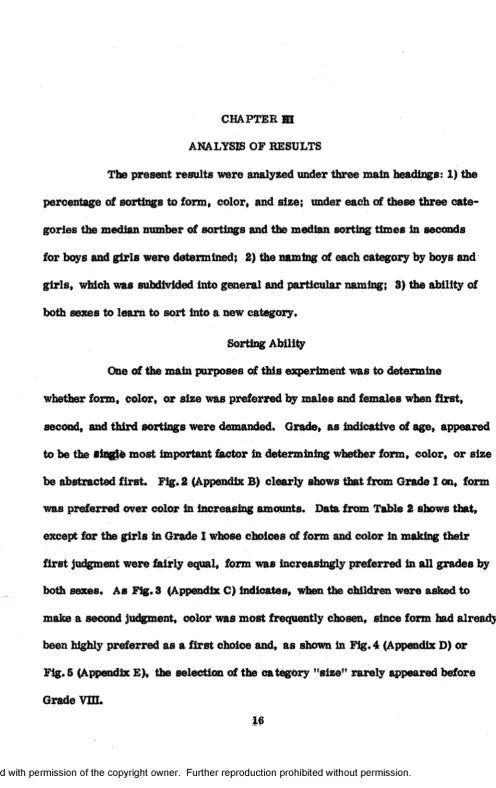
The present results were under three wain headings: 1) the
percentage of sortings to form , color, and size; under each of these three cate
gories flu* wariian number of sortings the median sorting *toto* In seconds
fo r hoys find g irls were determined; 2) die naming of each category by boys and
-g irls , which was subdivided into -general end particular namin-g; 3) the ability of
both sexes to learn to sort into a new category.
Sorting A bility
Cmo, of to** main of fMff A-gpAylwiAnf WSS to determine
whether form , color, or size was preferred by males and females when firs t,
PfMBtotd, find fMwi sortings were AA-m^raton. Grade, as indicative of age, appeared
to be the single most important factor in determining whether form , color, or size
be abstracted fir s t Fig. 2 (Appendix B) clearly shows that from Grade I on, form
w » i p m f l T i u w ? 0 f QwIOjP lu H w rO ftS IB g S IS O l22IIS « U E m IfO S I 1 1 1 /1 $ m SHOW S tQ v l»
except fo r the g irls in Grade I whose choices of form and color in making their
firs t judgment were fa irly equal, form was increasingly preferred in a ll grades by
both As FJg, 3 (Appendix C) IMdtofitofi, when the children were asked to
make a second judgment, color was most frequently chosen, since form had already
been highly preferred as a firs t choice and, as shorn in fig , 4 (Appendix D) or
Fig. 5 (Appendix Eh the of the ca tegory "size” rarely «pp»flt*ari before
mm
Frequency erf Judgments as to Form , Color, Size
MALE FEMALE BOTH
F C S T F
c
s
T F C S TGrade! N » 49 N « 3 4 N * 83
Sortings
1 20 13 2 44 14 13 - 27 43 26 2 71
2 6 5 *« 11 3 4 1 8 9 9 1 19
3 — —* — — — — . 1 1 1 1
Grade H H * 30 N "*32 N * 62
o@ryMS
i 22 7 — 29 22 29 44 14 ~ 58
2 2 2 1 5 3 4 2 9 5 6 3 14 '
3 — — **» «»«* * * • » « 1 1 — 1 I
Grad© IF N **19 N «*29 n * 48
Sortings
i 15 Jt «•»#• 16 24 — . 2 26 30 1 2 42
2 1 3 - 4 1 7 1 9 2 10 1 13
3 — 1 1 — 2 2 mmm- 2 3 5
Grade V t N * 22 N * 16 N » 38
Sortings
I ■ 16 2 *“* 18 15 15 31 2 « 33
2 1 8 — 9 -mum 1 2 3 1 9 2 12
3 — — 2 2 2 1 3 2 3 5
Grade V III N * 44
Sortings 1 2 3 36 4 1
5 1
26 5
4 9
As is shown to Fig. 6 (Appendix F), the ability to categorize improved
with grade. G irls to Grades llf. W ana V I made a greater number of sortings than
did boys, to Grades 'St and IV this difference was due mainly to the greater shinty
of females to malt** a second wArting to r which color was almost alwsvs used.
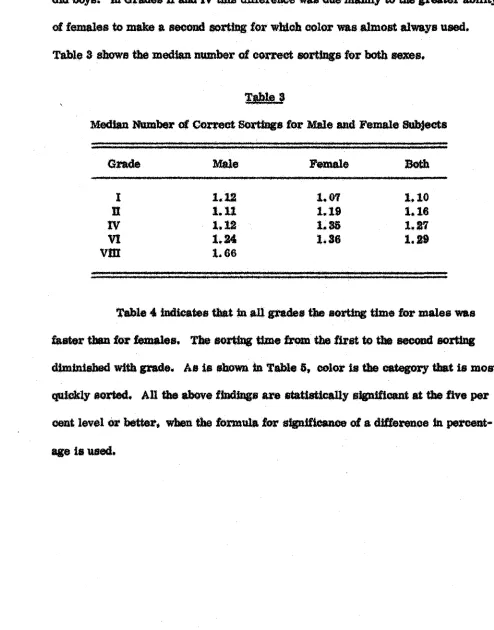
Table 3 stows the median number of correct sortings fo r both sexes.
Table 3
Median Number of Correct Sortings fo r Male and Female Subjects
Grade Male Female M b
I 1.12 1.07 1.10
t t 1.11 1.19 1.16
IV 1.12 1.35 1.27
f t 1.24 1.36 1* 20
vm 1.66
Table 4 j«dtoft.tes that to a ll grades # e sorting *!*»* fo r males was
fhi»hyf than to r females. The sorting time» from to * firs t to the nanrmd sorting
diminished with grade. As is shown to Table Sy color is the category that is most
quickly sorted. A ll toe -above ffadtgg*i are «i»tf«Mn»iiy at the five per
level dr better, when toe formula to r of a deffarwaoo to percent*
Table 4
Sorting Time in fNw indf
MALE FEMALE TOTAL
F C s T F C s T F C S . T
G rad el Sortings
1 5.5 3.8 4 0 4,84 5.0 5 .0 * 8,00 5.5 5.0 4 .0 5.27
2 3.0 2.5 * * • * 2.77 1,5 4 ,0 7,0 8.44 2.0 3.5 7 .0 2.97
3 • » « * ; — 2 ,0 2.00 rnmm 2 .0 2.00
Total 5.07 3.22 4 0 0 4.43 4,38 4 7 6 4 5 0 4.57 4,89 4 6 1 4 2 8 4.76
Grad© a Sortings
1 6.0 4 .0 — 5.52 7.0 4 .0 6,28 7.0 4 .0 — 6.28
2 1.5 3.0 1 .5 2,10 2.5 3.0 3 .0 2.83 2.0 3.0 2.5 2.54
3 — — m + m • •m-rnm 12.0 12,00 . 12.0 12.00
Total
mm mm-m-'m fm mmmmrnf-mm
5.58 3.77 1.50 5.01 6.46 3.63 6,00 5,63 6.69 3.30 4.88 5.64 M * m t»m mmmmmmtmmm.mm"m
Grad© IV Sortings
1 4 5 1.0 4.28 5.5 — 6.0 5.54 5.0 1.0 5 .0 4,90
2 4 .0 1.0 1,75 3.0 3 .0 2 .0 2.88 3.0 2.0 2 .0 2.15
3 — <■*«* 4 .0 4.00 — 4.0 2.0 3,00 — 4 .0 3 .0 3.40
Total 4.47 1.00 4.00 3.79 5.40 3 ,® 3.00 4.60 4.90 2.23 3.50 4.18
Grad© V I Sortings
1 6 .0 1.0 M X ** 5.41 8.0 — — 8.00 7 .0 1.0 . « 6.62
2 2 .0 2,0 — 2,00 12.0 2.0 5.33 2 ,0 2.0 2.0 2.00
3 -mm mm 2 .0 2.00 — 2 .0 60.0 21.33 mrn-Hm 2 .0 6 .0 4 4 0
Total 5.78 1.82 2.00 4,00 8.00 8,33 21.33 9.52 6.84 1.86 4.40 5.20
Grad© V ® Sortings
1 4 .0 2 .0 3 .0 3,74
2 3 .0 3.0 3 ,0 3.00
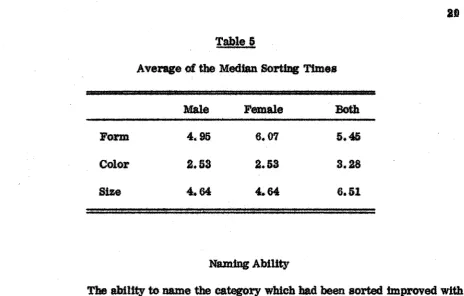
Table 5 .
Average of the Median Sorting Times
M ate Female soth
Form 4.95 6.07 5.45
Color 2 , S3 2.53 3.28
Size 4* -64 4*64 6,51
Naming A bility
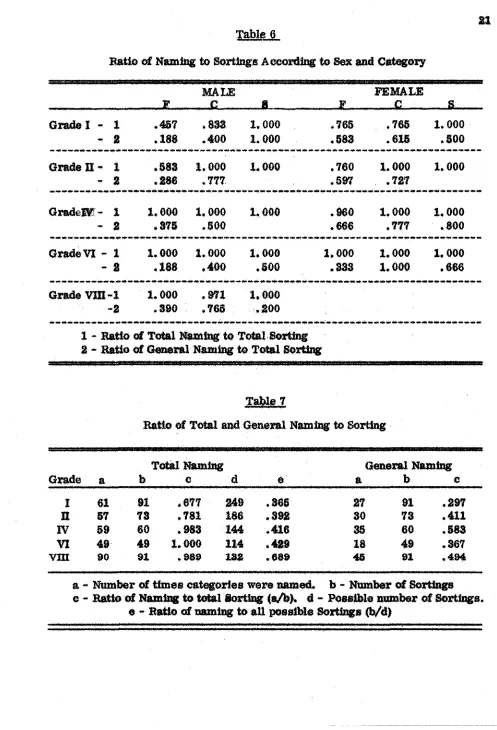
The ability to name the category which had been sorted improved with
grade, as seen in Fig. 7 (Appendix G). From Table 6 it is seen that females named
form significantly better than did males. The naming ability for both males and
females was almost perfect from Grade IV cm. G irls in a ll grades gave general
names fo r form significantly better te n did the boys, as is shown in Table 7,
When the results for a ll grades were combined it was found that boys gave signifi
cantly more general names for color te n they did fo r form . A ll results reported
were atyGstePflty significant in t-hte section,
Learning A bility
BAwtnsp there was no nawinHmr procedure mummI in ntmnaincr iiw subiects
tested fo r learning, the following results are presented cnlv fo r the osmose of
indi-eating a trend. Possible subjects fo r the learning test were any children who failed
Ratio o l Naming to Sortings According to Sex and Category
MALE FEMALE
•*» ft 8... w . C .... S ...
Grade I - 1 .457 .833 1.000 *765 .765 1. 000
- 2 .188 .400 1.000 .583 .615 .500
Grade H - 1 .583 1.000 1*000 ,760 1.000 1.000
- 2 .286 .777 .597 ,727
G rad e»> 1 1.000 1.000 1.000 .960 1,000 1.000
* 2 .375 .500 .666 .777 ,800
Grade V I - 1 1*000 1.000 1,000 1,000 1,000 1. 000
- S *188 , 400 .500 .333 1.000 .666
Grade m u -1 1.000 . 971 1,600
-2 .890 ,765 *200
1 * Ratio of Total Naming to Total • Sorting
■
2 - Ratio of General Naming to Total Sorting
Table 7
Ratio of Total and General Naming to Sorting
Total Naming General Naming
Grade a b e d e a b c
I 61 91 .677 249 .365 27 91 .297
n
m 73 .781 186 .892 30 73 .411IV 59 60 . 983 144 .416 35 60 .583
V I 49 49 1.000 114 *429 18 49 .367
v a t 9 0 91 .989 132
.689
4591
.494
a - N am ier of times categories were named. b - Number of Sortings c - Ratio of Naming to total Sorting (a/b ), d
*
Possible number of Sortings.Learning According to t o
Grade
A
MALE
B C A
FEMALE
- B ■C A
BOTH
B C
I 49 18 3 34 12 0 88 30 3
n 30 11 1 81 10 1 61 21 2
IV 18 $ 1 i f 9 6 43 14 1
V I 20 11 5 18 ! § 33 20 10
VISE 21 21 11 •** **■ 21 21 11
A - Total possible number of subjects fo r tbe testing of learning. B - Total number of subjects tested.
€ - Total number who succeeded to learning. ,
Approximately one-third of tie subjects was tested to Grades X. H» and
IV ; two-thirds to Grade V I; and a ll of tbe possible subjects to Grade VXSt. It m s
found that the learning ability did improve with grade* to Grades X f»«d n , only
about ten per cent of the subjects tested learned, whereas to Grades XV, V I and V IS ,
DISCUSSION OF RESULTS
&i order to evaluate tbe results properly, a b rief review of tbs various
theories of concept formation is necessary. English (1961, p. 105) stated that the
two requirements fo r forming a concept were abstraction (to isolate the property)
and generalization (to recognize that it may be ascribed to several objects.)
Osgood (1953, p. 666) maintained that tbe concept may be quite concrete (e .g .,
Tree) or quite abstract (e .g ., G ravity). Hilgard (1953, p. 315) believed that the
concepts are symbols fo r classes of objects, which become more general as they
become more abstract. In so becoming they lose toe "thing" character that ordi
nary objects possess# Piaget (1966, p. 37) recognized four stages in the develop
ment of a child's concept. In the third stage, the child is capable of im plicit
responses , that are symbolic of the class in question but he is unable to give a
satisfactory verbal formulation of the concept. In the final stage, toe child is able
to organize objects in groups. Goldstein (1941) differentiated between the concrete
and abstract attitudes. In toe concrete attitude, toe bond# between the individual
and the perceived stim uli are so strong tost a rigidity or inability to shift concepts
results, hindering toe individual’s recognition of other potential functions of the
same object. The response which toe individual might make is realistic but
unre-fiective. The abstract attitude im plies conscious reasoning and the ability to trans
cend toe immediate situation so told it becomes possible to abstract common from
particular properties. A ll theorists seem to agree that the naming of the concept
is an important part of the ability to think abstractly.
Sorting A bility
Tbe present study concurred with the previous experiments of Descoudres
(1914), Brian and Goodenough (1919) and Lindberg (1938), which reported tbe age
(inferred from grade) as being the single most important factor in determining
or color be firs t abstracted. There was further agreement with
these studies that from the age of sis onwards, form was preferred to color in
increasing amounts corresponding to age. lindberg (1938) also found that color
responses decreased with age. la an ftypTftnaBrtn of results found in the
study by Brian and Goodenough, it was hypothesized that this final swing is tbe
result of gyaHnpi of to** various attributes of a given in
term s o f those factors which experience has shown are most frequently effective,
to Grade I, It was found matos in itia lly chose form to a greater extent then
uiu xemaies. rnis iinding seems to disagree with mat or Brian and Goodenough
who claim tim i there is no consistent eev difference to ehfXMafag form over color.
Also, the evMenee here presented seems to favor the argument that concept forma
tion does not develop through the quantitative addition of bits of information. Rather,
it would seem to support toe hypothesis of Piaget that toe development of concepts
comes about through qualitative ctomgn* within toe individual, at least to tbe early
years.
It was found that the median number of sortings increased with age. to
la th is
study, then, it was found that the ability simply to abstract had to generalize
along one dimension Is almost id ly developed by toe age Of six. The ability to
abstract in two categories does not seem to develop until the vm th grade, when
eighty per oswt of the subjects demonstrate an ability to do so. Even greater flexi
b ility , as <»y<*Tttpnficrfi in the ability to whtffe from one concept to nnotosr, is noted
when male# showed a atyntftcfrnt improvement between Grades V I and v ffi in. their
ability to mf-fa* a third u n rtty , mostly according to size. Tims Goldstein’s c ri
terion fo r concept formation, which Is toe ability to is met by boys between
G rades V I age: 11.7 years of age) a™! Grade Vm ( *n**sn age. 13.4 year* of
age.) These .results differ' from 'those reported by Reicfaard, Schneider
Bapaport (1043) which indicated that, by the age of seven or eight, toe ability to
perform two groupings is perfected »wd th a t .real conceptual ot« are
attoto^d' about toe age of eleven. Thompson (1941) 'reported that there was a quan
titative and qualitative change in toe abstractions which takes place ’between (6-8)
and (9-11) years of age." Also, Piaget, Buhler, mid Terman and associates, who
tttftrtdarrify.Afi the Stanford M ast, reported too* the ability to generalize does not
develop until toe eleventh or twelfth year.
The auicker sorting towo fo r 'males than fo r females must be explained.
It was noted thyt in Grades Q a»d jv , females ma-dp a greater median number of
sortings <*»*« did m ales, chiefly fa»ram«A of their gr**»t«»y ajfoitity to abst*1****
generalize color. Also, in Grade I, females chose equally between form and color
females may lie undecided to the early grades as ft© their preference fo r form and
color and consequently take a longer sorting time* The second sorting is faster
te a the firs t, possibly because, after the firs t sorting, the children have learned
just what is demanded of them.
Naming Ab^tty
to experiment, it was found*hst tbe ability to name or to verbalize
the concept improves with grade, to Grade 1, 68 per cent of the subjects named
their yiotfwd of sorting, whereas to Grade n , 78 per cent of the subjects did so.
These results concur with the studies by Piaget (1928) and Reickard, Schneider
and Bapaport (1943) which etoo the ability to formulate categories
precedes the ability to verbalize the concept. There Is disagreement with
Thomason’s studv 119411 reported a ll subiects who formed categories
gave poTne jsason to r it. Thompson also reported *fa»t over half of the namfa»g could
be called generalizations (e .g ., foam, color, s ize .) The present study indicated
that g irls always give more te a fifty per cant generalizations to r form and a much
higher percentage for color and size. Boys are able to generalize color and size
over fifty per cent of the tim e, but it Is noted that even older mate students failed
to generalize form fifty pet cent of the tim e. Thompson’s study also reported
that both the older and the younger subjects give significantly more color than form
SUMMARY ANJ> CONCLUSIONS
Two hundred and seventy-five children in Grades I, H, IV , V I and
VIH , raiding in mean chronological age per grade from 6 .4 to 13,4 years, were
given a concept formation test* The purpose of the research was to study the
development of concept formation in grade-sehool children when grade, sex, and
social status were controlled. The main variables studied were: 1) the ability to
to shift from erne concept to another; 3) tee
sorting tim e, in seconds; 4) the ability to name the concept; 5) tee ability to
learn the concept.
It was found that age, as inferred from grade, is the single most impor
tant teeter in determining whether form , color, or size is tee basis of tee sorting.
Form is preferred to color in increasing ammmts corresponding to age, fo r the
firs t sorting. However, when children are asked to make a second sorting, color
is tee predominating choice and females do significantly better than males in
Grades I and M (beyond the . 01 level of confidence). Also, it was found that tee
ability simply to abstract and generalize ei«wig «n« is almost telly deve
loped by the age of ate. The ability to shift from erne concept to another seems to
develop between Grade V I ( mean age: 11.4 years) and Grade VH I ( mean age: 13.4
years), fo r at this tim e tee capacity to make second sortings {mainly by tee abstrac
tion of color) seemed to increase, f**yi a third sorting, naitig aim*, occurred with
considerably increased frequency at the* grade. Piaget’s hypothesis tto * concept
formation develops by au&iitative chances from within seemed to receive support
from the finding foal a statistically significant difference m s found fo r both sexes
in the preference o f form over color as a firs t judgment between Grades I and XL
In a ll grades* 'the sorting tfa c m ,gonnn^fa fo r mai^g was fa ate* tfaw fo r fomf'tos,
a*td there was a decreased sorting ttn^> 'from foe firs t to foe. second sorting* Form ,
foe main basis for foe firs t judgment, necessitated a longer sorting than did color,
which m s the most freauent ehtoto* fo r a second lodgment. Siae. servine as a
-hafffs for tM rd ludcments. reattired foe loneest sorting tim e.
The ability to name or verbalize foe concept improved with grade toto
foe ability to sort developed foster than foe ability to give verbal explanations for
foe groupings. It m s found' that the naming of color and size was accomplished
equally w ell by both boys a id g irls and Is almost perfect after Grade h Combining
the results fo r Grade I and Grade n , females named form significantly better than
males (beyond foe » # level of confidence). Tim naming ability fo r form in both
sexes is practically perfect after Grade IV (mean age: 9.9 years). The results
fnd(<iyfoagf thyit general nmntog improved with »g*t- Girl'S show a «l|amlfl<*nwfc1y
greater ability (beyond foe * 01 level of confidence) over boys, fo r foe general
— ■-.*• —- *- t . i . n n irv *ri V rfc ■ ■ JtM*.. — -..- . . . .---TT&ITiing OI COiOr tMB to t tOHB*
The f«*f**,nfog ahiitty improved with age* indicated fo»t m, Grades
I and IX, ten percent of the subjects learned, while in Grades IV , V I and VXXX, approx!
BLtJE RED
tel
o
>
»
to
S»
Ao
I o
FORM
COLOR
\
\
\
\
\
\
\
+
GRADES
6
FORM
COLOR
GRADES
2ft
P
E
R 0E
MT A G
E
Is
Vo
COLOR
*
GRADE
8
too*
8o
FIRST JUDGMENTS
SECOND JUDGMENTS
THIRD JUDGMENTS
/
/
/
f
/
/
/
I 0
' *• H k 8
GRADES
S3 t> S W W « o & t C O O K f i H Z j C W M. I -S3* t- 4-« I -^0 I Aft Vie
KALE
FEMALE
BOTH
/
ifGRADES
8
loo
To
L«
S®
Ho
/
/
/
T/S
- A
\
\
\
\
/\
/
\
/
\ /
/
GRAPE
T /s — T otal naming to t o t a l s o r t in g .
G/T — General naming to t o t a l naming.
Anaetasi, Anne. Psychological Testing. New Yorks The Macmillan Company, 1955.
Brian, C. R. and Goodenough, Florence L. The relative potency of color and and form perception at various ages* 3. exp. Psyehol., 1929, 12, 197-213.
Buhler, Charlotte. From B irth to M aturity: an outline of the psychological development of the ehiid. London: Kegan Paul, Trench, Trubner & C o., Ltd. 1947.
Descoudres, A lice. Couleur, form e, ou nombre. Arch, de Psvchol. . 1914.
English, H. B. & English, Ava C. A Comprehensive Dictionary of Psychological Term s, New York; Longman's, Green and C o., 1961,
F W j v 7 j 4 | I- m . e y h T A t t f ’V r t - V i L f * * * t M, j , i t . i n i r i f i f > A 'jjt x i x u f ii * 4 j o c l m T t f y
Goldstein, K . Toe organism. New YorK, Cincinnati, etc. s American book com
pany, 1939,
Goldstein, K. & Scheerer, M . Abstract and concrete behavior: an Avpartm cmtsii
study with speeial tests, Psvchol, Monogr. . 1941, 53, No. 2, 1-151.
xx£Uly vie Be Tufi G0llt6BtS O* UXLiluX^££X 8 MlQdS 1911 oOIM)Oi* ID. W* JDCOIliS (E d .) Readings in the History of Psychology. New York: Appleton-Century-Crofts In c ., 1948.
Hnnfmnw, Eugenia & K'^«aftwir>l j . a for the study of c<y»eof»t formation. 1937, 3, 521-540.
Hilgard, E . R, Introduction to Psychology. New York: Harcourt, Brace and Company, 1953.
H ull, C. L , Quantitative aspects of the evolution of the concepts. Psvchol. Monogr. 1920, 28. No. 1.
Kogan, Kate. Review of Goldstein, K. & Scheerer, M. Abstract and Concrete Be havior: An Figpft,H*yi«tntol Study with Spoofs! Tests. Ih O. K. Boros (E d .), The Third Mental Measurements Yearbook. New Brunswick: Rutgers Univer sity Press, 1949.
Lindberg, B. J. Experimental studies of color and non-color attitude in school children and adults. Acta, psvchiat, et neurol.. 1938, Supplement X V I.
Lindzey, 0 * Handbook of Social Psychology. Cambridge, Mass: Addison-Wesley Publishing C o., In c ., 1954.
Osgood,. C. E . Method and Theory in Experimental Psychology. Mew York: Oxford University Press, 195$.
Piaget, J . Iv d B m m .m S m s m to *.. In £Ha T^ndrOT ? Eoutledge and Kagan Paul L td ., 1028,
Piaget* J. H e Language and Thought of the Child. New York: Meridian Books te c ,, 1959.
Piaget, J . H e Child's Conception of the World. London: ROUtledge and Kagan
Paul Ltd., m o ,
Rapaport, D. Diagnostic Testing of Concept Formation. P art 3 in Diagnostic Psychological Testing. Chicago: Yearbook Publishers, 1945,
Schneider, M arian, & Rapaport, D. Af
concept formation in children. Trans. Kan. Acad. S ci,. 194$, 220-223.
Smoke, K, L. The objective study of concept formation. Psvchol. Monogr. 1932, 14, Mo. 4
Smoke, K. L . The esqperimental approach to concept learning. Psvchol. R ev.. 1985, J i, 174-279,
Turman, L. M , Measuring Intelligence: a guide to the administration of dm new revised Stanford Binet Tests of intelligence. Boston, New York: Houghton M ifflin C o., 1937.
1987 Born In Windsor, Ontario, Canada, to Herve and Charlotte Daignault.
1943-55 Educated at St. Clara School and Assumption High School, Windsor, Ontario,
1959 Graduated with the degree of B .A ., Assumption University of Windsor, Windsor, Ontario.
1960 Served as a R etail Sales Representative with Im perial Chi Company, Ltd., Toronto, Ontario.
1961 Registered as a fu ll-tim e graHnato Aidant at Assumption University of Windsor.
Psychological intern a t the Ontario Hospital, St. Thomas.
1962 Awarded a Mental Health Bursary by the Ontario Government.